Weihrauch HW75 Pistol — Recoilless Match-Grade Precision for Every Shooter
Precision, consistency, and lifetime durability are delivered by the Weihrauch HW75 Pistol. Recoilless single-stroke pneumatic performance is engineered into this German match-style air pistol so that trigger control, hold discipline, and 10-metre accuracy can be practised by right- and left-handed shooters alike. Because no CO2 capsules or PCP bottles are required, session after session is enjoyed with nothing more than a single overlever stroke and a quality .177 pellet.
Why the Weihrauch HW75 Pistol Is Chosen by Target Shooters
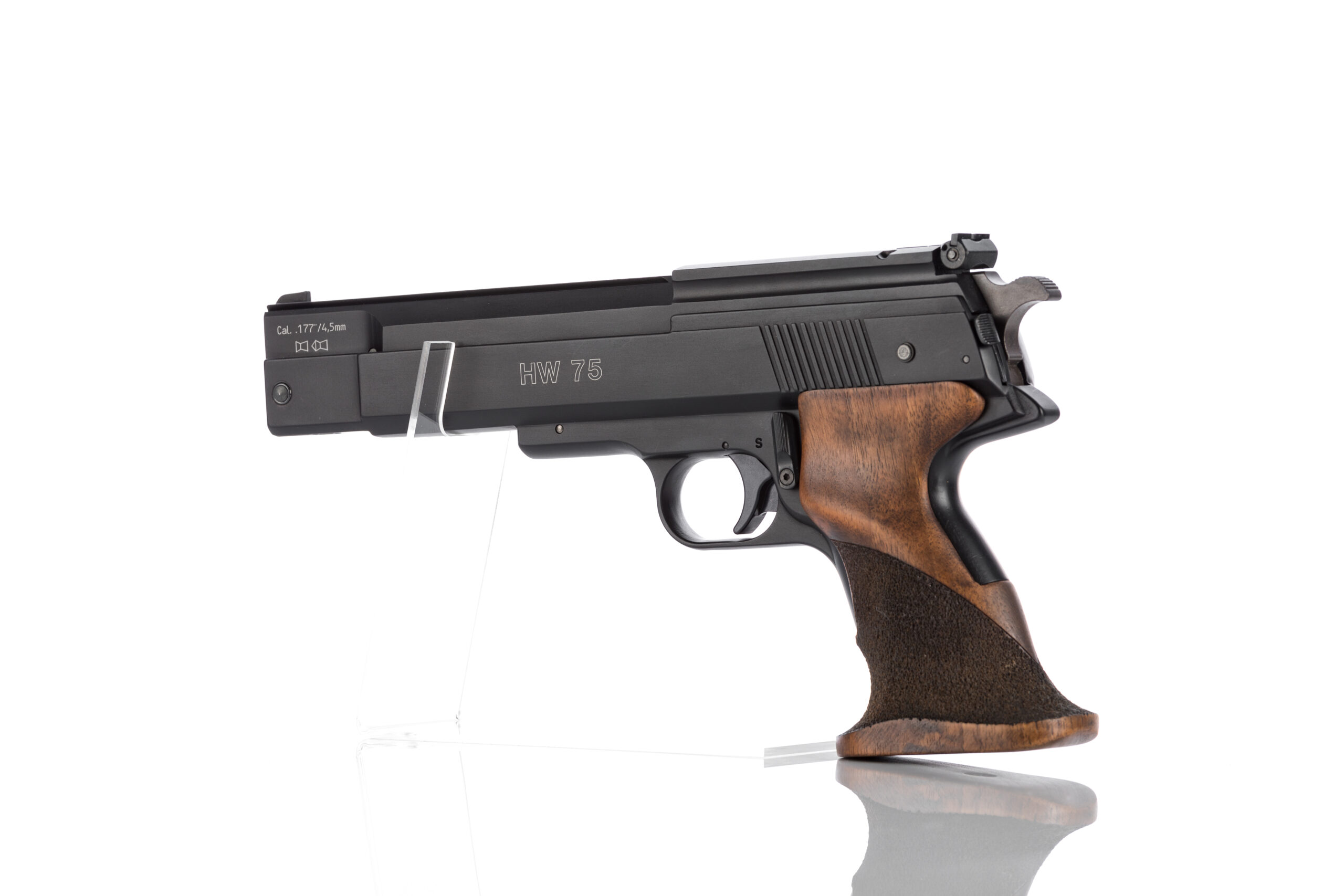
An all-metal action finished in durable matte black is combined with a walnut sport grip so that a 1911-inspired silhouette is presented without the recoil of a spring-piston design. Consequently, muzzle jump is virtually eliminated and follow-up shots are placed more easily. Moreover, a dry-fire facility is built in, therefore technique can be rehearsed even when pellets are not loaded.
Furthermore, an 11 mm prism rail is machined into the cocking arm so that a compact pistol scope or red-dot sight can be mounted when open sights are no longer preferred. In addition, an accessory Picatinny rail can be fitted beneath the barrel when extra mounting options are desired.
Key Features Highlighted
- Recoilless single-stroke pneumatic action is employed so that sight picture remains undisturbed
- Two-stage adjustable match trigger is fitted and a crisp, light break is achieved
- Ambidextrous walnut sport grip with thumb rest and stippling is supplied for secure control
- Dry-fire mechanism is included so that training can continue without ammunition
- Adjustable rear notch and fixed blade front sight are provided for open-sight work
- 11 mm dovetail rail plus optional under-barrel Picatinny rail are offered for optics and accessories
- Manual safety is located for positive engagement before every shot
- Precision-rifled 170 mm barrel is used exclusively in .177 calibre

Design, Powerplant and Handling of the Weihrauch HW75 Pistol
A single overlever stroke is used to compress air inside the action. After the lever is closed and the hammer is cocked, a pellet is seated and the shot is released. Because a spring is not present, the firing cycle is felt as a short, clean pulse of air rather than a sharp kick. As a result, groups of well under an inch at typical indoor distances are routinely recorded by shooters of every experience level.
Overall length of 280 mm and a weight of approximately 1.06 kg (2.34 lb) are maintained so that the pistol remains stable in a two-handed hold yet still compact enough for range bags and club lockers. Meanwhile, cocking effort of around 19 lb is accepted as the price of consistent, regulator-free power that does not fade from shot to shot.
Velocity in the region of 410 fps (about 125 m/s) and muzzle energy of roughly 2.5–2.9 ft-lbs are produced with standard match wadcutters. Therefore legal limits in most jurisdictions are comfortably respected while accuracy remains the priority rather than raw power.
Sights, Trigger and Grip Details
Rear-sight adjustment for windage and elevation is performed with a simple screwdriver slot, while a well-proportioned blade front sight is fixed. Consequently a generous sight radius is created and fine corrections can be made at the bench. When optics are preferred, the 11 mm rail accepts common air-pistol mounts.
The two-stage trigger is fully adjustable. First-stage take-up can be set to personal taste and the final break can be lightened until a match-like release is obtained. Because the trigger is not loaded by a powerful spring, a lighter, more predictable pull is typically felt compared with the related HW45 spring-piston pistol.
Walnut panels with stippled lower sections and modest palm shelves are shaped so that both right- and left-handed shooters can obtain a repeatable grip. Inclusive design is therefore realised without the need for separate left-hand stocks.
Practical Use Scenarios for the Weihrauch HW75 Pistol
Informal 10-metre target practice is the natural home of this pistol. Tight groups with match pellets are produced when a consistent two-handed stance and a smooth trigger press are applied. Likewise, dry-fire drills can be performed at home so that muscle memory is built before the next range visit.
Firearm-style training is also supported. Because the profile loosely follows a 1911 service pistol, grip and sight alignment habits can be transferred to centre-fire practice. In addition, quiet backyard plinking is possible where local rules allow, since report is only moderate and no extra gas cylinders need to be stored.
Club nights, family sessions and coaching environments all benefit from the same traits: no recoil to flinch against, no consumable power source to run out, and a trigger that rewards patience rather than punishing it. Inclusive language is used throughout because the HW75 is intended for every shooter who values precision over spectacle.
Calibre, Accessories and Care
Only .177 (4.5 mm) is offered, because that calibre delivers the highest pellet count per tin and the flattest trajectory at pistol distances. Quality wadcutter or match pellets are recommended so that the rifled barrel can show its grouping potential.
A compact red-dot or low-power pistol scope can be added via the existing rail. An optional Picatinny section can be attached under the barrel when a light or additional rail real-estate is wanted. After shooting, a light wipe of the metalwork and occasional inspection of the piston seal are all that is normally required; factory lubrication of the seal is already applied.hw 44.hw 98
Conversion-Focused Summary
German engineering, recoilless consistency and a true match trigger are combined in the Weihrauch HW75 Pistol so that accuracy can be pursued without the cost or complexity of a dedicated 10-metre competition pistol. Because the action is single-stroke pneumatic, running costs stay low and every session remains self-contained. Therefore the HW75 is selected by clubs, coaches and enthusiasts who want an heirloom-quality training tool that can be shared by right- and left-handed shooters.weihrauch hw45
Responsible ownership, local legal limits and proper eye protection are always observed. When those fundamentals are followed, decades of precise, enjoyable shooting can be expected from this classic Weihrauch design.
Weihrauch HW100X Karbine, Thumbhole PCP Air Rifle, HW35, HW45, HW97K, HW70, HW40, HW30, HW80, HW95, HW98, HW77, HW50S, HW44 and HW90, while explaining differences between PCP, spring piston, underlever, break-barrel, compressed-air rifles and air pistols. It can also incorporate comparison phrases such as Weihrauch HW77 vs HW97, HW77 vs break barrel air rifle, HW77 Green Laminate vs HW97 comparison, and informational searches including what are air rifles, what are air pistols, what is a PCP air rifle, and precision shooting airgun.hw 40.hw 70
For the HW77 specifically, the content can discuss the Weihrauch HW77 air rifle, HW77 Green Laminate rifle, Weihrauch underlever air rifle, HW77 spring piston air rifle, German precision air rifle, Weihrauch HW77 accuracy review, Weihrauch HW77 Green Laminate price and specs, is Weihrauch HW77 good for beginners, air rifle with low recoil, durable air rifle for outdoor use, reliable air rifle for long term use, top rated underlever air rifle, best Weihrauch air rifles, and most accurate air rifle for target shooting.weihrauch hw90.h 45
Broader terminology can also be integrated naturally, including german air rifle, accurate air rifles, compressed air rifles, air rifle makes, spring piston, air pistols, rifles de aire, high quality German airguns, affordable premium air rifle, hw100 airgun, Weihrauch HW100, Weihrauch HW95, Weihrauch HW50S, Weihrauch HW44, Weihrauch HW98, Weihrauch HW70, Weihrauch HW30, HW30S, HW50, HW50 S, HW40, HW44, HW70, HW98, HW100, HW97K, HW97K, HW35 air rifle, HW77 air rifle, Weihrauch English, Weihrauch Englisch, H45, SK X rifles, and air shot gun.weihrauch hw 30.weihrauch hw80.hw 97k
Commercial search expressions such as Weihrauch HW35E for sale, Weihrauch HW77 for sale, buy Weihrauch HW77 Green Laminate online, best price Weihrauch HW77, where to buy Weihrauch HW77, and Weihrauch HW77 in stock can be discussed as examples of common buyer search terminology without directing readers toward acquiring a weapon.weihrauch hw100.weihrauch hw 95
Calibre Options on the Weihrauch HW75 Pistol
Only .177 (4.5 mm) is supplied. Because this calibre produces the flattest trajectory at typical pistol distances and the highest pellet count per tin, it is selected by Weihrauch for a dedicated training and target platform. Moreover, match wadcutters and lightweight target pellets are readily available worldwide, therefore grouping potential can be explored without hunting for specialist ammunition.
A heavier .20 or .22 option is not provided. As a result, energy remains modest, recoil stays absent and the pistol continues to sit comfortably inside standard air-pistol power limits in most jurisdictions. Inclusive practice is supported because the same pellet type and point of aim can be used by right- and left-handed shooters, juniors under supervision and experienced club members alike.
Why .177 Is the Sole Calibre
- Flattest short-range trajectory is achieved with standard match pellets
- Tightest groups at 6–10 metres are routinely recorded
- Widest choice of wadcutter and target ammunition is available
- Lowest running cost per shot is maintained
- Legal simplicity is preserved in countries that treat low-power .177 pistols as airguns
When a different calibre is required for hunting or higher energy, a separate Weihrauch spring-piston or PCP model is chosen instead. The HW75 itself remains a specialist .177 instrument.
FAC Classification and Legal Power Context
FAC (Firearms Certificate) status is not normally required for the Weihrauch HW75 Pistol in the United Kingdom. Energy in the region of 2.5–2.9 ft-lbs is produced—well below the 6 ft-lb air-pistol threshold. Therefore the pistol is generally treated as an unlicensed airgun where local age and storage rules are observed.
Elsewhere, national and regional limits still apply. Consequently, local regulations must always be checked before purchase or transport. Because power is modest and the action is single-stroke pneumatic rather than a high-capacity PCP or a powerful spring, classification as a firearm is uncommon in most markets. Responsible ownership, secure storage and eye protection are nevertheless expected from every user.
Inclusive language is used because legal compliance protects the whole shooting community. Club rules, range standing orders and parental or guardian supervision for younger shooters remain essential even when a certificate is not needed.
Power Plant and Output
A single overlever stroke is used to compress air. After the lever is closed and the hammer is cocked, one pellet is released. Velocity around 410 fps (approximately 125 m/s) is typically recorded with lightweight match pellets, while muzzle energy of roughly 2.5–2.9 ft-lbs is measured on test examples.
Because a spring is absent, shot-to-shot variation is kept very small—spreads of only a few feet per second are commonly reported. Power does not fade across a session the way a leaking PCP reservoir might, nor does it surge like an unregulated spring. Consistency, not maximum velocity, is therefore the design goal.
Cocking effort of about 19 lb is accepted as the trade-off for that consistency. After a short familiarisation period the stroke becomes routine, and all-day practice sessions remain practical.
Accessories That Complete the Weihrauch HW75 Pistol
An 11 mm prism / dovetail rail is already machined into the cocking arm. Compact pistol scopes, red-dot sights and low-profile mounts can therefore be fitted without gunsmithing. In addition, an optional Picatinny rail can be attached under the barrel when a light, laser or extra accessory real-estate is wanted.
Open sights remain fully usable: a fixed blade front and a windage-and-elevation adjustable rear notch are supplied from the factory. Many shooters begin with irons and later add optics once grouping confidence is established.
Recommended Accessory Categories
- Quality .177 match wadcutters and lightweight target pellets are stocked so that barrel potential can be realised
- 11 mm air-pistol rings or a compact red-dot mount are selected for the top rail
- Optional under-barrel Picatinny section is added when extra mounting points are required
- A padded pistol case or range bag is used for transport and storage
- Spare seals and a light maintenance kit are kept for long-term reliability
- Shooting glasses and a pellet trap or safe backstop are treated as essential safety items
- A simple chronograph is useful when velocity consistency is being verified
Because the action is dry-fire capable, no extra dummy rounds are needed for indoor trigger practice. A rest or sandbag can still be employed at the bench when groups are being tested.
Conversion-focused choice is straightforward: the Weihrauch HW75 Pistol arrives ready to shoot with open sights, yet the rail system invites later upgrades without altering the recoilless character of the gun. Pellets, a case and eye protection form the minimum kit; optics and an under-barrel rail form the natural next step for shooters who want a more customised training tool.
Local laws, age restrictions and range rules continue to govern every session. When those conditions are met, the combination of a single .177 calibre, sub-limit power and a flexible accessory rail makes the HW75 a durable, inclusive platform for precision pistol practice.
Frequently Asked Questions
Precision, legal status, power delivery and everyday use are explained below so that informed decisions can be made by every shooter. Clear, practical answers are provided in an inclusive tone because the platform is intended for right- and left-handed users, club members and supervised newcomers alike.
General Questions About the Pistol
What type of air pistol is this?
A single-stroke pneumatic, overlever match-style pistol is supplied. Air is compressed by one upward stroke of the top lever; afterwards the hammer is cocked and a single .177 pellet is released. Because a spring-piston is not used, a recoilless firing cycle is experienced. Consequently, sight picture remains stable from shot to shot.
Is recoil felt when the shot is released?
Virtually no recoil is produced. A short pulse of expanding air is felt instead of the jump associated with spring-powered pistols. Therefore follow-up shots and dry-fire practice are both easier to control. Muzzle flip is minimised and grouping consistency is improved for shooters of every experience level.
Can the pistol be dry-fired?
Yes. A dedicated dry-fire facility is built in. The hammer can be cocked without the action being pressurised, so trigger control can be practised at home without pellets. As a result, technique can be refined between range visits and ammunition is not wasted during indoor drills.
Who is this pistol intended for?
Target practice, informal 10-metre work, club training and firearm-style grip practice are all supported. Inclusive design is realised through an ambidextrous walnut sport grip, so both right- and left-handed shooters can obtain a repeatable hold. Supervised juniors and experienced competitors can share the same platform when local rules and safety standards are observed.
Calibre, Power and Legal Status
Which calibre is available?
Only .177 (4.5 mm) is offered. That calibre is chosen because the flattest short-range trajectory and the widest choice of match wadcutters are obtained. Heavier calibres are omitted so that energy stays modest and legal classification remains straightforward in most markets.
How much power is produced?
Muzzle energy in the region of 2.5–2.9 ft-lbs is typically measured, with velocity around 410 fps (approximately 125 m/s) when lightweight match pellets are used. Power is therefore kept well below common air-pistol limits. Consistency rather than maximum velocity is the design goal; shot-to-shot spreads of only a few feet per second are commonly recorded.
Is a Firearms Certificate required?
In the United Kingdom a certificate is not normally required, because energy remains under the 6 ft-lb air-pistol threshold. Elsewhere, national and regional rules still apply. Local legislation must always be checked before purchase, transport or use. Age restrictions, storage requirements and range standing orders continue to apply even when a certificate is not needed.
Does power drop during a session?
Power fade of the kind seen with a leaking PCP reservoir is not experienced. Each shot is generated by a fresh single stroke, so output remains consistent from the first pellet to the last. Regulator complexity is avoided and running costs stay low because no extra air tanks or CO2 capsules are required.
How much effort is needed to cock the action?
Cocking effort of approximately 19 lb is typical. After a short familiarisation period the overlever stroke becomes routine. All-day practice remains practical for most adults; when younger or less strong shooters are involved, a brief rest between strings can be taken.
Sights, Rails and Accessories
What sights are fitted from the factory?
A fixed blade front sight and a fully adjustable rear notch (windage and elevation) are supplied. A generous sight radius is created so that open-sight groups can be shot immediately. Many users begin with irons and add optics later.
Can a scope or red-dot sight be mounted?
Yes. An 11 mm prism / dovetail rail is machined into the cocking arm. Compact pistol scopes and red-dot sights can therefore be fitted with standard air-pistol mounts. In addition, an optional Picatinny rail can be attached under the barrel when a light or extra accessory space is wanted.
Which pellets work best?
Quality .177 match wadcutters and lightweight target pellets are recommended. Tight groups at 6–10 metres are most often recorded with consistent, well-made ammunition. Hunting or heavy pellets are unnecessary because energy is modest and the intended use is precision practice rather than pest control.
What other accessories are commonly added?
A padded pistol case, shooting glasses, a safe pellet trap or backstop, and a simple chronograph are the most useful additions. Spare seals and a light maintenance kit support long-term reliability. Because dry-fire is already possible, dummy rounds are not required for indoor trigger work.
Is a silencer or moderator fitted?
A dedicated silencer is not part of the standard design. Report is only moderate (typically described as medium). Indoor club ranges and backyard use where local rules allow remain practical without extra suppression.
Handling, Grip and Build
Is the grip suitable for both hands?
An ambidextrous walnut sport grip with stippled lower sections and modest palm shelves is supplied. Inclusive use is therefore possible without a separate left-hand stock. A 1911-inspired profile is presented so that firearm-style hold and sight alignment can be practised.
How large and heavy is the pistol?
Overall length of about 280 mm (11 in) and a weight of approximately 1.06 kg (2.34 lb) are maintained. Stability in a two-handed hold is provided without excessive bulk, so the pistol packs easily into a range bag or club locker.
What is the construction like?
An all-metal action with a durable matte-black finish is combined with walnut grip panels. Cheap sheet-metal frames and plastic receivers are avoided. Longevity is expected when basic care is applied.
How does this model differ from the spring-powered sibling?
A single-stroke pneumatic system is used instead of a spring-piston. Recoil is virtually eliminated, the trigger is typically lighter, and dry-fire is straightforward. Power is lower and only .177 is offered, whereas the spring sibling is available in additional calibres and can produce higher energy on its stronger setting.
Accuracy, Training and Maintenance
How accurate is the pistol in practice?
Groups well under an inch at typical indoor pistol distances are routinely reported when a consistent hold and a smooth trigger press are applied. Open-sight groups in the region of 10 mm centre-to-centre at six yards have been recorded in published tests; even tighter clusters are often obtained once a compact optic is fitted.
Can it be used for formal 10-metre competition?
Informal matches, club nights and training for 10-metre discipline are well supported. A dedicated Olympic-style match pistol with a fully anatomical grip and finer adjustments will still be chosen by sanctioned competitors. This model is positioned as an all-round training tool that delivers match-like consistency at a more accessible price.
Is it suitable for firearm training?
Grip angle and overall profile loosely follow a 1911 service pistol. Trigger control, sight alignment and dry-fire habits can therefore be transferred. Recoilless operation means flinch is not reinforced, which is useful when live-fire practice with a centre-fire pistol is also undertaken.
What maintenance is required?
A light wipe of the metalwork after use and occasional inspection of the piston seal are normally sufficient. Factory lubrication of the seal is already applied; re-lubrication is typically needed only after repair or if a sealing issue appears. Harsh solvents on the walnut grip should be avoided.
How loud is a shot?
Loudness is generally classed as medium. Neighbours and indoor range officers are less likely to be disturbed than with a full-power spring pistol, yet ear protection is still recommended as good practice.
Buying, Safety and Everyday Use
What should be purchased at the same time?
Pellets, eye protection and a safe backstop or trap form the essential kit. A case protects the finish during transport. Optics and an under-barrel rail can be added later without changing the recoilless character of the action.
Are there age or storage rules?
Local age limits and secure-storage requirements must be followed even when a firearms certificate is not required. Inclusive family use is possible only when supervision, eye protection and a safe direction are always observed.
Can the pistol be left cocked?
The action should not be stored under compression for long periods. After a session the lever is closed, the hammer is left uncocked where design allows, and the pistol is locked away unloaded. Dry-fire practice is performed only when a safe direction is confirmed.
Is the trigger adjustable?
A two-stage match trigger is fitted. First-stage take-up and final break weight can be set to personal taste. A light, predictable release is typically achieved because the trigger is not holding back a powerful spring.
Why is this design still popular after many years?
Recoilless consistency, a true adjustable trigger, dry-fire capability and German all-metal construction are combined in one compact package. Running costs stay low because no gas capsules or fill bottles are needed. Inclusive ergonomics allow the same pistol to be shared across a household or club. When local laws and safety rules are respected, decades of precise practice can reasonably be expected.
Responsible ownership remains the foundation of every session. When that standard is met, the combination of a single .177 calibre, modest legal power and a flexible accessory rail supports accurate, enjoyable pistol shooting for every user who values control over spectacle.


Reviews
There are no reviews yet.