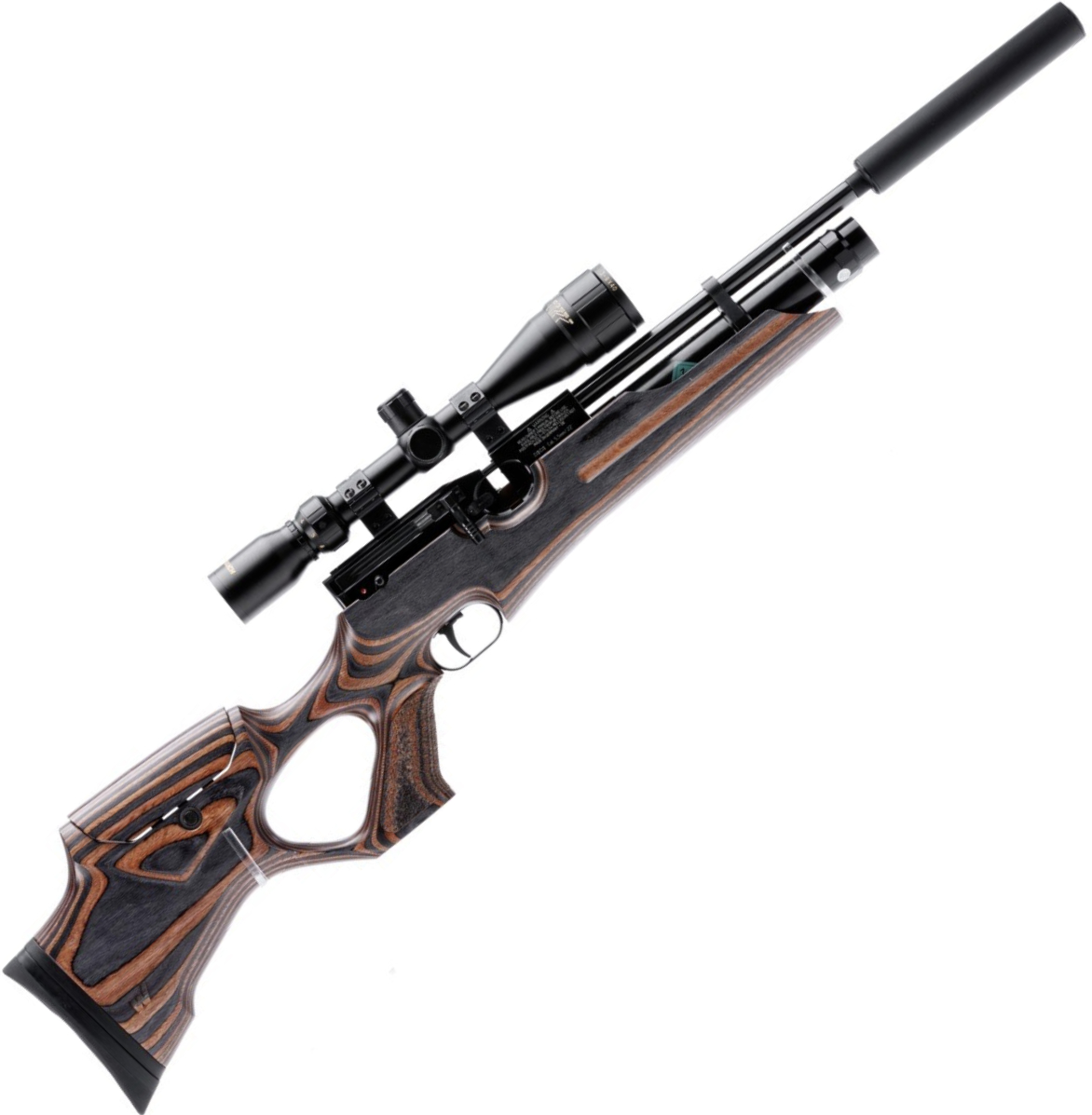
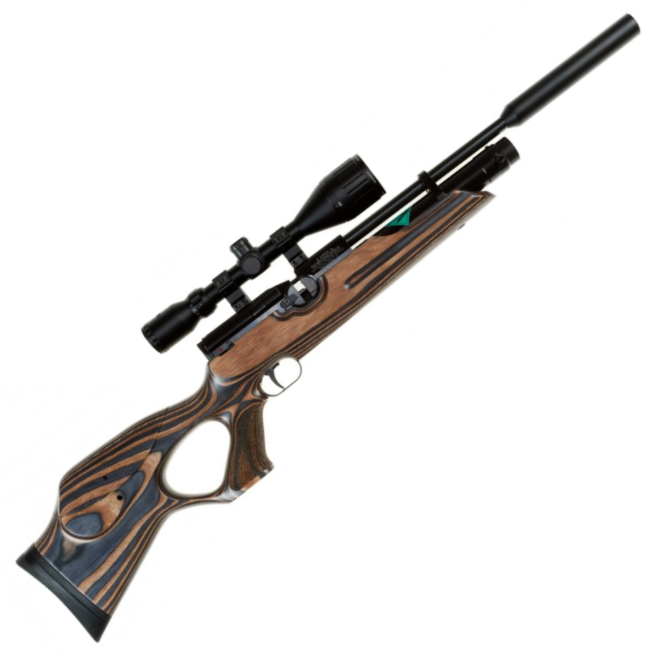
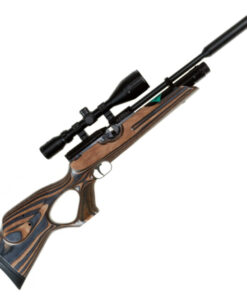
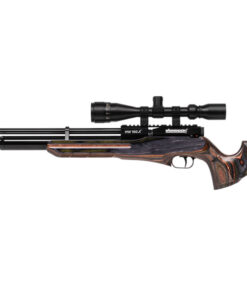
Precision Is Delivered by the Weihrauch HW100 KT Laminate
Exceptional field performance is consistently associated with the Weihrauch HW100 KT Laminate. Consequently, this carbine-length PCP platform is widely regarded as a benchmark among pre-charged sporting rifles. Moreover, German engineering is embodied throughout its action, stock, and barrel. Therefore, accuracy, quiet operation, and refined handling are offered to hunters, target shooters, and pest-control specialists alike.
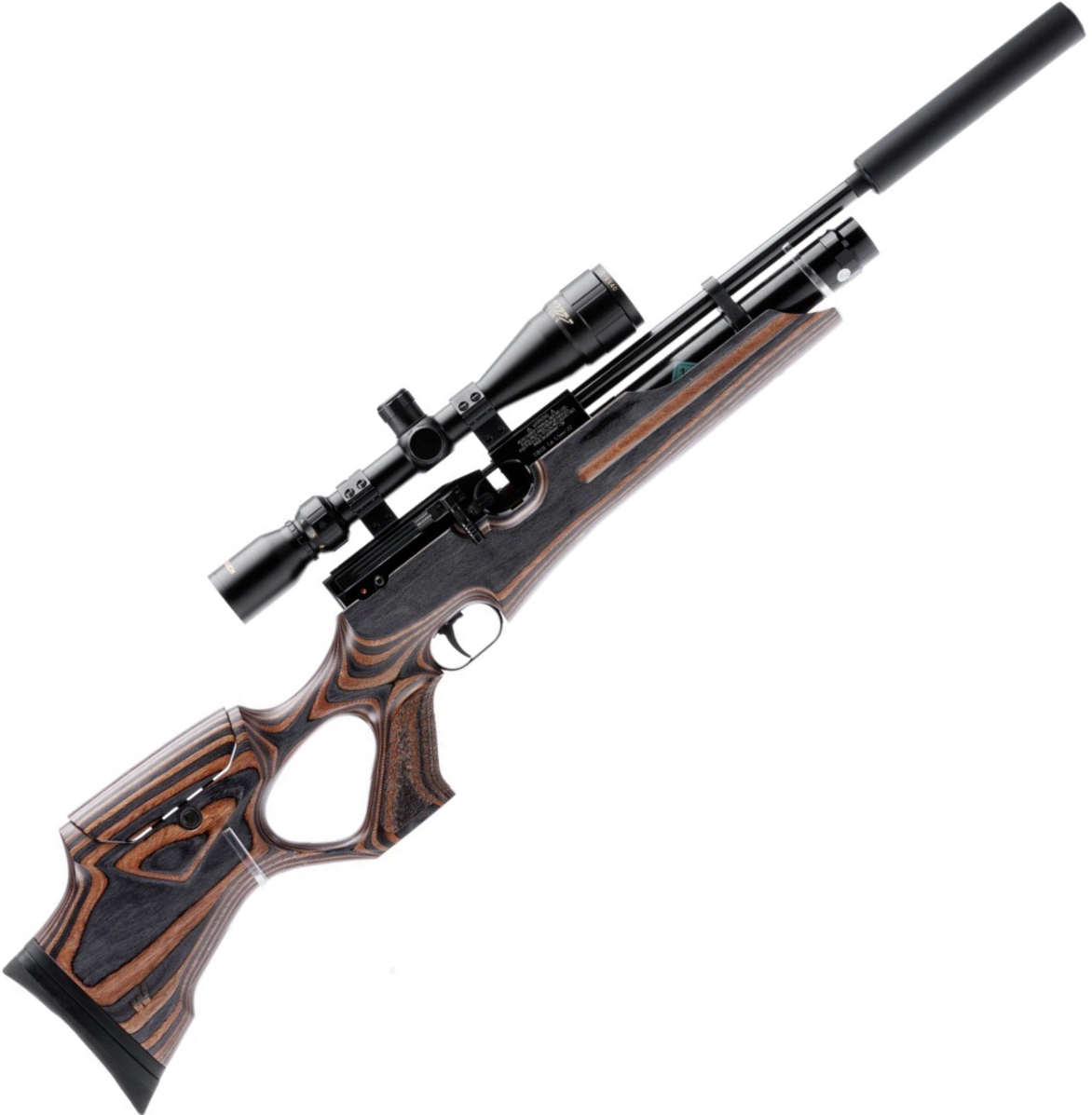
Furthermore, compact dimensions are combined with match-grade control. As a result, the Weihrauch HW100 KT Laminate is readily carried in woodland, hedgerow, and range environments. In addition, an ambidextrous laminate thumbhole stock is fitted so that comfortable mounting is achieved by both left- and right-handed shooters.
Signature Features That Define the Platform
A complete set of premium features is supplied as standard. Accordingly, the following highlights are presented for product listings:
- Ambidextrous laminate thumbhole stock with adjustable cheekpiece and adjustable butt pad
- Smooth side-lever action with anti-double-load rotary magazines
- Two 14-shot magazines typically included
- Two-stage match trigger with manual, resettable safety
- Factory high-efficiency silencer for exceptionally quiet report
- Removable air cylinder with onboard pressure gauge and quick-fill probe
- 11 mm dovetail rail, often supplied with a slide-on Picatinny adapter
- Carbine-length barrel of approximately 310 mm
- Overall length of roughly 920–958 mm including moderator
- Unscoped weight of about 3.3–3.4 kg
- Calibres commonly offered: .177 and .22, with .20 available by special order
- Fill pressure: 200 bar
- Typical UK-legal output: around 11–12 ft-lbs
- Approximate shot count per fill: about 50–60 in .177 and 70–75 in .22 (subject to pellet, temperature, and fill)
Moreover, vibration-free shot release is delivered by the proven valve system. Consequently, tight groups are produced with quality pellets once a consistent hold is established.
Why the Weihrauch HW100 KT Laminate Is Chosen by Serious Shooters
Outstanding mechanical consistency is expected from Weihrauch barrels and actions. Therefore, sub-inch groups at 30–40 yards are frequently reported when suitable ammunition is used and conditions are favourable. Additionally, a self-regulating valve arrangement is employed on classic HW100 KT models, so velocity variation remains low across a useful portion of the fill.
Meanwhile, handling is improved by the carbine layout. Hence, the rifle is easily shouldered in confined stands or from sticks. Likewise, the thumbhole geometry allows a secure wrap of the firing hand, while the adjustable cheekpiece is raised or lowered until a repeatable sight picture is obtained. Subsequently, the butt pad can be repositioned so that length of pull and shoulder contact are tailored to the individual.
Furthermore, quiet operation is provided by the integral Weihrauch moderator. As a result, disturbance of quarry is reduced and range sessions remain neighbour-friendly. In the same way, the side lever is cycled with modest effort, so follow-up shots are taken without breaking position.
Calibres, Power, and Practical Accessories
Legal limits are respected in standard UK-spec examples. Nevertheless, useful hunting and HFT-style performance is retained. Consequently, .177 is often selected for flatter trajectory and target work, whereas .22 is preferred by many for pest species and slightly greater downrange energy. Additionally, a single-shot tray can be fitted when maximum precision is required.
Moreover, spare magazines, probes, and cylinder options are widely supported. Therefore, field time is extended without frequent returns to a compressor or bottle. Likewise, quality optics are readily mounted on the dovetail or adapter rail, so the Weihrauch HW100 KT Laminate is transformed into a complete hunting or competition outfit.
Everyday Use, Care, and Responsible Ownership
Long service life is associated with Weihrauch construction when basic care is observed. Accordingly, the cylinder is filled only to the recommended pressure, seals are kept clean, and the action is protected from grit. Subsequently, a light wipe-down after wet sessions is advised so that the laminate finish and metalwork remain presentable.
Meanwhile, inclusive design is emphasised by the ambidextrous stock and safety placement. Thus, the rifle can be shared among family members or club shooters of different statures once the cheekpiece and pad are reset. In addition, a manual safety is applied whenever the rifle is carried or cased.
Furthermore, local laws must always be followed. Therefore, power levels, storage, transport, and land permission are checked before any shooting session. Likewise, eye protection and safe backstops are treated as non-negotiable.
Who Benefits Most from This Carbine
Compact precision is sought by woodland hunters. Consequently, the Weihrauch HW100 KT Laminate is frequently selected for rabbits, squirrels, and similar quarry where a short, quiet rifle is an advantage. Equally, club shooters appreciate the trigger and barrel quality for HFT practice and informal competition. Moreover, newcomers to premium PCP rifles are given a platform that rewards good technique without demanding constant tinkering.
In contrast to bulkier full-length sporters, easier transport is achieved. Yet accuracy potential is not sacrificed. As a result, one rifle can serve both field and range duties for many owners.
Final Invitation to Precision
Refined German craftsmanship is expressed in the Weihrauch HW100 KT Laminate. Therefore, a quiet, accurate, and highly adjustable carbine PCP is placed in the hands of shooters who value consistency over fashion. Additionally, proven magazines, a match trigger, and a laminate stock that can be fitted to the user are supplied together.
Consequently, if a dependable multi-shot PCP with classic Weihrauch manners is required, this model should be examined in person whenever possible. Then a suitable scope, pellets, and fill equipment can be matched so that the rifle’s potential is fully realised. Ultimately, responsible use, legal compliance, and regular maintenance will keep the Weihrauch HW100 KT Laminate performing as intended for years of precision shooting.
Weihrauch Air Rifles, PCP Platforms, Spring-Piston Systems, and Related Airgun Terminology
Enthusiasts researching premium German airgun engineering frequently encounter models and search terms such as Weihrauch HW100X Karbine, Thumbhole PCP Air Rifle, hw35, h 45, german air rifle, accurate air rifles, hw97k, hw 70, hw35e for sale, hw40, weihrauch hw30, weihrauch hw80, weihrauch hw 95, hw100, hw 97k, hw35 air rifle, hw50 s, weihrauch hw45, weihrauch english, weihrauch hw98, weihrauch englisch, hw77 air rifle, weihrauch hw50s, compressed air rifles, air rifle makes, spring piston, what are air rifles, weihrauch hw44, air shot gun, sk x rifles, weihrauch hw50, hw30s, hw 30, what are air pistols, hw50, and rifles de aire.
Within the Weihrauch lineup, the Weihrauch HW77 air rifle is widely recognized as a traditional fixed-barrel underlever platform. Related terminology includes HW77 Green Laminate rifle, Weihrauch underlever air rifle, HW77 spring piston air rifle, Weihrauch HW77 for sale, and German precision air rifle. Researchers comparing versions may also encounter phrases such as buy Weihrauch HW77 Green Laminate online, Weihrauch HW77 Green Laminate price and specs, Weihrauch HW77 accuracy review, HW77 Green Laminate vs HW97 comparison, is Weihrauch HW77 good for beginners, precision shooting airgun, high quality German airguns, best price Weihrauch HW77, where to buy Weihrauch HW77, Weihrauch HW77 in stock, affordable premium air rifle, and top rated underlever air rifle.
Technical comparison searches commonly include Weihrauch HW77 vs HW97, HW77 vs break barrel air rifle, best Weihrauch air rifles, most accurate air rifle for target shooting, air rifle with low recoil, durable air rifle for outdoor use, and reliable air rifle for long term use. These phrases generally reflect interest in operating systems, mechanical durability, handling characteristics, consistency, and the differences between fixed-barrel underlever designs, break-barrel rifles, and PCP platforms.
Other Weihrauch-related terminology includes air pistols, hw100 airgun, weihrauch hw95, weihrauch hw 30, weihrauch hw90, hw 44, hw 40, hw 98, and weihrauch hw100. The HW100 family represents the PCP side of Weihrauch’s catalog, while models such as the HW30, HW50, HW80, HW90, HW95, HW97, and HW98 are associated with spring-powered or gas-ram-style sporting airgun platforms depending on the specific model and configuration. By contrast, the HW44 is commonly discussed as a PCP air pistol.
The broader airgun market also includes search terminology connected with alternative PCP manufacturers and modern platforms. Examples include 25 karma, pcp bb gun, karma eq air rifle, karma red panda, panda guns, full auto pcp, karma sls compact, air karma, red panda hat, eq air, karma sls, eq magazine, air pcp, and karma airguns. These terms may refer to specific products, product families, accessories, community terminology, or unrelated search phrases that appear alongside airgun research.
Reximex is another name frequently encountered in PCP discussions. Related search phrases include reximex airguns, reximex rp, reximex throne gen 2, reximex mito, reximex rpa, sbs12, reximex mitos, reximex lieva, reximex accura pcp air rifle, and reximex throne gen2. Model naming can vary slightly between retailers, regions, and search listings, which explains variations such as “Throne Gen 2” and “Throne Gen2” or “Mito” and “Mitos.”
Airgun research also involves understanding velocity and energy. Searches such as fps to joules calculator, fps to ft lbs, and airgun calculator relate to converting projectile velocity and mass into kinetic-energy measurements. These calculations are commonly used for technical comparison, range evaluation, regulatory research, and understanding how different compressed-air or spring-powered platforms perform within their intended specifications.
More general discovery terms can include gunseek and yivli av tüfeği, alongside broader international phrases such as rifles de aire. Because airgun terminology varies considerably between English, German, Spanish, and Turkish-speaking markets, researchers may encounter several different naming conventions for comparable sporting, target, and recreational airgun platforms.
Taken together, terms ranging from Weihrauch HW100X Karbine and Thumbhole PCP Air Rifle to HW77 Green Laminate rifle, spring piston, compressed air rifles, karma airguns, and reximex airguns illustrate the diversity of modern airgun technology. Weihrauch remains particularly associated with German engineering, fixed-barrel underlever rifles, traditional spring-powered designs, precision PCP systems, and air pistols, while Karma and Reximex represent additional names encountered when comparing contemporary PCP platforms and associated airgun technology.
Calibres, FAC Options, Power Output, and Accessories for the Weihrauch HW100 KT Laminate
Careful matching of calibre, legal power, and supporting equipment is required before the Weihrauch HW100 KT Laminate can be used at its best. Consequently, the notes below are presented so that an informed choice can be made by hunters, target shooters, and pest-control users alike. Moreover, local regulations must always be confirmed, because power limits and licensing differ from one country to another.
Available Calibres and Typical Applications
Three pellet sizes are commonly associated with this platform. Therefore, the following options are outlined:
- .177 (4.5 mm) is frequently selected for flatter trajectory, paper targets, HFT-style practice, and smaller pests at moderate range.
- .22 (5.5 mm) is widely preferred for general hunting and pest control, because a slightly heavier pellet is delivered with useful downrange energy.
- .20 (5.0 mm) is offered by special order in many markets and is valued by some shooters for a balance between trajectory and impact.
Furthermore, pellet choice remains as important as calibre. As a result, JSB, Air Arms, QYS, and similar match-grade diabolo pellets are usually tested until a favoured lot is identified. Likewise, a single-shot tray can be fitted when magazine variation is to be removed from the equation.
Meanwhile, barrel length on the carbine KT remains short at approximately 310 mm. Hence, velocity is still sufficient for UK-legal work, yet the rifle stays compact in cover. In addition, Weihrauch’s own barrel quality is credited for the tight groups that are regularly reported when consistent ammunition is used.
FAC Status and Legal Power Levels
In the United Kingdom, a standard Weihrauch HW100 KT Laminate is normally supplied below the 12 ft-lb threshold. Consequently, a Firearm Certificate is not required for that configuration, provided all other air-weapon rules are observed. Conversely, higher-power FAC versions can be ordered where a valid certificate is held and local conditions allow.
Therefore, two broad power classes should be distinguished:
- Sub-12 ft-lb / no-FAC specification is intended for general sporting use within UK legal limits. Typical muzzle energy is quoted around 11–11.5 ft-lbs, with shot counts commonly cited near 50–60 in .177 and 70–75 in .22 from a 200-bar fill.
- FAC / high-power specification is reserved for certificate holders. Increased energy, different valve setups, and sometimes altered shot counts are then expected. Exact figures must be confirmed with the supplier, because FAC builds vary.
Moreover, energy claims on any listing should be treated as indicative. Subsequently, a chronograph check after purchase is recommended so that the rifle remains within the owner’s legal class. Likewise, export and import rules, FAC wording, and storage conditions must be respected wherever the rifle is used.
Additionally, other jurisdictions apply different joule or foot-pound limits. Hence, buyers outside the UK should verify that the chosen Weihrauch HW100 KT Laminate is legal in their region before an order is placed.
How Power, Fill Pressure, and Consistency Interact
A recommended fill of 200 bar is specified for classic KT models. Consequently, the removable cylinder is charged with the supplied probe, after which the onboard gauge is monitored. Furthermore, a self-regulating valve system is employed on many HW100 KT rifles, so velocity spread remains modest across a useful portion of the charge.
Nevertheless, the first few shots after a fresh fill can sit slightly outside the tightest band. Therefore, those shots are often counted off before serious groups are taken. In the same way, temperature, pellet weight, and seal condition all influence both energy and shot count.
Meanwhile, FAC rifles may be set for higher output and can consume air more quickly. As a result, spare cylinders or a reliable compressor become more important for extended sessions. Likewise, a quality fill hose, bleed valve, and dust-protected probe are treated as essential, not optional.
Accessories That Complete the Weihrauch HW100 KT Laminate
A capable rifle is only part of a working system. Accordingly, the following accessories are commonly paired with this model:
- Spare 14-shot rotary magazines so that one can be loaded while another is in use
- Single-shot loading tray for maximum consistency on the range
- Slide-on Picatinny rail for modern mounts, lights, or bipod adapters
- Additional air cylinders with gauges for rapid change in the field
- Quick-fill probes, bleed adapters, and cylinder caps
- High-quality scopes on 11 mm dovetail or Picatinny rings, with side-focus or AO preferred for airgun distances
- Bipods, shooting sticks, and slings matched to the carbine forend
- Pellets in the proven weight for that barrel, plus a tin of alternatives for testing
- Hard or padded case, plus eye and hearing protection
- Compressor or diving bottle rated for 200 bar fills, with moisture filtration
- Weihrauch-pattern silencer extras only where thread and legality allow
Furthermore, magazine springs and O-rings should be kept as service parts. Consequently, downtime is reduced if a seal weeps after years of use. Additionally, a torque-aware approach is advised when rings and rails are fitted, so the action is not marked.
Building a Practical Outfit
Inclusive use is supported by the adjustable laminate stock. Therefore, different shooters in a household or club can share one Weihrauch HW100 KT Laminate after the cheekpiece and butt pad are reset. Moreover, optics height should be chosen so that a natural head position is retained once the cheekpiece is locked.
Meanwhile, hunting kits benefit from spare magazines, a quiet sling, and a compact range-finder. Conversely, target kits often add a single-shot tray, a finer-adjustment scope, and a stable rest. In both cases, legal power must remain the first filter before extra equipment is added.
Finally, accessories should be selected for reliability rather than novelty. Thus, proven magazines, a known pellet, a sound fill source, and a well-mounted scope will extract more performance from the Weihrauch HW100 KT Laminate than a crowded rail of unused gadgets. Responsible storage, transport, and land permission complete the package so that calibre, FAC status, power, and equipment work together as intended.
Practical Use in the Field and on the Range
Everyday shooting is where a compact, quiet PCP carbine earns its keep. Consequently, the notes that follow describe how such a rifle is actually carried, zeroed, and employed by hunters, pest controllers, and club shooters. Moreover, inclusive language is used so that left- and right-handed users, different statures, and mixed experience levels are all considered. Legal limits, land permission, and safe backstops are assumed throughout.
Woodland and Hedgerow Hunting
Close cover is where a short overall length is most appreciated. Therefore, the carbine is easily slipped through bramble gaps and along narrow rides without the muzzle being snagged. Meanwhile, a laminate thumbhole stock is gripped with a full wrap of the firing hand, so a stable hold is maintained when a shot must be taken offhand.
Furthermore, quarry is less likely to be alerted when a factory moderator is fitted. As a result, rabbits at field edges and grey squirrels in canopy gaps can often be addressed with a second opportunity if the first pellet is missed. Likewise, a side-lever is cycled without the rifle being lowered from the shoulder, so follow-up shots are taken while the animal is still in view.
Additionally, sticks or a kneeling position are commonly adopted when a clear window appears. Hence, the forend is long enough for a leading hand to be placed well forward, yet short enough that the balance remains between the hands. Subsequently, an adjustable cheekpiece is set so that the same sight picture is recovered after every movement through cover.
Typical woodland sequences are summarised below:
- Quiet approach along a ride is made with the safety applied
- A rest is taken on sticks or a tree when a target presents
- The safety is released only when a clear, ethical shot is confirmed
- The lever is cycled if a second pellet is required
- The rifle is made safe before any retrieve or change of position
Meanwhile, wet foliage is less likely to warp a laminate stock than untreated timber. Consequently, a brief wipe after a damp outing is usually sufficient to keep the furniture presentable.
Pest Control Around Buildings and Farm Yards
Controlled distances and hard backstops are essential around sheds, grain stores, and outbuildings. Therefore, a quiet report is valued because livestock and neighbours are less disturbed. Moreover, a 14-shot magazine allows several opportunities without a noisy reload, provided each shot is still taken with care.
Furthermore, rats and feral pigeons are often engaged at short to medium range. As a result, .22 is frequently chosen for these tasks, while .177 remains popular where a flatter line is preferred. In either case, pellet testing at the actual working distance is recommended so that point of impact is known.
Likewise, lighting must be legal and appropriate. Night work, where permitted, is supported by a compact lamp on a rail adapter, yet the rifle should never be pointed toward windows, roads, or occupied spaces. Subsequently, spent magazines are swapped behind cover so that attention is not drawn to the firing point.
Inclusive use is straightforward here as well. Thus, a shorter-stature shooter can drop the cheekpiece and adjust the butt pad until a natural mount is achieved. Conversely, a taller user can raise the comb and extend the pad so that neck strain is avoided during a long wait.
HFT, Club Practice, and Informal Competition
Course shooting rewards a rifle that can be shouldered quickly and held still on awkward pegs. Consequently, a carbine-length barrel and balanced weight help when kneeling or standing lanes are drawn. Additionally, a two-stage match trigger allows a clean break once the sight picture has settled.
Moreover, magazine variation can be removed by fitting a single-shot tray on precision lanes. Therefore, each pellet is seated identically, and the action is still cycled with the same side-lever motion. Meanwhile, a slide-on rail adapter accepts a preferred scope without the original dovetail being abandoned.
Typical range routines are organised as follows:
- A 25–35 yard zero is confirmed on a calm day
- Groups are recorded with the chosen pellet lot
- Kneeling and standing practice is added after bench work
- The cheekpiece is locked so that head position does not drift
- Magazines or a single-shot tray are prepared before the course walk
Furthermore, wind reading remains the shooter’s responsibility. Hence, the mechanical consistency of a quality barrel is useful only when holdover and drift are applied correctly. Likewise, the first shots after a fresh 200-bar fill may sit slightly outside the tightest velocity band, so those shots are often used as warmers.
Zeroing, Holds, and Distance Management
A reliable zero is established before any live quarry is approached. Consequently, the same rest, pellet, and fill pressure should be used whenever the zero is checked. Moreover, 30 yards is a common starting point for UK-legal hunting rifles, after which 20- and 40-yard confirmation shots are added.
Additionally, holdover cards or a simple turret system can be prepared once groups are known. As a result, a sitting rabbit at 25 yards and a squirrel at 35 yards can be engaged without guesswork. In the same way, a rangefinder is carried on mixed ground so that distance is measured rather than estimated.
Meanwhile, cant must be watched because a thumbhole stock invites a firm wrap. Therefore, the butt pad is set so that the rifle sits square in the shoulder, and a bubble or careful visual check is used on sloping ground. Subsequently, the same mounting pressure is repeated so that groups do not wander high or low.
Transport, Hides, and Shared Use
A compact profile is an advantage when a vehicle, hide, or high seat is involved. Consequently, the rifle is cased with the magazine removed and the cylinder pressure noted. Furthermore, a spare cylinder can be carried so that a session is not cut short by a single fill.
Likewise, two shooters of different builds can share one rifle during a club evening. The cheekpiece button or bolt is released, the comb is reset, and the pad is moved until each person obtains a repeatable sight line. Inclusive design is therefore practical rather than theoretical.
Additionally, a sling is fitted for long walks between permissions. Yet the sling swivels should not interfere with the leading hand when a shot is taken from sticks. Hence, a simple two-point setup is often preferred over a complicated harness.
Weather, Maintenance Between Shots, and Session Planning
Changeable conditions are expected in field use. Therefore, rain covers, a dry cloth, and capped fill ports are packed as a matter of habit. Moreover, laminate furniture resists swelling better than many solid woods, but metalwork still benefits from a light oil film after wet days.
Furthermore, shot counting is easier when two magazines are rotated and marked. As a result, the shooter knows when the useful portion of the fill is ending and when a cylinder change should be made. Meanwhile, a gauge on the reservoir is glanced at during pauses rather than trusted blindly after months of use.
Session planning can be kept simple:
- Permission and legal class are confirmed before leaving home
- Pellets from a known tin are loaded only at the firing point
- Safety is applied whenever the rifle is moved
- Cylinders are refilled at the end of the day, not left half-empty for weeks
- A brief function check is made before the next outing
Consequently, reliability is preserved without workshop-level work between hunts.
Ethical Shots and Knowing When Not to Fire
A capable rifle does not justify a poor opportunity. Therefore, shots are taken only when a vital area is clear, a backstop is safe, and the animal is settled. Moreover, foliage, wire, and glass are treated as reasons to wait rather than to force a pellet through.
Likewise, maximum hunting distance should be limited to the range at which the shooter can place a pellet reliably from the position that will actually be used. Bench groups at 40 yards do not automatically transfer to a leaning offhand shot at the same distance. Subsequently, practice from sticks, kneeling, and sitting is given equal time.
Inclusive coaching is useful here. A less experienced companion can be shown the same hold and the same “no-shot” criteria so that standards are shared rather than assumed.
Building Confidence Across Roles
One compact PCP can cover several roles if the setup is honest. Consequently, a hunting zero, a spare magazine, a quiet sling, and a known pellet will serve woodland work. Meanwhile, a single-shot tray and a finer scope adjustment will serve club lanes. Additionally, farm-yard pest control is supported by the same quiet moderator and a disciplined approach to backstops.
Furthermore, the rifle is not asked to do everything at once. A lamp, bipod, and heavy optic can be added when needed, then removed when a light woodland walk is planned. As a result, balance is preserved and fatigue is reduced.
Finally, enjoyment and responsibility travel together. Quiet shots, a fitted stock, and predictable cycling make long sessions more comfortable for a wide range of shooters. When permission, power class, and safety habits are already in place, practical use becomes a matter of reading the ground, taking only the shots that can be finished cleanly, and leaving the permission as it was found.
Frequently Asked Questions
Clear answers are offered below so that buying, setup, and day-to-day use can be planned with fewer surprises. Consequently, each question is treated in plain language. Moreover, local laws still override any general note, and inclusive wording is used so that left- and right-handed shooters, different statures, and mixed experience levels are all considered. The exact model name is omitted here by request; the replies refer to this compact, magazine-fed PCP carbine with an adjustable laminate thumbhole stock.
General Setup and First Use
What should be checked before the first shot is fired?
A visual inspection is recommended first. Therefore, the barrel is confirmed clear, the magazine is seated correctly, and the cylinder is filled only to the maker’s stated pressure. Additionally, the safety is understood before live pellets are loaded. Meanwhile, eye protection is worn, and a safe backstop is arranged. Subsequently, a few familiarisation cycles of the side lever are made with an empty magazine so that the action is felt before ammunition is introduced.
Is a scope included?
A scope is not normally supplied with the rifle. Consequently, an optic suited to airgun distances should be budgeted separately. Furthermore, an 11 mm dovetail is provided, and a slide-on Picatinny adapter is often packed so that modern rings can be used. Likewise, mount height should be chosen after the cheekpiece is set, so that a strained neck position is avoided.
How is the stock fitted to different shooters?
An adjustable cheekpiece and an adjustable butt pad are fitted. Therefore, comb height is raised or lowered until the eye meets the scope naturally. Moreover, the pad can be moved so that length of pull and shoulder contact are comfortable. Inclusive sharing is then practical: one rifle can be reset between users in a household or club without a permanent compromise.
Calibres, Power, and Legal Class
Which calibre is usually chosen?
.177 is often selected for flatter trajectory and target work. Conversely, .22 is widely preferred for general pest control and hunting at typical UK-legal distances. Additionally, .20 is sometimes available by special order. Pellet testing still matters more than the label on the barrel, so several tins should be tried at the intended zero range.
Is a Firearm Certificate required?
In the United Kingdom, a standard sub-12 ft-lb specification is commonly sold without an FAC. However, higher-power builds exist for certificate holders. Consequently, the listing and the transfer documents must be read carefully. Export, import, and other national limits differ, so confirmation with the retailer and local rules is essential before an order is placed.
How much power should be expected?
UK-legal sporting versions are typically set around 11–12 ft-lbs. Therefore, they are intended for small-game hunting, pest control, and club use within that class. FAC examples are set higher by arrangement. A chronograph check after purchase is still advised so that the rifle remains in the class that was paid for.
How many shots are obtained from one fill?
Figures vary with calibre, pellet, temperature, and how much of the fill is used. Approximate published ranges for carbine models at legal limit are often near 50–60 shots in .177 and 70–75 in .22 from a 200-bar fill. Moreover, the first shots after a fresh fill can sit slightly outside the tightest velocity band. Hence, those shots are frequently treated as warmers before groups or quarry shots are taken.
Magazines, Loading, and the Side Lever
How many pellets does each magazine hold?
Fourteen shots per rotary magazine is the usual capacity. Additionally, two magazines are commonly supplied. Spare units can be purchased so that one is loaded while another is in the rifle.
Can a single pellet be loaded instead?
A single-shot tray is widely available. Consequently, magazine-to-magazine variation is removed for precision practice. The same side lever is still used, so the firing routine remains familiar.
Is double loading prevented?
A well-designed indexing system is intended to stop a second pellet being chambered while one is already seated. Nevertheless, the lever should still be cycled deliberately, and the magazine should not be forced if it feels wrong. A pause and a visual check are safer than extra pressure.
Is the action suitable for left-handed shooters?
An ambidextrous stock and a side lever that can be managed from either side of a thumbhole are part of the design. Therefore, left-handed users are not excluded. Inclusive testing is still worthwhile in the shop, because reach to the lever and safety should feel natural before money is spent.
Filling, Cylinders, and Air Supply
What fill pressure is used?
A 200-bar fill is specified for classic examples of this carbine. Overfilling is avoided. Furthermore, the probe is inserted only when the port is clean, and the dust plug is replaced afterwards.
Can the cylinder be removed?
A removable reservoir is a feature of the platform. Consequently, a spare cylinder can be carried and swapped in the field. A gauge on the cylinder is monitored so that a session is not continued on a fading fill.
Is a compressor required immediately?
A dive bottle or a friend’s fill may cover the first outings. However, regular use soon justifies a dry, filtered supply. Moisture in the air system is a common cause of later trouble, so cheap, wet fills are a false economy.
Accuracy, Quietness, and Field Performance
How accurate is the rifle in practical use?
Tight groups at 30–40 yards are regularly reported when a favoured pellet is used and the shooter does their part. Mechanical potential is high; wind, cant, and an inconsistent hold still open groups. Therefore, practice from sticks and kneeling is as important as bench testing.
How quiet is the shot?
A factory moderator is fitted on standard sporting builds. As a result, the report is among the quieter PCP carbines in common use. Neighbours, livestock, and quarry are less disturbed, yet hearing protection on a busy range remains sensible.
Is the rifle suitable for hunting and HFT?
Both roles can be covered if the setup is honest. A compact length helps in woodland and on awkward pegs. A match-style trigger helps on the course. Magazine capacity helps on a permission where several opportunities may appear. Ethical distance, a safe backstop, and land permission remain the first filters.
Maintenance, Storage, and Common Concerns
What routine care is needed?
The barrel is kept clear, seals are kept clean, and the rifle is wiped after wet use. Moreover, the laminate stock resists warping better than many solid woods, but metalwork still benefits from a light protective film. Storage is in a dry cabinet, unloaded, with magazines empty.
Do seals need regular replacement?
Years of reliable service are common when fills are clean and pressures are respected. Eventually, an O-ring may weep. Spare seals and a competent technician are then the correct response rather than overtightening fittings.
Why might velocity change through a fill?
A self-regulating valve is used on many examples, yet temperature, pellet weight, and the very top of a fresh fill still have an effect. Counting usable shots and staying off the last thin bar of air produces more consistent results than chasing the final pellet.
Can the trigger be adjusted?
A two-stage match trigger is fitted and can be set within safe limits. Adjustment is best made in small steps. A trigger that is set too light is a safety problem, not an upgrade.
Accessories and Buying Decisions
Which extras are actually useful?
The following items are most often worth adding:
- Spare magazines and a single-shot tray
- A quality scope with adjustment suited to airgun ranges
- Rings or a Picatinny adapter that match the chosen optic
- A spare cylinder and a proper fill hose
- Sticks or a light bipod for field rests
- A case, sling, and eye protection


Reviews
There are no reviews yet.