Outstanding Design Features of the Weihrauch HW100 KT Air Rifle
Smooth, rapid cycling is enabled by the renowned side-lever action. In addition, two 14-shot rotary magazines are supplied so that extended sessions can be completed with minimal interruption. Meanwhile, a two-stage adjustable match trigger is fitted, allowing a crisp, consistent break to be achieved after personal adjustment. Likewise, a manual resettable safety is incorporated for responsible handling.
Compact Carbine Handling and Stock Options
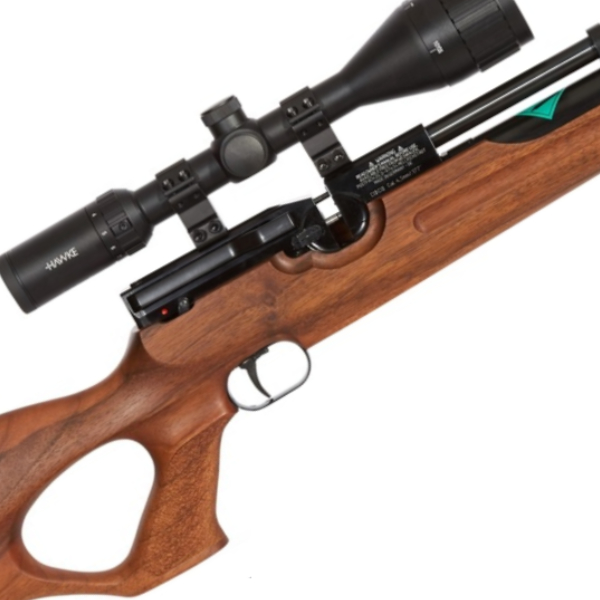
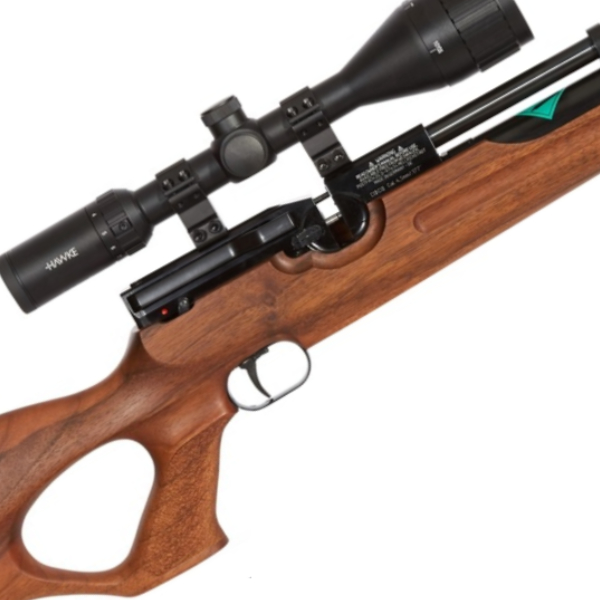
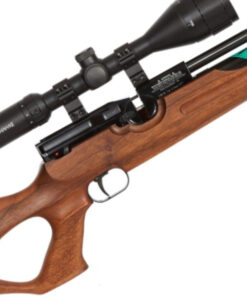
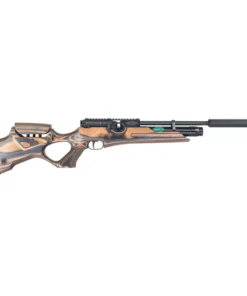
A short 31 cm barrel is used so that overall length remains approximately 95–96 cm including the standard moderator. As a result, excellent balance and easy maneuverability are maintained in woodland or confined spaces. Additionally, an ambidextrous thumbhole stock (available in walnut, laminate, or synthetic) is provided, complete with finger grooves and a raised cheekpiece. Consequently, a secure, comfortable hold is offered to both left- and right-handed shooters. Furthermore, an adjustable butt pad is featured on many laminate versions so that length of pull and alignment can be fine-tuned.
Quiet Operation and Filling Convenience
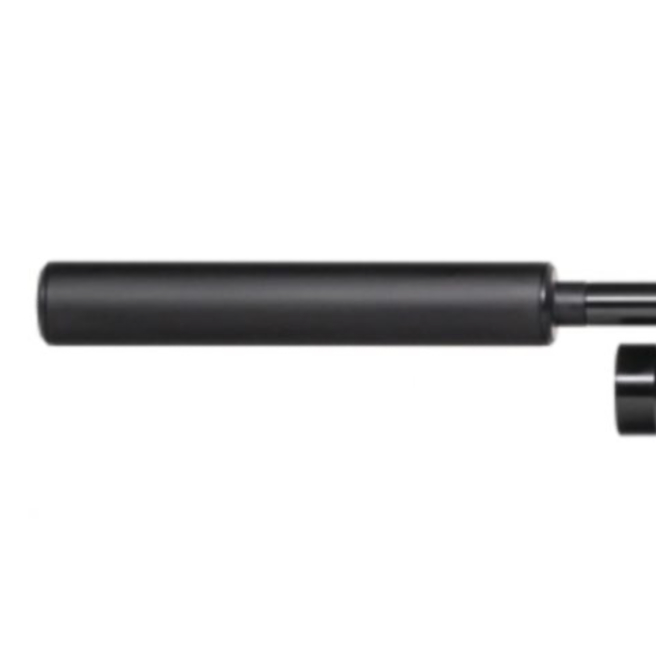
A high-efficiency silencer is fitted as standard (or the barrel is threaded ½” UNF). Therefore, muzzle report is substantially reduced, making discreet pest control and range use possible. Moreover, a removable air cylinder with integral pressure gauge and quick-fill probe is included. Subsequently, filling to the recommended 200 bar can be completed quickly on or off the rifle. In addition, a bleed tool is typically supplied for safe depressurization.
Key Specifications Highlighted
The following specifications are consistently reported for the Weihrauch HW100 KT Air Rifle:
- Action: Side-lever multi-shot PCP
- Magazine: 14-shot rotary (two magazines included)
- Calibres: .177, .22 ( .20 available by special order)
- Typical UK power: Approximately 11–11.5 ft-lbs
- Shot count (approx.): 50 shots in .177 / 75 shots in .22 per 200 bar fill
- Barrel length: 31 cm
- Overall length: 95–96 cm (including silencer)
- Weight (unscoped): Approximately 3.1–3.4 kg
- Trigger: Two-stage adjustable match trigger
- Safety: Manual, resettable
- Stock: Ambidextrous thumbhole (walnut / laminate / synthetic options)
- Fill pressure: 200 bar
- Scope rail: 11 mm dovetail (Picatinny adapter often supplied)
Notably, newer HW100 X variants introduce a 250 bar aluminium cylinder and revised regulator for higher shot counts, yet the classic KT platform remains highly regarded for its proven consistency.
Accuracy, Consistency and Real-World Performance
Remarkable shot-to-shot consistency is produced by the self-regulating valve system. For instance, velocity spreads of only a few feet per second across a string are commonly recorded. Consequently, tight groups are regularly achieved at 30–40 yards when quality pellets are used. Furthermore, sub-half-inch groups at 40 yards have been documented under favourable conditions. Therefore, competition-level precision is accessible even in a compact hunting-oriented package.
In addition, the match-grade trigger and vibration-free shot cycle contribute to excellent shot placement. Likewise, the carbine length and well-balanced weight reduce fatigue during standing or kneeling shots. As a result, both target shooters and hunters benefit from the same refined platform.
Practical Uses for Every Shooter
Versatile application is supported by the Weihrauch HW100 KT Air Rifle. Target practice and HFT-style shooting are well served by its accuracy and trigger quality. Meanwhile, pest control and small-game hunting are facilitated by the quiet report, multi-shot capability, and compact size. Moreover, plinking and training sessions remain enjoyable thanks to the smooth side-lever and generous magazine capacity. Importantly, the ambidextrous design ensures that shooters of all preferences can enjoy the same high standard of performance.
Responsible ownership is always emphasised. Local airgun laws and power limits must be observed, and safe handling practices should be followed at all times.
Why the Weihrauch HW100 KT Air Rifle Continues to Be Chosen
Premium build quality is delivered at a competitive price point within the high-end PCP category. Furthermore, proven reliability over many years of production inspires confidence. Additionally, the combination of compact handling, outstanding trigger, quiet operation, and consistent accuracy creates a rifle that few competitors match in the carbine class. Consequently, both newcomers seeking a quality first PCP and experienced shooters upgrading their kit find lasting value.
Ultimately, precision German engineering is placed in the hands of the shooter when the Weihrauch HW100 KT Air Rifle is selected. Therefore, every session—whether on the range or in the field—can be approached with greater confidence and enjoyment.
Weihrauch Air Rifles, PCP Platforms, Spring-Piston Systems, and Related Airgun Terminology
Enthusiasts researching premium German airgun engineering frequently encounter models and search terms such as Weihrauch HW100X Karbine, Thumbhole PCP Air Rifle, hw35, h 45, german air rifle, accurate air rifles, hw97k, hw 70, hw35e for sale, hw40, weihrauch hw30, weihrauch hw80, weihrauch hw 95, hw100, hw 97k, hw35 air rifle, hw50 s, weihrauch hw45, weihrauch english, weihrauch hw98, weihrauch englisch, hw77 air rifle, weihrauch hw50s, compressed air rifles, air rifle makes, spring piston, what are air rifles, weihrauch hw44, air shot gun, sk x rifles, weihrauch hw50, hw30s, hw 30, what are air pistols, hw50, and rifles de aire.
Within the Weihrauch lineup, the Weihrauch HW77 air rifle is widely recognized as a traditional fixed-barrel underlever platform. Related terminology includes HW77 Green Laminate rifle, Weihrauch underlever air rifle, HW77 spring piston air rifle, Weihrauch HW77 for sale, and German precision air rifle. Researchers comparing versions may also encounter phrases such as buy Weihrauch HW77 Green Laminate online, Weihrauch HW77 Green Laminate price and specs, Weihrauch HW77 accuracy review, HW77 Green Laminate vs HW97 comparison, is Weihrauch HW77 good for beginners, precision shooting airgun, high quality German airguns, best price Weihrauch HW77, where to buy Weihrauch HW77, Weihrauch HW77 in stock, affordable premium air rifle, and top rated underlever air rifle.
Technical comparison searches commonly include Weihrauch HW77 vs HW97, HW77 vs break barrel air rifle, best Weihrauch air rifles, most accurate air rifle for target shooting, air rifle with low recoil, durable air rifle for outdoor use, and reliable air rifle for long term use. These phrases generally reflect interest in operating systems, mechanical durability, handling characteristics, consistency, and the differences between fixed-barrel underlever designs, break-barrel rifles, and PCP platforms.
Other Weihrauch-related terminology includes air pistols, hw100 airgun, weihrauch hw95, weihrauch hw 30, weihrauch hw90, hw 44, hw 40, hw 98, and weihrauch hw100. The HW100 family represents the PCP side of Weihrauch’s catalog, while models such as the HW30, HW50, HW80, HW90, HW95, HW97, and HW98 are associated with spring-powered or gas-ram-style sporting airgun platforms depending on the specific model and configuration. By contrast, the HW44 is commonly discussed as a PCP air pistol.
The broader airgun market also includes search terminology connected with alternative PCP manufacturers and modern platforms. Examples include 25 karma, pcp bb gun, karma eq air rifle, karma red panda, panda guns, full auto pcp, karma sls compact, air karma, red panda hat, eq air, karma sls, eq magazine, air pcp, and karma airguns. These terms may refer to specific products, product families, accessories, community terminology, or unrelated search phrases that appear alongside airgun research.
Reximex is another name frequently encountered in PCP discussions. Related search phrases include reximex airguns, reximex rp, reximex throne gen 2, reximex mito, reximex rpa, sbs12, reximex mitos, reximex lieva, reximex accura pcp air rifle, and reximex throne gen2. Model naming can vary slightly between retailers, regions, and search listings, which explains variations such as “Throne Gen 2” and “Throne Gen2” or “Mito” and “Mitos.”
Airgun research also involves understanding velocity and energy. Searches such as fps to joules calculator, fps to ft lbs, and airgun calculator relate to converting projectile velocity and mass into kinetic-energy measurements. These calculations are commonly used for technical comparison, range evaluation, regulatory research, and understanding how different compressed-air or spring-powered platforms perform within their intended specifications.
More general discovery terms can include gunseek and yivli av tüfeği, alongside broader international phrases such as rifles de aire. Because airgun terminology varies considerably between English, German, Spanish, and Turkish-speaking markets, researchers may encounter several different naming conventions for comparable sporting, target, and recreational airgun platforms.
Taken together, terms ranging from Weihrauch HW100X Karbine and Thumbhole PCP Air Rifle to HW77 Green Laminate rifle, spring piston, compressed air rifles, karma airguns, and reximex airguns illustrate the diversity of modern airgun technology. Weihrauch remains particularly associated with German engineering, fixed-barrel underlever rifles, traditional spring-powered designs, precision PCP systems, and air pistols, while Karma and Reximex represent additional names encountered when comparing contemporary PCP platforms and associated airgun technology.
Frequently Asked Questions
What type of action and power source is used?
A pre-charged pneumatic system is employed so that consistent energy is delivered shot after shot. Consequently, a side-lever mechanism is fitted, allowing the action to be cycled quickly and smoothly without the rifle being taken from the shoulder. Furthermore, a rotary magazine is utilised so that multiple pellets can be loaded in succession. Therefore, follow-up shots are made possible with minimal disruption. In addition, a self-regulating valve arrangement is incorporated on classic versions, while later updates introduce a redesigned regulator. As a result, velocity consistency is maintained across a useful string of shots. Moreover, vibration-free release is experienced because the design has been refined over many years of production. Ultimately, reliable multi-shot performance is provided for both range work and field use.
Which calibres can be chosen?
Three calibres are commonly offered. Specifically, .177 is selected when a flatter trajectory and higher pellet count are preferred. Meanwhile, .22 is chosen when additional down-range energy is desired for pest control. Additionally, .20 can be ordered as a special request when a compromise between trajectory and impact is sought. Consequently, different shooting disciplines can be served by the same platform. Furthermore, pellet choice remains important because grouping and consistency are influenced by quality ammunition. Therefore, trial of several premium brands is recommended so that the most suitable combination can be identified. Likewise, local power limits must always be observed when a calibre is selected.
How many shots are normally obtained from one fill?
Approximately fifty usable shots in .177 and seventy-five shots in .22 are typically recorded from a 200-bar fill on the carbine cylinder. However, actual numbers vary slightly according to pellet weight, ambient temperature, and exact fill pressure. Moreover, later aluminium-cylinder updates operating at 250 bar produce a higher shot count. Consequently, session length can be extended without frequent refilling. In addition, the integral pressure gauge allows remaining air to be monitored at a glance. Therefore, unexpected loss of power mid-session is avoided. Likewise, a conservative approach to the lower end of the pressure curve is advised so that consistency is preserved.
What power level can be expected?
Legal-limit output of approximately 11 to 11.5 ft-lbs is produced in standard UK-specification examples. Subsequently, higher-power FAC versions can be supplied where licensing permits. As a result, both recreational and more demanding hunting applications can be accommodated. Furthermore, energy remains stable across the useful shot string because of the valve or regulator design. Importantly, chronograph testing after any modification or new pellet choice is recommended. Therefore, compliance with local regulations can be confirmed. In addition, responsible use of any elevated-power variant is expected at all times.
How is filling carried out?
A removable air cylinder is fitted so that charging can be performed on or off the rifle. Moreover, a quick-fill probe is supplied and inserts into a protected port at the front of the cylinder. Consequently, connection to a pump or scuba bottle is made straightforward. In addition, an integral manometer is positioned for easy reading. Therefore, fill status can be checked without looking down the barrel. Likewise, a bleed tool is included so that residual pressure can be released safely when required. Subsequently, the cylinder can be detached for compact storage or transport. Ultimately, routine filling becomes a simple and repeatable process.
Is the design suitable for both left- and right-handed shooters?
An ambidextrous thumbhole stock is provided so that comfortable shouldering is possible from either side. Furthermore, the cheekpiece and grip geometry are shaped to serve both preferences. Consequently, no dedicated left-hand action is required for most users. In addition, the side lever remains on the right yet can still be operated efficiently by left-handed shooters after a short period of familiarisation. Moreover, the adjustable butt pad on laminate versions allows alignment to be refined. Therefore, inclusive use is supported without compromise to handling. Likewise, scope mounting remains conventional and accessible to all.
What stock configurations are available?
Walnut, laminate, and synthetic thumbhole options are offered. Specifically, oiled walnut presents a traditional appearance and pleasant feel. Meanwhile, laminate versions frequently incorporate an adjustable cheekpiece and butt pad so that fit can be customised. Additionally, synthetic stocks provide weather resistance and reduced maintenance. Consequently, personal preference and intended environment can guide the choice. Furthermore, finger grooves in the forend improve purchase in all weather. Therefore, a secure hold is maintained whether the rifle is used from a bench, kneeling, or standing position. In addition, the compact carbine proportions keep overall balance favourable.
How quiet is the rifle in use?
A high-efficiency moderator is fitted as standard on most examples, or the muzzle is threaded ½” UNF so that an aftermarket silencer can be attached. As a result, muzzle report is substantially reduced. Consequently, disturbance of quarry and nearby shooters is minimised. Moreover, the already efficient valve system contributes to a subdued report. Therefore, discreet pest control and club-range use become practical. Likewise, additional moderator length can be selected if even greater sound reduction is desired. Importantly, hearing protection is still recommended during extended sessions.
What trigger characteristics can be expected?
A two-stage adjustable match trigger is installed. Furthermore, pull weight and travel can be tailored to individual preference. Consequently, a crisp, predictable break is achieved after correct setup. In addition, the blade itself can often be repositioned along its rail so that finger placement feels natural. Therefore, precision shot release is supported. Moreover, a manual resettable safety is incorporated and is engaged only when the action is cocked. Likewise, the combination of trigger quality and vibration-free cycle contributes directly to grouping potential.
How accurate is typical performance?
Sub-inch groups at 30 yards and tight clusters at 40 yards are regularly produced when quality pellets are used and the rifle is properly zeroed. Furthermore, velocity variation across a ten-shot string is commonly measured in single-digit feet per second. Consequently, hold-over remains predictable. In addition, the match trigger and rigid action help eliminate shooter-induced error. Therefore, both competition-style target work and ethical hunting distances are well within capability. Likewise, results improve further once the barrel is seasoned and a favoured pellet is identified. Ultimately, consistency rather than raw velocity is the source of the rifle’s reputation.
What are the approximate dimensions and weight?
Overall length of roughly 95–96 cm including the standard moderator is typical, while barrel length remains about 31 cm. Meanwhile, unscoped weight usually falls between 3.1 kg and 3.4 kg depending on stock material. Consequently, the carbine format remains easy to carry and quick to mount. Furthermore, the shorter cylinder compared with full-length models reduces bulk without sacrificing the essential shooting qualities. Therefore, woodland stalking and hide work are facilitated. In addition, the balance point sits comfortably for offhand shooting. Likewise, scoped weight remains manageable for most adults.
Is the rifle suitable for hunting and pest control?
Compact length, modest weight, quiet report, and multi-shot capability make field use practical. Moreover, adequate energy at legal limit is delivered for small-game and vermin species when appropriate pellets and ranges are observed. Consequently, humane dispatch can be achieved within the rifle’s effective envelope. Furthermore, the thumbhole stock aids control from improvised positions. Therefore, the platform is frequently chosen by hunters who also value range accuracy. Importantly, local game laws and permission requirements must always be respected. In addition, practice at realistic distances is essential before live quarry is engaged.
Can the same rifle serve target and training roles?
Excellent trigger quality and inherent accuracy allow demanding target disciplines to be practised. Subsequently, HFT-style courses and bench sessions are commonly undertaken with confidence. Moreover, the two supplied magazines support extended strings without constant reloading. Consequently, skill development is encouraged. Furthermore, the ambidextrous stock and adjustable features accommodate a wide range of physiques. Therefore, both newcomers and experienced marksmen can train productively. Likewise, the same rifle can transition between club evenings and weekend hunting trips with only a change of optic or pellet.
What routine maintenance is recommended?
Regular inspection of the air cylinder O-rings and fill-port seal is advised. Furthermore, the barrel should be cleaned periodically with appropriate felt pellets or a pull-through when grouping deteriorates. Consequently, accuracy is preserved. In addition, the side-lever pivot and magazine are kept free of grit. Therefore, smooth cycling continues. Moreover, the stock finish is maintained according to material—oil for walnut, wipe-down for laminate or synthetic. Likewise, the rifle should be stored uncocked and at moderate pressure when not in use. Ultimately, modest care rewards the owner with long service life.
Are higher-power or specialised versions available?
FAC-rated examples can be obtained where licensing allows. Additionally, later “X” updates introduce a 250-bar aluminium cylinder and revised regulator for increased shot capacity. Consequently, different regulatory environments and shooting styles can be served. Furthermore, single-shot trays are sometimes offered as extras for those who prefer one-pellet loading. Therefore, the core design remains adaptable. Importantly, any power increase must be accompanied by correct legal documentation. In addition, chronograph verification after conversion is strongly recommended.
Which accessories are commonly added?
A quality telescopic sight is almost always fitted, using either the 11 mm dovetail or an optional Picatinny adapter. Moreover, a bipod, sling swivels, and extra magazines are popular additions. Consequently, versatility is increased. Furthermore, a larger or quieter aftermarket moderator can be substituted if desired. Therefore, the rifle can be tailored to specific tasks. Likewise, a hard case or padded bag protects the rifle during transport. In addition, a reliable stirrup pump or dive-bottle setup completes the charging system. Ultimately, the platform accepts a wide range of supporting equipment without modification.
How does the carbine version differ from longer models?
A shorter barrel and reduced cylinder capacity distinguish the carbine. As a result, overall length and weight are lowered, improving handling in confined cover. Meanwhile, shot count per fill is modestly reduced compared with full-length counterparts. Consequently, a trade-off between compactness and endurance is accepted. Furthermore, the same trigger, magazine system, and accuracy potential are retained. Therefore, many shooters consider the carbine the most practical all-round configuration. Likewise, the difference in feel is immediately noticeable when the rifle is carried for extended periods.
What should be considered before purchase?
Local airgun legislation, power limits, and age restrictions must be confirmed first. Furthermore, intended use—target, hunting, or mixed—should guide calibre and stock choice. Consequently, disappointment after delivery is avoided. In addition, a reputable retailer able to demonstrate the rifle and advise on filling equipment is preferred. Therefore, first-time PCP owners receive proper support. Moreover, budget should include a suitable scope, pellets, and charging solution. Likewise, handling the rifle in person remains the best way to assess stock fit. Ultimately, informed selection leads to long-term satisfaction with this refined German carbine.
Practical Use Scenarios
Early-Morning Pest Control Around Farm Buildings
Quiet approach is favoured when first light is used for vermin control. Consequently, the compact carbine length allows the rifle to be carried through gates and along hedgerows without snagging. Furthermore, the subdued report produced by the standard moderator reduces the chance that nearby quarry will be alerted after the first shot. Moreover, two rotary magazines are kept loaded so that a second opportunity can be taken immediately if a follow-up is required. Therefore, disruption of the session is minimised.
A kneeling or standing position is commonly adopted beside a barn or grain store. In addition, the thumbhole stock and finger-grooved forend provide a secure hold even when gloves are worn. Likewise, the two-stage trigger can be adjusted beforehand so that a light, predictable break is obtained. As a result, precise shot placement at typical farmyard distances of twenty to thirty-five yards is supported. Subsequently, humane dispatch of rats, rabbits, or feral pigeons can be achieved when legal-limit energy and appropriate pellets are combined.
The integral pressure gauge is glanced at before the session begins. Consequently, sufficient air for the expected number of shots is confirmed. Furthermore, a spare filled cylinder can be carried in a pouch if a longer morning is planned. Therefore, the need to return to a vehicle mid-session is avoided. Importantly, permission from the landowner and compliance with local wildlife regulations are obtained in advance. Ultimately, a discreet and efficient start to the day is made possible.
Woodland Stalking and Hedgerow Work
Dense cover is negotiated more easily because overall length remains modest. Meanwhile, the balanced weight distribution allows the rifle to be carried at the ready for extended periods. Additionally, the ambidextrous stock serves both left- and right-handed users equally, so no awkward change of grip is required when a shooting lane appears on the opposite side of a path. Consequently, opportunities are not missed.
A standing shot from the edge of a ride is frequently taken. In addition, the raised cheekpiece aids consistent head position when a compact scope is fitted. Moreover, the short barrel clears undergrowth that would otherwise catch a longer tube. Therefore, the rifle can be brought on target quickly. Likewise, the quiet cycle of the side lever permits a second pellet to be chambered without excessive movement. As a result, a pair of rabbits or a grey squirrel can be addressed in succession when conditions allow.
Wind drift at woodland distances is managed by selecting a slightly heavier pellet in .22 when extra momentum is preferred, or by retaining .177 when a flatter trajectory is valued. Furthermore, practice at known distances beforehand ensures hold-over is instinctive. Subsequently, ethical ranges are observed and shots beyond the rifle’s consistent capability are declined. In addition, a sling can be fitted for longer walks between likely spots. Therefore, fatigue is reduced and readiness is maintained.
Formal Range Sessions and Group-Size Practice
A bench or bipod is used when grouping potential is to be evaluated. Consequently, the inherent consistency of the valve or regulator system becomes apparent. Furthermore, ten-shot strings with velocity variation of only a few feet per second are commonly recorded. Moreover, the adjustable match trigger allows the same break to be repeated shot after shot. Therefore, shooter error is isolated from rifle performance.
Zeroing at thirty yards is typically completed first. In addition, confirmation groups at forty yards are fired so that hold-over or turret adjustment can be noted. Likewise, several premium pellet brands are tested in rotation because barrel preference varies. As a result, the most accurate combination for that particular rifle is identified. Subsequently, a data card is kept so that the same load can be used in the field.
The two magazines are loaded in advance and swapped rather than refilled on the firing point. Consequently, rhythm is preserved. Furthermore, the removable cylinder can be exchanged if a long club evening is planned. Therefore, time spent pumping is reserved for the end of the session. Importantly, hearing protection and eye protection remain in use even though the report is modest. Ultimately, both enjoyment and measurable improvement are obtained.
Hunter Field Target Style Courses
Varied targets at unknown distances between eight and forty-five yards are engaged. Meanwhile, the compact dimensions help when shots must be taken from kneeling or standing pegs in awkward woodland settings. Additionally, the crisp trigger and lack of recoil assist in holding the aiming mark steady. Consequently, knockdowns become more repeatable once the trajectory of the chosen pellet is known.
A kneeling shot over a fallen log is a typical test. In addition, the thumbhole and adjustable butt pad (on laminate versions) allow a stable position to be built quickly. Moreover, the side lever can be operated without breaking the cheek weld excessively. Therefore, follow-up shots on reset targets remain controlled. Likewise, the quiet report avoids disturbing other competitors on adjacent lanes.
Wind flags are read carefully because even a consistent rifle is affected by gusts. Furthermore, a slightly heavier pellet may be selected on exposed parts of the course. Subsequently, hold-off is applied rather than last-moment aiming changes. In addition, the magazine capacity of fourteen shots covers a full lane with a spare remaining. Therefore, the need to reload under time pressure is reduced. Ultimately, the combination of handling and precision suits this demanding discipline well.
Evening Sessions Around a Smallholding
Dusk work around chicken runs or vegetable plots is frequently undertaken. Consequently, the moderator keeps the report from carrying across neighbouring properties. Furthermore, a compact illuminated-reticle scope or a modest lamp can be fitted without unbalancing the carbine. Moreover, the ambidextrous stock remains comfortable when gloves and a jacket are added as temperature falls. Therefore, control is retained in poorer light.
A standing or sitting shot from a gateway is common. In addition, the finger grooves help prevent the forend from slipping when dew is present. Likewise, the manual safety is engaged until the shot is certain, then slipped off with the thumb. As a result, a deliberate process is followed even when time is short. Subsequently, only clear, safe backstops are used.
The pressure gauge is checked by torch if necessary. Consequently, unexpected power drop is avoided. Furthermore, a second magazine is kept in a pocket so that a busy evening does not end prematurely. Therefore, several opportunities can be taken before the rifle is put away. Importantly, livestock and domestic animals are accounted for before any shot is released. Ultimately, effective and neighbour-considerate control is achieved.
Training New or Returning Shooters
Inclusive design allows shooters of differing stature and handedness to be coached on the same rifle. Meanwhile, the modest weight and short length reduce fatigue during a first lesson. Additionally, the two-stage trigger can be set a little heavier initially so that premature release is discouraged. Consequently, safe habits are established.
A supported sitting or bench position is used at the start. In addition, the absence of recoil lets the learner watch the pellet strike without flinching. Moreover, the side lever is demonstrated slowly so that the cycling motion becomes familiar. Therefore, confidence grows quickly. Likewise, both magazines are employed so that the learner experiences a realistic string rather than single-shot loading only.
Distance is kept short until groups tighten. Subsequently, range is increased in small steps. Furthermore, discussion of hold-over, wind, and pellet choice is introduced once basic marksmanship is sound. In addition, the same rifle can later be used by the coach for demonstration shots. Therefore, continuity of equipment aids learning. Ultimately, a positive first experience with a quality PCP is provided.
Transport, Filling, and Multi-Site Days
A padded slip or compact hard case is used because overall length remains manageable. Consequently, the rifle fits easily behind a seat or in a modest locker. Furthermore, the removable cylinder can be transported separately if regulations or space require it. Moreover, a small stirrup pump or pre-filled spare cylinder travels in the same bag. Therefore, a full day’s shooting at more than one location remains practical.
Filling is performed at the vehicle before the first walk. In addition, the quick-fill probe and bleed tool are kept together in a small pouch so that nothing is misplaced. Likewise, the gauge is read in good light to confirm a complete charge. As a result, the first shot of the day is taken with known pressure. Subsequently, a second fill can be completed at lunch if a long afternoon is planned.
Weather protection for the stock is considered according to material. Walnut receives a light oil wipe after rain, while laminate and synthetic need only a dry cloth. Consequently, appearance and function are preserved. Furthermore, magazines are kept in a sealed tin so that moisture and grit are excluded. Therefore, feeding reliability is maintained across changing conditions. Ultimately, the rifle remains ready whenever the next opportunity arises.
Mixed-Discipline Weekends
A single rifle is often asked to serve both a Saturday club shoot and a Sunday permission. Meanwhile, only the optic magnification or pellet tin may be changed between the two. Additionally, the consistent trigger and point of impact reduce the need for re-zeroing. Consequently, time is spent shooting rather than adjusting.
Standing practice on the club range prepares the shooter for unsupported field shots the following day. In addition, the same kneeling technique used on an HFT peg transfers directly to a woodland bank. Moreover, knowledge of remaining shot count from Saturday informs how many magazines are loaded on Sunday. Therefore, planning becomes straightforward.
Inclusive handling means a partner or family member can also take a few shots without a different rifle being required. Likewise, the quiet report keeps the experience pleasant for everyone present. As a result, the weekend remains enjoyable rather than specialised to one person. Subsequently, the rifle is cleaned lightly, pressure is dropped to a storage level, and it is put away ready for the next outing. Ultimately, versatility across practical scenarios is demonstrated without compromise to the core qualities of accuracy, control, and reliability.


Reviews
There are no reviews yet.