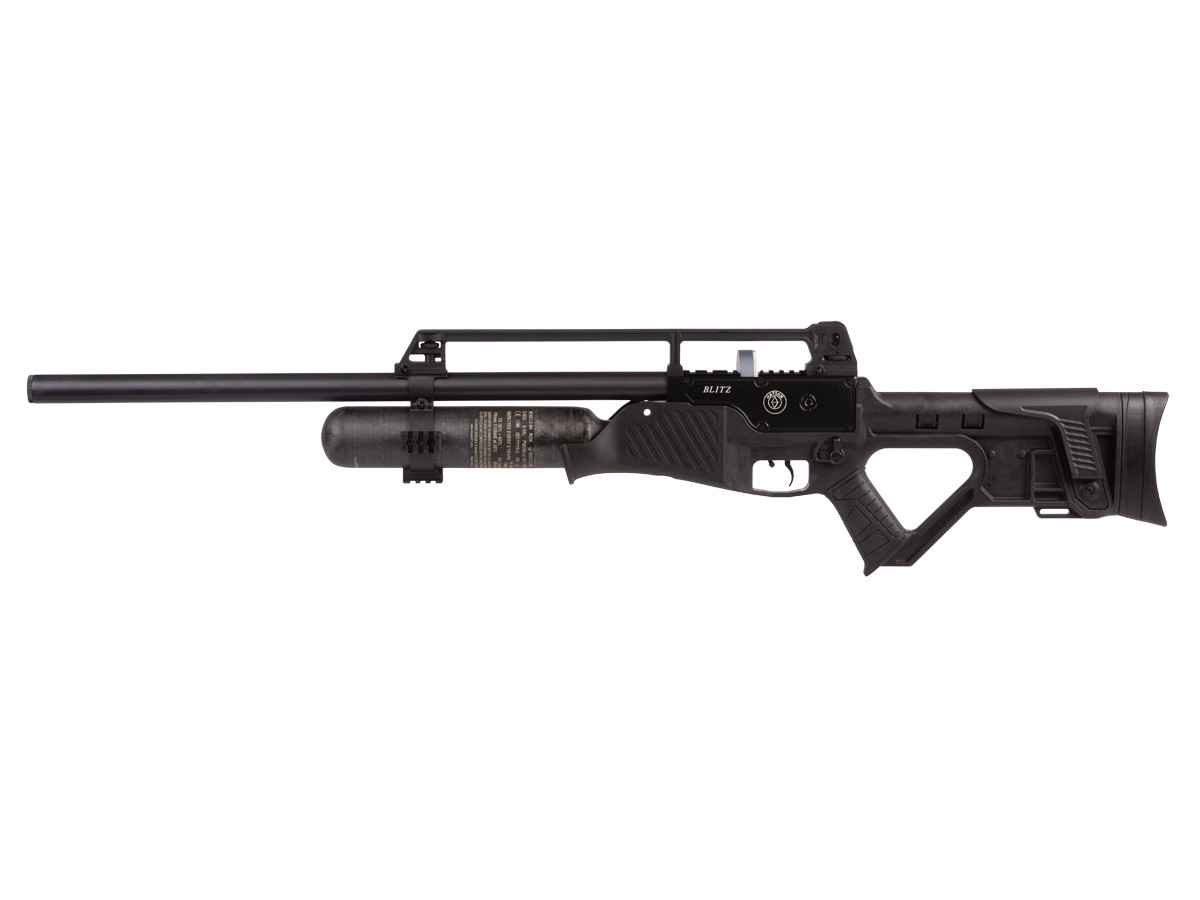
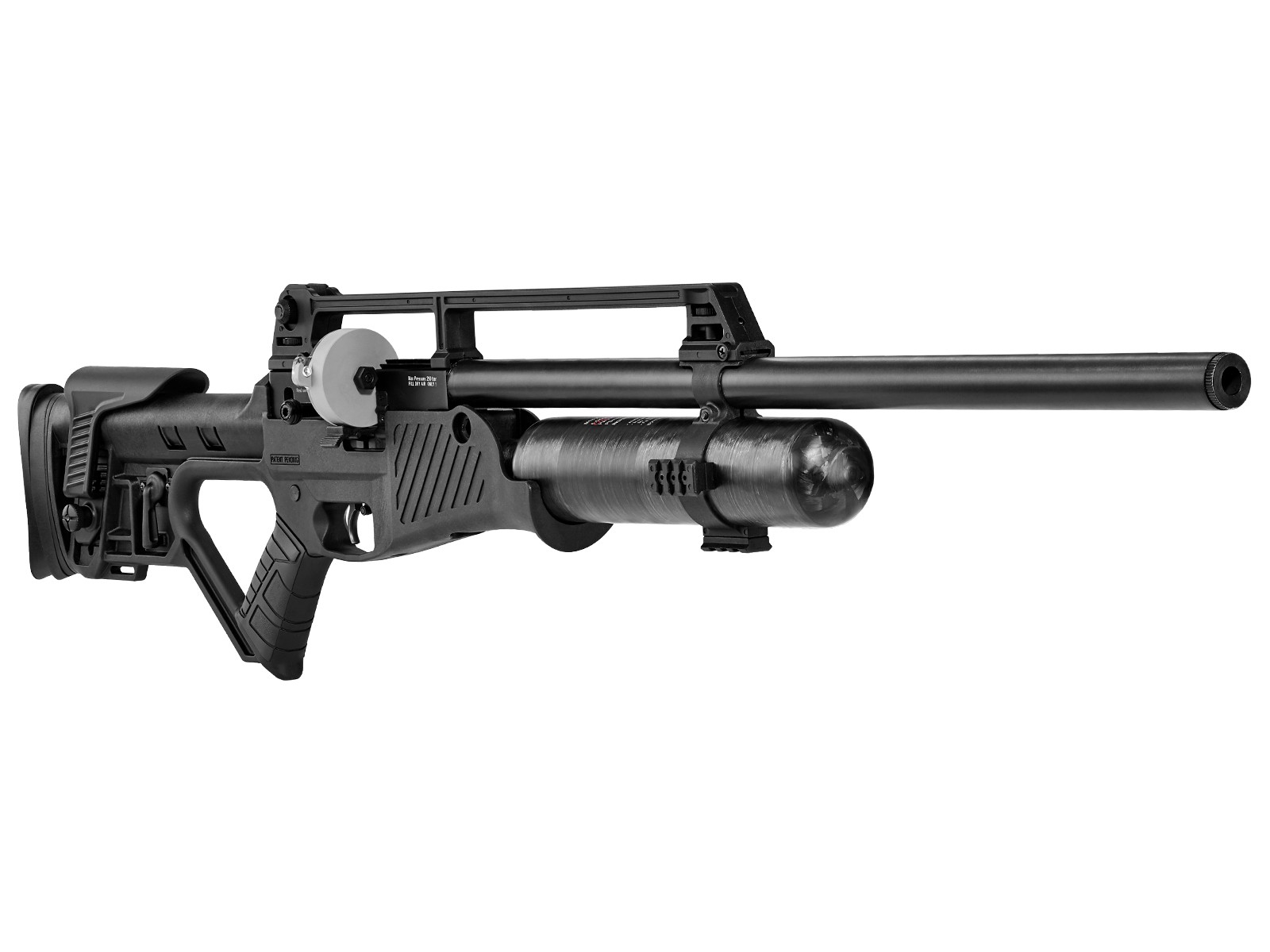
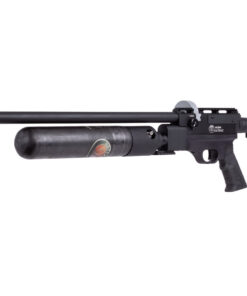
A fully shrouded, precision-rifled and choked barrel is fitted so that grouping consistency is supported across .22, .25, and .30 calibers. Consequently, velocities of up to 1,120 FPS and energies reaching 59 FPE are produced by the current Hatsan Blitz 777, while earlier Hatsan Blitz configurations remain valued for their compact 580 cc carbon-fiber bottles. Inclusive shooting is encouraged throughout, since adjustable cheek pieces, folding or bullpup stocks, and ambidextrous controls are provided so that comfort can be tailored to every body type and shooting style.
Full-auto and semi-auto modes are switched by a simple selector so that the rate of fire can be matched to the task at hand. Up to 1,000 rounds per minute can be cycled by the patented air-operated system, provided tank pressure stays above the minimum 100 BAR threshold required for reliable auto function. Two SwingLoad rotary magazines are included with each rifle; capacities of 21 rounds in .22, 19 rounds in .25, and 16 rounds in .30 are thereby supplied out of the box.
High shot counts per fill are achieved because a large carbon-fiber air bottle is mounted. On the Hatsan Blitz 777, 175 optimal-velocity shots in .22, 170 shots in .25, and 160 shots in .30 are commonly recorded from the 700 cc tank filled to 300 BAR. On original Hatsan Blitz models, 130 / 110 / 100 shots are typically obtained from the 580 cc bottle filled to 250 BAR. Digital or analog manometers are fitted so that remaining pressure can be monitored at a glance.
Versatile hunting and range performance is offered across three popular calibers:
Iron sights on a removable carry handle are supplied as standard, while a combination 11 mm dovetail / Weaver rail is machined so that optics can be mounted without extra adapters. Side Picatinny sections and sling swivels are also present; lights, bipods, or slings can therefore be added whenever field conditions require them. A manual safety is positioned for positive engagement, and a QuietEnergy-style shroud is used so that report is moderated during extended strings.
Tactical synthetic furniture is employed on both standard and folding-stock versions. An elevation-adjustable cheek rest and rubberized pistol-grip panels are integrated so that a stable cheek weld and secure hold can be maintained by left- or right-handed shooters. The Hatsan Blitz BP bullpup variant further shortens overall length to approximately 35.6 inches while the same 23-inch barrel length is retained, making tight spaces and vehicle transport more convenient.
Rapid follow-up shots are made possible when a flock of pests or a moving steel plate is presented. Full-auto bursts can be reserved for close-range saturation or demonstration, while semi-auto is selected whenever each pellet must be placed with care. Because the action is gas-operated rather than electrically driven, reliability in cold or wet weather is preserved and extra batteries never need to be packed.
Extended practice sessions are supported by the high shot count per fill; fewer trips to the compressor are required, so more time can be spent on fundamentals. After a fill to the rated pressure, the rifle can be carried into the field with confidence that a full afternoon of mixed semi- and full-auto fire remains available. Responsible use is always expected: local airgun laws, FAC or power limits, and safe backstops must be observed, and full-auto capability is restricted in some jurisdictions.
Distinctive select-fire performance is packaged in a proven Hatsan chassis that has already been refined through the original Blitz, Blitz BP, and current Blitz 777 generations. Accuracy is protected by a choked, fully shrouded barrel; endurance is supplied by large carbon-fiber bottles; and adaptability is granted by folding stocks, bullpup layouts, and ample rail space. Inclusive language and adjustable furniture ensure the platform can be enjoyed by a wide community of shooters rather than a narrow demographic.
Frequently Asked Questions
A wide range of practical questions is answered below so that first-time buyers and experienced PCP users can prepare a safe, legal and enjoyable setup. Inclusive language is used throughout, and every answer is written so that readers of all experience levels can follow the guidance without specialised jargon being assumed.
How is select-fire operation switched on this rifle?
A dedicated selector is rotated between semi-automatic and fully automatic positions. When semi-auto is chosen, a single pellet is released each time the trigger is pressed. When full-auto is selected and tank pressure remains above the minimum threshold, the magazine can be emptied in a continuous burst for as long as the trigger is held. A battery-free, gas-operated cycling system is employed, so electrical power is never required. Reliable auto function is maintained only while residual pressure stays above approximately 100 BAR; below that level the action may slow or cease cycling until a refill is completed.
Which calibres can be chosen and how do they differ in the field?
Three primary calibres are offered on current models, with a fourth appearing on some earlier variants. The lightest option is reserved mainly for high-volume target work or markets where energy must be kept low. The .22 option is treated as the most versatile all-rounder, combining a 21-round magazine with velocities suitable for small game and steel. The .25 option adds extra energy and a 19-round magazine, making mid-size pests more practical. The .30 option supplies the highest published energy and a 16-round magazine, yet wind drift and pellet cost increase, so it is best matched to larger quarry where local law permits the extra power.
Published velocities and energies are maximum figures obtained under favourable conditions. Pellet weight, pellet shape, temperature, altitude and remaining tank pressure all influence results, and a variation of up to 20 percent is openly acknowledged. Chronograph confirmation with the chosen pellet is therefore recommended after every fill.
Is a firearms certificate or equivalent licence required?
High factory energy figures place unrestricted export models above the 12 ft-lb threshold used in several jurisdictions. Consequently, a firearms certificate, FAC-equivalent document or other local authorisation is often required before ownership or use is legal. In regions where only sub-12 ft-lb air rifles may be held without a certificate, a factory-limited or professionally tuned version must be specified instead. Full-auto capability is restricted or prohibited in many countries even when semi-auto remains lawful. Local airgun statutes, import rules and hunting regulations must be verified by the purchaser before an order is placed, because legality cannot be assumed from a product listing alone.
How many shots can be expected from one fill?
Shot count depends on bottle size, calibre and whether strings are fired in semi-auto or full-auto. The larger 700 cc bottle, filled to 300 BAR, is typically credited with around 175 optimal-velocity shots in .22, 170 shots in .25 and 160 shots in .30. Earlier 580 cc bottles filled to 250 BAR yield lower counts, commonly near 130 / 110 / 100 shots respectively. Full-auto bursts consume air far more rapidly than measured semi-auto strings, so the first magazines of a fill deliver the highest energy and the last magazines show a gradual decline because the system is unregulated on most versions.
What magazines and loading tools are supplied or recommended?
Two detachable SwingLoad rotary magazines are included from the factory. Capacities of 21, 19 or 16 pellets are provided according to calibre. Extra magazines can be purchased so that downtime between strings is reduced. Dedicated speed loaders and, where legal, higher-capacity aftermarket drums are offered by accessory makers. A winding tool is often stored in the stock on original configurations. Magazines should be loaded with the clear cover facing the correct direction and should never be forced if a pellet is misaligned.
How is the air bottle filled safely?
A quick-fill probe is supplied. The bottle is charged from a compatible compressor, hand pump or scuba adapter rated for the correct maximum pressure—300 BAR for the larger bottle and 250 BAR for the earlier 580 cc bottle. The digital or analogue manometer must be observed throughout the fill. The digital gauge on later models should be charged with its supplied charger before first use. Filling should be performed slowly so that heat build-up is limited. The bleed valve on the hose must be opened before the probe is disconnected. Both probe O-rings should be inspected regularly and replaced at the first sign of leakage.
Can optics and accessories be mounted easily?
A combination 11 mm dovetail and Weaver-style rail is machined on the receiver, and a removable carry handle with adjustable iron sights is included. Compact low-power variable optics, red-dot sights or dedicated airgun scopes are commonly fitted. High rings or a cantilever mount are often chosen because the receiver sits relatively high. Side Picatinny sections surrounding the bottle accept lights, lasers or bipods. Sling swivels are integrated, and aftermarket slings, dual-tank adapters and additional moderators can be added where the muzzle is threaded. Inclusive fitment is supported by an elevation-adjustable cheek piece and rubberised pistol-grip panels that accommodate a wide range of hand sizes and shooting positions.
Is the rifle suitable for left-handed shooters?
Standard folding-stock versions present an ambidextrous pistol grip and a selector that can be reached from either side by most users. The bullpup layout, however, places the magazine and ejection path in a position that is typically described as right-hand biased; left-handed shooters may find that variant less comfortable. Adjustable cheek height and telescoping or folding stocks allow length of pull and comb height to be tailored, so a stable hold can still be achieved by many shooters regardless of dominant eye or hand.
How loud is the report and can extra sound reduction be added?
A fully shrouded barrel with QuietEnergy-style moderation is fitted as standard, placing the rifle in a medium loudness category. An additional ½-inch UNF moderator can be attached on threaded examples. Full-auto strings remain more audible than single shots because multiple pellets exit in rapid succession. Hearing protection is still advised during extended sessions, especially indoors or in enclosed ranges.
What maintenance routine is recommended?
After each range day the exterior is wiped dry, the probe port is capped, and magazines are emptied. Barrel cleaning is performed sparingly with a felt pellet or pull-through designed for PCP rifles; aggressive solvents that attack seals are avoided. O-rings on the fill probe and magazine are inspected and lightly lubricated with airgun-safe grease. The digital manometer battery or charge state is checked on later models. Annual inspection of the bottle, according to local pressure-vessel rules, is strongly encouraged. Internal hammer and valve work should be left to a qualified technician, because the auto-cycling mechanism is more complex than a conventional single-shot PCP.
Can the rifle be used for hunting and pest control?
When local law and energy limits allow, small-game and pest applications are within the design brief. The .22 and .25 options are most often chosen for typical farm and woodland pests; the .30 option is reserved for larger quarry where ethics and legislation permit. Semi-auto is preferred for precise placement. Full-auto is generally unsuitable for hunting because pellet placement cannot be controlled shot-to-shot and air is consumed too quickly. A safe backstop, appropriate pellet and a clear understanding of maximum effective range remain essential. Inclusive outdoor use is encouraged only when every participant has been briefed on muzzle discipline and local seasons or permissions.
What happens if tank pressure drops during a session?
Velocity and cycling reliability decline as pressure falls. Once the gauge approaches the 100 BAR region, full-auto and even semi-auto function may become inconsistent. The session should be paused and the bottle refilled rather than forcing the action. Because the platform is unregulated on most versions, the first magazines of a fill are the most powerful; later magazines are better reserved for closer targets or plinking.
Are spare parts and support widely available?
Factory magazines, probes, O-ring kits and stock components are stocked by many specialist retailers. Aftermarket dual-tank adapters, speed loaders and rail accessories have also been developed by third-party makers. A limited manufacturer warranty is commonly offered; proof of purchase and adherence to fill-pressure limits are required. Inclusive support is helped when owners register the rifle and retain the original manuals, because service centres can then identify the exact generation—original 580 cc, bullpup or 700 cc—before parts are ordered.
How should the rifle be stored and transported?
The tank is preferably stored with a moderate residual pressure rather than completely empty, unless local advice states otherwise. The selector is left on safe, magazines are removed, and the folding stock is collapsed for compact cases. During transport the rifle is cased, pointed in a safe direction and never left unattended in a vehicle where heat or theft risk is high. Airline or international shipping of charged PCP bottles is subject to dangerous-goods rules; professional advice must be sought before any air travel is planned.
Who is this platform intended for?
Recreational shooters who enjoy high-rate fire, pest controllers operating within legal energy limits, and collectors of distinctive PCP designs are all served. Beginners can start in semi-auto with iron sights and later add optics or extra magazines. Experienced users can exploit full-auto where lawful and pair the rifle with compressors and high-capacity accessories. Inclusive participation is supported by adjustable furniture and clear safety features, provided every user accepts that select-fire air rifles demand the same respect as any other powerful airgun.
Frequently Asked Questions
Practical concerns from first-time owners and seasoned PCP users are addressed in the questions that follow. Inclusive wording is used so that every reader can apply the answers, and each response is written in a consistent, conversion-ready style that still respects safety and local law.
How is the firing mode changed during a session?
A side-mounted selector is rotated between the semi-automatic and fully automatic positions. A single pellet is released with each trigger press when semi-auto is chosen. A continuous string is produced for as long as the trigger is held when full-auto is selected and residual tank pressure remains adequate. Electrical power is never required, because cycling is performed by a gas-operated system. Reliable automatic function is preserved only while pressure stays above the published minimum; once that threshold is crossed, cycling may slow or stop until a refill is completed.
Which calibre should be selected for typical use?
Four projectile diameters appear across the product family, although three dominate current production. The smallest diameter is usually reserved for high-volume paper or low-energy markets. The most common mid-size option is favoured for small game, farm pests and steel because a generous magazine capacity is paired with a useful balance of speed and energy. A slightly larger diameter adds authority on mid-size pests while magazine capacity remains practical. The largest diameter supplies the highest published energy, yet wind effect and ammunition cost rise, so that choice is best reserved for heavier quarry where regulations allow it.
Field results are influenced by pellet mass, pellet profile, temperature, altitude and remaining bottle pressure. Manufacturer figures are therefore treated as typical maxima, and a variation of about one fifth is considered normal. Confirmation on a chronograph after each fill is recommended before ethical hunting distances are assumed.
Does ownership require a certificate or special permit?
Unrestricted factory energy often exceeds the 12 ft-lb ceiling applied in several countries. A firearms certificate or equivalent document is therefore required in those markets before the rifle may be possessed or used. Where only sub-limit airguns may be held without paperwork, a factory-restricted or professionally limited example must be ordered instead. Fully automatic fire is separately regulated and may be forbidden even when semi-automatic fire remains lawful. Import rules, hunting seasons and transport restrictions must be checked by the buyer, because a website listing cannot replace local legal advice.
How many usable shots are obtained from a single fill?
Usable shot count is governed by bottle volume, calibre and the mix of semi-auto versus full-auto fire. The larger carbon-fibre bottle, charged to its higher rated pressure, is commonly credited with well over one hundred and fifty optimal-velocity shots in the most popular mid-size calibres. The earlier, smaller bottle yields a lower but still substantial count. Full-auto bursts consume air far faster than measured single shots, so the first magazines of a fill deliver peak energy while later magazines show a gradual decline. An unregulated valve is fitted on most versions; velocity therefore tapers as pressure falls rather than remaining flat.
What feeding system is used and how is it maintained?
Detachable rotary magazines of the SwingLoad type are employed. Two magazines are supplied in the box, with capacities that change by calibre. Additional magazines and purpose-made speed loaders can be added so that pauses between strings are shortened. High-capacity aftermarket drums exist for demonstration use where such devices remain legal. Magazines are loaded with the transparent cover oriented correctly; force is never applied if a pellet sits proud or crooked. Seals inside the magazine are inspected periodically and replaced when feeding becomes hesitant.
How should the bottle be charged without damaging seals?
A probe-style fill fitting is provided. Charging is performed with a compressor, hand pump or scuba adapter rated for the correct maximum pressure of the bottle in use. The onboard gauge—digital on later examples, analogue on earlier ones—is watched throughout the fill. The digital unit on current rifles must itself be charged with the supplied cable before the first fill is attempted. Air is introduced slowly so that heat soak is limited. The hose bleed valve is opened before the probe is withdrawn. Both probe O-rings are examined after every few fills and renewed at the first hint of hissing or ejection.
Can sights and other equipment be added without gunsmithing?
A dual-purpose rail combining a narrow dovetail with a Weaver-style profile is machined on the receiver. A detachable carry handle carrying adjustable iron sights is included for immediate use. Compact variable optics, red-dot sights and dedicated airgun scopes are routinely fitted. Elevated rings or a cantilever mount are often selected because the receiver sits relatively high. Accessory rails around the bottle accept lights, lasers or a bipod. Sling points are already present. Aftermarket dual-bottle adapters, extra moderators and rail covers can be attached where threads and rail space allow. Comb height and length of pull are adjusted at the stock so that a comfortable hold can be found by a wide range of shooters.
Is left-handed use practical?
Folding-stock versions present a largely ambidextrous grip and a selector that can be reached from either side by most adults. The bullpup layout places the magazine well and ejection path in a position generally described as right-side biased; that compact variant is therefore less convenient for many left-handed users. An elevation-adjustable cheek piece and telescoping or folding butt still allow length and comb height to be tailored, so a stable position can often be achieved regardless of dominant hand or eye.
How is the report described and can further quieting be added?
A full-length shroud with integral moderation is fitted at the factory, placing the rifle in a medium-loudness band. An extra muzzle device can be attached on examples that carry a standard thread. Rapid strings remain more noticeable than single shots because several pellets leave the muzzle in quick succession. Hearing protection is still advised during long sessions, particularly on indoor or enclosed ranges.
What routine care keeps the action reliable?
After each outing the exterior is dried, the fill port is capped and magazines are emptied. The bore is cleaned only occasionally with felt pellets or a pull-through intended for pre-charged rifles; harsh solvents that attack elastomers are avoided. Probe and magazine O-rings are inspected and given a thin film of airgun-safe grease. The charge state of any digital gauge is checked. Periodic inspection of the pressure vessel, in line with local cylinder rules, is strongly encouraged. Internal hammer, valve or auto-cycling repairs are left to a qualified technician because the mechanism is more involved than a conventional single-shot PCP.
Can the rifle be used on live quarry?
When energy limits, seasons and permissions allow, small-game and pest work fall within the intended role. Mid-size calibres are most often chosen for typical farm and woodland pests; the largest calibre is reserved for heavier animals where ethics and statute permit. Semi-automatic fire is preferred whenever precise placement is required. Fully automatic fire is generally unsuitable for hunting because individual impacts cannot be directed and air is spent too quickly. A safe backstop, a pellet matched to the quarry and a realistic maximum range remain essential. Inclusive field use is appropriate only when every person present has been briefed on muzzle awareness and local rules.
What occurs when bottle pressure falls mid-session?
Both velocity and cycling consistency decrease as pressure drops. Once the gauge nears the minimum figure published for automatic function, strings may become irregular. The session is paused and the bottle refilled rather than the action being forced. Because regulation is absent on most versions, the opening magazines of a fill are the most powerful; remaining air is better used on closer targets or informal practice.
Are spare magazines, probes and furniture easy to obtain?
Factory magazines, fill probes, seal kits and stock parts are carried by many specialist dealers. Third-party dual-bottle adapters, speed loaders and rail accessories have also been developed. A limited manufacturer warranty is commonly offered, provided proof of purchase is retained and fill-pressure limits have been observed. Inclusive after-sales support is helped when the exact generation—smaller bottle, bullpup or larger bottle—is identified before parts are ordered.
How should storage and travel be arranged?
A moderate residual pressure is often left in the bottle rather than a complete empty, unless local guidance states otherwise. The selector is left on safe, magazines are removed and the folding stock is collapsed for compact cases. During vehicle travel the rifle is cased, oriented in a safe direction and never left on display. Air transport of charged cylinders is treated as dangerous goods; professional advice is obtained before any flight is booked.
Who is expected to benefit from this design?
Recreational shooters who value a high rate of fire, pest controllers working inside legal energy limits, and collectors of distinctive pre-charged designs are all served. New owners can begin in semi-automatic mode with the supplied iron sights and later add optics or extra magazines. Experienced users can employ fully automatic fire where it remains lawful and can pair the rifle with compressors and high-capacity accessories. Inclusive participation is supported by adjustable furniture and clear safety controls, provided every user treats select-fire performance with the same care expected of any powerful airgun.
Legal confirmation, correct filling practice and disciplined handling remain the basis of every successful outing. When those conditions are observed, the select-fire PCP covered here can supply a distinctive mix of measured single shots and, where permitted, rapid strings that few conventional air rifles are designed to deliver.






Reviews
There are no reviews yet.