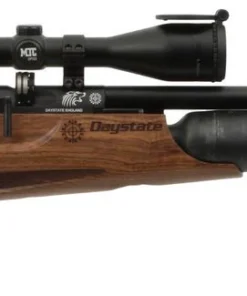
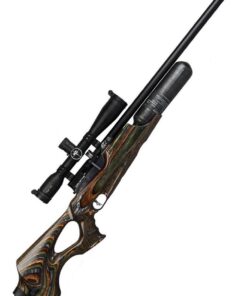
Daystate Wolverine R B-Type Regulated Laminate
Presented as a refined mechanical PCP platform in which consistency, capacity, and classic handling are combined for hunters, field target shooters, and pest-control users of every experience level.
Precision Is Delivered by a Factory-Fitted Huma Regulator
Exceptional shot-to-shot consistency is achieved because a Huma-Air regulator, developed in partnership with Daystate, is installed downstream of the buddy bottle. Consequently, a measured volume of air is released at a stable pressure on every cycle. Therefore, velocity variation is kept tight across a long string, and downrange grouping is improved as a result. Moreover, air is used more efficiently than on an unregulated Wolverine 2, so a substantially higher shot count is returned from the same fill.
Furthermore, two side-mounted gauges are provided so that reservoir pressure and regulator pressure can both be monitored at a glance. In addition, a recommended fill of up to 250 bar (3,625 psi) is supported on the B-Type bottle, while factory power may be set lower than the maximum published figure whenever accuracy with specified pellets is prioritised.
Capacity and Handling Are Balanced in the B-Type Chassis
A large-capacity alloy buddy bottle of 400 cc or 500 cc is fitted to the Daystate Wolverine R B-Type Regulated Laminate. Accordingly, extended sessions can be completed without frequent refills. Typical published returns include up to approximately 600 shots at 12 ft/lbs in .22 and around 500 shots at 12 ft/lbs in .177, with high-power FAC outputs also available where local law permits (for example, about 150 shots at 30 ft/lbs in .22 and about 110 shots at 35 ft/lbs in .25).
Meanwhile, overall length is held to 96.5 cm (38 in) and barrel length to 43 cm (17 in). Unscoped weight is listed in the 3.2–3.7 kg (7–8 lb) range, so the rifle remains manageable in the field even when the larger steel bottle is chosen. Subsequently, balance is preserved by the compact action and the ambidextrous thumbhole stock.

Laminate Furniture Is Designed for All Shooters
A grey (or forest) laminate thumbhole stock is used so that durability and visual contrast are obtained together. Finger grooves, stippled panels, and an adjustable butt pad are incorporated so that a comfortable hold can be found by right- and left-handed shooters alike. Likewise, the side lever is factory-reversible, and a magnetic single-shot tray is supplied in addition to the rotary magazine.
Core Specifications and Feature List
The following highlights are offered so that configuration choices can be compared quickly:
- Action: Mechanical side-lever PCP, factory-reversible for left- or right-hand use
- Regulator: Huma-Air, factory-fitted for consistent velocity and higher shot count
- Air reservoir: B-Type alloy buddy bottle, 400 cc or 500 cc
- Fill pressure: Up to 250 bar (3,625 psi)
- Barrel: Lothar Walther match-grade, 43 cm (17 in), shrouded and ½ UNF threaded
- Overall length: 96.5 cm (38 in)
- Weight (unscoped): Approximately 3.2–3.7 kg (7–8 lb)
- Calibres commonly offered: .177 (4.5 mm), .22 (5.5 mm), and .25 (6.35 mm) depending on market
- Magazine: Typically 13-shot .177 / 11-shot .22 / 10-shot .25 (confirm current Daystate magazine for the exact batch)
- Loading: Magazine or magnetic single-shot tray
- Trigger: Two-stage mechanical, adjustable for weight and first-stage travel
- Safety: Manual cross-bolt with lever-open deactivation
- Stock: Ambidextrous grey laminate thumbhole with adjustable pad
- Gauges: Dual—cylinder pressure and Huma regulator pressure
- Typical sub-12 ft/lbs shot counts (B-Type, published figures): up to ~500 in .177 and ~600 in .22
- Typical FAC examples (where legal): ~180 shots @ 18 ft/lbs (.177), ~150 shots @ 30 ft/lbs (.22), ~110 shots @ 35 ft/lbs (.25)
Power figures and magazine capacities can vary by territory, FAC status, and factory setting; therefore, the exact configuration should always be confirmed before purchase.
Accuracy and Field Use Are Supported by Match Components
A two-stage match trigger is fitted so that break weight and first-stage length can be tailored. Consequently, a clean release is encouraged for both bench and standing work. In the same way, the shrouded Lothar Walther barrel is prepared for a moderator, so report can be reduced when a ½ UNF silencer is added.
Additionally, the mechanical action contains no electronics, so reliability in wet or dusty conditions is favoured by many field users. After a fill, long strings can be completed because the regulator meters air instead of allowing the classic unregulated power curve. Reviews of the platform have recorded tight velocity spreads (often single-digit to low-teen fps over meaningful strings with quality pellets), and groups in the region of a quarter-inch at 40 yards have been reported when conditions and ammunition cooperate.
Practical Scenarios in Which the Rifle Is Employed
For pest control, a quiet, consistent .22 or .25 setup is frequently selected so that humane placement can be repeated without constant top-ups. For Hunters Field Target and informal range work, the laminate thumbhole and reversible lever allow a stable position to be adopted by shooters of either dominant hand. For training days, the high shot count of the 500 cc bottle means a full tin can often be expended from one fill at legal-limit power.
Inclusive language is used throughout because the ambidextrous stock and reversible lever are intended for any adult shooter who is legally entitled to own the rifle. Responsible use, local FAC or energy limits, and safe storage remain essential; therefore, buyers are encouraged to verify regulations in their jurisdiction before ordering.
Why the Daystate Wolverine R B-Type Regulated Laminate Is Chosen
Classic Daystate mechanical quality is retained while modern regulation and side-lever convenience are added. As a result, consistency, shot count, and handling are improved together. Moreover, the laminate furniture resists weather better than many walnut options and presents a distinctive, high-contrast appearance.
Finally, the platform can be specified in legal-limit or FAC power where permitted, so the same chassis can serve club, field, and higher-energy roles. When a dependable, regulated mechanical PCP with a large bottle and an ambidextrous laminate stock is required, the Daystate Wolverine R B-Type Regulated Laminate is offered as a complete, conversion-ready choice for shooters who value precision and endurance in equal measure.
FX Airguns, PCP Air Rifles, Hatsan Models and Modern Airgun Platforms
Modern airguns cover a wide range of platforms, from a basic pellet gun or BB gun to sophisticated regulated PCP airguns designed for target shooting, sporting applications, and long-range precision. Buyers researching an air rifle and air pistol collection will often encounter manufacturers such as FX and Hatsan because both companies offer extensive selections of air rifles, accessories, configurations, and caliber choices.
FX Airguns Sweden and the FX PCP Rifle Range
FX Airguns has become strongly associated with Swedish airgun engineering. Searches for fx airguns sweden, fx airguns sverige, fxairguns, and fx usa commonly lead enthusiasts toward the manufacturer’s extensive PCP lineup. In the American market, fx airguns usa is another widely searched phrase when people are researching available models, specifications, support, and accessories.
Among fx air rifles, the Impact family remains particularly recognizable. Searches frequently include fx impact, f x impact, fx impact m4, fx m4, impact m4 air rifle, and impact m4 500mm when comparing current configurations. The modular design philosophy associated with the Impact platform has helped make the fx air rifle range popular among shooters who appreciate adjustability and configurable PCP systems.
Earlier generations remain widely researched as well. The fx impact m3, impact m3, fx impact mk3, fx m3, and fx m3 airgun continue to attract attention from owners comparing generations or researching replacement components.
Caliber-specific searches include fx impact m3 .22cal air rifle, fx impact m3 .22cal air rifle. 600mm barrel, and the more general fx impact m3 air rifle. People comparing international pricing may also search fx impact m3 precio, fx impact m3 precio en usa, or fx impact m3 price before checking local regulations, specifications, and availability.
Beyond the Impact series, the FX catalog includes several distinctive designs. The fx leopard and fx leopard airgun are frequently researched alongside fx leopard .22 pcp specs by users interested in specifications and configuration details.
Other notable searches include fx drs, fx drs tactical, fx drs classic, and fx drs pro. These terms reflect interest in the different DRS configurations and their intended shooting styles.
The wider FX family also includes models such as the fx king, fx wildcat, fx panthera, and fx dreamline. Collectively, these platforms demonstrate the variety available to anyone researching a premium pcp air rifle, pellet rifle, or configurable precision air gun.
Some enthusiasts also search fx outdoors when researching outdoor shooting equipment and related products, while marketplaces and information sources such as guns.com may appear during broader online research.
Understanding Pellet Guns and PCP Air Rifles
A traditional pellet gun uses shaped pellets rather than conventional firearm ammunition. The broader term pellet guns can describe spring-powered, CO₂-powered, pneumatic, and PCP platforms.
A PCP air rifle stores compressed air inside a reservoir. This system can provide consistent pressure across multiple shots depending on the rifle’s regulator, reservoir capacity, caliber, and power configuration.
For shooters comparing ammunition sizes, .177 caliber remains one of the most common options. Larger configurations are also available, including the increasingly searched 30 cal air rifle category.
Some users accidentally search pallet gun when looking for pellet-powered equipment. Regardless of terminology, specifications such as energy output, caliber, barrel length, intended range, and local legal requirements should always be reviewed before use.
The practical range of air rifle platforms varies significantly. Pellet weight, velocity, environmental conditions, barrel design, optics, and shooter technique can all affect useful range and accuracy.
Hatsan Air Rifle and PCP Platforms
The hatsan air rifle lineup covers traditional spring-powered designs as well as modern PCP systems. Searches such as hatsanusa, hatsan usa, hatsan air guns, and hatsan pcp are commonly used by enthusiasts researching the company’s models.
One of the most recognizable platforms is the hatsan blitz. Search variations include hatsun blitz, hatzan blitz, hatsan blitz full automatic, hatsan blitz 30 cal, and hatsan blitz .30 cal. Specifications and legal classifications can vary by market, so owners should verify the rules applicable in their jurisdiction.
Another frequently researched model is the hatsan model 95, also searched as hatsan mod 95 and mod 95. This traditional air rifle platform remains familiar to shooters interested in conventional stock designs.
The hatsan 125 is another established model, while the hatsan 135 family attracts shooters researching powerful spring-piston platforms. Related searches include hatsan 135 vortex air rifle, hatsan 135 carnivore, and hatsan big bore carnivore rifle.
Hatsan Sortie, BullBoss and Bullpup Designs
Compact and semi-automatic PCP designs form another part of Hatsan’s catalog. The hatsan sortie is commonly researched alongside hatsan sortie tact, hatsan sortie tact semi-auto pcp, and hatsan sortie accessories.
Bullpup enthusiasts may encounter the hatsan bullboss, bullmaster, and hatsan hercules bully. Their compact layouts are designed to reduce overall length while maintaining useful barrel dimensions.
Other PCP models include the hatsan flash, hatsan flashpup qe, and hatsan invader. These rifles provide additional choices for people comparing conventional and bullpup PCP configurations.
Hatsan Hercules, Piledriver and Large-Caliber Platforms
For people researching larger airgun platforms, hatsan hercules and hatsan piledriver often appear in search results. Large-bore air rifles differ considerably from standard .177 and .22 pellet rifles in projectile size, power output, air consumption, and intended application.
The hatsan harpoon is associated with specialized projectile launching, while an arrow launcher represents another distinct air-powered category. Such equipment can be subject to different legal rules depending on location, so local regulations should be checked before ownership or use.
Additional Hatsan Models
The Hatsan catalog extends well beyond its best-known rifles. The hatsan airtact and hatsan airtact air rifle provide another entry point into the brand’s conventional rifle selection.
Other searches include hatsan zada, hatsan neutron star, hatsan factor rc, hatsan velox, and hatsan jet 2. Each platform serves a somewhat different role, making specifications such as caliber, reservoir capacity, operating system, barrel configuration, and overall dimensions important comparison points.
Shoppers researching discounted equipment may also encounter hatsan refurbished listings or broader searches for refurbished air rifles. Condition, warranty coverage, seals, regulators, reservoirs, and service history should be checked carefully when evaluating previously used or factory-refurbished equipment.
Airgun Optics, Pellets and Accessories
Accessories can significantly affect how an air rifle is configured. A compact 4×20 optic may suit basic shooting applications, while more advanced PCP rifles are frequently paired with adjustable optics.
Pellet choice also matters. Products such as h&n field target trophy bleifrei provide an option for shooters specifically researching lead-free projectile designs. Pellet diameter, weight, head size, and barrel compatibility should all be considered when evaluating accuracy.
Terms such as econ ii may also appear when researching airgun-related equipment and accessories. Compatibility should always be verified against the exact manufacturer, model, and specification rather than relying solely on a product name.
Comparing FX and Hatsan Air Guns
FX and Hatsan approach the modern air rifle market from different directions. FX is particularly well known for highly configurable PCP platforms such as the Impact, Panthera, Wildcat, Dreamline, Leopard, DRS, and King. Hatsan, meanwhile, maintains an exceptionally broad range spanning spring-powered rifles, PCP systems, bullpups, semi-automatic platforms, and larger-caliber airguns.
Whether researching an FX Impact M3, FX Impact M4, FX DRS, Hatsan Blitz, Hatsan Sortie, Hatsan Hercules, or another platform, specifications should be compared carefully. Caliber, operating pressure, reservoir capacity, barrel length, projectile compatibility, optics mounting, overall dimensions, energy output, and regional legal requirements can all influence which configuration is appropriate for a particular lawful sporting or target-shooting application.
Practical Use Scenarios
Extended sessions in the field are supported because a large-capacity bottle and a regulated action are combined in one compact chassis. Consequently, fewer interruptions for filling are required, and a consistent velocity is maintained from the first shot to the last usable shot. Moreover, an ambidextrous thumbhole stock and a reversible side lever are provided so that a comfortable hold can be found by right-handed and left-handed shooters alike. Therefore, the same rifle can be employed across pest control, hunting, informal range work, and club-style precision practice without a change of platform.
Quiet Pest Control Around Buildings and Livestock
Humane placement on rabbits, rats, and similar pests is favoured when a legal-limit setup in .22 is chosen and a moderator is fitted to the threaded muzzle. Meanwhile, report is reduced by the shrouded barrel, so disturbance to livestock and neighbours is kept lower than with an unmoderated rifle. In addition, a stable two-stage trigger is adjusted so that a light, predictable break can be used from a kneeling or standing rest beside a barn wall.
Furthermore, magazines can be pre-loaded before dusk, and a magnetic single-shot tray can be substituted when only one careful shot is wanted. After that, residual pressure is checked on the cylinder gauge and regulator gauge so that the remaining charge is known before the next circuit of the farmyard. Subsequently, long strings are possible because air is metered rather than dumped in an unregulated curve. As a result, a full evening of pest work can often be completed from a single fill when sub-12 ft/lbs power is specified.
Weather resistance of laminate furniture is also useful here. Rain, mud, and condensation are less likely to mark the stock than on some open-pore walnut finishes. Inclusive handling is maintained because the thumbhole and reversible lever allow either shoulder to be used when a gate or fence forces an awkward angle.
Woodland Stalking and Short-Range Hunting
Movement through cover is assisted by an overall length of under a metre and a weight that remains manageable even with the larger steel bottle. Consequently, the rifle can be carried slung or in the hands for long periods without excessive fatigue. When a shot is presented, the regulated action delivers a repeatable point of impact, so hold-over learned at the range can be trusted at typical woodland distances.
A .22 or .25 FAC configuration, where local law permits, is sometimes selected for larger quarry or longer shots. In that case, published shot counts are lower than at legal limit, yet they remain generous compared with many unregulated bottles of similar size. Therefore, a morning stalk can still be finished without a mid-session top-up if the fill was completed at the recommended pressure.
Safety habits remain essential. A manual cross-bolt safety is engaged whenever the rifle is carried, and the lever-open deactivation helps prevent a discharge if the action is not fully closed. Inclusive language applies equally in the wood: the same furniture and lever layout serve any adult who is legally entitled to use the rifle, regardless of dominant hand.
Hunter Field Target and Club Precision Practice
Stable kneeling and standing positions are encouraged by the thumbhole grip, finger grooves, and adjustable butt pad. Meanwhile, the two-stage trigger can be set for a short first stage and a crisp second stage so that the break coincides with the natural pause in breathing. Consequently, small kill zones at 20–45 yards can be engaged with confidence when pellets of known quality are used.
Moreover, a high shot count at legal-limit power means an entire card, plus sighters, can often be shot from one fill. After each detail, the dual gauges are consulted so that regulator pressure is confirmed as still on the plateau. In addition, the mechanical action contains no batteries, so cold mornings and damp clubhouses do not interrupt the session.
Left-handed competitors are accommodated because the side lever can be factory-fitted or swapped to the opposite side. Likewise, the ambidextrous stock does not force a right-hand-only grip. Transition between kneeling, sitting, and standing is therefore smoother for a wider range of body types and shooting styles.
Range Training and Pellet Development
Chronograph work and group testing are simplified by the regulator. Velocity spreads are typically kept tight across a magazine or several magazines, so differences between pellet brands and weights can be attributed to the ammunition rather than to a falling power curve. Subsequently, a preferred pellet can be selected and then used with repeatable results in the field.
A single-shot tray is often preferred for this work because each pellet can be seated identically. After that, the magazine is returned for high-volume practice once the load is chosen. Barrel cleaning after several hundred shots is still recommended, yet the shrouded Lothar Walther tube holds grouping well when quality pellets and a clean crown are maintained.
Long training days are practical because 400 cc or 500 cc of air is carried on board. Therefore, multiple tins can be expended at 12 ft/lbs before a compressor or bottle is needed again. Inclusive use continues on the firing line: the same rifle can be shared, after safe handling checks, by shooters of either dominant hand without a second gun being required.
High-Power Use Where FAC Rules Allow
Where a firearms certificate or equivalent permission is held, higher muzzle energy in .22 or .25 can be specified. Shot counts fall compared with legal-limit settings, yet they remain useful for a full day’s hunting when the larger bottle is fitted. Consistency is still provided by the regulator, so the first shot after a fill and the last shot of the usable plateau remain close in velocity.
Longer shots on appropriate quarry become more realistic, provided legal, ethical, and landowner conditions are met. A moderator remains advisable to protect hearing and to reduce disturbance. The same laminate stock and reversible lever are retained, so handling does not change when power is increased—only the pellet, zero, and hold-over are updated.
Local law must always be followed. Power figures published by the maker may be reduced at the factory when accuracy with a given pellet is judged more important than peak energy. Buyers are therefore encouraged to confirm the exact setting of the individual rifle.
All-Weather and Seasonal Use
Laminate construction is chosen so that swelling and shrinking are reduced compared with some solid-timber stocks. Frost, rain, and summer heat are therefore less likely to shift the point of impact through stock movement. Gauges remain readable in low light, and the fill port is protected by a cover so that grit is kept out of the valve.
Winter gloves can still operate the side lever and safety because the controls are not overly small. In summer, the thumbhole venting and open grip help keep the shooting hand cooler during long waits. Inclusive access is unchanged across seasons: the furniture does not assume a single hand size or a single shooting style.
Travel Between Permission and Club
A compact 38-inch overall length allows the rifle to be cased without an oversized bag in most vehicles. Weight stays within a range that can be carried from the car to a high seat or a club bench. After arrival, a quick check of both gauges confirms that the fill survived the journey. Subsequently, magazines are loaded and the zero is verified with a few shots before serious work begins.
Because the action is fully mechanical, no charging of electronics is required at the destination. Reliability in remote permissions is therefore favoured by many users who prefer not to depend on batteries.
Shared Use and Instruction
An instructor and a student can use the same rifle in sequence because the stock is ambidextrous and the lever can be set for the person behind the trigger. Trigger weight can be lightened for a new shooter and then returned to a preferred setting for the owner. Inclusive language is appropriate here: the platform is intended for any legally qualified adult, not for a single body type or a single dominant hand.
Safety briefings remain mandatory. The cross-bolt safety, muzzle discipline, and confirmation of a clear backstop are observed on every shot, whether the user is experienced or newly qualified.
Maintenance During Active Use
Field maintenance is kept simple. After a dusty day, the action is wiped, the barrel is checked for lead, and the fill probe area is inspected. Periodic barrel cleaning after several hundred shots is advised so that grouping is preserved. Regulator and cylinder gauges are watched so that a falling reservoir is noticed before the plateau is left.
No electronic menus need to be navigated. Consequently, a mechanical platform remains usable when conditions are wet or when the user prefers a straightforward routine.
Choosing a Role and Staying Legal
Legal-limit .177 or .22 is typically selected for club, HFT, and close pest work. A .25 or FAC .22 is considered only where the law, the land, and the quarry justify the extra energy. In every case, local energy limits, licensing, transport rules, and safe storage requirements are observed. Inclusive, responsible ownership is expected of every user.
When these scenarios are combined—quiet farmyard circuits, woodland stalks, club cards, and long training strings—the regulated bottle-fed mechanical rifle is employed as a single, adaptable tool. High shot counts reduce time spent filling. Consistent velocity reduces time spent chasing zeros. Ambidextrous furniture and a reversible lever allow more people to shoot the same gun well. The result is more time on target and less time fighting the equipment, provided safety and the law are placed first on every outing.
Frequently Asked Questions
Answers to common questions are gathered below so that buying, setup, and day-to-day use can be planned with fewer surprises. Inclusive wording is used throughout because the platform is intended for any adult who is legally entitled to own and shoot it. Local energy limits, licensing, and storage rules must still be checked before a purchase is completed.
What Does the Regulator Actually Do?
A measured volume of air is released at a stable pressure on every shot because a factory-fitted regulator is placed between the bottle and the valve. Consequently, velocity is kept far more consistent than on a typical unregulated curve. Therefore, the first shot after a fill and a shot many magazines later remain close in speed, provided the reservoir has not dropped off the regulator’s working plateau.
Moreover, air is used more efficiently. As a result, a higher shot count is usually obtained from the same bottle size compared with an unregulated sibling. Downrange grouping also tends to improve because hold-over learned at one velocity remains valid for longer. Two gauges are fitted so that bottle pressure and regulator pressure can both be read; the second gauge is the practical clue that regulation is present.
How Many Shots Can Be Expected From One Fill?
Published figures vary with calibre, power setting, pellet weight, fill pressure, and temperature. At legal-limit energy with a large B-type bottle, several hundred shots in .177 and up to around six hundred shots in .22 are commonly quoted by the maker. High-power FAC settings reduce that number, yet counts remain useful for a full day’s hunting when the 400 cc or 500 cc bottle is chosen.
Furthermore, real-world strings should be confirmed on a chronograph with the pellet that will actually be used. After that, the usable plateau can be marked against the cylinder gauge so that the rifle is refilled before consistency falls away. Inclusive planning applies here: a shared club rifle can still complete a long card if the fill was completed at the recommended pressure.
Which Calibres Are Typically Offered?
Legal-limit and FAC options are usually listed in .177, .22, and often .25, depending on the market and the individual batch. A .177 setup is frequently chosen for club work and tight grouping at modest ranges. Meanwhile, .22 remains the most common all-round choice for pest control and hunting at typical airgun distances. A .25 FAC configuration is considered where law and quarry justify the extra energy.
Magazine capacity changes with calibre. Higher shot counts per magazine are typical in .177 than in .25. A magnetic single-shot tray is supplied as well, so bench testing and careful hunting shots can be loaded one at a time. Exact magazine numbers should be confirmed with the retailer for the rifle in hand.
Is a High-Power or FAC Version Different to Live With?
Barrel length on the standard B-type remains 17 inches; some high-power variants in the wider family use a longer tube, but the compact B-type layout is retained on the common regulated bottle model. Shot count falls as energy rises. Recoil stays modest compared with a firearm, yet a firmer hold and a confirmed zero at the new velocity are required.
Legal permission is mandatory. Energy figures published in brochures may be reduced at the factory when accuracy with a specified pellet is judged more important than peak power. Therefore, the certificate, the land, and the individual rifle’s setting must all be aligned before FAC use is planned.
Can Left-Handed Shooters Use It Comfortably?
An ambidextrous thumbhole stock is fitted as standard. In addition, the side lever is factory-reversible, so the cocking stroke can be placed on the side that suits the shooter. Finger grooves and an adjustable butt pad help a wider range of hand sizes and cheek positions. Inclusive design is the point: one rifle can be set up for either dominant hand without a second stock being purchased.
Trigger reach and pad height should still be checked in person. After that, a few magazines on the range will show whether further pad or trigger adjustment is wanted.
What Kind of Trigger Is Fitted?
A two-stage mechanical trigger is used. Weight and first-stage travel can be adjusted so that a light, predictable break is obtained. Consequently, standing and kneeling shots are easier to release without a snatch. No electronics are involved, so batteries are not required and damp weather does not stop the trigger from working.
Over-adjustment should be avoided. A competent gunsmith or the maker’s guidance is recommended if the break becomes unsafe or inconsistent. Inclusive coaching is straightforward because the same trigger can be lightened for a new shooter and then returned to a preferred setting for the owner.
How Is the Rifle Filled, and What Pressure Is Used?
A probe or foster-style fitting is used at the fill port. Maximum fill pressure on the B-type bottle is typically listed up to 250 bar (about 3,625 psi). A small disc on the action often states the safe working pressure for that rifle. Both gauges should be watched during filling: cylinder pressure rises, while regulator pressure should remain on its preset mark.
The bleed screw on the charging hose must be handled correctly so that the probe is not ejected under pressure. After filling, the port cover is replaced so that grit is kept out. Inclusive safety applies to everyone on the filling station: eye protection and a clear area are used every time.
Does the Laminate Stock Need Special Care?
Laminate is chosen because it is more stable in rain and humidity than many solid walnut blanks. Swelling that can shift zero is reduced. A wipe with a slightly damp cloth and a dry follow-up are usually enough after a wet day. Harsh solvents on the wood and on the gauges should be avoided.
Sling studs may be added if they were not factory-fitted. An adjustable pad should be checked after transport so that cheek weld has not moved. Inclusive fit remains the goal: the same furniture can serve different shoulder widths if the pad is set with care.
How Accurate Is a Regulated Mechanical Rifle of This Type?
Match-grade Lothar Walther barrels are fitted and shrouded. With quality pellets and a clean crown, groups in the region of a quarter-inch at 40 yards have been reported in published tests of the family, though results always depend on the shooter, the pellet, and the wind. Regulator consistency is the main reason hold-over stays trustworthy across a long string.
A moderator on the ½ UNF thread reduces blast and can slightly change point of impact, so zero should be confirmed after a silencer is added. Inclusive practice on the range—same rifle, either shoulder—helps more people learn the same trajectory.


Reviews
There are no reviews yet.