AirMaks Arms CAiMAN Standard – Compact PCP Performance and Precision
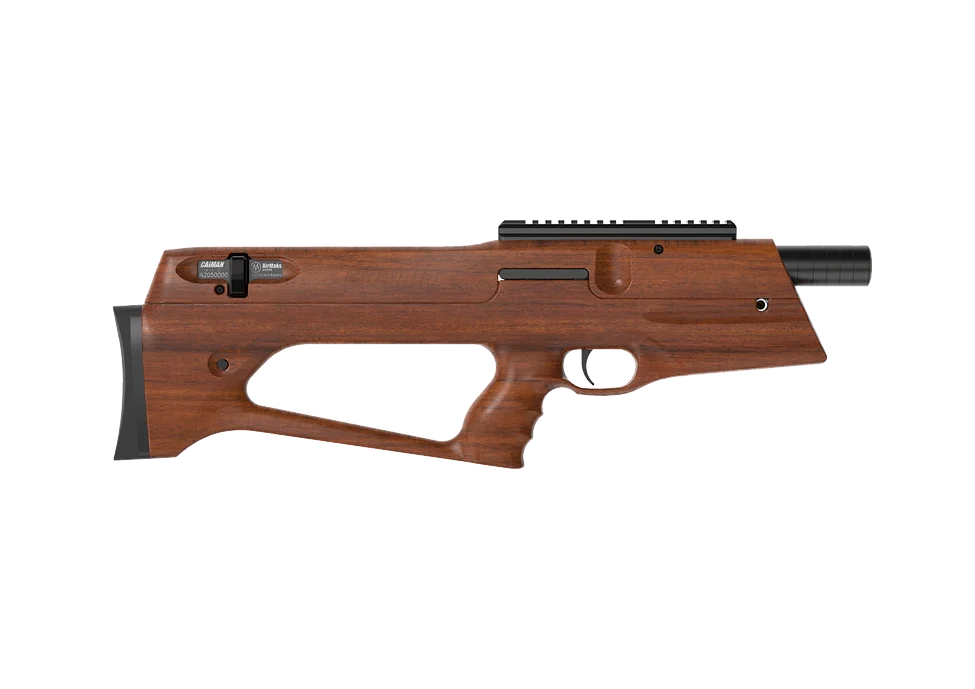
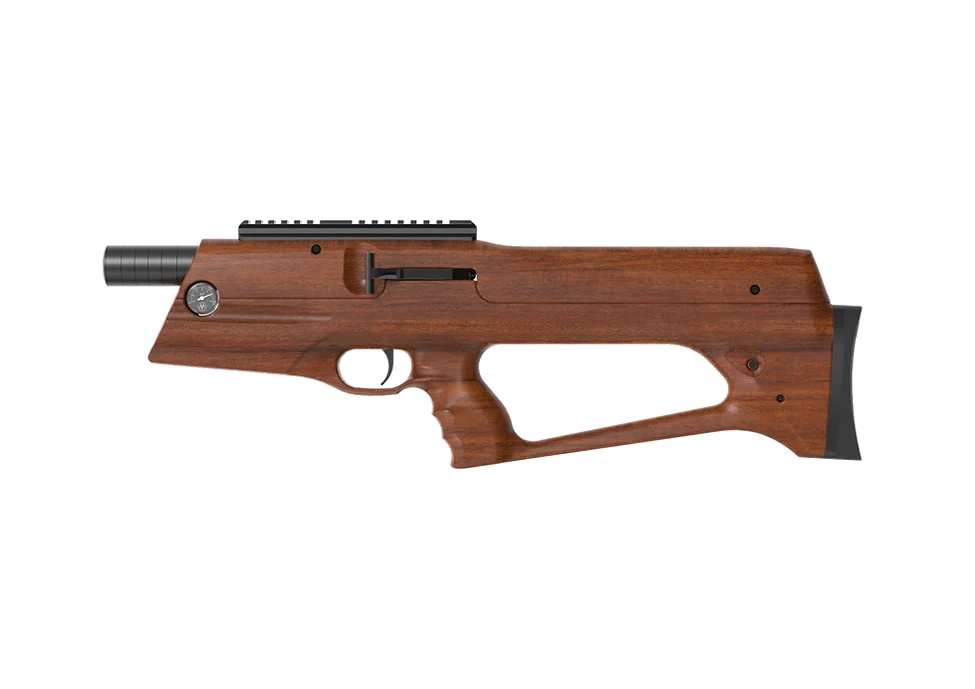
The AirMaks Arms CAiMAN Standard has been designed for shooters who value compact proportions, consistent performance, refined handling, and modern PCP engineering. With its distinctive bullpup-inspired layout, balanced construction, and carefully engineered pneumatic system, this air rifle delivers an impressive combination of accuracy and practicality.
Rather than relying on unnecessary size or weight, the platform has been developed around efficient use of space. Consequently, the rifle remains manageable in confined shooting positions while still providing the stability expected from a precision-oriented PCP system. Its compact architecture also makes transportation, storage, and range handling considerably easier.
Furthermore, the AirMaks Arms CAiMAN Standard combines premium machining with an ergonomic shooting position. Every major component has been arranged to create a comfortable relationship between the shooter, trigger, grip, cheekpiece, and barrel.
Why Choose the AirMaks Arms CAiMAN Standard?
Performance has been placed at the centre of the rifle’s design. AirMaks Arms has developed the CAiMAN platform to offer the controlled shot delivery, consistency, and mechanical refinement associated with modern pre-charged pneumatic rifles.
At the same time, versatility has been retained. The compact configuration can be appreciated by recreational shooters, target enthusiasts, and experienced PCP users who prefer a manoeuvrable rifle without sacrificing stability.
A streamlined exterior also contributes to the rifle’s appeal. Instead of excessive accessories or bulky furniture, a functional design philosophy has been followed. As a result, the rifle presents a clean and professional appearance while keeping important controls within practical reach.
Product Highlights
- Compact PCP configuration designed for excellent manoeuvrability
- Precision-engineered barrel system for dependable shot placement
- Regulated pneumatic action designed to support consistent velocity
- Ergonomic bullpup-style layout for improved overall balance
- Adjustable trigger system for a more personalised shooting feel
- Multi-shot magazine operation for convenient target sessions
- Integrated pressure monitoring for easier air management
- Quality metal construction for durability and long-term reliability
- Optics-ready platform for fitting a suitable riflescope
- Modern AirMaks engineering with a strong focus on accuracy and efficiency
Compact Design with Serious Capability
Although relatively compact, the AirMaks Arms CAiMAN Standard has been engineered to provide the stability needed for deliberate shooting. Because the action is positioned farther rearward than on a conventional sporting rifle, barrel length can be retained without creating an unnecessarily long overall package.
Consequently, the rifle feels especially manageable when being carried or moved between shooting positions.
Balance is equally important. Weight has been distributed to help the rifle remain controlled when shouldered. Therefore, less effort may be required to maintain a stable position during longer target sessions.
The compact layout can also be particularly useful when bench space is limited. Likewise, shooters who appreciate shorter PCP rifles may find the CAiMAN format easier to handle than a traditional full-length platform.
Precision-Oriented PCP Engineering
Consistency plays a major role in practical air-rifle accuracy. For this reason, the pneumatic system of the AirMaks Arms CAiMAN Standard has been developed to provide controlled air delivery throughout an appropriate working pressure range.
Regulated Air Delivery
A regulated PCP action helps maintain more uniform pressure behind each shot. Accordingly, velocity variation can be reduced when the rifle is properly configured and suitable ammunition is used.
More predictable velocity contributes to repeatable trajectories. In turn, repeatability helps shooters concentrate on technique, wind conditions, aiming points, and trigger control rather than compensating for large differences between individual shots.
Efficient air use is another advantage. Because metering is carefully managed, the available compressed-air supply can be used more effectively.
Refined Trigger Control
Trigger quality can significantly influence practical precision. Therefore, the AirMaks Arms CAiMAN Standard incorporates an adjustable trigger system intended to provide a clean and controlled release.
Rather than forcing every user into one factory-defined setup, adjustment enables the shooting experience to be refined according to individual preferences and applicable manufacturer guidance.
A predictable trigger break can also reduce unwanted rifle movement immediately before pellet release. Consequently, groups can become more consistent when good shooting fundamentals are maintained.
Ergonomic Handling and Comfortable Shooting
Comfort has not been ignored in pursuit of compact dimensions. Instead, the CAiMAN’s architecture has been shaped around a natural shooting position.
The grip supports positive control, while the rear section helps position the rifle securely against the shoulder. Meanwhile, the cheek area provides an appropriate reference point for obtaining a repeatable sight picture.
Once optics have been correctly installed, the shooter can develop a consistent head position. This repeatability is especially valuable during target shooting because small changes in alignment can affect perceived point of aim.
Moreover, the rifle’s shorter profile can make transitions between supported shooting positions feel natural and controlled.
Multi-Shot Convenience
For shooters who enjoy longer range sessions, magazine-fed operation adds welcome convenience. Several pellets can be prepared before the shooting sequence begins, thereby reducing interruptions between shots.
The magazine arrangement is intended to complement the compact receiver layout without creating unnecessary bulk. Nevertheless, careful loading and correct pellet selection remain important for reliable operation.
Single-shot shooting techniques may still be preferred in certain precision disciplines. However, for general recreational use and repeated target practice, a multi-shot system provides an efficient and enjoyable experience.
Built for Optics
Modern PCP rifles are typically used with optical sights, and the AirMaks Arms CAiMAN Standard has been configured accordingly. A suitable mounting interface allows compatible optics to be installed according to the user’s preferred shooting application.
For example, a lighter optic can complement the rifle’s compact character. Conversely, higher-magnification equipment can be selected when precision target shooting is the main priority.
Proper eye relief, secure mounts, and correct alignment should always be considered during installation. Once the setup has been completed correctly, the rifle and optic can function as a cohesive shooting system.
Construction and Finish
Durability is supported through the use of quality materials and precision manufacturing. Metal components provide structural strength, while carefully finished external surfaces contribute to the premium character expected from AirMaks Arms.
Importantly, the design remains functional rather than purely decorative. Components have been shaped to minimise unnecessary bulk while supporting reliable everyday handling.
Routine maintenance should still be performed according to manufacturer recommendations. Keeping the rifle clean, protecting seals, monitoring operating pressure, and storing the system appropriately can help preserve dependable performance over time.
Who Is the AirMaks Arms CAiMAN Standard For?
The AirMaks Arms CAiMAN Standard can appeal to shooters looking for something more specialised than a conventional full-length PCP rifle.
Its compact design makes it particularly attractive to those who prioritise manoeuvrability. At the same time, its regulated pneumatic system, precision-focused construction, and adjustable controls provide the characteristics expected by experienced PCP enthusiasts.
Newer PCP users may also appreciate the straightforward operating concept once correct filling, handling, storage, and maintenance procedures have been learned.
A Strong Choice for Precision-Focused Shooters
Ultimately, the AirMaks Arms CAiMAN Standard brings compact dimensions and sophisticated PCP engineering together in a thoughtfully designed platform. Accuracy, efficient air management, ergonomic handling, and mechanical refinement have all been prioritised.
Whether it is being used for structured target sessions or general recreational shooting where lawful, the CAiMAN Standard provides a responsive and confidence-inspiring shooting experience.
For anyone searching for a premium compact PCP rifle with distinctive European engineering, practical adjustability, and a strong emphasis on repeatable performance, the AirMaks Arms CAiMAN Standard deserves serious consideration.
Its combination of manageable dimensions, precise construction, regulated operation, multi-shot convenience, and optics-ready versatility creates a well-rounded platform that can remain enjoyable through countless shooting sessions.
Calibres, FAC, Power & Accessories
The AirMaks Arms CAiMAN Standard has been developed to give shooters considerable flexibility when choosing calibre, power configuration, optics, and supporting equipment. Because different shooting applications place different demands on an air rifle, the platform is offered in several popular calibres while combining regulated PCP operation with a compact bullpup-style layout.
Its precision CZ barrel, regulator, external velocity adjustment system, adjustable trigger, Picatinny optics rail, and accessory mounting provisions also create a highly adaptable shooting platform.
Available Calibres
The CAiMAN Standard is commonly available in .177, .22, and .25 calibre, giving shooters three distinctly different ballistic options. Magazine capacity changes according to calibre, with approximately 12 shots in .177, 10 shots in .22, and 8 shots in .25.
.177 Calibre – 4.5 mm
The .177 version is an excellent choice for shooters who favour a relatively flat trajectory, economical pellet consumption, and precision-oriented target shooting.
Because .177 pellets are generally lighter than their larger-calibre equivalents, useful velocity can be achieved without requiring excessive muzzle energy. Consequently, trajectory management can become easier across typical air-rifle target distances.
Target shooters may particularly appreciate this characteristic because less elevation correction can be required when moving between different distances.
The 12-shot magazine capacity also provides the highest magazine capacity of the three standard calibre options.
.22 Calibre – 5.5 mm
For users wanting a balance between pellet weight, trajectory, energy retention, and air efficiency, .22 calibre offers an attractive middle ground.
Its heavier pellets generally retain more momentum than comparable .177 projectiles. Therefore, .22 remains one of the most widely selected PCP calibres for general recreational shooting and lawful pest-control applications where regulations permit.
The CAiMAN’s regulated air system complements this calibre particularly well because predictable air delivery can contribute to consistent velocities throughout the usable portion of the cylinder’s pressure range.
A 10-shot magazine is normally used with the .22 configuration.
.25 Calibre – 6.35 mm
Shooters who favour heavier projectiles may prefer the .25 calibre version.
A .25 pellet generally offers greater projectile mass and energy potential than .177 or .22 ammunition. However, heavier pellets can require more air to achieve a desired performance level, particularly in higher-output configurations.
Trajectory characteristics are also different. Consequently, range estimation, pellet selection, and optic setup become increasingly important.
The .25 version normally uses an 8-shot magazine.
Standard and FAC Power Configurations
Power specification is an especially important consideration when selecting any PCP rifle.
In markets such as the United Kingdom, the CAiMAN Standard is available in a sub-12 ft-lb configuration, with UK retailers listing versions around 11.5 ft-lb.
This configuration is designed around the applicable UK legal framework for non-FAC air rifles.
By comparison, an FAC configuration refers to a higher-powered specification that may require the appropriate firearm certificate or equivalent legal authorisation depending on jurisdiction.
Higher power should never be viewed simply as being automatically better. Instead, the correct configuration should be selected according to shooting purpose, calibre, preferred pellet, target distance, legal requirements, and air consumption.
Increasing output can also reduce the number of shots available from each fill because a larger quantity of compressed air is generally consumed during each firing cycle.
Regulated PCP Power Delivery
An important feature of the CAiMAN platform is its regulated pneumatic system.
Rather than allowing reservoir pressure to directly determine every shot’s performance, regulated air is supplied to the firing system more consistently. As a result, variations in pellet velocity can be reduced through much of the rifle’s optimal operating pressure range.
The Standard model uses an approximately 190 cc aluminium air cylinder with a maximum fill pressure of 200 bar according to current retailer specifications.
Air efficiency can consequently be impressive, particularly in lower-powered configurations.
External velocity regulation through the hammer-spring system is also listed among the platform’s features. However, adjustments should always remain within manufacturer specifications and local legal power restrictions.
Optics and Scope Accessories
A quality scope is one of the most useful additions to this rifle.
The CAiMAN uses a 20 MOA Picatinny-style optics rail, providing a secure mounting platform for compatible scope rings and optical sights.
Depending on intended use, shooters can select anything from a compact lightweight optic to a higher-magnification target scope.
Adjustable-objective or side-focus scopes can be particularly useful where precise focus and parallax management are important.
Scope rings should always match both the optic tube diameter and mounting rail.
Moderator Compatibility
The barrel is supplied with a 1/2-inch UNF thread, allowing a compatible moderator to be fitted where ownership and use are lawful.
A moderator can reduce muzzle report and create a more comfortable shooting environment, although legal restrictions vary considerably between jurisdictions.
Buyers should therefore confirm local requirements before purchasing or installing one.
Useful Accessories
A well-planned accessory setup can make the rifle considerably more practical without adding unnecessary weight.
Useful additions can include:
- Quality riflescope matched to the intended shooting distance
- Picatinny-compatible scope rings
- Suitable bipod or shooting rest
- Spare calibre-specific magazines
- PCP charging probe and fill equipment
- High-pressure hand pump, cylinder, or compatible compressor
- Pellet selection in the correct calibre
- Cleaning and maintenance equipment
- Protective padded rifle case
- Pressure-rated filling hose and fittings
- Compatible moderator where legally permitted
The rifle also features a UIT/T-rail for accessory mounting, while current listings show the platform supplied with a padded case and, depending on seller configuration, two magazines.
Choosing the Right Setup
Choosing between .177, .22, and .25 should ultimately depend on how the rifle will be used rather than simply selecting the largest calibre.
For precision target shooting and flatter trajectories, .177 can be particularly attractive. Meanwhile, .22 provides an excellent balance of pellet weight, efficiency, and versatility. For shooters operating within appropriate legal frameworks who prefer heavier projectiles, .25 provides another capable option.
Likewise, sub-12 and FAC configurations should be selected according to local regulations and genuine shooting requirements.
When the correct calibre, power level, optic, pellets, and accessories are brought together, the CAiMAN Standard becomes a highly adaptable PCP platform capable of delivering the refined shooting experience expected from a premium compact air rifle.
Always use and store air rifles responsibly and follow the laws, licensing requirements, power limits, and shooting regulations applicable in your location.
Western Airguns, Benjamin PCP Rifles and Big-Bore Airgun Guide
People searching for air guns near me or comparing air gun dealers near me increasingly look beyond conventional pellet rifles toward PCP platforms, compact bullpups, hunting configurations, and American-designed big-bore systems. Whether the search begins with airguns usa, air rifle dealers, air rifle online, or airguns online, understanding the major platforms, calibers, operating systems, and intended applications makes it easier to compare available models responsibly.
Western Airguns and Big-Bore PCP Platforms
Among modern PCP manufacturers, western airguns has attracted considerable attention for compact designs and larger-caliber platforms. Searches such as western air guns, western air gun, western rifles, western firearm, western firearms, and western arms are commonly associated with people researching the Western Airguns product family.
Popular models include the western rattler, western rattler air gun, and western rattler bullpup. Buyers researching larger calibers may also encounter the western rattler 357, 357 rattler, 357 air rifle, .35 cal air rifle, western rattler 45, and western big bore bushbuck 45. These searches generally relate to powerful PCP platforms designed around larger projectiles rather than conventional small-caliber recreational pellet rifles.
The term western rattler bullpup for sale is frequently used by shoppers comparing availability, while western rattler bullpup amazon may appear in searches from users attempting to determine whether the platform is offered through major marketplaces. Availability, shipping rules, age restrictions, and licensing requirements should always be verified for the buyer’s jurisdiction.
Another recognizable Western platform is the western mordax. Related searches include western mordax pcp, western airguns mordax, western mordax venom, mordax venom, mordax airgun, mordax air gun, and mordax air gun price. People using these phrases are generally researching specifications, configurations, pricing, and availability rather than a traditional spring-powered rifle.
The western sidewinder is another platform frequently associated with the brand. Search phrases include western sidewinder compact, sidewinder gun, sidewiner, sidewinder length, and even technical searches such as sidewinder k7a-00008 manual. Product dimensions, magazine systems, air-cylinder capacity, operating pressure, and manufacturer documentation should be checked against the exact version because specifications can vary.
For customers researching very large-caliber Western models, bush buck and bushbuck air rifle price are common search phrases. Big-bore platforms are sometimes described broadly as a big bore pellet gun, big air rifle, big game airgun, or big game air guns. Their intended use, permissible energy level, and legal hunting applications vary significantly between regions.
Bullpup and PCP Air Rifle Technology
A bullpup air rifle places much of the action behind the trigger, allowing a comparatively long barrel to be packaged into a shorter overall platform. This layout has become particularly popular with pcp guns, pcp rifle, and pcp air rifles because compressed-air cylinders and magazines can be incorporated into relatively compact designs.
A compressed air rifle stores high-pressure air and releases a controlled amount during each shot. This system differs substantially from a break barrel pellet gun, where the barrel is typically used to cock a spring or gas-ram mechanism.
People researching an accurate pellet rifle or long range air rifle often compare regulator performance, barrel quality, projectile consistency, trigger characteristics, stock fit, shot count, and optics compatibility. Accuracy depends on the complete system rather than power alone.
Some shoppers also search for a semi automatic pellet gun or full auto air gun. These terms describe different cycling mechanisms and should not be treated as interchangeable. Regulations governing semi-automatic or fully automatic air-powered platforms may also differ from regulations covering manually cycled rifles.
Search phrases such as lethal air guns and steel penetrating full auto airgun sometimes appear online, but airguns should never be treated as toys or casually tested against unsafe targets. High-energy models can cause severe injury and should be used only with suitable backstops, eye protection, safe handling procedures, and full compliance with local law.
People also ask where do bullets land when shot in air. Projectiles fired upward eventually return toward the ground, and their landing point cannot be safely predicted. For that reason, an airgun or firearm should never be discharged vertically or in any direction without a verified safe impact area and backstop.
Other Western-Style and Specialty Airgun Searches
A number of additional terms appear alongside Western Airguns searches, including serpent arms, venom arms, desert scorpion pistol, atlas airguns, and lindstradt air gun. Similar searches may also include edgun west, edgunwest, and ed gun west, which are spelling variations commonly entered by people researching EDgun-related products and U.S. availability.
Search terms such as az air guns can relate to retailers, regional airgun communities, or businesses associated with Arizona. Because similar names can refer to different organizations, buyers should verify the manufacturer, retailer, warranty provider, and exact product before ordering.
A double barrel air gun or shotgun air rifle represents another specialized category that differs considerably from the typical single-barrel PCP rifle. Likewise, searches for a western arms shotgun may refer to products from a different manufacturer than Western Airguns, so model identification remains important.
Benjamin Air Rifles and PCP Platforms
Benjamin has a long history in the airgun market, which is why searches for a benjamin air rifle, benjamin air rifles, benjamin pellet gun, and benjamin pellet remain common among recreational shooters and hunters.
One of the best-known PCP families is the benjamin marauder. Search variations include benjamin marauder pcp and benjamin marauder air rifle. The Marauder platform is often researched by users comparing PCP rifles for target use, recreational shooting, and lawful pest-control applications.
Another widely searched model is the benjamin bulldog, a larger-caliber PCP platform. Queries such as benjamin bulldog 457 20 joules may refer to specific regional configurations, energy-restricted versions, or product information. Because power specifications can differ by market, purchasers should verify the manufacturer’s specifications and applicable regulations.
The benjamin prowler represents another area of interest for users comparing more traditional air-rifle configurations. Meanwhile, benjamin air rifle 22 break barrel is frequently searched by shoppers specifically looking for .22-caliber break-barrel designs.
Older or heavily used rifles may lead owners to search for benjamin air rifle repair. Seal condition, valves, pressure systems, triggers, barrels, stocks, and other components should be inspected or serviced according to manufacturer recommendations, particularly when dealing with high-pressure PCP equipment.
Airbows, Arrow Rifles and Alternative Air-Powered Platforms
Not every compressed-air hunting platform uses pellets. Searches for air bow, airbow, air bow rifle, arrow gun, benjamin airbow, and benjamin bow refer to systems designed to propel arrows using compressed air.
These products differ fundamentally from ordinary air pellet gun systems and should be selected according to their intended purpose and applicable local hunting regulations. Buyers should also confirm compatible arrows, pressure requirements, filling equipment, optics mounting options, and manufacturer-recommended accessories.
Air Pistols and Hunting-Oriented Searches
An air rifle and air pistol can serve very different roles depending on caliber, energy, operating system, and regional law. Searches such as hunting air pistol, air pistols for hunting, and co2 pellet guns often involve very different products.
CO2-powered models typically use replaceable carbon-dioxide cartridges, whereas PCP pistols rely on pre-charged compressed air. Local regulations determine whether either type can lawfully be used for hunting.
The term m357 can also appear when shoppers research revolver-style air pistols or products carrying similar model designations. Because this phrase can refer to multiple items, checking the manufacturer’s full model number is important before selecting accessories or replacement components.
Additional Airgun Types and Search Categories
The broader airgun market includes everything from a basic bb gun rifle and traditional spring-powered designs to sophisticated regulated PCP systems. Some buyers search for a pellet gun with silencer, although suppressor, moderator, and sound-reduction laws vary significantly between jurisdictions.
Others look for a hunting air rifle, big game air guns, or other high-powered platforms. The appropriate caliber and energy level depend on local law, target species where hunting is legal, shooting distance, projectile selection, and manufacturer recommendations.
A search such as air gun for semi truck may refer to an air-powered accessory, cleaning tool, pneumatic device, or another product entirely rather than an air rifle. Clarifying the intended equipment category is therefore important before purchasing anything based solely on that phrase.
Choosing Between Western, Benjamin and Other Airgun Platforms
Comparing products from western airguns, Benjamin, EDgun-related brands, and other PCP manufacturers requires more than comparing advertised power figures. Consider overall length, weight, caliber availability, magazine capacity, fill pressure, regulator design, shot count, trigger system, stock configuration, warranty coverage, parts availability, and manufacturer support.
A compact western sidewinder, larger western rattler, western mordax pcp, traditional benjamin marauder, big-bore benjamin bulldog, or another pcp air rifles platform may suit very different users and applications.
Responsible selection should therefore begin with the intended lawful use, followed by caliber, dimensions, power level, filling equipment, ammunition availability, service support, and local regulatory requirements. Whether someone begins their search with air guns near me, air gun dealers near me, air rifle dealers, or airguns online, careful comparison helps distinguish between recreational airguns, precision PCP rifles, hunting-oriented systems, specialty bullpups, and big-bore platforms.
Frequently Asked Questions
What type of air rifle is this model?
This model is a pre-charged pneumatic air rifle, commonly referred to as a PCP. Compressed air is stored inside the rifle and released in a controlled amount each time a shot is fired. Because no spring or gas ram needs to move during the firing cycle, recoil is extremely limited compared with many traditional air rifles.
As a result, PCP rifles are often chosen by shooters who value smooth operation, consistent performance, and excellent practical accuracy. The compact configuration also makes this rifle noticeably different from conventional full-length sporting designs.
Is this rifle regulated?
Yes, the platform uses a regulated pneumatic system. A regulator helps maintain a more consistent amount of pressure behind each shot as the main air reservoir gradually loses pressure.
This consistency can contribute to more uniform pellet velocity and, consequently, more predictable trajectories. Although environmental conditions, pellet selection, rifle setup, and shooter technique still influence performance, a regulator provides an important foundation for repeatable shooting.
It can also improve air efficiency by ensuring that only the necessary amount of compressed air is released during each firing cycle.
Is the rifle suitable for target shooting?
Yes. Its compact dimensions, stable construction, adjustable controls, and smooth PCP firing cycle make it particularly well suited to recreational and precision-oriented target shooting.
The lack of substantial recoil allows the shooter to concentrate on trigger control, sight alignment, breathing, and follow-through. Additionally, the rifle can be paired with a suitable riflescope to create a highly capable target setup.
Different shooting disciplines have different equipment requirements, so owners should always confirm that their particular configuration complies with any competition or club rules.
Is it suitable for beginners?
It can be suitable for shooters who are new to PCP rifles, provided they understand the additional equipment and maintenance associated with pre-charged pneumatic systems.
Unlike a spring-powered air rifle, a PCP requires an external source of compressed air. This may be provided by a suitable hand pump, compressor, or certified air cylinder, depending on the manufacturer’s filling specifications.
New users should also become familiar with safe charging pressures, correct magazine loading, storage procedures, and routine inspection. Once these fundamentals are understood, the rifle’s smooth firing behaviour can make it very enjoyable and straightforward to operate.
What makes the compact configuration useful?
The compact arrangement reduces overall rifle length without requiring an equally dramatic reduction in barrel length. This is achieved by positioning key parts of the action farther toward the rear.
Consequently, the rifle can be easier to manoeuvre around benches, shooting shelters, vehicles, and other confined environments where lawful use is permitted. Storage and transportation may also be easier than with a long conventional rifle.
However, compactness does not automatically mean that a rifle will feel light. Balance, total weight, optic selection, and accessory configuration should all be considered.
Does it come with a multi-shot magazine?
The rifle is designed around a magazine-fed operating system, allowing multiple pellets to be loaded before a shooting sequence begins.
This reduces the need to manually place a pellet into the action after every shot. Therefore, range sessions can become faster and more convenient.
Magazine capacity can vary according to calibre and configuration, so buyers should confirm the exact specification of the rifle being purchased. It is also important to use pellets that fit the magazine correctly and cycle smoothly.
Can a scope be fitted?
Yes. The rifle has been designed to accept an optical sight through its compatible mounting system.
A wide range of riflescopes can therefore be considered, depending on the intended application. Lower-magnification optics can provide a wider field of view, while higher-magnification scopes may be preferred for deliberate target shooting.
Buyers should confirm mounting dimensions before ordering rings or mounts. Proper eye relief, optic height, and cheek position are equally important because a poorly mounted scope can make an otherwise excellent rifle uncomfortable to use.
What calibre options are normally available?
Availability can depend on market and production configuration, but PCP rifles in this series are typically offered in popular airgun calibres.
Different calibres provide different characteristics in terms of pellet weight, trajectory, retained energy, air consumption, and magazine capacity.
A smaller calibre may provide a flatter trajectory at common target distances, while larger calibres can use heavier projectiles. However, power limits and permitted calibres can differ significantly between countries and licensing systems.
For this reason, buyers should always verify the exact calibre, power specification, and legal status of the rifle before purchasing.
How accurate is the rifle?
Practical accuracy depends on several interacting factors, including pellet quality, barrel condition, regulator consistency, optic setup, wind, shooting position, and individual technique.
The rifle is designed as a precision PCP platform, which means repeatability and controlled air delivery are important parts of its engineering.
For the best results, shooters should test several suitable pellet types rather than assuming that every pellet will perform identically. Even pellets of the same calibre can vary in shape, weight, skirt design, and barrel compatibility.
Once a preferred pellet is identified, consistency can improve considerably.
Does pellet choice really matter?
Yes. Pellet choice can make a significant difference in accuracy.
Every barrel has slight dimensional and manufacturing differences. Consequently, one pellet design may group exceptionally well while another produces noticeably wider groups.
Weight also matters because heavier and lighter pellets respond differently to air pressure, barrel twist, and external conditions.
Shooters should use high-quality ammunition in the correct calibre and test different options safely from a stable position. Keeping notes on group size and consistency can make it easier to identify the best-performing pellet for a particular rifle.
How is the rifle filled with air?
The air reservoir must be charged from a compatible high-pressure air source.
Depending on the equipment available, this can be done with a suitable PCP hand pump, high-pressure compressor, or certified compressed-air cylinder.
The correct filling adaptor must be used, and the pressure limits stated by the manufacturer must never be exceeded. Clean, dry air is also important because moisture and contamination can damage internal components over time.
When disconnecting the fill line, the system should be depressurised according to the instructions supplied with the filling equipment.
How many shots can be expected from one fill?
Shot count varies according to calibre, power level, regulator setup, reservoir pressure, pellet weight, and environmental conditions.
Lower-powered configurations will generally consume less air per shot than high-output configurations. Therefore, they can often provide more usable shots from a single fill.
Rather than focusing only on the total number of shots, shooters should consider the rifle’s usable regulated pressure range. Once pressure drops below the regulator’s ideal operating range, velocity consistency may begin to change.
Is the trigger adjustable?
The rifle incorporates an adjustable trigger system designed to help shooters achieve a comfortable and predictable firing feel.
Trigger adjustment can influence factors such as travel, break characteristics, and overall feel depending on the specific mechanism.
However, adjustments should be made carefully and only within the manufacturer’s recommended limits. Excessively light or incorrectly adjusted triggers can compromise safe operation.
After any adjustment, the rifle should be checked thoroughly before normal use.
Is it a loud air rifle?
Noise levels vary according to calibre, power output, pellet choice, barrel configuration, and local specification.
PCP rifles can produce a noticeable muzzle report, particularly in higher-powered configurations.
Where legally permitted, compatible sound-moderating equipment may reduce muzzle noise. Nevertheless, owners should first check local regulations because suppressors or moderators may be controlled differently from the air rifle itself.
Hearing protection can also be considered when shooting in enclosed or acoustically reflective environments.
Is the rifle suitable for hunting?
Whether an air rifle can legally and ethically be used for hunting depends entirely on local laws, quarry species, permitted energy levels, required licences, and the shooter’s ability.
Some jurisdictions allow air-rifle hunting under specific conditions, while others restrict or prohibit it.
Anyone considering lawful pest control or hunting should verify the regulations applicable to their area and ensure that the rifle has sufficient lawful performance for the intended application.
Accuracy, pellet selection, distance, and ethical shot placement are also critical considerations.
What maintenance does a PCP rifle require?
Routine maintenance is generally straightforward.
External metal surfaces should be kept clean and protected from corrosion, while the barrel can be cleaned when accuracy indicates that maintenance is required. Excessive cleaning is not always necessary.
Seals and filling components should also be inspected periodically for signs of wear or leakage.
Only lubricants approved for PCP systems should be used because incompatible oils can damage seals and may be unsafe around high-pressure air.
Professional servicing is recommended when internal regulator or valve work becomes necessary.
How should the rifle be stored?
The rifle should be stored unloaded, secured against unauthorised access, and protected from excessive moisture or temperature extremes.
A dry, stable environment helps reduce the risk of corrosion and protects seals, optics, and other accessories.
Local storage laws should always be followed, particularly where locked cabinets or separate ammunition storage are required.
The correct long-term air pressure should also be maintained according to manufacturer guidance rather than leaving the system overfilled.
Can accessories be fitted?
Yes. Depending on the exact configuration, a range of compatible accessories may be added.
Common additions include optics, scope mounts, bipods, carry cases, cleaning equipment, filling systems, spare magazines, and suitable shooting supports.
Accessories should be selected carefully so that they do not interfere with controls or create unnecessary weight.
Compatibility should always be confirmed before purchase because rail standards, thread sizes, and mounting dimensions can vary.
Is a hand pump enough to fill the rifle?
A high-quality PCP hand pump can be used where it meets the required pressure specification.
Hand pumps offer portability and do not require electricity. However, filling can require considerable effort, particularly when bringing a large reservoir up from a low pressure.
For frequent shooters, a compressor or certified cylinder may provide greater convenience.
Whichever method is used, the air source must be suitable for high-pressure PCP applications and should provide clean, dry air.
What should be checked before purchasing?
Several details should be confirmed before placing an order.
Buyers should check the calibre, power specification, legal classification, included magazine, filling adaptor, rail type, warranty coverage, and whether a case or other accessories are supplied.
It is also sensible to verify which charging system will be required.
Additionally, local airgun regulations should be reviewed before purchasing because licensing and energy restrictions vary significantly between jurisdictions.
Is this rifle a good long-term PCP platform?
For shooters who appreciate compact ergonomics, regulated performance, precise construction, and adjustable features, it can provide a strong long-term platform.
Its modern PCP architecture allows different optics and accessories to be selected according to changing preferences.
Regular servicing, correct air management, careful storage, and suitable pellet selection can help preserve performance over many shooting sessions.airrifle
Ultimately, the best results come from combining quality equipment with consistent shooting technique, appropriate maintenance, and responsible use.
What makes this model different from a conventional full-length PCP?
The most noticeable difference is the compact architecture.
A traditional rifle generally places the action in front of the shooter’s face and uses a longer stock behind it. By comparison, this configuration moves much of the action farther rearward.
That design approach reduces overall length while retaining a practical barrel and pneumatic system.
As a result, the rifle offers a distinctive combination of manoeuvrability, mechanical sophistication, and precision-focused handling that appeals to shooters who prefer a compact modern PCP rather than a traditional sporting layout.
Is it suitable for regular range use?
Yes. The regulated action, magazine system, adjustable trigger, compact balance, and optics compatibility make the rifle especially appealing for repeated recreational range sessions.
Shooters can concentrate on building consistency, testing different pellets, improving trigger technique, and refining their optic setup.
As with any high-pressure air rifle, safe handling, correct filling procedures, and responsible storage should remain part of every shooting routine.
Used correctly and maintained according to manufacturer recommendations, the rifle can provide a highly refined and enjoyable PCP shooting experience.american made air rifles




Reviews
There are no reviews yet.