Air Arms S410 Rifle Walnut Stock – Classic British Engineering, Outstanding Accuracy, and Premium PCP Performance
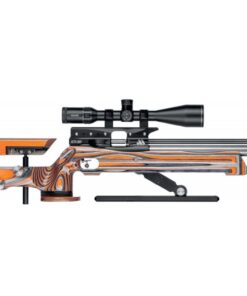
The Air Arms S410 Rifle Walnut Stock combines timeless British craftsmanship, impressive shooting consistency, and refined sporting elegance in one exceptionally balanced pre-charged pneumatic (PCP) air rifle. Developed for enthusiasts who appreciate mechanical reliability, comfortable handling, and traditional aesthetics, this distinguished model continues to hold a respected position within the premium airgun market.
Designed around Air Arms’ proven multi-shot platform, the rifle brings together a beautifully finished walnut stock, a precision-engineered barrel, and a dependable bolt-action mechanism. Furthermore, its practical construction supports enjoyable target sessions, recreational shooting, and responsible field applications wherever permitted by law.
Unlike purely contemporary designs, this classic sporting rifle maintains an unmistakable traditional character. Nevertheless, modern manufacturing standards, carefully developed components, and thoughtful ergonomics contribute to its lasting appeal.
Whether you are an experienced enthusiast, a sporting club member, or someone exploring premium PCP equipment, the S410 offers an appealing combination of functionality, appearance, and proven engineering.
Key Features and Highlights of the Air Arms S410 Rifle Walnut Stock
-
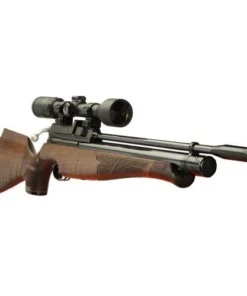
Premium Walnut Stock: Beautiful natural wood grain, a traditional sporting profile, and a comfortable finish.
-
Precision Lothar Walther Barrel: Quality barrel engineering supports consistent pellet performance and repeatable accuracy.
-
10-Shot Rotary Magazine: A convenient multi-shot system reduces interruptions during recreational shooting sessions.
-
Smooth Bolt-Action Mechanism: A dependable mechanical action provides controlled, straightforward operation.
-
Pre-Charged Pneumatic Technology: Compressed-air operation eliminates the need for a spring-piston cocking system.
-
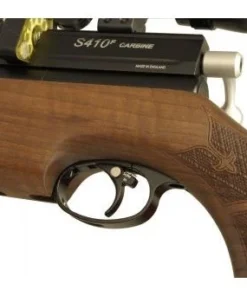
Adjustable Two-Stage Trigger: Allows individual adjustment within the manufacturer’s specifications.
-
Integrated Pressure Gauge: Provides convenient monitoring of the rifle’s remaining air pressure.
-
Available Calibres: Common configurations include .177 (4.5 mm) and .22 (5.5 mm).
-
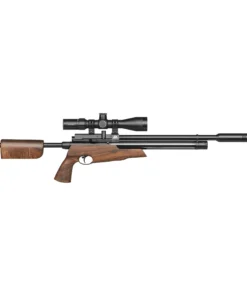
Full-Length Rifle Configuration: Offers traditional proportions and a balanced sporting profile.
-
Unregulated Air System: A straightforward design emphasizes established engineering and practical reliability.
-
Scope-Mounting Compatibility: An integrated dovetail rail accommodates compatible optical equipment.
-
British Engineering Heritage: Developed by a respected manufacturer with decades of airgun expertise.
Product specifications and included accessories should always be confirmed against the exact model and retailer listing.
Premium Walnut Stock Design and Traditional Sporting Elegance
Natural Wood Grain and Distinguished Appearance
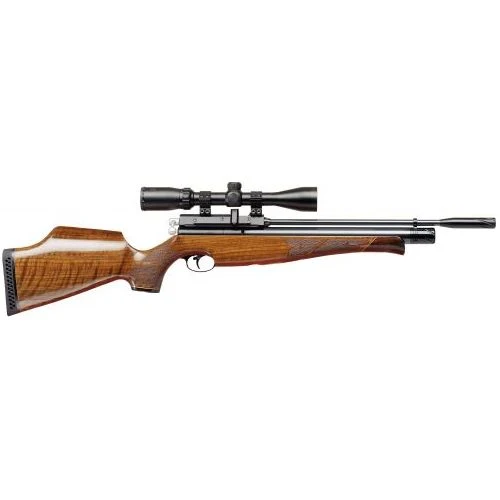
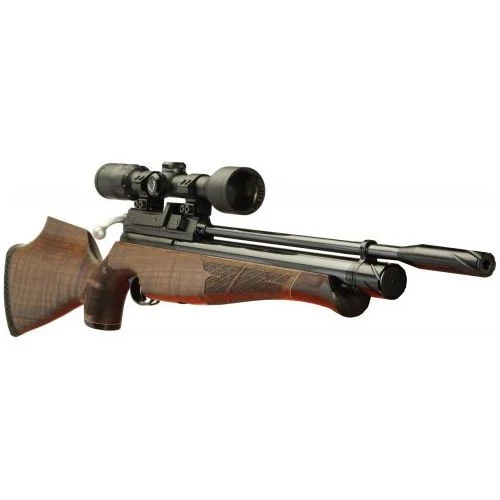
One of the defining characteristics of the Air Arms S410 Rifle Walnut Stock is its attractive hardwood construction. Walnut has long been appreciated in sporting equipment because of its distinctive grain patterns, natural warmth, and enduring visual character.
Each stock displays individual variations in colour and grain, giving the rifle a distinctive appearance. Additionally, the wood complements the metal action and barrel assembly, creating a traditional sporting profile that remains appealing across generations.
Beyond aesthetics, the shaped stock contributes to a comfortable shooting experience. Its contours provide familiar contact points, while the overall design encourages a stable, natural hold.
For enthusiasts who appreciate traditional sporting equipment, the combination of polished engineering and genuine walnut creates an especially appealing presentation.
Ergonomic Comfort and Balanced Handling
A well-designed stock should offer more than visual appeal. Equally important, its dimensions and contours should support comfortable positioning during extended recreational sessions.
The S410 features a conventional sporting configuration that offers a familiar feel to many air rifle enthusiasts. Its full-length proportions contribute to a measured, stable handling experience.
Furthermore, the cheekpiece and grip geometry are intended to work comfortably with suitable optical sights. Individual fit will naturally depend on the shooter’s build, chosen scope, and shooting position.
As a result, the walnut-stocked S410 offers a compelling balance of sporting tradition and everyday practicality.
Precision Engineering and Consistent PCP Performance
Lothar Walther Barrel Quality
At the centre of the rifle’s precision-focused design sits its Lothar Walther barrel. Recognized throughout the airgun industry, this barrel manufacturer has established a reputation for producing carefully engineered rifled barrels.
Air Arms incorporates this component into the S410 platform to support dependable accuracy and consistent pellet performance.
Moreover, the combination of a precision barrel and a stable PCP operating system provides a strong foundation for repeatable recreational target results.
Actual accuracy naturally varies according to pellet quality, environmental conditions, equipment condition, and individual shooting experience.
Nevertheless, the barrel represents an important reason why the S410 continues to attract attention from enthusiasts who value established mechanical quality.
Pre-Charged Pneumatic Air System
Unlike spring-powered air rifles, PCP equipment uses compressed air stored within a dedicated cylinder.
This approach removes the characteristic spring-piston movement associated with conventional spring rifles. Consequently, the shooting experience can feel smoother, with reduced mechanical disturbance.
The S410 uses an established, unregulated pneumatic system designed around reliable valve operation and practical simplicity.
Additionally, its built-in pressure gauge gives owners a convenient reference for monitoring stored air pressure.
The manufacturer recommends following the specific operating manual for all filling, inspection, and maintenance procedures. Approved equipment and appropriate compressed-air safety practices remain essential.
Reliable Bolt-Action Operation
A defining element of the S410 is its traditional bolt-action mechanism.
Rather than adopting a complex electronic operating system, the rifle relies on a straightforward mechanical design. This gives enthusiasts a familiar operating experience that complements its classic sporting appearance.
Its 10-shot rotary magazine also distinguishes the S410 from the single-shot S400 platform.
Furthermore, Air Arms developed the magazine system to work directly with the rifle’s action, maintaining the practical benefits of a multi-shot configuration.
Together, these features contribute to the S410’s longstanding reputation as a dependable sporting PCP rifle.
Adjustable Trigger and User-Friendly Features
Two-Stage Trigger for a Personalized Feel
Trigger characteristics are an important consideration when evaluating any precision-oriented sporting rifle.
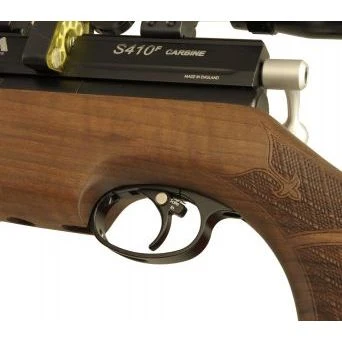
The S410 incorporates an adjustable two-stage trigger designed to offer a controlled and familiar feel.
Its two-stage arrangement separates initial movement from the final release point, an arrangement appreciated by many experienced target shooters.
Furthermore, manufacturer-approved adjustments allow the trigger characteristics to accommodate individual preferences.
For safety and reliability, adjustments should remain within the manufacturer’s specifications and be performed by a suitably qualified professional when necessary.
Integrated Pressure Monitoring
Convenience also forms an important part of the S410’s overall design.
The integrated manometer provides a visible indication of the compressed air remaining within the cylinder.
Because the air system forms a central part of PCP operation, accessible pressure information simplifies routine equipment checks.
Additionally, the gauge complements the rifle’s otherwise traditional appearance without requiring an external electronic display.
This practical feature reinforces the model’s emphasis on useful engineering rather than unnecessary complexity.
Calibre Options and Recreational Versatility
.177 Calibre for Target Shooting
The .177 calibre version appeals particularly to enthusiasts interested in recreational target shooting and precision-focused sporting activities.
Its smaller pellet diameter is commonly associated with comparatively flatter trajectories under equivalent conditions, although actual performance depends on pellet characteristics and the rifle’s specifications.
Moreover, .177 ammunition is widely available in a variety of target-oriented designs.
For club members and recreational participants, this configuration represents a familiar option within the PCP air rifle category.
.22 Calibre for Traditional Sporting Preferences
Alternatively, the .22 calibre configuration provides a larger pellet diameter and a different ballistic profile.
Many sporting enthusiasts appreciate this calibre for its traditional field-shooting associations and broad selection of commercially available ammunition.
However, neither calibre automatically guarantees superior accuracy or performance in every situation.
Local regulations, intended sporting activities, and manufacturer-approved ammunition specifications should guide any equipment selection.
Both configurations retain the core engineering qualities that define the S410 platform.
Built for Long-Term Enjoyment and Ownership
Established Air Arms Manufacturing Heritage
British manufacturer Air Arms has developed a strong reputation through decades of involvement in sporting airgun engineering.
Its S400 and S410 platforms became particularly recognizable because of their traditional appearance, practical operating systems, and precision-oriented construction.
Instead of depending entirely on dramatic styling changes, the company has refined established mechanical principles over time.
This approach appeals to enthusiasts who value reliability, maintenance support, and familiarity with proven equipment.
Furthermore, the availability of manufacturer documentation and appropriate servicing resources contributes to the rifle’s long-term ownership appeal.
Practical Maintenance and Responsible Care
Like other precision sporting equipment, the S410 benefits from appropriate maintenance and careful storage.
Keeping the external metalwork clean, protecting the walnut stock from excessive moisture, and following the manufacturer’s servicing schedule can help preserve its condition.
Similarly, compressed-air components should only be inspected or serviced according to approved procedures.
Professional attention is especially important when dealing with pressurized assemblies, seals, or internal mechanical issues.
With responsible care, owners can help maintain both the rifle’s attractive appearance and its intended operating condition.
Why Choose the Air Arms S410 Rifle Walnut Stock?
A Distinctive Combination of Tradition and Quality
The Air Arms S410 Rifle Walnut Stock remains noteworthy because it combines several desirable qualities without sacrificing its classic identity.
Its genuine walnut furniture provides elegance, while the bolt-action mechanism and rotary magazine represent an established approach to multi-shot PCP equipment.
Meanwhile, the Lothar Walther barrel, adjustable trigger, and full-length configuration demonstrate the manufacturer’s attention to sporting performance.
Unlike products designed primarily around futuristic appearances, the S410 embraces understated styling and recognizable British airgun heritage.
A Lasting Addition to a Sporting Collection
For enthusiasts comparing traditional PCP rifles, the S410 deserves consideration because of its proven platform, quality materials, and practical features.
Whether appreciated for recreational target sessions, responsible sporting activities, or its craftsmanship, this walnut-stocked model offers an enduring connection between traditional design and modern airgun technology.
Its appeal extends beyond technical specifications alone. The combination of natural wood, carefully manufactured metalwork, and established mechanical design creates a sporting rifle with a distinctive character.
Explore the Air Arms S410 Rifle Walnut Stock to discover its available calibre configurations, manufacturer specifications, and compatible equipment. Before purchasing, confirm the exact model, included accessories, and applicable ownership requirements with an authorized retailer.
Air Arms S410 Rifle Walnut Stock – Calibres, FAC Options, Power, Recommended Scopes, and Essential Accessories
The Air Arms S410 Rifle Walnut Stock offers an impressive combination of traditional British craftsmanship, dependable PCP technology, and versatile sporting performance. Available in two popular calibres, this premium air rifle appeals to enthusiasts who appreciate mechanical precision, comfortable handling, and elegant walnut furniture.
Furthermore, understanding its calibre configurations, power classifications, optical compatibility, and available accessories helps prospective owners identify the specification that best suits their sporting interests and local regulations.
Air Arms S410 Rifle Walnut Stock Calibre Options
.177 Calibre (4.5mm) – Precision and Target Shooting
The .177 calibre remains a popular choice among recreational target shooters and sporting enthusiasts. Its smaller pellet diameter and typically flatter trajectory make it a familiar option for precision-oriented disciplines.
Additionally, .177 pellets are widely available in different weights and profiles, providing considerable choice across established ammunition manufacturers.
Key characteristics of the .177 configuration include:
-
Smaller 4.5mm pellet diameter.
-
Popularity within recreational and competitive target disciplines.
-
Broad availability of sporting pellets.
-
Compatibility with the S410’s 10-shot rotary magazine in the correct calibre.
-
Precision-focused engineering supported by a Lothar Walther barrel.
Moreover, the .177 configuration retains the model’s traditional walnut stock, adjustable trigger, and convenient pressure gauge.
.22 Calibre (5.5mm) – Traditional Sporting Versatility
Alternatively, the .22 calibre appeals to enthusiasts who prefer a larger pellet diameter and traditional sporting characteristics.
Its heavier projectile options provide different ballistic properties compared with .177 ammunition. However, actual performance varies according to pellet design, rifle configuration, and operating conditions.
The .22 version maintains the same core mechanical architecture, making it another established option within the S410 family.
Notable characteristics include:
-
Larger 5.5mm pellet diameter.
-
Extensive selection of compatible sporting ammunition.
-
Traditional recreational and field-sporting associations.
-
Reliable rotary magazine design.
-
Premium walnut furniture and full-length rifle styling.
Ultimately, calibre selection should reflect the owner’s intended lawful sporting activities, available ammunition, and personal preferences.
FAC and Non-FAC Power Classifications
Standard Sub-12 ft-lb Configuration
In the UK market, the current Air Arms S410 range includes sub-12 ft-lb configurations designed around established air rifle power classifications.
These models have muzzle energy below 12 foot-pounds, approximately 16.3 joules.
For eligible adult owners in England and Wales, qualifying air rifles below the relevant legal threshold generally do not require a firearms certificate. However, Scotland has separate air weapon certification requirements, while Northern Ireland operates under different firearms legislation.
Consequently, buyers should always verify the applicable rules before purchasing or possessing an air rifle.
Air Arms identifies its current S410 Rifle variants as sub-12 ft-lb models.
FAC Versions and Higher-Power Classifications
Historically, Air Arms also manufactured higher-powered S410 variants, including models associated with the S410 Extra FAC series.
FAC stands for Firearms Certificate, a licensing classification relevant to certain firearms and higher-powered air rifles in the United Kingdom.
Unlike standard sub-12 ft-lb configurations, higher-powered variants may require specific firearm licensing, registration, and additional storage arrangements.
Furthermore, availability differs by country, production year, and individual model designation.
Prospective buyers should distinguish between historical FAC versions and the current manufacturer’s advertised product range rather than assuming every S410 has identical power options.
Importantly, changes to muzzle energy or internal pressure components should only be handled by authorized professionals in accordance with applicable law.
PCP Power System and Shooting Consistency
Dependable Compressed-Air Engineering
At the heart of the S410 sits a pre-charged pneumatic system that stores compressed air within an integrated cylinder.
Unlike conventional spring-powered alternatives, this technology operates without a large internal mainspring. As a result, the platform offers a distinct mechanical feel and reduced spring-related vibration.
The S410 uses an unregulated system, emphasizing straightforward construction and established mechanical reliability.
Additionally, its integrated pressure gauge helps owners monitor the cylinder’s remaining air pressure during routine inspections.
Air Capacity and Expected Shot Count
Shot capacity depends on the rifle’s calibre, configuration, condition, and operating pressure.
Air Arms provides approximate shot-count guidance for standard sub-12 ft-lb versions:
-
.177 calibre: Approximately 70–90 shots per fill.
-
.22 calibre: Approximately 60–80 shots per fill.
These figures serve as general expectations rather than guarantees. Actual performance can vary between individual rifles and production configurations.
Owners should always observe the filling pressure specified in their particular rifle’s handbook and use approved compressed-air equipment.
Recommended Scopes for the Air Arms S410 Rifle Walnut Stock
Optical Compatibility and Scope Selection
The Air Arms S410 incorporates a dovetail mounting interface suitable for compatible sporting rifle optics.
A quality scope can provide clear target observation, comfortable eye relief, and a practical viewing experience during authorized range activities.
For recreational target shooting, buyers may consider the following general optical categories:
-
3–9×40 sporting scope: A versatile, traditional option with moderate magnification.
-
4–12×40 adjustable-objective scope: Provides additional viewing flexibility for organized target disciplines.
-
Fixed 4× scope: Offers uncomplicated operation and a straightforward sight picture.
-
Variable-magnification target optic: Suitable for enthusiasts who prefer greater flexibility in visual observation.
When comparing optics, prioritize clear glass, robust construction, suitable eye relief, and manufacturer-confirmed mounting compatibility.
Furthermore, compatible 11mm dovetail mounts should be selected according to the scope manufacturer’s dimensional requirements.
The rifle generally does not include a scope unless the retailer specifically advertises an optical package.
Recommended Accessories and Equipment
Essential PCP Ownership Accessories
A carefully selected collection of maintenance and ownership accessories helps protect the rifle and preserve its condition.
Recommended accessories include:
-
Compatible 10-shot spare magazines: Manufacturer-approved replacements for the correct calibre.
-
Approved PCP filling equipment: Suitable charging equipment used according to manufacturer instructions.
-
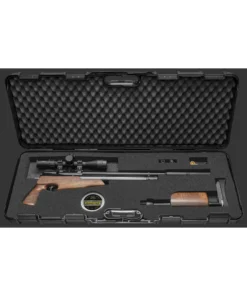
Protective rifle case: A padded case designed to protect the walnut stock and metal surfaces during lawful transport.
-
Lockable storage cabinet: Secure storage equipment appropriate to local legal requirements.
-
Walnut stock care products: Suitable maintenance products for preserving the wood finish.
-
Microfiber cleaning cloths: Gentle materials for routine exterior cleaning.
-
Manufacturer-approved maintenance kit: Appropriate supplies for basic preventive care.
-
Eye protection: Certified shooting glasses for supervised sporting activities.
-
Pressure-system inspection services: Qualified professional servicing for components requiring specialist attention.
Accessories That Complement the Walnut Finish
Beyond technical equipment, owners may appreciate accessories that match the S410’s traditional character.
For example, a quality padded carrying case provides useful protection, while suitable walnut-care products help maintain the stock’s natural appearance.
Similarly, protective lens covers and a dedicated optics cleaning kit can help preserve separately purchased sporting scopes.
Before adding any aftermarket component, verify its compatibility with the rifle’s particular production version and follow the manufacturer’s instructions.
Final Considerations
The Air Arms S410 Rifle Walnut Stock combines two established calibre choices, reliable PCP engineering, traditional walnut craftsmanship, and useful accessory compatibility.
Whether evaluating the .177 or .22 configuration, buyers benefit from understanding the difference between standard power classifications and historical FAC variants.
Furthermore, selecting suitable protective equipment, compatible optics, and manufacturer-approved accessories can contribute to a more convenient ownership experience.
With its precision-engineered barrel, 10-shot magazine, adjustable trigger, and distinguished walnut stock, the S410 remains a recognizable example of traditional British airgun craftsmanship.
Air Rifles, PCP Systems, Calibers, Target Shooting and Popular Models
The world of air arms, air guns, and precision shooting equipment covers everything from recreational target shooting to sporting applications. For newcomers asking what is an air gun, what is an air rifle, what is air rifle, what is a air rifle, what is a airgun, what is an airgun, or what are airguns, the basic principle is straightforward. An air gun uses compressed gas or air to propel a projectile rather than relying on the combustion system associated with conventional firearms.
Understanding how does an air gun work, how does air gun work, how do air guns work, how does an air rifle work, how does air rifle work, and how do air rifle work can help buyers distinguish between the different operating systems available. Depending on the design, power can be supplied by a spring piston, compressed air cylinder, CO2 cartridge, or another pneumatic mechanism.
PCP Air Rifles and Compressed-Air Systems
One of the most popular categories is the pre-charged pneumatic platform. Searches such as what is a pcp air rifle, what is a pcp airgun, what is pcp air rifle, what is a pcp air gun, what is a pcp rifle, what is pcp rifle, what are pcp air rifles, and what is a pre charged pneumatic air rifle all relate to the same fundamental technology. A PCP rifle stores compressed air inside a reservoir and releases a controlled quantity each time the rifle is fired.
For shoppers researching pcp gun meaning, pcp rifle meaning, or pcp air rifle meaning, PCP simply refers to a pre-charged pneumatic system. Air is normally added using a pcp hand pump, dive cylinder, or pcp air compressor. Consequently, an air compressed gun or air compressor rifle can deliver consistent performance without requiring the shooter to manually compress a spring before every shot.
Some searches also include pcp bb gun, although many PCP platforms are primarily designed around pellets rather than traditional BB ammunition. Understanding the intended ammunition is therefore important before selecting accessories, magazines, or loading equipment.
.177 Caliber, .22 Caliber and Pellet Selection
Caliber choice is one of the most frequently researched subjects among airgun buyers. The .177 caliber remains extremely popular for recreational shooting and precision target applications. Products described as a 177 air rifle, 177 bullet, or even 177 cal darts may appear during searches, although ammunition compatibility always needs to be checked against the manufacturer’s specifications.
Questions including 177 or 22, 177 cal vs 22, 177 caliber vs 22, .177 caliber vs .22, .177 pellet vs .22 pellet, and .22 vs .177 pellet generally focus on differences in projectile size, trajectory, energy, and intended use. A smaller .177 pellet is commonly chosen for paper targets and precision shooting, whereas larger calibers may be selected for applications where additional projectile mass is desired.
Understanding bb gun pellet sizes is equally important because BBs and pellets are not automatically interchangeable. Before purchasing ammunition, shooters should confirm the caliber and projectile type specified for their particular pellet rifle, pellet pistol, or bb gun.
Air Arms Rifles and Popular Models
Among established manufacturers, air arms products remain widely searched by enthusiasts interested in precision PCP and spring-powered platforms. Well-known searches include air arms s510, s510, air arms s410, aa s400, pro sport air arms, prosport air arms, tx 200, and tx200.
Variations such as air arm and airarm are also commonly entered by shoppers searching for the brand. Buyers looking specifically for regulated sporting configurations may encounter the air arms s510 ultimate sporter .177 sub 12, a phrase frequently associated with UK-oriented searches for the S510 platform.
Each Air Arms model has its own action, stock design, power configuration, caliber options, and intended shooting environment. Therefore, specifications should always be checked against the exact version being considered rather than assumed from another model in the same family.
FX Impact M3, FX Maverick and Modern PCP Platforms
Premium PCP research frequently includes the fx maverick and the fx impact m3. Buyers may also search for fx impact mk3, fx m3 airgun, fx m3, impact m3, or fx impact m3 air rifle while comparing generations and configurations.
More specific searches such as fx impact m3 .22cal air rifle. 600mm barrel focus on caliber and barrel-length combinations. Meanwhile, international shoppers may search fx impact m3 precio, fx impact m3 precio en usa, or fx impact m3 price when researching current market pricing.
Because FX platforms can be produced in multiple barrel lengths, calibers, power settings, and regional configurations, buyers should verify the exact specification offered in their country before ordering.
Break-Barrel Air Rifles
Another major category is the break barrel air rifle. Anyone asking what is a break barrel air rifle or what is a break barrel pellet gun is usually referring to a rifle in which the barrel is hinged downward to cock the internal powerplant and expose the breech for loading.
Break-barrel designs remain popular because they can provide a self-contained shooting system without an external compressor or air bottle. Models such as a gamo pellet gun are frequently encountered by buyers exploring this category.
Learning how to load pellet gun equipment properly is particularly important. Pellets should match the manufacturer’s recommended caliber and should be loaded in accordance with the owner’s manual while the rifle is pointed in a safe direction and handled under normal shooting-range safety procedures.
CO2, Pellet Pistols and Other Airgun Types
Not every airgun uses PCP or spring power. A co2 powered pellet rifle, for example, uses replaceable CO2 cartridges as its propellant source. CO2 systems can be found in rifles and handguns intended for recreational shooting, training, and target use.
People researching air pistol uses or general pellet gun uses will encounter equipment intended for target practice, recreational plinking, skills training, competition, and other lawful sporting activities. A pellet pistol can offer a compact platform, while rifles generally provide a longer sight radius and additional stability.
Search terms such as pelet guns are also common misspellings of pellet guns and can still represent useful search intent when website content is designed to answer frequently asked buyer questions naturally.
Target Shooting and Airgun Practice
One of the most established uses of airguns is target shooting with air rifles. Dedicated air guns for target shooting may emphasize accuracy, adjustable stocks, match triggers, regulated air delivery, and compatibility with precision optics.
Likewise, airgun target practice and airgun for target practice are common search topics among people looking for an accessible way to develop shooting fundamentals. Proper backstops, eye protection, safe handling practices, and suitable ranges should always be used.
The practical range of air rifle equipment varies considerably according to caliber, muzzle energy, projectile selection, environmental conditions, and the rifle itself. As a result, buyers should use manufacturer specifications and local range rules rather than assuming that every air rifle performs identically.
Hunting Air Rifles and Appropriate Use
Some shooters research air rifles for hunting, hunting air rifles, best air rifle for hunting, pellet gun for rabbits, or even the informal phrase rats gun when looking for equipment designed for lawful pest-control or hunting applications.
Suitability depends heavily on local law, caliber, projectile energy, quarry species, shot placement requirements, and humane hunting standards. Questions such as can a bb gun kill a fox should therefore not be treated simply as equipment-selection questions. Legal restrictions and animal-welfare requirements should be checked first, and low-powered BB guns are not appropriate substitutes for equipment legally and ethically suitable for a particular species.
Similarly, searches for air rifles for deer hunting and big game hunting with air rifle involve specialized legal and ballistic requirements. Large-bore systems such as a 72 caliber air rifle or products associated with bluegrass big bore illustrate how different big-bore pneumatic platforms can be from conventional small-caliber pellet rifles. Local hunting regulations must determine whether such equipment may legally be used.
Licensing and UK Airgun Regulations
Legal requirements differ considerably by jurisdiction. UK-oriented searches frequently include do you need a licence for air rifle, air rifle certificate uk, and 22 rifle uk license. However, the rules governing air rifles, conventional .22 firearms, certificates, age restrictions, possession, transportation, and power limits are not identical.
Consequently, buyers should confirm current legislation with the relevant licensing authority before purchasing or using any regulated equipment. Particular attention should also be paid to whether a rifle is configured below or above applicable power thresholds.
Sportsman, Gamo and Other Popular Searches
Beyond specialist PCP manufacturers, buyers may encounter products such as the sportsman 900 while comparing recreational air rifles. Searches for a gamo pellet gun are also common because Gamo offers numerous spring-powered and pneumatic models across different price points and configurations.
The broader search for best air guns can include everything from affordable recreational platforms to sophisticated regulated PCP rifles. Rather than treating one design as universally superior, buyers should compare caliber, intended application, weight, stock ergonomics, power source, shot capacity, charging equipment, availability of spare parts, and local legal requirements.
Airgun Safety, Home Use and Responsible Ownership
Searches for air guns for home defense do appear online, but an airgun should not automatically be assumed to be suitable for defensive use. Laws vary significantly, and airguns can cause serious injury. Secure storage, lawful ownership, training, safe handling, and avoidance of unnecessary confrontation remain essential.
Whether someone owns an air rifle, pellet rifle, bb gun, or PCP platform, the equipment should always be treated as capable of causing injury. A secure backstop should be used for recreational shooting, the muzzle should remain pointed in a safe direction, and manufacturer instructions should be followed carefully.
Ultimately, understanding the differences between PCP rifles, break-barrel systems, CO2 equipment, caliber choices, and individual models makes it easier to compare the extensive range of modern airguns. From Air Arms platforms to FX rifles and recreational pellet guns, careful specification checking, responsible handling, lawful use, and suitable ammunition selection remain central to getting the right equipment for the intended purpose.
Practical Use Scenarios – Real-World Applications, Sporting Performance, and Everyday Versatility
1. Recreational Target Shooting at an Outdoor Range
Recreational target shooting represents one of the most enjoyable applications for a precision-engineered pre-charged pneumatic platform. Whether participating in an organized club session or enjoying a supervised sporting event, enthusiasts can appreciate the combination of mechanical consistency, comfortable handling, and traditional design.
Furthermore, an outdoor shooting range provides a controlled environment where participants can develop confidence while following established safety procedures. Designated shooting lanes, appropriate backstops, and qualified supervision contribute to a responsible sporting experience.
The full-length stock provides a familiar profile, while the precision-manufactured barrel supports consistent performance under suitable conditions. Additionally, the two-stage trigger offers characteristics appreciated by target-shooting enthusiasts.
Unlike spring-powered alternatives, compressed-air operation eliminates the movement associated with a conventional mainspring. Consequently, the equipment provides a different shooting experience that many recreational participants find appealing.
For individuals who enjoy traditional sporting disciplines, this combination offers an engaging opportunity to appreciate precision engineering.
2. Indoor Shooting Clubs and Organized Training Facilities
Indoor shooting facilities offer another practical environment for responsible recreational participation.
Unlike outdoor ranges, indoor facilities generally provide controlled lighting, defined shooting distances, and designated target areas. As a result, participants can enjoy organized activities without the same exposure to changing outdoor weather conditions.
Moreover, qualified range officers can help reinforce appropriate safety practices and equipment handling requirements.
The traditional sporting configuration makes the platform recognizable to enthusiasts familiar with conventional air rifle designs. Its compact mechanical controls and clearly identifiable pressure gauge also contribute to straightforward equipment inspection.
However, facility operators may impose restrictions concerning muzzle energy, approved ammunition, and equipment categories.
Therefore, participants should confirm the facility’s policies before attending.
For newer enthusiasts, structured indoor sessions can offer an accessible introduction to precision-oriented sporting activities under suitable supervision.
3. Competitive Target Shooting and Club Activities
Organized sporting competitions bring together enthusiasts who appreciate consistency, discipline, and mechanical quality.
While different competitions maintain distinct equipment regulations, traditional pneumatic rifles may be permitted in selected recreational and club-level categories.
Furthermore, structured events provide opportunities to observe experienced participants, learn established range etiquette, and become familiar with formal sporting standards.
The combination of a quality barrel, traditional stock, and adjustable two-stage trigger supports the platform’s appeal among precision-minded enthusiasts.
Nevertheless, competition eligibility depends on the exact configuration and the governing body’s rules.
Some disciplines specify particular equipment types, dimensions, weight limits, or sighting arrangements.
Consequently, prospective competitors should review official event requirements before registering.
Participation can also create valuable opportunities for social interaction, shared learning, and a greater appreciation of precision engineering.
4. Recreational Shooting on Authorized Private Property
Private-property recreational shooting may be permitted in certain jurisdictions, provided the location and activity comply with applicable laws.
For example, some rural property owners maintain authorized shooting areas designed around appropriate containment, restricted access, and established safety requirements.
However, owning substantial outdoor space does not automatically make recreational shooting legal or safe.
Local discharge restrictions, neighboring properties, public access, and environmental considerations must all be evaluated.
Furthermore, suitable projectile containment and a properly designed shooting area remain essential.
Where necessary, owners should consult local authorities or qualified range professionals before conducting any activity.
The traditional pneumatic platform may appeal to enthusiasts who have legitimate access to properly approved private sporting facilities.
Nevertheless, professional supervision and compliance with local regulations should always take priority over convenience.
5. Appreciating Traditional British Sporting Craftsmanship
Not every ownership experience needs to revolve around active shooting.
For many enthusiasts, traditional sporting equipment represents an opportunity to appreciate craftsmanship, manufacturing heritage, and mechanical design.
The naturally patterned hardwood furniture provides a distinctive aesthetic that differs considerably from modern synthetic configurations.
Additionally, the metal components showcase a conventional mechanical layout developed around established engineering principles.
Owners may enjoy examining the exterior craftsmanship, studying the manufacturer’s history, or comparing design characteristics with other traditional sporting models.
Furthermore, carefully maintained examples can become meaningful additions to collections focused on British sporting equipment.
Appropriate display arrangements must still prevent unauthorized access and comply with relevant storage requirements.
For collectors, the combination of recognizable design and mechanical heritage provides lasting appeal beyond ordinary recreational use.
6. Demonstrations at Sporting Clubs and Equipment Exhibitions
Sporting clubs occasionally organize equipment demonstrations, educational exhibitions, and supervised introduction days.
Such events allow enthusiasts to become familiar with different manufacturing approaches and historical design developments.
For example, instructors may explain the distinctions between compressed-air systems, spring mechanisms, and other approved sporting technologies.
Additionally, attendees can observe differences in stock materials, manufacturing finishes, magazine configurations, and external controls.
A traditional walnut-furnished pneumatic design provides a useful illustration of how classic aesthetics can coexist with modern production techniques.
However, any functional demonstration must comply with venue rules and relevant safety procedures.
When presented responsibly, sporting exhibitions promote informed ownership, technical understanding, and appreciation for established manufacturing traditions.
7. Shooting Activities in Changing Outdoor Weather Conditions
Outdoor sporting activities frequently involve changing environmental conditions.
For instance, temperature variations, shifting light, and occasional wind can influence the overall experience at an approved shooting facility.
A traditionally finished hardwood stock offers an attractive appearance, but natural materials require appropriate protection from excessive moisture.
Furthermore, exposed metal surfaces benefit from routine exterior inspection and suitable corrosion prevention.
When conditions become unfavorable, participants should follow range guidance and suspend activities whenever safety may be compromised.
The integrated pressure gauge also provides useful information during routine pre-activity equipment checks.
After returning indoors, owners should follow manufacturer-approved care procedures to preserve the exterior finish.
Consequently, responsible outdoor ownership involves not only sporting enjoyment but also careful equipment preservation.
8. Supervised Introduction Sessions for New Enthusiasts
For someone unfamiliar with pre-charged pneumatic equipment, an organized introductory session provides valuable opportunities for learning.
Qualified instructors can explain basic safety responsibilities, legal considerations, and the importance of secure storage.
Additionally, newcomers may become familiar with equipment terminology and understand the differences between pneumatic and traditional spring-powered systems.
The conventional stock profile and mechanical controls offer recognizable design features that instructors can discuss during supervised demonstrations.
Nevertheless, a beginner’s suitability for any particular equipment depends on physical fit, age restrictions, applicable laws, and professional assessment.
No single sporting platform is automatically appropriate for every new participant.
Instead, instruction should emphasize responsible decision-making, respect for range rules, and safe ownership practices.
These experiences can help newcomers develop an informed understanding of recreational shooting culture.
9. Comparison Sessions at Authorized Sporting Retailers
Choosing premium sporting equipment often involves comparing several models before purchasing.
Authorized retailers may offer opportunities to inspect different stock configurations, evaluate exterior craftsmanship, and discuss manufacturer specifications.
For example, prospective owners might compare traditional hardwood furniture with lighter synthetic alternatives.
Furthermore, examining overall proportions can help individuals determine whether a full-length sporting profile feels comfortable.
Differences in weight distribution, stock contour, and grip dimensions may influence personal preferences.
Retail specialists can also clarify warranty arrangements, factory specifications, maintenance requirements, and regional legal classifications.
Where a retailer offers supervised evaluation facilities, all activities should remain subject to established safety procedures.
This purchasing scenario highlights the importance of firsthand evaluation rather than relying exclusively on photographs or promotional descriptions.
10. Long-Term Ownership and Routine Equipment Care
Maintaining sporting equipment over several years requires consistent attention to storage, external condition, and professional servicing.
Natural hardwood furniture deserves particular care because prolonged moisture exposure can affect its finish and appearance.
Similarly, metal components should receive suitable protection against corrosion.
For pneumatic equipment, the pressurized reservoir and associated mechanical assemblies require manufacturer-approved inspection procedures.
Furthermore, qualified servicing becomes important whenever unusual behavior, visible damage, or suspected component deterioration occurs.
Owners should avoid unauthorized internal alterations and rely on approved replacement parts.
Maintaining purchase records, service documentation, and manufacturer instructions can simplify future maintenance arrangements.
Through responsible care, enthusiasts can help preserve the equipment’s traditional appearance and intended mechanical condition for long-term enjoyment.
11. Educational Discussions About Pneumatic Engineering
Precision sporting equipment provides an interesting subject for educational discussions about mechanical engineering and manufacturing.
For instance, instructors may explain the general differences between compressed-air energy storage and conventional spring mechanisms.
Furthermore, discussions can cover manufacturing tolerances, material selection, exterior corrosion protection, and the importance of professional quality control.
The integration of hardwood furniture with machined metal components illustrates how traditional materials remain relevant in modern sporting products.
Likewise, an integrated pressure gauge demonstrates the practical importance of monitoring compressed-gas systems.
Such educational activities should remain focused on approved demonstrations and non-invasive observation.
Pressurized components should never be dismantled during informal learning sessions.
For technically curious enthusiasts, studying established sporting designs can encourage a broader appreciation of mechanical principles and responsible equipment ownership.
12. Participation in Community Sporting Events
Community sporting events offer opportunities for enthusiasts to connect with others who share an interest in traditional recreational shooting.
Local clubs may organize social gatherings, equipment exhibitions, introductory sessions, or friendly competitions.
Furthermore, experienced participants often share insights into equipment care, manufacturer history, and sporting regulations.
A well-maintained traditional model can attract interest because of its natural wood furniture and recognizable engineering.
However, event organizers determine which equipment configurations are permitted.
Owners should therefore confirm registration requirements, storage arrangements, and transportation rules before attending.
Beyond competitive activities, community events help promote responsible sporting culture and encourage respectful interaction between enthusiasts of different experience levels.
For many participants, the social and educational aspects are just as rewarding as the sporting activities themselves.


Reviews
There are no reviews yet.