Artemis P35 PCP Air Rifle
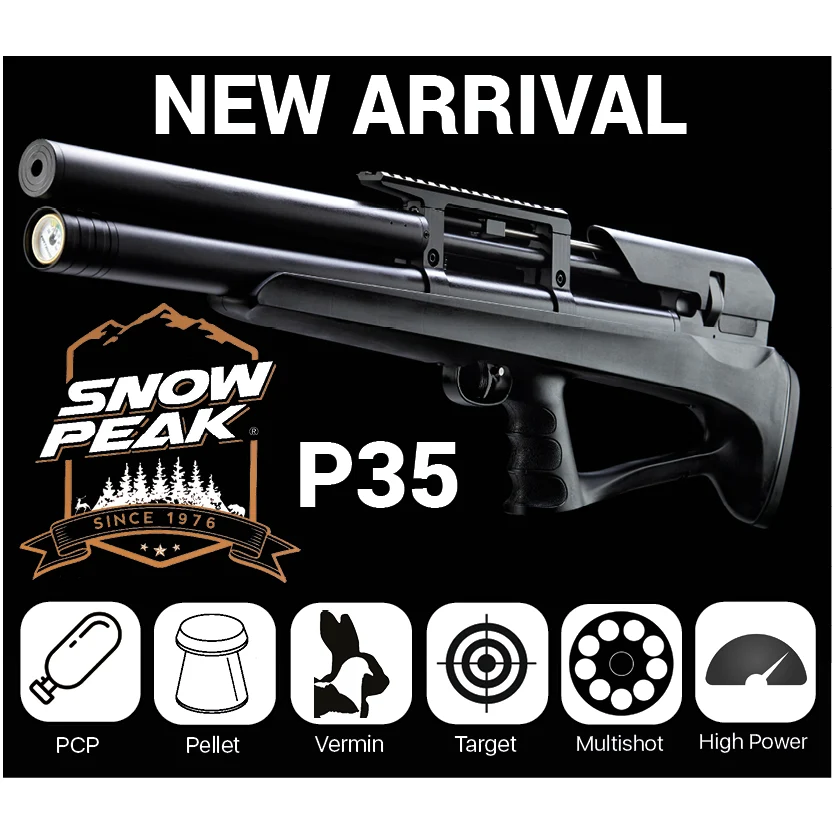
The Artemis P35 PCP Air Rifle has been designed around a compact bullpup platform in which portability, balanced handling, and consistent pneumatic performance are combined. Because a pre-charged pneumatic power system is used, smooth operation can be experienced without the recoil characteristics normally associated with traditional spring-powered air rifles. Moreover, a compact overall profile has been achieved without sacrificing the practical barrel length required for dependable pellet performance.
For shooters who value a lightweight and maneuverable platform, the Artemis P35 PCP Air Rifle can therefore be considered a practical combination of modern styling, convenient operation, and regulated PCP technology.
Compact Bullpup Design
A bullpup configuration has been incorporated into the Artemis P35 PCP Air Rifle, allowing the action to be positioned farther toward the rear of the stock. Consequently, a comparatively long barrel can be accommodated while the rifle’s overall dimensions are kept compact.
An overall length of approximately 675 mm and a weight of around 2.4 kg are quoted for commonly sold versions. A 450 mm barrel is also listed for several configurations.
Because much of the rifle’s mass has been centralized, a manageable shooting position can be maintained. Furthermore, fatigue during longer recreational shooting sessions may be reduced when compared with substantially heavier full-length platforms.
The synthetic thumbhole stock has also been designed for ambidextrous use. Therefore, comfortable handling can be achieved by both right- and left-handed shooters. A rubber buttpad has additionally been fitted on commonly listed configurations so that shoulder contact can be made more comfortably.
Regulated PCP Performance
A regulated PCP system has been incorporated into many Artemis/Snowpeak P35 variants. Through regulation, air pressure delivered to the firing system can be managed more consistently as the cylinder pressure gradually decreases.
As a result, improved shot-to-shot consistency can be supported throughout the useful portion of an air fill. This characteristic can be particularly valuable when repeatable point-of-impact performance is desired for target shooting.
A 265 cc air cylinder has commonly been fitted to the P35 platform. However, maximum filling-pressure specifications have been reported differently by various retailers and markets, with listings ranging from approximately 200 bar to 250 or 300 bar depending on the particular version. Therefore, the pressure stated on the rifle, manufacturer documentation, or supplied manual should always be followed rather than a generic online specification.
Smooth Side-Lever Operation
A side-lever cocking system has been provided so that the action can be cycled conveniently between shots. On the P35, the lever has been positioned near the center of the rifle, above and around the pistol-grip area.
Because the cocking mechanism has been brought closer to the shooter, unnecessary hand movement can be reduced. Accordingly, a stable shooting position can be maintained more easily between shots.
Multi-shot rotary magazines are supplied or supported on common configurations, while magazine capacity is determined by calibre. Published examples include approximately 11 rounds in 4.5 mm/.177, 9 rounds in 5.5 mm/.22, and 8 rounds in 6.35 mm/.25 configurations.
Key Product Highlights
- PCP power system for smooth pneumatic operation
- Regulated configuration on commonly available P35 models
- Compact bullpup layout for improved maneuverability
- 265 cc air cylinder on widely listed versions
- Side-lever cocking mechanism for convenient cycling
- Multi-shot rotary magazine system
- Ambidextrous synthetic thumbhole stock
- Rubber buttpad for improved shoulder comfort
- Manual safety system
- Optics mounting rail on common configurations
- Shrouded or moderated barrel arrangement, depending on market specification
- Approximately 2.4 kg weight on commonly published versions
- Approximately 675 mm overall length
- Approximately 450 mm barrel on several currently listed versions
Optics-Ready Configuration
Traditional open sights are not provided on many P35 models. Instead, an optics rail has been incorporated so that an appropriate sighting system can be mounted.
Consequently, the rifle can be configured according to its intended sporting application and the regulations applicable in the user’s jurisdiction. Picatinny rails are listed on several versions, although rail specification may vary between production runs and regional models.
Because an optic can be selected separately, the sighting arrangement can be tailored more closely to recreational target shooting, range practice, or other lawful sporting applications.
Adjustable Trigger and Manual Safety
A two-stage adjustable metal trigger has been reported for several current P35 configurations. Through this arrangement, a more controlled trigger feel can be provided than would normally be expected from a basic fixed-trigger design.
Furthermore, a manual cross-trigger safety has been incorporated into common versions. The safety is intended to provide an additional mechanical safeguard, although normal safe-handling practices must always be followed regardless of whether the safety has been engaged.
Lightweight Synthetic Construction
Durability and low overall mass have been prioritized through the use of a synthetic stock. Because the material is less vulnerable to ordinary moisture-related dimensional changes than unfinished natural timber, maintenance can also be simplified.
Meanwhile, the thumbhole layout provides a defined gripping position. The cheekpiece and butt area have been shaped around the compact bullpup architecture so that the rifle can be shouldered naturally despite its shortened overall dimensions.
As a result, the Artemis P35 can be particularly appealing where a compact sporting air rifle is preferred over a conventional full-length PCP platform.
Available Calibres
Depending on the country and distributor, the Artemis P35 PCP Air Rifle has been offered in several common pellet calibres, including:
- .177 / 4.5 mm
- .22 / 5.5 mm
- .25 / 6.35 mm
Calibre availability, muzzle energy, velocity, magazine capacity, pressure settings, and legal classification can vary considerably by market. For example, one current European listing specifies approximately 21 J for a 4.5 mm version, another lists approximately 34 J for a 5.5 mm version, while a 6.35 mm example is listed at approximately 46 J. These figures should therefore be treated as configuration-specific rather than universal P35 specifications.
Why Choose the Artemis P35 PCP Air Rifle?
The P35 has been engineered around simplicity and compactness. Instead of unnecessary bulk being added, the action, air reservoir, stock, magazine system, and barrel have been packaged into a short bullpup format.
Moreover, regulated pneumatic operation has been combined with a conveniently positioned side lever. Therefore, a modern handling experience can be provided while the mechanical layout remains relatively straightforward.
Because the stock has been designed for ambidextrous use, the rifle is also accessible to a wider range of shooters. Meanwhile, its relatively low weight can make transportation and handling easier.
For lawful recreational target shooting and sporting use, the Artemis P35 PCP Air Rifle can therefore be viewed as a compact PCP platform in which portability, multi-shot convenience, regulated operation, and contemporary ergonomics have been brought together.
Artemis P35 PCP Air Rifle Specification Summary
Powerplant: Pre-Charged Pneumatic (PCP)
Configuration: Bullpup
Action: Side lever
Regulator: Fitted on commonly listed versions
Air Capacity: Approximately 265 cc
Stock: Synthetic, ambidextrous
Overall Length: Approximately 675 mm
Barrel Length: Approximately 450 mm on commonly listed models
Weight: Approximately 2.4 kg
Calibres: .177 / 4.5 mm, .22 / 5.5 mm and .25 / 6.35 mm, depending on market
Magazine: Multi-shot rotary design; capacity varies by calibre
Safety: Manual
Optics: Rail provided; exact rail type may vary by version
Because specifications can differ between production batches, calibres, and national-market versions, the specification supplied with the individual rifle should be treated as authoritative.
Brocock BRK and Benjamin Air Rifles: Complete Guide to PCP Technology, Precision, Calibres and Accessories
Discover the Engineering Behind Brocock Airguns and Benjamin Air Rifles
Modern airgun technology has transformed recreational target shooting, competitive marksmanship, and precision air-powered sporting equipment. Today, manufacturers combine advanced pneumatic systems, ergonomic construction, and innovative engineering to produce dependable shooting platforms. Among the established names in this industry, brocock ltd and Benjamin continue to attract attention from enthusiasts seeking technical sophistication and reliable performance.
The evolution of brocock airguns reflects a strong emphasis on compact designs, efficient compressed-air systems, and consistent shot delivery. Similarly, the Benjamin product range offers numerous configurations, from traditional pellet rifles to specialized pneumatic platforms.
Whether researching a compressed air rifle, comparing a conventional pellet gun, or exploring advanced sporting equipment, understanding the available technologies helps buyers make informed decisions.
Brocock BRK Air Rifles: Innovation and Precision Engineering
Brocock Sniper XR and BRK Sniper XR
The brocock sniper xr represents an important development in regulated pneumatic rifle engineering. Featuring a semi-bullpup configuration, adjustable ergonomics, and a sidelever operating system, this model emphasizes handling convenience and mechanical consistency.
Additionally, the brk sniper xr incorporates a regulated air-delivery system designed to reduce variations between successive shots. Its adjustable stock components provide flexibility for different shooting positions.
For enthusiasts researching the .25 caliber brocock sniper xr, calibre selection deserves particular attention. The larger pellet diameter offers different projectile characteristics compared with smaller calibres, while energy output and shot capacity depend on the specific configuration.
The sniper xr also offers an example of how modern engineering combines compact dimensions with adjustable controls.
Brocock Commander XR and BRK Commander
Another noteworthy platform is the brocock commander xr, which combines a tactical-inspired stock configuration with pneumatic engineering.
The brocock commander has attracted interest from enthusiasts who appreciate adjustable furniture, modular features, and consistent operation.
Similarly, buyers researching brk ghost and Commander models often compare ergonomics, overall dimensions, available calibres, and compatible accessories.
Searches for brocock commander xr price should be evaluated using current retailer listings because pricing varies according to country, configuration, condition, and included equipment.
BRK Ghost Air Rifle: Modern Design and Customization
The brk ghost air rifle represents a distinctive approach to modern PCP rifle design. Its bullpup layout places major operating components within a compact overall configuration while retaining a full-length barrel arrangement appropriate to the model.
Furthermore, the BRK Ghost offers adjustable ergonomic components and a mechanical design intended to support controlled operation.
Owners researching ghost accessories should pay attention to manufacturer compatibility, factory specifications, and approved replacement components.
A replacement ghost handle, for example, should be checked against the exact model and production variant before purchase.
Likewise, a magpul sl k buttpad is a product-specific accessory reference rather than a guarantee of compatibility with every rifle stock.
Pathfinder XR and Compact BRK Models
The pathfinder xr offers another example of the manufacturer’s emphasis on compact pneumatic platforms.
Buyers researching the brk pathfinder, brk pathfinder xr, or general pathfinder air rifle specifications should compare verified product dimensions, stock arrangements, and applicable power ratings.
The brk concept xr is another model worth examining when comparing compact sporting rifles.
While these designs share elements of the manufacturer’s engineering philosophy, each has its own configuration and intended handling characteristics.
For anyone comparing several platforms, factors such as overall weight, trigger characteristics, stock adjustment, and service support are more useful than appearance alone.
What Are PCP Air Rifles and How Do They Work?
New enthusiasts frequently ask, what are pcp air rifles?
The abbreviation PCP means precharged pneumatic, referring to an air-powered system that stores compressed air in a pressurized cylinder or reservoir.
Consequently, understanding pcp rifle meaning helps explain the operating principles behind modern pneumatic sporting rifles.
Other common searches include what does pcp mean in air rifles, what is pcp air rifle, what is a pcp air rifle, and what is a pre charged pneumatic air rifle.
All describe the same general operating technology.
Likewise, what is a pcp air gun and pcp air rifle meaning refer to compressed-air propulsion rather than spring-powered or carbon-dioxide systems.
A pcp rifle stores energy before firing, whereas a break barrel pellet gun typically compresses a spring or gas ram through a cocking action.
This distinction also explains why a pneumatic gun, gun pneumatic, and pneumatic weapons may refer to several different mechanisms, depending on the context.
Modern pcp air rifles often feature pressure regulators, adjustable triggers, and specialized magazines. Nevertheless, operating pressure, energy output, and maintenance requirements vary substantially between models.
Essential Accessories and Equipment Compatibility
Properly selected accessories contribute to equipment suitability and long-term maintenance.
For example, the 0db moderator and 0 db moderator are search variations referring to a sound-moderating accessory. Actual sound reduction depends on the individual device, rifle configuration, and applicable legal requirements.
Meanwhile, a pcp o ring kit may contain replacement seals for specified components. Seal dimensions, materials, and pressure ratings must match the manufacturer’s requirements.
Optics are another consideration. A buyer researching how to connect scope equipment should first confirm the mounting-rail standard and the compatibility of the selected mounting system.
The mtc copperhead 4 16×44 is one example of an optical sight that may appear in airgun accessory searches.
Separately, what does prc stand for in guns is a terminology question commonly encountered during broader firearm research. PRC often refers to Precision Rifle Cartridge, which is distinct from PCP pneumatic technology.
Some searches also include bro air, a broad term that may appear alongside BRK and Brocock product research without identifying a specific manufacturer model.
Benjamin Air Rifles: Traditional Performance and Modern Pneumatic Technology
Benjamin Marauder and Popular PCP Models
The benjamin air rifle range encompasses numerous designs developed for different shooting preferences. From conventional air pellet gun platforms to specialized pneumatic systems, the manufacturer offers equipment for recreational and sporting applications.
Among its recognized products, the benjamin marauder has established a strong presence in PCP airgun discussions.
The benjamin marauder pcp and benjamin marauder pcp air rifle are associated with regulated or unregulated configurations, depending on model and generation. Similarly, the benjamin marauder air rifle is frequently considered by enthusiasts researching accurate pneumatic equipment.
Buyers comparing the benjamin marauder .25, benjamin marauder 22, and benjamin marauder regulated variants should verify the exact specifications rather than assume identical performance.
The benjamin marauder pistol provides another distinct option for enthusiasts interested in compact air-powered platforms.
Additionally, searches for benjamin pellet, benjamin pellet gun, and benjamin air pistol reflect the manufacturer’s broader presence in the sporting airgun market.
For owners of older equipment, benjamin air rifle repair should involve model identification, manufacturer-approved parts, and qualified servicing of pressurized components.
Benjamin Bulldog and Big-Bore Airguns
The benjamin bulldog is associated with the development of larger-calibre PCP platforms.
In particular, the benjamin bulldog 457 belongs to the big-bore category, while the bulldog 357 represents another calibre designation within the family.
Those researching benjamin bulldog 457 20 joules should distinguish search terminology from verified factory specifications, since this phrase does not establish an official 20-joule configuration.
More broadly, big bore air guns differ from conventional small-calibre pellet rifles in projectile dimensions, pressure-system requirements, and applicable regulations.
A hunting air rifle or hunting pellet gun must also be evaluated according to local laws, permitted activities, and the manufacturer’s intended application.
Benjamin Trail, Prowler and Break-Barrel Models
Traditional spring and gas-piston airguns remain popular alongside pneumatic equipment.
The benjamin prowler and benjamin trail np are examples associated with conventional sporting air-rifle designs.
Likewise, the benjamin np trail xl and benjamin air rifle 22 break barrel appear frequently in searches involving gas-piston technology.
The phrase benjamin break may also describe general interest in the manufacturer’s break-barrel products.
Enthusiasts comparing a benjamin 22 caliber pellet rifle with PCP alternatives should consider the differences in cocking mechanism, maintenance, recoil behavior, and operating requirements.
Benjamin Airbow Technology and Arrow-Launching Systems
The benjamin airbow belongs to a specialized category that uses compressed air to propel compatible arrows rather than conventional pellets.
Also called an air bow, airbow, arrow gun, air bow rifle, or air bow gun, this equipment differs substantially from standard pellet platforms.
The benjamin pioneer airbow helped establish the manufacturer’s presence in this category.
More recent searches for benjamin airbow m600, benjamin m600 airbow, and the general benjamin bow category reflect interest in advanced arrow-launching technology.
An airbow rifle may also be compared with an air powered crossbow, although their propulsion mechanisms and equipment requirements are different.
The M600 is a distinct PCP-powered arrow launcher with manufacturer-specific arrows and components.
Understanding Pellet Gun Calibres and Power Ratings
Airgun buyers frequently compare .177 pellet guns, 177 pellet guns, a 22 pellet gun, and a .25 pcp air rifle.
Each calibre has its own projectile characteristics, compatible ammunition, and model-specific performance limits.
Similarly, searches for a high powered pellet gun, high power pellet gun, or pellet rifle 1500 fps should be assessed carefully. Advertised velocity alone does not establish accuracy, suitability, or energy output.
A bolt action pellet gun describes a particular loading or cycling arrangement rather than a specific power system.
Other familiar categories include the bb gun rifle, air gun rifle, airrifle, and the broader grouping of air rifle and air pistol equipment.
In comparison, co2 pellet guns use carbon dioxide cartridges, while PCP platforms rely on stored high-pressure air.
The search term m357 may refer to different products and requires model confirmation before any technical comparison.
Choosing the Right Airgun and Understanding Online Availability
Buyers asking can i buy air rifles online should first investigate local restrictions, age requirements, licensing obligations, and shipping regulations.
Rules vary significantly by jurisdiction, especially for higher-powered equipment and specialized arrow-launching platforms.
Whether comparing benjamin air rifles or modern BRK sporting platforms, reliable model specifications, lawful ownership, and qualified maintenance remain essential considerations.
The Brocock product family includes established Sniper XR, Commander XR, Pathfinder XR, Concept XR, and Ghost designs, while the manufacturer’s newer range includes updated XR2 variants.
Ultimately, selecting appropriate air-powered sporting equipment involves balancing ergonomics, engineering quality, compatible accessories, and long-term support. Understanding the distinctions between compressed-air systems, gas-piston mechanisms, and specialized arrow platforms makes product comparisons clearer and more informative.
A well-informed buying decision begins with accurate technical information, clearly identified models, and responsible equipment ownership.
Calibres, FAC Power, Scope and Recommended Accessories for the Artemis P35 PCP Air Rifle
The Artemis P35 PCP Air Rifle has been produced in several popular pellet calibres, allowing different versions to be selected according to local regulations, recreational preferences, and intended sporting use. Commonly listed choices include .177 / 4.5 mm, .22 / 5.5 mm, and .25 / 6.35 mm. Furthermore, magazine capacity is generally matched to the diameter of each pellet, with published factory specifications listing 11 shots for 4.5 mm, 9 shots for 5.5 mm, and 8 shots for 6.35 mm.
.177 / 4.5 mm Calibre
The .177 version is generally selected when a flatter pellet trajectory and economical ammunition use are preferred. Because the pellet diameter and typical projectile weight are comparatively low, higher muzzle velocities can be produced without requiring extremely high muzzle energy.
Factory literature for the P35 platform has listed velocities of up to approximately 1,000 fps for 4.5 mm configurations, although the actual result will depend on the individual rifle, pellet weight, regulator setting, and regional power specification.
For recreational target shooting, the calibre can therefore provide an enjoyable combination of light recoil-free PCP operation and relatively flat short-to-medium-range trajectory characteristics.
.22 / 5.5 mm Calibre
For many shooters, .22 / 5.5 mm is regarded as the balanced option within the P35 family. A heavier pellet can be used than in .177, while magazine capacity and overall handling remain practical.
Published P35 documentation has listed approximately 900 fps for the 5.5 mm version. A more recent Artemis catalogue also lists certain 5.5 mm P35 configurations at approximately 39 joules, while newer P35 Evolution variants are offered at still higher manufacturer-rated energy levels. Therefore, the precise specification should always be confirmed for the individual model rather than assuming every P35 has identical output.
Because of this versatility, 5.5 mm versions are commonly chosen for general-purpose recreational shooting where a balance between pellet weight, trajectory, and energy is wanted.
.25 / 6.35 mm Calibre
The .25 / 6.35 mm version uses the largest commonly listed calibre for the standard P35 platform. Consequently, heavier pellets can be used, although velocity will generally be lower than with smaller calibres.
Factory specifications have listed approximately 800 fps for standard 6.35 mm P35 configurations, with an 8-shot magazine being commonly specified.
Because heavier projectiles are normally used, greater muzzle energy can potentially be produced. However, projectile drop also becomes increasingly relevant, meaning an appropriate optic and clearly understood trajectory can become more important during lawful sporting use.
FAC and Higher-Power Versions
The term FAC is commonly associated with air rifles that exceed particular legal power thresholds in jurisdictions such as the United Kingdom. However, licensing requirements differ significantly by country and region.
Accordingly, the legal status of an Artemis P35 should never be determined solely from the model name. Both calibre and actual muzzle energy must be considered.
Some European P35 versions have been supplied below approximately 20–24 joules, whereas other international-market configurations are listed at substantially higher outputs. For example, a current Artemis catalogue lists the standard 5.5 mm P35 Blackened configuration at around 39 J, while a European catalogue lists another P35 version below 24 J.
Therefore, buyers should verify the legal classification applicable to their jurisdiction before purchase, possession, modification, transportation, or use.
Understanding Artemis P35 Power
PCP performance is influenced by more than calibre alone. Pellet mass, regulator pressure, valve configuration, barrel specification, fill pressure, environmental conditions, and individual production tolerances can all influence measured velocity and muzzle energy.
For that reason, advertised velocity should not automatically be interpreted as the exact performance that will be obtained with every pellet.
The P35 is nevertheless equipped with a regulator on commonly listed versions. Consequently, more stable pressure delivery can be maintained through much of the useful air charge, helping to support consistent shot-to-shot performance.
A 265 cc cylinder is commonly fitted, and manufacturer documentation lists maximum pressure at up to 25 MPa / 250 bar on certain versions. Other distributors specify 200 bar for their regional P35 configuration, reinforcing the importance of following the markings and manual supplied with the individual rifle.benjamin air bow
Recommended Scope for the Artemis P35
Because the P35 is normally supplied as an optics-ready platform, a suitable scope can be selected according to the type of recreational shooting being undertaken.
For general target shooting, a 3-9×40 scope offers a practical starting point. Its lower magnification can provide a broad field of view, while 9× magnification remains useful for more precise aiming.
A 4-12×40 or 4-12×44 scope can be considered where additional magnification is preferred. Meanwhile, shooters primarily interested in paper-target precision may prefer variable optics such as 4-16×44 models.
Because the P35 is compact, excessively large optics can affect balance. Consequently, a medium-sized scope is often better suited to the bullpup configuration.
Published P35 specifications commonly identify a 21 mm optics rail, so compatible mounts should be selected for the exact rail fitted to the rifle.
Recommended Accessories
Several practical accessories can make ownership and maintenance of the P35 more convenient:
- Compatible scope and 21 mm mounts for a complete sighting setup.
- Spare rotary magazines for convenient magazine changes during lawful range use.
- PCP hand pump, compressor, or suitable charging system rated for the pressure specified by the individual rifle.
- Correct filling adaptor or Foster-style connector, depending on the supplied configuration.
- Protective rifle case for storage and lawful transportation.
- Pellet storage containers to protect ammunition from deformation.
- Basic cleaning equipment suitable for air-rifle maintenance.
- Spare O-rings and seals for routine servicing.
- Chronograph where lawful, for checking that the rifle remains within the applicable power limit.
- Protective eyewear for responsible recreational shooting.
Choosing the Best Artemis P35 Configuration
The best configuration will depend on the buyer’s requirements and applicable legislation. The .177 version can provide flatter trajectory characteristics, the .22 offers a versatile middle ground, while the .25 version accommodates heavier pellets and greater potential energy.
Likewise, optic selection should remain proportional to the compact P35 platform. A quality medium-magnification scope, correct mounting hardware, appropriate filling equipment, and basic maintenance accessories can therefore provide a practical overall setup.
Above all, the exact calibre, power rating, maximum fill pressure, and legal classification should be confirmed from the markings and documentation supplied with each individual Artemis P35 PCP Air Rifle, since market-specific versions can differ substantially.
Practical Use Scenarios
A compact pre-charged pneumatic bullpup can be highly useful in a wide range of lawful sporting and recreational environments. Its combination of short overall length, manageable weight, multi-shot capability, regulated air delivery, and optics-ready design allows it to adapt to different shooting styles without feeling excessively bulky. Whether it is being used for informal paper-target practice, organized range sessions, accuracy development, recreational plinking, or supervised sporting activities, the platform can provide a comfortable and efficient experience when it is used responsibly and within local regulations.
Backyard and Private-Range Target Practice
Where local laws, property layout, and safe backstop conditions permit, a compact pneumatic rifle can be especially convenient for controlled target practice on private land. Because the overall platform is relatively short, it can be handled easily around shooting benches, covered firing points, and confined practice spaces.
Paper targets can be positioned at appropriate distances, allowing grouping consistency, trigger control, breathing, and sight alignment to be practiced. Furthermore, because the firing cycle of a pre-charged pneumatic system is generally smooth, the shooter can concentrate on technique rather than managing the movement associated with some other power systems.
For new shooters, this type of practice can be particularly useful when conducted under competent supervision. Safe handling routines can be learned gradually, including muzzle awareness, correct use of the safety, disciplined trigger-finger placement, and correct procedures for loading and unloading.
A reliable pellet trap or properly engineered backstop should always be used. Shooting toward fences, walls, hard surfaces, water, or areas where people or animals may enter unexpectedly should be avoided completely.
Recreational Plinking Sessions
Informal target shooting can become more enjoyable when a lightweight, easy-handling platform is used. Approved reactive targets, commercial airgun targets, and other purpose-built shooting targets can provide immediate visual or audible feedback.
The compact layout can be convenient during longer sessions because the rifle does not require the same amount of handling space as a traditional full-length design. In addition, its multi-shot magazine arrangement can reduce the need to manually load an individual pellet after every shot.
Nevertheless, casual shooting should never mean careless shooting. Approved targets should be placed in front of a safe backstop, and the surrounding area should be checked before firing begins.
For shooters who enjoy practicing with friends or family, the platform can also be shared relatively easily when appropriate supervision is provided. Scope position, cheek placement, and shooting stance may need to be adjusted between users, particularly where shooters differ considerably in height or body shape.
Benchrest Accuracy Practice
One of the most suitable environments for this type of rifle is a stable shooting bench. A benchrest position allows the shooter to evaluate mechanical accuracy, pellet consistency, scope adjustment, and personal shooting technique under relatively controlled conditions.
The front of the rifle can be supported using a suitable rest or shooting bag, while the rear can be stabilized according to normal range practice. From this position, groups can be fired at consistent distances and compared.
Several factors can then be evaluated, including pellet performance, regulator consistency, scope zero, and changes in point of impact as air pressure gradually decreases.
Because pellet barrels can sometimes show clear preferences for particular projectile designs or weights, controlled bench shooting can also be used to determine which commercially available ammunition performs consistently.
Results should be recorded over several groups rather than being judged from a single target. Environmental conditions such as wind can significantly influence small projectiles, particularly as distance increases.
Developing Consistent Shooting Technique
A regulated pneumatic platform can be a useful training tool for shooters seeking to improve fundamental technique. Since heavy recoil is absent, errors in trigger control, breathing, follow-through, or sight alignment can often be identified more easily.
A shooter can practice maintaining the same shoulder pressure from shot to shot. Cheek placement can also be repeated consistently, helping the eye align naturally behind the optic.
Trigger technique can be developed gradually. Rather than abruptly pulling the trigger, pressure can be applied smoothly while the sights remain aligned with the target. Once the shot is released, the sight picture can be maintained briefly through proper follow-through.
These seemingly small habits can make a noticeable difference in group consistency over time.
Because the stock layout is relatively compact, attention should also be given to correct head position. The optic should be mounted so that a full sight picture can be obtained naturally without stretching the neck forward or forcing the head excessively downward.
Indoor Range Use
Where a properly rated indoor airgun range is available, the platform can offer a convenient practice option. Its compact dimensions can make it comfortable to handle at benches or firing points where space is limited.
Indoor ranges also provide the advantage of reduced wind influence. Consequently, pellet grouping can be evaluated under more predictable conditions.
This can be particularly helpful when setting an initial scope zero or comparing different ammunition. Once a reliable combination has been identified indoors, additional testing can later be completed outdoors to observe how wind and changing environmental conditions affect trajectory.
Range rules should always be followed exactly. Some facilities may restrict maximum muzzle energy, calibre, ammunition type, or target design, so the requirements of the specific facility should be checked before attending.
Outdoor Range Sessions
At an outdoor range, the user can gradually learn how distance and environmental conditions affect pellet flight. Wind is especially important because lightweight projectiles can be moved noticeably from their intended path.
Targets can be placed at the distances permitted by the facility, allowing trajectory changes to be observed safely.
A scope with appropriate magnification can make this type of practice more productive. However, excessive magnification is not always beneficial. A moderate setting usually provides a wider field of view and can make target acquisition easier.
Outdoor sessions are also useful for evaluating equipment. Scope mounts can be checked for movement, magazine function can be observed, and the rifle’s point of impact can be monitored as temperature and air pressure change.
Standing, Kneeling, and Supported Positions
Not every practice session needs to be completed from a bench. Different positions can be incorporated to improve general sporting skills.
Standing shooting places greater emphasis on balance and stability. Because the rifle is held entirely by the shooter, natural body movement becomes much more noticeable.
Kneeling can provide additional support while remaining more mobile than a benchrest position. A seated position may also be used where permitted.
Supported positions can involve resting against approved range equipment or using shooting sticks designed for sporting use.
Because the bullpup layout centralizes much of the mass closer to the shooter’s body, some users may find it easier to manage than a longer front-heavy design.
Regardless of position, the muzzle should always remain pointed safely downrange.
Scope-Zero Verification
One practical use for regular range sessions is checking whether the optic remains correctly zeroed.
A rifle that has been transported, stored for a long period, or fitted with new mounting hardware should be checked before normal target practice begins.
A large paper target can initially be used at an appropriate close range. Once impact location has been confirmed, small adjustments can be made according to the optic manufacturer’s instructions.
Afterward, the zero can be verified at the intended practice distance.
Once adjustment has been completed, several groups should be fired rather than relying on one shot. A single projectile can be affected by shooter error, pellet variation, or environmental conditions.
Scope mounts should also be checked periodically for secure installation.
Pellet Testing and Comparison
Different commercially manufactured pellets may behave differently in the same barrel. For this reason, organized testing can be useful.
Several pellet types of the correct calibre can be compared under identical conditions. The same target distance, shooting rest, fill condition, and approximate weather conditions should be maintained whenever possible.
Groups can then be compared for overall size and consistency.
The best-performing choice is not necessarily the fastest pellet. Consistency, reliable loading, and stable point of impact are usually more useful indicators.
Damaged or deformed ammunition should not be used, as irregular skirts or heads can affect accuracy.
Pellets should also be stored in closed containers so that dirt, moisture, and physical damage are minimized.
Longer Recreational Sessions
Comfort becomes increasingly important during extended range visits.
A relatively lightweight rifle can reduce fatigue during repeated handling. The compact configuration can also make movement between benches or firing areas more convenient.
Spare magazines may be useful where permitted because they can be prepared before the session begins. However, magazines should remain unloaded until the appropriate time according to range rules.
Air supply should also be planned before arriving. A suitable charging source that is rated for the required pressure can prevent unnecessary interruptions.
The pressure gauge should be monitored according to the manufacturer’s operating guidance, and the reservoir should never be filled beyond the pressure marked for the individual rifle.
Introducing a New Shooter
Under responsible adult supervision and where legally permitted, an adjustable and relatively smooth pneumatic platform can be used to introduce a new shooter to basic recreational marksmanship.
The session should begin without ammunition while safe handling procedures are explained.
The new shooter should understand that the muzzle must remain in a safe direction at all times. Trigger contact should occur only when the sights are on the intended target and firing has been authorized.
A supported bench position can initially be used because it reduces the physical effort required to hold the rifle steady.
Targets should be large and placed at an appropriate short distance so that early success is achievable.
As confidence improves, smaller targets or different shooting positions can gradually be introduced.
Practical Transport to the Range
The shortened overall dimensions can make transportation more convenient compared with a traditional full-length sporting rifle.
A padded or rigid case should be used so that the optic and other components are protected against impact.
Before transportation, the rifle should be unloaded and handled according to local laws. Magazines and ammunition should be carried as required by the regulations applying to the user’s jurisdiction.
The case should not be left unattended in unsecured areas.
When the destination is reached, the rifle should remain cased until it reaches an appropriate shooting area and permission has been given for equipment to be unpacked.
Routine Practice and Performance Monitoring
Regular practice can be more productive when simple records are maintained.
Shooters can record target distance, pellet type, group size, air pressure, weather conditions, and optic settings. Over time, these notes can reveal useful patterns.
For example, a particular pellet may consistently produce tighter groups. A scope setting may work particularly well at a frequently used distance. A change in group position may also indicate that mounts, fasteners, or equipment should be checked.
A chronograph can be used where lawful to monitor consistency and confirm that the rifle remains within the power limits applicable to its legal classification.
Equipment Familiarization
A new owner should spend time becoming familiar with the controls before beginning an extended shooting session.
The magazine system, safety mechanism, charging connection, pressure gauge, side lever, and optic should all be understood.
The supplied manual should be read carefully, especially because fill pressure and configuration can differ between versions.
Dry firing should only be performed where the manufacturer specifically permits it.
Any unusual sound, air leakage, sudden change in accuracy, damaged seal, or abnormal mechanical resistance should be investigated before continued use.
Responsible Storage After Use
After a shooting session has been completed, the rifle should be confirmed unloaded before leaving the firing area.
The exterior can be wiped with a clean cloth to remove fingerprints, dust, or moisture. The optic lenses can be protected using suitable covers once they have been checked.
The rifle should then be stored securely in accordance with local regulations and away from unauthorized users.
Ammunition should also be stored responsibly.
Routine inspection can help identify loose mounts, damaged seals, or other maintenance requirements before the next range visit.
A Versatile Platform for Recreational Shooting
The greatest practical advantage of this type of design is its versatility. It can be used from a bench when accuracy is being evaluated, from supported positions when sporting technique is being practiced, or during informal recreational sessions where convenient handling is valued.
Its compact dimensions can make transport and range use easier, while regulated pneumatic operation can support repeatable performance throughout an appropriate portion of the air charge.
Ultimately, the best results are produced when equipment is combined with disciplined shooting habits. Safe handling, correct ammunition selection, careful scope setup, regular equipment inspection, and respect for local regulations should remain central to every session.
When those principles are followed, the platform can serve as an enjoyable and practical option for target practice, skills development, recreational range shooting, equipment testing, and supervised sporting activities.



Reviews
There are no reviews yet.