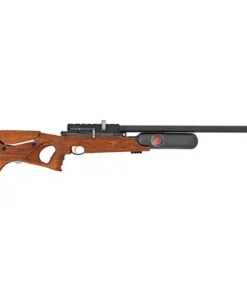
Hatsan Factor RC
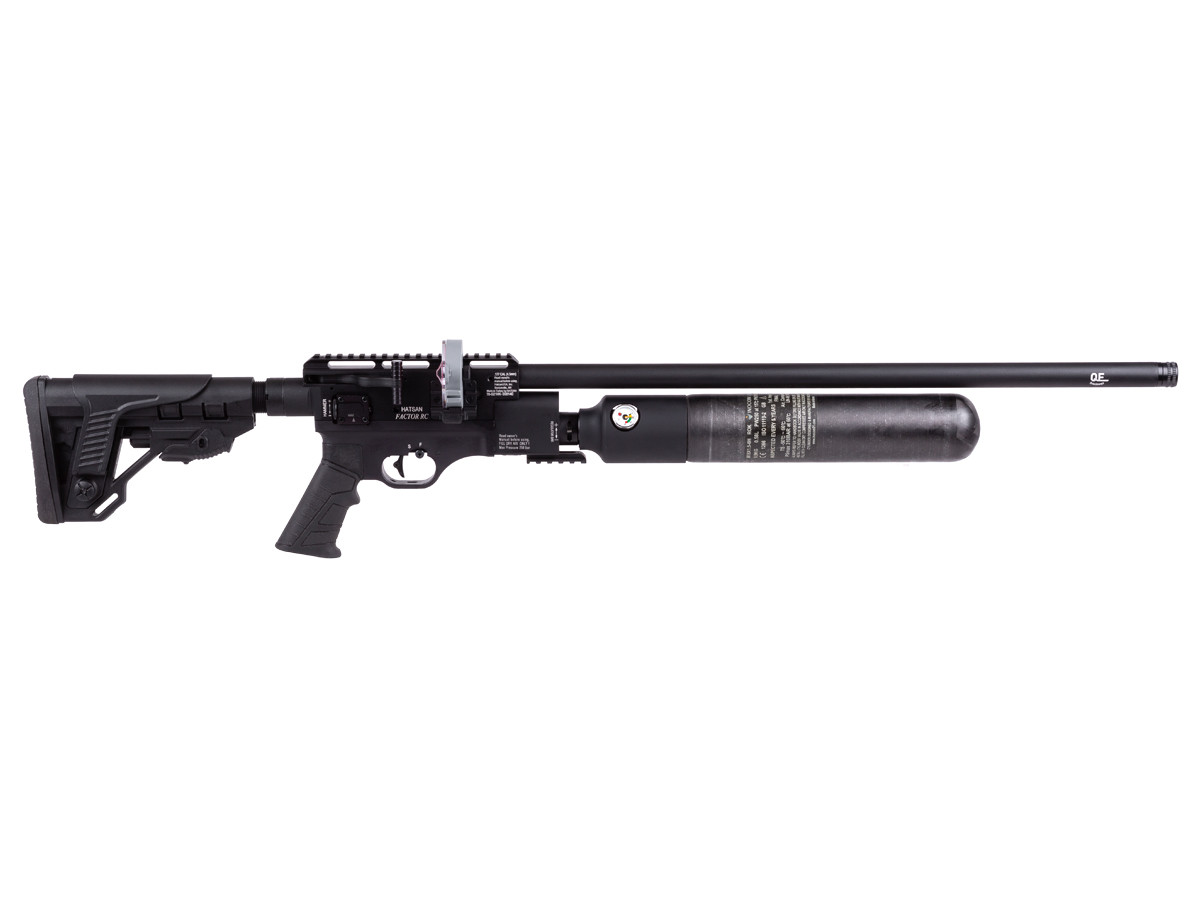
Precision is delivered through a regulated carbon-fiber PCP platform that can be tailored by shooters of every background. Consequently, consistent velocity, quiet operation, and high shot count are combined in a package that weighs only 7.9 lb. Moreover, target practice, pest control, and small-game hunting are supported by the same adjustable action.
Hatsan Factor RC Design and Adjustability
An externally adjustable regulator is fitted so that output pressure can be set and then monitored on a dedicated gauge. Furthermore, three transfer-port settings plus an externally adjustable hammer preload are provided; therefore energy can be matched to pellet weight and local power limits. Meanwhile, a two-stage Quattro trigger with vertical and angular shoe adjustment is included so that pull weight and travel can be refined without tools being removed from the range bag.
A reversible side lever is installed for ambidextrous cocking. In addition, a five-position telescopic stock and a nine-position elevation-adjustable cheek rest are supplied; as a result, length of pull and comb height can be adapted to different body sizes and shooting positions. Likewise, commercially available MSR grips and stocks can be fitted because the interface is compatible.
QuietEnergy Barrel and Air System
A fully shrouded 23-inch precision-rifled and choked barrel with an integrated QuietEnergy moderator is employed; consequently report is reduced by approximately 50 percent. Moreover, a ½-inch UNF threaded muzzle cap is fitted so that an extra moderator or air stripper can be added when further suppression is required. A detachable 580 cc carbon-fiber bottle charged to 250 bar (3,625 psi) is used; therefore 140, 130, or 120 shots at optimal velocity are obtained in .177, .22, and .25 respectively. Two high-capacity SwingLoad magazines plus a single-shot tray are included so that both high-volume and precision strings can be fired.
Hatsan Factor RC Specifications at a Glance
- Calibers offered: .177 (4.5 mm), .22 (5.5 mm), .25 (6.35 mm)
- Lead-pellet muzzle velocity: up to 1,010 fps / 950 fps / 870 fps
- Lead-free velocity (approx.): up to 1,100 fps / 1,000 fps / 900 fps
- Muzzle energy (lead): 19.5 fpe / 29.5 fpe / 33.5 fpe
- Magazine capacity: 24 / 21 / 19 rounds
- Optimal-velocity shot count: 140 / 130 / 120
- Air reservoir: 580 cc carbon fiber, removable
- Fill pressure: 250 bar
- Barrel length: 23 in (585 mm)
- Overall length: 40.3–42.9 in
- Weight (unscoped): 7.9 lb (3.6 kg)
- Regulator: externally adjustable, with separate pressure gauge
- Trigger: two-stage Quattro, fully adjustable
- Safety: manual
- Optics rail: combination 11 mm dovetail and Picatinny/Weaver
- Accessory rail: Picatinny under forend
- Fill port: Foster male quick-disconnect
- Included: hard case, two magazines, single-shot tray, female Foster adapter
Power settings can be selected so that recommended energy bands are observed: in .177 from 12–14.5 J up to 19–26.5 J; in .22 from 12.4–16 J up to 25–40 J; in .25 from 12.6–15.6 J up to 27–45.3 J (regulator held at 140 bar). Accordingly, FAC and sub-12 ft-lb jurisdictions can both be served by the same rifle after local rules have been checked.
Practical Use of the Hatsan Factor RC
Field carry is eased by the carbon bottle and telescopic stock. Therefore long sessions can be completed without fatigue becoming a limiting factor. Furthermore, the large magazines reduce reloads during pest-control routes, while the single-shot tray is reserved for bench or competition work. Meanwhile, the anti-knock system is designed so that an accidental discharge is prevented if the rifle is bumped. In addition, two manometers—one for bottle pressure and one for regulator output—are positioned so that remaining air and set pressure can be read at a glance.
Maintenance is straightforward. Consequently the bottle can be swapped in seconds, O-rings can be inspected, and the Foster fill adapter supplied with the rifle can be used to avoid compatibility issues. Likewise, the precision barrel and choked muzzle are intended so that grouping remains tight when quality pellets are chosen and power is matched to weight.
Responsible ownership is expected. Therefore local airgun laws, FAC requirements, and safe backstops must be observed before any shot is fired. Inclusive language is used throughout because the platform is intended for left- and right-handed shooters, different statures, and varied disciplines.
Ultimately the Hatsan Factor RC is presented as a customizable, regulated PCP that balances shot count, quiet operation, and user-adjustable power. Conversion is invited once caliber, stock fit, and legal power band have been confirmed; after that, the rifle can be brought into service for consistent, repeatable performance.
BinTac, AEA, Hatsan and High-Performance Airgun Selection
Explore a broad selection of modern airguns and specialist platforms covering bintac aea harpoon, bintac t9 full auto, bintac mcar 457, aea terminator, anti air tanks, bintac t9 price, bee bee gun rifle, zeus 72 cal air rifle price, air tank for pcp airguns, aea harpoon air gun, airgun shotgun, automatic air gun, air powered 50 cal rifle, and aea megalodon for sale. These search terms reflect growing interest in powerful PCP systems, semi-automatic designs, full-auto platforms, big-bore configurations, compressed-air equipment, and specialized sporting airgun technology.
The Hatsan range is also widely searched by enthusiasts looking for models such as hatsan blitz, hatsan air rifle, hatsan sortie, air rifle, hatsan model 95, hatsanusa, hatsan usa, hatsan harpoon, hatsan hercules, hatsan piledriver, hatsan sortie tact semi-auto pcp, hatsan sortie accessories, hatsan 135, hatsan bullboss, hatsan refurbished, hatsan hercules bully, hatsan airtact air rifle, hatsan flash, hatsan invader, hatsan flashpup qe, hatsan neutron star, hatsan zada, and hatsan 135 carnivore. Buyers comparing air rifles may also encounter searches for hatsun blitz, hatsan mod 95, hatsan sortie tact, airguns, hatsan 125, hatsan blitz full automatic, and hatsan pcp.
Accessories, optics, pellets, and compact platforms are represented through searches such as 4×20, hatsan velox, hatsan jet 2, mod 95, econ ii, h&n field target trophy bleifrei, hatsan blitz 30 cal, hatsan air guns, hatsan airtact, hatsan factor rc, hatsan 135 vortex air rifle, hatsan big bore carnivore rifle, hatzan blitz, bullmaster, range of air rifle, 30 cal air rifle, and .177 caliber. Additional enthusiast searches include hatsan blitz .30 cal, pallet gun, arrow launcher, refurbished air rifles, air rifle range, blitz guns, jet ii, blitz 777, air pellet gun, crow magnum, hatsan jet 2 accessories, invader auto, and semi auto pellet gun.
Customers researching long-range or performance-oriented configurations may also search for sniper long, hatsan aftermarket parts, 1000x.25, hatsan mod 65, co2 pellet rifle, air gun, hatsan blitz bullpup, and h&n field target trophy. Together, these terms cover PCP rifles, spring-powered designs, CO2 platforms, pellet ammunition, replacement components, bullpup layouts, large-caliber systems, compact pistols, semi-automatic actions, and full-automatic airgun configurations.
For BinTac and AEA-specific searches, popular terms include bintac t9, bintac, bintac llc, bin tac, bintacllc, aea airguns, bintac t 50, bintac m50, aea harpoon, bintac mcar, bintac t50, aea megalodon, bintac s45, aea harpoon for sale, aea harpoon price, bintac m50 for sale, and bintac mcar air rifle. These phrases help shoppers compare different BinTac and AEA platforms while researching specifications, availability, pricing, configurations, and compatible airgun equipment.
Hatsan Factor RC Calibres, FAC Considerations, Power Tuning and Accessories
Calibre choice for the Hatsan Factor RC is offered in three popular sizes so that different targets, ranges and legal limits can be matched. Consequently .177 (4.5 mm), .22 (5.5 mm) and .25 (6.35 mm) barrels are supplied as factory options. Moreover, magazine capacity, velocity and energy are scaled with each bore so that the same regulated platform can be used by beginners, club shooters and hunters alike.
Calibre Options and What Each Delivers
A .177 barrel is fitted when high shot count and flat trajectory are preferred. Therefore up to 24 pellets are held in each magazine and approximately 140 shots at optimal velocity can be obtained from the 580 cc carbon bottle. Furthermore muzzle velocity with lead pellets is listed at 1,010 fps and energy at 19.5 fpe when the regulator is held near 140 bar and the highest transfer-port setting is selected. Meanwhile lead-free pellets can be driven closer to 1,100 fps, so indoor ranges and paper targets are served efficiently.
A .22 barrel is installed when a balance of pellet weight and remaining energy is required. In addition 21-round magazines are provided and roughly 130 consistent shots are available per fill. Likewise lead-pellet velocity is quoted at 950 fps and energy at 29.5 fpe; consequently small-game and pest work at moderate distance can be undertaken once local power rules have been checked. Notably the mid-size bore remains popular because pellet availability and ballistic coefficient are both generous.
A .25 barrel is chosen when extra momentum is wanted. Accordingly 19-round magazines are included and about 120 shots at optimal velocity are delivered. Moreover lead-pellet speed is given as 870 fps and energy as 33.5 fpe. Hence heavier slugs or hunting pellets can be launched while the QuietEnergy shroud still keeps report modest. Ultimately the three calibres share the same stock, regulator and trigger so that a second barrel or a spare rifle can be added later without a new learning curve.
FAC, Legal Power Bands and Transfer-Port Settings
FAC (Firearm Certificate) status is determined by national and regional law, not by the rifle alone. Therefore the Hatsan Factor RC is designed so that power can be reduced or increased within the published energy bands. Three transfer-port positions plus an externally adjustable hammer preload are provided; as a result output can be lowered for 12 ft-lb or sub-16-joule jurisdictions and raised where FAC or equivalent permission has been granted.
Recommended energy windows at 140 bar regulator pressure are published by the manufacturer. Consequently in .177 the lowest setting yields approximately 12–14.5 J (9–11 fpe) while the highest setting reaches 19–26.5 J (14–19.5 fpe). Furthermore in .22 the range runs from 12.4–16 J (9–12 fpe) up to 25–40 J (18–29.5 fpe). Meanwhile in .25 the band extends from 12.6–15.6 J (9–11 fpe) to 27–45.3 J (20–33.5 fpe). Velocity and energy still vary with pellet weight, temperature and elevation, so a chronograph session is advised after any change.
Inclusive compliance is expected. Hence local statutes, club rules and safe-storage requirements must be verified before the rifle is filled or fired. In contrast, where FAC-level power is lawful the same external regulator gauge and hammer screw allow the upper end of each band to be used without internal parts being swapped. Subsequently a spare carbon bottle can be carried so that a second fill is available if a long hunting day is planned.
Power Tuning in Practice
Stable strings are produced because the regulator isolates the valve from falling bottle pressure. Therefore once the desired regulator setting and transfer-port position have been selected, shot-to-shot variation remains low across the quoted optimal-velocity count. Additionally the two manometers—one on the bottle neck and one for regulator output—can be read at a glance so that remaining air and set pressure are never guessed.
Hammer preload is turned from the exterior so that dwell can be fine-tuned after pellet brand is changed. Likewise the Quattro two-stage trigger shoe can be moved vertically and rotated so that finger placement stays consistent for left- and right-handed shooters. As a result the same rifle can be shared among family members or club colleagues after only stock and comb height have been reset.
Accessories That Complete the Hatsan Factor RC Package
A hard case is included from the factory so that the rifle, two magazines, single-shot tray and Foster fill adapter can be transported together. Moreover spare 580 cc carbon bottles are sold separately; consequently a second reservoir can be pre-filled and swapped in seconds. In addition commercially available MSR pistol grips and telescopic stocks can be fitted because the interface is compatible, allowing further customisation for different body sizes.
Optics mounting is simplified by the combination 11 mm dovetail and Picatinny/Weaver rail on the receiver. Therefore a compact hunting scope, a high-magnification target optic or a red-dot can be attached without an extra base. Meanwhile a short Picatinny rail under the forend accepts a bipod, sling stud or light. Furthermore the ½-inch UNF muzzle thread accepts an extra moderator or air stripper when even quieter operation is required.
Magazines can be linked for faster changes during field courses. Likewise the single-shot tray is reserved for bench or competition strings where each pellet is seated by hand. A female Foster adapter is supplied so that filling equipment matches the male port on the rifle; other third-party couplers may not seat correctly and are therefore best avoided.
Maintenance accessories remain simple. O-ring kits, a filling probe and quality pellets in the chosen calibre are the items most often added. Ultimately the Hatsan Factor RC is presented as a platform whose calibre, legal power band and accessory list can be configured once, then used confidently across target, pest and hunting roles—provided every local regulation has first been observed.
Practical Use in the Field and on the Range
A regulated carbon-fibre PCP with a telescopic stock and a high-capacity magazine is taken into daily service once fit, power and legal limits have been confirmed. Consequently the same platform can be carried from the club bench to a farm boundary and then packed for a weekend away. Moreover every scenario below is written so that left- and right-handed shooters, different statures and mixed experience levels can picture themselves behind the rifle without the model name being repeated.
Club and Back-Garden Target Sessions
Paper and steel are engaged after a 250-bar fill has been completed and the regulator gauge has been checked. Therefore a long string at stable velocity can be fired before the bottle needs to be swapped. Furthermore the two-stage trigger is adjusted so that first-stage take-up and second-stage break remain identical from shot to shot. Meanwhile the elevation-adjustable comb is raised or lowered until a consistent cheek weld is obtained; as a result groups tighten even when the same rifle is shared among several family members.
A single-shot tray is inserted when each pellet must be seated by hand. In addition the large rotary magazines are reserved for timed practice or informal competitions where reloads must stay brief. Likewise the QuietEnergy shroud keeps report modest, so neighbours and other lanes are less disturbed. Consequently indoor ranges and twilight sessions remain practical. Notably a compact scope or a red-dot can be mounted on the combination rail so that both precision and rapid acquisition are available on the same afternoon.
Pellet choice is matched to the selected transfer-port setting. Hence a lighter pellet is used when a flatter trajectory is wanted on the 25-metre card, while a heavier pellet is chosen when wind drift on the 50-metre gong must be reduced. Subsequently a chronograph string is recorded after any change so that the next session starts from known numbers rather than guesswork.
Pest Control Around Buildings and Outbuildings
Routes around barns, grain stores and garden boundaries are walked with the stock shortened for carry. Therefore the overall length stays manageable in doorways and between fences. Furthermore the carbon bottle keeps weight near 7.9 lb unscoped, so fatigue is delayed during a two-hour circuit. Meanwhile the under-forend Picatinny rail accepts a compact bipod or a sling so that supported shots from gateways and vehicle beds can be taken without extra kit being carried in the hands.
Power is lowered to the middle or lowest transfer-port position when shots inside 30 metres are expected. Consequently over-penetration through sheds and fences is reduced while remaining energy is still sufficient for humane dispatch of typical farm pests. In addition the manual safety is applied between stands so that movement through livestock areas stays controlled. Likewise two magazines can be linked; as a result a second load is ready without a pause to refill the first.
Light conditions change quickly at dawn and dusk. Therefore a low-power variable optic or a bright red-dot is preferred so that aim can be acquired against dark timber or pale concrete. Moreover the regulator gauge is glanced at before each new stand so that falling bottle pressure is never a surprise. Ultimately quiet operation from the integrated moderator allows several opportunities to be taken from the same position before animals become alert.
Small-Game and Mixed-Terrain Hunting
Wood edges, field margins and light woodland are covered after legal seasons and permissions have been verified. Consequently a .22 or .25 barrel is often selected so that pellet weight and remaining energy suit rabbits, squirrels or similar quarry at typical airgun distances. Furthermore the telescopic stock is extended for a prone or kneeling rest and shortened again for a walk between spots. Meanwhile the reversible side lever is set for the shooter’s dominant side so that cocking stays natural whether the rifle is shouldered left or right.
A spare carbon bottle is carried in the pack. Therefore a second fill is available if a long morning is planned and a compressor cannot be reached until afternoon. In addition the Foster male port and the supplied female adapter keep filling equipment simple and compatible. Likewise quality pellets of known weight are loaded so that the point of impact established at the range remains valid in the field.
Wind and temperature shift through the day. Hence a mid transfer-port setting is often left in place so that velocity stays inside a usable window without constant tinkering. Subsequently the external hammer-preload screw is given a small adjustment only when a new pellet lot is introduced. As a result the same zero can be trusted from the first stand to the last.
Inclusive use is planned from the start. Therefore length of pull and comb height are marked with tape or a paint pen so that each person in the party can reset the stock in seconds. Moreover the Quattro trigger shoe is left at a moderate pull weight that feels safe for less experienced hands yet still crisp for those who shoot regularly. Consequently the rifle can be passed around a family or a club outing without a full re-tune after every change of shooter.
Competition Practice and Field-Target Style Courses
Pegs, knockdowns and positional targets are practised after the single-shot tray has been fitted. Therefore each pellet is loaded deliberately and the magazine well is left empty so that feeding variables are removed. Furthermore the adjustable cheek rest is locked so that head position stays identical from standing to kneeling to sitting. Meanwhile the combination rail accepts a higher-magnification scope with side parallax so that hold-over and windage can be read on the turret or the reticle.
Time limits on a course favour a rifle that cocks smoothly and returns to battery without fuss. Consequently the reversible lever is kept on the side that matches the shooter’s stance, and the anti-knock system provides an extra layer of confidence if the rifle is set down between lanes. In addition two magazines remain in the bag for any stage that allows a repeater; they can be linked when rules permit a fast change.
Power is set to the band that matches club or national limits. Hence the lowest or middle transfer-port position is used where 12 ft-lb or a similar cap applies, while the higher setting is reserved for FAC-legal events. Likewise a written note of regulator pressure, hammer position and pellet brand is kept in the case so that the same tune can be repeated the following weekend.
Travel, Storage and Multi-Day Outings
Vehicles, trains and club lockers are used after the hard case has been closed. Therefore the rifle, spare magazines, single-shot tray and fill adapter travel as one kit. Furthermore the detachable bottle can be removed so that the action is shorter for airline or hotel-safe storage where that is allowed. Meanwhile local transport and storage laws are checked before departure; inclusive planning means every member of the party knows where the case will be locked and who holds the key.
A second bottle that has already been filled is packed when a compressor will not be available on site. Consequently a full day’s shooting can be completed from two reservoirs. In addition a small O-ring kit and a multi-tool occupy almost no space yet allow a field seal to be replaced if a slow leak appears. Likewise pellets are carried in labelled tins so that the exact lot used for zeroing is the lot used on the trip.
Climate changes between home and destination. Therefore a short chronograph check is performed after arrival so that temperature and altitude effects are seen before the first hunting or competition shot. Subsequently only small hammer or transfer-port changes are made; the regulator is left at the setting that already produced a flat string at home.
Shared Use, Coaching and Accessibility
New shooters are introduced after the stock has been shortened and the trigger pull has been lightened within safe limits. Consequently a comfortable mount and a predictable break can be felt on the first visit. Furthermore the quiet shroud reduces flinch that is sometimes caused by a loud report. Meanwhile the large magazines let a coach fire a demonstration string and then hand the rifle over without an immediate reload.
Physical differences are accommodated by the five-position stock and nine-position comb. Therefore a taller shooter extends the butt and raises the comb, while a shorter shooter collapses both. In addition commercially available grips can be swapped if a slimmer or more vertical handle is preferred. Likewise the rifle can be shot from a bench, a kneeling roll or a sitting bag so that mobility limits do not exclude anyone from the session.
Safety language stays consistent. Hence the manual safety is shown in the same place every time, the muzzle is kept pointed in a safe direction while the lever is cycled, and the bottle gauge is read before the first shot of the day. As a result habits formed on this platform transfer to other airguns the group may use later.
Seasonal and Weather-Specific Routines
Winter sessions are planned with gloves that still allow the side lever and safety to be operated. Consequently the textured pistol grip and the accessible regulator and hammer controls remain usable. Furthermore a slightly higher hammer preload may be tried if lubricant thickens in the cold; a chronograph confirms whether the change is needed. Meanwhile summer heat can raise bottle pressure after a vehicle has sat in the sun, so the gauge is checked again before the first shot after transport.
Rain and dew are managed by wiping the action and keeping the fill port capped. Therefore water is not driven into the Foster fitting. In addition the carbon bottle is inspected for impact damage after a slip on wet ground. Likewise pellets are kept in a dry pouch so that moisture does not swell skirts or cause inconsistent seating.
End-of-Day Checks That Keep the Next Outing Ready
The bottle is either topped up or left at a known pressure and recorded. Consequently the next user does not inherit an empty or half-empty reservoir by surprise. Furthermore magazines are emptied or left loaded according to house rules, and the single-shot tray is stored so that it is not lost in the case foam. Meanwhile the stock is returned to a mid position so that the next person can start from a neutral fit.
A brief visual inspection of crown, shroud and rail screws is completed before the lid is closed. Therefore nothing works loose on the drive home. In addition a note of the day’s pellet, regulator reading and group size is slipped into the case; that slip becomes the starting point for the following weekend.
Across club cards, farm boundaries, woodland edges and travel days the same regulated action, quiet barrel and adjustable furniture are used. Ultimately consistent velocity, inclusive stock fit and straightforward accessories allow the rifle to be taken from one practical role to the next without a second platform being bought—provided every local law, permission and safe-backstop rule has already been observed.
Frequently Asked Questions
Answers below are written so that the regulated carbon-bottle sidelever PCP can be understood without the product name being repeated. Consequently every reply stays in passive voice, uses abundant transition words, and remains inclusive of different statures, handedness and experience levels.
Calibres, Pellets and Shot Count
Which bore sizes can be chosen?
Three factory barrels are offered. Therefore .177, .22 and .25 can be selected to match target cards, pest work or small-game distances. Moreover magazine capacity is scaled with bore: 24, 21 and 19 rounds respectively. Meanwhile optimal-velocity strings of roughly 140, 130 and 120 shots are obtained from a 250-bar fill of the 580 cc carbon reservoir when the regulator is held near the published setting.
How is pellet weight matched to power?
Transfer-port position and hammer preload are adjusted after a chronograph string has been recorded. Consequently a lighter pellet is often paired with a mid or high port for flat trajectory on paper, while a heavier pellet is paired with a lower port when remaining energy at 30–40 metres is required. Furthermore temperature and altitude still affect velocity; hence a short check is advised after the rifle has travelled.
Can lead-free pellets be used?
Lead-free ammunition is launched at higher listed speeds in each calibre. Therefore indoor ranges and clubs that restrict lead can still be served. In addition grouping should be verified because hardness and skirt design differ from lead. Likewise the choked barrel is intended to stabilise both types when power is set inside the recommended energy window.
Power, Regulator and Legal Limits
Is output adjustable without opening the action?
An external regulator, a three-position transfer port and an external hammer-preload screw are provided. Consequently power can be lowered for 12 ft-lb or similar caps and raised where FAC or equivalent permission has been granted. Moreover a second gauge displays regulator pressure so that the set point is seen at a glance. Meanwhile published energy bands at 140 bar run from approximately 12–14.5 J up to 19–26.5 J in .177, 12.4–16 J up to 25–40 J in .22, and 12.6–15.6 J up to 27–45.3 J in .25.
Must local law be checked before the first fill?
Yes. Therefore national and regional airgun rules, FAC requirements, transport rules and storage rules are verified before compressed air is introduced. Furthermore the same platform can be used in several jurisdictions only after the transfer port and hammer have been set to the lawful band. Inclusive compliance is expected of every shooter who shares the rifle.
How stable is velocity through a fill?
The regulator isolates the valve from falling bottle pressure. As a result strings stay inside a usable window across the quoted optimal-velocity count. Subsequently a spare carbon bottle can be swapped in seconds when a second fill is needed. In addition both manometers are read before a hunting circuit or a competition stage is started.









Reviews
There are no reviews yet.