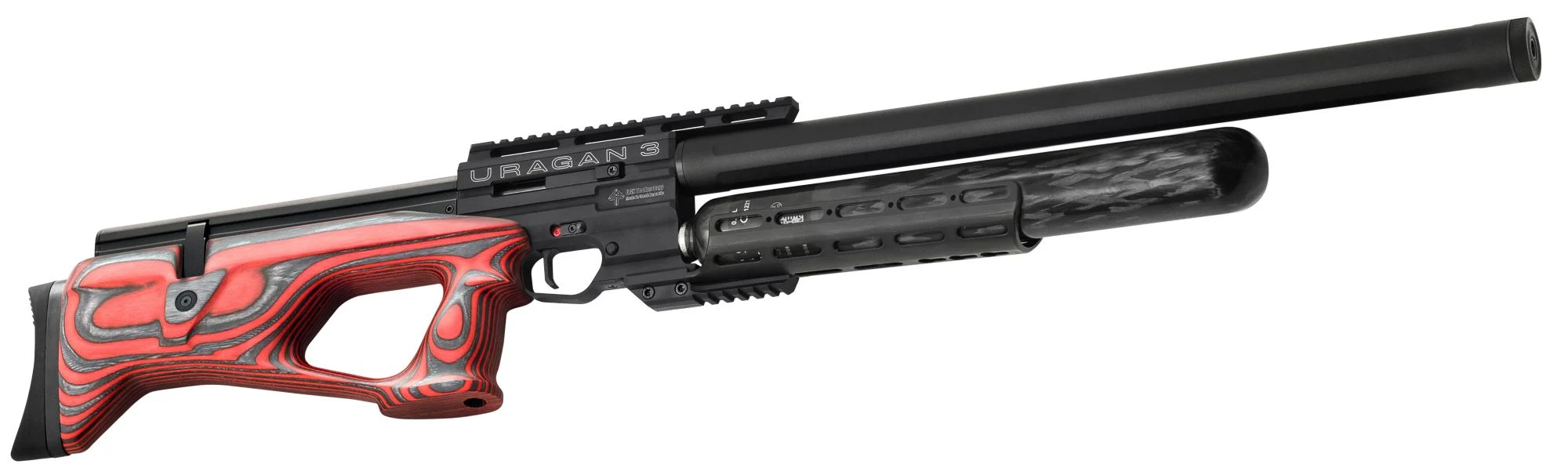
Precision and Power Are Delivered by the AGT Uragan 3 700
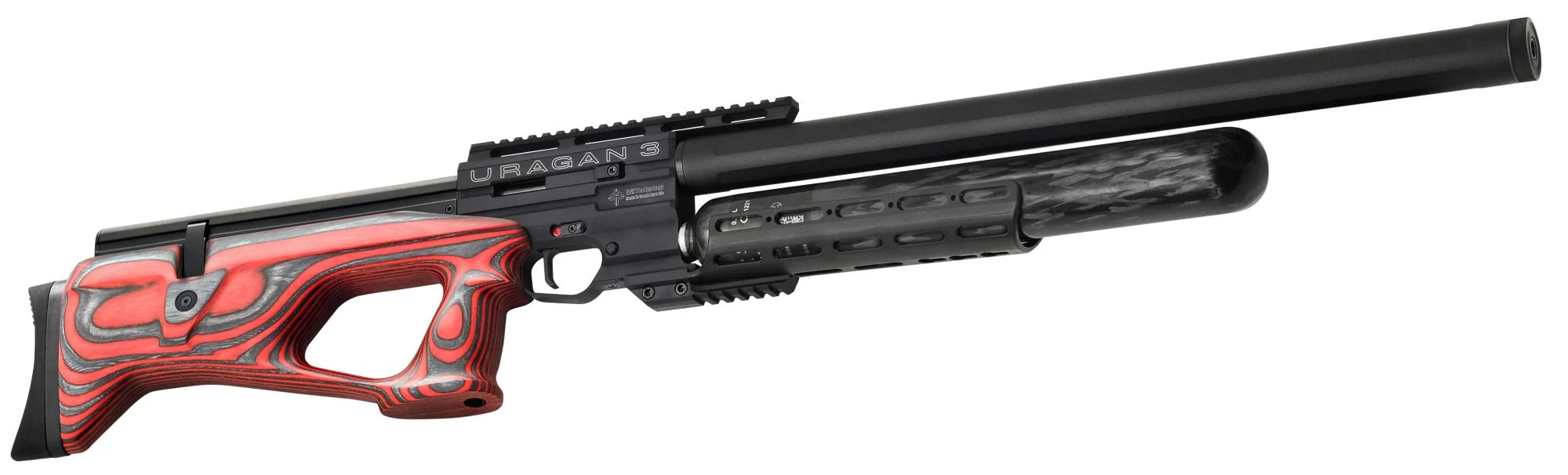
Exceptional long-range capability is provided by the AGT Uragan 3 700. Advanced Czech engineering is combined with a 700 mm CZ barrel so that consistent accuracy can be achieved by shooters of every background. Moreover, a refined bullpup platform is utilized so that compact overall length and rear-biased balance can be enjoyed without compromise. Consequently, demanding field and range use is supported by this PCP air rifle.
Furthermore, a completely rebuilt action is featured so that reliability and serviceability can be improved over earlier generations. In addition, a new high-pressure regulator is fitted so that shot-to-shot consistency can be maintained even at elevated fill pressures. Therefore, a stable power curve is produced across a long string of shots.
Core Mechanical Advantages of the AGT Uragan 3 700
A simplified power plenum is employed so that airflow can be optimized and routine maintenance can be completed more easily. Subsequently, an upgraded firing-valve assembly is incorporated so that the valve can be reached without full disassembly of the rifle. Meanwhile, a stronger hammer and revised spring tensioner are installed so that ignition can be made more predictable. Additionally, a depinger is integrated so that residual mechanical noise can be reduced.
Highlighted features of the AGT Uragan 3 700 include:
- A 700 mm shrouded CZ cold-hammer-forged barrel with integral moderator and M14 threading for an extra silencer
- A 530 cc carbon-composite air cylinder filled to a maximum of 300 bar
- A new high-pressure regulator for consistent output
- An ambidextrous, tool-free swappable biathlon side-lever action
- A two-stage adjustable match trigger
- A 20 MOA Picatinny/Weaver top rail of extended length
- A lower Picatinny rail with bottle guard and forward Keymod mounting
- An adjustable rubber butt pad and glove-friendly trigger guard
- An ambidextrous manual safety
- Dual magazines supplied as standard
Notably, overall length of approximately 997–1000 mm and an unscoped weight near 3.7 kg are achieved so that a stable yet portable package can be carried. Likewise, magazine capacities of 15 rounds in .177, 12 rounds in .22, and 10–11 rounds in .25 are offered so that rapid follow-up shots can be taken.
Consistent Performance Is Produced Across Calibers
Versatile power levels are made available by the AGT Uragan 3 700. Accordingly, .177, .22, .25, and special-order .30 chamberings can be selected according to intended use. In particular, FAC-rated configurations are capable of substantial muzzle energy when local regulations permit. As a result, both precision target work and ethical hunting or pest-control applications can be supported.
Moreover, typical shot counts of around 220 in .177 and 110 in .22 are obtained from a single 300-bar fill on the standard 530 cc cylinder. Nevertheless, actual figures vary with pellet weight, power setting, and ambient conditions. Therefore, a pressure gauge is provided so that remaining air can be monitored at a glance.
Quiet Operation and Accuracy Are Enhanced
An integral shroud moderator plus the added depinger are used so that report can be kept moderate. Furthermore, additional external silencers can be fitted thanks to the muzzle thread. Consequently, discreet practice and field use become more practical for a wider range of environments.
High grouping potential is delivered by the long, high-quality CZ barrel. In addition, the 20 MOA rail is sloped so that long-range optics can be mounted with sufficient elevation. Thus, distant targets can be engaged with confidence once a suitable scope is fitted.
Ergonomics and Inclusivity Are Prioritized
Comfort for left- and right-handed users alike is ensured by the fully ambidextrous layout. Specifically, the side lever can be swapped without special tools. Likewise, the thumbhole-style stock options—walnut, synthetic, red or green laminate, and carbon—allow personal preference and weather conditions to be accommodated.
An adjustable butt pad is fitted so that length of pull and cheek weld can be tailored. Meanwhile, the redesigned trigger guard accepts gloved hands more readily. As a result, year-round use by shooters of varying stature and experience is facilitated.
Inclusive design choices mean that the AGT Uragan 3 700 can be enjoyed by newcomers who value ease of handling as well as by experienced competitors who demand repeatable mechanics. Responsible ownership and adherence to local airgun laws remain essential; power levels and licensing requirements differ by jurisdiction and must be verified before purchase.
Everyday Use and Ownership Are Simplified
Routine care is made less time-consuming by the unthreaded plenum fixation and accessible valve. Subsequently, the rifle can be kept in reliable condition with standard PCP practices: clean, dry air, appropriate fill equipment, and periodic inspection of seals and the regulator.
A fill probe and two magazines are typically included so that the owner can begin shooting promptly. Additional accessories such as bipods, extra magazines, or a larger “King” dual-cylinder variant can be added later if higher shot counts are desired.
Conversion-focused value is created because a premium Czech-made platform, refined internals, and a long, accurate barrel are combined at a competitive price point within the high-end PCP category. Therefore, shooters seeking a capable 700 mm bullpup are invited to consider the AGT Uragan 3 700 as a serious, future-proof choice for precision airgunning.
When legal compliance, proper training, and quality pellets are observed, outstanding results can be obtained. The AGT Uragan 3 700 stands ready to reward careful owners with consistent, engaging performance session after session.
Calibres, FAC Options, Power Levels and Accessories Are Offered by the AGT Uragan 3 700
A versatile choice of chamberings is provided by the AGT Uragan 3 700 so that different shooting goals can be matched. Moreover, both sub-12 ft-lbs configurations and higher-output FAC versions can be specified where local licensing allows. Consequently, target work, pest control and licensed hunting applications can all be supported by the same long-barrel platform.
Furthermore, magazine-fed operation is retained across calibres so that rapid follow-up shots can be taken. In addition, a regulated 530 cc carbon cylinder filled to 300 bar is used so that usable shot strings can be obtained before a refill is required.
Available Calibres and Magazine Capacities
Standard production chamberings of .177 (4.5 mm), .22 (5.5 mm) and .25 (6.35 mm) are supplied. Likewise, a .30 (7.62 mm) option can be requested as a special order. Therefore, pellet or slug preference and intended range can be taken into account when the rifle is configured.
Typical rotary-magazine capacities for the AGT Uragan 3 700 are listed below:
- .177: approximately 15 rounds per magazine
- .22: approximately 12 rounds per magazine
- .25: approximately 10–11 rounds per magazine
- .30 (special order): reduced capacity suited to larger projectiles
Two magazines are customarily included so that a spare can be kept loaded. Subsequently, extra magazines can be added as accessories when longer sessions are planned.
Notably, the 700 mm CZ barrel is often preferred for .25 and .30 because additional dwell time and velocity potential can be utilised. Meanwhile, .177 and .22 remain popular for high-volume practice and precision target use.
FAC Status and Power Output
Power is governed by regional law. Accordingly, UK-style unlicensed versions of the AGT Uragan 3 700 are commonly set at or below 12 ft-lbs (approximately 16 J). In contrast, FAC-rated rifles are supplied with a high-power assisted valve, fuller regulator adjustability and the removal of compliance restrictors. As a result, substantially higher muzzle energy can be produced when a valid certificate is held.
Indicative performance on the 700 mm platform (figures vary with pellet weight, regulator setting and fill) can be summarised as follows:
- Sub-12 ft-lbs examples in .177 have been recorded near 11.5–12 ft-lbs with suitable lightweight pellets.
- FAC .25 listings have shown energies in the region of 100+ J (around 75+ ft-lbs) at velocities near 310 m/s on some European configurations.
- .22 FAC settings typically sit between these extremes, offering a balance of trajectory and energy.
- .30 special-order FAC builds are intended for maximum energy on larger game where legally permitted.
A new high-pressure regulator is fitted so that a flatter power curve can be maintained across the usable pressure band. Therefore, first-to-last shot consistency is improved compared with unregulated designs. Nevertheless, actual chronograph results must always be verified after any power adjustment, because pellet choice and temperature affect output.
Responsible ownership is required. Local FAC or equivalent licensing, storage and transport rules must be observed before an elevated-power AGT Uragan 3 700 is purchased or used.
Shot Count and Air System Considerations
From the standard 530 cc cylinder, approximate shot counts on moderate settings are often quoted near 220 in .177 and 110 in .22. Lower counts are expected in .25 and still fewer in .30, especially on FAC power. Moreover, the optional 700 King dual-cylinder arrangement (approximately 1060 cc) can be selected when longer strings are desired; published figures then rise toward 430 / 330 shots in .177 / .22 on comparable settings.
A fill-pressure gauge is provided so that remaining air can be monitored. A probe-style fill port with dust cover is used so that a standard high-pressure hose and DIN or Foster adapter can be connected. Consequently, a quality compressor or scuba-style charging station is recommended as a complementary accessory.
Accessories That Complete the AGT Uragan 3 700
A well-chosen set of extras allows the rifle to be tailored to the individual shooter. Inclusive, ambidextrous design means left- and right-handed users can benefit equally.
Highlighted accessory and configuration options include:
- Additional rotary magazines in the chosen calibre
- Extra sound moderators threaded M14 for further noise reduction
- Quality 30 mm or 34 mm scopes matched to the 20 MOA Picatinny rail
- Bipods or tripods attached to the lower Picatinny rail or forward Keymod section
- Protective bottle guard already integrated; optional rail swaps (e.g. ARCA-style) on some setups
- Stock finishes: walnut, synthetic, red laminate, green laminate or carbon fibre
- Adjustable butt-pad spacers for length-of-pull customisation
- Padded rifle bag, cleaning mat and quick-fill station (hose, probe and 90° DIN adapter) frequently supplied
- High-quality pellets or slugs matched to the selected calibre and power level
- Sling, spirit level, bubble or anti-cant device mounted on available rails
Epic Airguns, Hatsan, Bintac and High-Performance PCP Air Rifles
Modern epic airguns continue to attract shooters who want advanced PCP technology, adaptable configurations, precision, and high-capacity air systems. Whether someone searches for epic air, epic 1, epic one, epic1, or the epic one air rifle, the interest generally centers on premium compressed-air platforms built for accurate shooting. The growing Epic lineup also includes searches for epic 2, the epic 2, epic 2.0, epic two lite, and epic two walnut, giving enthusiasts several terms to explore when comparing configurations, materials, and performance.
Shooters researching an air rifle com resource or a specialized pcp air gun shop may also encounter terms such as epicair, airgun one incorporated, 30 epic, epic optics, epic eagle, epic vision, airpne, and pist2 while comparing manufacturers, accessories, optics, and PCP platforms. Other searches, including pellet gun yeeps, kalibrgun snipe 2, air gun makers, and compressed air rifles, reflect how broad the modern airgun market has become.
For larger-caliber and tactical PCP enthusiasts, products associated with bintac aea harpoon, bintac t9 full auto, bintac mcar 457, and aea terminator have generated interest among buyers looking beyond conventional sporting rifles. Shooters researching anti air tanks may instead be looking for filling equipment and high-pressure storage solutions, while searches for bintac t9 price often come from buyers comparing premium PCP platforms before making a purchase.
Interest in a bee bee gun rifle can range from recreational plinking to entry-level target shooting, whereas searches such as zeus 72 cal air rifle price focus on extremely large-bore PCP technology. A suitable air tank for pcp airguns is particularly important for shooters who want convenient refilling away from a compressor or dive shop.
Large-caliber PCP platforms are also reflected in searches such as aea harpoon air gun, airgun shotgun, automatic air gun, air powered 50 cal rifle, and aea megalodon for sale. These terms demonstrate how air-powered technology has expanded far beyond the traditional pellet rifle and into increasingly specialized shooting platforms.
Hatsan Air Rifles, PCP Models and Popular Configurations
Among established manufacturers, hatsan blitz remains one of the most recognizable search terms for shooters interested in rapid-fire PCP designs. The wider hatsan air rifle lineup covers numerous shooting applications, while models such as the hatsan sortie, hatsan model 95, hatsan harpoon, hatsan hercules, and hatsan piledriver appeal to different sections of the airgun market.
Buyers searching hatsanusa or hatsan usa are often looking for Hatsan products, specifications, service information, accessories, or replacement components available within the American market. Meanwhile, the hatsan sortie tact semi-auto pcp offers a semiautomatic-style platform, and interest in hatsan sortie accessories gives owners options for refining their setup.
Traditional spring-powered enthusiasts frequently research the hatsan 135, hatsan 125, hatsan mod 95, and the shorter mod 95 search phrase. PCP shooters may instead consider the hatsan bullboss, hatsan hercules bully, hatsan flash, hatsan invader, or hatsan flashpup qe.
Value-conscious customers can also explore hatsan refurbished products and other refurbished air rifles when available. Models such as the hatsan airtact air rifle, hatsan neutron star, hatsan zada, and hatsan 135 carnivore broaden the selection even further.
Because terminology varies among shoppers, searches may include air rifle, air rifles, airguns, hatsun blitz, hatzan blitz, or the broader phrase hatsan air guns. Likewise, shooters researching PCP-specific options frequently use hatsan pcp when comparing regulated systems, air cylinders, magazines, power levels, and available calibers.
Hatsan Blitz, Big-Bore PCP and Semi-Automatic Options
The hatsan blitz full automatic platform is especially notable among buyers interested in fast cycling and high-capacity PCP technology. Searches such as hatsan blitz 30 cal and hatsan blitz .30 cal commonly focus on the larger-caliber Blitz configuration, while terms such as blitz guns and blitz 777 may appear during broader product research.
For shooters interested in other compact pneumatic platforms, the hatsan velox and hatsan jet 2 offer additional choices. Searches for jet ii may refer to the same general family, while hatsan jet 2 accessories can help owners locate compatible components and upgrades.
Additional Hatsan searches include hatsan sortie tact, hatsan airtact, hatsan factor rc, and hatsan 135 vortex air rifle. Buyers seeking larger projectiles and increased energy may also investigate the hatsan big bore carnivore rifle or related big-bore configurations.
The bullmaster provides another PCP platform for shooters comparing bullpup-style layouts, while invader auto attracts interest from users researching semiautomatic air rifle designs.
Calibers, Pellets, Optics and Shooting Accessories
Choosing the correct caliber remains an important part of selecting an airgun. A 30 cal air rifle can offer considerably more projectile mass than a traditional .177 caliber rifle, although the best choice depends on intended use, legal requirements, shooting distance, and available ammunition.
A quality air pellet gun should be paired with ammunition suited to its barrel and power output. Some users may type pallet gun when searching for pellet-powered equipment, while competitive shooters might research premium ammunition such as h&n field target trophy bleifrei.
Optics are equally important for accurate shooting. A basic 4×20 optic may be sufficient for recreational use at modest distances, whereas more advanced scopes can provide adjustable magnification, parallax correction, and improved reticles for longer-range shooting.
Searches involving econ ii may relate to specific airgun equipment or components, while crow magnum remains another term encountered by enthusiasts researching established airgun products.
PCP Air Supply, Range and Specialized Shooting Equipment
Unlike spring-powered rifles, PCP systems rely on compressed air stored at high pressure. Therefore, shooters comparing compressed air rifles should consider cylinder capacity, regulator performance, fill pressure, shot count, and refill equipment alongside muzzle performance.
A dependable air tank for pcp airguns can simplify field refilling, while suitable fill adapters and rated high-pressure equipment should always be used according to manufacturer specifications.
The practical range of air rifle performance varies considerably according to caliber, projectile design, muzzle energy, weather conditions, optics, and shooter ability. Consequently, there is no single universal air rifle range that applies to every platform.
Some shooters also explore an arrow launcher configuration, which uses air pressure to propel compatible arrows or bolts rather than conventional pellets. This specialized equipment demonstrates the versatility available across today’s airgun market.
From epic one and epic two walnut configurations to hatsan blitz, aea terminator, and large-bore PCP platforms, today’s market includes recreational rifles, precision systems, semiautomatic designs, tactical configurations, and specialized high-powered airguns. Comparing construction quality, caliber, air capacity, ammunition compatibility, intended shooting application, and available accessories can help buyers identify the platform that best matches their needs.
Furthermore, a two-stage adjustable trigger can be fine-tuned so that first-stage take-up and second-stage break can be set to personal preference. In addition, the side lever can be swapped without tools so that cocking can be performed from the preferred side.
Optics with generous elevation travel are advised because the 20 MOA rail is intended to assist long-range zeroing. Similarly, a robust bipod improves stability when the 700 mm barrel is used from a rest or prone position.
Conversion value is created when the AGT Uragan 3 700 is specified with the correct calibre, legal power level and a practical accessory package. Therefore, shooters are encouraged to confirm licensing status, intended use and preferred stock finish before ordering so that a complete, ready-to-shoot setup can be assembled. When regulations are followed and quality ammunition is used, the long-barrel Uragan 3 platform can deliver consistent, engaging performance for a wide community of airgun enthusiasts.
Practical Use Scenarios Are Supported Across Range, Field and Training Settings
Everyday shooting tasks are handled more confidently when a long-barrel regulated bullpup is employed. Moreover, rear-biased balance and a compact overall outline are utilised so that movement between positions can be completed without excessive fatigue. Consequently, sessions that last several hours can be enjoyed by shooters of differing stature, handedness and experience.
Furthermore, a 700 mm shrouded barrel is relied upon so that pellet stability at distance can be improved. In addition, a two-stage adjustable trigger and ambidextrous side lever are used so that the same platform can be shared among left- and right-handed members of a household or club. Therefore, inclusive participation is encouraged rather than limited to a single shooting style.
Precision Practice on the Club Range Is Made More Repeatable
Controlled grouping work is typically begun from a bench or bipod. Subsequently, the 20 MOA top rail is employed so that a suitable optic can be mounted with enough elevation for 50–80 metre targets. Meanwhile, the lower rail or Keymod section is used so that a bipod can be attached without tools in most cases.
A magazine is loaded and seated from the rear of the action so that the cheek weld remains undisturbed. Likewise, the side lever is cycled with a short, consistent motion so that the next pellet can be chambered quietly. As a result, a rhythm is established that favours concentration rather than mechanical struggle.
Highlighted range habits that support consistency include:
- Confirmation that fill pressure sits within the regulator’s working band before the first string
- Use of the same pellet lot throughout a zeroing session
- Recording of temperature and pellet weight alongside group size
- Periodic checking of the butt-pad setting so that length of pull stays constant
- Allowing the barrel to cool between high-volume strings on warmer days
Notably, sub-12 ft-lbs configurations are often chosen for club use where licensing is not held. Nevertheless, FAC-rated examples, where legally possessed, can be employed on designated high-power ranges so that trajectory and wind drift at longer distances can be studied. In either case, a chronograph check after any regulator or hammer-spring change is recommended so that recorded energy remains within the intended limit.
Quiet operation is assisted by the integral shroud and depinger. Consequently, neighbouring lanes are disturbed less, and longer practice blocks become more socially acceptable. Additional external moderators can be fitted when local rules permit, so that report can be reduced still further.
Field Pest Control and Ethical Hunting Applications Are Facilitated Where Lawful
Movement through woodland edges, farm buildings or open pasture is aided by the bullpup layout. Moreover, the rifle can be carried closer to the body so that snagging on brush is reduced. Therefore, approaches to wary quarry can be completed with less visual and physical disruption.
A rest against a fence post, bag or kneeling position is commonly adopted. Subsequently, the adjustable butt pad is set so that a firm shoulder contact can be obtained even when outdoor clothing is worn. Meanwhile, the glove-friendly trigger guard allows a gloved first finger to reach the blade without forcing an awkward grip in cold weather.
Calibre choice is matched to the task. In particular, .22 is frequently selected for a balance of trajectory and energy on small pests. Likewise, .25 or special-order .30 FAC setups, where certificates and land permissions exist, are reserved for larger species and greater ranges. Responsible shot placement remains the priority; power alone does not replace fieldcraft or knowledge of anatomy.
Inclusive field practice means that a partner of the opposite handedness can use the same rifle after the side lever is swapped. No special tools are required for that change, so a shared outing can continue without delay. Safety catch use between stalks is emphasised so that accidental discharge is avoided when terrain is uneven.
Weather considerations are addressed as follows:
- Synthetic or carbon stocks are preferred when rain or mud is expected
- Walnut or laminate finishes are reserved for drier days or range-only use if cosmetic wear is a concern
- A dust cap is kept on the fill port so that grit cannot enter the valve area
- Optics with decent water resistance are chosen because morning dew is common
After a successful outing, the magazine is removed and the action is left uncocked for transport. Additionally, remaining air pressure is noted so that a top-up can be planned before the next trip rather than discovered in the field.
Home Zeroing, Back-Garden Practice and Skill Building Are Supported Within Legal Limits
Where private land and local by-laws allow safe discharge, short-range confirmation of zero can be completed. A 20–30 metre backstop of adequate depth is prepared first. Subsequently, the same pellet that will be used in the field is fired so that point of impact is not shifted by a change of ammunition.
New shooters benefit from the predictable two-stage trigger. First-stage travel can be felt, then a clean break can be learned without a heavy pull fighting the shooter. Experienced users can refine hold-over and hold-under on the same platform because the regulator keeps velocity steadier than many unregulated designs.
Training progressions that work well include:
- Grouping at a fixed distance until five-shot clusters tighten
- Introduction of a mild crosswind so that drift can be observed
- Positional work: sitting, kneeling, then unsupported standing in small increments
- Timed but unhurried magazine changes so that reloads become automatic
- Night or low-light sessions only when a legal, eye-safe illuminator and appropriate optic are fitted
Family or club members of different ages and strengths can share the rifle because weight is moderate for a 700 mm barrelled PCP and balance sits rearward. Coaching is made easier when both instructor and pupil can operate the same controls after a brief lever swap.
Travel, Storage and Day-Long Events Are Managed with Simple Routines
A padded slip or hard case is used so that the optic remains aligned during car journeys. Moreover, magazines are carried separately or empty so that a loaded rifle is never transported contrary to local rules. Fill equipment—probe, hose and a charged cylinder or portable compressor—is packed so that a top-up can be performed at the venue rather than guessed.
At a competition or charity shoot, the longer top rail accepts larger optics, including some night-vision or thermal add-ons where permitted. Consequently, the same rifle can serve daylight paper targets in the morning and permitted dusk pest work later, provided zeros are confirmed for each sight.
Maintenance during a long event stays modest. The simplified plenum and accessible valve mean that a trained owner can address a minor air leak more readily than on designs requiring full strip-down. Still, major work is left for a workshop; field fixes are limited to tightening visible screws, wiping the barrel crown and keeping the fill port clean.
Highlighted travel and event checks include:
- Confirmation that the safety functions in both directions
- Inspection of the shroud and moderator thread for looseness
- Verification that the magazine seats fully and indexes cleanly
- A quick function-fire into a safe backstop after transport
- Logging of fill pressure at the start and end of the day
Seasonal and Environmental Use Is Adapted Without Changing Core Handling
Summer heat can raise regulated pressure slightly; a brief chronograph check after the rifle has sat in a hot vehicle is wise. Winter cold thickens lubricants and can reduce apparent velocity; gloves and the enlarged trigger guard mitigate handling issues. Dusty agricultural settings call for more frequent wiping of the side-lever slot and magazine well.
Rain does not preclude use when a weather-resistant stock and sealed optic are fitted, yet the rifle should be dried and lightly oiled on steel surfaces afterwards. Coastal air introduces salt; a freshwater wipe-down after such trips is advisable.
Inclusive language and shared equipment matter here as well. A smaller-statured shooter can have the butt pad shortened; a taller shooter can add spacers. The same 700 mm barrel length that aids external ballistics also lengthens the sight radius when iron-sight or low-power optic work is practised, helping newer users see alignment errors more clearly.
Pairing Optics, Rests and Ammunition Completes Practical Setups
A 30 mm or 34 mm scope with generous elevation is commonly chosen because the sloped rail is intended for distance. Parallax that focuses down to 20–25 metres remains useful for closer pest shots. A bubble level or anti-cant device on the rail reduces left-right error when the rifle is fired from uneven ground.
Pellet selection is treated as part of the use scenario, not an afterthought. Domed pellets of consistent weight are favoured for general accuracy; heavier slugs, where the barrel and power level allow, are reserved for FAC hunting setups. Each new tin is tested for group size before a hunt or match.
Bipod height is set so that the forend sits level; excessive cant is avoided because the long barrel amplifies small angular errors at the target. Shooting sticks or a tripod can be substituted when vegetation prevents a low bipod.
Conversion-focused ownership means that one well-specified rifle can cover club league nights, weekend permission work and occasional high-power range days if the legal power variant is chosen correctly at purchase. Accessories are added only when they solve a real task: extra magazines for high-volume days, a second moderator for sensitive locations, or a dual-cylinder “King” air supply when shot count becomes the limiting factor.
When safety rules, land permissions and licensing are respected, practical use of this long-barrel regulated bullpup remains straightforward. Sessions become less about fighting the equipment and more about reading wind, calling shots and enjoying time outdoors with others. That is the everyday purpose the platform is designed to serve.
Frequently Asked Questions Are Answered for Everyday Ownership
Clear guidance is offered so that first-time buyers and experienced shooters alike can make informed decisions. Moreover, legal, mechanical and practical topics are addressed in one place. Consequently, uncertainty before purchase or first fill can be reduced.
Furthermore, inclusive wording is used because left- and right-handed users, new club members and licensed FAC holders all encounter different questions. In addition, answers remain general enough that local laws can still be checked independently. Therefore, this section is intended as orientation rather than a substitute for official regulations.
Calibre, Magazines and Ammunition Choices Are Explained
Which chamberings can be selected?
Standard options of .177, .22 and .25 are normally supplied. Likewise, a .30 configuration can be requested as a special order on the longer barrel. Accordingly, intended use—high-volume paper, small-pest work or licensed larger quarry—should be decided before the rifle is built.
How many pellets are held in each magazine?
Typical capacities are approximately 15 rounds in .177, 12 in .22 and 10–11 in .25. Reduced capacity is expected in .30. Two magazines are customarily included so that a spare can be kept ready. Extra magazines can be added later when long sessions are planned.
Must the same pellet brand always be used?
Consistent results are more easily obtained when one lot is tested and then retained for zeroing and field use. Nevertheless, a new tin should be grouped before a hunt or match because weight and skirt dimensions vary. Slugs may be considered only when barrel twist, power level and local rules support them.
Power, FAC Status and Shot Count Are Clarified
Is a firearms certificate required?
Requirement depends entirely on muzzle energy and national or regional law. Sub-12 ft-lbs (approximately 16 J) versions are commonly available where unlicensed air rifles are permitted. Higher-output builds use a different valve arrangement and regulator freedom; those examples are supplied only where a valid certificate or equivalent licence is held. Local rules must be verified before an order is placed.
How much energy can be produced on FAC settings?
Figures vary with calibre, pellet mass, regulator setting and temperature. Published European examples on the 700 mm barrel have shown energies well above sporting limits in .25, sometimes exceeding 100 J. .22 FAC settings usually sit between .177 practice levels and .25 hunting levels. A chronograph check after any internal adjustment is essential so that recorded output remains legal for the owner’s paperwork.
How many shots can be expected from one fill?
On the standard 530 cc cylinder, approximate strings near 220 shots in .177 and 110 in .22 are often quoted at moderate power. Fewer shots are obtained in .25 and still fewer in .30, especially on FAC energy. Dual-cylinder “King” air supplies roughly double capacity and can raise those counts toward 430 / 330 in .177 / .22 on comparable settings. Actual numbers shift with pellet weight and ambient conditions.
Is a regulator fitted?
A high-pressure regulator is installed so that a flatter velocity curve can be maintained across the usable fill band. Consequently, first-to-last shot variation is reduced compared with many unregulated designs. No separate regulator gauge is always present; the main fill gauge is used to monitor remaining air.
Handling, Ergonomics and Inclusive Use Are Covered
Can left-handed shooters use the rifle comfortably?
The side lever can be swapped from one side to the other without special tools. An ambidextrous safety and rear magazine insertion are also provided. Therefore, the same rifle can be shared by left- and right-handed members of a household or club after a brief changeover.
Is the trigger adjustable?
A two-stage match-style trigger is fitted. First-stage weight and second-stage break can be tuned within the design limits so that both new and experienced users can find a preferred pull. Glove use is assisted by an enlarged trigger guard.
How is length of pull altered?
An adjustable rubber butt pad is supplied. Spacers can be added or removed so that shorter and taller shooters can obtain a consistent shoulder contact. Cheek weld on the bullpup comb remains relatively fixed; optic height is chosen to match.
What does the rifle weigh and how long is it?
Unscoped weight is typically near 3.7 kg on the standard 530 cc cylinder. Overall length is approximately 997–1000 mm despite the 700 mm barrel because a bullpup layout is used. Rear-biased balance is intentional so that the muzzle can be held steadier from unsupported positions.


Reviews
There are no reviews yet.