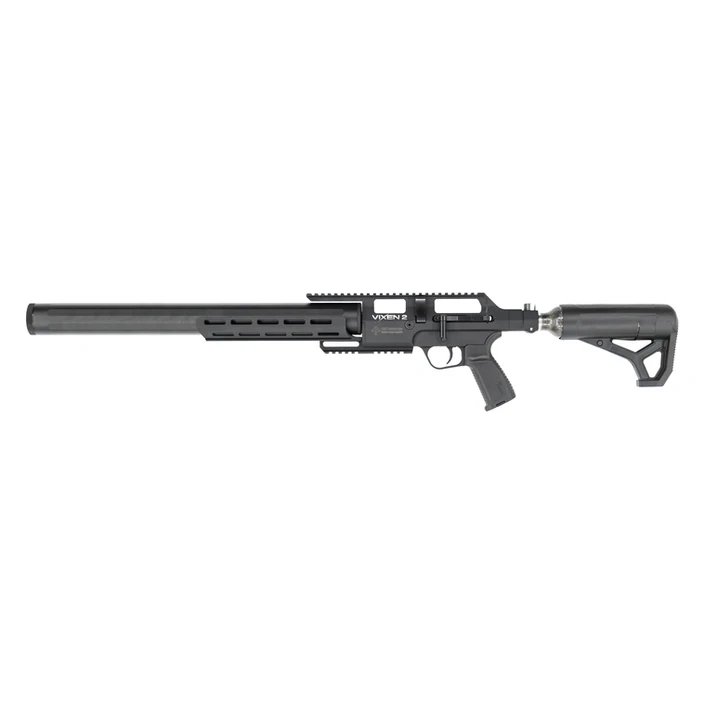
AGT VIXEN 2 Long PCP Air Rifle
Precision shooting is elevated by the AGT VIXEN 2 Long PCP Air Rifle, a lightweight regulated platform that was refined through collaboration with reviewers, field testers, and the AGT engineering team. Consistent performance is delivered across target, hunting, and longer-range plinking sessions because a 500 mm CZ-made barrel, a 250 cc carbon-fibre bottle, and a high-precision regulator are combined in one compact tactical layout. Consequently, accuracy, shot-to-shot consistency, and modular mounting options are placed within reach of left- and right-handed shooters alike.
Furthermore, modern field requirements are met by an ambidextrous biathlon side lever, an ARCA/M-LOK aluminium handguard, a threaded shroud, and extended Picatinny rails. Therefore, optics, bipods, lights, and silencers can be fitted without aftermarket workarounds. In addition, inclusive handling is supported so that the same rifle can be shared comfortably among different users.
Key Features of the AGT VIXEN 2 Long PCP Air Rifle
Outstanding versatility is provided by a feature set that was purpose-built for stability and adaptability.
- A 500 mm CZ cold-hammer-forged barrel is employed so that pellet stability and long-range potential are maximised.
- An ambidextrous biathlon-style side lever is fitted; consequently, left- or right-hand configuration can be selected without special tools.
- A one-piece aluminium handguard with integrated SWISS ARCA rail and M-LOK slots is used, allowing tripods, bipods, and accessories to be mounted quickly.
- A precision pressure regulator and visible pressure gauge are included so that output remains consistent from the first shot to the last usable fill.
- Extended Weaver/Picatinny rails are provided on the action and forend; therefore, scopes, night-vision, and lasers can be aligned with ease.
- A threaded muzzle/shroud (commonly ½” UNF or M18×1 depending on market) is supplied so that a moderator can be attached directly.
- A 250 cc carbon-fibre bottle with 300 bar fill capability is utilised, while a 43 cc power plenum supports efficient air use.
- A two-stage adjustable trigger and a positive safety catch are installed for controlled, confident operation.
- Two magazines, a fill probe, and typically a quality soft case are supplied with the rifle.
Moreover, a moulded bottle stock replaces earlier soft covers, so rigidity and cheek weld are improved without adding bulk. As a result, the AGT VIXEN 2 Long PCP Air Rifle remains balanced at approximately 2.75–2.8 kg while still offering a 997 mm overall length.
Design Details That Support Everyday Use
Smooth cycling is achieved by the side-lever action, and single-loading remains possible through the magazine well when a slower, more deliberate shot is preferred. Additionally, the inline bottle layout keeps the centre of gravity predictable, while the ARCA rail allows the rifle to be locked onto modern shooting tripods without extra clamps. Hence, benchrest sessions and field rests can be set up in seconds.
Calibres, Power, Regulator Settings and Accessories
Flexible performance is offered because the AGT VIXEN 2 Long PCP Air Rifle is available in .177 (4.5 mm), .22 (5.5 mm) and .25 (6.35 mm). Factory-regulated output varies by market: UK-legal 12 ft/lbs versions are commonly supplied, while FAC/export tunes produce higher energy.
Typical published figures (unregulated or factory-tune values may differ by pellet and regulator set-point) include:
- .177: velocities around 950–1017 fps, energies from ~12 ft/lbs (UK) up to ~22–23 ft/lbs on higher tunes, magazine capacity 15–16 shots, shot counts often quoted at 145+ per fill.
- .22: velocities around 278 m/s to ~1000 fps, energies from 12 ft/lbs to ~29–35 ft/lbs, magazine capacity 12–13 shots, shot counts commonly 60–200 depending on power setting.
- .25: velocities around 850–890+ fps, energies from modest UK figures up to ~41–44 ft/lbs on FAC tunes, magazine capacity 10–11 shots, shot counts around 50 per fill on higher power.
Meanwhile, regulator set-points are frequently listed near 110 bar (.177), 130 bar (.22) and 140 bar (.25) on higher-output examples, with a 300 bar maximum fill. Twist rates around 1:17.7 are used so that a wide pellet range can be stabilised. Subsequently, accessories such as AGT Liska silencers, extra magazines, scuba adaptors, and Picatinny/M-LOK add-ons can be fitted without modifying the core rifle.
Therefore, legal compliance in the shooter’s jurisdiction should always be confirmed before a high-power configuration is selected. Inclusive language is used throughout because responsible ownership and local airgun laws apply equally to every enthusiast.
Shot Count, Fill Routine and Maintenance
Efficient air use is maintained by the regulator and plenum combination. Consequently, fewer refills are required during a typical range session. Filling is completed with the supplied probe; afterwards, residual pressure can be monitored on the gauge. Regular inspection of O-rings, barrel cleanliness, and moderator threads is recommended so that accuracy and quiet operation are preserved.
Practical Use Scenarios for the AGT VIXEN 2 Long PCP Air Rifle
Longer-range precision work is supported by the 500 mm barrel, so groups can be tightened on paper or steel at distances where shorter carbines begin to lose consistency. Likewise, pest-control and small-game hunting applications benefit from the regulated power curve and the ability to add a moderator for neighbour-friendly sound levels.
In addition, HFT-style or informal field-target practice is facilitated by the light weight and ARCA mounting options. Tripod or bipod use is simplified; therefore, supported positions can be adopted quickly on uneven ground. Meanwhile, shared club or family use is made practical by the tool-free lever swap, so both left- and right-handed shooters can enjoy the same platform.
Furthermore, the generous top rail accepts a wide range of airgun-rated optics, from compact 4–16× scopes to larger night-vision or thermal units. As a result, dawn, dusk, and low-light sessions remain productive. Finally, the compact 2.8 kg mass means the rifle can be carried for extended periods without excessive fatigue, while the tactical profile still looks purposeful on the range.
Why the AGT VIXEN 2 Long PCP Air Rifle Is Chosen by Precision Shooters
Refinement rather than gimmicks is emphasised by AGT. The CZ barrel, regulated 300 bar system, modular handguard, and reversible lever are combined so that accuracy, adaptability, and ease of ownership are delivered together. Consequently, newcomers and experienced PCP users can both find a configuration that matches their discipline.
Moreover, included magazines, fill probe, and case reduce the number of extra purchases required on day one. Transition words and clear structure are used here so that product pages remain readable, while the focus keyword AGT VIXEN 2 Long PCP Air Rifle is placed naturally in headings and opening paragraphs without forced repetition.
Responsible shooting, correct local licensing (FAC where required), and safe storage practices are expected of every owner. When those standards are followed, consistent groups, high shot counts, and a modular accessory ecosystem can be enjoyed for years.
Calibres, FAC Ratings, Power Output and Accessories for the AGT VIXEN 2 Long PCP Air Rifle
Flexible performance is delivered by the AGT VIXEN 2 Long PCP Air Rifle because three established calibres are offered and both sub-12 ft/lbs and higher FAC configurations can be selected according to local law. Consequently, target work, pest control and longer-range hunting can be matched to the same regulated platform. Furthermore, inclusive ownership is supported: left- and right-handed shooters, club members and field users can share one rifle after the biathlon lever is reversed and the appropriate magazine is fitted.
Available Calibres and Typical Magazine Capacities
Three pellet diameters are supplied so that trajectory, energy and wind drift can be chosen for the intended task.
- .177 (4.5 mm) is preferred when a flatter trajectory and high shot count are required; magazine capacity is commonly listed at 15–16 rounds.
- .22 (5.5 mm) is selected when a balance of energy and pellet availability is needed; magazine capacity is typically 12–13 rounds.
- .25 (6.35 mm) is chosen when extra down-range energy is wanted for larger pests or FAC hunting; magazine capacity is usually 10–11 rounds.
Meanwhile, a 500 mm CZ-made barrel with an approximate 1:17.7 twist is employed across the line. Therefore, a wide range of wadcutter, domed and heavy hunting pellets can be stabilised. In addition, two magazines are normally included so that reloading interruptions are reduced during a session.
Power Levels, FAC Considerations and Regulator Behaviour
Legal power is determined by the market in which the rifle is sold. In the United Kingdom, a factory-regulated 12 ft/lbs (approximately 16 joules) specification is frequently supplied so that a firearms certificate is not required for lawful possession and use. Elsewhere, or when an FAC is held, higher factory or dealer tunes are available.
Published factory-tune figures (pellet weight and exact regulator set-point will alter results) are commonly reported as follows:
- .177: velocities in the region of 950–1017 fps; energy from the UK 12 ft/lbs ceiling up to approximately 22–23 ft/lbs on higher tunes; shot counts often quoted around 145 per fill at the stronger setting.
- .22: velocities from about 278 m/s (UK-legal) to roughly 1000 fps; energy from 12 ft/lbs up to approximately 29–35 ft/lbs; shot counts ranging from about 60 on high-power FAC settings to 180–200 on milder tunes.
- .25: velocities around 850–890+ fps; energy from modest UK-legal figures up to approximately 41–44 ft/lbs on FAC examples; shot counts frequently listed near 50 per fill at the higher output.
Additionally, a 300 bar maximum fill is used with a 250 cc carbon-fibre bottle and a 43 cc power plenum. Regulator set-points are often cited near 110 bar for .177, 130 bar for .22 and 140 bar for .25 on the stronger configurations. As a result, muzzle velocity remains consistent for a large portion of the fill, after which a gradual decline is observed. Therefore, a visible pressure gauge is provided so that remaining air can be monitored before a refill is required.
FAC ownership is governed by national and local legislation. Consequently, the higher-power versions of the AGT VIXEN 2 Long PCP Air Rifle must only be purchased, transported and used where a valid certificate and lawful purpose exist. Inclusive advice is given because every shooter—regardless of experience—is expected to confirm the exact legal limit that applies in their jurisdiction before a high-energy configuration is ordered.
Accessories Supplied and Recommended Add-Ons
Ready-to-use convenience is increased because several items are packed with the rifle.
- Two rotary magazines are included so that a second load is immediately available.
- A fill probe (and often a scuba adaptor) is supplied so that charging from a bottle or compressor can begin without extra purchases.
- A quality padded soft case is commonly provided for transport and storage.
- Extended Picatinny/Weaver rails on the action and forend accept scopes, bipods, lights and night-vision devices.
- An integrated SWISS ARCA rail with M-LOK slots on the one-piece aluminium handguard allows tripods and additional Picatinny sections to be attached without clamps.
- A threaded muzzle or shroud (½” UNF or M18×1 according to specification) is fitted so that a moderator can be mounted directly.
Moreover, popular aftermarket additions are readily accepted. An AGT Liska or compatible silencer can be fitted for neighbour-friendly report. Extra magazines reduce downtime. A compact compressor or large scuba bottle extends session length. Quality airgun-rated optics in the 4–16× or 6–24× class are recommended so that the 500 mm barrel’s accuracy potential is fully used. Night-vision or thermal units can be mounted on the generous top rail when low-light pest control is planned.
Subsequently, sling studs are not always factory-fitted; therefore, M-LOK or Picatinny sling mounts can be added if a carry strap is desired. Likewise, a raised cheek piece or aftermarket butt-pad can be considered if a particular optic height changes head position. Maintenance accessories—barrel cleaning pellets, appropriate lubricants for the probe and O-rings, and a torque-appropriate rail tool—are advised so that consistency is preserved over thousands of shots.
Matching Calibre and Power to the Intended Use
A practical pairing can be made once legal limits are known. Flat-shooting .177 at 12 ft/lbs is frequently chosen for HFT-style practice and high-volume paper punching. Meanwhile, .22 at either 12 ft/lbs or a moderate FAC tune is selected when small-game or rabbit work is the main task. Furthermore, .25 on an FAC setting is reserved for larger pests or longer shots where extra energy is required and a certificate is already held.
In every case, pellet testing at the shooter’s own range is recommended, because barrel harmonics and regulator behaviour reward a specific weight and head size. Inclusive language is used here because newcomers and experienced FAC holders alike benefit from starting with the manufacturer’s suggested pellets and then confirming groups at 25, 40 and 55 metres.
Responsible storage, safe handling and compliance with airgun laws remain essential. When those obligations are observed, the calibre, power and accessory options of the AGT VIXEN 2 Long PCP Air Rifle can be combined into a precise, adaptable and long-lasting shooting system.
Diana, Bintac, AEA and Hatsan Airguns: Rifles, Pistols, PCPs and Accessories
For shooters comparing trusted platforms, the Diana range remains a major point of interest. Searches such as diana air rifle, diana air rifles, air rifle diana, rws diana air rifle, rws diana, diana rws, and diana r reflect the continued popularity of classic airgun designs. Well-known spring-powered choices include the diana 34, diana model 34, diana rws 34, rws diana 34, diana r34, and diana 34 air rifle. Shooters interested in the updated modular platform may also search for diana 34 ems or diana 34 ems fiber optic sights.
Other established models continue to attract enthusiasts, including the diana 35, diana 48, diana mod 48, rws diana model 48, diana 54, diana 350 magnum, diana 350 magnum air rifle, 350 magnum diana, and diana rws 460 magnum. These rifles appeal to buyers comparing traditional spring-piston construction, power, accuracy, build quality, and different configurations for recreational or sporting use.
Diana PCP Air Rifles, Pistols and Accessories
The Diana catalog also includes PCP, CO2, and pistol-format options suited to different shooting preferences. Popular searches include diana r22, diana 2, diana 250, diana two fifty, diana 250 air rifle, diana stormrider, diana outlaw gen 2, diana airbug, diana bandit black, diana lp8, lp8 diana, diana air pistol, and diana pellet gun.
Owners looking to maintain, repair, or customize certain platforms may also search for diana chaser accessories and diana chaser parts. For target shooting and recreational plinking, a 4.5mm air gun remains a common caliber choice. Meanwhile, hunting diana searches often focus on Diana rifles suited to lawful pest-control or hunting applications where airgun use is permitted.
The term nerf diana can occasionally appear alongside Diana-related search traffic, although it represents a different product category and should not be confused with traditional pellet rifles or air pistols.
Bintac and AEA PCP Airguns
Big-bore and tactical PCP enthusiasts frequently compare Diana products with Bintac and AEA platforms. Popular searches include bintac aea harpoon, aea harpoon air gun, bintac t9 full auto, bintac t9 price, bintac mcar 457, aea terminator, and aea megalodon for sale.
Other related searches include airgun shotgun, automatic air gun, air powered 50 cal rifle, and zeus 72 cal air rifle price. Shooters setting up high-pressure PCP equipment may also research an air tank for pcp airguns or anti air tanks while comparing suitable filling equipment and accessories.
The broader phrase bee bee gun rifle may also be used by new shooters searching for BB rifles, pellet rifles, and other recreational air-powered platforms.
Hatsan Air Rifles and PCP Platforms
Hatsan remains another widely searched manufacturer across spring-piston, PCP, semi-automatic, and big-bore categories. General searches such as hatsan air rifle, hatsan air guns, hatsan pcp, hatsanusa, hatsan usa, air rifle, air rifles, and airguns cover a broad selection of products.
Break-barrel shoppers frequently compare the hatsan model 95, hatsan mod 95, mod 95, hatsan 125, hatsan 135, hatsan 135 vortex air rifle, hatsan 135 carnivore, hatsan zada, and hatsan airtact air rifle. The related search hatsan airtact is also common among buyers researching lightweight and affordable break-barrel rifles.
Customers searching for discounted or previously owned products may also use the phrase hatsan refurbished while comparing factory-refurbished or pre-owned Hatsan models.
Hatsan PCP and Big-Bore Airguns
For PCP enthusiasts, popular searches include hatsan flash, hatsan flashpup qe, hatsan bullboss, hatsan hercules, hatsan hercules bully, hatsan invader, hatsan factor rc, hatsan neutron star, hatsan harpoon, hatsan piledriver, and hatsan big bore carnivore rifle.
These searches cover everything from compact PCP rifles to powerful large-caliber platforms. Buyers can compare factors such as air capacity, operating pressure, caliber, barrel configuration, magazine capacity, stock design, overall weight, and intended use before selecting a suitable platform.
Hatsan Blitz, Sortie and Semi-Automatic Models
Shooters interested in rapid-fire PCP platforms frequently search for hatsan sortie, hatsan sortie tact, hatsan sortie tact semi-auto pcp, and hatsan sortie accessories. The Hatsan Blitz family also generates searches including hatsan blitz, hatsun blitz, hatsan blitz full automatic, and hatsan blitz 30 cal.
Compact PCP pistol and carbine shoppers may also research the hatsan velox and hatsan jet 2, providing additional choices for shooters who prefer smaller platforms.
Airgun Optics, Pellets and Accessories
Accessories, optics, ammunition, and filling equipment are important parts of a complete airgun setup. A basic 4×20 optic may suit certain entry-level rifles, while ammunition such as h&n field target trophy bleifrei can appeal to shooters specifically searching for lead-free pellets.
The search phrase econ ii may also appear alongside airgun-related product research depending on the equipment, accessory, or platform being compared.
Whether the goal involves target shooting, recreational plinking, collecting, pest control, or lawful hunting, the wide selection of Diana, AEA, Bintac, and Hatsan platforms gives shooters numerous choices. Comparing the correct caliber, rifle type, filling system, optics, pellets, accessories, and replacement parts can help buyers identify equipment that best matches their intended application.
Practical Use Scenarios
Everyday shooting is transformed when a lightweight, regulated, long-barrel PCP is taken from the case and placed into real conditions. Stability is improved by the 500 mm barrel, consistency is maintained by the regulator and plenum, and adaptability is provided by the ARCA handguard and reversible side lever. Consequently, a wide range of sessions can be completed without a second rifle being packed. Inclusive use is supported throughout, because left- and right-handed shooters, club members and family users can share the same platform after a brief lever change.
Supported Precision Work on the Range
Paper and steel targets are engaged more confidently once the rifle is rested on a bench or locked to a tripod via the integrated ARCA rail. First, a bipod or tripod is attached to the M-LOK or ARCA interface; afterwards, a suitable airgun-rated scope is zeroed at 25 or 30 metres. Subsequently, groups are checked at 40, 50 and 55 metres so that pellet choice and hold-over can be confirmed.
A two-stage trigger is adjusted so that a clean break is obtained without disturbing the sight picture. Meanwhile, the side lever is cycled smoothly between shots; therefore, rhythm is kept without the rifle being lifted from the rest. High shot counts on milder power settings allow an entire afternoon of group testing to be completed from a single 300 bar fill. As a result, barrel harmonics and pellet preference can be mapped without frequent trips to a compressor.
Wind flags are observed between strings. Because the longer barrel helps pellets remain stable, drift is reduced compared with shorter carbines of similar power. Inclusive practice is encouraged: coaching notes can be shared, and the same zero can be used by more than one shooter once the lever is swapped and the comb height is accepted.
Informal Field Target and HFT-Style Courses
Course layout is navigated more easily when weight stays near 2.8 kg and the forend can be locked to a tripod or rested on a bean bag. Distances from 8 to 45 metres are typical. Consequently, a compact variable scope with a fine reticle is preferred so that kill-zone sizes can be read without guesswork.
Kneeling and sitting positions are adopted without the rifle becoming muzzle-heavy to an unmanageable degree. The inline bottle keeps balance predictable; therefore, the support hand can stay relaxed on the handguard. A moderator is fitted when the club or landowner requests reduced report. Afterwards, follow-up shots are taken quickly because two magazines are carried and the action remains on the shoulder.
Time limits on timed stages are met more readily when the lever stroke is short and the magazine indexes positively. Inclusive participation is possible: a left-handed visitor can reverse the lever in minutes and continue the same course of fire. Safety flags and muzzle discipline remain essential on every lane.
Pest Control Around Farm Buildings and Smallholdings
Quiet, precise shots are required when rats, feral pigeons or rabbits appear near outbuildings. A 12 ft/lbs configuration is frequently chosen where a certificate is not held; higher FAC output is reserved for larger pests only where the law allows. Dawn and dusk sessions benefit from a compact illuminated-reticle scope or a night-vision unit mounted on the long Picatinny rail.
The rifle is carried slung or in a soft case until the shooting position is reached. Then it is placed on a fence post, windowsill or lightweight tripod. Because the ARCA rail accepts modern shooting supports, a stable rest is obtained even on uneven concrete or packed earth. A single well-placed shot is the goal; therefore, pellet selection and zero confirmation at the expected distance are completed beforehand.
Magazine capacity of 10–16 rounds, depending on calibre, allows several opportunities before a reload is needed. Residual pressure is checked on the gauge so that a refill can be planned before velocity drops. Inclusive land-access rules are observed: permission is obtained, safe backstops are confirmed, and neighbouring properties are considered when a moderator is chosen.
Small-Game and Longer-Range Field Use
Open pasture and woodland edges place different demands on the shooter. A .22 or .25 pellet on an appropriate power setting carries energy farther, while the 500 mm barrel helps maintain accuracy when the target is smaller than a dinner plate at 40–50 metres. Stalking distances are covered on foot; the modest mass reduces fatigue during a two-hour walk.
When a shot presents itself, the rifle is shouldered from a kneeling or sitting position, or it is locked to a walking-stick monopod via an M-LOK adaptor. The regulator keeps the first shot of the session similar to the twentieth, provided the fill has not been exhausted. Consequently, hold-over charts prepared at the range remain valid in the field.
A second magazine is kept in a pocket so that a follow-up is available if needed. After the session, the probe is used at the vehicle or a portable compressor is connected. Inclusive ethics apply: only lawful quarry is taken, ranges are kept within the shooter’s proven capability, and wounded animals are followed up immediately.
Low-Light and Night Sessions
Thermal or digital night-vision units are mounted on the extended top rail when after-dark pest work is planned. The rail length accepts larger housings without crowding the ocular. A modest cheek weld on the moulded bottle stock keeps the eye aligned; if a particularly high mount is used, a simple riser or aftermarket comb can be added.
Battery packs and recorders can be attached to M-LOK slots so that cables stay tidy. The side lever can still be cycled with gloves. Meanwhile, the threaded muzzle accepts a moderator that reduces both sound and muzzle flash signature. Safety is increased because the manual catch is easy to find by touch.
Inclusive night shooting requires extra care: identification of the target and what lies beyond it must be certain before the trigger is pressed. Landowners and household members should be informed when night work is scheduled.
Shared Club and Family Sessions
One rifle can serve several users when the biathlon lever is reversed without tools and spare magazines are labelled by calibre. A new shooter can be introduced on a 12 ft/lbs setting with a simple 4–12× scope. Later, an experienced FAC holder can fit a higher-magnification optic and use a stronger tune on the same action, provided the certificate and local rules allow it.
Coaching is easier because the trigger and safety locations remain familiar after the lever swap. Inclusive language and patient demonstration help newcomers feel welcome. After the session, the same fill probe and case are used by everyone, reducing the number of loose accessories that must be tracked.
Travel, Temporary Ranges and Holiday Use
A padded case protects the rifle during car journeys. At a rented cottage or a friend’s permission, a portable 300 bar bottle or a small compressor restores the fill. The overall length of just under one metre still fits many vehicle boots when the moderator is removed and stored separately.
Temporary zeros can be confirmed on a safe backstop at 25 metres before longer shots are attempted. Because the platform is regulated, a partial fill still produces usable consistency for a short session. Inclusive travel planning includes checking local airgun laws at the destination, especially when borders are crossed.
Maintenance Habits That Support Reliable Field Use
Accuracy in the scenarios above is preserved when simple routines are followed. The barrel is kept free of lead and debris with appropriate felt pellets or a pull-through. The fill probe and bottle threads are kept clean and lightly lubricated with a compatible product. O-rings are inspected after dusty or wet days.
The gauge is glanced at before every outing so that an unexpected empty bottle is avoided. Magazines are stored unloaded when the rifle is cased for long periods. Inclusive responsibility means these checks are performed whether the user is a new owner or a veteran; consistent habits protect both the equipment and everyone nearby.
Building Confidence Across Distances and Conditions
Skill grows when the same rifle is used in several of the situations described. Short indoor or garden ranges (where legal and safe) build trigger control. Club paper targets confirm zero. Farm visits add time pressure and real quarry. Night sessions teach identification and equipment management. Each environment reinforces the others.
Hold-over and wind calls become instinctive once a favourite pellet is chosen for the chosen calibre and power level. A notebook or ballistic app can be kept in the case so that results from 20, 35 and 50 metres are not forgotten. Inclusive improvement is possible at any age or experience level because the rifle’s weight and ambidextrous controls do not exclude smaller-framed or opposite-handed shooters.
Closing the Session Safely
After the last shot, the magazine is removed, the action is confirmed empty, and the safety is applied. The rifle is returned to the case with the moderator detached if space requires it. Residual air may be left in the bottle or bled according to the owner’s preference and the manufacturer’s guidance. Inclusive club rules often require a chamber flag during transport on shared land; that habit is worth adopting even for private use.
When these practical patterns are followed—range confirmation, ethical field shots, shared handling, careful travel and simple maintenance—the long-barrel regulated PCP becomes a single, dependable tool rather than a collection of compromises. Precision is then available at first light, at midday on the club range, and after dark on permitted ground, provided every shot remains within the law and within the shooter’s proven ability.
Frequently Asked Questions
Clear answers are provided below so that buying, setup and day-to-day use can be planned with confidence. Inclusive language is used throughout, because the same platform is intended to serve left- and right-handed shooters, club members and field users. Local laws must always be checked before a power level or calibre is chosen.
General Setup and Handling
How is left- or right-handed use arranged?
An ambidextrous biathlon-style side lever is fitted. Consequently, the lever can be moved from one side to the other without special tools. After the change is made, the same magazines and safety catch remain in familiar positions. Therefore, a shared rifle can be used by more than one person during a single session.
What overall size and weight should be expected?
An overall length of approximately 997 mm and a weight of about 2.75–2.8 kg are typical once the aluminium handguard is fitted. As a result, the rifle can be carried for extended walks without excessive fatigue, while a 500 mm barrel is still provided for stability. A padded case is commonly supplied so that transport in a vehicle remains straightforward.
Is a scope included?
Optics are not normally packed in the box. Instead, an extended Picatinny or Weaver rail is provided on the action so that a suitable airgun-rated scope can be mounted immediately. Night-vision and thermal units can also be accepted when the rail length is sufficient. Inclusive advice is given: a scope that parallaxes down to typical airgun distances should be selected rather than a centre-fire optic.
Can a silencer or moderator be fitted?
A threaded muzzle or shroud is supplied (commonly ½” UNF or M18×1 according to the specification of the individual rifle). Therefore, a compatible moderator can be attached directly without an aftermarket adaptor in most cases. Neighbour-friendly report is then achieved on both 12 ft/lbs and higher-power examples.
Calibres, Magazines and Pellets
Which calibres are offered?
Three diameters are generally available: .177 (4.5 mm), .22 (5.5 mm) and .25 (6.35 mm). A flatter trajectory is often associated with .177, a balance of energy and availability with .22, and greater down-range energy with .25 on appropriate power settings. Magazine capacity is typically 15–16 rounds in .177, 12–13 in .22 and 10–11 in .25. Two magazines are usually included.
Must a particular pellet brand be used?
No single brand is mandatory. However, consistent groups are obtained only after several weights and head sizes are tested in that specific barrel. Domed pellets in the mid-to-heavy class for each calibre are a sensible starting point. Afterwards, a notebook of results at 25, 40 and 50 metres can be kept in the case.
Can pellets be single-loaded?
Yes. The magazine well still allows a single pellet to be placed by hand when a slower, more deliberate shot is preferred. Inclusive use is supported: newcomers who are not yet comfortable with rotary magazines can begin this way.
Power, FAC and Shot Count
Is a firearms certificate required?
That question is answered only by local law. In some markets a factory-regulated 12 ft/lbs (approximately 16 joules) version is supplied so that a certificate is not needed for lawful possession. Higher factory or dealer tunes exist where an FAC or equivalent permit is held. Consequently, the exact power of the rifle that is delivered must be confirmed with the retailer before purchase.
How many shots can be expected from one fill?
Shot count depends on calibre and power setting. On milder or UK-legal tunes, figures of 145 or more in .177 and 180–200 in .22 are sometimes quoted. On higher FAC outputs, counts nearer 60 in .22 and 50 in .25 are commonly listed. A 250 cc bottle filled to 300 bar and a 43 cc plenum are used; a regulator keeps velocity consistent for a large portion of the fill. The onboard gauge should be checked so that a refill can be planned before power falls away.






Reviews
There are no reviews yet.