We Deliver Airguns Directly To Your Door
SKU N/A Category

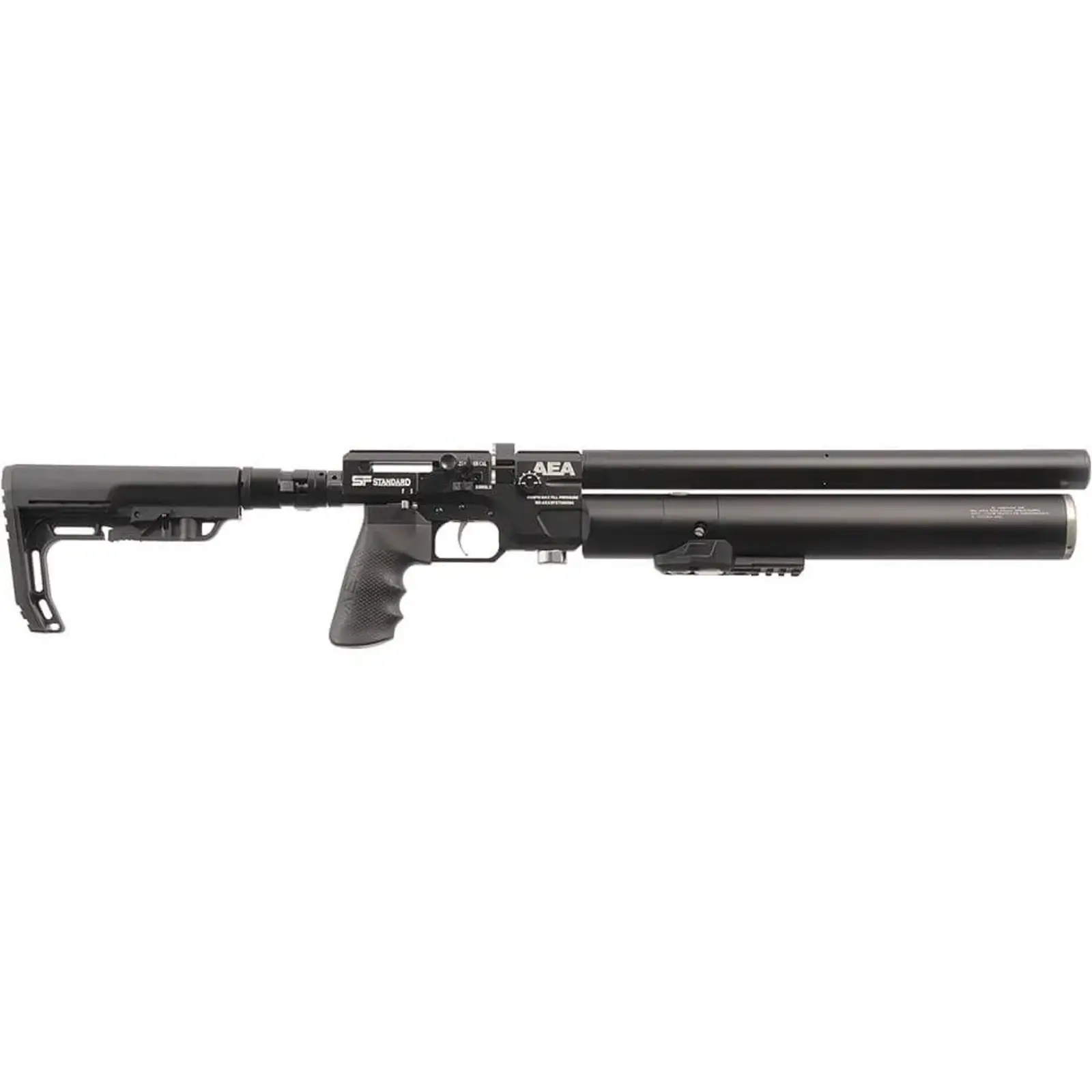
AEA SF Standard Semi-Auto

€840.00


Discover the Versatile Power of the AEA SF Standard Semi-Auto

The AEA SF Standard Semi-Auto is engineered as a groundbreaking select-fire PCP air rifle that combines rapid semi-automatic capability with precise bolt-action performance. Designed for shooters of all experience levels who value both speed and accuracy, this model is positioned as the balanced middle ground in the AEA SF series. A 13-inch barrel and 330cc air tube are featured, allowing the platform to deliver consistent performance across a wide range of applications. Consequently, the AEA SF Standard Semi-Auto is frequently chosen by those seeking an adaptable, high-quality airgun for hunting, pest control, recreational plinking, and range sessions.

Moreover, the select-fire system is integrated so that mode switching is accomplished simply by means of a dedicated selector. In semi-automatic mode, follow-up shots are delivered as quickly as the trigger can be pressed, while bolt-action mode is engaged when maximum energy and deliberate precision are required. As a result, the AEA SF Standard Semi-Auto is valued for its dual-purpose design that adapts to changing conditions without the need for multiple firearms.

Select-Fire Operation and External Regulation

The heart of the AEA SF Standard Semi-Auto is its innovative select-fire mechanism. Semi-automatic cycling is enabled when the rifle is configured at sufficient power levels (typically around 30 joules or higher). When lower power settings are selected, the system reverts to manual bolt operation, ensuring reliable function across the full adjustable range. Furthermore, an externally adjustable regulator is provided so that velocity can be tuned precisely without disassembly. Consistent shot-to-shot performance is therefore maintained as long as reservoir pressure remains above the regulated setting.

In addition, an integrated shroud with internal baffles is incorporated around the barrel. Sound signature is thereby reduced meaningfully right out of the box, while the mechanism itself is protected. Adapters for aftermarket moderators can also be fitted by many users when even quieter operation is desired. Overall length measures 35 inches when the stock is extended and folds to just 24 inches for convenient transport and storage. Weight is held to a manageable 5.3 pounds (approximately 2.4 kg), making the AEA SF Standard Semi-Auto easy to carry during extended sessions or field use.

Key Specifications and Performance Highlights

A comprehensive set of features is delivered by the AEA SF Standard Semi-Auto, making it suitable for diverse shooting needs:

  • Select-fire capability allowing seamless switching between semi-automatic and bolt-action modes
  • Externally adjustable regulator for precise velocity control without tools or disassembly
  • 13-inch precision barrel housed in an integrated, baffled shroud for reduced report
  • Folding stock reducing overall length from 35 inches to 24 inches
  • 330cc air tube with maximum fill pressure of 4500 PSI / 300 BAR
  • Approximately 40+ consistent shots per fill across all available calibers
  • Available in .22 (12-round magazine), .25 (10-round magazine), and .30 (9-round magazine)
  • 11mm dovetail rail for secure optic mounting
  • Lightweight 5.3 lb design with ergonomic grip featuring molded finger grooves and textured surfaces

Muzzle velocities in bolt-action / full-power configuration typically reach up to approximately 860–950 FPS in .22 caliber with standard-weight pellets around 18 grains, up to 850–900 FPS in .25 caliber with pellets near 25 grains, and up to 690–775 FPS in .30 caliber with heavier projectiles near 45 grains. Energy output and exact figures vary with pellet choice, regulator setting, and environmental conditions. It is recommended that quality JSB standard-weight pellets be used; Crosman Premier pellets are generally advised against for optimal reliability and accuracy.

Moreover, two magazines and a fill probe are included so that the rifle is ready for use shortly after unboxing. A Picatinny-style accessory rail under the air tube is also present on many configurations, allowing bipods or other accessories to be mounted for added stability when desired.

Design Features That Enhance Usability

Ergonomics receive careful attention in the AEA SF Standard Semi-Auto. An adjustable length-of-pull stock is provided so that a comfortable shooting position can be achieved by a wide range of users. The grip is textured and contoured to promote a secure hold even during rapid semi-automatic strings or extended sessions. In addition, dual pressure gauges are commonly fitted—one for monitoring reservoir pressure and another for the regulated output—so that air status can be checked at a glance.

The platform is constructed to withstand regular field use. Robust materials and thoughtful engineering ensure that the AEA SF Standard Semi-Auto continues to perform reliably under varied conditions. Consequently, confidence is inspired among shooters who rely on their equipment for pest management, small-game pursuits, or high-volume practice.

Ideal Applications for the AEA SF Standard Semi-Auto

Versatility is one of the strongest attributes of the AEA SF Standard Semi-Auto. In semi-automatic mode, rapid follow-up shots are available for dynamic pest control or fast-paced plinking. When precision is prioritized, bolt-action mode is selected so that every shot receives the full regulated energy and deliberate control. The compact folded dimensions further allow the rifle to be transported discreetly in a backpack or case, expanding its usefulness for mobile hunters and outdoor enthusiasts.

Furthermore, the availability of three popular calibers means that the platform can be matched to specific needs. The .22 caliber option is frequently preferred for high-volume target work and smaller pests, while .25 and .30 calibers deliver increased energy for larger pests or small game where legal and appropriate. Because the external regulator permits fine tuning, velocity can be optimized for the chosen pellet and intended use.

Inclusive design considerations ensure that the AEA SF Standard Semi-Auto can be enjoyed by a broad community of shooters. Whether someone is new to PCP airguns or an experienced enthusiast refining skills, the combination of manageable weight, adjustable stock, clear controls, and dual operating modes supports progressive learning and long-term satisfaction.

Why the AEA SF Standard Semi-Auto Stands Out

Several advantages are combined in this model that are not always found together in a single airgun. Select-fire flexibility is paired with an externally adjustable regulator, a compact yet capable air capacity, effective integrated sound reduction, and a folding stock. As a result, both convenience and performance are delivered without unnecessary compromise. Transitioning between modes requires only a simple selector adjustment, and velocity changes can be made quickly in the field.

In addition, the balanced 13-inch barrel length positions the AEA SF Standard Semi-Auto as a true all-rounder between shorter compact variants and longer sniper configurations. Enough velocity and energy are retained for effective field use, while overall handling remains agile. Consistent regulated shots further support accuracy potential when quality optics are mounted on the 11mm dovetail rail.

Shooters seeking a modern PCP platform that adapts to different scenarios will find that the AEA SF Standard Semi-Auto meets those expectations effectively. Reliability is supported by thoughtful engineering, and the included accessories allow immediate setup. When paired with recommended high-quality pellets and proper filling equipment, the system is ready to deliver engaging shooting sessions.

Experience the Difference Today

The AEA SF Standard Semi-Auto represents a thoughtful evolution in select-fire PCP design. Dual operating modes, external regulation, compact folding dimensions, and solid shot capacity are integrated into a lightweight, user-friendly package available in three practical calibers. Whether rapid semi-automatic fire or deliberate bolt-action precision is required, the platform is prepared to perform.

Anyone looking for an adaptable, engaging, and conversion-ready airgun is encouraged to explore the AEA SF Standard Semi-Auto further. Its combination of features, thoughtful ergonomics, and real-world versatility makes it a compelling choice for a wide range of airgun enthusiasts. Proper local regulations should always be observed, and safe handling practices followed at all times. With the AEA SF Standard Semi-Auto, capable performance and flexible operation are placed within easy reach.

Bintac, AEA Airguns, PCP Platforms and Model Terminology

Bintac and AEA Airguns are names commonly associated with large-caliber PCP airgun discussions, including models and search terms such as bintac t9, bintac, bintac llc, bin tac, bintacllc, aea airguns, bintac t 50, bintac m50, bintac mcar, bintac t50, and bintac s45.

Enthusiasts researching these platforms may also encounter terminology including bintac t9 full auto, bintac mcar air rifle, bintac mcar 457, bintac m50 pistol, bintac t50 extreme, bintac m50 pump action, aea bintac t50 extreme, and automatic air gun. These terms generally describe particular configurations, operating systems, calibers, or model families and should always be understood in the context of applicable local airgun laws and safe handling requirements.

Calibres, FAC Considerations, Power Output and Accessories

The AEA SF Standard Semi-Auto is offered in three practical calibres that allow shooters to match projectile size, energy and magazine capacity to their primary needs. Each option is supported by a regulated air system and the same select-fire mechanism, so the choice of calibre mainly influences terminal performance, shot count and trajectory rather than core handling characteristics.

Available Calibres and Magazine Capacities

Three calibres are currently produced for this model. The .22 calibre version is supplied with a twelve-shot magazine and is frequently selected for high-volume practice, pest control of smaller species and general plinking. Projectiles in the 15–18 grain range are commonly used and deliver a useful balance of speed and accuracy. The .25 calibre option carries a ten-shot magazine and provides a noticeable step up in energy while remaining suitable for a wide range of field applications. Standard projectiles around 25 grains are typically recommended. The .30 calibre variant uses a nine-shot magazine and is favoured when greater down-range energy is required for larger pests or small game where local regulations permit. Projectiles in the mid-40-grain range are the usual choice for this calibre.

Because the external regulator can be adjusted without tools, velocity can be fine-tuned for each calibre and projectile combination. This flexibility means the same rifle platform can be optimised for different roles simply by changing the magazine and adjusting the regulator setting. Magazines are calibre-specific and are designed for reliable auto-indexing in both semi-automatic and bolt-action modes.

FAC Status and Legal Power Considerations

In many jurisdictions, including the United Kingdom, air rifles that exceed the legal energy limit for unlicensed ownership require a Firearms Certificate (FAC). The AEA SF Standard Semi-Auto is generally configured to produce muzzle energies well above the common 12 ft-lb (approximately 16 joule) threshold. European listings commonly quote figures in the region of 30 joules for the smallest calibre, rising to approximately 55–64 joules for the larger options when the rifle is set for full power. These levels place the platform firmly in the FAC category in the UK and in similar regulated environments elsewhere.

It is essential that every prospective owner verifies the legal requirements in their own location before purchase or use. Licensing, secure storage, and permitted uses vary significantly between countries and even between regions. In FAC areas the higher power levels unlock greater effective range and terminal performance, yet they also bring corresponding responsibilities regarding transport, storage and authorised shooting locations. The rifle’s adjustable regulator allows the power to be reduced if a lower-energy configuration is preferred for specific training or practice sessions, although semi-automatic cycling typically requires a sufficient power level to function reliably.

Power Delivery and Performance Characteristics

Power is delivered by a 330 cc air tube filled to a maximum of 4500 PSI (300 BAR). An externally adjustable regulator maintains consistent output pressure for each shot as long as reservoir pressure remains above the set point. This regulated design produces far more stable velocities than unregulated systems and contributes directly to the platform’s accuracy potential.

Approximate performance figures in bolt-action or full-power mode (using recommended standard-weight projectiles) are as follows:

  • .22 calibre: velocities typically ranging from the mid-800s to around 950 FPS depending on exact pellet weight and regulator setting
  • .25 calibre: velocities commonly in the 850–900 FPS range
  • .30 calibre: velocities generally between 690 and 775 FPS

Corresponding muzzle energies rise with calibre and projectile mass. Shot counts of forty or more consistent rounds per fill are regularly reported across all three calibres when the regulator is set at moderate levels. Higher power settings reduce the number of usable shots while increasing energy on target. Because the system is regulated, velocity remains useful deep into the fill rather than dropping sharply after only a few shots.

The select-fire mechanism itself influences power delivery. In semi-automatic mode the rifle cycles as quickly as the trigger can be pressed, provided the power setting is high enough to complete the cycle. In bolt-action mode the full regulated energy is directed into each individual shot, making this setting preferable when maximum precision or energy is required.

Included and Recommended Accessories

The standard package typically includes the rifle, a fill probe compatible with common high-pressure fittings, and two magazines matched to the chosen calibre. These items allow the rifle to be filled and used shortly after unboxing once any necessary local legal formalities have been completed.

A wide range of additional accessories is commonly fitted by owners to expand capability and convenience. An 11 mm dovetail rail accepts a broad selection of scopes, red-dot sights and mounts; most users add an optic because open sights are not supplied. Under-tube accessory rails support bipods for added stability during longer sessions or when shooting from improvised rests. Aftermarket moderator adapters (including popular DonnyFL-style options) can be fitted to the integrated shroud for further sound reduction where regulations allow.

Extra magazines are a practical addition for extended range time or field use. Quality filling equipment—hand pumps, carbon-fibre bottles or compressors—ensures the 4500 PSI maximum can be reached safely and efficiently. Soft cases or hard cases sized for the folded 24-inch length simplify transport and storage. Because the rifle is relatively light at 5.3 lb, many shooters also add sling swivels or a suitable sling for comfortable carry over longer distances.

When selecting accessories it is advisable to choose items specifically compatible with the platform’s rail dimensions, thread standards and overall dimensions. Proper installation and regular inspection help maintain reliability and accuracy over time.

Together, the three available calibres, the FAC-level power potential, the adjustable regulated output and the expanding ecosystem of accessories make the AEA SF Standard Semi-Auto a highly adaptable platform. Whether the priority is high-volume practice, discreet pest control or more demanding field use, the combination of calibre choice, power flexibility and accessory support allows the rifle to be configured for a wide range of legitimate shooting activities while remaining within the bounds of local law.

AEA Harpoon and Related Search Terms

The AEA Harpoon family is frequently discussed alongside phrases such as bintac aea harpoon, aea harpoon, aea harpoon magnum, aea harpoon gun, aea harpoon cartridge, aea .50 harpoon, aea harpoon air gun, harpoon air gun, and the commonly mistyped aa harpoon.

Because specifications can differ between generations and configurations, prospective researchers should verify caliber, energy output, compatible air systems, ammunition type, and manufacturer documentation rather than relying solely on model-name searches.

AEA Megalodon and Large-Caliber PCP Airguns

Another commonly researched platform is the AEA Megalodon, appearing under terms including aea megalodon, megalodon air rifle, aea megalodon 58 cal, aea megalodon .58 cal, aea megalodon air rifle, and aea megalodon 50 caliber.

Large-caliber PCP platforms are also associated with broader terms such as air powered 50 cal rifle, air tank for pcp airguns, and airgun shotgun. Because high-powered PCP equipment can store substantial compressed-air pressure and generate significant projectile energy, tanks, fittings, valves, and charging equipment should be used only within their certified operating limits.

AEA Defender and Terminator Platforms

Other AEA terminology includes aea defender, aea defender 2, aea defender 3, aea terminator, aea terminator gen 3, and the broader phrase aea guns. Different generations may vary substantially in action type, dimensions, magazine arrangement, air capacity, caliber, and operating pressure.

Anyone comparing these systems should therefore check the exact model designation and generation before comparing technical specifications.

PCP Air Systems and Supporting Equipment

PCP airguns depend on compressed-air storage systems. Search terms such as anti air tanks and air tank for pcp airguns may refer to high-pressure cylinders or charging equipment. Only pressure-rated equipment designed for the intended system should be used.

Other broad search phrases, including bee bee gun rifle, airgun shotgun, and automatic air gun, describe different categories of air-powered equipment rather than one standardized product type.

Additional Large-Caliber Airgun Terminology

Researchers may also encounter terms including zeus 72 cal air rifle, b&w m50, bintac t9, bintac m50, bintac t50, bintac s45, and bintac mcar. Model names alone do not establish compatibility, legality, operating pressure, caliber, or performance, so manufacturer documentation remains the appropriate source for technical specifications.

For all Bintac, AEA Airguns, and large-caliber PCP systems, safe storage, responsible handling, appropriate protective equipment, and compliance with local laws should remain central considerations.aea megalodon for sale

Frequently Asked Questions

What operating modes are available and how does mode switching work? Two distinct operating modes are supported so that users can match the rifle’s behavior to the situation at hand. In one mode, the mechanism cycles automatically after each trigger pull, enabling rapid follow-up shots limited only by how quickly the trigger can be pressed. In the alternative mode, each shot requires a deliberate manual cycle of the bolt, which directs the full available energy into a single, carefully placed projectile. Switching between these modes is accomplished with a simple selector lever located for convenient access. When the automatic mode is engaged, the bolt moves freely; when the manual mode is selected, the bolt is held forward until released by the operator. It is important to note that reliable automatic cycling generally requires the power setting to remain at a sufficient level. If the output is reduced substantially, the system reverts to manual operation to maintain consistent function. This dual-mode design allows the same platform to serve both dynamic, fast-paced shooting and deliberate, precision-oriented work without the need for additional equipment.

Which caliber options can be selected and what magazine capacities accompany them? Three popular calibers are offered so that the platform can be matched to different projectile weights, energy needs, and intended uses. The smallest caliber utilizes a magazine holding twelve projectiles, the mid-size option holds ten, and the largest holds nine. Each magazine is designed for reliable indexing so that feeding remains consistent whether the automatic or manual mode is in use. Caliber choice influences both velocity potential and terminal performance; lighter projectiles in the smaller caliber typically achieve higher speeds, while heavier projectiles in the larger calibers deliver greater energy on target. Because the external regulator permits fine adjustment, velocity can be optimized for the specific projectile and application. Many users find that matching the caliber to the primary purpose—whether high-volume practice, pest management, or small-game pursuits—produces the most satisfying results. Magazines are interchangeable within the same caliber, and extras can be carried for extended sessions without interruption.

How many consistent shots can typically be expected from a full fill? With a properly filled 330 cc air reservoir pressurized to the maximum recommended level, approximately forty or more consistent shots are commonly obtained across all three caliber options when the regulator is set appropriately. The exact number depends on the chosen power setting, projectile weight, ambient temperature, and shooting cadence. Because the system is regulated, shot-to-shot velocity remains far more stable than unregulated designs, which means usable accuracy is maintained deeper into the fill. As reservoir pressure drops toward the regulator set point, velocity begins to decline gradually; most users refill before this point to preserve consistency. Monitoring the onboard pressure gauges allows the remaining air supply to be checked at a glance so that an unexpected loss of power can be avoided. In practical terms, a single fill often supports an entire range session or a productive outing for pest control, provided the power level is not set excessively high.

What type of projectiles are recommended for reliable performance? High-quality, standard-weight projectiles from reputable manufacturers are strongly preferred. Projectiles that maintain consistent weight, skirt dimensions, and overall form tend to feed reliably and deliver predictable accuracy. Certain widely available lower-cost options have been found to cause feeding or cycling issues in this platform and are therefore best avoided. Experimentation with different weights within the recommended range can help identify the combination that produces the tightest groups for a given regulator setting. Because the barrel is precision-made and the system is regulated, the rifle responds well to carefully chosen ammunition. Keeping projectiles clean, properly stored, and free from damage further supports consistent feeding and accuracy. Many experienced users keep a selection of proven projectiles on hand and test new lots to confirm performance before relying on them for important shooting.

How is the air reservoir filled and what maximum pressure is supported? Filling is performed with a compatible high-pressure air source such as a hand pump, scuba tank, or compressor equipped with the appropriate probe or fitting. The maximum recommended fill pressure is 4500 PSI (approximately 300 BAR). Overfilling beyond this limit is not advised, as it can place unnecessary stress on components and may affect regulator performance. A fill probe is typically supplied so that connection is straightforward. After filling, both the reservoir pressure gauge and the regulator gauge should be checked to confirm that the system is within the desired operating range. Regular inspection of seals and fittings helps maintain leak-free performance over time. Because the platform uses a regulated design, the usable shot count and consistency remain high even as the reservoir pressure declines, provided the regulator set point is respected.

What role does the external regulator play and how is it adjusted? The external regulator maintains a consistent output pressure for each shot as long as the reservoir pressure remains above the set point. This consistency is the foundation of the platform’s accuracy potential and shot-to-shot reliability. Adjustment is performed externally without the need to disassemble any major components, allowing fine-tuning of velocity in the field or at the range. Turning the adjustment alters the regulated pressure, which in turn changes the energy delivered to the projectile. Lower settings reduce velocity and energy while extending the number of usable shots; higher settings increase performance at the cost of fewer shots per fill. Because the adjustment is external and accessible, users can experiment efficiently to find the combination of velocity, accuracy, and shot count that best suits their needs. Once a preferred setting is established, it remains stable until deliberately changed.

What are the overall dimensions and weight, and does the stock fold? Overall length measures approximately 35 inches with the stock fully extended. When the stock is folded, the length is reduced to roughly 24 inches, making transport and storage considerably more convenient. Weight is held to approximately 5.3 pounds, which contributes to comfortable carry during extended periods afield or at the range. The folding stock is designed for quick deployment and secure locking in both positions. An adjustable length of pull further allows the rifle to be fitted to a wide range of users for improved comfort and control. The combination of modest weight, compact folded dimensions, and adjustable stock makes the platform practical for mobile use while still providing a stable shooting platform when extended.

How is sound signature managed and can additional moderation be added? An integrated shroud containing internal baffles surrounds the barrel and reduces the report to a more neighbor-friendly level compared with unshrouded designs. The baffles disrupt and slow the escaping air, lowering perceived loudness without significantly affecting velocity. For users who require even quieter operation, aftermarket adapters are available that allow additional moderators to be fitted to the muzzle end of the shroud. The effectiveness of any additional moderation depends on the specific device chosen and local regulations governing sound-reducing accessories. Even without extra equipment, the built-in baffling provides meaningful reduction that many users find sufficient for backyard practice or discreet field use where permitted.

What mounting options exist for optics and accessories? An 11 mm dovetail rail is provided on the receiver for secure attachment of scopes, red-dot sights, or other optical devices. This standard interface accepts a wide variety of rings and mounts commonly available for air rifles. Under the air tube, a short accessory rail is typically present so that a bipod or other support can be attached when additional stability is desired. Because the rifle does not come equipped with open sights, an optic is recommended for realizing its accuracy potential. Proper mounting torque and alignment help maintain zero across temperature changes and repeated use. Many users pair the platform with a quality variable-power scope that matches their typical engagement distances.

Is the platform suitable for both new and experienced shooters? The combination of manageable weight, adjustable stock, clear controls, and dual operating modes makes the rifle accessible to those who are relatively new to pre-charged pneumatic systems while still offering the performance features valued by experienced users. Automatic mode allows rapid practice and dynamic shooting once the basics of safe handling and filling are understood. Manual mode encourages deliberate shot placement and is useful for developing fundamental skills. Inclusive design elements such as the textured grip, accessible selector, and external regulator adjustments support a broad range of hand sizes and experience levels. As with any airgun, proper instruction in safe handling, local regulations, and basic maintenance is essential before use.

What routine maintenance is recommended to keep the system performing well? Regular inspection of seals, the fill probe, and magazine feed lips helps prevent common issues. The barrel should be cleaned periodically with appropriate airgun-safe methods to remove residue that can affect accuracy. Lubrication should be applied sparingly and only to manufacturer-recommended points; over-lubrication can attract debris or affect regulator function. After each use, residual pressure can be left in the reservoir or bled according to personal preference, though many users prefer to store the rifle with some pressure remaining. Magazines benefit from occasional cleaning to ensure smooth rotation. Avoiding exposure to extreme moisture or prolonged direct sunlight helps preserve both metal and polymer components. Following these straightforward practices supports long-term reliability and consistent performance.

What items are typically included when the rifle is purchased? The standard package generally contains the rifle itself, a fill probe compatible with common high-pressure fittings, and two magazines matched to the selected caliber. Documentation covering basic operation and safety is also provided. Additional magazines, optics, bipods, and filling equipment are available separately so that the platform can be customized to individual preferences. Checking the contents upon receipt ensures that everything expected is present and undamaged before first use.

These answers address the most common questions raised by users evaluating or owning this select-fire platform. Proper adherence to local laws, safe handling practices, and manufacturer guidelines remains essential for every shooter.
Caliber

.22, .25, .30

Reviews

There are no reviews yet.

Be the first to review “AEA SF Standard Semi-Auto”

Related Products

FAQ

  • Spring-Piston (Break-Barrel or Underlever): Cock by compressing a spring. Reliable, no external air source needed, but can have more recoil (“spring twang”) and require technique to shoot accurately.
  • Pre-Charged Pneumatic (PCP): Filled from a scuba tank, compressor, or pump. High power, low recoil, multiple shots per fill. Popular for precision and hunting.
  • CO₂: Powered by disposable cartridges. Good for pistols and semi-auto/repeaters, but performance drops in cold weather.
  • Multi-Pump Pneumatic: Hand-pumped to build pressure. Versatile but requires effort.
  • Gas Ram (Nitro Piston): Uses compressed gas instead of a metal spring. Smoother than traditional springers.

Calibers: Most common are .177 (4.5mm) for speed/flat trajectory and general use, and .22 (5.5mm) for better hunting knockdown power. Larger “big bore” (.25, .30, .357+) exist for hunting bigger game where legal.

Yes, many modern PCP and springers deliver enough energy for small game (rabbits, squirrels, birds) and even larger game in some areas. Muzzle energy (in ft-lbs or joules) matters more than velocity alone. Always match caliber, pellet weight, and energy to the game and check local hunting regs.

Treat every airgun as if it is loaded.

  • Always point the muzzle in a safe direction.
  • Keep your finger off the trigger until ready to shoot.
  • Know your target and what is beyond it (pellets can ricochet or travel far).
  • Wear eye protection.
  • Store unloaded, out of reach of children/untrained users, and ideally locked.
  • Never shoot at hard surfaces or in areas where pellets could escape your property.

Follow these rules strictly—airguns cause real injuries.

Laws differ dramatically by country, state/province, and even city. Always verify current local laws before buying, owning, transporting, or using an airgun. Age restrictions (often 18+) are common.

Examples (summaries only; check official sources):

  • UK: Air rifles ≤12 ft-lbs (16.3 joules) and pistols ≤6 ft-lbs generally do not require a license (FAC needed above that).
  • USA: Varies by state. Some treat powerful airguns as firearms; others do not. Many states now allow big-game hunting with air rifles.
  • Canada: Some airguns classified as firearms if they exceed velocity/energy thresholds.
  • Australia: Often treated as firearms; licensing/registration required in most states.
  • EU/France/Belgium/etc.: Varies; many allow low-power (<20J) guns freely to adults, with higher power needing permits. Germany has strict ~7.5J limits in some contexts.
  • Other countries: Some have no restrictions below certain energies; others ban or heavily regulate them.

Resources: Wikipedia “Air gun laws”, airgun forums, or official government sites. For travel, research transit laws carefully.

Consider:

  • Purpose: Plinking/backyard → lower power springer or CO₂. Hunting/precision → PCP.
  • Budget: Entry-level springers are affordable; PCPs need a fill system (extra cost).
  • .177 vs .22: .177 easier for beginners/targets; .22 better for hunting.
  • Power source: Convenience vs performance.
  • Test pellets in your gun—accuracy varies.

Buy from reputable dealers and consider warranties.

  • Clean barrel periodically (especially if accuracy drops) with patches and appropriate tools/solvents. Avoid over-oiling.
  • Lubricate moving parts and seals with airgun-specific oil (not general gun oil). Springers need piston seal oil occasionally.
  • Check screws, seals for leaks (PCP), and safety mechanisms regularly.
  • Store in a cool, dry place, ideally in a case. Avoid leaving cocked for long periods.

Follow your model’s manual. Basic care extends life significantly.

International shipping may be available for select products. Customers are responsible for understanding and complying with their local import laws and regulations before ordering.

Yes. Customers are required to confirm their order number through WhatsApp or Live Chat before orders are processed and shipped.

If local laws prevent shipment to your area, your order may be canceled and refunded according to our store policy.

Processing typically takes 1–3 business days after payment confirmation. Delivery times vary depending on destination, carrier, and product availability.


  • Wrong pellets for your barrel/caliber.
  • “Death grip” or poor shooting form (especially with springers—let the gun recoil naturally).
  • Loose scopes or mounts.
  • Ignoring safety or local laws.
  • Over-oiling or shooting with obstructions.


Pellets are the most common projectile (lead or lead-free). Match them to your gun, caliber, and purpose—test several brands as accuracy varies by barrel.

  • Domed (Round-Head): Best all-rounder. Excellent accuracy, ballistic coefficient, and energy retention. Ideal for target shooting, field target, and general hunting (e.g., JSB Exact, Air Arms Diabolo Field, H&N Field Target Trophy).
  • Wadcutter (Flat-Head): Clean holes in paper. Best for close-range target/plinking (under 20-25 yards).
  • Hollow Point: Expands on impact for better energy dump. Good for small game hunting (e.g., Predator Polymag, H&N Terminator).
  • Pointed: More penetration, but often less accurate than domed.
  • Slugs: Heavier, more aerodynamic for high-power PCPs at longer ranges (better for big game where legal).

Tips: Heavier pellets in .22/.25 for hunting (better momentum). Lighter in .177 for speed/flat trajectory. Always check head size fit (e.g., 4.51-4.53mm variants).

Muzzle energy (ft-lbs or joules) matters more than velocity. Ethical shots require precise placement (head/heart-lung) within effective range.

Rough Guidelines (adjust for distance, pellet, and local laws):

  • Small game (squirrels, rabbits, birds): 9-20+ FPE, .177/.22.
  • Medium (raccoons, etc.): 25+ FPE, .22/.25 recommended.
  • Larger game: 40-100+ FPE in .30+ calibers (up to big bore for deer/hogs where permitted).

PCPs dominate serious hunting due to power and shot count. Springers/gas rams work well for small game but require skill. Always prioritize clean kills and check seasons/species rules.

  • Barrel Cleaning: Use a pull-through kit or rod with patches. Avoid brushes that could damage rifling. Clean when accuracy drops or after 500-1000 shots.
  • Lubrication: Airgun-specific silicone oil for seals/O-rings (sparingly—excess causes dieseling in springers). Springers may need piston lube periodically.
  • PCP Specific: Check for leaks (soapy water test), monitor regulator/hammer settings, and keep fill systems clean. Don’t exceed rated pressure.
  • General: Tighten stock screws, inspect for wear, store properly. Chronograph shots to track consistency.

Common Issues:

  • Inconsistent velocity → dirty barrel, bad pellets, or seal problems.
  • Spring “twang” → tuning or proper hold.
  • Low power → worn seals or under/over-pumping.

Toggle Content

  • Scopes: Airgun-rated (hold zero under recoil). 3-9x or 4-12x common.
  • Fill Systems: Hand pumps, compressors, or tanks for PCPs.
  • Safety Gear: Eye/ear protection, targets with backstops.
  • Noise: Airguns quieter than firearms, but moderators help further.

Budget Tip: Start with a quality springer (~$150-400) before investing in PCP setup.

Airgunning offers endless depth—from backyard plinking to precision competition and ethical hunting. Prioritize safety, legality, and practice. If you want specifics (e.g., recommendations for a country, budget, hunting small game, or a particular type like PCP vs springer), let me know for more targeted info! Shoot responsibly.

Tuning improves accuracy, reduces noise/recoil, or increases power (within legal limits).

  • Springers: Lighter springs, guides, seals, or custom tuning kits for smoother shot cycle. “V-Mach” or similar professional tunes popular.
  • PCPs: Regulator tuning, hammer spring adjustments, valve work for efficiency and shot count. Some add electronic systems.
  • Accessories: Suppressors (often unregulated on airguns), better triggers, stocks, and scopes.

Caution: Check laws—power increases may reclassify your gun. DIY only if experienced; professional tuners recommended.

You must be at least 18 years old to purchase any airgun or related accessories from our store. By placing an order, you confirm that you meet the legal age requirements in your state or country.

Yes. Orders may require age verification before processing and shipping. In some cases, we may request a valid government-issued ID to confirm eligibility.