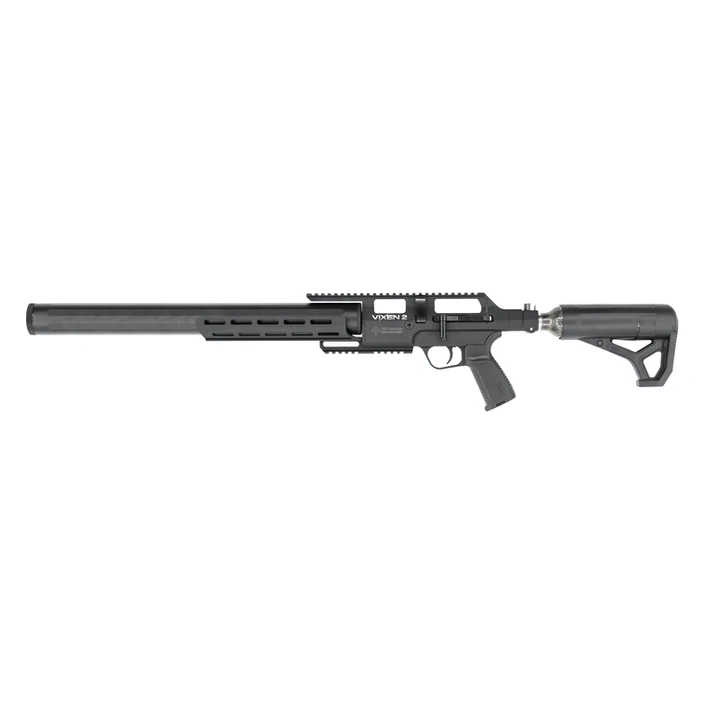
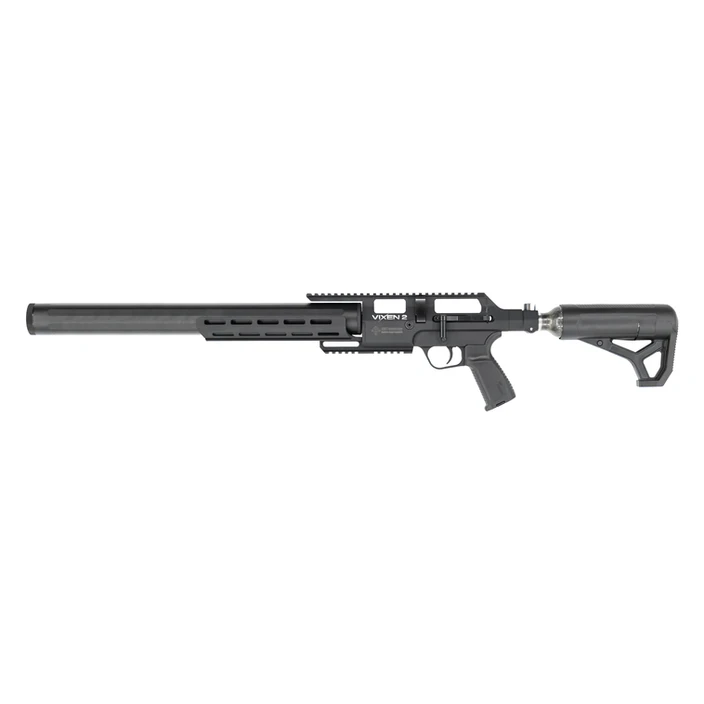
Furthermore, a short overall length of approximately 803 mm is combined with a weight of about 2.5 kg. As a result, the rifle can be carried, mounted, and repositioned with less fatigue. Meanwhile, a 310 mm CZ-made barrel is employed so that pellet flight remains consistent from shot to shot.
Traditional layouts have been set aside in several areas. Instead, an inline bottle-stock configuration has been adopted so that the carbon-fibre cylinder sits in line with the action. Therefore, balance is improved and the profile stays slim.
In addition, a moulded bottle stock has been fitted in place of earlier sleeve-style arrangements. Comfort at the shoulder is increased, and a more finished appearance is presented. At the same time, an ambidextrous comb and rubber butt pad are provided so that left- and right-handed shooters can share the same platform with equal ease.
Moreover, a reversible biathlon-style side lever is included. The lever can be swapped from one side to the other, and a rotary safety above the trigger guard can be reached without changing grip. Consequently, operation remains straightforward during longer strings.
Accessory mounting has been modernised. An ARCA handguard with M-LOK slots is fitted along the forend, so the rifle can be clamped to tripods and shooting rests without a basic friction mount. Additionally, Picatinny sections are placed under the barrel and a long 26-slot Picatinny rail is offered on top. Optics, thermals, lights, and bipods can therefore be added as needs change.
Likewise, a threaded muzzle (typically 1/2″ UNF) is supplied on the shrouded barrel. A silencer of the owner’s choice—including AGT’s own Liska unit—can be fitted without adapters. Sound is moderated further, and neighbours or nearby wildlife are disturbed less.
Three popular calibres are offered: 4.5 mm (.177), 5.5 mm (.22), and 6.35 mm (.25). Local regulations and intended use should always be checked before a power level is selected. In many markets a sub-12 ft-lb configuration is supplied; FAC or higher-output setups may be available where permitted.
A regulator is fitted so that air is delivered at a more stable pressure. Plenum volume (around 43 cc on many examples) has been increased compared with earlier designs. Therefore, shot-to-shot variation is reduced and vertical stringing on target is limited. Fill pressure is rated to 300 bar via a probe charger. Shot counts vary with calibre, pellet weight, and tune; typical figures quoted by retailers include roughly 145 shots in .177 and fewer, higher-energy shots in the larger calibres.
Additionally, hammer-spring tension is adjustable on many examples. Velocity can be raised or lowered within legal limits. A compact manometer is placed so that remaining pressure can be read at a glance.
Rotary magazines are supplied in the capacities listed above. A mag well that also accepts single pellets is retained, so practice or careful loading can be completed without a magazine if preferred. Note that an anti-double-load feature is not always present; attention during cycling is still required.
On the range, the long top rail accepts a variety of scopes. Parallax-friendly airgun optics are recommended so that shorter distances can be focused cleanly. Groups from a rested position are commonly described as tight when quality pellets are matched to the barrel.
Inclusive use is supported by the reversible lever, ambidextrous comb, and modest weight. New shooters and experienced owners alike can find a comfortable hold. Responsible storage, legal compliance, and eye protection remain essential for every user.
A carbon-fibre bottle and aluminium/polymer furniture keep mass down, yet regular inspection of O-rings, the probe port, and the regulator is still advised. Dry storage and manufacturer-recommended lubrication help preserve consistency. Local airgun laws, age limits, and transport rules must be followed in every jurisdiction.
Diana, Bintac, AEA and Hatsan Airguns: Rifles, Pistols, PCPs and Accessories
For shooters comparing trusted platforms, the Diana range remains a major point of interest. Searches such as diana air rifle, diana air rifles, air rifle diana, rws diana air rifle, rws diana, diana rws, and diana r reflect the continued popularity of classic airgun designs. Well-known spring-powered choices include the diana 34, diana model 34, diana rws 34, rws diana 34, diana r34, and diana 34 air rifle. Shooters interested in the updated modular platform may also search for diana 34 ems or diana 34 ems fiber optic sights.
Other established models continue to attract enthusiasts, including the diana 35, diana 48, diana mod 48, rws diana model 48, diana 54, diana 350 magnum, diana 350 magnum air rifle, 350 magnum diana, and diana rws 460 magnum. These rifles appeal to buyers comparing traditional spring-piston construction, power, accuracy, build quality, and different configurations for recreational or sporting use.
Diana PCP Air Rifles, Pistols and Accessories
The Diana catalog also includes PCP, CO2, and pistol-format options suited to different shooting preferences. Popular searches include diana r22, diana 2, diana 250, diana two fifty, diana 250 air rifle, diana stormrider, diana outlaw gen 2, diana airbug, diana bandit black, diana lp8, lp8 diana, diana air pistol, and diana pellet gun.
Owners looking to maintain, repair, or customize certain platforms may also search for diana chaser accessories and diana chaser parts. For target shooting and recreational plinking, a 4.5mm air gun remains a common caliber choice. Meanwhile, hunting diana searches often focus on Diana rifles suited to lawful pest-control or hunting applications where airgun use is permitted.
The term nerf diana can occasionally appear alongside Diana-related search traffic, although it represents a different product category and should not be confused with traditional pellet rifles or air pistols.
Bintac and AEA PCP Airguns
Big-bore and tactical PCP enthusiasts frequently compare Diana products with Bintac and AEA platforms. Popular searches include bintac aea harpoon, aea harpoon air gun, bintac t9 full auto, bintac t9 price, bintac mcar 457, aea terminator, and aea megalodon for sale.
Other related searches include airgun shotgun, automatic air gun, air powered 50 cal rifle, and zeus 72 cal air rifle price. Shooters setting up high-pressure PCP equipment may also research an air tank for pcp airguns or anti air tanks while comparing suitable filling equipment and accessories.
The broader phrase bee bee gun rifle may also be used by new shooters searching for BB rifles, pellet rifles, and other recreational air-powered platforms.
Hatsan Air Rifles and PCP Platforms
Hatsan remains another widely searched manufacturer across spring-piston, PCP, semi-automatic, and big-bore categories. General searches such as hatsan air rifle, hatsan air guns, hatsan pcp, hatsanusa, hatsan usa, air rifle, air rifles, and airguns cover a broad selection of products.
Break-barrel shoppers frequently compare the hatsan model 95, hatsan mod 95, mod 95, hatsan 125, hatsan 135, hatsan 135 vortex air rifle, hatsan 135 carnivore, hatsan zada, and hatsan airtact air rifle. The related search hatsan airtact is also common among buyers researching lightweight and affordable break-barrel rifles.
Customers searching for discounted or previously owned products may also use the phrase hatsan refurbished while comparing factory-refurbished or pre-owned Hatsan models.
Hatsan PCP and Big-Bore Airguns
For PCP enthusiasts, popular searches include hatsan flash, hatsan flashpup qe, hatsan bullboss, hatsan hercules, hatsan hercules bully, hatsan invader, hatsan factor rc, hatsan neutron star, hatsan harpoon, hatsan piledriver, and hatsan big bore carnivore rifle.
These searches cover everything from compact PCP rifles to powerful large-caliber platforms. Buyers can compare factors such as air capacity, operating pressure, caliber, barrel configuration, magazine capacity, stock design, overall weight, and intended use before selecting a suitable platform.
Hatsan Blitz, Sortie and Semi-Automatic Models
Shooters interested in rapid-fire PCP platforms frequently search for hatsan sortie, hatsan sortie tact, hatsan sortie tact semi-auto pcp, and hatsan sortie accessories. The Hatsan Blitz family also generates searches including hatsan blitz, hatsun blitz, hatsan blitz full automatic, and hatsan blitz 30 cal.
Compact PCP pistol and carbine shoppers may also research the hatsan velox and hatsan jet 2, providing additional choices for shooters who prefer smaller platforms.
Airgun Optics, Pellets and Accessories
Accessories, optics, ammunition, and filling equipment are important parts of a complete airgun setup. A basic 4×20 optic may suit certain entry-level rifles, while ammunition such as h&n field target trophy bleifrei can appeal to shooters specifically searching for lead-free pellets.
The search phrase econ ii may also appear alongside airgun-related product research depending on the equipment, accessory, or platform being compared.
Whether the goal involves target shooting, recreational plinking, collecting, pest control, or lawful hunting, the wide selection of Diana, AEA, Bintac, and Hatsan platforms gives shooters numerous choices. Comparing the correct caliber, rifle type, filling system, optics, pellets, accessories, and replacement parts can help buyers identify equipment that best matches their intended application.
Frequently Asked Questions
Answers to the questions most often raised about this compact, regulated PCP carbine are collected below. Legal power, calibre choice, filling, accessories, and everyday handling are explained in plain terms so that a confident, responsible purchase can be made.
General Setup and Handling
What overall size and weight should be expected?
A short overall length of about 803 mm is combined with a mass of roughly 2.5 kg before a scope is fitted. Consequently, carrying, mounting on a rest, and moving through tight cover are made easier. Balance is further improved because the carbon bottle is placed in line with the action rather than hung as a separate club-like stock.
Can the rifle be used comfortably by left-handed shooters?
Yes. A biathlon-style side lever can be swapped from one side to the other. An ambidextrous comb and a reachable rotary safety are also provided. Therefore, left- and right-handed users can share the same platform without a second dedicated rifle.
Is the trigger adjustable?
A two-stage trigger is fitted. First-stage travel and release weight can be tailored after the owner has become familiar with the let-off. Safe dry practice with an empty magazine and confirmed clear barrel is recommended before any live-fire adjustment is attempted.
How is the safety operated?
A rotary switch is located above the trigger guard. It can be moved with the thumb without a change of firing grip. The rifle should still be treated as loaded until the magazine has been removed and the barrel has been checked.
Calibres, Pellets, and Magazines
Which calibres are available?
Three options are normally listed: 4.5 mm (.177), 5.5 mm (.22), and 6.35 mm (.25). Choice should be matched to legal power, typical shooting distance, and pellet availability in the owner’s region.
How many pellets does each magazine hold?
Sixteen rounds are held in .177, thirteen in .22, and eleven in .25. Spare magazines can be carried so that a session is not interrupted by slow single loading. A well that also accepts a single pellet is retained for careful practice or for testing a new pellet type.
Are slugs supported?
An un-choked CZ barrel is used, so slug potential is often discussed by reviewers. Accuracy is not guaranteed with every slug design. Extensive testing at the intended distance is required before slugs are relied upon for pest work or hunting where that use is lawful.
Which pellets usually group well?
No single pellet is ideal for every barrel. Mid-weight wadcutters or domed pellets in the calibre’s common grain range should be tried first. After groups have been shot from a rest, the most consistent lot can be bought in quantity. Chronograph readings help confirm that the chosen pellet stays inside the legal energy limit.
Power, FAC, and Legal Considerations
Is this a sub-12 rifle or an FAC rifle?
Both configurations can be supplied, depending on market and licence. Many examples are prepared under 12 ft-lb (about 16 joules) for jurisdictions such as the United Kingdom. Higher-output FAC versions may be available where a firearms certificate and local law allow. The stamp and the seller’s documentation must be checked before payment is completed.
Can power be changed after purchase?
Hammer-spring tension is adjustable on many rifles. Velocity can be raised or lowered, but the result must remain inside the legal envelope. A chronograph session after any change is essential. Unlicensed increase of power above the local limit is unlawful.
Why is .25 sometimes discouraged in a low-power tune?
Efficiency and accuracy can suffer when a large pellet is driven at modest energy. Retailers often note that .25 in a sub-16-joule setup is chosen at the buyer’s own risk. .177 or .22 is usually preferred when a garden-legal or low-power rifle is required.
Must local laws be checked even if the rifle looks “airgun only”?
Yes. Age limits, transport rules, storage requirements, hunting seasons, and silencer rules differ by country and sometimes by region. Inclusive, responsible ownership includes reading the current law rather than assuming that a compact PCP is unrestricted.
Air System, Regulator, and Filling
What fill pressure is used?
A maximum fill of 300 bar is specified. Overfilling must be avoided. A compatible probe and a gauge that can be read clearly should be used every time the bottle is charged.
Is the system regulated?
Yes. A regulator is fitted so that working pressure stays more consistent through the useful part of the fill. Typical factory set-points quoted in listings include about 110 bar for .177, 130 bar for .22, and 140 bar for .25. Exact figures can vary by batch and tune.
How many shots can be expected from one fill?
Counts depend on calibre, pellet weight, regulator setting, and how far pressure is allowed to drop. Published examples often mention around 145 shots in a sub-12 .177 tune, with fewer shots in the larger calibres or on FAC settings. A personal logbook of chronograph data is more reliable than a brochure number.
What bottle capacity is used?
A compact carbon-fibre cylinder in the region of 220–250 cc is commonly described. High shot counts are still achieved because the regulator and plenum (often about 43 cc) use air efficiently. The bottle also forms the rear stock, so extra length is not added.
How should the probe port and O-rings be treated?
The fill probe should be kept clean and lightly lubricated with a product approved for high-pressure air. Damaged O-rings should be replaced before the next fill. Moisture in the airline should be avoided so that internal corrosion is limited.
Accessories, Optics, and Sound
What mounting options are built in?
An ARCA rail with M-LOK slots runs along the forend. The carbine can be clamped to a tripod or shooting rest without a simple friction saddle. Short Picatinny sections under the barrel accept bipods or lights. A long 26-slot Picatinny rail on top accepts scopes, thermals, and night-vision devices.
Which scope height works best?
Rings should be chosen so that a natural cheek weld is kept on the fixed comb. Airgun scopes with parallax adjustment down to 10 yards (or metres) are preferred. Optics that only focus beyond 50 m make close-range work frustrating.
Can a silencer be fitted?
A 1/2″ UNF thread is provided on the shrouded muzzle. A moderator of the owner’s choice, including the maker’s own Liska unit, can be attached without extra adapters. Local rules on silencers must be confirmed first. Report is reduced and disturbance to neighbours or livestock is lowered when use is lawful.
Is the shroud itself enough for quiet shooting?
The shroud already softens the report. A threaded moderator changes tone further and is usually preferred for backyard or close-permission work. FAC and sub-12 versions are often described as similarly discreet once a can is fitted.
What else is useful in a starter kit?
Spare magazines, a quality fill hose or pump, extra O-rings, a padded case, and a chronograph cover most first-year needs. A spirit level or anti-cant device on the scope rail helps when the rifle is used from a tripod.
Maintenance, Storage, and Daily Use
How often should seals be inspected?
Visual checks before each fill session are wise. Full service intervals follow the manufacturer’s guidance or a gunsmith’s advice after heavy use. Dry storage away from solvents that attack polymer or carbon finishes is recommended.
Can the rifle be decocked?
The side lever is described as decockable on many examples. The manual for the exact batch should be followed. An empty chamber must still be verified after decocking.
Is there an anti-double-load feature?
That feature is often noted as absent. Attention during cycling is required so that two pellets are not chambered. Inclusive training for new shooters should include this point.
How should the rifle be stored?
Unloaded, with the magazine removed, in a lockable cabinet that meets local rules. Children and unauthorised adults must not be able to access it. Air pressure may be left in the bottle or dropped according to the maker’s storage advice; sudden complete emptying is not always recommended for regulated systems.
What typical uses suit this carbine length?
Hides, vehicle windows, woodland paths, and club ranges where a short, light rifle is easier to support. Mid-range pest control and precision plinking are common roles when the power level and pellet are matched. Long-range slug work is better assessed after the owner has tested groups, because barrel length is modest.
Buying and Aftercare
What should be confirmed with the seller before payment?
Calibre, legal power stamp, magazine count in the box, thread standard, and whether a bag or extra magazine is included. FAC paperwork, where relevant, must be in order. Inclusive customer service also means asking about return policy and warranty handling in the destination country.
Are shot counts and velocities identical on every rifle?
No. Barrel condition, pellet batch, temperature, and individual regulator calibration produce small differences. Chronograph results from the actual rifle should be trusted over catalogue claims.
Can accessories from other brands be mixed?
ARCA, M-LOK, Picatinny, and 1/2″ UNF are widely used standards. Quality rings, bipods, and moderators from reputable makers can usually be fitted. Cheap mounts that crush a carbon bottle or block the lever should be avoided.
When these points have been reviewed, a compact regulated carbine with modern rails and a reversible lever can be specified with fewer surprises. Responsible, legal use remains the owner’s duty after the rifle has left the shop.
Practical Use Scenarios
Everyday field and range situations are used below so that handling, legal power, accessories, and etiquette can be pictured before a purchase is completed. Inclusive practice is assumed throughout: left- and right-handed shooters, new owners, and experienced permission holders can apply the same habits once local law has been checked.
Supported Shooting From a Hide or Window
A compact overall length is valued when a hide net, garden shed window, or vehicle door limits swing. The carbine can be rested on a beanbag or clamped to a tripod because an ARCA rail is already present on the forend. Consequently, muscle tremor is reduced and follow-through can be held after the shot.
A mid-weight domed pellet in the chosen calibre is usually seated from the magazine. After the first-stage trigger has been taken up, the release is completed only when the sight picture is still. Report is already softened by the shroud; a threaded moderator can be added so that livestock or neighbours are disturbed less when that accessory is lawful.
Between strings, remaining bottle pressure is read on the manometer. A regulated system keeps velocity more even through the useful part of the fill, so hold-over does not have to be reinvented after every magazine. Spare magazines are kept in a pouch rather than loose in a pocket, so grit is kept out of the rotor.
Woodland Pest Routes and Short Stalks
Narrow paths and fallen timber favour a short, light rifle. The inline bottle stock keeps the profile slim when the carbine is carried muzzle-down or across the chest with a sling attached to available hardware. Sudden stops are easier because weight is modest before a scope is added.
Shots are typically taken at modest distances. Therefore a .177 or .22 sub-legal-limit tune is often selected where energy caps apply. A larger calibre may be specified only where a licence and humane energy levels are confirmed. Pellet choice is verified on paper at the same distance that will be used on the permission.
Safety remains continuous. The rotary catch is applied while a fence is crossed. The magazine is removed if the rifle must be passed through a hedge. Inclusive groups that include younger supervised shooters should rehearse this sequence before live pest work begins.
Club Range and Group Testing
A long Picatinny rail accepts a scope with close-range parallax. Bags or a bench rest can be used, yet the ARCA section also allows a modern shooting tripod to be locked on so that standing or kneeling practice resembles field positions.
Chronograph work is completed after each pellet change. Velocity and extreme spread are recorded so that legal limits are never assumed. Hammer-spring adjustment, where fitted, is touched only after the current setting has been written down. A second magazine of the same pellet lot is kept for confirmation groups.
Because an anti-double-load device is often absent, the lever is cycled with attention. A second pellet in the breech is avoided by feeling the rotor index. Decocking, when the design allows it, is practised with an empty chamber so that a match string can be stopped safely if a detail is called.



Reviews
There are no reviews yet.