Practical Use Across Range, Field and Training
A compact high-power bullpup is put to work only after legal conditions have been met and a stable, inclusive fit has been established. Consequently, every session—whether it is a measured range day, a licensed hunt or a structured practice block—is planned around position, projectile, wind and a clear backstop. Moreover, reversible controls and fully adjustable furniture allow the same rifle to be shared safely by left- and right-handed users and by shooters of different stature. Inclusive setup is therefore completed before the first shot is fired.
High energy output is treated as a responsibility rather than a headline. Certificate conditions, permitted places and permitted quarry are checked on the morning of use. Safety routines, including muzzle control, inspection of every slug or pellet, and confirmation that the action is clear after the last shot, are followed without exception.
Range Sessions That Are Built Around Repeatable Data
A known-distance range is used first so that a reliable zero and a personal dope card can be produced. From the bench, the rifle is supported on bags or a rest while length of pull and comb height are fine-tuned until the sight picture sits without neck strain. Subsequently, a 50-metre or 100-metre zero is confirmed and written down together with fill pressure and air temperature.
Further distances are then added in measured steps. Elevation clicks are recorded after each change so that the reserved travel on a canted rail is not wasted. Meanwhile, a chronograph is placed so that velocity at the chosen regulator setting can be logged. If the reading drifts outside the planned window, the external velocity control is adjusted and a short confirmation string is fired. As a result, later field shots can be taken from notes rather than from guesswork.
Wind is treated as a separate subject. Flags, mirage and a handheld meter are consulted between groups. Hold-off or turret correction is applied only after the same shoulder pressure and the same trigger process have been repeated. Group size is judged only when those constants are present; otherwise the barrel’s potential is masked by inconsistent form.
Position Changes That Are Practised Until They Become Automatic
After bench work is complete, the same zero is tested from prone with a bipod on the forward rail. The adjustable butt pad is lengthened or shortened until the comb still meets the cheek at the same place. Consequently, head position does not change when the shooter moves from bags to the ground. Kneeling and sitting on sticks are added next, because those positions appear more often in the field than a perfect bench.
Magazine changes and the reversible side lever are rehearsed with an empty action first, then with live ammunition once the motion is smooth. A single-shot tray is substituted when a new projectile is being evaluated, after which rotary magazines are returned for volume practice. Inclusive coaching is supported by a quick swap of lever and safety when a left-handed participant takes over the same rifle.
Licensed Hunting and Pest Control That Are Planned, Not Improvised
When conditions on the certificate allow, extra energy is applied only at distances where a clean, humane result can reasonably be expected. Stalking lines are chosen so that a supported shot can be taken. A bipod, sticks or a solid natural rest is preferred to an unsupported standing shot. The short overall length of a bullpup remains useful in cover, while the long barrel still contributes to velocity and grouping once the firing point is reached.
Quarry size, angle and the chosen slug or pellet are considered together. Heavier projectiles in the larger common chambering are often selected because they retain energy more effectively after the first 80–100 metres. Terminal performance is never assumed from a catalogue figure; recovered projectiles and observed reactions are used to refine future loads.
Light and weather are read as carefully as range. Side rails accept a lamp or an infrared unit when night work is both legal and ethically justified. Cable routing is kept clear of the lever and the safety. After a shot is taken, the rifle is made safe before any approach. Magazines are refilled only when a secure position has been regained.
Calibres, FAC Requirements, Power Output and Accessories
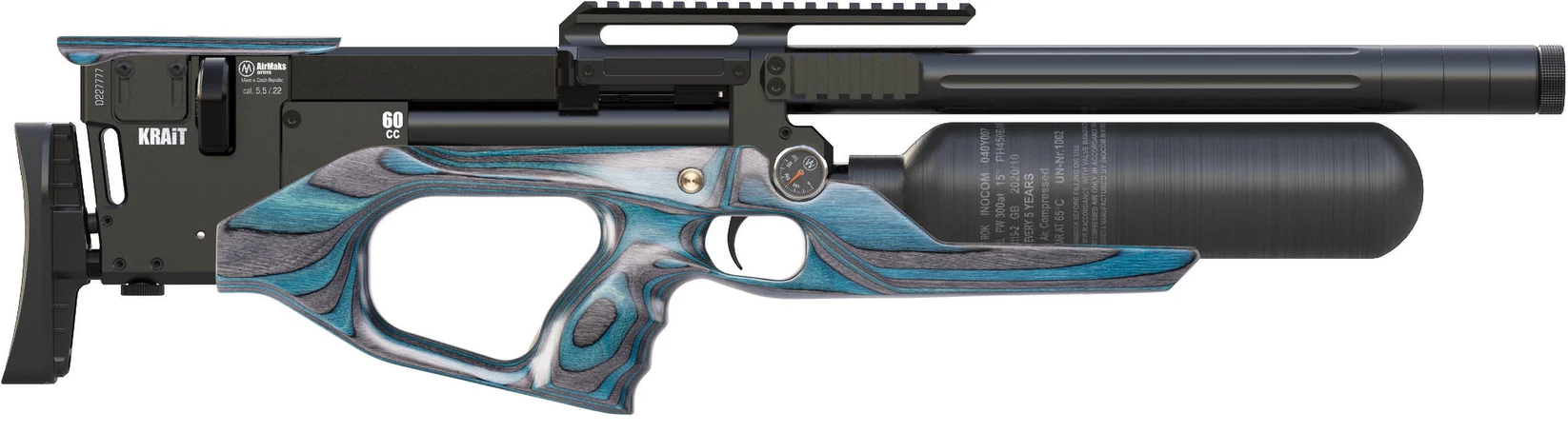
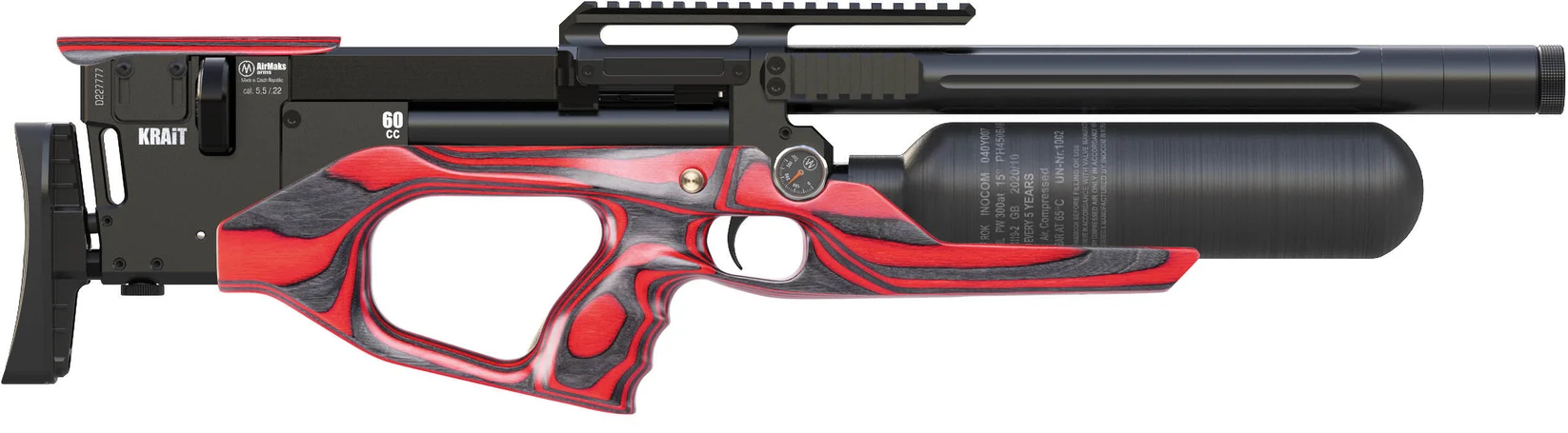
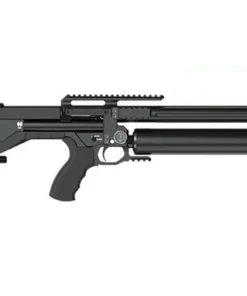
Correct chambering, lawful high-power status and a coherent accessory set are specified together before this extra-high-power tube bullpup is put into service. Consequently, calibre choice, certificate conditions, regulated energy and supporting equipment are treated as one system. Moreover, reversible controls and fully adjustable furniture are provided so that left- and right-handed users, and shooters of differing stature, can be fitted without compromise.
Calibres That Are Supplied on the Extra High Power Tube Model
Two chamberings are offered as the standard pairing on this configuration. Therefore, .22 (5.5 mm) and .25 (6.35 mm) are the calibres most frequently listed. In particular, .22 is selected when a flatter trajectory, wide projectile availability and moderate recoil are required. Likewise, .25 is specified when greater sectional density and retained energy at distance are prioritised for heavier slugs or larger permitted quarry.
Furthermore, rotary magazines that are typically quoted hold 16 rounds in .22 and 14 rounds in .25. Additionally, a single-shot tray is commonly included so that individual projectiles can be loaded during load development or precision work. As a result, both volume practice and carefully aimed shots are supported by the same action.
.177 and .30 options appear elsewhere in the wider family; however, they are not the usual pairing for this extra-high-power tube specification. Confirmation of barrel, twist and magazine set should therefore be obtained at the point of order.
Projectiles That Must Be Matched to Barrel and Energy Level
Match-grade pellets or purpose-designed slugs are required if the 700 mm CZ barrel is to deliver consistent groups. Moreover, heavier slugs are often preferred in licensed extra-high-power use because energy is retained more effectively beyond the first 80–100 metres. Skirt condition, weight and ogive should be tested in the individual rifle so that the most stable combination is identified. Damaged or deformed ammunition must never be used, because barrel harm and unsafe pressure events can otherwise be caused.
FAC Status and Power Figures That Must Be Observed
Extra-high-power output places this rifle in the FAC—or equivalent high-power—category in jurisdictions such as the United Kingdom. Accordingly, possession and use are permitted only where the correct certificate, conditions, storage and transport rules have already been granted. Local law varies; every owner remains responsible for verification before purchase or collection.
Advertised energies that are commonly published for this specification approach 59 ft-lbs in .22 and 73 ft-lbs in .25. Those figures are associated with the 700 mm barrel, an enlarged tube reservoir and a regulated valve when settings and projectiles are correct. Nevertheless, chronograph results depend on projectile mass, regulator pressure, fill level and temperature. Independent verification after any change of load is therefore recommended.
An externally adjustable regulator and an external hammer-spring or velocity control are fitted so that output can be tuned within the licensed envelope. Fine adjustment is completed without full disassembly. The rifle must never be set above the power authorised on the certificate.
Fill Pressure, Plenum and Shot Consistency
A 300-bar fill is the usual maximum for the tube cylinder. Subsequently, a substantial plenum—typically around 60 cc on this generation, with some high-power variants using a larger volume—is charged by the regulator so that shot-to-shot variation remains low across a usable string. Consistency is maintained until the working pressure band is exhausted. Regular inspection of the fill probe, seals and burst disc is still required so that safety is preserved.
Accessories That Complete a Legal, Usable Package
Factory and aftermarket items are readily accepted by the chassis. Consequently, a working field or range kit can be assembled without custom machining.
Highlighted items that are commonly specified include:
- 20 MOA Picatinny rail already fitted so that long-range optics retain elevation travel
- Side and underside Picatinny rails so that bipods, lamps, lasers and rangefinders can be mounted
- 1/2″ UNF muzzle thread so that a moderator can be fitted when noise reduction is legal and required
- Reversible side lever and ambidextrous AR15-style safety so that handedness can be matched
- Height-adjustable cheek piece plus length- and height-adjustable butt pad so that an inclusive, repeatable fit is achieved
- Rotary magazines and single-shot tray so that both follow-up shots and precision loading are possible
- Hard transport case (often a Negrini-style unit) so that zero is protected in transit
- Filling probe so that a 300-bar source can be connected
- Proven slugs or pellets, a chronograph and a suitable compressor or bottle so that power and grouping can be verified
Additionally, AR15-pattern grips and aftermarket pads can often be exchanged if a different angle or length of pull is needed for a second user. QD sling points can be added so that carry during long stalks remains comfortable.
A rigid optic and mount are essential if the extra-high-power trajectory is to be used at distance. Eye relief, ring height and the 20 MOA rail must be considered together so that a usable zero and enough remaining clicks are obtained. Point of impact is always re-checked after a moderator, bipod or new mount is fitted.
One System Rather Than Separate Choices
Calibre, FAC conditions, regulated power and accessories function only as a set. When licensing is in place, when projectiles are matched to the barrel, and when rails, furniture and filling gear are specified for the actual task, extra-high-power performance becomes usable rather than theoretical. Inclusive, reversible controls further ensure that the rifle is adapted to the shooter. Responsible specification of all four elements is what turns the platform into a practical, lawful tool.
Daystate, Delta Wolf, Alpha Wolf and Premium PCP Air Rifle Accessories
For shooters researching premium PCP platforms, daystate blackwolf, daystate redwolf, delta wolf, huntsman daystate, and daystate alpha wolf frequently appear among the most searched Daystate-related terms. Whether someone searches for wolf delta, day state, daystate delta wolf, blackwolf, deltaw, daysta, or wants to understand the delta wolf meaning, these rifles are commonly associated with modern PCP engineering, electronic control systems, adjustable configurations, and high-end airgun performance.
People asking what is a delta wolf are generally researching the electronic Daystate platform and how it differs from conventional PCP rifles. Related searches often include electronic wolves, firing cycle, lock time, lock timing, short cocking, cocking ball, index pin, and pin magazine. Searches may also focus on configuration-specific components such as an alpha wolf barrel, stock walnut, safari stock, dima stock, stock replacement, rimfire stocks, or a rifle butt pad.
Daystate Red Wolf, Alpha Wolf and Wolverine Searches
The daystate redwolf family remains closely connected with searches for daystate redwolf price, red alpha wolf, alpha red wolf, and the newer daystate blackwolf platform. Some shoppers may also compare these rifles with the daystate wolverine sapphire, wolverine gun, wolveriner, wolf gun, wolfpack armory wolverine, or even search unusual phrases such as can wolverine go on planes while researching transport rules.
Accessories frequently searched alongside these platforms include a rubber butt, rubber butt pad, butt pad rifle, bradley cheek riser, gecko grips, picatinny bag rider, and buddy bottle cover. Cosmetic or clothing-related search phrases such as red bodywarmer and black snood may also appear alongside broader brand searches.
Magazine-related searches include 177 magazine, mag 177, and 25 magazine, while ammunition research can include 177 pellets types, 5.0 mm pellets, and slug pellet. Because pellet suitability depends on the rifle, barrel, legal power level, and intended range use, compatible ammunition should always be selected according to the manufacturer’s specifications.
PCP Air Systems, Moderators and Thread Accessories
Many enthusiasts researching Daystate rifles also search for air rifle compressed air, compressed air rifle, what are pcp air rifles, and what is a pre charged pneumatic air rifle. These searches relate to the fundamental operating principle of PCP systems, in which stored compressed air is used to power each shot.
Common accessory searches include air gun pc, air gun suppressor, air gun suppressors, airgun moderator, air rifle moderator, 0db, 0db moderator, and 0 db moderator. Buyers may also encounter searches for a hogan decimeater silencer, silencer thread adapter, thread protector rifle, and muzzle thread protector when comparing muzzle accessories and compatible threaded components. Local regulations should always be checked before purchasing or fitting sound-moderating equipment.
Maintenance-related searches often include pcp o ring kit, while tuning-oriented users may look for an ats tuner. Search terms such as unfend can also appear in broad airgun keyword datasets, even when the intended product or meaning is unclear.
M-LOK, Picatinny and Rifle Sling Accessories
Accessory compatibility is another major area of interest. Common searches include mlok to picatinny rail adapter, best m-lok to picatinny rail adapter, m-lok to picatinny adapter, and picatinny m lok adapter. These adapters are often researched by users who want to mount compatible optics, rests, bipods, bags, or other permitted accessories on an appropriate rail system.
Sling-related searches include riffle sling, rigle sling, how to put a gun sling on a rifle, how to put a rifle sling on, how to install a rifle sling, how to put sling on rifle, installing a rifle sling, and attaching a sling to a rifle. Because attachment arrangements differ between stocks, rails, swivels, and chassis systems, the correct mounting points should always be confirmed from the manufacturer’s documentation.
Other general mechanical or unrelated search phrases found within broader keyword datasets include how to put extinguisher call back together, weatherby vanguard trigger adjustment, and 3.55kg in lbs. While these terms may appear in search data, they are not necessarily specific to Daystate PCP rifles.
BRK, Brocock and XR Air Rifle Searches
Alongside Daystate products, many buyers compare models produced under the Brocock and BRK families. Popular searches include brocock ltd, brocock sniper xr, brocock commander xr, pathfinder xr, brk ghost, brocock airguns, brocock commander, brk ghost air rifle, and brk sniper xr.
The brocock sniper xr is often researched by shooters comparing compact PCP platforms, while the brocock commander xr and brocock commander searches generally relate to larger tactical-style PCP configurations. Meanwhile, brk ghost and brk ghost air rifle searches reflect growing interest in BRK-branded PCP systems.
Those comparing local purchasing options may also search fx airgun dealer near me, even when their primary interest is Daystate or Brocock. This reflects the way many airgun shoppers compare several premium manufacturers before deciding which PCP platform, stock configuration, calibre, regulator setup, magazine system, and accessory package best matches their intended sporting use.
Additional Daystate and Airgun Search Terms
Broader searches surrounding these rifles may include model alpha gun, griffin gun, and general comparisons involving a wolf gun or other premium PCP platform. Buyers may also investigate different stock materials, rail systems, moderators, magazines, barrel options, butt pads, cheek risers, thread protectors, and compressed-air accessories before completing a build.
Whether someone begins with daystate redwolf, explores the daystate alpha wolf, compares a daystate delta wolf, investigates the daystate blackwolf, or considers a daystate wolverine sapphire, the most useful approach is to verify model compatibility, calibre, pressure specifications, local regulations, and manufacturer-supported accessories before purchasing replacement components or upgrades.
Movement, Carry and Fills That Are Kept Quiet and Controlled
A sling or a compact carry method is used between firing points so that the hands remain free for glassing or for fences and ditches. Balance is checked after the optic and bipod have been fitted, because a front-heavy combination increases fatigue on long walks. After the last shot of a stalk, residual pressure is managed according to published guidance and local rules.
Field fills are performed only with a known-good probe and a bottle or compressor that has already been inspected. Dirt and moisture are kept away from the filling port. A spare magazine, a small toolkit for the external adjusters and a labelled batch of projectiles travel with the rifle so that a change of plan does not end the day.
Training Blocks That Turn Specifications into Habit
Structured practice is scheduled in short, focused blocks rather than in one long, tiring outing. A typical block begins with confirmation of zero, continues with a set number of shots from two positions, and ends with notes on wind, temperature and group size. Over weeks, those notes become a personal data book that is more useful than any advertised energy number.
Trigger weight and first-stage travel are left at the settings that have already been found comfortable. Frequent alteration undermines muscle memory. Likewise, comb height and length of pull are marked or photographed once a good fit has been found, so that a second user—or the same user after a different jacket—can return the furniture to a known place.
Inclusive training is planned from the start. A smaller-framed or younger shooter is given extra time to set comb and pad so that a full sight picture is obtained without stretching. A left-handed shooter is given the lever and safety on the preferred side before the lesson begins. The same targets and the same distances are then used so that the only variable is the person behind the rifle.
Seasonal and Weather Effects That Are Anticipated
Cold thickens lubricants and can shift regulator behaviour. Therefore a short confirmation string is fired after the rifle has reached ambient temperature. Heat and high fill pressures increase the need for a sound burst disc and for disciplined filling. Rain and mud are kept off the action with a simple cover while the rifle is carried; rails are wiped before a bipod is reattached.
Summer foliage often forces closer, more angled shots. Winter fields may offer longer, clearer lanes. In both seasons the reserved elevation on a canted rail and the extra barrel length remain useful only if data at those distances has already been confirmed. New foliage or a change of clothing that alters length of pull is treated as a reason to re-check fit before the first live shot.
Accessory Roles That Appear in Ordinary Use
A robust bipod is the most frequent companion in both range and field. It is folded when the rifle is slung and locked when a prone or sitting shot is prepared. A moderator is fitted when local rules and courtesy require a reduced report; point of impact is always re-checked after the can is attached or removed.
Side rails accept illumination, a small laser or a rangefinder according to the task. Mounts are chosen for rigidity, because a shifting optic wastes the grouping that a long barrel can produce. Spare magazines, a chronograph, a fill probe and a hard case for vehicle travel complete a practical kit. Inclusive extras—an alternate pad thickness or a different grip angle—are kept so that more than one person can use the same rifle without discomfort.
Highlighted items that are typically carried on a working day include:
- A bipod or sticks so that a supported position can be taken quickly
- A labelled batch of proven slugs or pellets so that dope remains valid
- A compact toolkit for external regulator and velocity controls
- A lamp or IR unit on a side rail when legally and ethically required
- A sling and a hard case so that carry and transport do not shift zero
- Notes or a data book so that wind, temperature and fill pressure are not forgotten
A Session Pattern That Is Repeated Until It Is Automatic
Preparation is finished at home: documents, projectiles, a checked cylinder and a tight optic are packed. On arrival a safe direction is identified and a fill is completed. A few sighters confirm zero. The planned strings or the planned hunt then proceed. After the last shot the action is cleared, the magazine is removed and the rifle is left safe. Notes are written before the drive home.
Over many repetitions that pattern becomes habit. The platform’s role is to remain stable, adjustable and regulated so that the notes stay valid. When licensing is respected, when furniture is fitted to the person who will fire the shot, and when position, projectile and accessories are matched to the task, extra-high-power output is turned into practical, repeatable results rather than unused specification. Consistency is the outcome that is sought, and it is produced by method, preparation and inclusive setup—not by haste.






Reviews
There are no reviews yet.