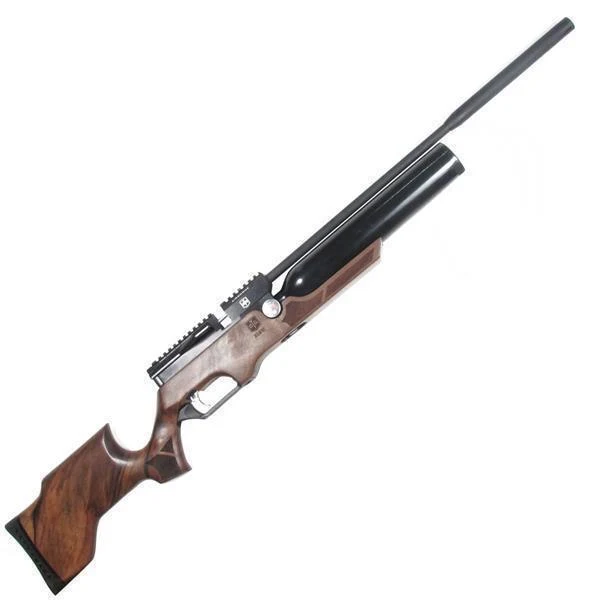
ATA Airborne Walnut PCP Air Rifle – Precision Engineering, Classic Walnut Design & Reliable PCP Performance
The ATA Airborne Walnut PCP Air Rifle combines traditional Turkish walnut craftsmanship with modern pre-charged pneumatic technology. Developed by ATA Arms, this multi-shot air rifle features a side-lever operating system, a generous compressed-air reservoir, an adjustable two-stage trigger, and a practical optics mounting platform. Consequently, the Airborne presents a combination of familiar sporting-rifle styling and contemporary pneumatic engineering.
Unlike conventional spring-powered air rifles, the ATA Airborne operates through a pre-charged pneumatic (PCP) system. Compressed air is stored inside a dedicated reservoir and released through the rifle’s firing mechanism. As a result, the system eliminates the spring-driven recoil cycle associated with traditional spring-piston designs.
Furthermore, the natural walnut stock gives the rifle a distinctive appearance, while its carefully arranged controls contribute to a practical shooting experience.
Key Features of the ATA Airborne Walnut PCP Air Rifle
-
-
Model: Airborne Walnut PCP Air Rifle
-
Operating System: Pre-Charged Pneumatic (PCP)
-
Available Calibres: .177 (4.5mm) and .22 (5.5mm), depending on market
-
Stock Material: Genuine Turkish walnut
-
Action: Side-lever, multi-shot operation
-
Magazine: Detachable rotary pellet magazine
-
Magazine Capacity: Commonly listed as 12 rounds; verify individual calibre configuration
-
Barrel: Free-floating design
-
Barrel Length: Listed variants include 480mm and 550mm
-
Air Reservoir Capacity: 545cc
-
Maximum Listed Fill Pressure: 220 BAR
-
Trigger: Adjustable two-stage mechanism
-
Safety: Integrated manual safety
-
Optics Mounting: Picatinny rail
-
Sound Moderator: Included on certain market configurations
-
Approximate Weight: 4.2–4.3kg, depending on configuration
-
Overall Length: Approximately 1130mm with moderator
Specifications are compiled from retailer listings and may differ according to calibre, regulatory market, production version, and supplied accessories.
Premium Turkish Walnut Stock and Traditional Craftsmanship
Natural Walnut Finish with Distinctive Character
One of the most recognizable features of the ATA Airborne Walnut PCP Air Rifle is its traditional wooden stock. Made from Turkish walnut, the stock showcases natural grain patterns, subtle variations in colour, and the warm appearance associated with classic sporting rifles.
Moreover, walnut provides a contrasting aesthetic against the rifle’s dark metal components. This combination produces a timeless design that distinguishes the Airborne from synthetic-stock alternatives.
Each natural wooden stock may display individual grain characteristics. Therefore, slight differences in appearance should be expected between rifles.
Ergonomic Stock Design
Beyond its appearance, the walnut stock contributes to the rifle’s handling characteristics. Its shaped grip and shoulder-contact surfaces provide established points of support during controlled target shooting.
Additionally, the stock accommodates the rifle’s air reservoir and mechanical assembly without sacrificing its conventional sporting-rifle profile.
The resulting configuration brings together traditional materials and modern PCP construction.
Advanced Pre-Charged Pneumatic Technology
Consistent Compressed-Air Operation
At the centre of the ATA Airborne lies its PCP operating system. Rather than relying on a mechanical mainspring, the rifle uses compressed air stored within its reservoir.
Consequently, the shooting cycle differs from that of a conventional spring-piston air rifle.
The design also incorporates an air-management system intended to support repeatable operation. Certain configurations feature regulated actions, although prospective owners should verify the exact specification of their chosen version.
Furthermore, the rifle’s PCP architecture requires a compatible high-pressure filling system and adherence to the manufacturer’s filling instructions.
Large 545cc Air Reservoir
An important characteristic of the Airborne is its substantial 545cc air reservoir.
This capacity offers a considerable supply of compressed air for shooting sessions. Nevertheless, the actual number of usable shots depends on the rifle’s calibre, power setting, regulated configuration, and operating pressure.
For this reason, published shot-count estimates should be treated as configuration-specific rather than universal guarantees.
The listed maximum filling pressure is 220 BAR. Operators should always follow the pressure markings and instructions supplied with their particular rifle.
Smooth Side-Lever Action and Multi-Shot Magazine
Practical Side-Lever Mechanism
The ATA Airborne Walnut PCP Air Rifle incorporates a side-lever cocking mechanism designed for manually cycling its action.
Compared with traditional bolt-operated arrangements, this system uses a different lever movement to operate the feeding mechanism.
Additionally, its positioning provides straightforward access to the rifle’s action.
A smooth operating cycle is frequently highlighted in retailer descriptions, although handling characteristics may vary between individual examples and with maintenance.
Detachable Rotary Magazine
Multi-shot capability forms another major part of the Airborne’s design.
The rifle uses a detachable rotary magazine that accommodates multiple pellets. Several product listings specify a 12-round magazine, although capacities may differ across individual configurations.
Meanwhile, magazine compatibility depends on calibre and model version.
For reliable operation, owners should use the correct manufacturer-approved magazine and ammunition dimensions.
Free-Floating Barrel and Precision-Oriented Construction
Barrel Design
ATA incorporates a free-floating barrel arrangement into the Airborne platform.
In general, a free-floating configuration is designed to limit unintended contact between the barrel and adjacent structural components.
However, practical accuracy depends on several additional factors, including manufacturing tolerances, pellet consistency, maintenance, and environmental conditions.
Certain retailer specifications identify barrel lengths of approximately 480mm and 550mm.
Therefore, the actual barrel dimensions should be confirmed against the specific model supplied.
Adjustable Two-Stage Trigger
Trigger design plays an important role in the overall handling of any target air rifle.
The Airborne features an adjustable two-stage trigger with an integrated safety mechanism.
This arrangement provides a staged trigger movement, although the exact adjustment range and factory settings can vary.
Importantly, trigger adjustments should be performed only according to the manufacturer’s instructions or by a suitably qualified technician.
Integrated Picatinny Optics Rail
Versatile Optics Mounting Platform
Modern sporting air rifles frequently incorporate standardized mounting systems, and the ATA Airborne follows this approach.
Its Picatinny rail provides a mounting interface for compatible optical equipment.
Consequently, the rifle can accommodate suitable accessories according to the user’s application and local requirements.
However, mounting dimensions, accessory weight, and component compatibility should always be checked before installation.
An optical sight is not necessarily included with the rifle, even when promotional photographs show one.
Available Calibres and Market-Specific Power Ratings
.177 and .22 Calibre Options
The ATA Airborne Walnut is commonly offered in two popular air-rifle calibres:
.177 calibre (4.5mm): A widely established airgun calibre used in recreational target shooting and organized air-rifle disciplines.
.22 calibre (5.5mm): Another common air-rifle calibre, available across numerous sporting and recreational PCP platforms.
Both options belong to the same general Airborne family, but magazine compatibility, pellet dimensions, and operating characteristics may differ.
FAC and Non-FAC Configurations
Power specifications are especially important when comparing models sold internationally.
For example, UK-market non-FAC versions are generally configured to remain below the applicable 12 ft-lb threshold. Higher-powered versions may be subject to firearm certification or other licensing requirements, depending on jurisdiction.
Therefore, a particular Airborne’s actual muzzle energy should be established from its manufacturer documentation rather than assumed from a generic international listing.
Maintenance, Ownership, and Responsible Handling
Routine PCP Care
Regular inspection contributes to the long-term condition of a PCP air rifle.
Owners should monitor the air reservoir, visible seals, magazine, stock, and external metal surfaces in accordance with the manufacturer’s maintenance schedule.
Furthermore, appropriate storage helps protect the natural walnut finish against excessive moisture, harsh sunlight, and sudden temperature changes.
Only approved lubricants and maintenance procedures should be used, particularly around high-pressure pneumatic components.
Safe Storage and Legal Compliance
As with all air rifles, the Airborne must be handled and stored responsibly.
Always treat the rifle as loaded, keep its muzzle directed safely, and confirm that the shooting area provides a suitable backstop.
Additionally, observe age restrictions, licensing requirements, transport rules, and storage regulations applicable in the relevant country or region.
Professional inspection is advisable whenever the rifle develops an air leak or mechanical malfunction.
Final Overview: ATA Airborne Walnut PCP Air Rifle
The ATA Airborne Walnut PCP Air Rifle brings together traditional walnut styling, a modern PCP operating system, side-lever functionality, and a substantial air reservoir.
Its free-floating barrel design, adjustable two-stage trigger, detachable magazine, and Picatinny mounting rail establish a comprehensive technical feature set.
Equally important, the use of Turkish walnut gives the rifle an identifiable appearance within the Airborne product range.
For recreational target shooters, sporting-airgun enthusiasts, and those researching PCP rifle specifications, the ATA Airborne offers an informative example of how conventional stock design can be combined with contemporary pneumatic engineering.
Ultimately, selecting the appropriate configuration requires careful consideration of calibre, power rating, market-specific specifications, and applicable legal requirements.
Gamo Air Rifles, PCP Airguns, Pellet Pistols and Modern Airgun Systems
Choosing the right gamo air rifle depends on how the rifle will be used, the preferred caliber, the powerplant, and the shooter’s experience level. Gamo produces a broad range of recreational, target, and sporting airguns, so buyers searching for a gamo pellet gun, gamo air rifles, or a traditional gamo pellet rifle can compare several operating systems before deciding which configuration best fits their needs.
One of the most familiar designs is the break barrel air rifle. This platform remains popular because it combines straightforward operation with a self-contained powerplant. Shooters comparing high powered air rifles or a high power air rifle should consider much more than headline velocity. Pellet weight, caliber, barrel length, trigger quality, consistency, and shooting conditions all affect practical performance.
Models chambered as a gamo 177 configuration are frequently selected for target shooting and recreational use because .177 pellets generally offer a flatter trajectory than heavier calibers. Likewise, a gamo break barrel rifle provides the simplicity many shooters want without the need for a separate compressed-air charging system.
Break-Barrel Rifles and Pistols
People researching the best air rifles frequently encounter spring-powered and gas-piston break-barrel platforms. Search terms such as brake barrel bb gun are also common, although pellet rifles and BB guns are technically different categories and may use different ammunition and barrel designs.
Compact airguns include the break barrel pellet pistol, break barrel air pistol, and break barrel pistol. Larger-caliber searches may include a 22 caliber break barrel air pistol, while buyers may also look for a break action pellet pistol, the best break barrel pellet pistol, or a 22 pellet pistol for recreational shooting.
Power-oriented shoppers sometimes search for the most powerful break barrel pellet gun. However, raw velocity should never be the only specification considered. Accuracy, appropriate ammunition, safe handling, and local laws are equally important. A phrase such as bee bee gun pistol may be used informally by shoppers, but users should confirm whether a particular handgun actually fires steel BBs, lead pellets, or another compatible projectile.
Gamo Swarm Multi-Shot Air Rifles
Gamo’s magazine-fed break-barrel systems have helped popularize multi-shot operation in a category that historically required a pellet to be loaded manually after every shot.
The gamo swarm magnum 10x gen3i is closely associated with this concept, while searches for the gamo swarm magnum, gamo swarm maxxim gen 3, and swarm magnum gen3i reflect interest in different Swarm generations and configurations. Another commonly researched model is the gamo swarm magnum pro 10x gen3i.
The broader gamo magnum gen3i category appeals to shooters who want high-energy break-barrel performance together with magazine-fed convenience. Gamo’s multi-shot technology is also frequently found through searches for gamo 10x, multi shot pellet gun, gamo swarm, gamo swarm 10x, and pellet gun with magazine.
A magazine system can make repeated target sessions more convenient because pellets can be prepared before shooting begins. Nevertheless, users should always verify magazine compatibility, pellet length, pellet diameter, and model generation before ordering replacements.
Gamo Arrow PCP Air Rifles
Shooters interested in pre-charged pneumatic technology may encounter the gamo arrow range. The gamo arrow pcp combines a PCP powerplant with a lightweight sporting format, while the full term gamo arrow pcp air rifle is commonly used when comparing it with conventional spring or gas-piston rifles.
Related searches include pcp arrow guns, arrow rifle, pcp arrow gun, arrow rifles, and arrow air rifle. These phrases generally reflect interest in compact PCP-style sporting rifles rather than traditional break-barrel platforms.
Caliber-specific buyers may search for a gamo arrow .22, while the gamo arrow classic may appeal to shooters looking for another Arrow-series configuration.
PCP technology uses stored compressed air rather than relying on a spring or piston being compressed for each shot. This can produce a smooth firing cycle, reduced mechanical movement, and consistent shot-to-shot performance when the rifle is properly filled and maintained.
Understanding PCP Airguns
A pcp air rifle uses a reservoir filled with high-pressure air. PCP stands for precharged pneumatic, and the technology is widely used in modern sporting and precision airguns.
Searches for pcp air rifles, pcp rifle, pcp guns, pcp rifles, and pcp air gun generally refer to this same basic operating principle. Some buyers describe the platform as an air rifle compressed air system, while others search for a pcp pellet rifle or use the reversed phrase rifle pcp.
PCP rifles usually require additional filling equipment such as a suitable hand pump, compressor, or certified high-pressure cylinder. Users should follow the manufacturer’s recommended fill pressure because overfilling a reservoir can be unsafe and may also reduce performance.
Gas-Piston and Lever-Operated Airguns
A common beginner question is what is a gas piston air rifle. Instead of using a traditional coiled steel spring, a gas-piston system compresses gas inside a sealed cylinder. When the trigger is released, the piston moves rapidly and compresses air behind the pellet.
Other mechanical airgun designs include under lever air rifles, the singular underlever air rifle, and the alternative spelling under lever air rifle. In these designs, a separate lever positioned beneath the barrel is used to cock the mechanism.
Shooters may also research a side lever air gun or side lever air rifle, where the cocking lever operates from the side of the receiver. These fixed-barrel layouts can provide a different shooting experience compared with conventional break-barrel systems.
Search terms such as lever action pellet gun, air gun thumb lever, and lever action air rifle can refer to several different mechanisms, so buyers should check the specific manufacturer’s action type rather than assuming every lever-operated airgun works identically.
Gamo Shadow and High-Velocity Searches
Long-running Gamo product lines continue to generate searches including gamo shadow 1000, shadow 1000 gamo, and gamo 1000 shadow. Another associated search phrase is 1000/4.5, which is often used by shoppers researching 4.5 mm or .177-class air rifles.
Velocity-focused buyers may also search for a gamo 1800 fps air rifle. Advertised velocity can vary according to pellet composition and weight, so actual shooting performance may differ when standard lead pellets are used.
Likewise, shoppers researching gamo 1800 fps air rifle price should compare the exact model number, caliber, powerplant, bundled optic, warranty, and regional specification rather than relying solely on a velocity figure.
Other unusual search terms such as shotgun pellet gun may describe an airgun with styling inspired by a shotgun rather than a conventional pellet rifle. Searches for pellet guns that can kill should be approached from a safety perspective: airguns are not toys, and even relatively modest-powered models can cause severe or fatal injuries. Every airgun should therefore be handled with the same disciplined muzzle and trigger control expected of potentially dangerous sporting equipment.
Air Pistols, Pellet Pistols and CO2 Systems
The air pistol category includes many different operating systems, and modern air pistols may use springs, gas pistons, CO2 cartridges, or pre-charged pneumatic reservoirs.
For pellet-firing handguns, common searches include pellet pistols, pellet pistol, pistol pellet gun, pellet handgun, pellet gun pistol, pellet gun pistols, pistol air, and air pellet pistol.
CO2-powered handguns form another major category. A co2 pistol typically uses a disposable carbon-dioxide cartridge to propel BBs or pellets. Buyers may also search for pistol co2, co2 pistols, or the commonly mistyped c02 pistol.
Related searches include co2 air pistols, co2 gun, c02 guns, guns co2, and co 2 gen. Regardless of spelling, the key consideration is ammunition compatibility and the correct cartridge type specified by the manufacturer.
CO2 performance can be affected by ambient temperature because pressure changes as the cartridge becomes warmer or colder. For that reason, shooters should expect some variation in velocity during different environmental conditions.
Target Shooting and 10-Meter Airgun Use
Precision shooting requires appropriate targets and a safe backstop. A 10m rifle is generally associated with structured 10-meter air-rifle shooting, where accuracy, repeatability, shooting position, and trigger control are emphasized.
Recreational shooters may use pellet gun targets, while rifle users commonly search for air rifle targets, targets for air rifle, and airgun targets. The term air gun targets is another broad variation covering both rifle and pistol applications.
Dedicated practice setups can include air rifle shooting targets and airgun shooting targets designed to provide clear aiming points and easy scoring. Depending on the shooting discipline, an air rifle target may use small scoring rings intended for precision practice.
Handgun shooters may choose air pistol targets, whereas a pellet rifle target should be paired with a backstop capable of safely containing the pellets used by the particular rifle.
Airgun Cleaning and Maintenance
Regular airgun maintenance helps preserve reliability, accuracy, and safe function. Although airguns generally require less bore cleaning than many powder-burning firearms, seals, external metalwork, fasteners, magazines, and moving components still need periodic inspection.
A pellet rifle cleaning kit can contain cleaning rods, pull-through systems, suitable patches, and other airgun-safe tools. Likewise, a pellet gun cleaning kit can help remove accumulated debris when cleaning is genuinely required.
Proper air gun maintenance also involves checking stock screws, inspecting seals, keeping optics securely mounted, and following the manufacturer’s lubrication guidance. Excessive oil should be avoided because unsuitable lubricants can damage seals or cause unwanted combustion inside some spring-piston airguns.
For PCP equipment, reservoir condition, fill fittings, O-rings, and pressure gauges should also be inspected periodically. Magazine-fed models should be kept clean so pellets feed smoothly without deformation.
Ultimately, the best choice depends on the intended use. A traditional break-barrel rifle offers simplicity, a Gamo Swarm platform adds multi-shot convenience, and a PCP system provides a smoother firing cycle with an external filling requirement. Comparing caliber, powerplant, ergonomics, ammunition, maintenance demands, and safe target equipment makes it much easier to select an airgun that delivers dependable performance for responsible recreational or target shooting.
Calibres, FAC Power, Scope Compatibility and Recommended Accessories
The ATA Airborne Walnut PCP Air Rifle combines modern pneumatic engineering with traditional Turkish walnut craftsmanship. Its design accommodates different calibre configurations, while the large air reservoir, adjustable two-stage trigger, and integrated optics rail contribute to its versatility.
Furthermore, understanding the available power classifications, compatible equipment, and maintenance requirements helps owners make informed decisions. Since specifications vary between countries and production versions, the exact manufacturer’s documentation should always take priority.
Available Calibres and Their Characteristics
.177 Calibre (4.5mm)
The .177 calibre is one of the most established choices for recreational air rifle shooting. Its relatively small pellet diameter makes it common in organized target disciplines and sporting airgun activities.
Additionally, .177 ammunition is widely available in several pellet shapes and weights. Competition-approved target pellets are particularly familiar to users participating in controlled shooting environments.
Key characteristics include:
-
-
Ammunition: Compatible .177 airgun pellets
-
Common applications: Recreational and organized target shooting
-
Magazine: Calibre-specific rotary magazine
-
Power classification: Dependent on the market-specific configuration
Importantly, a particular muzzle velocity or energy level should not be assumed solely from the calibre designation.
.22 Calibre (5.5mm)
Another commonly available version uses the .22 calibre. This established sporting-airgun calibre features a larger pellet diameter than .177 and is supported by numerous ammunition manufacturers.
However, pellet selection must reflect the rifle’s actual specifications, and ammunition should never be mixed between calibres.
Furthermore, operating characteristics differ according to pellet mass, reservoir pressure, barrel configuration, and factory power rating.
Key characteristics include:
-
-
Ammunition: Compatible .22 airgun pellets
-
Magazine: Detachable rotary design
-
Barrel: Free-floating configuration
-
Power: Market-dependent FAC or non-FAC specification
Some Australian listings also reference a .25 (6.35mm) version, although availability should be confirmed directly with the distributor.
FAC and Non-FAC Power Configurations
Understanding Non-FAC Models
In the United Kingdom, non-FAC air rifles are generally configured to remain at or below the statutory 12 ft-lb muzzle-energy limit, approximately 16.3 joules, in England and Wales.
Consequently, several UK-market listings advertise versions around this power classification.
However, regulations differ across jurisdictions. Scotland, for example, has separate air weapon licensing requirements.
FAC Power Ratings
FAC stands for Firearm Certificate, a term commonly used in the British firearms licensing system.
Higher-powered variants may require an appropriate certificate, depending on the relevant legal jurisdiction.
Some international retailer specifications list maximum energies around 42 joules, equivalent to approximately 31 ft-lb. Nevertheless, these figures should not be interpreted as applying to every calibre or production variant.
For comparison:
| Configuration |
Published energy |
| UK non-FAC example |
Approximately 12 ft-lb / 16.3 J |
| Higher-power international listing |
Approximately 31 ft-lb / 42 J |
These are advertised specifications, not independently verified test results.
Air Reservoir and Shot Capacity
The rifle is commonly listed with a 545cc compressed-air reservoir and a maximum fill pressure of 220 BAR.
Additionally, retailer estimates suggest approximately 75–95 shots for certain configurations, although other versions have substantially different advertised shot counts.
Actual performance varies according to calibre, power level, regulator configuration, and operating pressure.
Therefore, the pressure marking on the individual rifle must always govern filling procedures.
Recommended Scope Specifications
Understanding Optics Compatibility
The rifle features a Picatinny optics rail, providing an established mounting interface for compatible sporting optics.
For recreational target shooting, buyers can consider an optical sight offering clear image quality, suitable eye relief, a legible reticle, and dependable manufacturer support.
Rather than selecting equipment based exclusively on magnification, owners should assess the intended lawful application and the conditions under which the rifle will be used.
Features to Consider
Important optical characteristics include:
-
Clear glass: Supports comfortable target observation.
-
Adjustable focus: Helps accommodate different viewing distances.
-
Suitable eye relief: Contributes to comfortable viewing.
-
Weather resistance: Offers protection against ordinary outdoor exposure.
-
Compatible mounting hardware: Must match the rifle’s Picatinny interface.
-
Manufacturer warranty: Provides additional ownership support.
Optical equipment may be sold separately, and compatibility should be verified before purchase.
Recommended Accessories for Ownership and Maintenance
Essential PCP Filling Equipment
A compatible high-pressure air source is necessary for operating a PCP rifle.
Approved options may include a purpose-designed PCP compressor, an appropriately rated filling cylinder, or a compatible manual filling system.
In addition, owners should verify connector dimensions, pressure limits, and air-quality requirements against the official manual.
Useful Safety and Maintenance Accessories
-
Lockable rifle case: Provides secure storage and protection during authorized transportation.
-
Protective shooting glasses: Help protect the eyes during range activities.
-
Hearing protection: Appropriate protection may be needed depending on the shooting environment.
-
Manufacturer-approved cleaning kit: Supports routine external and barrel maintenance.
-
Compatible spare seals: Intended for servicing by appropriately qualified personnel.
-
Soft microfiber cloth: Helps preserve the natural walnut finish.
-
Moisture-control products: Reduce exposure to excessive humidity during storage.
-
Calibre-compatible magazines: Replacement magazines must match the exact model.
-
Approved filling connector: Must comply with the manufacturer’s specifications.
Maintenance and Long-Term Performance
Caring for the Walnut Stock
Natural walnut benefits from careful maintenance. Regular cleaning with a soft, dry cloth removes fingerprints, ordinary dust, and surface moisture.
Furthermore, suitable storage conditions help preserve the stock’s appearance.
Avoid prolonged exposure to excessive humidity, direct sunlight, and harsh cleaning chemicals.
Looking After the Pneumatic System
The air reservoir, valves, and seals require particular attention because they operate under substantial pressure.
Consequently, internal repairs should be handled by qualified technicians rather than attempted while the system remains pressurized.
Routine inspection, appropriate storage, and adherence to manufacturer service intervals contribute to safe ownership.
Final Overview
The ATA Airborne Walnut PCP Air Rifle is commonly offered in .177 and .22 calibres, with power classifications depending on the country and version supplied.
Its substantial air reservoir, side-lever action, adjustable trigger, and Picatinny optics rail provide a modern technical platform within a traditional walnut-stock design.
Ultimately, the most suitable configuration depends on local legal requirements, intended recreational use, available maintenance support, and personal preferences.
Before purchase, customers should confirm calibre, advertised muzzle energy, regulator configuration, filling pressure, supplied accessories, and applicable licensing requirements with an authorized retailer.
Frequently Asked Questions (FAQs)
1. What is a pre-charged pneumatic air rifle, and how does it work?
A pre-charged pneumatic (PCP) air rifle operates using compressed air stored inside a dedicated high-pressure reservoir. Unlike traditional spring-powered models, this system does not depend on a mainspring to generate the energy needed for each shot. Instead, a controlled quantity of compressed air propels the pellet through the barrel.
Furthermore, PCP technology eliminates the distinctive spring-piston firing cycle, which can contribute to a different shooting experience. The system also supports multi-shot magazine configurations and adjustable trigger mechanisms.
However, performance depends on the rifle’s design, pressure level, calibre, and factory configuration. Proper filling equipment, routine maintenance, and responsible handling remain essential for safe operation.
2. What makes a walnut-stock air rifle different from a synthetic-stock model?
Walnut-stock air rifles offer a traditional appearance characterized by natural wood grain, warm colour variations, and distinctive patterns. Because walnut is a natural material, every stock may feature slightly different grain characteristics.
Additionally, wooden stocks provide a classic sporting-rifle aesthetic that appeals to enthusiasts who appreciate traditional craftsmanship.
Synthetic stocks, by comparison, are generally less sensitive to moisture and environmental changes. Walnut requires more attention to storage conditions and surface protection.
Therefore, the choice between walnut and synthetic construction often depends on personal preference, maintenance expectations, environmental conditions, and desired appearance rather than one material being universally superior.
3. Which calibres are commonly available?
Commonly listed configurations include .177 (4.5mm) and .22 (5.5mm). Both calibres are widely recognized in recreational airgun shooting.
The .177 option is frequently associated with target shooting disciplines, while .22 is another established choice among sporting airgun enthusiasts.
Nevertheless, calibre availability varies according to the manufacturer, distributor, and national market. Magazine dimensions and other components may also differ between versions.
Before selecting a particular configuration, prospective owners should verify the exact calibre marked on the rifle and review the manufacturer’s corresponding specifications.
4. What is the maximum filling pressure?
The commonly published maximum filling pressure for this platform is approximately 220 BAR. However, the pressure indicated on the individual rifle and its official documentation must always take precedence over general retailer listings.
Moreover, high-pressure air reservoirs require appropriate filling equipment and careful handling.
Exceeding the manufacturer’s stated pressure limit can damage pneumatic components and create serious safety hazards.
For that reason, owners should never estimate a safe pressure from the reservoir’s appearance or from specifications belonging to another model. Only the manufacturer-approved filling pressure and procedures should be followed.
5. How many shots are available from one complete air fill?
The number of usable shots depends on several operating conditions, including calibre, muzzle energy, reservoir pressure, regulator characteristics, and the manufacturer’s configuration.
Although a larger reservoir may support longer shooting sessions, its capacity does not guarantee a particular shot count.
Furthermore, some models produce their most consistent performance within a specific operating-pressure range rather than throughout the entire reservoir capacity.
Published shot-count figures should therefore be interpreted as estimates obtained under particular test conditions.
For accurate expectations, consult manufacturer documentation for the exact calibre and power version instead of relying on a universal figure.
6. Does the rifle feature a regulated air system?
Regulated PCP systems are designed to control the pressure delivered to the firing mechanism, supporting more consistent operation across a defined pressure range.
Some market descriptions identify regulated configurations within this product family. However, regulator specifications should be verified for the exact production version.
Importantly, a regulator does not eliminate all differences between consecutive shots. Pellet quality, component condition, temperature, and other factors can still influence performance.
Consequently, prospective owners should examine the official technical documentation before assuming that every version includes an identical regulator arrangement or pressure setting.
7. What is the advantage of a side-lever operating mechanism?
A side-lever mechanism provides a manual method of cycling the rifle’s action and preparing its feeding system for the next shot.
Compared with traditional bolt-action arrangements, the operating movement and lever position are different.
Additionally, many shooters appreciate the accessibility and familiar mechanical feedback offered by side-lever designs.
Nevertheless, individual preferences vary according to hand size, shooting position, and previous experience.
The mechanism should always be operated according to the manufacturer’s instructions. Excessive force, unauthorized modifications, or the use of incompatible magazines may lead to unnecessary wear or mechanical problems.
8. Does it include a detachable magazine?
Yes. Commonly listed configurations use a detachable rotary magazine designed to accommodate multiple pellets.
Several retailer specifications identify a 12-round magazine, although the correct capacity must be confirmed for the individual calibre and production version.
Furthermore, detachable magazines allow the ammunition-holding component to be inspected separately from the rifle.
Magazine compatibility should never be assumed solely from physical similarity to another product.
Using the wrong magazine may interfere with feeding or damage internal components. Owners should therefore choose manufacturer-approved replacements and follow the recommended loading, inspection, and handling procedures.
9. What type of barrel does the rifle use?
The platform is commonly described as having a free-floating barrel, with listed barrel lengths varying between product configurations.
A free-floating design generally seeks to minimize unwanted contact between the barrel and surrounding structural components.
However, accuracy is determined by more than barrel construction alone.
Pellet consistency, mechanical condition, manufacturing tolerances, weather conditions, and the shooter’s technique all contribute to results.
Additionally, barrel specifications can differ according to distributor and production version. The exact length, configuration, and maintenance requirements should always be checked against the manufacturer’s current documentation.
10. Is an adjustable trigger included?
Yes. The rifle is commonly listed with an adjustable two-stage trigger.
A two-stage trigger incorporates an initial movement followed by a distinct second stage before firing. Its design differs from a conventional single-stage mechanism.
Furthermore, an adjustable assembly may allow certain characteristics to be configured within the limits established by the manufacturer.
However, the available adjustments and factory settings should not be assumed to be identical across all versions.
Any adjustment should follow the official manual or be performed by a suitably qualified gunsmith. Unauthorized modifications may compromise safe operation and affect warranty coverage.
11. Does the rifle come with a safety mechanism?
Yes. An integrated manual safety is included in commonly published specifications.
The safety mechanism provides an additional means of controlling the rifle’s firing system. Nevertheless, it should never replace safe handling procedures.
Every air rifle must be treated as loaded until its condition has been positively verified.
Additionally, the muzzle should remain directed in a safe direction, with fingers kept away from the trigger except when firing at an appropriate, authorized range.
Mechanical safety devices can malfunction, particularly when damaged or improperly maintained. Responsible handling therefore remains essential regardless of the rifle’s safety features.
12. Can an optical sight be mounted?
The rifle incorporates a Picatinny mounting rail on commonly listed versions, providing a standardized interface for compatible optical equipment.
However, the presence of a mounting rail does not mean that a scope is automatically included in the package.
Retailer photographs may show optional equipment that is sold separately.
Furthermore, accessory compatibility depends on mounting dimensions, manufacturer specifications, and the weight of the selected equipment.
Before purchasing accessories, owners should verify the rifle’s rail specification and confirm the contents of the supplied package.
13. Is a sound moderator supplied as standard?
Some market configurations are advertised with a sound moderator, although package contents may vary according to distributor, jurisdiction, and production version.
A moderator is designed to influence the sound generated when compressed air exits the barrel.
Nevertheless, it does not make the rifle silent, and actual sound levels depend on the operating configuration.
Additionally, sound moderators may be regulated differently across countries and regions.
Buyers should confirm whether one is supplied, whether it is permanently integrated or removable, and whether ownership is permitted under the applicable laws.
14. How much does the rifle weigh?
Published specifications commonly place the rifle’s weight at approximately 4.2–4.3 kilograms, depending on its configuration.
However, the final assembled weight may increase when optional accessories are installed.
The walnut stock, air reservoir, barrel assembly, and other mechanical components all contribute to the overall mass.
Furthermore, weight distribution can influence how a rifle feels when supported or carried.
A buyer evaluating handling comfort should therefore consider both the published weight and the balance of the complete configuration.
Exact dimensions and weight should be confirmed with the supplier before purchase.

Reviews
There are no reviews yet.