We Deliver Airguns Directly To Your Door
SKU N/A Category

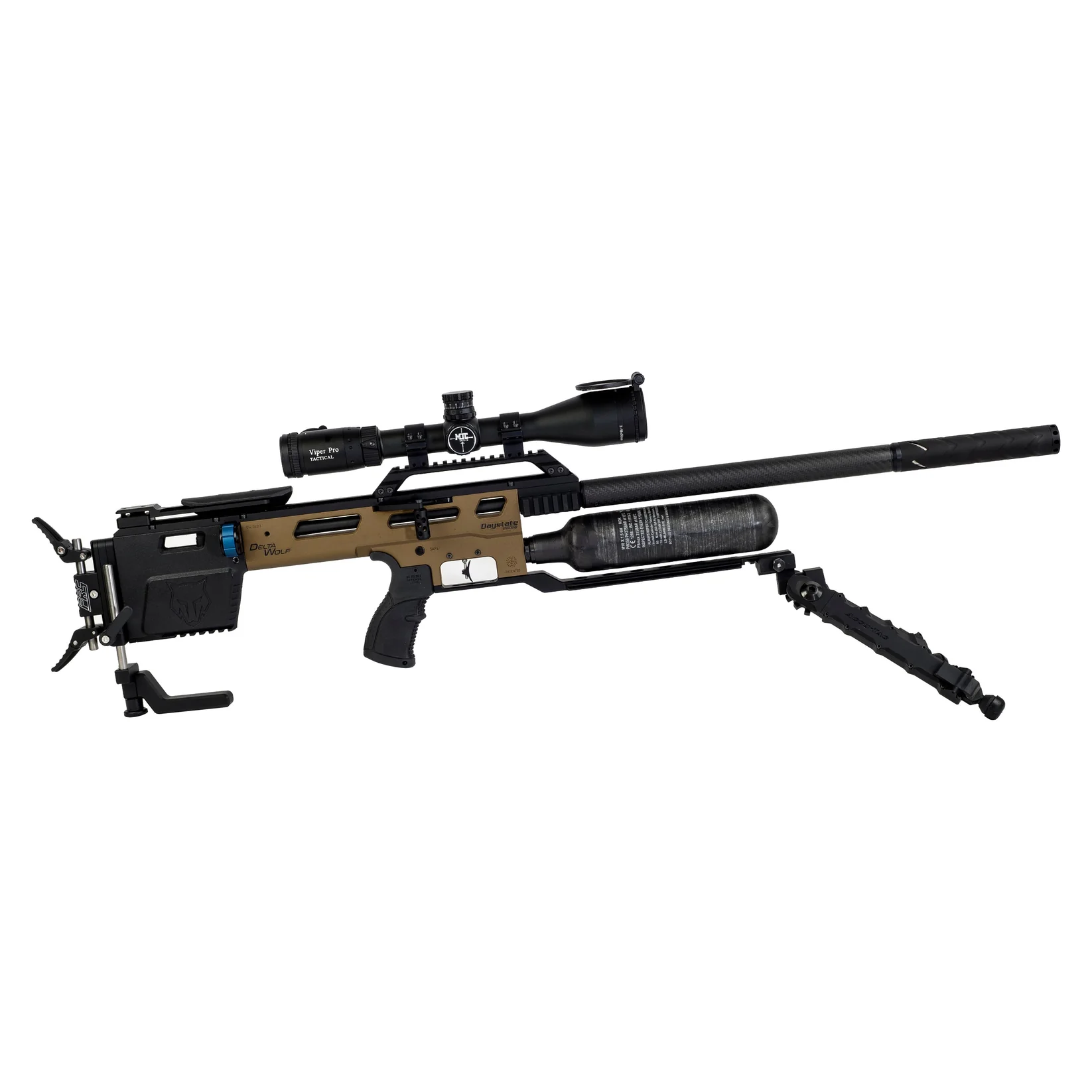
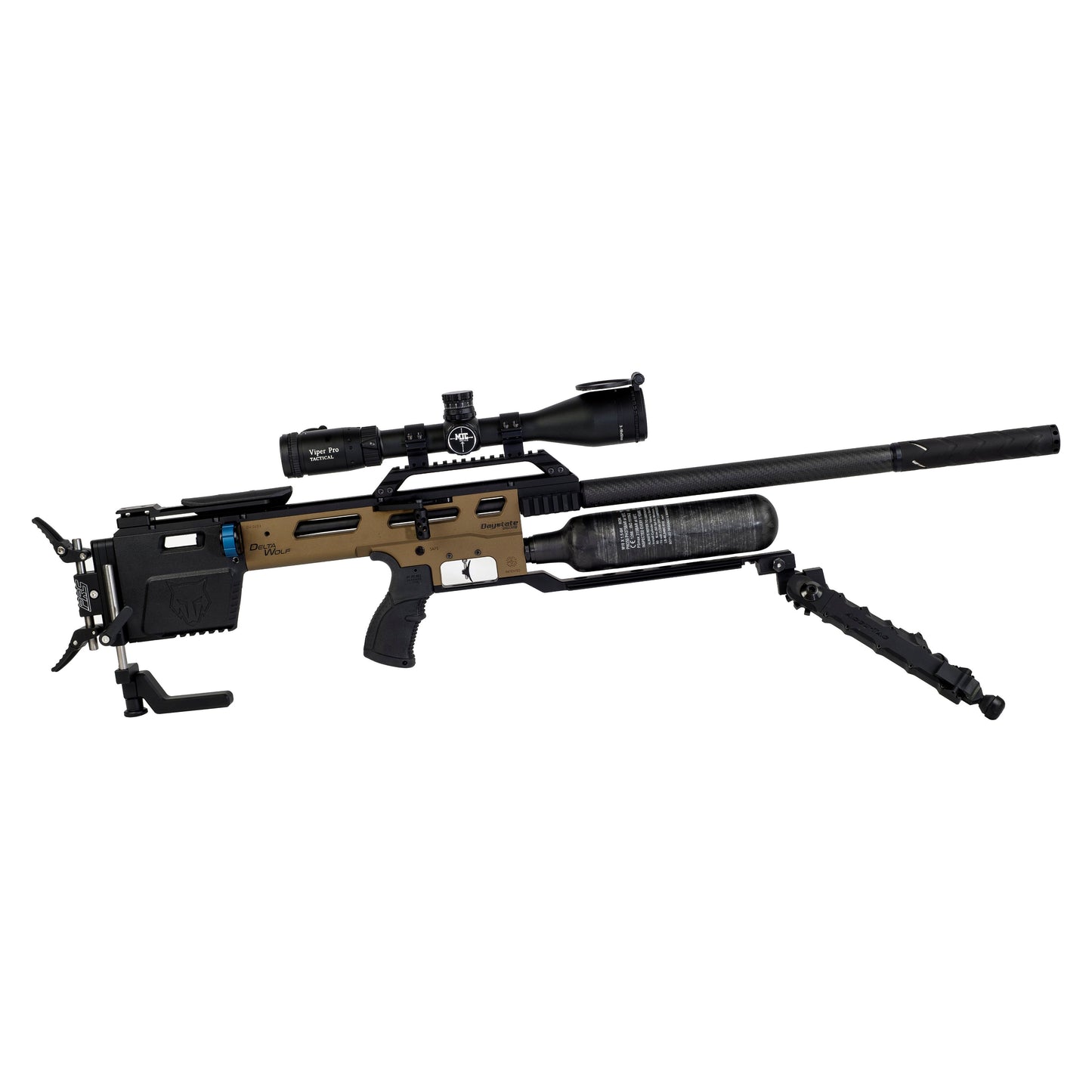
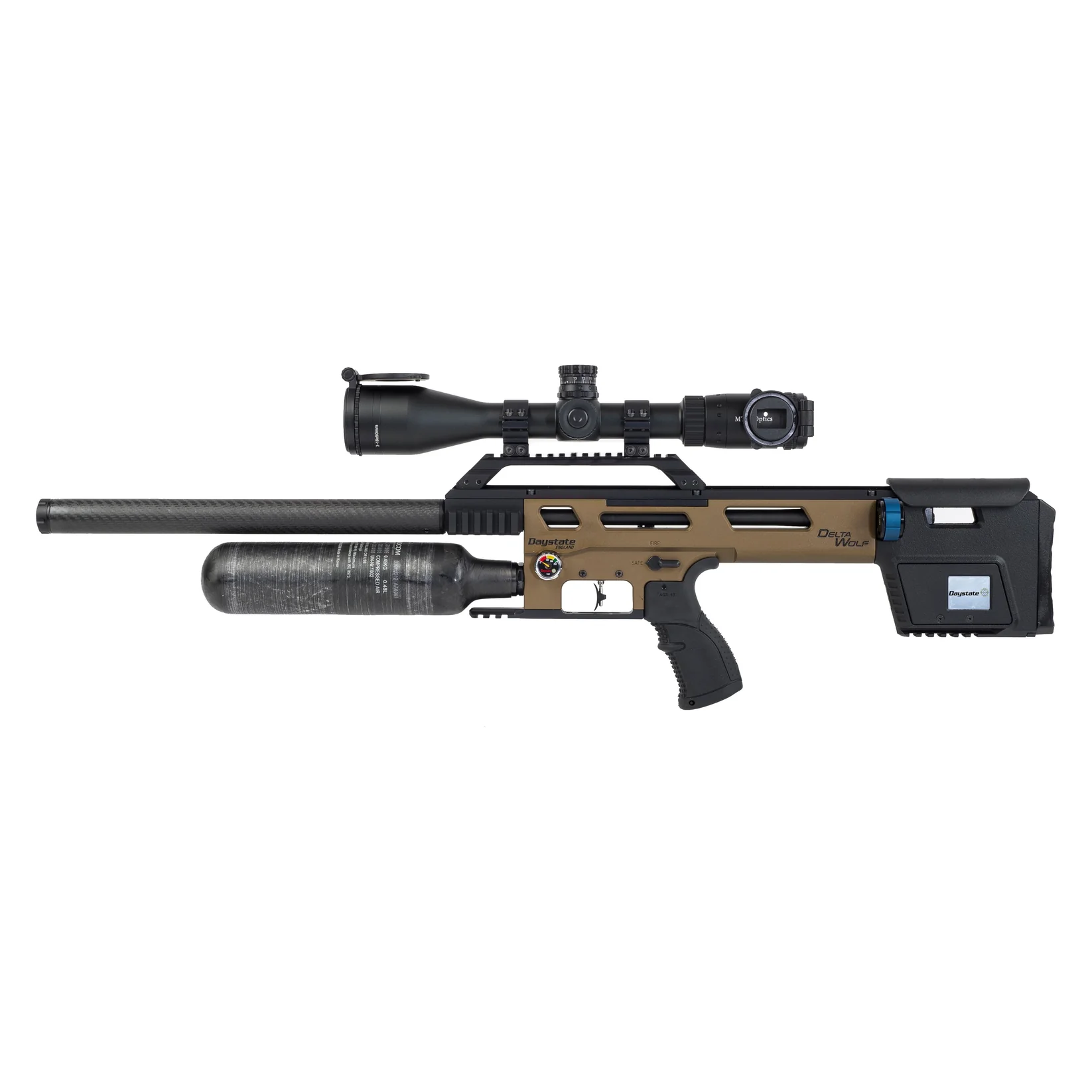
Daystate Delta Wolf Bronze

€2,245.00

THE DELTA WOLF

INTRODUCING…THE MOST ADVANCED AIRGUN OF ALL TIME

The Delta Wolf heralds the birth of a new family of electronic precharged pneumatic airguns for the decade ahead. The advent of this technology truly reinforces Daystate’s reputation as a maker of the world’s most advanced airguns. Nothing like Delta Wolf has been attempted in either the airgun  – or firearm  – worlds before.

FEATURES AND SPECIFICATIONS OF THE DELTA WOLF AIR RIFLE

Delta Wolf is the first Daystate to adopt an advanced tactical form factor that has proven popular with shooters across multiple disciplines – but make no mistake; Delta Wolf the world’s most advanced airgun and represents years of development and investments that, courtesy of newly-filed patents, will make it a very hard act to follow, let alone actually beat!

Building on years of expertise that has already resulted in market-leading electronic rifles such as the Red Wolf and Pulsar, Daystate has taken the concept to the next level. At its electronic heart, the Delta Wolf has next-generation touch screen Advanced Velocity Technology (AVT) which enables the selection of pre-set calibre-specific power levels. AVT is also Bluetooth enabled to connect to other devices and is designed to accept future upgrades and technological innovations, helping to make the Delta Wolf future-proof.


The incorporation of an onboard chronograph further enables users to customise the Delta Wolf according to their specific needs and different pellets. Users can also adjust the pressure in the Huma-Air regulator and exploit the benefits of the huge 34cc plenum chamber, to achieve specific velocities. In addition, a newly designed fast flow valve system improves efficiency and shot count from the 480cc carbon bottle, which takes a 240-bar fill and is removable, allowing a spare to be fitted in seconds.

A new design, higher-capacity Self-Indexing magazine system taking between eight and 13 shots is cycled with a smooth side-lever cocking action, the lever for which can be swapped by the shooter to the left in a minute.  Inserted from either side, the Delta Wolf is configured to allow two magazines to be installed and used in concert to effectively double the shot count.


In addition to technological advances, the Delta Wolf has a fully modular tactical stock design. Weighing 3.1kg (6.8lbs) for the full-length 600mm barrel version and measuring 840mm (34”)the rifle is available in black or bronze and features an ambidextrous AR-style safety catch and pistol grip.

There are under and side-mounted Picatinny accessory rails and a 20mm Picatinny scope rail that can be moved by as much as 150mm to accommodate zero eye relief scopes, like the MTC Optics SWAT Prismatic, as well as a large objective lens, high magnification optics. Additional adjustments to the cheek piece and butt pad, which is compatible with a range of exclusive optional accessories developed by PGS Precision Rifle Services for perfect eye alignment.


The Delta Wolf is available with 430 and 600mm ART developed barrels. A 30mm diameter carbon shroud reduces muzzle blast considerably and the addition of a 0db silencer makes the rifle almost silent.

Although users of high-powered air rifles, in particular, will value the ability to fine-tune it, a UK legal version of the Delta Wolf has also been designed to take into account the legal power restriction. For example, on the UK version, the power settings allow adjustment down from 12-foot pound in % increments and the onboard chronograph displays muzzle velocity allowing the shooter to ensure that he remains compliant. On all versions, every component has been painstakingly designed to optimise accuracy and efficiency. The Delta Wolf sets a new standard for others to follow.

Delta Wolf Video Review

Delta Wolf Video Review 2

* Scope & mount are for illustration purposes and not included.

SPECIFICATION

DELTA WOLF
Overall Length 722. mm (28.4 ins)
Barrel Length 430 mm (17 ins)
Cylinder Capacity 480 cc
Weight (Unscoped) from 3.1 kg (6.8lbs)
Available Calibres .177 inch (4.5 mm), .22 inch (5.5 mm)
Loading Magazine
Cocking Side Lever action – reversible
Magazine 13 Shot (.177), 11 Shot (.22)
Fill Pressure Up to 240 BAR (3,480 psi)
Power / Shots Per Charge 0.303 N/A
Power / Shots Per Charge 0.25 N/A
Power / Shots Per Charge 0.22 TBC
Power / Shots Per Charge 0.177 TBC
Trigger Electronic release. Adjustable for weight and length of stage.
Safety Manual, Electronic isolation. AR15 type lever
Stock Alloy, black anodised or Bronze Cerakote
Options PRS accessories 0dB Silencer, Bipod


Daystate Delta Wolf Bronze: Precision That Is Commanded by Smart Electronics

A new standard in electronic PCP design is represented by the Daystate Delta Wolf Bronze. Tactical modularity is combined with touchscreen-controlled Advanced Velocity Technology so that consistency can be maintained shot after shot. Consequently, hunting, pest control, and precision target work can all be approached with one configurable platform. Moreover, a distinctive bronze Cerakote finish is applied to the alloy chassis so that a distinctive field presence is achieved without excess weight being added.

Furthermore, an onboard chronograph is housed inside the carbon-fiber shroud. Therefore, muzzle velocity is measured continuously and valve timing is corrected automatically. As a result, pellet-to-pellet variation is reduced even when temperature or fill pressure changes. In addition, factory profiles for caliber, barrel length, and pellet weight can be selected from the rear touchscreen. Subsequently, custom velocities can be stored so that ammunition changes are completed without tools or guesswork.


How Advanced Velocity Technology Is Applied

At the electronic heart of the Daystate Delta Wolf Bronze, AVT is used so that pre-set, caliber-specific power levels can be chosen in seconds. Meanwhile, Bluetooth connectivity is provided for future firmware and accessory updates. Consequently, the platform is future-proofed rather than locked to a single firmware generation.

Likewise, a factory-fitted Huma-Air regulator is paired with a class-leading 34 cc plenum. Hence, air is delivered to the fast-flow valve with exceptional stability. Afterward, the removable 480 cc carbon-fiber bottle—filled to 240 bar—is swapped in moments when a spare cylinder is preferred. Thus, a full session can be completed without the rifle being taken off the line for a refill.

Electronic Trigger and Safety Interface

An electronic match trigger is fitted and is fully adjustable for pull weight, first-stage length, and blade position. Meanwhile, an AR-style safety lever is mounted so that the action can be isolated electronically as well as mechanically. Therefore, both left- and right-handed shooters are accommodated without extra parts. Additionally, the reversible side-lever is swapped in minutes so that cocking preference is honored.


Calibers, Power, and Accessories That Are Supported

Interchangeable A.R.T. barrels are offered so that .177, .22, .25, and .30 can be used on the same action. Compact 430 mm (17 in) and standard 600 mm (23 in) tubes are available, while a longer Performance barrel option is listed on higher-power variants. Accordingly, legal-limit and FAC configurations can both be specified where local regulations allow.

Highlighted product listings for the Daystate Delta Wolf Bronze:

  • Action & powerplant: Electronically managed PCP with AVT touchscreen and integral chronograph
  • Finish: Alloy chassis with bronze Cerakote
  • Air reservoir: Removable 480 cc carbon-fiber bottle, 240 bar fill
  • Regulator & plenum: Factory Huma-Air regulator plus 34 cc plenum
  • Barrels: A.R.T.-developed 430 mm or 600 mm (interchangeable kits)
  • Calibers: .177 / .22 (standard); .25 / .30 on HP configurations
  • Magazine: Self-indexing cassette — 13 (.177), 11 (.22), 10 (.25), 8 (.30); dual-magazine capability
  • Cocking: Reversible side lever
  • Trigger: Electronic two-stage, adjustable weight, stage length, and blade
  • Safety: Manual AR-style lever with electronic isolation
  • Rails: Sliding Picatinny / 20–22 mm optic rail plus under and side accessory rails
  • Stock: Modular tactical alloy; adjustable cheekpiece and butt pad; AR-style grip
  • Shroud: 30 mm carbon-fiber shroud; 0 dB silencer compatible
  • Power source (electronics): High-capacity Li-Po battery, USB-C charging
  • Typical compact length / weight: Approx. 722 mm / 3.35 kg unscoped
  • Typical HP length / weight: Approx. 842 mm / 3.55 kg unscoped
  • Warranty: Manufacturer-backed multi-year coverage as supplied

Furthermore, two magazines can be inserted back-to-back so that shot count is effectively doubled between reloads. Meanwhile, the sliding optic rail is moved up to 150 mm so that prismatic, zero-eye-relief, or large-objective scopes are aligned correctly. Consequently, the same chassis can be set up for hunting, HFT-style work, or bench sessions.


Practical Use Scenarios That Are Served

In the field, a compact 17-inch setup is favored when brush and vehicles limit space. Conversely, the 23-inch HP configuration is selected when extra velocity and downrange energy are required for larger quarry, always within local law. Moreover, the bronze finish is chosen because glare is reduced and the chassis remains identifiable among other tactical rifles.

Likewise, range sessions benefit from the live chronograph readout. Therefore, a new pellet lot is verified immediately rather than after a wasted card. Afterward, a stored profile is recalled so that zero and power are restored without a full re-tune. In addition, USB-C charging keeps the Li-Po pack ready; thousands of shots are typically supported from a single charge under normal use.

Inclusive access is supported throughout: ambidextrous safety, reversible lever, adjustable length of pull, and a grip that can be exchanged for aftermarket AR-pattern units. Thus, shooters of different statures and dominant hands can share one rifle without compromise.


Why Consistency Is Sustained Across the Charge

Because regulator pressure, plenum volume, and electronic dwell are coordinated, velocity is held tight across a long shot string. Subsequently, groups remain predictable as the bottle pressure falls. Meanwhile, the carbon shroud and optional 0 dB moderator keep report low enough for discreet pest work and neighbor-friendly practice.

Moreover, maintenance is simplified. The bottle is removed without the residual air being dumped first when a spare is fitted. O-rings, fill probe, magazines, and charging cable are commonly supplied so that first use is completed out of the case. Therefore, time on the range is spent shooting rather than assembling tools.

Legal and safety notes remain essential. Power output, licensing, and transport rules vary by country and region. Consequently, local FAC or equivalent requirements must be confirmed before a high-power specification is ordered. Responsible storage, muzzle discipline, and appropriate backstops are expected of every owner.

Daystate Delta Wolf Bronze


Conversion-Focused Summary

The Daystate Delta Wolf Bronze is positioned for shooters who want electronic control without giving up modular, field-ready ergonomics. Touchscreen AVT, an integral chronograph, a Huma-regulated 480 cc carbon bottle, interchangeable A.R.T. barrels, dual-magazine capability, and a fully adjustable electronic trigger are combined in a bronze Cerakote tactical chassis. As a result, one rifle can be adapted to target work, hunting, and pest control while remaining future-ready through Bluetooth and firmware updates.

When a smart, configurable PCP with distinctive bronze styling is required, the Daystate Delta Wolf Bronze is specified so that precision, shot count, and adaptability are delivered together.

Calibres, FAC, Power, and Accessories for the Daystate Delta Wolf Bronze

Calibre choice, legal power limits, and supporting accessories are treated as a single system on the Daystate Delta Wolf Bronze. Consequently, the same electronic action can be specified for legal-limit practice or higher-energy field work where a Firearm Certificate (FAC) or equivalent licence is held. Moreover, barrel kits, magazines, rails, and regulators are designed so that a change of role does not require a second rifle to be purchased.


How Calibres Are Specified on the Daystate Delta Wolf Bronze

Four popular pellet and slug calibres are supported across the range. Standard compact and many UK-legal configurations are offered in .177 (4.5 mm) and .22 (5.5 mm). Meanwhile, HP and Performance variants add .25 (6.35 mm) and .30 (7.62 mm) so that heavier projectiles can be used when energy and wind resistance are required.

Furthermore, A.R.T.-developed barrels are interchangeable. Therefore, a calibre swap is completed with a barrel, probe, and magazine change rather than a full action rebuild. Afterward, a stored AVT profile is recalled so that power, pellet weight, and target velocity are restored without a lengthy re-tune. In addition, twist, choke, and lead-in geometry are matched to each calibre so that both traditional diabolo pellets and modern slugs can be stabilised.

Magazine capacity is reduced as bore size increases, which is expected on a cassette system. Typical self-indexing capacities are listed as 13 shots in .177, 11 in .22, 10 in .25, and 8 in .30. Likewise, two magazines can be inserted back-to-back so that the effective string is doubled between reloads. Thus, high-volume range sessions and discreet pest circuits are both served.

Highlighted calibre options for the Daystate Delta Wolf Bronze:

  • .177 (4.5 mm): Highest shot count; preferred for targets, HFT-style practice, and legal-limit work
  • .22 (5.5 mm): Balanced trajectory and energy for mixed hunting and pest control
  • .25 (6.35 mm): Extra mass and downrange authority on HP configurations
  • .30 (7.62 mm): Heaviest option for FAC/high-power field use where permitted
  • Barrel lengths commonly paired: 430 mm compact and 600 mm standard; longer Performance tubes on selected HP models
  • Ammunition types supported: Diabolo pellets and compatible slugs, subject to barrel and tune

Inclusive setup is maintained because left- and right-handed operation is unchanged when a calibre kit is fitted. Consequently, a shared club or household rifle can be reconfigured without grip or lever conversion each time.


FAC, Legal Limits, and Power That Are Delivered

Power output is not a single fixed figure. Instead, factory AVT profiles and, on high-power models, regulator adjustment are used so that energy can be matched to ammunition and local law. In many markets a sub-12 ft-lb programme is locked so that an unlicensed legal-limit rifle cannot exceed the factory cap. Conversely, FAC or equivalent high-power versions are supplied where licensing allows substantially higher muzzle energy.

Published figures vary by barrel length, calibre, and programme. Compact legal-limit setups are commonly described in the low- to mid-teens of ft-lbs depending on market tune. Meanwhile, HP examples are listed with energies that can reach the mid-30s ft-lbs in .177, around 70 ft-lbs in .22, the mid-70s in .25, and over 100 ft-lbs in .30 on the longest, highest-output configurations. Therefore, a buyer must confirm the exact factory programme for the serial being ordered rather than assuming a brochure maximum.

Moreover, an integral chronograph is used so that velocity is verified on every shot. As a result, a new pellet lot is checked immediately and dwell is corrected if drift appears. Additionally, the Huma-Air regulator and 34 cc plenum are coordinated with the fast-flow valve so that consistency is held across a long charge from the 480 cc, 240-bar carbon bottle.

Responsible ownership remains non-negotiable. Licensing, transport, storage, and hunting species limits differ by country and region. Hence, an FAC or local equivalent must be confirmed before a high-power Daystate Delta Wolf Bronze is specified. Safety distances, suitable backstops, and approved ammunition are required regardless of energy level.

Highlighted power and legal notes:

  • Legal-limit programmes: Factory-capped output where unlicensed ownership is restricted (commonly 12 ft-lb class in the UK)
  • FAC / HP programmes: Higher energy in .177, .22, .25, and .30 where a certificate is held
  • Fill pressure: Up to 240 bar (3,480 psi)
  • Reservoir: Removable 480 cc carbon-fiber bottle
  • Control: Touchscreen AVT profiles plus regulator adjustment on HP models
  • Verification: Onboard chronograph for live fps readout
  • Compliance: Local law must be checked before purchase and use

Accessories That Are Fitted and Added

A modular tactical chassis is used so that optics, support, and quieting gear can be added without custom gunsmithing. A sliding Picatinny-style optic rail is moved through a generous travel so that prismatic, zero-eye-relief, and large-objective scopes are aligned. Meanwhile, under and side Picatinny sections accept bipods, lamps, lasers, and bags. An AR-pattern grip can be exchanged, and an adjustable cheekpiece and butt pad are provided so that length of pull and comb height suit different shooters.

Furthermore, a 30 mm carbon shroud reduces muzzle blast as standard. Afterward, a 0 dB-class moderator can be fitted where local rules allow silencers. Spare carbon bottles, extra magazines, calibre conversion kits, fill probes, USB-C charging leads, and PRS-style butt and forend furniture are commonly listed as companion items. Therefore, a hunting setup and a bench setup can share one action.

Battery life is supported by a high-capacity Li-Po pack charged on the rifle. Consequently, electronics remain available through long range days when the air supply is still plentiful. Inclusive access is reinforced by reversible side-lever cocking and an ambidextrous AR-style safety with electronic isolation.

Highlighted accessory ecosystem:

  • Sliding Picatinny / Weaver optic rail (extended eye-relief travel)
  • Under and side accessory rails
  • Optional 0 dB moderator and AimGrip-style bipod
  • Spare 480 cc carbon bottles and fill adaptors
  • Extra self-indexing magazines and dual-mag use
  • Calibre/barrel conversion kits and probes
  • USB-C charger and onboard Li-Po pack
  • Adjustable butt pad, cheekpiece, and aftermarket AR grips
  • Optional PRS furniture and single-shot loaders

When calibre, legal power, and accessories are planned together, the Daystate Delta Wolf Bronze is configured as a long-term platform rather than a one-role rifle. Precision profiles are stored, energy is kept within the law that applies to the owner, and rails, magazines, and bottles are added so that every session remains consistent, adaptable, and conversion-ready.

Snowpeak Airguns, PCP Rifles, Air Pistols and Umarex Airguns

For shooters researching Snowpeak airguns, Snowpeak Sports, and the wider Snowpeaks product range, there are many PCP rifles, air pistols, and shooting accessories to consider. Popular searches include the Snowpeak AP900, Snowpeak AP900B PCP air rifle, Snowpeak MAX 1, Snowpeak MAX 1 price, Snowpeak PP750, PP750, Snow Peak PP750, and PP750 air pistol. Buyers also regularly compare models such as the Snowpeak P35, P35, P 35, PCP P 35, Snowpeak P35X, P35X, P35X PCP, and Snowpeak P35 vs P35X.

Other Snowpeak models attracting attention include the Snow Peak PP20, Snowpeak PP20, Snowpeak M25, M25 rifle, M-25, M25 weapon, Snowpeak M60, Snowpeak M60B, M 60B, rifle M60, rifle M50, and M50 rifle. Searches such as Snow Peak brand origin are also common among buyers who want to understand the manufacturer before choosing a rifle or pistol.

Snowpeak PCP Models and Related Airgun Searches

The PCP category covers everything from compact pistols to full-size hunting and target rifles. Searches frequently include PR900 Gen 3, CR650, SR 1000X, T Rex 6000, and pistolet PCP Arcea-Snowpeak Onix Sport. People comparing pneumatic platforms may also search what is a PCP airgun, air gun, air rifle, pellet pistol, air gun accessories, 9mm pellet, and pellet 9mm.

Some search phrases overlap with firearm terminology even when shoppers are researching airgun products. These include rifle M60, how much did the M60 weigh, rifle M50, M50 rifle, M25 weapon, and snowfall gun. Therefore, model specifications should always be checked carefully so that a historical firearm search is not confused with a modern sporting airgun product.

Umarex Airguns, Air Rifles, Pistols and PCP Platforms

Alongside Snowpeak products, Umarex USA, UmarexUSA, Umarex airguns, and Umarex air rifles are widely searched by recreational shooters, target shooters, and PCP enthusiasts. The Umarex range includes PCP rifles, CO₂-powered platforms, break-barrel pistols, BB guns, airsoft replicas, and large-caliber airgun systems.

Popular PCP searches include Umarex Notos, Umarex Notos Carbine, Umarex Gauntlet, Umarex Gauntlet 2, Umarex Gauntlet 30, Umarex Zelos, Umarex Origin, Umarex Komplete, and Umarex Komplete NCR .22. Hunters researching larger airgun platforms may also encounter the Umarex Hammer, Umarex Hammer .50 caliber, Umarex Hammer Carbine, Umarex Primal 20, and Umarex AirSaber.

Practical Use in the Field and on the Range

A modular electronic bullpup is used most effectively when the session is planned around terrain, legal power, ammunition, and the shooter’s body. Consequently, the same chassis can be configured for a dawn pest circuit, a mid-morning zero check, or a late-afternoon hide without a second rifle being packed. Moreover, inclusive fit is achieved because comb height, length of pull, lever side, and grip style are adjusted before the first shot is fired.


How a Typical Outing Is Prepared

Preparation is begun the evening before. The Li-Po pack is charged by USB-C so that the display, solenoid, and chronograph remain available through a long day. Meanwhile, the carbon bottle is filled to the recommended working pressure and is leak-checked at the probe and bottle interface. Afterward, magazines are loaded with a single, weighed pellet lot so that velocity data on the screen can be compared fairly.

Furthermore, a stored electronic profile is selected to match barrel length, calibre, and pellet mass. Therefore, hammer dwell and intended velocity are recalled rather than guessed at the vehicle. In addition, the sliding optic rail is locked at the eye-relief that was proven on the last card. As a result, a rushed re-zero is avoided when light is fading.

Highlighted pre-session checklist:

  • Battery charge confirmed on the rear display
  • Bottle filled, seated, and inspected for damage
  • Magazines loaded with one ammunition lot
  • Correct electronic profile recalled
  • Optic rail, cheekpiece, and butt pad locked
  • Moderator or shroud cap fitted where permitted
  • Licence, land permission, and quarry rules reviewed

Inclusive practice is supported when two people share one rifle. The lever is swapped if needed, the AR-style grip is exchanged, and the safety is confirmed from both sides. Consequently, a left-dominant partner can take the second shift without the zero being lost.
Daystate Delta Wolf Bronze


Pest Control Around Buildings and Field Edges

Quiet, repeatable shots are required when work is conducted near outbuildings, orchards, and field margins. Therefore, the compact barrel and carbon shroud are favoured so that handling in doorways and along fences remains short. Meanwhile, a legal-limit programme is retained wherever licensing demands it, and a higher-energy profile is used only where a certificate and land permission allow.

A typical circuit is walked with the rifle slung close so that gates and stiles are crossed safely. Subsequently, a supported position is taken on a fence post, bag, or kneeling roll. The first-stage trigger is taken up, the chronograph reading is glanced at if a new lot is being used, and the shot is released when the animal is settled and a safe backstop is present. Afterward, the side-lever is cycled and the next pellet is indexed without the muzzle being swept across a yard.

Moreover, two magazines can be carried in the breech so that a productive corner is worked without a noisy reload. Thus, disruption of remaining quarry is reduced. Likewise, a spare bottle in the vehicle allows the session to continue if shot count runs higher than expected after a flush of activity.

Weather is managed rather than ignored. Light rain is tolerated because the alloy chassis and Cerakote-type finish shed moisture, yet the touchscreen is shielded with the body or a simple cover. Wind at fence-line height is read from grass and dust; consequently, a heavier .22 or .25 pellet is chosen on exposed ground when the licence permits that bore.


Hunting From a Hide, Vehicle, or High Seat

A rear-biased bullpup is carried into a hide more easily than a long conventional stock. Therefore, the muzzle clears the window while the action stays inside the shelter. Meanwhile, the sliding rail accepts a compact prismatic optic for tight eye relief or a larger objective glass when last light is used.

From a high seat, the adjustable butt and cheekpiece are set so that a slightly hunched posture still produces a repeatable weld. Afterward, the under-rail bipod or a bag is deployed only if the seat design allows a stable rest without the barrel being forced. In addition, electronic isolation of the safety is used whenever the rifle is lowered for a drink or a map check.

Vehicle-based work is handled with extra discipline. The rifle is cased until the permission boundary is reached. Subsequently, it is loaded only when a safe direction and a legal quarry opportunity exist. A spare magazine pair and a second bottle are kept in a padded pouch so that a long boundary ride does not end because air or pellets ran out.

Inclusive access in a hide is improved when height and reach differ between partners. Comb and pad are reset in seconds. Consequently, a shorter-statured shooter is not forced into a strained neck angle, and a taller partner is not perched on the comb.


Range, Zero, and Practice Sessions

On a formal range, the same electronics that serve the field are used to shorten the tuning loop. A five-shot group is fired, the live velocity string is read from the shroud-mounted chronograph path, and the profile is nudged only if the ammunition has drifted. Therefore, cardboard is not wasted on a guess.

Furthermore, a compact 17-inch tube is preferred for covered firing points and club benches with limited space. Conversely, a 23-inch or longer tube is mounted when a slug programme or extra velocity is being evaluated under FAC rules. Afterward, the original barrel and profile are restored so that the hunting zero is not orphaned.

Trigger work is practiced as a separate drill. First-stage length and break weight are set so that a gloved winter finger and a bare summer finger can both release cleanly. Meanwhile, dry handling with an empty magazine and engaged safety is used to rehearse mount, safety sweep, and follow-through without a shot being fired.

Highlighted range uses:

  • Confirmation of a new pellet lot against stored velocity
  • Comparison of two barrel lengths on the same action
  • Practice of dual-magazine changes under a clock
  • Zero checks after rail or moderator changes
  • Shared coaching because fit can be reset between shooters

A long charge from the 480 cc bottle supports a full club afternoon at legal-limit energy. High-power strings consume air faster; hence, a spare bottle is staged at the bench when FAC testing is planned.


Night, Low Light, and Discretion

Last-light pest work is common around farms. A lamp or illuminator is mounted on a side rail so that the optic remains dedicated to aiming. Meanwhile, the display can be set to a dimmer night mode where that option is provided, reducing glow inside a vehicle cab or hide.

Report is managed with the standard shroud and, where the law allows, an additional moderator. Consequently, livestock and neighbours are less likely to be disturbed by a necessary shot. Afterward, recovery of quarry is planned with a torch that is not mounted on the muzzle line, so that the rifle can be made safe before anyone walks forward.

Inclusive night use includes a clear verbal code between partners: loaded, safe, walking. The ambidextrous safety and reversible lever reduce fumbling in gloves. Therefore, a cold or less experienced partner is not asked to operate a control that only one hand can reach.


Travel, Storage, and Between-Session Care

Transport is completed with the rifle unloaded, magazines out, and the bottle either fitted and protected or removed according to local rules and case design. A hard tactical case is preferred when airlines, ferries, or long dirt roads are involved. Meanwhile, the USB cable and fill adaptor travel in a labelled pouch so that a host range can top up air and charge without tools being borrowed.

Between sessions, the action is wiped, the bottle threads are inspected, and O-rings are checked rather than ignored. The battery is not stored flat for months. Subsequently, a brief function check—display wake, safety isolation, lever travel—is performed before the next permission day. As a result, a flat pack or a sticky magazine is found at home rather than at first light.

Climate extremes are respected. High heat in a closed vehicle is avoided because both air pressure and battery health are affected. Freezing conditions call for a slower first string while seals and lubricant wake up; the chronograph is used to confirm that velocity has returned to the stored window before a hunting shot is taken.


Shared Clubs, Coaching, and Mixed Experience

A club rifle is more useful when fit is not locked to one body. Comb, pad, grip, and lever side are treated as part of the briefing. Consequently, a new member can be coached on hold-over and trigger break without fighting a stock that was set for someone else.

Coaching language stays inclusive. “The weld is taken here,” “the safety is isolated before the walk,” and “the profile is confirmed on the screen” replace assumptions about strength or prior military handling. Meanwhile, power is kept at the legal programme appropriate to the ground and the licence of the person holding the rifle.

Competition-style practice—timed magazine changes, positional shots from kneeling and sitting—is added only after a safe zero exists. Dual magazines reward smooth indexing; they are not an excuse for a rushed muzzle.


Matching Terrain to Configuration

Woodland edges favour the short overall length, a compact optic, and a lighter calibre for flatter indoor-range-like distances. Open pasture favours a longer barrel, a heavier pellet or slug where lawful, and a bipod or bag. Urban-adjacent allotments and yards demand the quietest lawful setup, the strictest backstop discipline, and often a legal-limit cap regardless of what the action can physically produce.

Water margins and hides over ditches require extra muzzle awareness; a bullpup’s balance helps, yet a slip still points the barrel. Therefore, a sling and a clear staging point on the bank are used. Mountain or steep farm tracks reward the modest unscoped weight and rear-biased mass, which reduce arm fatigue on the walk-in.

Highlighted configuration pairings:

  • Tight woods and vehicles: compact barrel, short optic, legal-limit profile
  • Open fields with permission and licence: longer barrel, heavier projectile, HP profile
  • Club bench: either barrel, chronograph on, spare bottle staged
  • Shared household or club: ambidextrous controls reset between users
  • Discretion-first pest nights: shroud plus lawful moderator, dim display, lamp on a side rail

Decision Points During a Live Session

A change of ammunition mid-session is treated as a new zero problem. The profile is updated, a confirmation group is fired if a safe berm exists, and hunting is resumed only when the point of impact is known. Likewise, a sudden drop in displayed velocity is treated as a signal to stop: ice in the valve, a seal issue, or a failing bottle must be diagnosed before another live shot is taken.

Fatigue is managed. After a long walk, the first shot from a new position is a deliberate supported shot, not a standing offhand attempt at a moving target. Inclusive teams rotate the carry so that one person is not exhausted at the moment a responsible shot appears.

When the light dies or the permission clock ends, the rifle is made safe in a fixed order: safety isolated, magazine removed, action cleared, bottle policy followed, case closed. That order is practiced until it is automatic.


Closing the Day So the Next One Starts Clean

At the vehicle, moisture is dried from rails and the screen. Magazines are emptied or boxed. Notes are kept on which profile and pellet lot printed on that ground, because electronic memory is only useful if the shooter remembers what was stored. Subsequently, air is topped or the spare bottle is marked empty. The pack is placed on charge at home.

A practical day with this platform is successful when every shot is legal, every backstop is real, and the electronics are used to remove doubt rather than to add theatre. Configuration is chosen for the ground. Fit is chosen for the person. Power is chosen for the licence. When those three decisions are made before the gate is opened, the outing remains consistent, adaptable, and worth repeating.
Umarex Pistols, BB Guns and T4E Models

For handgun-style platforms, popular searches include Umarex BB gun, BBgun, BB gun pistol, metal BB gun, Umarex TR50, Umarex HDR 50, Umarex T4E, Umarex T4E Smith, Umarex Smith, and Umarex P2P DR50 how many joules.

Glock-style replicas remain another major category. Search terms include Glock BB gun, Glock 19 BB gun, Umarex Glock 19, Umarex Glock 19X, Umarex Glock 19 Gen3 .177 caliber BB gun air pistol, Umarex Glock 17, Umarex Glock 17 Gen 5, Umarex Glock, airsoft Glock, airsoft Glock 19, Glock 17 airsoft, and Glock airsoft gun.

Other replica and recreational searches include Umarex MP40, Umarex MP5, Umarex Legends, Umarex HK Heckler, Umarex shotgun, and airsoft pistol.Umarex DX17.

Break-Barrel and Sporting Umarex Airguns

Shooters looking for spring or gas-piston platforms frequently research the Umarex Trevox, loading Umarex Trevox break barrel .177, Umarex pistol break barrel, Umarex Fusion 2, Umarex Synergis Elite, and Amazon Umarex Browning 800 Express. These platforms provide alternatives for people who want an airgun without relying on a high-pressure PCP charging system.

Additional searches across the Umarex catalog include Umarex H, while broader terms such as air rifle, pellet pistol, air gun, and air gun accessories help buyers compare platforms, ammunition, optics, filling equipment, targets, cases, and other shooting equipment.

Whether the focus is a Snowpeak M60, Snowpeak M25, Snowpeak P35X, Snowpeak PP750, Snowpeak MAX 1, Umarex Notos, Umarex Gauntlet 2, Umarex Origin, or Umarex Hammer Carbine, buyers should compare caliber, operating system, power level, dimensions, intended use, and local regulations before selecting an airgun.

Why This Platform Is Chosen Over a Conventional PCP

A better rifle is not defined by a single velocity number. Instead, consistency, fit, legal flexibility, and time-to-first-accurate-shot are weighed together. Consequently, an electronically managed tactical bullpup is selected when those factors matter more than a traditional wood-stock silhouette. Moreover, inclusive handling is built in, so more than one shooter can use the same action without a gunsmith visit.


Consistency That Is Maintained Shot After Shot

Velocity drift is the hidden cost of many spring and unregulated PCP designs. Here, an onboard chronograph is paired with a programmable valve so that dwell is corrected as conditions change. Therefore, a pellet lot that printed yesterday is more likely to print today. Meanwhile, a factory regulator and a large plenum are used so that the first magazine and the last magazine of a fill remain in the same window.

Daystate Delta Wolf Bronze

Furthermore, live speed is shown after each release. As a result, a bad tin, a cold soak, or a fading bottle is discovered on the bench rather than on a missed chance in the field. Afterward, a stored profile is recalled so that the same combination of barrel, mass, and target speed is restored without a notebook full of hammer-spring marks.

Highlighted consistency advantages:

  • Closed-loop velocity control rather than a set-and-hope hammer
  • Regulator plus large plenum for a stable air curve
  • Profile memory for ammunition and barrel changes
  • Immediate feedback when a lot or seal has drifted
  • Fewer wasted sighting-in sessions after travel or weather swings

Time That Is Saved When the Role Changes

A conventional rifle is often dedicated to one bore and one power band. By contrast, interchangeable barrels and electronic profiles allow .177 practice, .22 pest work, and—where a certificate allows—heavier calibres on the same chassis. Consequently, a second complete rifle is not required for a second job.

Moreover, two magazines can be staged so that a productive corner is worked without a noisy pause. The side-lever is reversed in minutes. The optic rail is slid to suit a prismatic glass or a large-objective scope. Thus, a hide session, a club bench, and a vehicle circuit are served by furniture changes rather than by buying another action.

Inclusive clubs benefit directly. Comb height, butt length, and grip pattern are reset between a shorter coach and a taller student. Therefore, instruction is spent on hold-over and trigger break, not on fighting a stock that only fits one body.

Caliber

.177, .22, .25, .30

Reviews

There are no reviews yet.

Be the first to review “Daystate Delta Wolf Bronze”

Related Products

FAQ

  • Spring-Piston (Break-Barrel or Underlever): Cock by compressing a spring. Reliable, no external air source needed, but can have more recoil (“spring twang”) and require technique to shoot accurately.
  • Pre-Charged Pneumatic (PCP): Filled from a scuba tank, compressor, or pump. High power, low recoil, multiple shots per fill. Popular for precision and hunting.
  • CO₂: Powered by disposable cartridges. Good for pistols and semi-auto/repeaters, but performance drops in cold weather.
  • Multi-Pump Pneumatic: Hand-pumped to build pressure. Versatile but requires effort.
  • Gas Ram (Nitro Piston): Uses compressed gas instead of a metal spring. Smoother than traditional springers.

Calibers: Most common are .177 (4.5mm) for speed/flat trajectory and general use, and .22 (5.5mm) for better hunting knockdown power. Larger “big bore” (.25, .30, .357+) exist for hunting bigger game where legal.

Yes, many modern PCP and springers deliver enough energy for small game (rabbits, squirrels, birds) and even larger game in some areas. Muzzle energy (in ft-lbs or joules) matters more than velocity alone. Always match caliber, pellet weight, and energy to the game and check local hunting regs.

Treat every airgun as if it is loaded.

  • Always point the muzzle in a safe direction.
  • Keep your finger off the trigger until ready to shoot.
  • Know your target and what is beyond it (pellets can ricochet or travel far).
  • Wear eye protection.
  • Store unloaded, out of reach of children/untrained users, and ideally locked.
  • Never shoot at hard surfaces or in areas where pellets could escape your property.

Follow these rules strictly—airguns cause real injuries.

Laws differ dramatically by country, state/province, and even city. Always verify current local laws before buying, owning, transporting, or using an airgun. Age restrictions (often 18+) are common.

Examples (summaries only; check official sources):

  • UK: Air rifles ≤12 ft-lbs (16.3 joules) and pistols ≤6 ft-lbs generally do not require a license (FAC needed above that).
  • USA: Varies by state. Some treat powerful airguns as firearms; others do not. Many states now allow big-game hunting with air rifles.
  • Canada: Some airguns classified as firearms if they exceed velocity/energy thresholds.
  • Australia: Often treated as firearms; licensing/registration required in most states.
  • EU/France/Belgium/etc.: Varies; many allow low-power (<20J) guns freely to adults, with higher power needing permits. Germany has strict ~7.5J limits in some contexts.
  • Other countries: Some have no restrictions below certain energies; others ban or heavily regulate them.

Resources: Wikipedia “Air gun laws”, airgun forums, or official government sites. For travel, research transit laws carefully.

Consider:

  • Purpose: Plinking/backyard → lower power springer or CO₂. Hunting/precision → PCP.
  • Budget: Entry-level springers are affordable; PCPs need a fill system (extra cost).
  • .177 vs .22: .177 easier for beginners/targets; .22 better for hunting.
  • Power source: Convenience vs performance.
  • Test pellets in your gun—accuracy varies.

Buy from reputable dealers and consider warranties.

  • Clean barrel periodically (especially if accuracy drops) with patches and appropriate tools/solvents. Avoid over-oiling.
  • Lubricate moving parts and seals with airgun-specific oil (not general gun oil). Springers need piston seal oil occasionally.
  • Check screws, seals for leaks (PCP), and safety mechanisms regularly.
  • Store in a cool, dry place, ideally in a case. Avoid leaving cocked for long periods.

Follow your model’s manual. Basic care extends life significantly.

International shipping may be available for select products. Customers are responsible for understanding and complying with their local import laws and regulations before ordering.

Yes. Customers are required to confirm their order number through WhatsApp or Live Chat before orders are processed and shipped.

If local laws prevent shipment to your area, your order may be canceled and refunded according to our store policy.

Processing typically takes 1–3 business days after payment confirmation. Delivery times vary depending on destination, carrier, and product availability.


  • Wrong pellets for your barrel/caliber.
  • “Death grip” or poor shooting form (especially with springers—let the gun recoil naturally).
  • Loose scopes or mounts.
  • Ignoring safety or local laws.
  • Over-oiling or shooting with obstructions.


Pellets are the most common projectile (lead or lead-free). Match them to your gun, caliber, and purpose—test several brands as accuracy varies by barrel.

  • Domed (Round-Head): Best all-rounder. Excellent accuracy, ballistic coefficient, and energy retention. Ideal for target shooting, field target, and general hunting (e.g., JSB Exact, Air Arms Diabolo Field, H&N Field Target Trophy).
  • Wadcutter (Flat-Head): Clean holes in paper. Best for close-range target/plinking (under 20-25 yards).
  • Hollow Point: Expands on impact for better energy dump. Good for small game hunting (e.g., Predator Polymag, H&N Terminator).
  • Pointed: More penetration, but often less accurate than domed.
  • Slugs: Heavier, more aerodynamic for high-power PCPs at longer ranges (better for big game where legal).

Tips: Heavier pellets in .22/.25 for hunting (better momentum). Lighter in .177 for speed/flat trajectory. Always check head size fit (e.g., 4.51-4.53mm variants).

Muzzle energy (ft-lbs or joules) matters more than velocity. Ethical shots require precise placement (head/heart-lung) within effective range.

Rough Guidelines (adjust for distance, pellet, and local laws):

  • Small game (squirrels, rabbits, birds): 9-20+ FPE, .177/.22.
  • Medium (raccoons, etc.): 25+ FPE, .22/.25 recommended.
  • Larger game: 40-100+ FPE in .30+ calibers (up to big bore for deer/hogs where permitted).

PCPs dominate serious hunting due to power and shot count. Springers/gas rams work well for small game but require skill. Always prioritize clean kills and check seasons/species rules.

  • Barrel Cleaning: Use a pull-through kit or rod with patches. Avoid brushes that could damage rifling. Clean when accuracy drops or after 500-1000 shots.
  • Lubrication: Airgun-specific silicone oil for seals/O-rings (sparingly—excess causes dieseling in springers). Springers may need piston lube periodically.
  • PCP Specific: Check for leaks (soapy water test), monitor regulator/hammer settings, and keep fill systems clean. Don’t exceed rated pressure.
  • General: Tighten stock screws, inspect for wear, store properly. Chronograph shots to track consistency.

Common Issues:

  • Inconsistent velocity → dirty barrel, bad pellets, or seal problems.
  • Spring “twang” → tuning or proper hold.
  • Low power → worn seals or under/over-pumping.

Toggle Content

  • Scopes: Airgun-rated (hold zero under recoil). 3-9x or 4-12x common.
  • Fill Systems: Hand pumps, compressors, or tanks for PCPs.
  • Safety Gear: Eye/ear protection, targets with backstops.
  • Noise: Airguns quieter than firearms, but moderators help further.

Budget Tip: Start with a quality springer (~$150-400) before investing in PCP setup.

Airgunning offers endless depth—from backyard plinking to precision competition and ethical hunting. Prioritize safety, legality, and practice. If you want specifics (e.g., recommendations for a country, budget, hunting small game, or a particular type like PCP vs springer), let me know for more targeted info! Shoot responsibly.

Tuning improves accuracy, reduces noise/recoil, or increases power (within legal limits).

  • Springers: Lighter springs, guides, seals, or custom tuning kits for smoother shot cycle. “V-Mach” or similar professional tunes popular.
  • PCPs: Regulator tuning, hammer spring adjustments, valve work for efficiency and shot count. Some add electronic systems.
  • Accessories: Suppressors (often unregulated on airguns), better triggers, stocks, and scopes.

Caution: Check laws—power increases may reclassify your gun. DIY only if experienced; professional tuners recommended.

You must be at least 18 years old to purchase any airgun or related accessories from our store. By placing an order, you confirm that you meet the legal age requirements in your state or country.

Yes. Orders may require age verification before processing and shipping. In some cases, we may request a valid government-issued ID to confirm eligibility.