Daystate Delta Wolf Tactical Is Specified for Modern PCP Use
Electronic control is combined with a bullpup layout so that barrel length is kept useful while overall length remains compact. Consequently, handling in hides, vehicles, and tight lanes is improved without a sacrifice in stability. Moreover, a removable 480cc carbon air bottle is fitted and can be charged to 240 bar, after which a large shot reserve is provided for range sessions and extended field work.
Furthermore, an integral chronograph is linked to the onboard computer so that velocity is monitored shot by shot. As a result, on-the-fly corrections can be applied and consistency can be maintained across a fill. In addition, firmware updates and deeper programming can be accessed when the optional data-transfer device is connected, so the platform can be kept current as new profiles are released.
Core Technology That Is Built Into the Platform
- AVT touchscreen control is provided so that calibre-specific power levels, magazine count, night mode, chrono status, and auto power-off can be selected.
- Huma-Air regulation is installed so that output can be stabilized; on high-power configurations, regulator pressure can be adjusted to match pellet or slug programs.
- A fast-flow valve is employed so that efficiency from the 480cc bottle is improved and usable shot count is increased.
- An electronic two-stage trigger is fitted and can be adjusted for pull weight, stage length, and blade position.
- An AR-style safety is used as an electronic isolation switch and can be operated from either side.
- A reversible short-throw side lever is included so that left- or right-side cocking can be set in minutes.
- Self-indexing magazines are supplied and can be inserted from either side; tandem loading can be used so that shot count is effectively doubled.
- A sliding Picatinny optic rail is mounted so that eye relief can be set for compact or long-eye-relief optics.
- Side, under-barrel, and butt rails are provided so that lights, bipods, slings, and other accessories can be attached.
- An adjustable cheek piece and butt pad are offered, and PRS-style accessories can be added for a closer fit.
Calibres, Power Options, and Accessories for the Daystate Delta Wolf Tactical
Legal compliance is supported because sub-12 ft-lb programming is available where required, while high-power and Performance variants are offered where FAC or equivalent authority is held. Therefore, the same family can be specified for club use, pest control, or longer-range hunting.
Typically, the compact tactical configuration is supplied with a 17-inch (430 mm) barrel and an overall length of about 28.4 inches (722 mm). Meanwhile, HP configurations are commonly supplied with a 23-inch (600 mm) barrel and an overall length of about 33.1 inches (842 mm). Performance barrels of 28 inches (711 mm) can also be specified on longer chassis options.
Calibre availability is organised as follows: .177 and .22 are commonly listed on standard models, while .25 and .30 are associated with HP and Performance platforms. Magazine capacity is generally quoted as 13 shots in .177, 11 in .22, 10 in .25, and 8 in .30. Consequently, a second magazine can be staged so that 26 shots in .177 or 22 shots in .22 can be fired before a reload is required.
Energy figures vary by barrel, program, and ammunition. On compact standard programming, up to about 20 ft-lb in .177 and 45 ft-lb in .22 may be available where law allows. On HP and Performance programming, higher outputs are quoted—extending, on the largest Performance setups, toward the upper 30-calibre figures published by the factory. Because local limits differ, power should always be confirmed against the certificate supplied with the individual rifle.
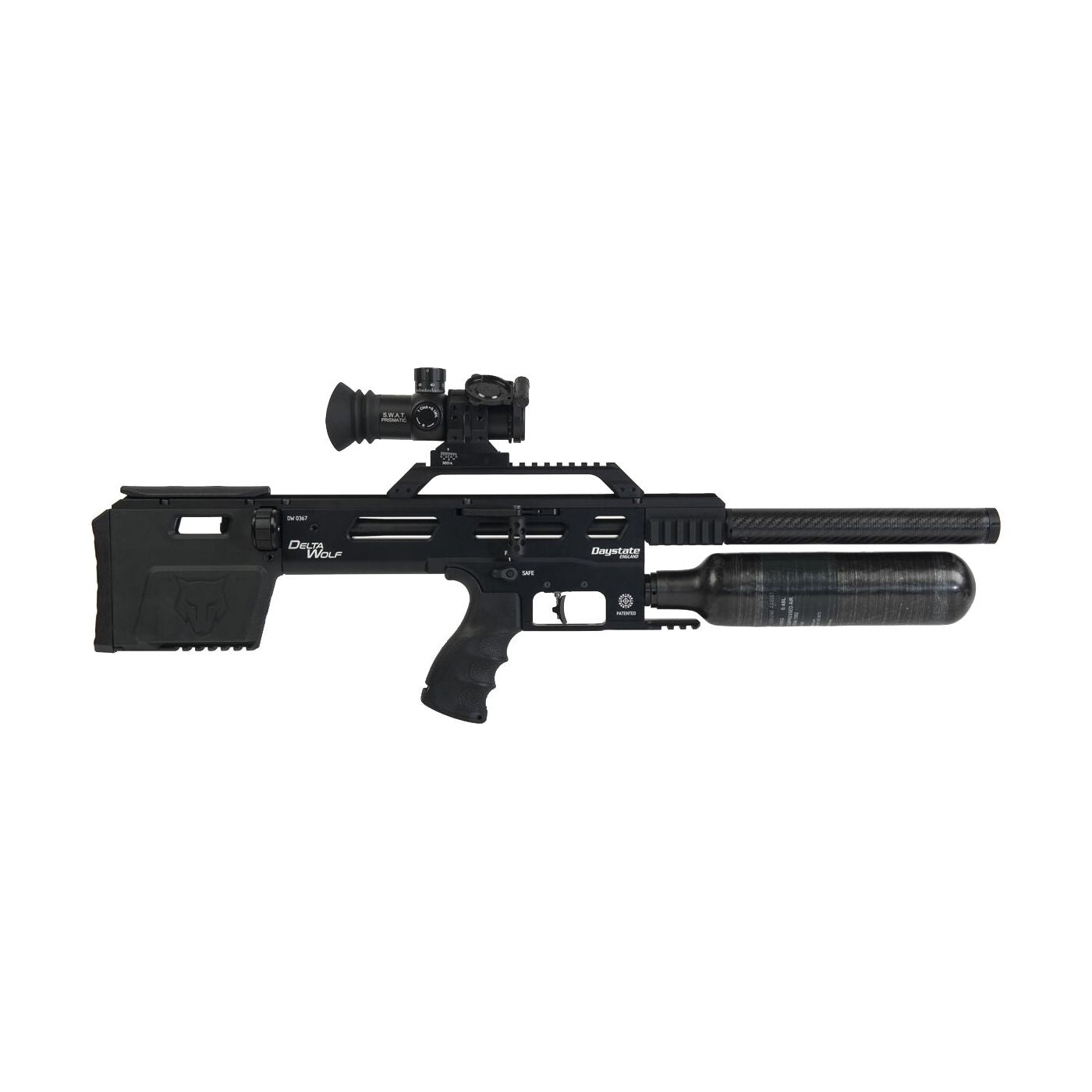
Barrel kits and probes can be changed in the field, after which the matching program can be selected on the screen. Therefore, a single action can be reconfigured between target pellets and heavier hunting ammunition without a workshop visit. Additionally, a carbon shroud is fitted to reduce muzzle report, and a 0 dB silencer option can be added where permitted.
Unscoped weight is typically listed around 7.2–7.4 lb (about 3.3–3.35 kg) for compact tactical models and around 7.8 lb (3.55 kg) for HP barrels, with longer Performance setups slightly heavier. Balance remains rearward because the electronics and battery are housed in the butt, so the rifle can be held on aim for longer sessions.
Practical Setup Details That Are Often Overlooked
Fill access is concealed under a magnetic cover ahead of the trigger guard, so dirt is kept away from the probe port. The 11.1 V Li-Po battery is housed behind the butt pad and is removed for balanced charging. Care around pacemakers and magnetic media is advised because electronic components and magnets are present.
Display information typically includes regulator pressure, selected mode, calibre, pellet program, barrel length, requested velocity, battery level, and magazine count. Night display can be enabled so that the screen remains usable after dark without excess glare.
Field Uses Where the Daystate Delta Wolf Tactical Is Applied
Compact length is used in vehicles, elevated hides, and woodland lanes where a conventional full-length rifle would be awkward. Meanwhile, the same platform can be set on a rest for bench or HFT-style work because the electronic trigger break is short and repeatable.
Pest control at closer ranges can be supported by reduced power steps on sub-12 programming, so over-penetration risk can be managed around buildings and livestock. Conversely, FAC configurations can be programmed for heavier projectiles when longer shots and larger quarry are lawful.
Hunting walk-ups benefit from the removable bottle, because a spare charged cylinder can be carried and swapped quickly. Target shooters benefit from stored profiles, because a favourite pellet weight and velocity can be recalled instead of being re-tuned from memory.
Inclusive fit is supported by the ambidextrous lever, dual-side magazines, AR-style grip, and sliding rail. Therefore, left- and right-handed shooters can share the same rifle after a short conversion, and aftermarket grips can be fitted if a different hand size is required.
Buying Considerations and Responsible Ownership
A premium electronic PCP is being purchased, so budget should include optics, a suitable moderator where legal, a quality fill source, spare magazines, and a balanced charger. Legal status must be verified before purchase: energy limits, licensing, transport, and hunting seasons differ by country and region.
Safe handling remains essential. The muzzle must be pointed in a safe direction, the safety must be applied until a shot is intended, and local rules on public carry and storage must be followed. Because the action is electronic, the battery should be kept charged and the rifle should be powered down after use.
When the Daystate Delta Wolf Tactical is specified correctly—calibre, barrel length, power program, and accessories matched to lawful use—an unusually flexible electronic bullpup is obtained. Precision is not left to a single factory setting; instead, it is managed, recorded, and repeated through the AVT system, the Huma regulator, and a modular tactical chassis that can be adapted as skills and shooting tasks change.
Daystate, Delta Wolf, Alpha Wolf and Premium PCP Air Rifle Accessories
For shooters researching premium PCP platforms, daystate blackwolf, daystate redwolf, delta wolf, huntsman daystate, and daystate alpha wolf frequently appear among the most searched Daystate-related terms. Whether someone searches for wolf delta, day state, daystate delta wolf, blackwolf, deltaw, daysta, or wants to understand the delta wolf meaning, these rifles are commonly associated with modern PCP engineering, electronic control systems, adjustable configurations, and high-end airgun performance.
People asking what is a delta wolf are generally researching the electronic Daystate platform and how it differs from conventional PCP rifles. Related searches often include electronic wolves, firing cycle, lock time, lock timing, short cocking, cocking ball, index pin, and pin magazine. Searches may also focus on configuration-specific components such as an alpha wolf barrel, stock walnut, safari stock, dima stock, stock replacement, rimfire stocks, or a rifle butt pad.
Calibres, FAC Status, Power Options, and Accessories
Lawful energy, projectile choice, and supporting furniture are specified together so that the electronic bullpup remains useful across club, pest, and hunting tasks. Consequently, calibre, barrel length, and power program are treated as a matched set rather than as separate extras. Moreover, accessories are chosen only after local licensing and transport rules have been confirmed, because a high-power configuration that is legal in one region may be restricted in another.
Calibres and Magazine Layout
Four projectile diameters are associated with the platform. Standard compact configurations are commonly supplied in .177 (4.5 mm) and .22 (5.5 mm). Meanwhile, high-power and Performance configurations extend the range to .25 (6.35 mm) and .30 (7.62 mm), so that heavier pellets and slugs can be used where authority allows.
Self-indexing magazines are sized to the chamber. Typical capacities are listed as 13 shots in .177, 11 shots in .22, 10 shots in .25, and 8 shots in .30. Furthermore, magazines can be inserted from either side of the breech. As a result, a second magazine can be staged in the opposite port so that shot count is effectively doubled before a reload is required.
Barrel and probe kits can be exchanged in the field after a retaining screw is released. Therefore, a shift from a light target pellet to a heavier hunting projectile is completed without a workshop visit. After the mechanical change, the matching electronic profile is selected on the screen so that requested velocity, regulator guidance, and magazine count remain aligned with the new tube.
Inclusive use is supported because left- and right-handed shooters can share the same action once the side lever and magazine direction have been set. Likewise, clubs that rotate rifles between members can keep spare magazines marked by calibre so that a .177 drum is not seated in a .22 breech.
FAC, Legal-Limit Programming, and Power Bands
Two legal families are offered. Where unlicensed ownership is limited to 12 foot-pounds, a separate program is loaded so that output cannot be raised above the factory cap. On that programming, power can still be reduced in steps—commonly described as five-percent increments—so that indoor ranges, garden pest work, and confined farm buildings can be served with less energy.
Where a firearm certificate or equivalent authority is held, high-power and Performance programs are made available. On those configurations, pre-set calibre-specific levels can be recalled, and regulator pressure can be adjusted to match a chosen pellet or slug. An integral chronograph is used so that the requested velocity is compared with the measured result after each shot.
Published energy bands vary by barrel length and software generation. Compact legal-limit rifles are typically held near or under 12 ft-lb. Compact standard programming on export or FAC examples has been quoted around 20 ft-lb in .177 and 45 ft-lb in .22. High-power figures commonly cited include roughly 31–37 ft-lb in .177, 61–78 ft-lb in .22, 67–81 ft-lb in .25, and 95–115 ft-lb in .30 on the longest Performance barrels. Because certificates differ by serial number, the figure printed for the individual rifle is treated as the governing limit.
Fill pressure is specified up to 240 bar (3,480 psi) into a removable 480 cc carbon bottle. Shot count on legal-limit programming is often quoted in the region of 400 shots in .177 and 450 shots in .22 from a full charge. Higher-power strings use more air per shot, so a spare bottle is carried when long hunting days are planned.
A Huma-Air regulator and a large secondary chamber are employed so that velocity remains stable across the usable portion of the fill. On high-power rifles, regulator pressure is brought into the band shown on the display after a calibre or velocity change. On sealed legal-limit rifles, that adjuster is left at the factory setting.
Barrels, Furniture, and Accessory Fitment
Two primary barrel lengths are associated with the tactical family: 17 inches (430 mm) on the compact chassis and 23 inches (600 mm) on many HP rifles. Performance tubes of 28 inches (711 mm) are listed on longer chassis options. Overall length follows the tube: about 28.4 inches (722 mm) for the compact rifle and about 33.1 inches (842 mm) for the common HP layout. Unscoped weight is typically given near 7.4 lb (3.35 kg) for compact models and 7.8 lb (3.55 kg) for HP barrels.
A carbon shroud is fitted to reduce muzzle blast. Where local rules allow, a 0 dB silencer can be added so that hide and vehicle work remain discreet. The muzzle thread and shroud length should be confirmed before a moderator is ordered, because barrel kits are not identical.
Picatinny furniture is distributed around the action:
- A sliding optic rail is provided so that short-eye-relief prismatic scopes and long, large-objective target scopes can both be aligned.
- Side rails on the forend accept lamps, lasers, or thermal clip-on supports where lawful.
- An under-rail beneath the bottle accepts a bipod or barrier stop.
- A rail under the butt accepts a sling stud, monopod, or rear bag plate.
- An adjustable cheek piece and butt pad can be raised or lowered; PRS-pattern parts can be fitted when a closer length of pull or a different pad angle is required.
- An AR-style pistol grip can be exchanged for an aftermarket grip if hand size differs.
Electronic accessories complete the system. A balanced charger is required for the 11.1 V Li-Po pack housed in the butt. An optional data-transfer device can be connected to a Windows computer so that firmware is updated and finer firing maps are written. Bluetooth capability has been reserved for later device links. Spare magazines, fill probes, O-ring kits, and a second charged bottle are treated as working parts rather than optional extras.
Because magnets and electronics are present, care is taken near pacemakers and payment cards. The fill port remains under a magnetic cover until the probe is ready. After any accessory is added, eye relief, balance, and the safety isolation lever are checked before live firing is resumed.
When calibre, certificate, power program, and furniture are specified as one package, the rifle can be moved between a legal-limit club lane and a licensed hunting permission without the action being replaced. The governing rule remains local law: energy, projectile type, and fitted devices are used only within the authority that has been granted for that shooter and that ground.
Daystate Red Wolf, Alpha Wolf and Wolverine Searches
The daystate redwolf family remains closely connected with searches for daystate redwolf price, red alpha wolf, alpha red wolf, and the newer daystate blackwolf platform. Some shoppers may also compare these rifles with the daystate wolverine sapphire, wolverine gun, wolveriner, wolf gun, wolfpack armory wolverine, or even search unusual phrases such as can wolverine go on planes while researching transport rules.
Accessories frequently searched alongside these platforms include a rubber butt, rubber butt pad, butt pad rifle, bradley cheek riser, gecko grips, picatinny bag rider, and buddy bottle cover. Cosmetic or clothing-related search phrases such as red bodywarmer and black snood may also appear alongside broader brand searches.
Magazine-related searches include 177 magazine, mag 177, and 25 magazine, while ammunition research can include 177 pellets types, 5.0 mm pellets, and slug pellet. Because pellet suitability depends on the rifle, barrel, legal power level, and intended range use, compatible ammunition should always be selected according to the manufacturer’s specifications.
PCP Air Systems, Moderators and Thread Accessories
Many enthusiasts researching Daystate rifles also search for air rifle compressed air, compressed air rifle, what are pcp air rifles, and what is a pre charged pneumatic air rifle. These searches relate to the fundamental operating principle of PCP systems, in which stored compressed air is used to power each shot.
Common accessory searches include air gun pc, air gun suppressor, air gun suppressors, airgun moderator, air rifle moderator, 0db, 0db moderator, and 0 db moderator. Buyers may also encounter searches for a hogan decimeater silencer, silencer thread adapter, thread protector rifle, and muzzle thread protector when comparing muzzle accessories and compatible threaded components. Local regulations should always be checked before purchasing or fitting sound-moderating equipment.
Maintenance-related searches often include pcp o ring kit, while tuning-oriented users may look for an ats tuner. Search terms such as unfend can also appear in broad airgun keyword datasets, even when the intended product or meaning is unclear.
M-LOK, Picatinny and Rifle Sling Accessories
Accessory compatibility is another major area of interest. Common searches include mlok to picatinny rail adapter, best m-lok to picatinny rail adapter, m-lok to picatinny adapter, and picatinny m lok adapter. These adapters are often researched by users who want to mount compatible optics, rests, bipods, bags, or other permitted accessories on an appropriate rail system.
Sling-related searches include riffle sling, rigle sling, how to put a gun sling on a rifle, how to put a rifle sling on, how to install a rifle sling, how to put sling on rifle, installing a rifle sling, and attaching a sling to a rifle. Because attachment arrangements differ between stocks, rails, swivels, and chassis systems, the correct mounting points should always be confirmed from the manufacturer’s documentation.
Other general mechanical or unrelated search phrases found within broader keyword datasets include how to put extinguisher call back together, weatherby vanguard trigger adjustment, and 3.55kg in lbs. While these terms may appear in search data, they are not necessarily specific to Daystate PCP rifles.
BRK, Brocock and XR Air Rifle Searches
Alongside Daystate products, many buyers compare models produced under the Brocock and BRK families. Popular searches include brocock ltd, brocock sniper xr, brocock commander xr, pathfinder xr, brk ghost, brocock airguns, brocock commander, brk ghost air rifle, and brk sniper xr.
The brocock sniper xr is often researched by shooters comparing compact PCP platforms, while the brocock commander xr and brocock commander searches generally relate to larger tactical-style PCP configurations. Meanwhile, brk ghost and brk ghost air rifle searches reflect growing interest in BRK-branded PCP systems.
Those comparing local purchasing options may also search fx airgun dealer near me, even when their primary interest is Daystate or Brocock. This reflects the way many airgun shoppers compare several premium manufacturers before deciding which PCP platform, stock configuration, calibre, regulator setup, magazine system, and accessory package best matches their intended sporting use.
Additional Daystate and Airgun Search Terms
Broader searches surrounding these rifles may include model alpha gun, griffin gun, and general comparisons involving a wolf gun or other premium PCP platform. Buyers may also investigate different stock materials, rail systems, moderators, magazines, barrel options, butt pads, cheek risers, thread protectors, and compressed-air accessories before completing a build.
Whether someone begins with daystate redwolf, explores the daystate alpha wolf, compares a daystate delta wolf, investigates the daystate blackwolf, or considers a daystate wolverine sapphire, the most useful approach is to verify model compatibility, calibre, pressure specifications, local regulations, and manufacturer-supported accessories before purchasing replacement components or upgrades.
Practical Use Scenarios
Field work is approached as a series of controlled tasks rather than a single fixed shooting style. Consequently, the electronic bullpup is treated as a configurable platform whose power program, magazine arrangement, optic position, and accessory layout can be matched to the day’s ground, light, and lawful purpose. Moreover, consistency is protected by the onboard chronograph and regulator, so that changes in temperature, fill pressure, and ammunition lot are observed rather than guessed.
Hide and Vehicle Work in Tight Ground
Compact overall length is used when a conventional full-length rifle would strike branches, dashboards, or hide frames. Therefore, the rifle is brought to the shoulder from a seated or kneeling position with less barrel swing. In addition, the rearward mass of the electronics and battery is employed so that the muzzle remains steady during long waits.
Access from a vehicle window is improved because the action can be supported on a door rest while the butt remains inside the cabin. Meanwhile, a compact moderator is fitted where permitted so that report is reduced near livestock and farm buildings. Furthermore, reduced power steps on sub-limit programming can be selected when shots are taken at short distance, so that over-penetration risk is lowered around walls, feeders, and machinery.
Magazine insertion from either side is used when the shooting position leaves only one hand free. As a result, a fresh magazine can be staged from the open side without the rifle being turned. Likewise, the reversible side lever is set before the session so that cocking motion does not collide with hide netting or a window frame.
Typical hide preparation is organised as follows:
- The optic rail is slid until eye relief is comfortable in the seated posture that will actually be used.
- The cheek piece and butt pad are raised or lowered until a repeatable cheek weld is obtained without strain.
- A bipod or bag is attached to the under-rail only after the hide floor or vehicle rest has been checked for height.
- Night display is enabled if last-light work is expected, so that screen glare is controlled.
- A spare charged bottle is carried in a padded sleeve so that a mid-session swap can be completed without tools.
After these steps are completed, the first shot is taken only when a safe backstop has been confirmed. Subsequently, velocity readings on the screen are compared with the planned program so that any unexpected drop can be investigated before a second shot is released.
Woodland Walk-Up and Pest Control on Mixed Ground
Movement through cover is aided by the short barrel and enclosed bottle layout. Consequently, snagging on bramble and young timber is reduced compared with a long-barrelled sporter. At the same time, the AR-style grip is used so that the trigger hand remains consistent when the rifle is carried at the ready.
When a target is presented at modest range, a lower power increment can be chosen on legal-limit programming. Therefore, pellet flight remains flat enough for a confident hold while excess energy is avoided near buildings. Conversely, when a longer, clear lane is offered and local law permits a higher program, the stored profile for a heavier pellet can be recalled so that the same zero is not abandoned.
Tandem magazines are employed on walk-ups because a second loaded magazine can be held in the opposite port. After the first magazine is emptied, the spare is pushed across and firing can continue with minimal movement. In addition, the magnetic magazine covers are kept closed until loading is required, so that debris is kept out of the chambers.
Quiet approach is supported by a shrouded barrel and an optional silencer. Nevertheless, safe backstops remain mandatory, because reduced report does not reduce the duty to know what lies beyond the target. Inclusive practice is maintained by checking that left- and right-handed members of a party can operate the same rifle after the lever and magazine direction have been set.
A woodland sequence is commonly followed in this order:
- The rifle is powered on only when the shooting ground has been reached, so that battery life is conserved.
- Regulator pressure and selected velocity are confirmed on the screen before the first stalk begins.
- Shots at feeders or runs are taken from a supported position whenever a tree, fence post, or kneeling roll can be used.
- After a shot, the chronograph reading is glanced at so that a flyer caused by a dirty barrel or a damaged pellet can be recognised.
- When the session ends, the action is isolated, the magazine is removed, and the rifle is cased with the muzzle pointed in a safe direction.
Because weather changes quickly under a canopy, a spare battery charge and a dry cloth are carried. Condensation on the screen is wiped before menus are used, and the fill port cover is kept closed so that grit is not introduced during a bottle swap.
Range Sessions, Zero Work, and Competition Practice
Bench and prone work benefit from the electronic trigger because a light, repeatable break can be set and then left alone. Consequently, group size is limited more by ammunition and wind than by a heavy mechanical sear. Moreover, every shot can be logged on the integral chronograph, so that a string is judged by measured velocity as well as by holes in paper.
Zeroing is organised around stored profiles rather than a single factory setting. First, a pellet weight and requested velocity are entered. Next, regulator pressure is brought into the band shown on the display. Then a group is fired and the optic is adjusted. After that, the same profile can be recalled on a later visit, so that time is not spent rediscovering last month’s tune.
When barrels are exchanged, the matching program is selected immediately. Therefore, a shift from a short target barrel to a longer hunting barrel is treated as a documented change rather than an experiment. Likewise, slug programs on high-power configurations are kept separate from pellet programs so that a competition zero is not overwritten by a hunting load.
Accessory rails are used to mount a rear bag plate, a data device, or a timer only when the extra weight does not disturb balance. The sliding Picatinny rail is moved until large-objective optics clear the bottle and still allow a natural head position. Night mode on the screen is useful even in daylight halls if glare from overhead lamps washes out a standard display.
A structured range card can be kept with these points:
- Date, temperature, and fill pressure at the start of the string
- Selected calibre, barrel length, pellet or slug, and requested velocity
- Measured average velocity and extreme spread from the onboard chrono
- Group size at the stated distance and wind note
- Any regulator adjustment that was required to hold the program
Because inclusive clubs share benches, the ambidextrous controls are left in a known state and are announced when the rifle is passed. The safety isolation lever is applied between strings. Magazines are unloaded before the rifle is placed in a rack.
Last Light, Thermal or Lamp Work, and Extended Sits
When legal illumination or thermal devices are used, the side and under rails accept lamps or clip-on units without a custom chassis. Eye relief is then rechecked because a clip-on changes the optical length. The cheek piece is raised if a higher line of sight is created.
Battery management becomes part of the plan. Auto power-off is lengthened for a long sit, yet the rifle is still isolated when no shot is expected, so that a bump cannot release a pellet. Night display is selected so that the screen remains readable without lighting the hide.
A second charged bottle is especially useful after dark because a refill at a vehicle may be noisy or unsafe. The magnetic fill cover is opened only when the probe is ready, then closed at once. Spare magazines are loaded at home under good light, then carried in a closed pouch so that pellets are not inverted in the dark.
Wind and range estimation remain the shooter’s responsibility. Electronic consistency does not replace a clear view of the target and what stands behind it. Inclusive night practice includes a brief verbal check that every person in the party knows where the muzzle is pointed before a lamp is switched on.
Seasonal Hunting Days and Mixed Quarries Where Law Allows
On open ground, the longer HP barrel option is often chosen so that velocity with heavier projectiles is supported. The same action can later be returned to a shorter barrel for woodland work. Because profiles are stored, the change is treated as a planned reconfiguration rather than a loss of zero.
Supported shooting from sticks, a bipod, or a natural rest is preferred whenever time allows. The adjustable butt pad is used to keep the recoil path consistent on higher-power programs. After a shot on game, the rifle is made safe before any approach, and local retrieval and tagging rules are followed.
Travel between permissions is planned around secure transport. The rifle is cased unloaded, with magazines empty and the battery isolated. Documents that prove lawful energy and ownership are carried where required. Inclusive parties assign one person to confirm that every rifle is clear before vehicles are entered.
Maintenance during a hunting week is kept simple. The barrel is cleaned according to the ammunition being used. The screen and rails are wiped. O-rings on the fill probe are inspected. The Li-Po pack is charged with the specified balancer rather than an unknown adapter. Pacemaker and card warnings are observed because magnets and electronics are present in the butt and covers.
Training New Shooters and Shared Club Use
A first session is begun with the lowest practical power program and a large, safe backstop. Trigger weight can be set slightly heavier for a new shooter, then lightened as control improves. The touchscreen menus are demonstrated once with the rifle pointing in a safe direction and the magazine removed.
Because the platform is ambidextrous, a left-handed newcomer is not forced into an awkward cocking motion. The lever is swapped before the lesson, and magazine insertion is practised from the comfortable side. Inclusive language is used throughout: the rifle is described as a shared tool whose fit can be adjusted, not as a device that suits only one body type.
Progress is measured with the chronograph and with group size, not with noise or spectacle. When confidence is established, a second profile can be introduced so that the difference between a close-range pest setting and a longer target setting is understood. The session is ended with a full safe-and-case routine so that good habits are rehearsed while attention is still high.
Across hides, woods, benches, and last-light sits, the same principle is applied. The electronic bullpup is prepared before it is needed, its program is confirmed rather than assumed, and every shot is taken only after a safe backstop and a lawful purpose have been established. When those conditions are met, the platform’s regulation, shot reserve, and modular furniture are used to keep the shooter stable, informed, and ready for the next ethical opportunity.25 caliber brocock sniper xr
Training New Shooters and Shared Club Use
A first session is begun with the lowest practical power program and a large, safe backstop. Trigger weight can be set slightly heavier for a new shooter, then lightened as control improves. The touchscreen menus are demonstrated once with the rifle pointing in a safe direction and the magazine removed.
Because the platform is ambidextrous, a left-handed newcomer is not forced into an awkward cocking motion. The lever is swapped before the lesson, and magazine insertion is practised from the comfortable side. Inclusive language is used throughout: the rifle is described as a shared tool whose fit can be adjusted, not as a device that suits only one body type.
Progress is measured with the chronograph and with group size, not with noise or spectacle. When confidence is established, a second profile can be introduced so that the difference between a close-range pest setting and a longer target setting is understood. The session is ended with a full safe-and-case routine so that good habits are rehearsed while attention is still high.
Across hides, woods, benches, and last-light sits, the same principle is applied. The electronic bullpup is prepared before it is needed, its program is confirmed rather than assumed, and every shot is taken only after a safe backstop and a lawful purpose have been established. When those conditions are met, the platform’s regulation, shot reserve, and modular furniture are used to keep the shooter stable, informed, and ready for the next ethical opportunity.




Reviews
There are no reviews yet.