EKOL VOLTRAN ESP 2450H/2550H PCP
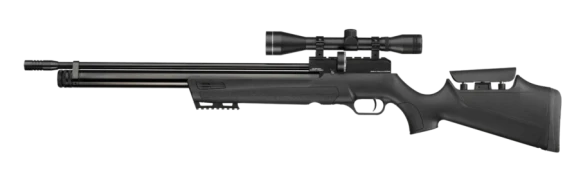
The EKOL VOLTRAN ESP 2450H/2550H PCP is a compressed-air sporting air rifle manufactured under the EKOL VOLTRAN brand. The model family is identified by two calibre variants, namely the ESP 2450H and ESP 2550H. Although they share the same general model designation, each version is associated with a different calibre specification.
The product is constructed around a pre-charged pneumatic (PCP) air system. This means that compressed air is used as the energy source. Furthermore, the model is identified in retailer catalogues as having a synthetic exterior and a compact overall configuration.
Model Identification and General Features
The two model designations should be distinguished carefully when preparing a product listing.
- ESP 2450H: Listed in 4.5 mm (.177) calibre.
- ESP 2550H: Listed in 5.5 mm (.22) calibre.
- Operating system: Pre-charged pneumatic (PCP).
- Manufacturer brand: EKOL VOLTRAN.
- General construction: Synthetic exterior components.
- Product category: PCP air rifle.
Additionally, retailer listings identify a bolt-action configuration. However, the precise configuration and included components should be confirmed against the supplied manufacturer’s documentation.
General Dimensions and Construction
The model family is listed with an overall length of approximately 710 mm and an unloaded weight of approximately 2.5 kg. These measurements should be treated as reference figures because specifications can differ between regional versions.
The exterior is identified as synthetic in several product catalogues. Consequently, the material description should be confirmed for the exact colour and finish being offered.
Product Identification Checklist
Before publishing a listing, verify:
- Exact model designation.
- Calibre marking.
- Manufacturer identification.
- Serial number and product documentation.
- Included accessories and packaging.
- Applicable safety and ownership documentation.
- Regional compliance requirements.
Safe Ownership and Storage
The safe handling of compressed-air sporting equipment is essential. Therefore, the manufacturer’s instructions should always be consulted before the product is handled, stored or transported.
The equipment should be secured against unauthorised access, particularly where children or inexperienced individuals may be present. Furthermore, local regulations concerning ownership, transportation and storage should be observed.
Only manufacturer-approved inspection and servicing procedures should be followed. Any suspected damage or malfunction should be referred to a qualified professional.
Frequently Asked Questions
What is the EKOL VOLTRAN ESP 2450H/2550H PCP?
It is a PCP air rifle model family manufactured under the EKOL VOLTRAN brand, with two separately identified calibre variants.
What is the difference between the ESP 2450H and ESP 2550H?
The ESP 2450H is listed as a 4.5 mm (.177) version, whereas the ESP 2550H is listed as a 5.5 mm (.22) version.
What does PCP mean?
PCP stands for pre-charged pneumatic. It describes an air-powered system that uses previously compressed air as its energy source.
What is the approximate overall length?
Retailer specifications commonly list an overall length of approximately 710 mm. The exact measurement should be verified for the individual version.
What is the approximate product weight?
The model family is listed at approximately 2.5 kg unloaded. Packaging and accessories are not included in this figure.
Are accessories included?
The contents of the package can vary between retailers and regional distributors. Buyers should consult the individual product inventory and manufacturer’s documentation.
What safety precautions should be observed?
Manufacturer instructions, secure storage, responsible handling and applicable local regulations should always be followed.
Important Product Information
Specifications are provided for product identification purposes only. Differences between regional configurations may exist. Therefore, the exact model, calibre, documentation and supplied components should be independently verified before the product is listed or purchased.
EKOL VOLTRAN ESP 2450H/2550H PCP – Calibre Identification, FAC Classification, Power Information and Accessories
1. Calibre Identification
The EKOL VOLTRAN ESP 2450H/2550H PCP is identified by two model variants. The calibre designation is an important part of product identification because it distinguishes the two configurations.
-
ESP 2450H: Listed as 4.5 mm (.177).
-
ESP 2550H: Listed as 5.5 mm (.22).
Calibre information should always be checked against the manufacturer’s markings and the documentation supplied with the individual rifle. Furthermore, regional specifications should not be assumed to be identical simply because the model names are similar.
2. FAC Classification and Legal Requirements
FAC stands for Firearms Certificate in jurisdictions such as the United Kingdom. Whether a particular PCP air rifle falls within a regulated or unregulated category depends on its verified muzzle energy and the applicable legislation.
For UK listings, the relevant airgun power thresholds and licensing requirements must be checked against current official guidance. A model name alone is not sufficient evidence of its legal classification.
For international customers, the following details should be verified before purchase or transportation:
-
Country-specific airgun ownership requirements.
-
Applicable licensing or registration requirements.
-
Import and export restrictions.
-
Transportation and storage regulations.
-
Manufacturer-certified product specifications.
3. Power Rating and Manufacturer Verification
The power rating of a PCP air rifle is expressed in joules (J), which represents its muzzle energy. However, the exact rating of the ESP 2450H/2550H should not be inferred from the calibre or model number.
Some retailer listings report different power configurations across the wider ESP product family. Consequently, the exact muzzle energy should be confirmed using the manufacturer’s documentation for the specific model and regional version.
For an accurate website listing, include:
-
Manufacturer-confirmed muzzle energy.
-
Regional product specification.
-
Applicable legal classification.
-
Any required ownership documentation.
4. Optical Equipment and Compatibility Information
The compatibility of additional optical equipment should be confirmed by a qualified retailer or the manufacturer. Mounting specifications, approved equipment and regional product configurations should be checked before accessories are purchased.
For a responsible product catalogue, avoid advertising unverified optical compatibility or suggesting equipment that has not been approved for the specific configuration.
5. Recommended Safety and Storage Accessories
Several non-performance accessories can be included in the product information to help owners maintain responsible storage and ownership.
Protective Storage Case
A suitable protective case can help shield the product from dust, moisture and accidental exterior damage during storage. A lockable design is preferable because it can help restrict unauthorised access.
Secure Storage Cabinet
A dedicated, lockable storage cabinet can provide an additional level of security. Furthermore, it can help keep the equipment separated from household items and inaccessible to children.
Protective Equipment
Appropriate protective eyewear should be used whenever the equipment is handled in a designated sporting environment. Manufacturer-approved safety instructions should always be followed.
Manufacturer Documentation
The original instruction manual, warranty information and product identification documents should be retained. These records can also help with professional servicing and verification of the correct regional specification.
Professional Inspection and Maintenance
Routine inspections should be conducted according to the manufacturer’s recommendations. If damage, leakage or an unusual mechanical condition is identified, professional servicing should be arranged rather than attempting unauthorised modifications.
6. Important Buying Considerations
Before purchasing the EKOL VOLTRAN ESP 2450H/2550H PCP, customers should verify the exact model designation, calibre, manufacturer-certified specifications and supplied documentation.
In addition, legal requirements should be checked in the destination country before an order is placed. This is particularly important for international purchases, where import restrictions and ownership regulations may differ.
Final product note: The ESP 2450H and ESP 2550H should be listed as separate calibre variants. Power, FAC classification and accessory compatibility should only be published after verification against the exact manufacturer’s specification sheet.
Frequently Asked Questions – Product Information, Specifications and Ownership
General Product Questions
1. What type of air rifle is this?
This product belongs to the pre-charged pneumatic (PCP) air rifle category. It is manufactured under the EKOL VOLTRAN brand. The PCP designation refers to its compressed-air operating system. Unlike conventional spring-powered designs, this category uses stored compressed air as its energy source.
2. Who manufactures this product?
The product is associated with EKOL, a brand operated by Voltran in Turkey. The manufacturer produces several categories of air-powered sporting equipment and related products. Additional company information can be obtained through its official website and product documentation.
3. What does PCP mean?
PCP means pre-charged pneumatic. It describes an air-powered system in which compressed air is stored in a dedicated reservoir. The term is used throughout the sporting airgun industry to distinguish this technology from spring-powered and gas-piston systems.
4. Is this product available in different versions?
Yes. The product family is identified by two model designations. Each designation is associated with a different calibre specification. Therefore, customers should check the exact model marking before relying on a retailer’s description.
5. What materials are used in its construction?
Retailer descriptions identify a synthetic exterior. However, the precise materials used in individual components should be confirmed through the manufacturer’s specification sheet. Product finishes and configurations may differ between regional versions.
Calibre and Technical Specifications
6. What calibre options are listed?
The two commonly advertised versions are:
- 4.5 mm (.177).
- 5.5 mm (.22).
The calibre should be confirmed from the manufacturer’s markings and original documentation before the product is identified or handled.
7. Why is calibre important in product identification?
Calibre is a fundamental technical specification. It identifies the nominal diameter associated with the ammunition intended for a particular configuration. Consequently, it should never be assumed that two visually similar products share identical specifications.
8. What is the overall length?
A retailer listing for the 5.5 mm version gives an overall length of approximately 710 mm. Nevertheless, measurements should be checked against the exact regional configuration because published catalogue information can differ.
9. What is the approximate unloaded weight?
The advertised unloaded weight is approximately 2.5 kg for the listed 5.5 mm configuration. This figure should not be confused with the packaged shipping weight or the weight of a complete product with additional equipment.
10. Are the specifications identical across all versions?
Not necessarily. Although the products belong to the same family, their individual specifications may differ. Customers should therefore consult the documentation associated with the exact model rather than transferring information from another version.
11. Does the product come with a scope?
Retailer listings indicate that optical equipment is not necessarily included. Package contents can vary by distributor. Consequently, the product listing should clearly identify everything supplied in the original package.
12. What is muzzle energy?
Muzzle energy is a measurement expressed in joules (J). It describes the energy associated with a projectile as it leaves the barrel. The exact certified figure for an individual product should be obtained from the manufacturer or an authorised distributor.
Power and Legal Classification
13. What does FAC mean?
FAC generally means Firearms Certificate in the United Kingdom. It is a legal licensing term associated with certain firearms and airgun classifications. Its application depends on the relevant legislation and verified product characteristics.
14. Is every PCP air rifle FAC-rated?
No. Legal classifications differ according to the country and the applicable power thresholds. A product’s operating system alone does not determine whether a certificate is required.
15. How can customers verify the power rating?
The manufacturer’s documentation or an authorised technical distributor should be consulted. Customers should avoid relying on specifications copied from unrelated models or advertisements that do not identify the exact configuration.
16. Can the legal classification differ between countries?
Yes. Different countries have different regulations concerning ownership, registration, transportation and importation. A product that is treated one way in one jurisdiction may be subject to different requirements elsewhere.
Construction and Product Identification
17. What does synthetic construction mean?
Synthetic construction generally refers to the use of manufactured polymer-based materials for exterior components. Such materials are commonly found in sporting equipment. However, the precise material composition should be confirmed using the manufacturer’s technical information.
18. How can customers identify the correct version?
Customers should check the model designation, calibre marking, serial identification and original manufacturer documentation. These details provide a more reliable identification method than photographs or general descriptions alone.
19. Is the product suitable for professional inspection?
Yes. A qualified and appropriately authorised professional can assess the condition and verify whether the product corresponds with its supplied documentation. Any suspected mechanical problem should be referred to an appropriate service provider.
20. Are replacement components available?
Availability depends on the manufacturer, authorised distributors and the age of the particular configuration. Customers should provide the exact model identification when making enquiries about replacement components.
Safety, Storage and Maintenance
21. How should the product be stored?
Secure storage should always be prioritised. The product should be kept in a locked storage location, away from children and unauthorised individuals. It should also be protected against excessive moisture, dust and avoidable physical damage.
22. Does it require regular maintenance?
Like other mechanical sporting equipment, it may require periodic professional inspection and maintenance. The recommended maintenance schedule should be taken from the manufacturer’s documentation.
23. Can customers perform repairs themselves?
Only maintenance procedures explicitly authorised by the manufacturer should be undertaken by the owner. Internal repairs and suspected mechanical faults should be referred to a qualified professional.
24. What should be done if damage is noticed?
The product should be removed from service and assessed by a qualified professional. Customers should not attempt to use damaged equipment or make unauthorised alterations.
25. Why is the instruction manual important?
The instruction manual contains information specific to the manufacturer’s product configuration. It also provides identification information, safety notices, warranty details and maintenance requirements.
26. What safety precautions should owners observe?
Owners should follow all manufacturer instructions, applicable legislation and recognised safety practices. Secure storage, controlled access and responsible handling should be maintained at all times.
Accessories and Package Information
27. Are additional accessories supplied?
The supplied accessories depend on the distributor and package configuration. Customers should review the product inventory to establish whether the original package includes a case, documentation or other manufacturer-approved items.
28. Are accessories interchangeable between versions?
Interchangeability should not be assumed. Different configurations can have different compatibility requirements. Manufacturer confirmation should be obtained before any accessory is purchased or fitted.
29. Does the product come with a carrying case?
This depends on the individual retail package. A carrying case should only be advertised as included when its presence has been verified by the seller.
30. Is the original packaging important?
Yes. Original packaging can help protect the product during authorised storage and transportation. It can also assist with product identification and warranty-related enquiries.
Purchasing, Warranty and Customer Support
31. What should customers check before purchasing?
Customers should verify the exact model, calibre, manufacturer specifications, package contents, warranty conditions and applicable ownership requirements. These checks help prevent misunderstandings about the product being supplied.
32. Does the product have a warranty?
Warranty coverage depends on the manufacturer’s terms and the authorised seller’s policy. Customers should review the warranty document for information about coverage periods, exclusions and service procedures.
33. What documents should accompany the product?
The relevant documentation may include the manufacturer’s instruction manual, warranty information, product identification records and any documents required by local regulations.
34. How can customers obtain technical support?
Technical questions should be directed to the manufacturer or an authorised distributor. Providing the exact model designation and available identification details can help ensure that the correct information is supplied.
35. Why should customers verify specifications before ordering?
Verification helps ensure that the selected product corresponds with the customer’s expectations and the applicable legal requirements. It also reduces the likelihood of receiving an incorrectly described configuration.
Final Customer Information
36. Is this product suitable for everyone?
No. Ownership and handling of air-powered sporting equipment require appropriate knowledge, responsibility and compliance with local laws. Age restrictions and licensing requirements may also apply.
37. Can the product be transported internationally?
International transportation is subject to the laws of the exporting country, transit countries and destination country. Customers should verify all applicable requirements before arranging transportation.
38. What is the most important information to retain after purchase?
The original instruction manual, product identification details, proof of purchase and warranty documentation should be retained. These records can be useful for future technical support, professional servicing and ownership verification.
39. Where can customers find reliable technical information?
The manufacturer’s official documentation and authorised distributors should be treated as the primary sources. Third-party listings can be useful for reference, but their specifications should be checked before publication or purchase.
40. What is the most important consideration when choosing between the two versions?
The exact model designation and verified manufacturer specifications should be considered first. Customers should also establish the applicable legal requirements in their location before making an ownership decision.
Practical Ownership Scenarios, Responsible Handling and Everyday Care
1. Understanding the Product in Everyday Ownership
The ownership of compressed-air sporting equipment involves more than understanding its external appearance. Product identification, responsible storage, documentation and regular professional inspection should all be considered part of everyday ownership.
The EKOL VOLTRAN product family is identified by two configurations, with differences in their calibre designations. Therefore, the correct model should always be established before any maintenance, inspection or customer-support enquiry is made.
For owners, keeping the original documentation available can make everyday administration considerably easier. Moreover, accurate records can help prevent confusion when dealing with authorised distributors or professional service providers.
A responsible ownership routine should include:
-
Maintaining the original instruction manual.
-
Keeping proof of purchase and warranty documents.
-
Recording the correct model designation.
-
Confirming the manufacturer’s specifications.
-
Following applicable ownership regulations.
-
Maintaining secure storage arrangements.
These measures contribute to better product accountability and more responsible ownership.
2. Practical Scenario: Receiving a Newly Purchased Product
Receiving a newly purchased sporting product is an important stage of the ownership process. Before the packaging is discarded, the supplied items and accompanying documentation should be checked against the seller’s description.
The first consideration should be product identification. The model designation, manufacturer markings and supplied documentation should be consistent with the order confirmation.
Additionally, the external condition should be examined for visible shipping damage. Any concerns should be documented and reported to the seller before the product is accepted as being in satisfactory condition.
What Should Be Checked?
-
Correct product identification.
-
Original packaging condition.
-
Manufacturer documentation.
-
-
-
Visible external condition.
-
Relevant ownership paperwork.
A careful receiving process can help prevent disagreements about missing components or incorrect product descriptions.
3. Practical Scenario: Organising Secure Storage at Home
A dedicated storage arrangement is an important part of responsible ownership. Sporting equipment should not be left unattended in common household spaces or stored where children and unauthorised individuals can access it.
A secure storage cabinet provides a dedicated location for the equipment. Furthermore, a lockable arrangement can help reduce the possibility of accidental access.
The storage environment should also be considered. Excessive moisture, dust and unsuitable environmental conditions may affect exterior materials and mechanical components over time.
Important Storage Considerations
A suitable storage location should be:
-
Secure and access-controlled.
-
Away from children and visitors.
-
Protected against excessive moisture.
-
Free from unnecessary physical obstructions.
-
Consistent with manufacturer storage recommendations.
Documentation and warranty records should also be maintained in an organised location.
Gamo Air Rifles, PCP Airguns, Pellet Pistols and Modern Airgun Systems
Choosing the right gamo air rifle depends on how the rifle will be used, the preferred caliber, the powerplant, and the shooter’s experience level. Gamo produces a broad range of recreational, target, and sporting airguns, so buyers searching for a gamo pellet gun, gamo air rifles, or a traditional gamo pellet rifle can compare several operating systems before deciding which configuration best fits their needs.
One of the most familiar designs is the break barrel air rifle. This platform remains popular because it combines straightforward operation with a self-contained powerplant. Shooters comparing high powered air rifles or a high power air rifle should consider much more than headline velocity. Pellet weight, caliber, barrel length, trigger quality, consistency, and shooting conditions all affect practical performance.
Models chambered as a gamo 177 configuration are frequently selected for target shooting and recreational use because .177 pellets generally offer a flatter trajectory than heavier calibers. Likewise, a gamo break barrel rifle provides the simplicity many shooters want without the need for a separate compressed-air charging system.
Break-Barrel Rifles and Pistols
People researching the best air rifles frequently encounter spring-powered and gas-piston break-barrel platforms. Search terms such as brake barrel bb gun are also common, although pellet rifles and BB guns are technically different categories and may use different ammunition and barrel designs.
Compact airguns include the break barrel pellet pistol, break barrel air pistol, and break barrel pistol. Larger-caliber searches may include a 22 caliber break barrel air pistol, while buyers may also look for a break action pellet pistol, the best break barrel pellet pistol, or a 22 pellet pistol for recreational shooting.
Power-oriented shoppers sometimes search for the most powerful break barrel pellet gun. However, raw velocity should never be the only specification considered. Accuracy, appropriate ammunition, safe handling, and local laws are equally important. A phrase such as bee bee gun pistol may be used informally by shoppers, but users should confirm whether a particular handgun actually fires steel BBs, lead pellets, or another compatible projectile.
Gamo Swarm Multi-Shot Air Rifles
Gamo’s magazine-fed break-barrel systems have helped popularize multi-shot operation in a category that historically required a pellet to be loaded manually after every shot.
The gamo swarm magnum 10x gen3i is closely associated with this concept, while searches for the gamo swarm magnum, gamo swarm maxxim gen 3, and swarm magnum gen3i reflect interest in different Swarm generations and configurations. Another commonly researched model is the gamo swarm magnum pro 10x gen3i.
The broader gamo magnum gen3i category appeals to shooters who want high-energy break-barrel performance together with magazine-fed convenience. Gamo’s multi-shot technology is also frequently found through searches for gamo 10x, multi shot pellet gun, gamo swarm, gamo swarm 10x, and pellet gun with magazine.
A magazine system can make repeated target sessions more convenient because pellets can be prepared before shooting begins. Nevertheless, users should always verify magazine compatibility, pellet length, pellet diameter, and model generation before ordering replacements.
Gamo Arrow PCP Air Rifles
Shooters interested in pre-charged pneumatic technology may encounter the gamo arrow range. The gamo arrow pcp combines a PCP powerplant with a lightweight sporting format, while the full term gamo arrow pcp air rifle is commonly used when comparing it with conventional spring or gas-piston rifles.
Related searches include pcp arrow guns, arrow rifle, pcp arrow gun, arrow rifles, and arrow air rifle. These phrases generally reflect interest in compact PCP-style sporting rifles rather than traditional break-barrel platforms.
Caliber-specific buyers may search for a gamo arrow .22, while the gamo arrow classic may appeal to shooters looking for another Arrow-series configuration.
PCP technology uses stored compressed air rather than relying on a spring or piston being compressed for each shot. This can produce a smooth firing cycle, reduced mechanical movement, and consistent shot-to-shot performance when the rifle is properly filled and maintained.
Understanding PCP Airguns
A pcp air rifle uses a reservoir filled with high-pressure air. PCP stands for precharged pneumatic, and the technology is widely used in modern sporting and precision airguns.
Searches for pcp air rifles, pcp rifle, pcp guns, pcp rifles, and pcp air gun generally refer to this same basic operating principle. Some buyers describe the platform as an air rifle compressed air system, while others search for a pcp pellet rifle or use the reversed phrase rifle pcp.
PCP rifles usually require additional filling equipment such as a suitable hand pump, compressor, or certified high-pressure cylinder. Users should follow the manufacturer’s recommended fill pressure because overfilling a reservoir can be unsafe and may also reduce performance.
Gas-Piston and Lever-Operated Airguns
A common beginner question is what is a gas piston air rifle. Instead of using a traditional coiled steel spring, a gas-piston system compresses gas inside a sealed cylinder. When the trigger is released, the piston moves rapidly and compresses air behind the pellet.
Other mechanical airgun designs include under lever air rifles, the singular underlever air rifle, and the alternative spelling under lever air rifle. In these designs, a separate lever positioned beneath the barrel is used to cock the mechanism.
Shooters may also research a side lever air gun or side lever air rifle, where the cocking lever operates from the side of the receiver. These fixed-barrel layouts can provide a different shooting experience compared with conventional break-barrel systems.
Search terms such as lever action pellet gun, air gun thumb lever, and lever action air rifle can refer to several different mechanisms, so buyers should check the specific manufacturer’s action type rather than assuming every lever-operated airgun works identically.
Gamo Shadow and High-Velocity Searches
Long-running Gamo product lines continue to generate searches including gamo shadow 1000, shadow 1000 gamo, and gamo 1000 shadow. Another associated search phrase is 1000/4.5, which is often used by shoppers researching 4.5 mm or .177-class air rifles.
Velocity-focused buyers may also search for a gamo 1800 fps air rifle. Advertised velocity can vary according to pellet composition and weight, so actual shooting performance may differ when standard lead pellets are used.
Likewise, shoppers researching gamo 1800 fps air rifle price should compare the exact model number, caliber, powerplant, bundled optic, warranty, and regional specification rather than relying solely on a velocity figure.
Other unusual search terms such as shotgun pellet gun may describe an airgun with styling inspired by a shotgun rather than a conventional pellet rifle. Searches for pellet guns that can kill should be approached from a safety perspective: airguns are not toys, and even relatively modest-powered models can cause severe or fatal injuries. Every airgun should therefore be handled with the same disciplined muzzle and trigger control expected of potentially dangerous sporting equipment.
Air Pistols, Pellet Pistols and CO2 Systems
The air pistol category includes many different operating systems, and modern air pistols may use springs, gas pistons, CO2 cartridges, or pre-charged pneumatic reservoirs.
For pellet-firing handguns, common searches include pellet pistols, pellet pistol, pistol pellet gun, pellet handgun, pellet gun pistol, pellet gun pistols, pistol air, and air pellet pistol.
CO2-powered handguns form another major category. A co2 pistol typically uses a disposable carbon-dioxide cartridge to propel BBs or pellets. Buyers may also search for pistol co2, co2 pistols, or the commonly mistyped c02 pistol.
Related searches include co2 air pistols, co2 gun, c02 guns, guns co2, and co 2 gen. Regardless of spelling, the key consideration is ammunition compatibility and the correct cartridge type specified by the manufacturer.
CO2 performance can be affected by ambient temperature because pressure changes as the cartridge becomes warmer or colder. For that reason, shooters should expect some variation in velocity during different environmental conditions.
Target Shooting and 10-Meter Airgun Use
Precision shooting requires appropriate targets and a safe backstop. A 10m rifle is generally associated with structured 10-meter air-rifle shooting, where accuracy, repeatability, shooting position, and trigger control are emphasized.
Recreational shooters may use pellet gun targets, while rifle users commonly search for air rifle targets, targets for air rifle, and airgun targets. The term air gun targets is another broad variation covering both rifle and pistol applications.
Dedicated practice setups can include air rifle shooting targets and airgun shooting targets designed to provide clear aiming points and easy scoring. Depending on the shooting discipline, an air rifle target may use small scoring rings intended for precision practice.
Handgun shooters may choose air pistol targets, whereas a pellet rifle target should be paired with a backstop capable of safely containing the pellets used by the particular rifle.
Airgun Cleaning and Maintenance
Regular airgun maintenance helps preserve reliability, accuracy, and safe function. Although airguns generally require less bore cleaning than many powder-burning firearms, seals, external metalwork, fasteners, magazines, and moving components still need periodic inspection.
A pellet rifle cleaning kit can contain cleaning rods, pull-through systems, suitable patches, and other airgun-safe tools. Likewise, a pellet gun cleaning kit can help remove accumulated debris when cleaning is genuinely required.
Proper air gun maintenance also involves checking stock screws, inspecting seals, keeping optics securely mounted, and following the manufacturer’s lubrication guidance. Excessive oil should be avoided because unsuitable lubricants can damage seals or cause unwanted combustion inside some spring-piston airguns.
For PCP equipment, reservoir condition, fill fittings, O-rings, and pressure gauges should also be inspected periodically. Magazine-fed models should be kept clean so pellets feed smoothly without deformation.
Ultimately, the best choice depends on the intended use. A traditional break-barrel rifle offers simplicity, a Gamo Swarm platform adds multi-shot convenience, and a PCP system provides a smoother firing cycle with an external filling requirement. Comparing caliber, powerplant, ergonomics, ammunition, maintenance demands, and safe target equipment makes it much easier to select an airgun that delivers dependable performance for responsible recreational or target shooting.
4. Practical Scenario: Maintaining Product Documentation
Documentation is frequently overlooked after a purchase. However, it can become particularly important when a customer requires professional servicing, warranty assistance or confirmation of product specifications.
For example, an owner contacting an authorised distributor may be asked to provide the precise model designation. If the original documentation has been retained, the identification process can be considerably easier.
A simple ownership record can include the purchase date, seller information, model identification and warranty details.
Recommended Records
Purchase documentation: Retain invoices and order confirmations.
Manufacturer information: Keep the original manual and technical literature.
Warranty records: Store warranty information and relevant service correspondence.
Ownership compliance: Retain any legally required permits or registration documents.
An organised recordkeeping system supports responsible ownership and makes future administrative enquiries easier.
5. Practical Scenario: Routine Exterior Inspection
Regular visual inspections can help owners identify visible changes that may require professional attention.
For example, scratches, damaged exterior surfaces, loose external components or signs of corrosion should not be ignored. Although some cosmetic marks may not affect the product’s condition, more serious damage should be assessed by a qualified professional.
An inspection should be conducted in accordance with the manufacturer’s safety instructions.
If an unusual condition is identified, the product should not be used until it has been assessed appropriately.
Areas of General Attention
-
External surface condition.
-
Visible signs of corrosion.
-
Damaged synthetic components.
-
Packaging and accessory condition.
-
Product identification markings.
-
Evidence of impact or accidental damage.
The objective is to identify visible concerns rather than attempt unauthorised repairs.
6. Practical Scenario: Professional Maintenance and Servicing
Professional servicing is an important consideration for mechanical sporting equipment. Over time, environmental conditions, storage practices and general ageing may affect the condition of individual components.
However, owners should not assume that every unusual appearance indicates a mechanical fault. An appropriately qualified service provider can assess the situation and determine whether attention is necessary.
The manufacturer’s maintenance schedule should always be followed.
Why Professional Inspection Matters
A professional inspection can help establish whether the product remains consistent with its documented condition. It can also identify concerns that cannot be reliably assessed through an external visual examination.
Owners should retain service reports and invoices whenever professional maintenance is performed.
7. Practical Scenario: Understanding Different Product Configurations
The two versions in this product family have different calibre designations. Consequently, accurate identification is important when discussing specifications or requesting manufacturer support.
A common problem with online product catalogues occurs when information from different configurations is combined into one description.
For instance, a retailer might accidentally publish the dimensions of one version alongside the calibre information of another. This can create confusion for customers.
Avoiding Specification Confusion
Each product listing should contain:
-
The exact model designation.
-
The correct calibre identification.
-
Manufacturer-confirmed dimensions.
-
Verified unloaded weight.
-
Applicable regional specifications.
-
Accurate package information.
Clear product identification improves catalogue accuracy and helps customers understand what is being described.
8. Practical Scenario: International Ownership and Transportation
International ownership requires additional attention because regulations are not identical across countries.
A product that can legally be owned in one jurisdiction may require additional documentation or may be restricted in another. Therefore, customers should not assume that ordinary parcel-shipping procedures automatically apply.
Before transportation is arranged, the relevant export, import, customs and carrier requirements should be established.
Important International Considerations
Destination regulations: Confirm the applicable ownership and import requirements.
Export documentation: Establish whether export authorisation is required.
Customs requirements: Verify the relevant declarations and supporting paperwork.
Carrier restrictions: Confirm whether the chosen transportation provider accepts the product.
Delivery documentation: Retain relevant shipping and customs records.
Responsible transportation planning can prevent avoidable administrative complications.


Reviews
There are no reviews yet.