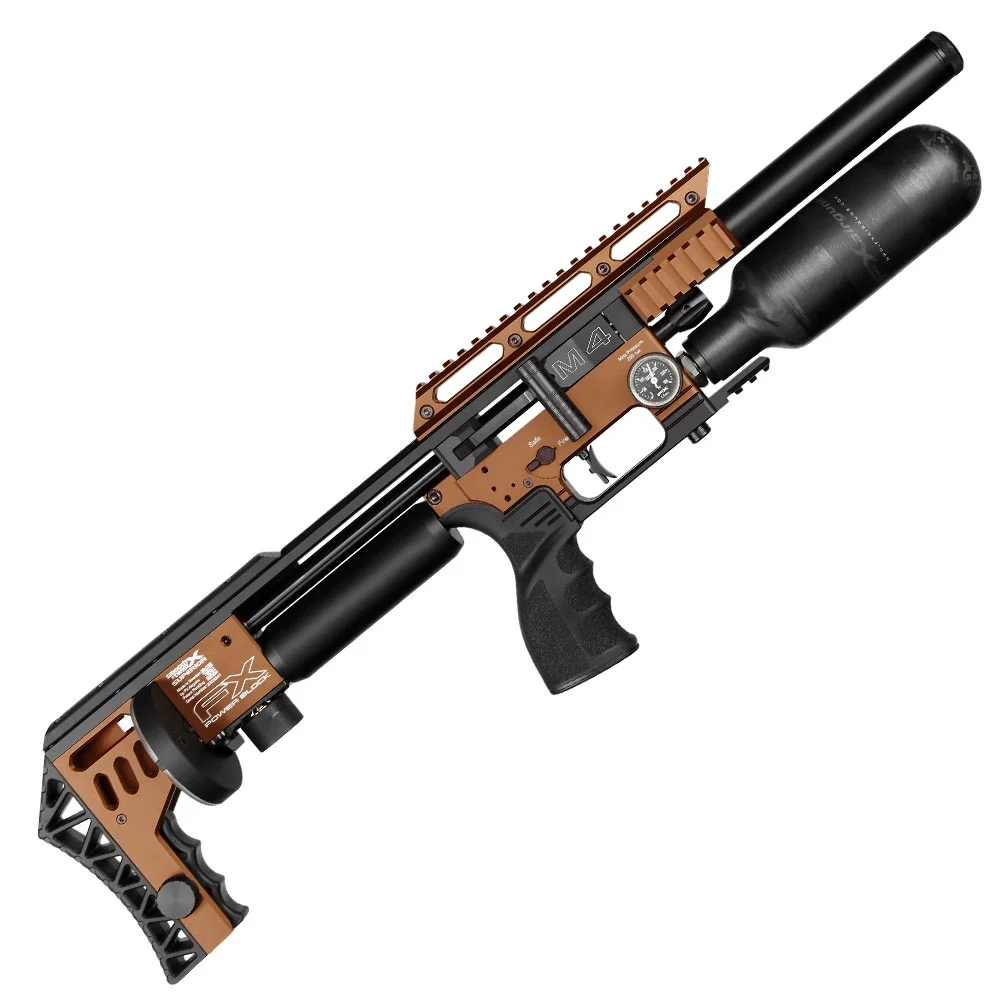
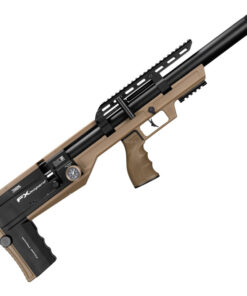
Precision, portability, and copper-finished presence are delivered by the FX Impact M4 Compact Copper. Swedish engineering is combined with a shortened 500 mm Superior STX barrel and a 300 cc carbon-fibre bottle so that field handling is improved without the platform’s hallmark adjustability being sacrificed. Consequently, target shooters, pest-control operators, and hunters who work in tight cover are given a regulated PCP that remains compact at 640 mm overall while still supporting interchangeable calibres, external tuning, and a 30 MOA Picatinny rail.
Moreover, an anodised copper chassis is paired with the FX UG1 AR-style grip and a vertically adjustable recoil pad. As a result, a distinctive look is achieved while a customisable fit is offered to a wide range of shooters. Furthermore, legal power configurations and FAC-capable setups are both supported, provided local regulations and licensing are followed.
Compact Chassis, Copper Finish, and Everyday Handling
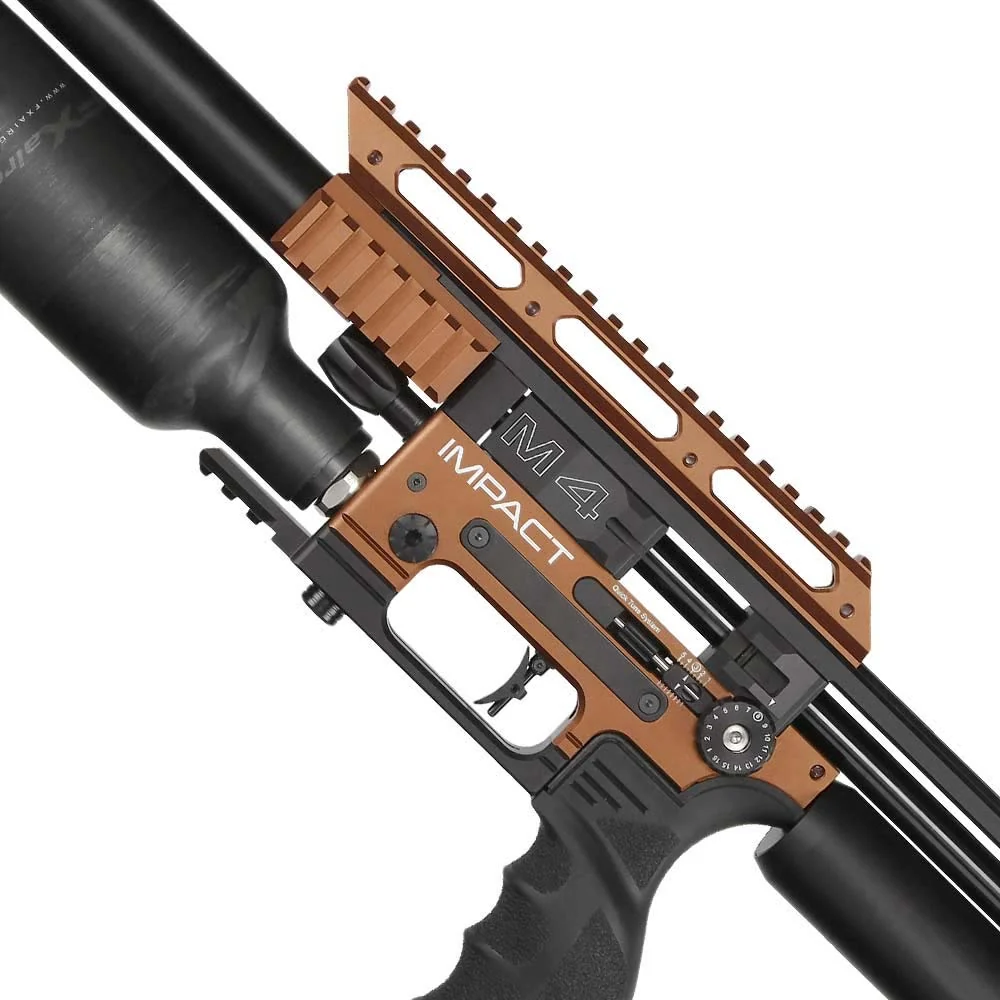
A reinforced M4 top plate is used so that rigidity is increased compared with earlier Impact generations. Meanwhile, the bullpup layout keeps the 500 mm Superior STX liner inside a compact 25-inch envelope. Therefore, balance is improved when the rifle is carried through woodland, vehicle blinds, or confined farm buildings.
Additionally, unscoped weight is held to approximately 2.8 kg (6.1 lb). Consequently, all-day use is made more practical. Likewise, the copper anodised finish is applied so that a modern tactical appearance is presented while surface durability is maintained. In the same way, the FX UG1 grip—with a defined palm swell and beaver-tail contour—is mounted on an AR15-style interface so that a secure hold can be obtained by left- and right-handed users alike.
An adjustable recoil pad is provided so that length of pull and cheek alignment can be refined. Meanwhile, an AR-style manual safety is positioned for instinctive use. As a further benefit, the sidelever is factory-reversible; thus, ambidextrous operation is supported without extra parts being required.
Highlighted Product Listings
- Configuration: FX Impact M4 Compact Copper PCP air rifle
- Barrel: 500 mm Superior Smooth Twist X (STX) liner
- Overall length: 640 mm / 25 in
- Weight (unscoped): approx. 2.8 kg / 6.1 lb
- Air cylinder: 300 cc carbon-fibre wrap, 250 BAR max fill
- Regulator: Brass-piston AMP MKII (externally adjustable)
- Trigger: Quick Set two-stage match unit (reach, height, and angle adjustable)
- Cocking: Reversible smooth sidelever
- Grip & pad: FX UG1 AR15-style grip; vertically adjustable recoil pad
- Rail: Removable/sliding 30 MOA Picatinny on machined dovetail backbone
- Magazine capacities: 34-shot (.177), 28-shot (.22), 25-shot (.25), 23-shot (.30)
- Muzzle: Shrouded; ½” × 20 UNF thread for a moderator
- Gauges: Dual WIKA (bottle and regulator)
- Finish: Copper anodised tactical chassis
- Typical inclusion: Fitted hard case (scope and rings not included)
Regulator, Plenum, and Consistent Power Delivery
Consistent shot-to-shot velocity is produced by the brass-piston AMP MKII regulator. In addition, faster refresh rates and higher working pressures (up to about 170 BAR regulator output) are handled more confidently than on earlier dual-regulator layouts. Therefore, long strings can be maintained after a 250 BAR fill of the 300 cc bottle.
Meanwhile, a Power Plenum arrangement (Power Plenum 750 on higher-output builds; a reduced plenum on many sub-12 configurations) is employed so that post-regulator volume is increased. As a result, airflow is stabilised and efficiency is improved. Furthermore, external Quick Tune controls—hammer-spring tension and valve flow—are provided so that power can be refined without the action being stripped.
Consequently, sub-12 ft·lb setups in markets that require them can still deliver high shot counts (often several hundred pellets per fill in .177 and .22, depending on tune and projectile). Conversely, FAC-legal configurations, when permitted, can be set for substantially higher energy with slugs and the appropriate power kit. In every case, local airgun laws, FAC requirements, and safe hunting ethics must be observed.
Calibres, Magazines, and Interchangeable Barrels
Calibre choice is supported across .177, .22, .25, and .30 on the Compact Copper (availability varies by market). Moreover, the STX liner system is designed so that barrels and liners can be exchanged. Thus, a shift between pellet and slug-optimised setups can be made as needs change.
High-capacity Side-Shot magazines in durable POM are supplied with a revised internal mechanism. Therefore, smooth rotation is retained even when heavier slugs are loaded. A magnetic single-shot tray is commonly included as well, so that bench or zeroing work can be completed without a magazine being used.
Additionally, dual transfer ports on some .22 and .25 FAC models allow pellet-optimised or slug-optimised flow to be selected. Meanwhile, the threaded shroud accepts a moderator so that report can be reduced for pest control and discreet practice.
Quick Set Trigger, Optics Rail, and Shot Placement
A foundation for precise shots is formed by the Quick Set Trigger. Specifically, a single adjustment can move the two-stage unit between hunting, sporting, and match-style pull weights. In addition, blade reach, height, and angle can be set so that a comfortable, repeatable release is obtained.
At the same time, the optics interface is improved. A 30 MOA Picatinny rail is clamped to an 11 mm dovetail machined into the backbone. Alignment issues after rail removal are thereby reduced. Moreover, the rail can be slid and re-clamped so that eye relief is fine-tuned for a chosen scope.
Accessory Picatinny sections on the forend and sides are provided so that bipods, lights, or slings can be attached. Consequently, the Compact Copper can be configured for prone target work, vehicle-supported hunting, or property management without the core action being altered.
Practical Field Use and Responsible Ownership
Manoeuvrability in hides, hedgerows, and farm buildings is improved by the short overall length. Therefore, the rifle is frequently chosen for rabbit, rat, grey squirrel, and similar pest work where a longer barrel would be cumbersome. Likewise, moderate-range target and HFT-style practice can be supported when a suitable optic and pellet or slug are selected.
However, maximum listed energies (for example, figures approaching 35 ft·lb in .177 or much higher in larger calibres on FAC rifles with slug kits and longer barrels) apply to specific high-power builds—not automatically to every Compact Copper. Energy, shot count, and velocity must always be verified on the individual rifle and kept within the law of the country of use.
Safe storage, correct filling procedure (Foster QD, 250 BAR maximum), and regular inspection of seals and bottles are required. Inclusive shooting communities are strengthened when every user—regardless of experience level or shooting hand—is given clear safety information and is encouraged to train responsibly.
Why the FX Impact M4 Compact Copper Belongs on a Serious Shortlist
Swedish competition heritage is carried forward in a more rigid M4 chassis, a stronger magazine, a faster-refreshing brass AMP MKII regulator, and a trigger that can be adapted in seconds. Meanwhile, the Compact Copper package concentrates that platform into 25 inches and roughly 6.1 lb, finished in a distinctive copper anodise that stands out on the range and in the field.
Therefore, shooters who want Impact-level tunability without a full-length Standard or Sniper rifle are given a focused option. Furthermore, future calibre or liner changes remain possible, so the investment can grow with skill and legal power needs.
Ready for a compact, regulated PCP that can be tuned, scoped, and carried with confidence? The FX Impact M4 Compact Copper is offered so that precision can be taken into tighter spaces—provided every shot is taken legally, safely, and with respect for people and wildlife. Confirm calibre, power rating, and local regulations before purchase, then pair the rifle with a quality optic, moderator, and filling system so that the platform’s consistency can be fully used.
FX Airguns, PCP Air Rifles, Hatsan Models and Modern Airgun Platforms
Modern airguns cover a wide range of platforms, from a basic pellet gun or BB gun to sophisticated regulated PCP airguns designed for target shooting, sporting applications, and long-range precision. Buyers researching an air rifle and air pistol collection will often encounter manufacturers such as FX and Hatsan because both companies offer extensive selections of air rifles, accessories, configurations, and caliber choices.
FX Airguns Sweden and the FX PCP Rifle Range
FX Airguns has become strongly associated with Swedish airgun engineering. Searches for fx airguns sweden, fx airguns sverige, fxairguns, and fx usa commonly lead enthusiasts toward the manufacturer’s extensive PCP lineup. In the American market, fx airguns usa is another widely searched phrase when people are researching available models, specifications, support, and accessories.
Among fx air rifles, the Impact family remains particularly recognizable. Searches frequently include fx impact, f x impact, fx impact m4, fx m4, impact m4 air rifle, and impact m4 500mm when comparing current configurations. The modular design philosophy associated with the Impact platform has helped make the fx air rifle range popular among shooters who appreciate adjustability and configurable PCP systems.
Earlier generations remain widely researched as well. The fx impact m3, impact m3, fx impact mk3, fx m3, and fx m3 airgun continue to attract attention from owners comparing generations or researching replacement components.
Caliber-specific searches include fx impact m3 .22cal air rifle, fx impact m3 .22cal air rifle. 600mm barrel, and the more general fx impact m3 air rifle. People comparing international pricing may also search fx impact m3 precio, fx impact m3 precio en usa, or fx impact m3 price before checking local regulations, specifications, and availability.
Beyond the Impact series, the FX catalog includes several distinctive designs. The fx leopard and fx leopard airgun are frequently researched alongside fx leopard .22 pcp specs by users interested in specifications and configuration details.
Other notable searches include fx drs, fx drs tactical, fx drs classic, and fx drs pro. These terms reflect interest in the different DRS configurations and their intended shooting styles.
The wider FX family also includes models such as the fx king, fx wildcat, fx panthera, and fx dreamline. Collectively, these platforms demonstrate the variety available to anyone researching a premium pcp air rifle, pellet rifle, or configurable precision air gun.
Some enthusiasts also search fx outdoors when researching outdoor shooting equipment and related products, while marketplaces and information sources such as guns.com may appear during broader online research.
Understanding Pellet Guns and PCP Air Rifles
A traditional pellet gun uses shaped pellets rather than conventional firearm ammunition. The broader term pellet guns can describe spring-powered, CO₂-powered, pneumatic, and PCP platforms.
A PCP air rifle stores compressed air inside a reservoir. This system can provide consistent pressure across multiple shots depending on the rifle’s regulator, reservoir capacity, caliber, and power configuration.
For shooters comparing ammunition sizes, .177 caliber remains one of the most common options. Larger configurations are also available, including the increasingly searched 30 cal air rifle category.
Some users accidentally search pallet gun when looking for pellet-powered equipment. Regardless of terminology, specifications such as energy output, caliber, barrel length, intended range, and local legal requirements should always be reviewed before use.
The practical range of air rifle platforms varies significantly. Pellet weight, velocity, environmental conditions, barrel design, optics, and shooter technique can all affect useful range and accuracy.
Hatsan Air Rifle and PCP Platforms
The hatsan air rifle lineup covers traditional spring-powered designs as well as modern PCP systems. Searches such as hatsanusa, hatsan usa, hatsan air guns, and hatsan pcp are commonly used by enthusiasts researching the company’s models.
One of the most recognizable platforms is the hatsan blitz. Search variations include hatsun blitz, hatzan blitz, hatsan blitz full automatic, hatsan blitz 30 cal, and hatsan blitz .30 cal. Specifications and legal classifications can vary by market, so owners should verify the rules applicable in their jurisdiction.
Another frequently researched model is the hatsan model 95, also searched as hatsan mod 95 and mod 95. This traditional air rifle platform remains familiar to shooters interested in conventional stock designs.
The hatsan 125 is another established model, while the hatsan 135 family attracts shooters researching powerful spring-piston platforms. Related searches include hatsan 135 vortex air rifle, hatsan 135 carnivore, and hatsan big bore carnivore rifle.
Hatsan Sortie, BullBoss and Bullpup Designs
Compact and semi-automatic PCP designs form another part of Hatsan’s catalog. The hatsan sortie is commonly researched alongside hatsan sortie tact, hatsan sortie tact semi-auto pcp, and hatsan sortie accessories.
Bullpup enthusiasts may encounter the hatsan bullboss, bullmaster, and hatsan hercules bully. Their compact layouts are designed to reduce overall length while maintaining useful barrel dimensions.
Other PCP models include the hatsan flash, hatsan flashpup qe, and hatsan invader. These rifles provide additional choices for people comparing conventional and bullpup PCP configurations.
Hatsan Hercules, Piledriver and Large-Caliber Platforms
For people researching larger airgun platforms, hatsan hercules and hatsan piledriver often appear in search results. Large-bore air rifles differ considerably from standard .177 and .22 pellet rifles in projectile size, power output, air consumption, and intended application.
The hatsan harpoon is associated with specialized projectile launching, while an arrow launcher represents another distinct air-powered category. Such equipment can be subject to different legal rules depending on location, so local regulations should be checked before ownership or use.
Additional Hatsan Models
The Hatsan catalog extends well beyond its best-known rifles. The hatsan airtact and hatsan airtact air rifle provide another entry point into the brand’s conventional rifle selection.
Other searches include hatsan zada, hatsan neutron star, hatsan factor rc, hatsan velox, and hatsan jet 2. Each platform serves a somewhat different role, making specifications such as caliber, reservoir capacity, operating system, barrel configuration, and overall dimensions important comparison points.
Shoppers researching discounted equipment may also encounter hatsan refurbished listings or broader searches for refurbished air rifles. Condition, warranty coverage, seals, regulators, reservoirs, and service history should be checked carefully when evaluating previously used or factory-refurbished equipment.
Airgun Optics, Pellets and Accessories
Accessories can significantly affect how an air rifle is configured. A compact 4×20 optic may suit basic shooting applications, while more advanced PCP rifles are frequently paired with adjustable optics.
Pellet choice also matters. Products such as h&n field target trophy bleifrei provide an option for shooters specifically researching lead-free projectile designs. Pellet diameter, weight, head size, and barrel compatibility should all be considered when evaluating accuracy.
Terms such as econ ii may also appear when researching airgun-related equipment and accessories. Compatibility should always be verified against the exact manufacturer, model, and specification rather than relying solely on a product name.
Comparing FX and Hatsan Air Guns
FX and Hatsan approach the modern air rifle market from different directions. FX is particularly well known for highly configurable PCP platforms such as the Impact, Panthera, Wildcat, Dreamline, Leopard, DRS, and King. Hatsan, meanwhile, maintains an exceptionally broad range spanning spring-powered rifles, PCP systems, bullpups, semi-automatic platforms, and larger-caliber airguns.
Whether researching an FX Impact M3, FX Impact M4, FX DRS, Hatsan Blitz, Hatsan Sortie, Hatsan Hercules, or another platform, specifications should be compared carefully. Caliber, operating pressure, reservoir capacity, barrel length, projectile compatibility, optics mounting, overall dimensions, energy output, and regional legal requirements can all influence which configuration is appropriate for a particular lawful sporting or target-shooting application.
Calibres, FAC Power, and Accessories for the FX Impact M4 Compact Copper
Calibre choice, legal power banding, and a modular accessory ecosystem are built into the FX Impact M4 Compact Copper so that one compact chassis can be adapted to target work, pest control, or FAC hunting. Consequently, performance is not locked to a single pellet or energy level. Instead, liner swaps, regulator settings, and add-on hardware are used so that the 500 mm Superior STX platform can be matched to local law and intended use. Inclusive shooting is supported when every configuration is selected with safety, licensing, and responsible field practice in mind.
Calibre Options and Magazine Capacity
Multiple calibres are offered on the Compact Copper so that trajectory, wind drift, and terminal performance can be balanced against the short 500 mm barrel. Typically, .177 (4.5 mm), .22 (5.5 mm), .25 (6.35 mm), and .30 (7.62 mm) are listed; .35 (9 mm) availability is more often associated with longer M4 variants and should be confirmed for Compact stock.
A redesigned high-capacity Side-Shot magazine in durable POM is paired with each calibre. Therefore, rotation remains smooth even when heavier slugs are loaded. Approximate capacities are commonly stated as follows:
- .177: 34-shot magazine
- .22: 28-shot magazine
- .25: 25-shot magazine
- .30: 23-shot magazine
- .35 (where offered): 18-shot magazine
Additionally, a magnetic single-shot tray is frequently included so that zeroing and bench work can be completed without a rotary magazine. Maximum projectile length must still be respected; otherwise, feeding reliability is reduced. Meanwhile, the interchangeable STX liner system is designed so that a calibre or liner type (pellet-optimised versus slug-optimised) can be exchanged when a compatible barrel kit is fitted. As a result, a Compact Copper purchased in .22 can later be converted if regulations and parts supply allow.
Furthermore, dual transfer ports on some .22 and .25 FAC rifles permit pellet-tuned or slug-tuned airflow to be selected. Consequently, consistency is improved when ammunition type is changed. Inclusive language applies here as well: left- and right-handed users are equally able to load magazines and swap liners once the reversible sidelever and standard FX interfaces are understood.
Practical Calibre Roles on a 500 mm Compact
A flatter trajectory and high shot count are typically associated with .177 when sub-12 use or paper punching is the goal. By contrast, .22 is widely chosen for general pest control because a useful balance of energy, magazine capacity, and pellet supply is obtained. Heavier .25 and .30 projectiles are preferred when wind resistance and knockdown on larger pests are required, provided legal energy and humane ranges are observed. In every case, grouping must be verified on the individual rifle; barrel length, tune, and projectile weight all influence real-world results.
FAC, Sub-12 Limits, and Power Potential
Power output is not a single fixed number on the Impact M4 Compact Copper. Instead, it is determined by market specification, plenum size, regulator setting, hammer and valve adjustment, barrel length, and whether a slug power kit is installed. Therefore, two Compact Copper rifles can look identical yet be legally limited to very different energies.
In the United Kingdom and similar jurisdictions, many Compact rifles are supplied as sub-12 ft·lb (approximately 16 J) PCP repeaters. Under that limit, a reduced plenum is often fitted. Even so, several hundred regulated shots per 250 BAR fill of the 300 cc bottle can still be produced in .177 and .22 when an efficient pellet is used. Approximate high-count strings in the 475–500 shot range are sometimes quoted for low-power Compact setups; actual count varies with tune and projectile.
Conversely, FAC-rated Compact and longer M4 rifles may use the larger Power Plenum 750 and higher regulator working pressure (AMP MKII brass piston, typically up to about 170 BAR output, 250 BAR bottle fill). Maximum published energies for the wider M4 family—often cited with slug ammunition, a slug power kit, and an 800 mm barrel rather than the Compact’s 500 mm tube—are in the region of:
- .177: up to about 47 J / 35 ft·lb
- .22: up to about 117 J / 87 ft·lb
- .25: up to about 135 J / 100 ft·lb
- .30: up to about 169 J / 125 ft·lb
- .35: up to about 211 J / 156 ft·lb
Those figures must not be treated as guaranteed Compact Copper output. A shorter barrel generally provides less acceleration distance; consequently, FAC Compact energy is usually lower than Extended or Sniper figures unless a specific high-power Compact build is confirmed by the seller. Moreover, legal possession of FAC air rifles requires the correct certificate, secure storage, and compliance with hunting and transport rules. Inclusive ownership means those requirements are explained clearly to every buyer, not only experienced FAC holders.
External Quick Tune controls (hammer-spring tension and valve flow) are provided so that power can be refined without full disassembly. Dual WIKA gauges display bottle pressure and regulator pressure; therefore, fill status and consistency can be monitored before a session. Fill pressure must not exceed 250 BAR, and only compatible Foster QD equipment should be used.
Accessories That Extend the Compact Copper Platform
A conversion-focused setup is completed when optics, sound management, filling gear, and spare feeding parts are added. The Compact Copper is supplied as a rifle; scope, rings, and moderator are typically sold separately.
A sliding 30 MOA Picatinny rail on a machined dovetail backbone is fitted so that long-range optics retain elevation travel. Side and underside Picatinny sections accept bipods, lights, slings, or weights. Meanwhile, the shrouded muzzle is threaded ½” × 20 UNF so that a moderator can be attached; report is thereby reduced for pest work and neighbour-friendly practice.
Recommended accessory categories include:
- Optics: Compact-to-mid-range scopes with robust 30 mm or 34 mm tubes; rings matched to the 30 MOA rail
- Sound reduction: ½” UNF airgun moderators sized for the shroud
- Feeding: Spare calibre-specific magazines and single-shot trays
- Power and conversion: FX slug power kit (Impact M3/M4), extra STX liners or barrel kits where legal
- Air supply: 250 BAR-capable compressor or bottle, Foster QD whip, and dust cover
- Support: Bipod or bag rider on forend rails; optional M-LOK or rail weights
- Protection: Factory-style fitted hard case; additional soft case for field carry
- Maintenance: FX Impact M3/M4 service kit, seals, and approved lubricants
Additionally, an adjustable recoil pad and UG1 grip already form part of the chassis, so aftermarket AR-pattern grips can be considered if a different contour is preferred. Inclusive fit is improved when pad height, trigger blade angle (Quick Set unit), and rail position are adjusted together rather than in isolation.
Choosing a Legal, Ethical Package
Calibre, FAC status, and accessories should be selected as one package. A sub-12 .22 Compact Copper with moderator, spare magazines, and a compact scope is often sufficient for close-to-mid-range pest control. By contrast, an FAC .25 or .30 build with slug kit, higher-capacity filling system, and a scope with generous elevation is better reserved for licensed users who have verified humane ranges.
Local airgun law, FAC conditions, and hunting seasons must be checked before any high-power configuration is ordered. When those steps are followed, the FX Impact M4 Compact Copper remains a flexible, regulated platform: short enough to be carried with ease, open enough to be tuned, and supported by magazines, liners, rails, and filling accessories that let every responsible shooter refine the rifle to the task at hand.
Practical Use in the Field, on the Range, and Around Property
A short regulated bullpup is carried into places where a full-length rifle would snag, tire the arms, or slow a safe shot. Consequently, everyday work is shaped less by brochure energy figures and more by how the rifle is held, filled, sighted, and used inside legal limits. Inclusive shooting is supported when those habits are explained for left- and right-handed users, new owners, and experienced field operators alike.
Portability is provided by a 500 mm shrouded barrel inside an overall package of about 640 mm and roughly 2.8 kg unscoped. Therefore, movement through gates, hides, vehicle doors, and farm outbuildings is simplified. Meanwhile, a carbon-fibre 300 cc bottle and dual pressure gauges allow remaining air and regulator status to be checked before a walk-in is begun. As a result, a session can be planned around a known fill rather than guesswork.
Close-Cover Pest Control and Yard Work
Dense hedgerows, poultry runs, grain stores, and overgrown ditch lines are among the settings in which a compact PCP is most often employed. In those places, a long forend or extended bottle would catch on netting and branches. Instead, the rifle can be brought to the shoulder in a narrow gap while a supported rest is still found on a post, bag, or vehicle window.
Quiet approach is assisted when a ½” UNF moderator is fitted to the shrouded muzzle. Report is thereby reduced, so that livestock and neighbours are less likely to be disturbed and so that a second opportunity is not immediately lost. A high-capacity rotary magazine is then used so that follow-up shots remain available without a loud single-shot tray being cycled in the open.
Ethical pest work still depends on range, pellet or slug choice, and a clean vital zone. Consequently, most compact setups are used inside distances that have already been verified on paper or steel. Typical farm and garden tasks include rabbits at field edges, rats around feed, and grey squirrels in woodland margins—always where local law permits and always where a safe backstop exists. Inclusive practice means that inexperienced helpers are not handed a charged rifle until muzzle awareness, safety-catch use, and magazine removal have been demonstrated.
Highlighted field checks before a pest round:
- Bottle and regulator gauges are read after the fill
- Safety is confirmed on and the magazine is loaded only at the working area
- Moderator and rail screws are checked after transport
- A known-zero optic is confirmed on a first safe target
- A backstop and escape line for people and animals are identified
After the round, unused air is not left as an excuse for neglect. Seals, the Foster dust cover, and the case foam are inspected so that the next early start is not delayed by a leak or a lost magazine.
Vehicle-Supported and Property-Management Routes
Farm lanes, orchard rows, and estate tracks are often worked from a truck or utility vehicle. A 25-inch overall length allows the rifle to be lifted from a rack or case without the barrel striking the cab roof. Thereafter, a window, sandbag, or bipod on the forend Picatinny rail can be used so that a stable shot is taken without the shooter standing fully exposed.
Night or low-light property work may call for a compact lamp on a side rail. Glare into the optic must still be managed; otherwise, a rushed shot is produced. Inclusive teams rotate roles so that one person watches the lane while another handles the rifle, and so that fatigue is not concentrated on a single operator during a long circuit.
Fill strategy matters on these routes. A 300 cc bottle at 250 BAR does not match the shot count of a 480 cc or 580 cc sibling. Therefore, a spare charged bottle or a planned return to a compressor is arranged when a long boundary is walked. Dual gauges reduce the chance that a regulator drop is noticed only after groups open.
Supported Target Practice and Skill Building
Paper, cards, and small steel are used so that the Quick Set trigger, rail alignment, and chosen ammunition are understood before live pest work. A sliding 30 MOA Picatinny rail on the dovetail backbone allows eye relief to be set for a particular scope. Consequently, a consistent cheek weld can be rebuilt after the rifle has been cased.
Trigger character can be moved between a more positive hunting break and a lighter match-style break with a simple adjustment. That flexibility is useful when the same rifle is shared among club members with different hand sizes, provided each change is recorded and the unit is returned to a known setting after the session. Inclusive clubs benefit when those settings are written on a card in the case rather than remembered by one person.
From a bench, the compact barrel still delivers enough length for meaningful grouping when pellets or slugs that match the liner are selected. Wind flags and a chronograph, where available, help a tune to be judged. External hammer and valve adjustments are then used in small steps so that velocity is centred without the action being stripped between strings.
Highlighted range habits:
- Chronograph strings are recorded with pellet weight and lot
- Scope rings and rail clamp screws are re-checked after travel
- Magazine and single-shot tray are both tried so feeding quirks are known
- Left- and right-side lever positions are tested if the rifle will be shared
- Hearing and eye protection are worn even with a moderator fitted
After practice, the rifle is uncocked according to the maker’s handling notes, the magazine is removed, and residual pressure practice follows the manual. Dry-firing policy is followed only as the manufacturer allows.
Hides, High Seats, and Awkward Positions
A bullpup balance point sits closer to the shooter than on a conventional long rifle. Therefore, a high seat rail or a tight hide window can be used without an excessive length of barrel projecting into view. Vertical adjustment of the recoil pad helps a standing or kneeling head position to be matched to the optic.
In a hide, magazines are loaded before entry so that noise inside the canvas is reduced. A spare magazine is kept in a quiet pouch rather than being clipped loosely to a rail where it can rattle. Inclusive groups assign a spotter so that the person on the rifle is not also scanning 360 degrees in thick cover.
Weather changes the plan. Rain on an anodised chassis is less of a cosmetic crisis than rain in an unprotected Foster fitting. A dust cap is kept on the fill port. Optics with honest waterproofing are preferred because a compact hunting rifle is rarely used only on dry days.
Licensed Higher-Power Use and Humane Limits
Where a certificate and local law allow higher energy, the same short rifle may be tuned beyond typical sub-12 pest settings. That does not automatically reproduce the energies listed for 700 mm or 800 mm barrels with slug kits. A shorter tube generally yields less acceleration; therefore, real muzzle energy and trajectory must be measured on the rifle in hand.
Humane hunting still requires adequate energy at the target, not only at the muzzle. Ranges are kept inside distances at which groups and expansion or pellet behaviour have been proven. Larger calibres and slugs are chosen only when the liner, probe, and transfer-port setup support them. Inclusive ethics treat every animal as deserving a certain shot; a compact profile is never used as an excuse for a longer, poorer attempt.
Transport and storage rules for higher-power air rifles are followed as strictly as for any other licensed firearm category in the relevant country. Cases, cabinets, and vehicle law vary; the compact length helps concealment in a locked case but does not replace legal duties.
Carry, Fatigue, and All-Day Routes
A walk of several hours is where the weight figure becomes real. Approximately 6.1 lb before scope, moderator, and bipod remains manageable for many adults when a sling is attached to suitable points. After optics and a silencer are added, the total should still be tested on a short walk before a full day is planned.
Fatigue shows first in trigger control and in lazy muzzle awareness. Scheduled rests, water, and a second person on long pest contracts reduce those errors. Inclusive planning also considers shooters of smaller stature: pad height, grip circumference, and rail position can be altered so that the compact package is not “one size” in practice.
Bottle swaps, if used, are done with clean probes and correct torque habits so that carbon-fibre cylinders are not damaged. Fill pressure is never pushed past 250 BAR. A gauge disagreement between bottle and filler is treated as a stop, not a debate in the field.
Accessories That Change the Scenario
A bipod turns a window shot into a repeatable prone or bonnet shot. A compact lamp changes dusk rat work. A spare magazine changes a single chance into a controlled pair. None of those items replaces a verified zero. After each accessory is added, groups are shot again because balance and point of impact can shift.
Moderators alter barrel harmonics on some setups; a brief check on paper after fitting is therefore wise. Weights on accessory rails can calm a light compact rifle on a windy bank, yet they also change carry comfort. Inclusive users experiment in small steps rather than loading every rail before the first walk.
After the Shot: Care That Keeps the Next Scenario Possible
Field use is only half the cycle. Moisture is wiped from the chassis and thread. The Foster fitting is capped. Magazines are emptied so that springs and drums are not left compressed with grit inside. A hard case with cut foam protects the copper finish and the rail alignment during vehicle return.
Seals and bottles have service lives. Unusual gauge behaviour, a change in shot count, or a new leak at the regulator is treated as a workshop issue, not a field tweak. Official service kits and approved procedures are used so that a compact rifle that was reliable on Monday remains reliable on Saturday.
Legal paperwork travels with licensed rifles. Insurance, permission letters for land, and identification are packed with the same seriousness as pellets. Inclusive communities share that checklist so that new owners are not left to learn it after a problem.
When these habits are followed, a short copper-finished regulated bullpup earns its place: close-cover pest routes, vehicle circuits, hide work, and structured practice can all be completed with less snagging and less fatigue than a longer chassis would allow. Power, calibre, and accessories remain tools. The scenario is completed only when every shot is legal, observed, and backed by a plan for the people and animals who share the ground.





Reviews
There are no reviews yet.