FX Impact MKII Bronze FAC
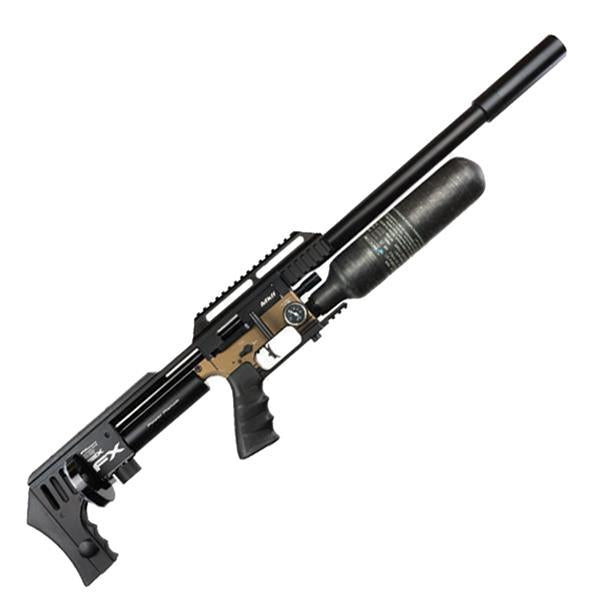
Uncompromising precision is delivered by the FX Impact MKII Bronze FAC, a regulated bullpup PCP that has been engineered for licensed FAC holders who demand tunable power, interchangeable calibres, and consistent shot-to-shot performance. Consequently, ethical hunting, long-range pest control, and high-power target work can be approached with confidence when this platform is selected. Moreover, a distinctive bronze finish is paired with compact bullpup geometry, so a distinctive presence is maintained without unnecessary bulk.
Furthermore, an externally adjustable AMP regulator, a FAC-only Power Plenum, hammer-spring power control, and valve-flow tuning are combined so that energy output can be matched to pellet or slug, range, and quarry. Therefore, a single rifle can be adapted rather than replaced when conditions change.
Why the FX Impact MKII Bronze FAC Is Chosen
A Swedish FX action is housed in a short, well-balanced bullpup so that a long Smooth Twist X barrel can be retained while overall length stays manageable in hides, vehicles, and tight woodland. In addition, a carbon-fibre air cylinder is used so that fill mass is kept low relative to capacity. As a result, all-day carry is made more practical for field users of every stature and shooting style.
Meanwhile, dual pressure gauges are provided so that bottle reserve and regulator setting can be monitored at a glance. Likewise, a Foster quick-disconnect fill is fitted so that topping up from a compressor or bottle can be completed quickly and cleanly. Subsequently, more time can be spent on zeroing and less on fussy filling.
Signature Features at a Glance
Highlighted capabilities of the FX Impact MKII Bronze FAC include:
- FX Smooth Twist X match-grade barrel — free-floating liners that can be swapped for calibre and twist
- Interchangeable calibre system — barrel and probe changes so .22, .25, .30, and (where offered) .35 can be used on one action
- FAC Power Plenum — enlarged post-regulator volume so higher energy and improved shot economy can be realised
- Externally adjustable AMP regulator — regulator pressure that can be tuned without stripping the action
- Hammer-spring power dial — multi-position output so quarry and range can be matched
- Valve-flow adjuster — air delivery that can be refined for pellet or slug
- Forward sidelever cocking — rapid follow-up shots with an ambidextrous-friendly layout
- High-capacity removable magazines — typically 28 shots in .22/.25, 23 in .30, 18 in .35
- Adjustable two-stage match trigger — first-stage travel and second-stage weight that can be set to preference
- Picatinny rails — optics, bipods, lights, and lasers that can be mounted on top, sides, and underside
- AR-style grip and height-adjustable recoil pad — a stable, inclusive hold for left- and right-handed shooters
- Built-in shroud with additional moderator interface — report that can be kept neighbour-friendly where local law allows
- Dual gauges and 250 bar fill — reserve and regulator status that can be read clearly
- Carbon-fibre cylinder — standard ~480 cc (compact and sniper bottle options exist by configuration)
Consequently, a modular high-power system is offered rather than a fixed, one-setting rifle.
Calibres, FAC Power, and Accessories
Factory-recommended FAC outputs are published as starting points and can be raised or lowered when regulator, hammer spring, and valve flow are adjusted. Typical published figures (pellet-dependent) are:
- .177 — around 18 ft-lbs / 24 J (where FAC .177 is offered)
- .22 — around 30 ft-lbs / 41 J (commonly ~920 fps with a 16 gr pellet)
- .25 — around 47 ft-lbs / 65 J
- .30 — around 77 ft-lbs / 105 J
- .35 / 9 mm — substantially higher energy on plenum-equipped FAC rifles (configuration-dependent)
Meanwhile, shot counts scale with calibre, bottle size, and tune. Illustrative standard-bottle figures often cited include roughly 225 consistent shots at ~30 ft-lbs in .22 and about 110 shots at ~47 ft-lbs in .25; compact 300 cc bottles reduce count, while sniper-length barrels and larger bottles change both balance and capacity. Therefore, a configuration can be chosen for stealthy compact work or for maximum downrange authority.
Additionally, Smooth Twist X liners allow twist and bore to be matched to diabolo pellets or slugs. As a result, grouping at 40–80+ metres can be refined once a preferred projectile is selected. Optics are supported on a Picatinny rail (often with 20 MOA on some editions), so high-magnification scopes, thermals, and clip-ons can be fitted without adapters. Furthermore, side and under-rail real estate is provided so bipods, lasers, and lamps can be added without crowding the action.
Legal note: FAC ownership, storage, transport, and use must be completed in accordance with local licensing. Power figures above are manufacturer-typical FAC settings and are not a substitute for chrono verification on the individual rifle.
Practical Field Use
Hides, vehicle windows, and woodland rides are handled more easily because bullpup length keeps the muzzle closer to the shooter while barrel length is preserved. Moreover, the sidelever is placed near the trigger so that a follow-up can be cycled without breaking cheek weld. Consequently, multi-shot pest sessions can be completed with fewer magazine changes.
In addition, power can be wound down for closer, quieter work around buildings and wound up for longer fox or hog-capable shots where law and ethics allow. Likewise, regulator and plenum tuning let slug set-ups be stabilised so that trajectory and retained energy remain predictable. Therefore, one FX Impact MKII Bronze FAC can cover several roles if barrels and magazines are kept on hand.
Inclusive handling is supported by an ambidextrous-friendly bullpup, a reversible-style sidelever layout on many builds, and a height-adjustable pad so length of pull and cheek alignment can be set for different body types and clothing layers. Safety is engaged by a positive switch; nevertheless, a clear barrel, correct pellet, and verified zero should always be confirmed before a shot is taken.
Build, Fill, and Day-to-Day Ownership
A match trigger is supplied so that a crisp, repeatable break can be dialled in. Subsequently, hold-over and hold-off become more repeatable at FAC velocities. Meanwhile, the bronze aesthetic is more than cosmetic: anodised metalwork and a tactical rubber grip are used so that weather and handling wear are resisted in real field use.
Charging is completed through a Foster QD under a protective cap. Maximum fill is 250 bar (3600 psi). Dual gauges then allow bottle pressure and regulator pressure to be read independently, so a flat power curve can be maintained and a premature empty bottle can be avoided. After filling, a short chrono string is recommended whenever hammer, valve, or regulator settings are changed.
Maintenance remains straightforward when official FX procedures are followed: liners and probes are exchanged as a set, magazines are kept clean and lightly lubricated as specified, and regulator adjustments are made only with the correct sequence (including dumping regulator volume between changes). Warranty and service support from FX and authorised dealers should be retained with proof of purchase.
Who This Rifle Suits
The FX Impact MKII Bronze FAC is intended for licensed FAC shooters who want a tunable, multi-calibre bullpup rather than a fixed-power hunting rifle. Target shooters who enjoy mapping pellets to power settings will find the external controls rewarding. Hunters who need compact length plus real energy will find the plenum-equipped FAC specification purpose-built. Beginners to FAC platforms are still well served if a competent dealer set-up and a chrono are used from day one.
Conversion is simple: choose calibre and barrel length (compact, standard, or sniper where available), add a quality optic and a verified pellet or slug, then confirm legal power and zero. After that, a regulated, high-capacity FX platform is ready for disciplined, ethical use.
Ready when you are — the FX Impact MKII Bronze FAC is built so that precision, power, and adaptability can be owned in one bronze-finished rifle.
FX Airguns, PCP Air Rifles, Hatsan Models and Modern Airgun Platforms
Modern airguns cover a wide range of platforms, from a basic pellet gun or BB gun to sophisticated regulated PCP airguns designed for target shooting, sporting applications, and long-range precision. Buyers researching an air rifle and air pistol collection will often encounter manufacturers such as FX and Hatsan because both companies offer extensive selections of air rifles, accessories, configurations, and caliber choices.
FX Airguns Sweden and the FX PCP Rifle Range
FX Airguns has become strongly associated with Swedish airgun engineering. Searches for fx airguns sweden, fx airguns sverige, fxairguns, and fx usa commonly lead enthusiasts toward the manufacturer’s extensive PCP lineup. In the American market, fx airguns usa is another widely searched phrase when people are researching available models, specifications, support, and accessories.
Among fx air rifles, the Impact family remains particularly recognizable. Searches frequently include fx impact, f x impact, fx impact m4, fx m4, impact m4 air rifle, and impact m4 500mm when comparing current configurations. The modular design philosophy associated with the Impact platform has helped make the fx air rifle range popular among shooters who appreciate adjustability and configurable PCP systems.
Earlier generations remain widely researched as well. The fx impact m3, impact m3, fx impact mk3, fx m3, and fx m3 airgun continue to attract attention from owners comparing generations or researching replacement components.
Caliber-specific searches include fx impact m3 .22cal air rifle, fx impact m3 .22cal air rifle. 600mm barrel, and the more general fx impact m3 air rifle. People comparing international pricing may also search fx impact m3 precio, fx impact m3 precio en usa, or fx impact m3 price before checking local regulations, specifications, and availability.
Beyond the Impact series, the FX catalog includes several distinctive designs. The fx leopard and fx leopard airgun are frequently researched alongside fx leopard .22 pcp specs by users interested in specifications and configuration details.
Other notable searches include fx drs, fx drs tactical, fx drs classic, and fx drs pro. These terms reflect interest in the different DRS configurations and their intended shooting styles.
The wider FX family also includes models such as the fx king, fx wildcat, fx panthera, and fx dreamline. Collectively, these platforms demonstrate the variety available to anyone researching a premium pcp air rifle, pellet rifle, or configurable precision air gun.
Some enthusiasts also search fx outdoors when researching outdoor shooting equipment and related products, while marketplaces and information sources such as guns.com may appear during broader online research.
Understanding Pellet Guns and PCP Air Rifles
A traditional pellet gun uses shaped pellets rather than conventional firearm ammunition. The broader term pellet guns can describe spring-powered, CO₂-powered, pneumatic, and PCP platforms.
A PCP air rifle stores compressed air inside a reservoir. This system can provide consistent pressure across multiple shots depending on the rifle’s regulator, reservoir capacity, caliber, and power configuration.
For shooters comparing ammunition sizes, .177 caliber remains one of the most common options. Larger configurations are also available, including the increasingly searched 30 cal air rifle category.
Some users accidentally search pallet gun when looking for pellet-powered equipment. Regardless of terminology, specifications such as energy output, caliber, barrel length, intended range, and local legal requirements should always be reviewed before use.
The practical range of air rifle platforms varies significantly. Pellet weight, velocity, environmental conditions, barrel design, optics, and shooter technique can all affect useful range and accuracy.
Hatsan Air Rifle and PCP Platforms
The hatsan air rifle lineup covers traditional spring-powered designs as well as modern PCP systems. Searches such as hatsanusa, hatsan usa, hatsan air guns, and hatsan pcp are commonly used by enthusiasts researching the company’s models.
One of the most recognizable platforms is the hatsan blitz. Search variations include hatsun blitz, hatzan blitz, hatsan blitz full automatic, hatsan blitz 30 cal, and hatsan blitz .30 cal. Specifications and legal classifications can vary by market, so owners should verify the rules applicable in their jurisdiction.
Another frequently researched model is the hatsan model 95, also searched as hatsan mod 95 and mod 95. This traditional air rifle platform remains familiar to shooters interested in conventional stock designs.
The hatsan 125 is another established model, while the hatsan 135 family attracts shooters researching powerful spring-piston platforms. Related searches include hatsan 135 vortex air rifle, hatsan 135 carnivore, and hatsan big bore carnivore rifle.
Hatsan Sortie, BullBoss and Bullpup Designs
Compact and semi-automatic PCP designs form another part of Hatsan’s catalog. The hatsan sortie is commonly researched alongside hatsan sortie tact, hatsan sortie tact semi-auto pcp, and hatsan sortie accessories.
Bullpup enthusiasts may encounter the hatsan bullboss, bullmaster, and hatsan hercules bully. Their compact layouts are designed to reduce overall length while maintaining useful barrel dimensions.
Other PCP models include the hatsan flash, hatsan flashpup qe, and hatsan invader. These rifles provide additional choices for people comparing conventional and bullpup PCP configurations.
Hatsan Hercules, Piledriver and Large-Caliber Platforms
For people researching larger airgun platforms, hatsan hercules and hatsan piledriver often appear in search results. Large-bore air rifles differ considerably from standard .177 and .22 pellet rifles in projectile size, power output, air consumption, and intended application.
The hatsan harpoon is associated with specialized projectile launching, while an arrow launcher represents another distinct air-powered category. Such equipment can be subject to different legal rules depending on location, so local regulations should be checked before ownership or use.
Additional Hatsan Models
The Hatsan catalog extends well beyond its best-known rifles. The hatsan airtact and hatsan airtact air rifle provide another entry point into the brand’s conventional rifle selection.
Other searches include hatsan zada, hatsan neutron star, hatsan factor rc, hatsan velox, and hatsan jet 2. Each platform serves a somewhat different role, making specifications such as caliber, reservoir capacity, operating system, barrel configuration, and overall dimensions important comparison points.
Shoppers researching discounted equipment may also encounter hatsan refurbished listings or broader searches for refurbished air rifles. Condition, warranty coverage, seals, regulators, reservoirs, and service history should be checked carefully when evaluating previously used or factory-refurbished equipment.
Airgun Optics, Pellets and Accessories
Accessories can significantly affect how an air rifle is configured. A compact 4×20 optic may suit basic shooting applications, while more advanced PCP rifles are frequently paired with adjustable optics.
Pellet choice also matters. Products such as h&n field target trophy bleifrei provide an option for shooters specifically researching lead-free projectile designs. Pellet diameter, weight, head size, and barrel compatibility should all be considered when evaluating accuracy.
Terms such as econ ii may also appear when researching airgun-related equipment and accessories. Compatibility should always be verified against the exact manufacturer, model, and specification rather than relying solely on a product name.
Comparing FX and Hatsan Air Guns
FX and Hatsan approach the modern air rifle market from different directions. FX is particularly well known for highly configurable PCP platforms such as the Impact, Panthera, Wildcat, Dreamline, Leopard, DRS, and King. Hatsan, meanwhile, maintains an exceptionally broad range spanning spring-powered rifles, PCP systems, bullpups, semi-automatic platforms, and larger-caliber airguns.
Whether researching an FX Impact M3, FX Impact M4, FX DRS, Hatsan Blitz, Hatsan Sortie, Hatsan Hercules, or another platform, specifications should be compared carefully. Caliber, operating pressure, reservoir capacity, barrel length, projectile compatibility, optics mounting, overall dimensions, energy output, and regional legal requirements can all influence which configuration is appropriate for a particular lawful sporting or target-shooting application.
Calibres, FAC Power, and Accessories for the FX Impact MKII Bronze FAC
A modular high-power platform is offered by the FX Impact MKII Bronze FAC, so calibre, energy, and supporting accessories can be matched to quarry, range, and local licensing rather than locked into a single factory setting. Consequently, ethical FAC use is supported when a suitable barrel liner, magazine, projectile, and optic are selected together. Moreover, published figures are treated as starting points, because hammer spring, valve flow, and the externally adjustable AMP regulator can be refined after a chrono string is completed.
Calibres That Can Be Fitted
An interchangeable barrel-and-probe system is used, therefore a change of calibre can be completed without a second rifle being purchased. Typically, FAC bronze Impact MKII rifles are supplied or converted in the following chambers:
- .22 (5.5 mm) — a versatile hunting and mid-range calibre in which high shot counts and flat trajectories are commonly achieved
- .25 (6.35 mm) — a heavier pellet or light-slug option through which extra downrange energy is delivered
- .30 (7.62 mm) — a larger-bore FAC chamber in which substantial impact energy is produced for bigger quarry where law allows
- .35 / 9 mm — a specialist slug-oriented option on plenum-equipped FAC rifles, for which a matching long liner and probe are required
- .177 (4.5 mm) — offered on some FAC configurations when a high-capacity, high-shot-count set-up is preferred
Additionally, FX Smooth Twist X match-grade liners are free-floating and can be specified with twist rates suited to diabolo pellets or slugs. As a result, grouping can be tightened once a preferred projectile weight is chosen. Meanwhile, magazine capacity is scaled to bore size: about 28 shots are typically provided in .22 and .25, about 23 shots in .30, and about 18 shots in .35, while .177 magazines can hold around 38 pellets. Therefore, fewer mid-session reloads are required during lamping or hide work.
Inclusive handling is preserved across calibres because the same ambidextrous-friendly bullpup, AR-style grip, and height-adjustable pad are retained when only liner and probe are swapped. Nevertheless, the correct probe must always be fitted with the liner; otherwise feeding and sealing cannot be guaranteed.
FAC Power, Regulator, and Power Plenum
FAC output is not a single fixed number. Instead, factory-recommended energies are published so that a safe, consistent baseline can be established before further tuning is attempted. Typical recommended FAC figures (pellet-dependent and adjustable up or down) include:
- .177 — approximately 18 ft-lbs / 24 J
- .22 — approximately 30 ft-lbs / 41 J (often near 920 fps with a 16 gr pellet)
- .25 — approximately 47 ft-lbs / 65 J
- .30 — approximately 77 ft-lbs / 105 J
- .35 / 9 mm — substantially higher energy on Power Plenum FAC rifles, configuration-dependent
Furthermore, a FAC-only Power Plenum is fitted so that a larger volume of regulated air can be held behind the valve. Consequently, higher muzzle energy can be produced at a given regulator pressure, and in many tunes a more efficient shot count can be retained compared with a non-plenum action at the same power. In addition, an external AMP regulator is provided so that plenum pressure can be raised or lowered without the action being stripped. Likewise, a hammer-spring power dial and a valve-flow adjuster are included, therefore twelve-plus practical combinations of output can be mapped for close pest work, mid-range hunting, or longer slug trajectories.
Shot count is then governed by calibre, bottle size, and tune. A standard carbon-fibre cylinder of about 480 cc filled to 250 bar is commonly cited at roughly 225 consistent shots around 30 ft-lbs in .22, and about 110 shots around 47 ft-lbs in .25. Compact 300 cc bottles reduce capacity; sniper-length barrels and larger bottles change both balance and available air. Therefore, a configuration should be chosen for the intended session length rather than for brochure maximums alone.
Legal compliance must be observed at every stage. FAC certificates, storage, transport, and use are jurisdiction-specific. Chronograph verification on the individual FX Impact MKII Bronze FAC is required after any regulator, hammer, or valve change, because advertised energies are not a substitute for measured output.
Accessories That Complete the Rifle
A conversion-ready accessory list is supported by Picatinny real estate on the top rail (often with 20 MOA on selected editions), plus side and under-rails. Highlighted additions that are commonly paired with this rifle include:
- Optics — high-magnification day scopes, FFP tactical glass, or thermal / NV clip-ons that can be zeroed to each power setting
- Moderation — the built-in shroud plus an additional moderator where local law permits, so report can be kept discreet
- Support — bipods, bags, and barricade stops that can be clamped to the under-rail for prone or vehicle work
- Aiming aids — lamps, lasers, and IR illuminators for licensed night use
- Air supply — Foster QD hoses, 250 bar bottles or a quality compressor, plus a reliable gauge set
- Calibre kits — spare Smooth Twist X liners, matching probes, and extra high-capacity magazines
- Projectiles — matched JSB/FX-style diabolos or slugs whose weight and BC have been proven in that liner
- Protection — a fitted hard case, sling points, and rail covers so finish and zero are preserved in transit
Moreover, a two-stage match trigger can be set for first-stage length and second-stage weight, so a repeatable break is available to shooters of different hand sizes and strengths. Subsequently, hold-over becomes more predictable once each power level is recorded in a dope card. Meanwhile, dual gauges keep bottle reserve and regulator pressure visible, therefore an empty plenum or a forgotten top-up can be avoided before a critical shot.
Practical pairing advice is straightforward. A .22 FAC set-up with a mid-power tune and a quality 16–18 gr pellet is often chosen for general pest and mid-range work. A .25 or .30 liner with slugs is more frequently reserved for longer shots and larger quarry where energy retention matters. Accessories should then be added only after zero and chrono data are written down for that exact combination.
When calibre, FAC tune, and accessories are selected as a system, the FX Impact MKII Bronze FAC is transformed from a striking bronze bullpup into a licensed, adaptable precision tool. Responsible ownership, verified power, and a documented zero remain the foundation of every successful session.
Practical Use Scenarios
A licensed high-power bullpup is most useful when a session is planned around terrain, quarry, legal limits, and a verified tune rather than around brochure energy alone. Consequently, consistent results are obtained when zero, pellet or slug, regulator setting, and shot count are treated as one system. Moreover, inclusive handling is supported by an adjustable pad, a compact action, and controls that can be reached by left- and right-handed shooters of different statures.
Furthermore, every scenario below assumes a valid FAC, safe storage, and local rules on night shooting, land permission, and maximum permitted energy. Therefore, a chrono string and a written dope card should be completed before any live quarry is approached.
Pre-Session Set-Up That Makes Field Use Repeatable
A predictable outing is prepared on the bench first. Initially, a full 250-bar fill is completed through the Foster connector so that both bottle and regulator gauges can be read. Subsequently, a short dry-fire cycle is used only as the manufacturer allows, after which a ten-shot chrono group is recorded at the chosen hammer and valve settings. As a result, velocity spread can be seen before a hide is occupied.
Meanwhile, magazines are loaded with a single projectile type. Mixed weights in one wheel are avoided, because point of impact cannot then be trusted. In addition, the correct barrel liner and probe are confirmed after any calibre change. Likewise, rail-mounted optics are checked for torque and for a return-to-zero after the rifle has been transported.
Highlighted checks that are completed before leaving home include:
- A current FAC and permission documents that can be shown if required
- A chrono log for the exact pellet or slug and power dial position
- A dope card for 20, 30, 40, 50, and 70 metres (or the ranges actually used)
- A spare magazine, probe, and a small kit of liners if a mid-trip swap is planned
- Batteries for lamp, thermal, or illuminated reticle
- Hearing and eye protection suited to FAC report and debris
- A sling or case that protects zero during vehicle travel
Consequently, time in the field is spent on wind and quarry rather than on forgotten tools.
Woodland Pest Control at Close to Mid Range
Quiet approaches through mixed woodland are favoured by the short overall length of a bullpup. Accordingly, a muzzle can be kept clear of brambles while a relatively long liner is still used for stability. Moreover, a sidelever placed near the trigger allows a follow-up to be cycled without the cheek being lifted from the comb.
In this setting, a moderate FAC tune is often selected so that over-penetration through thin cover is reduced and so that report remains more neighbour-conscious when a moderator is legally fitted. A mid-weight diabolo in .22 or .25 is commonly chosen because a forgiving flight is produced in light wind under the canopy. Therefore, first-shot placement on rabbits, squirrels, or similar small quarry can be kept ethical when ranges are held inside the zero that has been proven.
Additionally, shooting sticks or a kneeling roll are used when a standing shot would be rushed. A rest is preferred to a heroic offhand attempt, because FAC energy does not excuse a poor hold. After a shot, the area is watched until the animal is accounted for. If a second shot is required, the already-cocked cycle of a multi-shot magazine is used rather than a scramble for a single-shot tray.
Inclusive technique matters here. A height-adjustable pad lets shorter and taller shooters share the same rifle on a family permission, provided each person has been trained and is legally entitled to use it. Likewise, a left-handed shooter can work the lever and safety without the action being rebuilt.
Farm Buildings, Yards, and Sensitive Close Work
Around barns, feed stores, and yards, power is frequently wound down even though a FAC certificate is held. Consequently, ricochet risk and excessive penetration of sheet metal or timber are reduced. A lower hammer setting, combined with a suitable pellet, keeps energy adequate for rats and feral pigeons while neighbours and livestock are shown consideration.
Furthermore, a compact configuration is easier to carry through doorways and along feed passages. A lamp or a low-candela torch on a side rail can be used where night work is permitted, yet the beam is kept off windows and roads. Meanwhile, a high-capacity magazine reduces the need to reload with dirty gloves in the dark.
Safety discipline is tightened in this environment. A clear backstop is confirmed before every shot. Hard surfaces behind quarry are treated as a reason to wait, not as a challenge. After the session, the rifle is unloaded, the magazine is removed, and the safety is applied before the vehicle is entered.
Open Pasture, Lamping, and Vehicle-Supported Hunts
Longer grass and hedgerow edges ask for a different tune. Here, a higher FAC setting and a heavier pellet or a light slug may be selected so that energy is retained at 50–80 metres. Subsequently, a flatter trajectory is recorded on the dope card, and hold-over is practised on paper before live use.
A vehicle window or a truck bed rest is often used on large permissions. The bullpup’s balance, with a carbon bottle slung beneath the barrel line, sits naturally on a rolled jacket or a small bag. Moreover, dual gauges can be glanced at between drives so that a falling bottle is noticed before the regulator drops off its plateau.
Night work, where licensed, benefits from thermal or NV on the Picatinny rail. Zero offset between day glass and a clip-on must be confirmed in daylight first. Additionally, lamp discipline is observed: quarry is identified, a safe backstop is verified, and only then is a shot taken. Follow-up shots are available from the magazine, yet each is still aimed; a “spray” of FAC pellets is never treated as a method.
Highlighted field habits that keep open-country use ethical include:
- Ranges estimated with a rangefinder rather than guessed in headlights
- Wind read from grass and from the last splash of dust or vapour
- A pause after the first animal so that others in the group can be assessed
- Recovery of every animal before the next drive is started
- A written note of shots fired versus shots on the chrono card so remaining air can be trusted
As a result, a long night can be completed from one fill on a standard bottle when a sensible tune is used.
Slug Use at Extended Range
Where slugs are legal and a matching Smooth Twist X liner is fitted, a different practical picture appears. Heavier projectiles retain energy farther, yet they also drop more once velocity is modest, and they can be more sensitive to valve and regulator harmony. Therefore, the Power Plenum and AMP regulator are used to stabilise a chosen speed rather than to chase a maximum number on a box.
A slug session is usually begun at the range. Five-shot groups are shot at 50 and 70 metres from a rest. If vertical stringing appears, regulator pressure or valve flow is altered one click at a time, with the regulator volume dumped between changes as instructed. Only after groups tighten is the same combination taken to a permission.
In the field, slugs are reserved for known distances and for quarry that justifies the extra energy. Thin-skinned small pests at 20 metres are still better served by a diabolo at a lower setting. Inclusive practice again applies: a heavier-recoiling slug tune should be tried from a rest first so that a smaller-framed shooter can decide whether that set-up is comfortable.
Hide, High Seat, and Still-Hunting
A high seat rewards a short rifle that can be brought on aim without the muzzle striking the timber. The bullpup layout helps. A bipod on the under-rail or a simple bag on the ledge is used so that the match trigger can be pressed without a wobble through the first stage.
Still-hunting along rides asks for a sling that does not rattle against rails. Rail covers and a snug moderator cap reduce noise. When a chance appears, the sidelever can be run silently enough for a second shot if the first is not conclusive. Power may be left at a mid FAC setting so that one zero covers the likely 25–45 metre window of most woodland still-hunts.
Patience is part of the method. A rushed shot from an off-balance stance wastes the accuracy that a free-float liner and regulator were designed to provide. Consequently, the rifle is used as a precise tool, not as a substitute for fieldcraft.
Range Practice, Zero Work, and Skill Building
Practical success in the field is built on paper. A 30-metre zero is a common starting point for mid-power FAC pellet work; a 40- or 50-metre zero may be chosen for slug tunes. Groups are shot from the same positions that will be used on land: sitting, kneeling, sticks, and a vehicle rest.
Transition between power-dial settings is practised because point of impact will move when hammer spring is changed. Each setting is named on the dope card (for example, “yard / mid / long”) rather than remembered as a vague click count. Inclusive coaching is straightforward on this platform: a new shooter can begin on a lower setting with a light pellet while an experienced partner uses a hotter slug liner on another day, provided magazines and probes are never mixed.
Maintenance between range and field is simple but non-negotiable. Liners are kept clean, probes are inspected, and the fill cap is replaced so that grit cannot enter the Foster valve. After wet weather, metalwork is dried and a manufacturer-approved wipe is used. A drop in shot count or a sudden change in note at the muzzle is treated as a reason to stop and inspect, not as a reason to “shoot through it.”
Weather, Wind, and Seasonal Adjustments
Cold air reduces measured velocity on many PCPs; therefore a winter chrono check is completed when temperatures fall. Conversely, a rifle left in a hot vehicle can show a brief pressure rise on the gauges. Sessions are planned with that drift in mind.
Wind on open ground is the main limit on small-calibre FAC pellets. A .25 or .30 projectile, or a slug, may be chosen on exposed permissions for that reason alone. In rain, optics are capped between stalks, and magazines are kept in a pocket rather than in wet grass. After the outing, moisture is removed from the shroud and from rail slots before the case is closed.
Seasonal quarry patterns change the practical tune. Tight summer woodland favours a quieter, lower setting. Winter lamping on grass fields may justify more energy and a heavier pellet. The same rifle can cover both if the work of recording each set-up has already been done.
After the Shot and End of Day
Ethical use does not end at the trigger. Every animal is approached and accounted for. A second shot is taken without delay if it is needed. Carcasses are handled according to landowner rules and hygiene practice.
At the vehicle, the magazine is removed, the action is confirmed clear, and the safety is applied. Remaining bottle pressure is noted so that the next fill is not a surprise. A brief log—date, permission, setting, pellet, shots fired—turns one outing into data for the next.
When these habits are followed, a regulated, multi-calibre FAC bullpup becomes a flexible field companion for licensed shooters of different body types, experience levels, and hunting styles. Precision is then produced by preparation, not by hope.




Reviews
There are no reviews yet.