FX Airguns, PCP Air Rifles, Hatsan Models and Modern Airgun Platforms
Modern airguns cover a wide range of platforms, from a basic pellet gun or BB gun to sophisticated regulated PCP airguns designed for target shooting, sporting applications, and long-range precision. Buyers researching an air rifle and air pistol collection will often encounter manufacturers such as FX and Hatsan because both companies offer extensive selections of air rifles, accessories, configurations, and caliber choices.
FX Airguns Sweden and the FX PCP Rifle Range
FX Airguns has become strongly associated with Swedish airgun engineering. Searches for fx airguns sweden, fx airguns sverige, fxairguns, and fx usa commonly lead enthusiasts toward the manufacturer’s extensive PCP lineup. In the American market, fx airguns usa is another widely searched phrase when people are researching available models, specifications, support, and accessories.
Among fx air rifles, the Impact family remains particularly recognizable. Searches frequently include fx impact, f x impact, fx impact m4, fx m4, impact m4 air rifle, and impact m4 500mm when comparing current configurations. The modular design philosophy associated with the Impact platform has helped make the fx air rifle range popular among shooters who appreciate adjustability and configurable PCP systems.
Earlier generations remain widely researched as well. The fx impact m3, impact m3, fx impact mk3, fx m3, and fx m3 airgun continue to attract attention from owners comparing generations or researching replacement components.
Caliber-specific searches include fx impact m3 .22cal air rifle, fx impact m3 .22cal air rifle. 600mm barrel, and the more general fx impact m3 air rifle. People comparing international pricing may also search fx impact m3 precio, fx impact m3 precio en usa, or fx impact m3 price before checking local regulations, specifications, and availability.
Beyond the Impact series, the FX catalog includes several distinctive designs. The fx leopard and fx leopard airgun are frequently researched alongside fx leopard .22 pcp specs by users interested in specifications and configuration details.
Other notable searches include fx drs, fx drs tactical, fx drs classic, and fx drs pro. These terms reflect interest in the different DRS configurations and their intended shooting styles.
The wider FX family also includes models such as the fx king, fx wildcat, fx panthera, and fx dreamline. Collectively, these platforms demonstrate the variety available to anyone researching a premium pcp air rifle, pellet rifle, or configurable precision air gun.
Some enthusiasts also search fx outdoors when researching outdoor shooting equipment and related products, while marketplaces and information sources such as guns.com may appear during broader online research.
Understanding Pellet Guns and PCP Air Rifles
A traditional pellet gun uses shaped pellets rather than conventional firearm ammunition. The broader term pellet guns can describe spring-powered, CO₂-powered, pneumatic, and PCP platforms.
A PCP air rifle stores compressed air inside a reservoir. This system can provide consistent pressure across multiple shots depending on the rifle’s regulator, reservoir capacity, caliber, and power configuration.
For shooters comparing ammunition sizes, .177 caliber remains one of the most common options. Larger configurations are also available, including the increasingly searched 30 cal air rifle category.
Some users accidentally search pallet gun when looking for pellet-powered equipment. Regardless of terminology, specifications such as energy output, caliber, barrel length, intended range, and local legal requirements should always be reviewed before use.
The practical range of air rifle platforms varies significantly. Pellet weight, velocity, environmental conditions, barrel design, optics, and shooter technique can all affect useful range and accuracy.
Hatsan Air Rifle and PCP Platforms
The hatsan air rifle lineup covers traditional spring-powered designs as well as modern PCP systems. Searches such as hatsanusa, hatsan usa, hatsan air guns, and hatsan pcp are commonly used by enthusiasts researching the company’s models.
One of the most recognizable platforms is the hatsan blitz. Search variations include hatsun blitz, hatzan blitz, hatsan blitz full automatic, hatsan blitz 30 cal, and hatsan blitz .30 cal. Specifications and legal classifications can vary by market, so owners should verify the rules applicable in their jurisdiction.
Another frequently researched model is the hatsan model 95, also searched as hatsan mod 95 and mod 95. This traditional air rifle platform remains familiar to shooters interested in conventional stock designs.
The hatsan 125 is another established model, while the hatsan 135 family attracts shooters researching powerful spring-piston platforms. Related searches include hatsan 135 vortex air rifle, hatsan 135 carnivore, and hatsan big bore carnivore rifle.
Hatsan Sortie, BullBoss and Bullpup Designs
Compact and semi-automatic PCP designs form another part of Hatsan’s catalog. The hatsan sortie is commonly researched alongside hatsan sortie tact, hatsan sortie tact semi-auto pcp, and hatsan sortie accessories.
Bullpup enthusiasts may encounter the hatsan bullboss, bullmaster, and hatsan hercules bully. Their compact layouts are designed to reduce overall length while maintaining useful barrel dimensions.
Other PCP models include the hatsan flash, hatsan flashpup qe, and hatsan invader. These rifles provide additional choices for people comparing conventional and bullpup PCP configurations.
Hatsan Hercules, Piledriver and Large-Caliber Platforms
For people researching larger airgun platforms, hatsan hercules and hatsan piledriver often appear in search results. Large-bore air rifles differ considerably from standard .177 and .22 pellet rifles in projectile size, power output, air consumption, and intended application.
The hatsan harpoon is associated with specialized projectile launching, while an arrow launcher represents another distinct air-powered category. Such equipment can be subject to different legal rules depending on location, so local regulations should be checked before ownership or use.
Additional Hatsan Models
The Hatsan catalog extends well beyond its best-known rifles. The hatsan airtact and hatsan airtact air rifle provide another entry point into the brand’s conventional rifle selection.
Other searches include hatsan zada, hatsan neutron star, hatsan factor rc, hatsan velox, and hatsan jet 2. Each platform serves a somewhat different role, making specifications such as caliber, reservoir capacity, operating system, barrel configuration, and overall dimensions important comparison points.
Shoppers researching discounted equipment may also encounter hatsan refurbished listings or broader searches for refurbished air rifles. Condition, warranty coverage, seals, regulators, reservoirs, and service history should be checked carefully when evaluating previously used or factory-refurbished equipment.
Airgun Optics, Pellets and Accessories
Accessories can significantly affect how an air rifle is configured. A compact 4×20 optic may suit basic shooting applications, while more advanced PCP rifles are frequently paired with adjustable optics.
Pellet choice also matters. Products such as h&n field target trophy bleifrei provide an option for shooters specifically researching lead-free projectile designs. Pellet diameter, weight, head size, and barrel compatibility should all be considered when evaluating accuracy.
Terms such as econ ii may also appear when researching airgun-related equipment and accessories. Compatibility should always be verified against the exact manufacturer, model, and specification rather than relying solely on a product name.
Comparing FX and Hatsan Air Guns
FX and Hatsan approach the modern air rifle market from different directions. FX is particularly well known for highly configurable PCP platforms such as the Impact, Panthera, Wildcat, Dreamline, Leopard, DRS, and King. Hatsan, meanwhile, maintains an exceptionally broad range spanning spring-powered rifles, PCP systems, bullpups, semi-automatic platforms, and larger-caliber airguns.
Whether researching an FX Impact M3, FX Impact M4, FX DRS, Hatsan Blitz, Hatsan Sortie, Hatsan Hercules, or another platform, specifications should be compared carefully. Caliber, operating pressure, reservoir capacity, barrel length, projectile compatibility, optics mounting, overall dimensions, energy output, and regional legal requirements can all influence which configuration is appropriate for a particular lawful sporting or target-shooting application.
Calibres, FAC, Power and Accessories
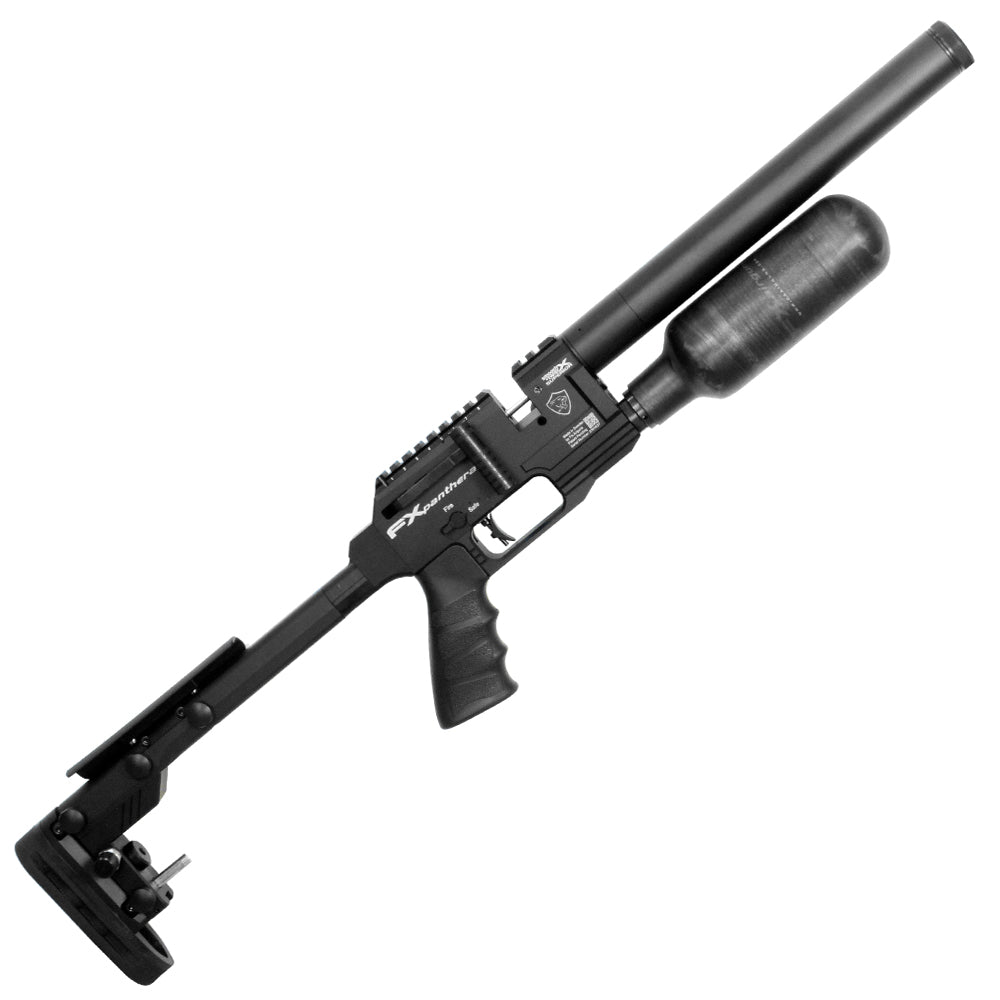
Four popular projectile sizes are supported by the FX Panthera Hunter PCP Air Rifle, so a single platform can be matched to target work, pest control, or hunting where local rules allow. Consequently, .177 (4.5 mm), .22 (5.5 mm), .25 (6.35 mm), and .30 (7.62 mm) configurations are offered. Moreover, magazine capacity, barrel length, plenum volume, and advertised energy change with calibre, which is why the correct setup should be confirmed before purchase. Inclusive fit is improved because left- and right-handed shooters can share the same chassis once the reversible sidelever and cheek piece have been set.
How Each Calibre Is Typically Used
A high shot count and a flatter trajectory are usually associated with .177. Therefore, this calibre is often selected for practice, HFT-style precision, and small pest work where legal power is modest. Magazine capacity of 21 rounds is commonly listed, and a 300 mm Superior Smooth Twist X barrel is typically fitted. As a result, overall length stays near 775 mm and weight remains close to 2.78 kg.
Meanwhile, .22 remains the most versatile all-round choice for many field shooters. Subsequently, an 18-round magazine is used, and the same 300 mm barrel length is retained on Hunter Compact layouts. Pellet strings near 80 shots per fill have been published under stated test weights and velocities, while slug energy can be raised on high-power kits. Consequently, small-game hunting and mid-range pest control are frequently assigned to this calibre.
Furthermore, .25 is chosen when heavier pellets or slugs and greater downrange energy are preferred. A 16-round magazine is normally supplied, and barrel length is increased to about 380 mm. Overall length therefore grows to roughly 855 mm, and weight is listed near 2.85 kg. In addition, a larger Dynamic Plenum volume is often paired with this calibre so that airflow can support heavier projectiles.
Likewise, .30 is selected for larger pests and hunting applications where FAC or equivalent high-power permission is held. Magazine capacity drops to 13 rounds, barrel length is extended to approximately 395 mm, and overall length approaches 870 mm. Weight is typically listed near 2.93 kg. As a result, compact handling is preserved even though projectile mass and energy are increased.
FAC, Legal Power, and Responsible Setup
Power output is not a single fixed figure. Instead, it is governed by market version, hammer kit, regulator setting, projectile weight, and national law. Therefore, sub-12 ft-lbs UK-style models must be distinguished from FAC or high-power export rifles. Local licensing, storage, transport, and hunting rules must always be followed, and no configuration should be assumed legal in every country.
Additionally, published pellet energies and slug-power figures should be treated as manufacturer test values, not a guarantee for every tune. Under stated pellet conditions, strings such as 140 shots in .177, 80 in .22, 48 in .25, and 34 in .30 have been listed. Meanwhile, higher maxima—often cited near 28 FPE in .177, 50 FPE in .22, 73 FPE in .25, and 105 FPE in .30 with slug-power kits at specified regulator settings—are associated with FAC-class setups. Consequently, a chronograph should be used after any Quick Tune or regulator change so that legal limits are not exceeded.
Moreover, fill pressure is specified at 250 BAR / 3,625 PSI. Safe charging equipment, a compatible Foster connection, and a dust cap are required. Inclusive safety practice means every user of the rifle—regardless of experience—should verify remaining bottle and regulator pressure on the dual angled manometers before a session is begun.
Power Delivery Inside the Action
Consistent air is supplied by the AMP MKII regulator. Subsequently, the short-impulse Dynamic Block valve meters that air through the over-the-barrel Dynamic Plenum. As a result, shot-to-shot variation can be kept tight when the rifle has been tuned to a known pellet or slug. The Quick Tune System is provided so that hammer tension can be refined externally. Therefore, a change from light pellets to longer slugs does not always require a full workshop strip.
In addition, deeper magazine lids are used so that projectiles up to the stated length (commonly around 13 mm on related Panthera magazines) can be fed. Side-shot magazines remain calibre-specific. Mixing magazines between calibres should be avoided.
Accessories That Complete the Rifle
A conversion-ready accessory set is supported by the chassis. Consequently, an extended Picatinny optics rail with 30 MOA cant is fitted so that long-range zero can be obtained with less internal elevation from the scope. Side Picatinny rails on the action block accept bipods, lights, lasers, or rangefinders where lawful. A 1/2 UNF muzzle thread allows a moderator to be mounted in jurisdictions that permit sound reduction on air rifles.
Furthermore, the textured FX UG1 grip, adjustable cheek rest, and adjustable rubber buttpad allow eye alignment and length of pull to be set for different body sizes and optics. Inclusive use is therefore improved when more than one shooter shares the rifle. A hard-shell case and one magazine are typically included with retail packages. Spare magazines, slugs, pellets matched to the liner, a quality fill whip, and a chronograph are strongly recommended additions.
Likewise, optional dual-bottle kits can be specified on some Hunter layouts so that extra air volume is carried without a larger single cylinder. Optics from established airgun-rated brands should be chosen with sufficient elevation and parallax for the intended range. Rings must match the Picatinny rail and the 30 MOA cant.
Finally, accessories do not change legal classification by themselves. Moderators, high-power hammers, and slug kits can affect report, energy, and licensing. Therefore, every upgrade should be checked against local FAC or airgun regulations before it is fitted. When calibre, lawful power, and accessories are matched with care, the FX Panthera Hunter PCP Air Rifle can be used as a compact, tunable hunting and precision platform by a wide community of responsible shooters.
Practical Use in the Field
A compact, regulated hunting rifle is carried most effectively when the session has been planned around terrain, legal power, and a known projectile. Consequently, stalks, hide work, vehicle approaches, and quiet farm duties can be completed with less fatigue than is often associated with a full-length bench platform. Moreover, inclusive handling is supported because the sidelever and cheek support can be reversed, so more than one shooter can share the same rifle after a brief setup. Ethical use remains the priority: a safe backstop is confirmed, local seasons and licensing are respected, and a shot is taken only when placement can be guaranteed.
Woodland Stalks and Tight Lanes
Narrow rides and low branches are negotiated more easily when overall length has been kept short. Therefore, the rifle can be brought to the shoulder without the muzzle catching on bramble or fence wire. Meanwhile, forward bottle placement helps keep the balance point useful for standing shots after a pause behind a tree. As a result, a brief rest against a trunk can be used to settle breathing before the first-stage trigger is taken up.
Furthermore, offhand work is improved when the textured grip is held with a consistent support-hand position under the forend. Subsequently, the support elbow can be tucked so that sway is reduced. A kneeling position is adopted when extra stability is needed and the ground is dry enough for a quiet kneel. Likewise, a sitting shot from a fallen log can be used if the animal remains unaware and the angle remains safe.
In addition, magazine capacity should be treated as a planning tool rather than an invitation to rush. A first shot is prepared with a known zero. Follow-up rounds are reserved for a clear, stationary target if the first pellet does not connect as intended. Consequently, noise discipline and movement discipline matter as much as mechanical consistency.
Farm Pest Control and Boundary Walks
Quiet boundary walks are often completed at first and last light. Therefore, dual pressure gauges are checked before the walk is begun so that bottle and regulator readings are known. A fill is completed at home or in a vehicle using a Foster connection and a dust cap is replaced immediately afterward. As a result, grit is kept out of the port during a muddy circuit of sheds, feeders, and hedgerows.
Moreover, a compact profile allows the rifle to be carried across a yard without drawing unnecessary attention from livestock. Switch-style safety use is rehearsed so that the action is made ready only when a shot is imminent. Inclusive practice means every person who may carry the rifle on that farm has been shown the same safety routine.
Additionally, calibre choice is matched to the task. Lighter projectiles and higher shot counts are often preferred for close, repeated pigeon or rat work where legal energy is modest. Heavier slugs and higher-power settings are reserved for larger pests only where FAC or equivalent permission has been granted. Local rules are verified before any high-power hammer or slug kit is fitted.
Hide, High Seat, and Vehicle Approaches
A hide or high seat rewards a short rifle because swing room is limited. Consequently, the muzzle can be eased through a window or net gap without the butt catching on the rear wall. An adjustable cheek piece is set so that a scope with higher rings still presents a full sight picture. Meanwhile, a 30-MOA-class rail helps long-range zeros when permitted ranges and legal energy make that shot appropriate.
Furthermore, vehicle approaches are common on large holdings. The rifle is unloaded or made safe according to local transport law before it is placed in a case. After arrival, a quiet exit is used, and the first minutes are spent watching rather than shooting. As a result, animals that have been alerted by a door or engine are allowed to settle.
Likewise, a bipod or small bag can be attached to side rails when a bonnet or fence rail will be used as a rest. The rest is padded so that the forend is not marked and so that the shot is not thrown by a hard contact point. Inclusive fieldcraft includes offering the rest and the shooting order to companions so that each person has a fair, safe opportunity.
Weather, Clothing, and Seasonal Conditions
Wet gloves change trigger feel. Therefore, the two-stage trigger is confirmed with the same gloves that will be worn on the day. A crisp second stage remains usable if the blade position has been set for gloved reach. Subsequently, the textured grip remains secure when rain has made timber rails slippery.
In addition, cold reduces shooter stamina faster than it reduces regulated consistency on a well-filled bottle. Layers that allow a natural mount are chosen so that the comb height still matches the optic. A rubber buttpad is adjusted so that clothing bulk does not create an inconsistent length of pull. As a result, the same zero can be trusted from a summer shirt to a winter jacket after a brief confirmation group.
Wind is read on grass, leaves, and dust rather than guessed. Compact rifles can still be affected by a full-value crosswind at longer pest ranges. Consequently, closer shots are selected when flags show unstable drift. Ethical range is shortened until groups on paper at that distance remain inside the vital zone of the intended species.
Range Confirmation Before Any Hunt
Field accuracy is earned on paper first. Therefore, a known-distance range session is completed with the same pellets or slugs that will be carried. Chronograph readings are recorded after any regulator or hammer-tension change. Shot strings are examined for extreme spread, not only for a single lucky group.
Moreover, zero is confirmed from the positions that will actually be used: standing with a stick, kneeling, and from a bag. A bench-only zero can mislead if the hunter never shoots from a bench. Inclusive coaching is offered when a new shooter joins the session, so that trigger control and follow-through are demonstrated rather than assumed.
Additionally, magazine feeding is tested with the exact projectile length that will be hunted. Deeper lids are intended for longer slugs; mixed lengths in one magazine can cause a stoppage at the worst moment. Spare magazines are loaded at home and carried in a pocket that will not collect grit.
Quiet Shots and Neighbour-Sensitive Ground
Many holdings sit close to houses, livestock, and public paths. Therefore, a lawful moderator is fitted where regulations allow, and the muzzle is kept pointed at a solid backstop. Report is reduced not only for courtesy but also so that remaining animals are less likely to flush after the first shot.
Meanwhile, angle and ricochet risk are considered on frost-hard ground and on steel feeders. A pellet that glances from a trough can travel farther than expected. Consequently, shots into crowded yards are refused even when the target appears close. Inclusive responsibility includes warning anyone working nearby before a session starts.
Shared Use, Travel, and All-Day Carry
Weight near six to six-and-a-half pounds without an optic makes an all-day walk realistic for many adults. Extra mass from a scope, moderator, and loaded magazines should still be counted. A sling stud or rail-mounted sling can be added so that hands remain free while fences are crossed. The rifle is never climbed with; it is passed up after the person is secure.
Furthermore, travel cases protect the adjustable comb and the carbon bottle. Airline and border rules differ widely; air rifles and high-pressure vessels are subject to declaration rules that must be researched before any journey. Inclusive planning means every adult in the party knows who is legally allowed to possess and carry the rifle at the destination.
Likewise, a second bottle kit, where available, can be used on long days far from a compressor. The extra vessel is filled at home and kept capped. Field topping from a buddy bottle is completed with the rifle pointed in a safe direction and the action confirmed empty.
Maintenance That Belongs in the Use Cycle
Practical use includes the minutes after the last shot. Therefore, the magazine is removed, the action is dry-fired only if the maker’s guidance allows it, and the bore is protected from rain. A light wipe of the exterior is completed before the rifle is cased so that moisture is not trapped against the gauges and rails.
In addition, regulator and bottle readings are noted in a small log. A sudden drop that cannot be explained by the shot count suggests a leak that should be diagnosed at home, not ignored on the next dawn walk. Foster ports are inspected for grit. Inclusive care means the next person to use the rifle receives it in a known, safe state.
Decision-Making at the Moment of the Shot
A practical scenario is completed only when the shooter can answer several quiet questions. Is the animal correctly identified? Is the distance known? Is the vital zone clear of cover? Is the backstop adequate? Has the safety been managed until that instant? If any answer is uncertain, the shot is passed.
Consequently, the compact platform’s speed should never be used as an excuse for a rushed mount. Breathing is settled, the first stage is taken up, and the break is allowed to surprise the shooter. Follow-through is held until the pellet or slug has struck. Only then is a second round considered.
Finally, the most successful outings are those in which the rifle is treated as a precise tool inside a larger practice of patience, law, and respect for land and wildlife. When positions, ammunition, weather, and ethics are aligned, a short regulated hunting rifle earns its place on the shoulder from first light until the walk back to the gate.
Frequently Asked Questions
Clear answers are provided below so that first-time buyers and experienced shooters can plan a compact, regulated hunting rifle with fewer surprises. Consequently, legal power, calibre choice, filling, magazines, and field use can be considered before an order is placed. Moreover, inclusive guidance is offered because more than one person in a household or club may share the same chassis after the lever and cheek support have been reversed. Local laws always take priority over any general note on this page.
Which calibre should be chosen first?
A first calibre is usually matched to the main task rather than to a catalogue maximum. Therefore, .177 is often selected when a high shot count, a flatter trajectory, and close-range precision are required. Meanwhile, .22 remains the most common all-round choice for mixed pest work and small-game hunting where modest-to-medium energy is lawful. Furthermore, .25 and .30 are reserved for heavier projectiles and larger pests only when licensing and land permission support that energy.
Additionally, barrel length and overall length change with calibre on compact Hunter-style layouts. Shorter tubes are typically fitted to .177 and .22, while slightly longer tubes are used for .25 and .30. As a result, balance and magazine capacity also change. A 21-round magazine is commonly listed for .177, 18 for .22, 16 for .25, and 13 for .30. Inclusive planning includes asking every regular user which distances and species will actually be encountered.
How is FAC or legal power handled?
Power is not a single factory promise. Instead, output is governed by market version, hammer kit, regulator setting, projectile weight, and national rules. Consequently, a sub-12 ft-lbs configuration must never be confused with an FAC or high-power export rifle. Local storage, transport, and hunting laws must be read in full before a high-power spring, slug kit, or unshrouded muzzle device is fitted.
Moreover, published pellet strings and slug-energy figures are test values under stated conditions. They are not a substitute for a chronograph session after every tune. A rifle that has been turned up for slugs can leave a legal class if the setting is left unchanged. Therefore, readings are recorded, and the rifle is returned to a lawful setting before it is carried on land that requires a lower limit.
Likewise, fill pressure is specified at 250 BAR / 3,625 PSI on typical packages. Safe charging gear is required. Inclusive responsibility means every adult who will fill the bottle has been shown the correct Foster connection, the dust cap routine, and the rule that the muzzle stays pointed in a safe direction during charging.
How many shots can be expected from one fill?
Shot count depends on calibre, projectile weight, regulator pressure, and how far the tune has been raised. Therefore, a light .177 pellet string can be far longer than a heavy .30 slug string from the same bottle size. Published examples under stated pellet tests have included figures on the order of 140 shots in .177, 80 in .22, 48 in .25, and 34 in .30. Other compact listings cite roughly 100 / 60 / 45 / 35 under different pellet weights and speeds.
Furthermore, those numbers fall when energy is increased or when slugs are used. A second bottle kit, where offered, extends time afield but does not change the need to watch both gauges. The bottle gauge shows stored air. The regulator gauge shows whether regulated pressure is still being held. A session is ended before regulated pressure collapses, even if the bottle still shows a partial fill.
Can pellets and slugs be used in the same rifle?
Both pellets and slugs can be used when the liner, magazine lid, and tune have been matched to the projectile. Consequently, a deeper magazine lid is provided on related designs so that longer slugs can be seated. Mixed lengths in one magazine should be avoided because a stoppage can occur at the feed lips.
Meanwhile, a pellet tune is not automatically a slug tune. Hammer tension and regulator pressure are refined with the Quick Tune approach after the projectile is changed. Groups and chronograph readings are then confirmed at the distances that will be hunted. Inclusive practice includes labelling magazines by projectile so that a guest shooter is not handed the wrong stack.


Reviews
There are no reviews yet.