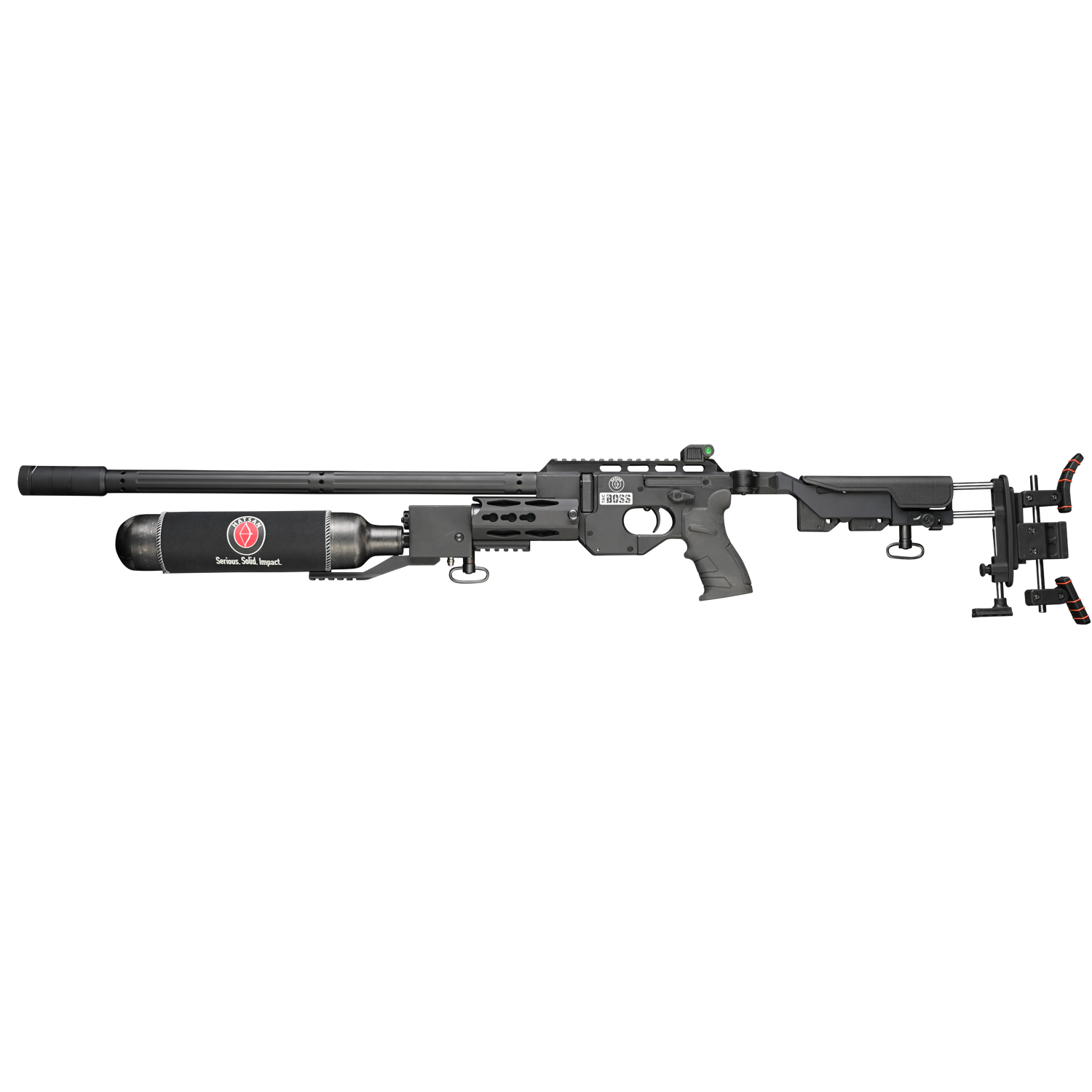
Precision, consistency, and tactical versatility are delivered by the Hatsan Tac Boss PCP Rifle, a competition-minded pre-charged pneumatic platform that is engineered for target work, field precision, and responsible hunting use. A compact aluminum architecture is combined with a high-capacity carbon-fiber air bottle, an externally adjustable regulator, and QuietEnergy barrel treatment so that stable velocity, reduced report, and comfortable handling can be enjoyed by shooters of every experience level. Consequently, confidence at the bench and in the field is supported without unnecessary bulk.
Moreover, modular stock geometry, dual pressure gauges, and a side-lever action are integrated so that follow-up shots can be taken quickly while fill status remains visible at a glance. Therefore, the Hatsan Tac Boss PCP Rifle is positioned as a practical choice whenever regulated power, magazine capacity, and accessory flexibility are required in one package.
Why the Hatsan Tac Boss PCP Rifle Stands Out
A regulated PCP system is employed so that pellet after pellet can be launched at a more consistent pressure once the bottle is charged. Additionally, a removable 580 cc carbon-fiber cylinder is specified and a 250 BAR fill ceiling is provided, while optimal-velocity shot counts of approximately 95, 90, and 80 rounds are listed by caliber when the regulator is set near 125 BAR. As a result, longer strings can be completed before a refill is needed.
Furthermore, a precision-rifled and choked barrel of 520 mm (20.5″) is fitted inside a QuietEnergy shroud, and a ½” UNF muzzle thread is retained so that an extra moderator can be added where local rules allow. Meanwhile, a side-lever cocking cycle is used so that the rifle can be kept on target between shots. In addition, two detachable magazines are typically supplied, and spare-magazine slots are machined into the folding stock so that reloads can be kept close at hand.
Core Performance Highlights
- Regulated PCP action is used so that velocity swing can be reduced across a fill.
- 580 cc carbon-fiber bottle is filled to 250 BAR and can be removed for charging or spare-tank swaps.
- Dual gauges are mounted so that bottle pressure and regulator pressure can be monitored independently.
- Externally adjustable regulator is provided so that power can be tuned to pellet weight and discipline.
- QuietEnergy shrouded barrel is fitted, and a ½” UNF thread is retained for additional moderation.
- Side-lever cocking is employed for fast, low-effort cycling.
- Magazine capacities of 18 / 16 / 14 shots are offered in .177 / .22 / .25.
- 3-way adjustable side-folding aluminum stock, cheek rest, and rubber butt pad are included; a competition / field-target plate can be fitted.
- Combination 11 mm / 22 mm top rail plus forend Picatinny sections are machined so that optics, bipods, and lights can be mounted.
- Patented anti-knock system and a manual safety are installed for safer handling.
- Foster quick-disconnect fill hardware is supplied for convenient charging.
Calibers, Power, and Air Management
Three factory calibers are listed on Hatsan’s specification sheet so that the Hatsan Tac Boss PCP Rifle can be matched to range work, pest control, or hunting where lawful. In .177 (4.5 mm), a maximum velocity near 318 m/s (1050 fps) and about 29 J / 21 ft-lbs are quoted at the stated 125 BAR regulator setting. Subsequently, in .22 (5.5 mm), figures near 297 m/s (980 fps) and 42 J / 31 ft-lbs are published. Likewise, in .25 (6.35 mm), values near 277 m/s (915 fps) and 50 J / 37 ft-lbs are given. Accordingly, energy and shot count should always be confirmed against local limits and the pellet actually used, because velocity and energy are affected by projectile mass, shape, temperature, and elevation.
Meanwhile, magazine capacity is scaled with bore size: 18 shots in .177, 16 in .22, and 14 in .25. Therefore, longer strings can be fired before a magazine is swapped. In the same way, optimal-velocity shot counts of roughly 95 / 90 / 80 are associated with those calibers when the bottle is filled to 250 BAR and the regulator remains at the published test setting. Hence, a full day of practice can often be completed with fewer fills than an unregulated tube of similar size would allow.
Additionally, two analog gauges are fitted so that remaining bottle pressure and set regulator pressure can be read without guesswork. Consequently, a fill can be planned before velocity begins to fall. Moreover, because the carbon-fiber bottle is detachable, a spare cylinder can be carried and exchanged at the bench. Filling is simplified by the Foster male fitting on the rifle and the female nozzle that is included in the box.
Barrel, Sound Control, and Optics Interface
Accuracy is supported by a precision-rifled, choked barrel that is fully shrouded. QuietEnergy treatment is applied so that muzzle report can be reduced for range courtesy and field discretion. Furthermore, the ½” UNF thread remains available so that a secondary moderator can be fitted when regulations permit. As a result, neighbors and wildlife are disturbed less than they would be by an unshrouded high-power PCP.
Optics mounting is handled by an aluminum receiver that carries a combination rail for both 11 mm dovetail and 22 mm Weaver / Picatinny rings. Beneath and beside the forend, extra Picatinny sections are provided so that a bipod, laser, or lamp can be attached without extra clamps. Therefore, the Hatsan Tac Boss PCP Rifle can be configured as a compact tactical trainer or as a supported precision rifle.
Stock Geometry, Handling, and Inclusive Fit
Comfort for a wide range of body sizes is addressed by a 3-way adjustable, side-folding aluminum stock. Length of pull and cheek height can be altered, and a rubber butt pad is fitted as standard. Optionally, a field-target or competition butt plate can be installed so that a more vertical, match-style contact can be obtained. Overall length is listed at about 1040 mm (41″) with the soft rubber pad and about 1100 mm (43.3″) with the FT-style plate, while barrel length remains 520 mm. Unloaded weight is published near 3.6 kg (7.9 lb), so the platform can be carried reasonably in the field yet remains stable on bags or a bipod.
An ambidextrous folding design is used so that left- and right-handed shooters can be accommodated, and spare magazines can be stored in dedicated stock slots. Interchangeable wood and synthetic grips are offered on many packages so that texture and appearance can be chosen by preference. Consequently, the rifle can be tailored rather than forcing every shooter into a single fixed comb and length.
A metal trigger and aluminum guard are specified, and a two-stage adjustable trigger is commonly associated with Hatsan PCP platforms of this class. Manual safety and the patented anti-knock system are included so that an unintended discharge is less likely if the rifle is bumped while cocked. Inclusive, responsible use is expected: eye protection should be worn, local airgun laws should be observed, and FAC or energy limits should be respected wherever they apply.
Practical Use: Range, Field, and Competition
On the range, consistent regulator pressure is valued because holdover and click charts remain trustworthy from the first shot of a fill to the last usable shot. Side-lever cycling keeps the firing hand close to the grip, so groups can be refined without a long break in position. For hunting and pest control where legal, the .22 and .25 energy figures, combined with a choked barrel, allow ethical shot placement inside appropriate distances when premium pellets are selected and zero is confirmed.
For field-target or club precision events, the folding stock, magazine storage, dual gauges, and optional competition butt plate make the Hatsan Tac Boss PCP Rifle easy to stage. A monopod-style rear support is described on some market packages, further aiding long-range stability. Transport is simplified because the stock can be folded and a hard case is frequently included.
Maintenance remains straightforward: high-quality pellets should be used, magazine seals can be lightly lubricated with airgun-safe silicone where recommended, and oil must never be introduced into the high-pressure air path. Filling should be performed only with equipment rated for 250 BAR, and the bottle should be inspected according to the manufacturer’s interval.
What Is Typically Included
- Hatsan Tac Boss PCP Rifle in the chosen caliber
- Two (sometimes three) detachable magazines
- Foster quick-fill nozzle / adapter
- Folding aluminum stock with magazine storage
- Dual pressure gauges already installed
- Hard case on many retail packages
- Optional competition / FT butt plate depending on kit
Ready for the Next Session
A compact, regulated, high-capacity PCP is offered by the Hatsan Tac Boss PCP Rifle so that precision shooting can be practiced longer, quieter, and with less setup fuss. Power can be tuned, optics and bipods can be mounted on factory rails, and the folding stock can be adjusted until a natural cheek weld is found. When responsible ownership, local compliance, and quality pellets are combined with this platform, consistent groups and confident follow-up shots can be expected—whether the next outing is a club match, a zeroing session, or lawful field work.
Shop the Hatsan Tac Boss PCP Rifle with confidence and pair it with a compressor or tank rated for 250 BAR, a matching optic, and the pellets that print tightest in that specific barrel.
Calibres, FAC Considerations, Power Output, and Accessories for the Hatsan Tac Boss PCP Rifle
A choice of factory calibres is offered so that the Hatsan Tac Boss PCP Rifle can be matched to discipline, distance, and local energy rules. Consequently, a single platform can be specified for club target work, pest control, or lawful hunting once the correct bore, regulator setting, and pellet are selected. Moreover, power figures that are published by Hatsan are quoted at a 125 BAR regulator setting; therefore, actual velocity and energy in the field should always be verified with a chronograph and with the ammunition that will be used.
Available Calibres and How Each Is Typically Applied
Three factory chamberings are listed on Hatsan’s specification sheet. In 4.5 mm / .177, a maximum velocity near 318 m/s (1050 fps) and energy of about 29 J (21 ft-lbs) are published, while an 18-shot magazine and roughly 95 optimal-velocity shots per 250 BAR fill are associated with that bore. Accordingly, the .177 option is often preferred wherever flat trajectory, high shot count, and paper or steel targets are the priority.

Subsequently, in 5.5 mm / .22, velocity near 297 m/s (980 fps) and energy of about 42 J (31 ft-lbs) are quoted, with a 16-shot magazine and about 90 usable shots at the same regulator setting. As a result, a practical balance of sectional density, wind resistance, and magazine capacity is provided for mixed range and field use. Likewise, in 6.35 mm / .25, figures near 277 m/s (915 fps) and 50 J (37 ft-lbs) are given, together with a 14-shot magazine and approximately 80 optimal shots. Hence, greater on-target energy is delivered when heavier pellets and ethical hunting distances are required and when local law permits that power level.
Furthermore, regional catalogues sometimes list only .22 and .25 for a given market, while the full three-calibre table remains published by the factory. Therefore, availability should be confirmed before an order is placed. In every calibre, velocity and energy remain dependent on pellet mass, shape, material, temperature, and elevation, so published maxima should be treated as reference values rather than guaranteed field results.
FAC, Legal Power Limits, and Responsible Setup
Legal classification is determined by the country or region in which the rifle is possessed, not by the model name alone. In the United Kingdom, energy above 12 ft-lbs (approximately 16.3 J) for a rifle typically requires a Firearms Certificate (FAC). Because factory figures for the Hatsan Tac Boss PCP Rifle in .22 and .25 sit well above that threshold at the published 125 BAR setting, FAC possession, storage, and use conditions are normally required in England, Wales, and Scotland unless the rifle has been professionally limited and certified below the limit. In Northern Ireland and in many EU jurisdictions, different joule ceilings and licensing routes apply; consequently, local police or a qualified dealer should be consulted before purchase or import.
Meanwhile, some export or domestic kits are supplied at a reduced setting (for example, a 24 J specification in certain markets) so that a lower national cap can be met. Even then, an externally adjustable regulator is fitted, so power can be raised or lowered within the mechanical limits of the valve and hammer. Therefore, any increase that would cross a legal threshold must be treated as the owner’s responsibility and must only be performed where the law allows. Inclusive, lawful use is expected: the rifle should be stored securely, transported unloaded where required, and fired only in permitted places with appropriate backstops.
Additionally, because a 250 BAR carbon-fibre bottle is used, filling equipment, hydro-test intervals, and cylinder handling rules must be observed. A Foster quick-disconnect is provided so that charging can be completed with a compatible compressor, hand pump rated for the pressure, or scuba/DIN adaptor. Oil must never be introduced into the high-pressure air path.
Power Tuning, Regulator Use, and Shot Consistency
Stable strings are produced because a regulator is installed and can be adjusted from the exterior. When the regulator is left near the published 125 BAR test point, the velocity and energy values listed above are the reference baseline. Subsequently, a lower regulator pressure can be selected so that pellet-friendly speeds, quieter report, and extra shot count can be obtained for 10-metre or 25-metre practice. Conversely, a higher setting within the safe design range can be chosen when heavier .22 or .25 pellets and longer ethical hunting ranges are intended and legally permitted.
Dual gauges are mounted so that remaining bottle pressure and the set regulator pressure can be read independently. As a result, a refill can be planned before the string falls off the plateau. Optimal-velocity counts of about 95 / 90 / 80 shots (.177 / .22 / .25) are associated with a full 580 cc bottle at 250 BAR; more shots of declining speed remain available after that plateau if a session is continued. Consistency is further supported by the QuietEnergy shrouded, choked barrel, provided that high-quality pellets of a length accepted by the magazine (often cited near 9 mm maximum projectile length on retailer sheets) are used.
Accessories That Complete the Platform
A conversion-ready accessory set is already built into the Hatsan Tac Boss PCP Rifle, and further items can be added without custom gunsmithing.
Factory-fitted or commonly included items
- Removable 580 cc carbon-fibre bottle rated to 250 BAR
- Two detachable magazines (calibre-specific: 18 / 16 / 14)
- Stock slots so that spare magazines can be carried on the rifle
- Foster QD male fitting on the gun and female fill nozzle in the box
- Combination 11 mm / 22 mm receiver rail for scopes or red dots
- Additional Picatinny sections under and beside the forend for bipod, lamp, or laser
- ½” UNF muzzle thread plus QuietEnergy shroud
- Side-folding aluminium stock, adjustable cheek piece, and rubber butt pad
- Optional competition / field-target butt plate on many kits
- Dual analogue gauges and manual safety
- Hard case on numerous retail packages
- Interchangeable wood and synthetic grips on selected market versions
Recommended pairings for accuracy and convenience
- A first-focal-plane or second-focal-plane scope in a 4–16× or 6–24× class, mounted in quality 30 mm or 34 mm rings on the combo rail
- A compact bipod on the under-forend rail for supported precision
- An extra carbon bottle so that one cylinder can be filled while the other remains on the rifle
- A 250 BAR compressor or charging kit with a water separator
- Premium domed or heavy hunting pellets matched to the chosen calibre
- A secondary moderator where local law allows extra sound reduction on the UNF thread
- Sling studs or a quick-detach sling if the folding stock will be carried afield
- A chronograph so that regulator changes can be documented for FAC records or load development
Because rails, thread, bottle interface, and magazine format are standardised on this model, optics, filling gear, and spare tanks can be shared with other modern PCPs in the same household. Inclusive setup is straightforward: length of pull and comb height can be altered until a comfortable weld is found for different body sizes and shooting positions, and left- or right-handed operation is supported by the folding ambidextrous stock and side lever.
When calibre, legal power, regulator setting, and accessories are chosen together, the Hatsan Tac Boss PCP Rifle can be specified as a high-count .177 trainer, a balanced .22 all-rounder, or a harder-hitting .25 field rifle—always within the rules that apply where it is used.
Barra Air Rifles, BB Guns, PCP Systems, Electric Airguns, and Advanced Shooting Platforms
The modern airgun market offers a wide range of shooting platforms designed for beginners, enthusiasts, and experienced shooters. From traditional BB gun designs to advanced pneumatic systems, today’s technology provides improved accuracy, power, reliability, and versatility. The Barra product range has gained attention among airgun users because of its combination of innovative engineering and practical shooting performance.
Popular models include the Barra 300Z, Barra 350Z, Barra 250Z, Barra 400, Barra 400E Gen 2, Barra 400 E, 400E, 400 e, Bara 400E, Barra 1100Z, Barra 1100Z Gen 2, Barra 1200G, Barra 100, BA-400, Barra 1866, Barra 1866 Rosie Bundle, Barra 270Z, Barra Sportsman 900, and Sportsman 900. These platforms are designed for different shooting preferences, including recreational shooting, target practice, and precision applications.
A BB gun rifle provides a classic shooting experience, while a BB rifle offers a compact and accessible option for users interested in recreational shooting. Many shooters also search for a BB gun rifle with scope because an optic can improve aiming consistency and overall shooting control. Traditional accessories and variations include BB rifle pump, BB gun pump, and BB gun rifle pump systems.
PCP Air Rifle and Compressed Air Technology
Advanced airgun technology has been transformed through precharged pneumatic systems. A PCP rifle uses stored air pressure to deliver consistent performance, making it a popular choice among users who want accuracy and power. A PCP air rifle operates through compressed air stored inside a reservoir, allowing multiple shots before refilling.
Many shooters research air rifle compressed air technology because it provides smooth operation, reduced vibration, and improved shot consistency. A compressed air pellet guns platform uses high-pressure air to propel pellets efficiently, while a high pressure air rifle is designed for users who require increased performance.
Other related systems include air gun compressed, compressed air guns, and compressed air rifle designs. These platforms are commonly paired with equipment such as a PCP pump for air rifle and other filling accessories.
For new users asking PCP air rifle meaning, what is a PCP air rifle, what is PCP air rifle, or whats a PCP gun, the answer refers to a precharged pneumatic system that stores compressed air before shooting. A pre charged pneumatic air rifles setup provides an alternative to spring-powered designs and is widely used for precision shooting.
Barra PCP Models and Caliber Options
The Barra 250Z PCP air rifle is designed for shooters looking for a powerful and compact pneumatic platform. The Barra 250Z for sale market includes different configurations, including the Barra 250Z .25 cal version.
Large-caliber airguns are becoming increasingly popular, with options such as a 25 cal air rifle 1000 fps, 25 caliber pellet rifle, .25 PCP air rifle, PCP 25 caliber air rifle, 25 caliber air rifle, and 25 Z configurations.
These larger-caliber platforms are designed for users who want increased energy and performance compared with smaller calibers. Other popular caliber choices include the 22 cal air rifle, 22 caliber air rifle, 22 caliber pellet gun, and 22 pellet rifle 1200 fps options.
Electric BB Guns and Automatic Airgun Platforms
Electric-powered shooting systems have created another category within recreational shooting. An electric BB gun uses battery-powered technology to provide a unique shooting experience. Related designs include electric pellet gun, electric air gun, air gun electric, electric rifle, battery powered air gun, electric BB guns, electric guns, and airsoft air guns electric.
Users searching for high-speed systems may look for terms such as most powerful fully automatic BB gun, full auto BB gun electric, best full auto BB gun, best full auto BB guns, full auto BB gun 1000 fps, full auto BB gun, and fully automatic BB gun.
These platforms are designed for users who want rapid operation and modern features. Performance-focused searches may also include strong BB guns when comparing powerful recreational shooting options.
Pellet Guns, Break Barrel, and Traditional Air Rifles
Traditional airgun designs remain popular because of their simplicity and reliability. A pellet gun provides a practical option for target shooting, while a pellet rifle offers improved stability and accuracy.
A pellet sniper platform is designed for users interested in precision shooting. Classic spring-powered systems include the break barrel pellet gun 1200 fps, break barrel, and single shot 22 break barrel rifle.
For beginners researching what is a break barrel air rifle, this system works through a hinged barrel mechanism that compresses a spring or gas piston before each shot. These designs remain popular because they require minimal additional equipment.
Additional traditional options include air gun pump action, air rifle pump action, pump pellet gun, and pump BB pistol platforms.
Barra Sportsman and Additional Airgun Platforms
The Sportsman 900 air rifle and Sportsman 900 BB gun provide versatile options for recreational users. These models are part of the wider selection of Barra shooting products designed for different experience levels.
Other available platforms include 250Z, Barra 300Z, and various modern Barra configurations. Accessories such as pellet trap for 1200 fps, camouflage pellet guns, and Mossy Oak 308 products allow shooters to customize their equipment.
Users interested in alternative power systems may also explore a CO2 rifle, lever action air rifle, and lever action PCP air rifle. These designs combine traditional handling with modern airgun technology.
Choosing the Right Airgun System
Selecting the right platform depends on shooting purpose, preferred caliber, power requirements, and experience level. A PCP review can help users compare different pneumatic systems, while PCP shooting provides insight into the performance advantages of regulated air platforms.
Whether choosing a Barra model, a compressed air system, an electric shooting platform, or a traditional spring-powered design, understanding features and applications helps buyers select the correct equipment.
From the Barra 400E price to advanced PCP technology and modern electric systems, today’s airgun market provides a wide range of choices for recreational shooters, target enthusiasts, and experienced users seeking reliable performance.
Practical Use Scenarios
A regulated, side-lever PCP with a folding aluminium stock, dual gauges, and a high-capacity carbon bottle is most useful when the same rifle is asked to cover several jobs without a workshop rebuild between outings. Consequently, the following scenarios describe how that combination of features is typically applied from the first fill of the day through transport home. Inclusive language is used throughout so that newcomers, experienced club shooters, and field users can recognise themselves in the same workflow.
Zeroing and Load Development at the Club Range
A calm first session is begun by a full 250 BAR charge and a note of regulator pressure on the second gauge. Afterwards, a bipod or sandbags are fitted to the forend rail so that human wobble can be reduced while groups are printed. Premium pellets of a single lot are then loaded into the rotary magazine, and five-shot clusters are fired at 25 metres, then 40 or 50 metres, until a clear favourite is identified.
Meanwhile, velocity is sampled with a chronograph after every regulator tweak. Because a plateau is produced by the regulator, holdover charts remain meaningful for dozens of shots rather than drifting after a short unregulated string. Subsequently, elevation and windage are confirmed on paper, and a simple dope card is written for the optic that has been clamped to the combination 11 mm / 22 mm rail. When a heavier pellet is preferred for field work, the regulator is raised within the safe design range, groups are re-shot, and the card is updated. Conversely, when quiet backyard practice is planned, pressure is lowered so that report and pellet splash are reduced.bara 250z
A folding stock is left extended on the bench so that length of pull and cheek height can be matched to the shooter. Spare magazines are kept in the stock slots so that a string is not interrupted by a hunt through a range bag. After the session, residual bottle pressure is read on the primary gauge, and a refill is scheduled before the plateau is exhausted.
Club Competition, Field Target, and Timed Strings
Supported precision events reward a rifle that can be staged quickly and left on aim between shots. Therefore, the side lever is cycled without the strong hand leaving the pistol grip, and the next pellet is presented from the magazine with minimal movement. A competition or field-target butt plate, where fitted, is used so that a more vertical shoulder contact can be obtained in kneeling or sitting lanes.
Additionally, two magazines in the stock mean a course of fire can be completed without a walk back to the parking area. Dual gauges are glanced at between lanes so that a bottle change can be made before velocity falls. When a monopod-style rear support is available on the stock, long-range steel or kill-zone discs are engaged with less rear wobble. QuietEnergy shrouding is appreciated by neighbouring squads because muzzle blast is reduced compared with an open high-power tube.
Inclusive match practice is organised by sharing bags and a spotting scope: one person calls wind while another cycles the lever. Left- and right-handed shooters can use the same folding architecture after comb height is reset. After the last target, the stock is folded, the magazine is removed, and the rifle is cased so that the next competitor’s space is left clear.
Introduction and Coaching for New Shooters
A first lesson is kept short and structured. Eye and ear protection are issued, the manual safety is demonstrated, and the anti-knock feature is explained so that a bump on the bench is less likely to produce an unexpected discharge. Afterwards, a low regulator setting and a light .177 or mild .22 pellet are selected so that recoil sensation stays negligible and the report remains neighbour-friendly.
Length of pull and comb are adjusted until a natural weld is found for different statures, including youth and adult frames sharing one rifle on a family ticket. The side lever is shown as a slow, deliberate motion rather than a race, and dry handling is practised before live pellets are loaded. Groups at 10 and 20 metres are celebrated when they tighten, not when they are merely loud.
Meanwhile, the coach watches the gauges so that the student is not asked to diagnose a falling fill. Magazines are pre-loaded at the back of the line so that only safe, pointed-down loading occurs on the firing point. When fatigue appears, the session is ended; a folding stock and modest all-up weight make the walk to the car less of a chore for smaller frames.
Pest Control Around Buildings and Smallholdings
Where local law permits airgun use against legally designated pests, a compact folding rifle with a shrouded barrel is carried along hedges, barns, and fruit cages. A .22 or .25 pellet of proven weight is chosen after the zero established at the club is confirmed on a safe backstop at the expected engagement distance. Ethical range is kept inside the distance at which the selected energy and pellet still deliver a clean, accountable shot.
Furthermore, the folding stock shortens the package for gates, ATV racks, and tight doorways. Magazine slots keep a spare drum on the rifle so that a follow-up, if required and safe, can be taken without a pocket search. A lamp or laser on a forend Picatinny section is used only where night work is lawful and only when the beam will not endanger people, livestock, or roads. Report is kept down by the factory shroud and, where permitted, an extra moderator on the ½” UNF thread so that livestock are less startled.
Inclusive field craft is emphasised: a second person can act as spotter, permission from the landowner is carried, and shots are refused when a backstop is uncertain. After the round, the magazine is emptied, the safety is applied, and the bottle pressure is checked before the next dawn patrol.
Lawful Hunting and Longer Field Walks
In jurisdictions where hunting with a PCP of this energy class is legal and an appropriate certificate is held, a .25 or heavy .22 load is prepared after regulator and pellet are documented. A sling can be attached if studs or adapters are fitted, and the folded stock rides closer to the body on long approaches. Dual gauges prevent a long stalk from ending on a near-empty bottle.
A bipod on the under-rail is deployed for a supported shot from a rise or fence line. Because the barrel is choked and rifled, consistent point of impact is expected when the same pellet lot is used and the regulator has not been disturbed since zero. Follow-up shots, when ethically required, are cycled with the side lever while the cheek weld is maintained. Game recovery and local tagging or reporting rules are observed before the rifle is unloaded for the walk out.250 z
Weather is allowed for: cold dense air and hot thin air both move velocity slightly, so a chronograph check at the vehicle is wise after a long drive. Carbon bottles are protected from sharp impacts and are not left in a sealed hot cabin beyond manufacturer guidance.
Travel, Storage, and Multi-Site Days
A folded overall length near a metre makes boot packing simpler than a fixed full-length sporter. A hard case, where supplied, accepts the rifle with a modest optic still mounted on the combo rail. Magazines and the Foster fill nozzle travel in the same case so that a second range or a friend’s permission ground can be used the same day.
At a second venue, the stock is unfolded, comb is reset if another shooter will fire, and bottle pressure is confirmed before the first shot. A spare 580 cc cylinder, if carried, is swapped in minutes so that the original bottle can be filled at a compressor while practice continues. Inclusive car-sharing is easier when one compact case holds the rifle, two magazines, and a small pellet tin rather than a sprawling spring-piston kit with separate cocking aids.
Overnight storage follows local secure-storage rules: ammunition and the rifle are separated where required, and the bottle is not stored at full pressure indefinitely if the maker advises a lower long-term rest pressure.what gen is black 2
Accessory-Driven Roles: Supported Precision, Low Light, and Training Aids
When a long session of steel or silhouette work is planned, a quality variable optic in the mid-magnification class is mounted, parallax is set, and a bipod is locked to the forend rail. The extra side rails accept a wind indicator or a small recording camera for later review of trigger timing and follow-through. Inclusive coaching uses that footage so that several shooters can learn from one string.
Low-light lawful use, where permitted, relies on a compact lamp on the rail and a simple duplex or illuminated reticle. The shroud keeps muzzle flash and noise from announcing every shot across a valley. For dry-fire or hold training, magazines are left empty, the safety is treated as live, and the adjustable trigger is dry-cycled only in accordance with the manufacturer’s guidance so that the mechanism is not abused.barra 400e aeg
A chronograph and notebook remain the most valuable “accessories” of all: regulator clicks, pellet mass, temperature, and group size are recorded so that the next outing starts from data rather than memory.
Mixed Household and Shared-Club Use
One regulated platform is often shared among several certificate holders or family members. Comb height and length of pull are marked with tape or a small index so that each person can return the stock to a known setting in seconds. Magazines can be colour-coded by calibre if more than one barrel kit exists in the same household. Inclusive etiquette is simple: the last user leaves the rifle unloaded, the gauges readable, and the case dry.
Club armoury nights benefit from the same traits. A duty officer can glance at both gauges, confirm the safety, and issue the rifle knowing that a folding stock and shrouded muzzle will fit the club’s rack and noise expectations.
End-of-Day Routine That Protects the Next Outing
After the last shot, residual pressure is noted. The magazine is removed and emptied. The bore is checked from the muzzle only with safe flags or manufacturer-approved tools. Light silicone is applied to magazine seals if the maker recommends it; oil is never introduced into the high-pressure air system. The Foster port is capped, the stock is folded or left extended according to the case, and the rifle is logged if FAC conditions require a record of use.ar bb gun.b a r r a
A brief wipe of rails and the aluminium folding mechanism prevents grit from grinding adjustment screws. The carbon bottle is inspected for obvious damage and is due for professional test on the interval stamped by the manufacturer. When that routine is followed, the next practical scenario—whether a coaching hour, a match, or a permitted field walk—begins with a rifle that is already understood rather than rediscovered.bb gunning
Across all of these uses, the same principles apply: regulator pressure is treated as a tool, magazines and gauges are kept visible, the stock is fitted to the person behind it, and every shot is taken only where law, backstop, and ethics allow. Consistency is produced not by a single heroic group but by repeating that modest, documented process from fill to case.full auto electric bb gun.barra 250z 25 cal



Reviews
There are no reviews yet.