Brocock BRK and Benjamin Air Rifles: Complete Guide to PCP Technology, Precision, Calibres and Accessories
Discover the Engineering Behind Brocock Airguns and Benjamin Air Rifles
Modern airgun technology has transformed recreational target shooting, competitive marksmanship, and precision air-powered sporting equipment. Today, manufacturers combine advanced pneumatic systems, ergonomic construction, and innovative engineering to produce dependable shooting platforms. Among the established names in this industry, brocock ltd and Benjamin continue to attract attention from enthusiasts seeking technical sophistication and reliable performance.
The evolution of brocock airguns reflects a strong emphasis on compact designs, efficient compressed-air systems, and consistent shot delivery. Similarly, the Benjamin product range offers numerous configurations, from traditional pellet rifles to specialized pneumatic platforms.
Whether researching a compressed air rifle, comparing a conventional pellet gun, or exploring advanced sporting equipment, understanding the available technologies helps buyers make informed decisions.
Brocock BRK Air Rifles: Innovation and Precision Engineering
Brocock Sniper XR and BRK Sniper XR
The brocock sniper xr represents an important development in regulated pneumatic rifle engineering. Featuring a semi-bullpup configuration, adjustable ergonomics, and a sidelever operating system, this model emphasizes handling convenience and mechanical consistency.
Additionally, the brk sniper xr incorporates a regulated air-delivery system designed to reduce variations between successive shots. Its adjustable stock components provide flexibility for different shooting positions.
For enthusiasts researching the .25 caliber brocock sniper xr, calibre selection deserves particular attention. The larger pellet diameter offers different projectile characteristics compared with smaller calibres, while energy output and shot capacity depend on the specific configuration.
The sniper xr also offers an example of how modern engineering combines compact dimensions with adjustable controls.
Brocock Commander XR and BRK Commander
Another noteworthy platform is the brocock commander xr, which combines a tactical-inspired stock configuration with pneumatic engineering.
The brocock commander has attracted interest from enthusiasts who appreciate adjustable furniture, modular features, and consistent operation.
Similarly, buyers researching brk ghost and Commander models often compare ergonomics, overall dimensions, available calibres, and compatible accessories.
Searches for brocock commander xr price should be evaluated using current retailer listings because pricing varies according to country, configuration, condition, and included equipment.
BRK Ghost Air Rifle: Modern Design and Customization
The brk ghost air rifle represents a distinctive approach to modern PCP rifle design. Its bullpup layout places major operating components within a compact overall configuration while retaining a full-length barrel arrangement appropriate to the model.
Furthermore, the BRK Ghost offers adjustable ergonomic components and a mechanical design intended to support controlled operation.
Owners researching ghost accessories should pay attention to manufacturer compatibility, factory specifications, and approved replacement components.
A replacement ghost handle, for example, should be checked against the exact model and production variant before purchase.
Likewise, a magpul sl k buttpad is a product-specific accessory reference rather than a guarantee of compatibility with every rifle stock.
Pathfinder XR and Compact BRK Models
The pathfinder xr offers another example of the manufacturer’s emphasis on compact pneumatic platforms.
Buyers researching the brk pathfinder, brk pathfinder xr, or general pathfinder air rifle specifications should compare verified product dimensions, stock arrangements, and applicable power ratings.
The brk concept xr is another model worth examining when comparing compact sporting rifles.
While these designs share elements of the manufacturer’s engineering philosophy, each has its own configuration and intended handling characteristics.
For anyone comparing several platforms, factors such as overall weight, trigger characteristics, stock adjustment, and service support are more useful than appearance alone.
What Are PCP Air Rifles and How Do They Work?
New enthusiasts frequently ask, what are pcp air rifles?
The abbreviation PCP means precharged pneumatic, referring to an air-powered system that stores compressed air in a pressurized cylinder or reservoir.
Consequently, understanding pcp rifle meaning helps explain the operating principles behind modern pneumatic sporting rifles.
Other common searches include what does pcp mean in air rifles, what is pcp air rifle, what is a pcp air rifle, and what is a pre charged pneumatic air rifle.
All describe the same general operating technology.
Likewise, what is a pcp air gun and pcp air rifle meaning refer to compressed-air propulsion rather than spring-powered or carbon-dioxide systems.
A pcp rifle stores energy before firing, whereas a break barrel pellet gun typically compresses a spring or gas ram through a cocking action.
This distinction also explains why a pneumatic gun, gun pneumatic, and pneumatic weapons may refer to several different mechanisms, depending on the context.
Modern pcp air rifles often feature pressure regulators, adjustable triggers, and specialized magazines. Nevertheless, operating pressure, energy output, and maintenance requirements vary substantially between models.
Essential Accessories and Equipment Compatibility
Properly selected accessories contribute to equipment suitability and long-term maintenance.
For example, the 0db moderator and 0 db moderator are search variations referring to a sound-moderating accessory. Actual sound reduction depends on the individual device, rifle configuration, and applicable legal requirements.
Meanwhile, a pcp o ring kit may contain replacement seals for specified components. Seal dimensions, materials, and pressure ratings must match the manufacturer’s requirements.
Optics are another consideration. A buyer researching how to connect scope equipment should first confirm the mounting-rail standard and the compatibility of the selected mounting system.
The mtc copperhead 4 16×44 is one example of an optical sight that may appear in airgun accessory searches.
Separately, what does prc stand for in guns is a terminology question commonly encountered during broader firearm research. PRC often refers to Precision Rifle Cartridge, which is distinct from PCP pneumatic technology.
Some searches also include bro air, a broad term that may appear alongside BRK and Brocock product research without identifying a specific manufacturer model.
Benjamin Air Rifles: Traditional Performance and Modern Pneumatic Technology
Benjamin Marauder and Popular PCP Models
The benjamin air rifle range encompasses numerous designs developed for different shooting preferences. From conventional air pellet gun platforms to specialized pneumatic systems, the manufacturer offers equipment for recreational and sporting applications.
Among its recognized products, the benjamin marauder has established a strong presence in PCP airgun discussions.
The benjamin marauder pcp and benjamin marauder pcp air rifle are associated with regulated or unregulated configurations, depending on model and generation. Similarly, the benjamin marauder air rifle is frequently considered by enthusiasts researching accurate pneumatic equipment.
Buyers comparing the benjamin marauder .25, benjamin marauder 22, and benjamin marauder regulated variants should verify the exact specifications rather than assume identical performance.
The benjamin marauder pistol provides another distinct option for enthusiasts interested in compact air-powered platforms.
Additionally, searches for benjamin pellet, benjamin pellet gun, and benjamin air pistol reflect the manufacturer’s broader presence in the sporting airgun market.
For owners of older equipment, benjamin air rifle repair should involve model identification, manufacturer-approved parts, and qualified servicing of pressurized components.
Benjamin Bulldog and Big-Bore Airguns
The benjamin bulldog is associated with the development of larger-calibre PCP platforms.
In particular, the benjamin bulldog 457 belongs to the big-bore category, while the bulldog 357 represents another calibre designation within the family.
Those researching benjamin bulldog 457 20 joules should distinguish search terminology from verified factory specifications, since this phrase does not establish an official 20-joule configuration.
More broadly, big bore air guns differ from conventional small-calibre pellet rifles in projectile dimensions, pressure-system requirements, and applicable regulations.
A hunting air rifle or hunting pellet gun must also be evaluated according to local laws, permitted activities, and the manufacturer’s intended application.
Benjamin Trail, Prowler and Break-Barrel Models
Traditional spring and gas-piston airguns remain popular alongside pneumatic equipment.
The benjamin prowler and benjamin trail np are examples associated with conventional sporting air-rifle designs.
Likewise, the benjamin np trail xl and benjamin air rifle 22 break barrel appear frequently in searches involving gas-piston technology.
The phrase benjamin break may also describe general interest in the manufacturer’s break-barrel products.
Enthusiasts comparing a benjamin 22 caliber pellet rifle with PCP alternatives should consider the differences in cocking mechanism, maintenance, recoil behavior, and operating requirements.
Benjamin Airbow Technology and Arrow-Launching Systems
The benjamin airbow belongs to a specialized category that uses compressed air to propel compatible arrows rather than conventional pellets.
Also called an air bow, airbow, arrow gun, air bow rifle, or air bow gun, this equipment differs substantially from standard pellet platforms.
The benjamin pioneer airbow helped establish the manufacturer’s presence in this category.
More recent searches for benjamin airbow m600, benjamin m600 airbow, and the general benjamin bow category reflect interest in advanced arrow-launching technology.
An airbow rifle may also be compared with an air powered crossbow, although their propulsion mechanisms and equipment requirements are different.
The M600 is a distinct PCP-powered arrow launcher with manufacturer-specific arrows and components.
Understanding Pellet Gun Calibres and Power Ratings
Airgun buyers frequently compare .177 pellet guns, 177 pellet guns, a 22 pellet gun, and a .25 pcp air rifle.
Each calibre has its own projectile characteristics, compatible ammunition, and model-specific performance limits.
Similarly, searches for a high powered pellet gun, high power pellet gun, or pellet rifle 1500 fps should be assessed carefully. Advertised velocity alone does not establish accuracy, suitability, or energy output.
A bolt action pellet gun describes a particular loading or cycling arrangement rather than a specific power system.
Other familiar categories include the bb gun rifle, air gun rifle, airrifle, and the broader grouping of air rifle and air pistol equipment.
In comparison, co2 pellet guns use carbon dioxide cartridges, while PCP platforms rely on stored high-pressure air.
The search term m357 may refer to different products and requires model confirmation before any technical comparison.
Choosing the Right Airgun and Understanding Online Availability
Buyers asking can i buy air rifles online should first investigate local restrictions, age requirements, licensing obligations, and shipping regulations.
Rules vary significantly by jurisdiction, especially for higher-powered equipment and specialized arrow-launching platforms.
Whether comparing benjamin air rifles or modern BRK sporting platforms, reliable model specifications, lawful ownership, and qualified maintenance remain essential considerations.
The Brocock product family includes established Sniper XR, Commander XR, Pathfinder XR, Concept XR, and Ghost designs, while the manufacturer’s newer range includes updated XR2 variants.
Ultimately, selecting appropriate air-powered sporting equipment involves balancing ergonomics, engineering quality, compatible accessories, and long-term support. Understanding the distinctions between compressed-air systems, gas-piston mechanisms, and specialized arrow platforms makes product comparisons clearer and more informative.
A well-informed buying decision begins with accurate technical information, clearly identified models, and responsible equipment ownership.
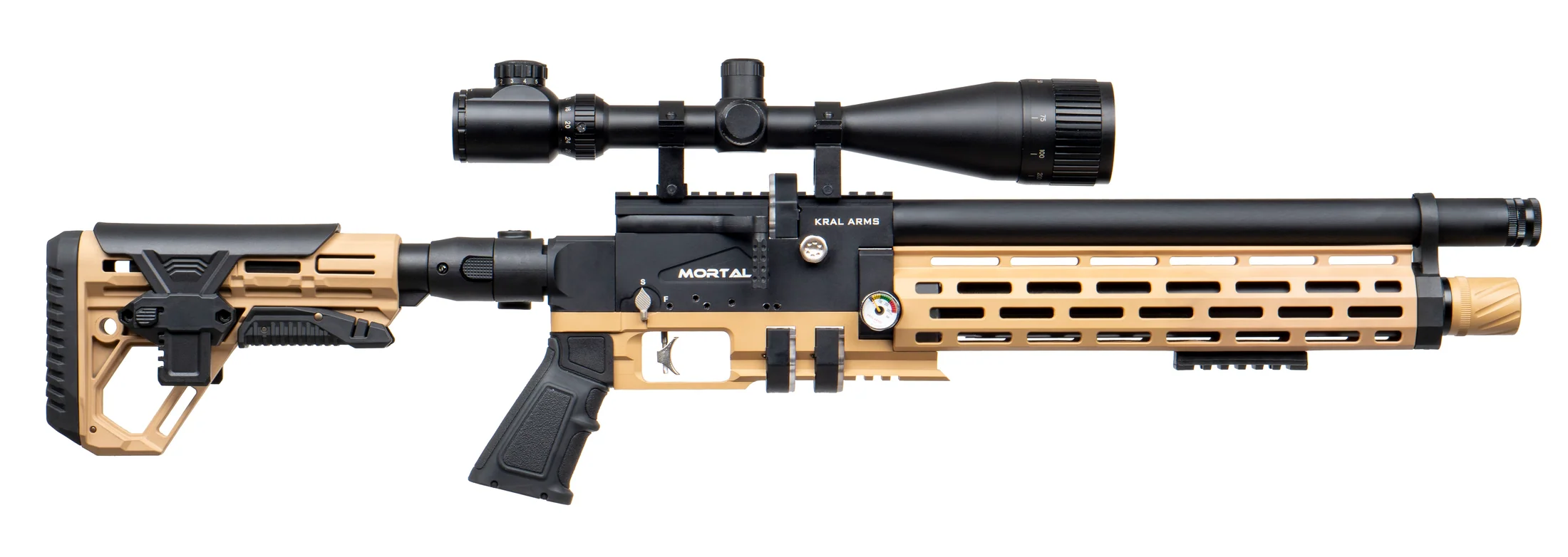
KRAL ARMS MORTAL DESERT – Calibres, FAC Power, Performance, Recommended Scopes and Accessories
Available Calibre Options and Their Characteristics
The KRAL ARMS MORTAL DESERT is offered in several calibre configurations, providing different pellet characteristics, magazine capacities, and manufacturer-rated energy levels. Furthermore, the rifle’s pre-charged pneumatic system provides the operating characteristics associated with compressed-air-powered sporting equipment.
Although the standard model is commonly listed in .177, .22, and .25 calibres, regional availability and power restrictions may vary.
.177 Calibre (4.5 mm) – Target Shooting and Recreational Practice
The .177 calibre version features a smaller pellet diameter and a manufacturer-listed magazine capacity of 14 shots.
Compared with larger calibres, .177 pellets generally have lower individual projectile weights. Consequently, this calibre is widely associated with recreational target shooting and organised sporting disciplines.
For the standard unrestricted configuration, published manufacturer figures indicate approximately 18.3 joules of muzzle energy and a maximum velocity of 850 feet per second.
However, those measurements should be understood as nominal specifications rather than guaranteed results.
Additionally, ammunition selection, environmental conditions, and regional power limitations may influence actual performance.
.22 Calibre (5.5 mm) – Balanced Sporting Characteristics
The .22 version incorporates a larger pellet diameter and a 12-shot rotary magazine.
This calibre is commonly selected by airgun enthusiasts who prefer heavier projectiles than those used in the .177 configuration.
According to published specifications, the standard .22 version is rated at approximately 35 joules, with a listed maximum velocity of 800 feet per second.
Furthermore, its configuration provides a different balance of projectile weight and velocity.
Nevertheless, precise performance depends on the factory configuration, ammunition, and individual rifle condition.
.25 Calibre (6.35 mm) – Larger Projectile Configuration
The .25 version represents the largest of the three commonly advertised calibre options.
Equipped with a 10-shot magazine, this configuration accommodates larger-diameter pellets.
Manufacturer information lists approximately 42.8 joules of muzzle energy and a maximum velocity of 750 feet per second for the standard model.
Moreover, the larger ammunition diameter distinguishes this configuration from the smaller-calibre alternatives.
Before purchasing, prospective owners should confirm that the selected version complies with local regulations and is suitable for their intended sporting discipline.
FAC and Non-FAC Power Configurations
Understanding FAC Classification
FAC stands for Firearm Certificate, a licensing term used in the United Kingdom.
In Great Britain, air rifles exceeding the applicable 12 ft-lb muzzle-energy threshold generally require the appropriate firearm authorisation. Because 12 ft-lb is approximately 16.3 joules, some factory configurations of the Mortal Desert may fall within FAC-controlled categories.
However, legislation and certification requirements differ between England, Wales, Scotland, Northern Ireland, and other countries.
The term non-FAC is commonly used in airgun retail descriptions to distinguish configurations that fall within particular licensing thresholds. It should not be treated as a universal exemption from firearm laws.
Manufacturer-Listed Energy Ratings
| Calibre |
Nominal energy |
Listed maximum velocity |
Magazine capacity |
| .177 (4.5 mm) |
18.3 J |
850 fps |
14 |
| .22 (5.5 mm) |
35 J |
800 fps |
12 |
| .25 (6.35 mm) |
42.8 J |
750 fps |
10 |
These figures reflect published standard-model specifications. Additionally, velocity and energy figures may be determined under different testing conditions and therefore should not be used to calculate a guaranteed result for every pellet.
For safe ownership, the precise factory-rated power and applicable legal classification should be verified before purchase.
13. How should the exterior surfaces be cleaned?
Routine exterior cleaning helps preserve the appearance and condition of the equipment.
Before cleaning, the rifle should be confirmed unloaded and handled according to the manufacturer’s safety procedures.
A clean, soft cloth is generally suitable for removing fingerprints, dust, and light surface contamination.
Meanwhile, manufacturer-approved protective products may be used on appropriate metal components.
Harsh solvents, abrasive materials, and unsuitable household chemicals should be avoided, particularly around synthetic furniture and seals.
Additionally, moisture should not be allowed to accumulate around exposed metal surfaces or mechanical openings.
Any internal maintenance beyond the manufacturer’s routine recommendations should be performed by a qualified technician.
14. How often should the seals be inspected?
Inspection frequency depends on usage, storage conditions, component age, and the manufacturer’s maintenance recommendations.
Seals are important components within compressed-air systems because they help maintain pressure integrity.
Over time, normal ageing or environmental exposure may affect their condition.
Therefore, unusual pressure loss, persistent air leakage, or visible deterioration should receive professional attention.
Importantly, pressure-system repairs should never be attempted while components remain pressurised.
Genuine replacement parts and qualified servicing are recommended whenever sealing components require attention.
15. What should be done if the rifle develops an air leak?
A suspected air leak should be treated as a maintenance issue requiring prompt attention.
Warning signs may include an unexpected decline in indicated reservoir pressure, an audible escaping-air sound, or a visible defect around a fitting.
If any of these symptoms appear, use should be discontinued.
Furthermore, the owner should consult the manufacturer’s authorised service network rather than attempting improvised repairs.
High-pressure pneumatic components can present serious hazards when incorrectly handled.
Professional inspection helps identify the underlying issue and determine whether replacement parts or additional servicing are required.
16. Is the folding-stock mechanism useful for transportation?
The folding-stock arrangement reduces the rifle’s overall physical profile when placed in its folded position.
Consequently, the design may offer practical storage advantages compared with certain fixed-stock configurations.
However, folding the stock does not make the equipment safe to transport without additional precautions.
A suitable protective case should still be used, and transportation must comply with the relevant legal requirements.
Moreover, public transportation, international travel, and vehicle storage may be subject to additional restrictions.
Before travelling, owners should verify applicable rules and ensure that all required documentation is available.
17. What factors influence long-term reliability?
Long-term reliability depends on several interconnected factors, including maintenance quality, environmental exposure, component condition, and adherence to manufacturer instructions.
For instance, unsuitable filling equipment may damage pneumatic components, while excessive moisture may contribute to corrosion.
Similarly, improper storage can affect seals, mechanical parts, and exterior finishes.
Regular professional servicing is therefore valuable, particularly when the equipment is used frequently.
Original replacement components, careful cleaning, and responsible storage can also contribute to preserving its condition.
Nevertheless, no manufacturer can guarantee indefinite operation without inspection, maintenance, or eventual component replacement.
18. Is the synthetic stock resistant to weather exposure?
Synthetic furniture generally provides good resistance to ordinary changes in environmental moisture.
Unlike untreated wood, synthetic materials do not absorb moisture and swell in the same way.
Nevertheless, prolonged exposure to intense sunlight, high temperatures, harsh chemicals, or excessive mechanical stress can still cause deterioration.
Accordingly, appropriate storage remains important.
A dry, secure, temperature-stable location is generally preferable.
After exposure to rain or dusty conditions, the exterior should be inspected and cleaned according to the manufacturer’s instructions.
Furthermore, metal components and pressure-system fittings should receive particular attention during routine condition checks.
19. What should buyers check before purchasing a used example?
A second-hand purchase should be approached with careful attention to condition, authenticity, and legal ownership requirements.
The manufacturer’s identification markings, serial number, and model designation should be verified.
Additionally, visible exterior damage, missing parts, corrosion, and evidence of unauthorised modification should be investigated.
A documented service history can provide useful information about previous maintenance.
Where possible, a qualified technician should inspect the compressed-air system and mechanical components before the transaction is completed.
Buyers should also establish whether the seller is legally authorised to transfer the equipment.
Any uncertainty regarding ownership, licensing, or mechanical integrity should be resolved before purchase.
20. What warranty and after-sales support are available?
Warranty coverage depends on the selling retailer, manufacturer policies, purchase location, and applicable consumer-protection laws.
A new product may be supplied with a manufacturer’s limited warranty covering qualifying defects, although the specific duration and exclusions should be confirmed.
Meanwhile, used equipment may be offered under different conditions.
Buyers should request written information concerning warranty eligibility, returns, servicing, and replacement-part availability.
Proof of purchase should also be retained for future reference.
Ultimately, reliable after-sales support, access to authorised servicing, and transparent product documentation are important considerations when evaluating long-term ownership.benjamin air bow
Why Choose This Tactical Air Rifle? Benefits, Practical Uses, Maintenance and Long-Term Care
1. Why Modern PCP Technology Is Worth Considering
Modern pre-charged pneumatic technology has become an established option among recreational shooting enthusiasts because of its distinctive operating characteristics, mechanical efficiency, and compatibility with contemporary sporting equipment.
Unlike traditional spring-powered designs, compressed-air systems rely on a reservoir of pressurised air rather than a spring-piston mechanism. Consequently, the mechanical vibration associated with spring movement is generally reduced.
Furthermore, this operating principle provides a different shooting experience, particularly in properly supervised recreational environments.
Another important consideration is mechanical consistency. Factory specifications, appropriate maintenance, and properly manufactured components all contribute to dependable operation.
Nevertheless, actual performance varies according to individual equipment condition, configuration, ammunition, and environmental factors.
For these reasons, the technology is often considered by enthusiasts who value contemporary engineering and established sporting equipment designs.
2. Reasons to Appreciate the Adjustable Tactical Design
Ergonomic flexibility is an important characteristic of modern sporting equipment.
An adjustable stock allows certain dimensions to be adapted to the physical proportions and personal comfort preferences of different users.
Additionally, an adjustable cheek piece provides flexibility when different compatible optical systems are fitted.
The butt pad is another practical feature because it helps accommodate individual preferences concerning shoulder contact.
Meanwhile, the folding-stock arrangement creates a more compact physical profile for suitable storage and transportation.
However, every adjustment should be carried out according to the manufacturer’s instructions.
Before use, adjustable components should also be inspected to ensure that locking mechanisms are properly secured and remain in good condition.
Ultimately, ergonomic features can contribute to comfort without removing the need for appropriate instruction and responsible handling.
3. Why Synthetic Construction Is a Practical Advantage
Synthetic furniture offers several benefits for owners who prefer uncomplicated exterior maintenance.
Compared with some traditional wooden stocks, synthetic materials are generally less susceptible to swelling caused by routine changes in humidity.
Consequently, ordinary environmental exposure may have less influence on the dimensions of the exterior furniture.
Furthermore, many synthetic surfaces can be cleaned using a soft cloth and manufacturer-approved cleaning products.
The distinctive desert-coloured finish also provides an appealing alternative to conventional black sporting equipment.
Nevertheless, synthetic construction should not be considered completely resistant to damage.
Extended sunlight exposure, extreme temperatures, abrasive materials, and unsuitable solvents can affect its appearance or structural condition.
Therefore, sensible storage and routine inspection remain essential for preserving the equipment over time.
Practical Uses and Suitable Environments
4. Recreational Shooting at Approved Facilities
One of the principal applications of this equipment is recreational target shooting in an appropriate and legally authorised environment.
Established shooting facilities typically provide designated shooting areas, safety procedures, and supervision arrangements.
Furthermore, organised recreational sessions offer opportunities for participants to become familiar with sporting regulations and responsible equipment handling.
Different facilities may impose restrictions based on projectile type, calibre, muzzle energy, or equipment configuration.
Accordingly, permission should be obtained from the facility operator before participation.
Beginners should also consider professional instruction to develop an understanding of essential safety principles.
Most importantly, recreational shooting must always take place where it is lawful and where appropriate protective measures have been established.
5. Sporting Clubs and Structured Training
Participation in a recognised shooting club can provide access to structured instruction, formal safety rules, and experienced supervisors.
Such environments may also offer educational programmes covering equipment responsibility, legal requirements, and safe handling practices.
Additionally, different sporting organisations establish their own technical eligibility standards.
For example, certain competitions permit only designated equipment categories or restrict allowable energy levels.
Therefore, prospective participants should confirm their equipment’s eligibility directly with the relevant organisation.
Participation in supervised activities can support responsible sporting engagement while encouraging respect for established safety procedures.
How to Care for the Equipment Properly
6. Routine Exterior Cleaning
Regular exterior cleaning helps preserve the condition of metal surfaces, synthetic furniture, and exposed mechanical components.
Before any cleaning activity, the equipment must be verified as unloaded and made safe according to the manufacturer’s instructions.
A soft, lint-free cloth may then be used to remove ordinary dust, fingerprints, and light surface contamination.
For stubborn dirt, cleaning products approved for the relevant materials should be selected.
However, aggressive household detergents, abrasive pads, and unidentified chemical solvents should be avoided.
Furthermore, moisture should not be allowed to accumulate around metal fittings or mechanical openings.
Cleaning should remain limited to the procedures approved in the manufacturer’s documentation.
7. Compressed-Air Reservoir Care
The compressed-air reservoir is a critical component requiring particular attention.
Its pressure rating, filling connections, seals, and associated fittings must remain within the manufacturer’s operating specifications.
Additionally, filling equipment must be compatible with the specified pneumatic system.
A pressure vessel should never be filled beyond its approved maximum pressure.
If unexpected pressure loss, unusual sounds, physical deformation, or visible damage occurs, use should be discontinued immediately.
Because high-pressure components can present serious hazards, suspected defects should be evaluated by an authorised service technician.
Professional maintenance is especially important when replacing seals, inspecting pressure-related components, or investigating persistent leaks.
8. Proper Storage Between Uses
Secure storage protects the equipment from unauthorised access, accidental damage, and unsuitable environmental conditions.
A lockable cabinet designed for sporting firearms or air-powered equipment is generally a suitable option, subject to local legal requirements.
Furthermore, the storage location should remain dry and reasonably stable in temperature.
Excessive humidity may contribute to corrosion, while prolonged heat exposure may damage certain materials.
Protective cases can help prevent scratches during appropriate transportation, although long-term storage in moisture-trapping cases should be avoided.
The equipment should always be unloaded before storage, with ammunition secured separately where required.
Any recommendations concerning reservoir pressure during storage should follow the manufacturer’s instructions.
9. Regular Inspections and Professional Servicing
Routine inspection allows visible deterioration to be identified before it develops into a more serious maintenance concern.
Exterior fasteners, stock components, fittings, and accessible metal surfaces should be checked for damage.
Likewise, unusual mechanical resistance, persistent air leaks, or changes in normal operation should be treated as reasons to stop using the equipment.
Unauthorised internal modifications should be avoided, particularly where trigger components, pressure systems, or safety mechanisms are involved.
Instead, servicing should be performed by a qualified professional familiar with the manufacturer’s design.
Maintaining service records can also help document the condition of the equipment throughout its ownership.
Final Reasons for Responsible Long-Term Ownership
10. Durability, Maintenance and Lasting Value
Long-term ownership value depends on more than appearance or published performance figures.
Durable construction, accessible servicing, suitable replacement components, and responsible maintenance all contribute to the ownership experience.
Furthermore, maintaining original product documentation and proof of purchase may simplify future warranty enquiries.
An informed owner should also understand the legal requirements governing transportation, possession, and use.
Ultimately, this modern sporting platform combines contemporary engineering, ergonomic adjustment, compressed-air technology, and distinctive styling.
With appropriate care, secure storage, professional servicing, and responsible use, its original condition and mechanical integrity can be better preserved for years of recreational ownership.

Reviews
There are no reviews yet.