KRAL Breaker Walnut PCP Air Rifle
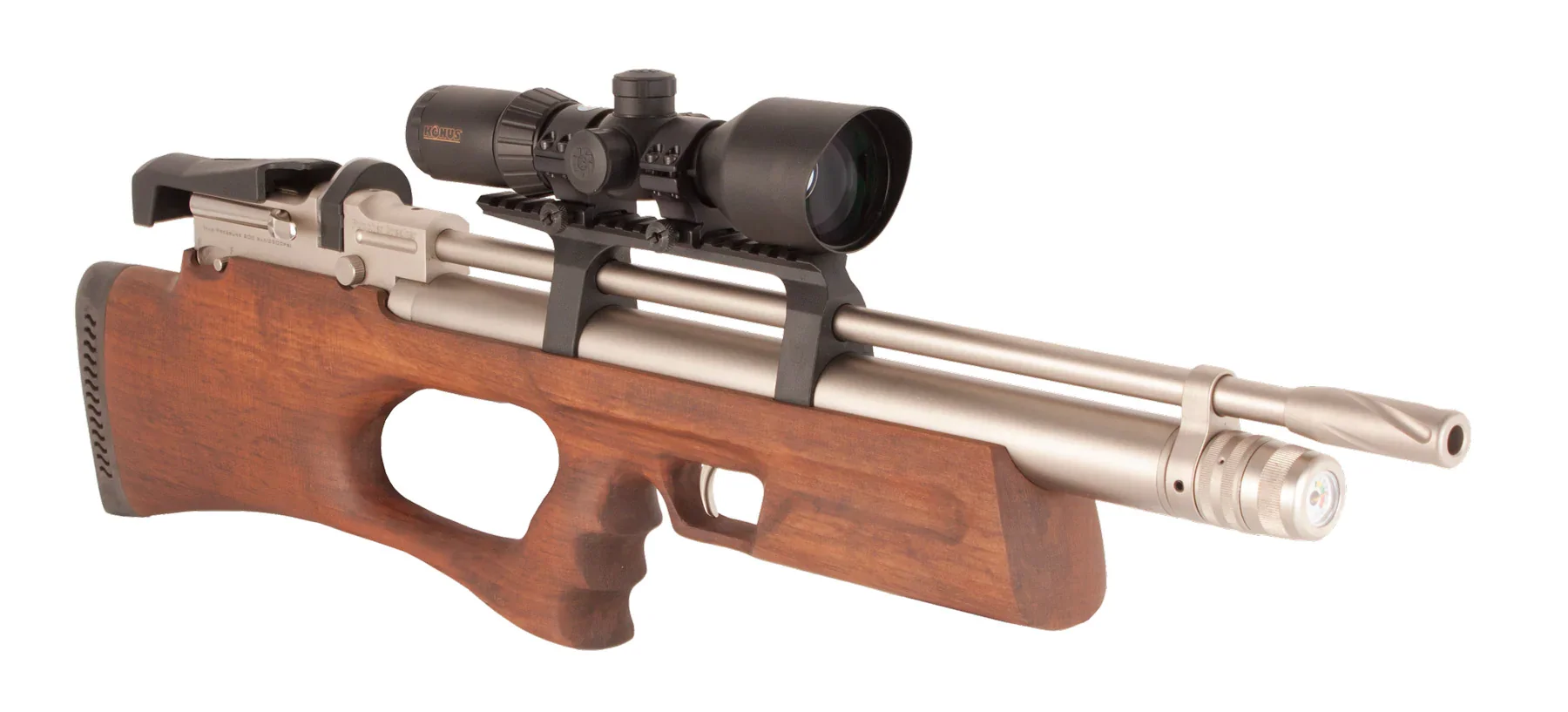
The KRAL Breaker Walnut is a compact pre-charged pneumatic air rifle designed for shooters who value traditional wood furniture, balanced handling, and practical PCP performance. Its bullpup-style configuration keeps the overall length manageable while retaining a full-length barrel system suited to recreational target shooting, range practice, and other lawful sporting applications.
A genuine walnut stock gives the rifle a more traditional appearance than many synthetic PCP platforms. At the same time, the compact action and rear-positioned mechanism help create a rifle that feels relatively short in the hands without sacrificing the core advantages associated with a PCP system.
For users comparing modern bullpup air rifles, the KRAL Breaker Walnut offers a combination of classic styling, multi-shot capability, adjustable features, and straightforward operation.
Traditional Walnut Stock and Compact Bullpup Layout
One of the most recognizable features of the KRAL Breaker Walnut is its wood stock. Walnut provides a natural grain pattern, so individual rifles can vary slightly in appearance. That variation gives each stock a distinctive visual character while maintaining a traditional sporting-rifle aesthetic.
Because the rifle uses a bullpup configuration, much of the action is positioned farther toward the rear. Consequently, the rifle can remain compact while still using a practical barrel length.
This layout may be useful for shooters who prefer:
- A shorter overall rifle profile
- Balanced handling during range sessions
- Traditional walnut furniture
- A modern PCP operating system
- Multi-shot capability
- A platform that can accept an optical sight
- Compact storage compared with many conventional rifle layouts
The stock shape also provides defined grip areas for consistent handling. Depending on the exact market version, minor stock details and finishes may vary.
Pre-Charged Pneumatic Operating System
The KRAL Breaker Walnut operates using a pre-charged pneumatic system, commonly known as PCP.
Rather than relying on a spring or gas ram that is compressed for every shot, compressed air is stored inside the rifle’s air cylinder. When the rifle is operated correctly, a measured amount of stored air is released to propel the pellet.
This operating method generally produces a different shooting feel from spring-powered air rifles. Recoil movement is normally reduced, and the firing cycle can feel smoother because a heavy spring is not moving inside the action.
However, PCP rifles require suitable filling equipment. Owners should always use equipment designed for the rifle’s approved working pressure and follow the manufacturer’s filling instructions.
Common PCP filling equipment can include:
- Approved hand pumps
- Suitable high-pressure compressors
- Certified diving or air cylinders
- Correct fill probes and adapters
- Pressure-rated hoses and fittings
Only equipment compatible with the rifle’s stated pressure specification should be used.
Multi-Shot Magazine System
A multi-shot magazine system is used on the KRAL Breaker Walnut, allowing several pellets to be loaded before the magazine needs to be removed and refilled.
This can make range sessions more convenient because the shooter does not need to manually place a pellet into the breech after every shot.
Magazine capacity can vary depending on calibre and specific production version. For that reason, buyers should confirm the exact capacity listed for the rifle being supplied.
When loading the magazine, pellets should be seated correctly and should match the rifle’s calibre. Damaged, deformed, or incorrectly sized pellets should not be forced into the magazine or breech.
Barrel and Accuracy Considerations
The barrel system is designed for pellet use and should be paired with good-quality ammunition of the correct calibre.
Accuracy with any air rifle depends on several factors. These include pellet design, pellet weight, air pressure, shooter technique, optic setup, environmental conditions, and the mechanical condition of the rifle.
Therefore, the best pellet for one rifle may not always produce the same results in another example of the same model.
Users who want consistent results can test several compatible pellet types at the range and compare grouping performance at controlled distances.
Consistency can also be improved by maintaining:
- Stable shooting technique
- Correct scope installation
- Consistent air pressure
- Clean, undamaged pellets
- Proper rifle maintenance
- A secure and repeatable shooting position
The rifle should always be used within lawful and appropriate shooting environments.
Scope and Optics Compatibility
The KRAL Breaker Walnut is intended to be used with an optical sight rather than relying solely on traditional open sights.
A suitable air-rifle scope can help provide a clearer aiming reference, particularly during structured target shooting.
Before installing a scope, users should verify the exact rail type fitted to their rifle and select compatible mounts.
Scope choice can depend on intended use. Moderate magnification is often sufficient for general range shooting, while higher magnification may be preferred for detailed target work.
Regardless of magnification, the scope should be mounted securely and correctly aligned. Fasteners should be tightened according to manufacturer recommendations without being overtightened.
Trigger and Shooter Controls
The trigger system is positioned in the forward section of the bullpup stock, while the firing mechanism remains farther toward the rear.
This arrangement is typical of bullpup air rifles.
Users should become familiar with the rifle’s controls before loading it. The owner’s manual should be consulted for information about the safety mechanism, cocking procedure, magazine installation, filling procedure, and any available trigger adjustments.
Trigger adjustments should only be performed within the manufacturer’s specified limits.
An excessively light or incorrectly adjusted trigger can create a safety risk.
Calibre Availability
The KRAL Breaker Walnut has been produced in multiple pellet calibres depending on regional market requirements.
Common PCP air-rifle calibres can include variations such as .177, .22, and .25, although exact availability should always be confirmed for the individual rifle being purchased.
Different calibres can provide different characteristics in terms of pellet weight, trajectory, energy, and air consumption.
Local laws may also regulate permitted calibre or muzzle energy.
For that reason, owners should verify the legal requirements that apply in their country, state, province, or region before purchasing or using the rifle.
Air Cylinder and Pressure Monitoring
A PCP rifle depends on compressed air stored under high pressure.
The KRAL Breaker Walnut includes an air reservoir designed specifically for this purpose. Pressure should be monitored using the rifle’s gauge or the manufacturer’s recommended filling equipment.
The rifle should never be filled beyond its approved maximum working pressure.
Likewise, users should avoid dismantling the pressure system unless they are appropriately trained and authorized to do so.
High-pressure pneumatic components can be dangerous when handled incorrectly.
Before servicing the air system, the manufacturer’s instructions should be followed carefully.
Practical Range Use
For recreational target shooting, the compact shape of the KRAL Breaker Walnut can make the rifle comfortable to handle on a bench or supported shooting position.
The bullpup layout also helps keep overall dimensions relatively short.
A typical range setup may include:
- Suitable eye protection
- A securely mounted air-rifle scope
- Correct-calibre pellets
- An approved pellet trap or safe backstop
- Appropriate PCP filling equipment
- A padded rifle case
- Magazine storage
- Cleaning and maintenance accessories
The shooting area should always have a reliable backstop capable of safely stopping pellets.
Maintenance and Care
Regular care helps preserve both the mechanical components and the walnut stock.
The exterior metal surfaces should be kept dry and lightly protected from corrosion according to the manufacturer’s recommendations.
Because walnut is a natural material, prolonged exposure to excessive moisture or heat should be avoided.
After use, the rifle should be stored in a dry, secure location.
Basic care may include:
- Wiping external metal surfaces after handling
- Keeping the stock dry
- Inspecting seals and fittings periodically
- Checking scope mounts
- Inspecting magazines for dirt or damage
- Using only approved lubricants
- Keeping the barrel free from obstructions
Only lubricants suitable for PCP air rifles should be used. Petroleum-based products should never be applied inside high-pressure areas unless specifically approved by the manufacturer.
Responsible Storage and Ownership
The KRAL Breaker Walnut should be treated with the same care and responsibility as any other projectile-firing air rifle.
It should always be stored unloaded and secured against unauthorized access.
Compressed-air systems, magazines, pellets, and filling equipment should also be handled responsibly.
Before ownership or use, local regulations should be checked because airgun laws vary considerably between jurisdictions.
KRAL Breaker Walnut Overview
The KRAL Breaker Walnut combines a traditional wood stock with a modern PCP bullpup platform. Its compact layout, multi-shot magazine system, scope-ready configuration, and compressed-air operation make it suitable for lawful recreational shooting and structured range practice.
Its walnut furniture provides a classic appearance, while the bullpup arrangement helps reduce overall length. At the same time, proper PCP filling procedures, maintenance, safe storage, and compliance with local regulations remain essential.
For buyers comparing compact PCP rifles, the KRAL Breaker Walnut represents a platform that blends traditional styling with contemporary pneumatic air-rifle design.
KRAL Breaker Walnut Calibres, FAC, Power, Recommended Scope and Accessories
The KRAL Breaker Walnut is offered in several calibre configurations, allowing the platform to accommodate different forms of lawful recreational and sporting airgun use. According to KRAL Arms, the Breaker platform is available in .177 (4.5 mm), .22 (5.5 mm), and .25 (6.35 mm). The manufacturer also notes that maximum velocity and power can vary according to regional specifications, pellet characteristics, temperature, elevation, and other operating conditions.
Because airgun power limits and licensing rules differ substantially between countries, buyers should always check the version being supplied rather than assuming that every KRAL Breaker Walnut has identical output.
.177 / 4.5 mm Calibre
The .177 calibre KRAL Breaker Walnut uses the smallest pellet diameter offered for this platform. This calibre is commonly associated with recreational target shooting because pellets are widely available and their comparatively light weight can provide a relatively flat trajectory.
KRAL lists the full-power specification at approximately 900 fps and 20.5 joules, although actual velocity changes according to pellet weight and other factors. The .177 magazine holds 14 pellets, giving it the largest magazine capacity among the three listed calibres. KRAL also lists approximately 98 shots per fill for this configuration under its test conditions.
For users primarily interested in paper targets, informal range practice and precision-oriented recreational shooting, .177 represents a practical option.
.22 / 5.5 mm Calibre
The .22 calibre KRAL Breaker Walnut provides a middle ground between .177 and .25.
According to KRAL’s published specification, the .22 version can be configured at approximately 900 fps and 44 joules in markets where that power level is permitted. It uses a 12-shot magazine, while the manufacturer lists approximately 84 shots from a full 200-bar charge under its specified testing conditions.
Because .22 pellets are heavier than typical .177 pellets, their external-ballistic characteristics are different. Consequently, the trajectory, preferred zeroing distance and scope adjustments may also differ.
Pellet choice should therefore be determined through controlled range testing rather than velocity figures alone.
.25 / 6.35 mm Calibre
For users considering the largest standard calibre available for the Breaker platform, KRAL also manufactures the rifle in .25 / 6.35 mm.
The manufacturer lists approximately 820 fps and 51.5 joules for its higher-output specification. Magazine capacity is 10 pellets, while approximately 70 shots per fill are listed under KRAL’s test conditions.
Since .25 pellets are substantially heavier than many .177 alternatives, shooters should expect different trajectory characteristics and greater air consumption.
Consequently, calibre selection should reflect intended lawful use, local regulations and the availability of suitable ammunition.
FAC and Higher-Power Versions
The term FAC is particularly relevant to jurisdictions such as the United Kingdom, where higher-powered air rifles may require a Firearm Certificate once they exceed the applicable legal threshold.
Therefore, a full-power KRAL Breaker Walnut should not automatically be treated as an unrestricted air rifle simply because the same model may be sold in a lower-powered configuration elsewhere.
KRAL specifically states that maximum velocity can be altered according to regional requirements. This means distributors may offer versions configured differently from the manufacturer’s headline figures.
Before ordering, buyers should confirm:
- The stated muzzle-energy specification
- Whether the rifle is an unrestricted or licensed version
- The calibre being supplied
- Local licensing requirements
- Storage and transportation regulations
- Any restrictions affecting moderators or other accessories
Power should never be altered solely to bypass a jurisdiction’s licensing requirements.
Air Reservoir and Shot Capacity
The standard Breaker platform uses a 280 cc aluminium air cylinder with a maximum listed fill pressure of 200 bar / 3000 psi.
This reservoir supplies the compressed air required by the PCP action.
Approximate manufacturer-listed shot counts are:
- .177: approximately 98 shots
- .22: approximately 84 shots
- .25: approximately 70 shots
These figures should be regarded as reference values rather than guaranteed numbers. Temperature, pellet characteristics, fill pressure and rifle configuration can influence actual results.
Recommended Scope for the KRAL Breaker Walnut
A practical scope choice for the KRAL Breaker Walnut is generally a 3-9×40, 4-12×40, or 4-12×44 airgun-compatible optic.
A 3-9×40 provides a straightforward setup for general target shooting. Meanwhile, 4-12× magnification gives the shooter additional flexibility when smaller targets need to be viewed more clearly at the range.
For users who regularly shoot at relatively short distances, an optic with adjustable objective or side-focus parallax adjustment can be particularly useful.
Recommended scope characteristics include:
- Variable magnification
- Clear multicoated lenses
- Adjustable parallax where available
- Suitable eye relief
- Simple duplex or mildot-style reticle
- Compatible mounting system
- Durable construction suitable for air-rifle use
KRAL lists the Breaker with an 11 mm/22 mm Picatinny-compatible mounting arrangement, allowing appropriate optics and accessories to be fitted.
Useful Accessories for the KRAL Breaker Walnut
A properly selected group of accessories can make routine ownership, storage and range use considerably easier.
Spare Magazine
An additional magazine allows magazines to be prepared before a range session. Capacity depends on calibre: 14 rounds in .177, 12 in .22 and 10 in .25.
PCP Filling Equipment
Because this is a pre-charged pneumatic rifle, suitable high-pressure filling equipment is essential.
Compatible options can include an approved PCP hand pump, certified air cylinder or purpose-designed high-pressure compressor.
All equipment must be rated for the required pressure.
Fill Probe and Replacement Seals
Keeping the correct filling adapter and manufacturer-compatible replacement seals available can simplify routine maintenance.
Only seals designed for the specific rifle should be used.
Rifle Case
A padded or hard protective case helps protect the walnut stock, optic and metal components during lawful transportation and storage.
Quality Pellets
Users should test several correctly sized pellets to determine which performs consistently in their particular rifle. Individual barrels can show preferences for different pellet weights and designs.
Cleaning and Maintenance Equipment
A suitable airgun cleaning kit, lint-free cloth, approved lubricant and basic maintenance tools can help keep the rifle in good condition.
Balanced PCP Configuration
Overall, the KRAL Breaker Walnut provides three primary calibre choices with distinctly different characteristics. The .177 configuration emphasizes economical shooting and high magazine capacity, the .22 provides a versatile middle option, while the .25 represents the heaviest standard calibre offered by KRAL.
Combined with a suitable variable-power scope, spare magazines, proper PCP filling equipment, protective storage and quality pellets, the platform can be configured effectively for lawful sporting and recreational range use. Most importantly, the exact calibre, energy level and FAC status should always be confirmed for the buyer’s jurisdiction before purchase or use.
Frequently Asked Questions
What type of air rifle is this?
This model is a pre-charged pneumatic air rifle, commonly referred to as a PCP. Instead of relying on a spring or gas ram, compressed air is stored inside an onboard reservoir and released in controlled amounts when the rifle is fired. This design generally produces a smooth firing cycle, low mechanical recoil and consistent handling during recreational shooting.
The compact bullpup layout places much of the action toward the rear of the stock, helping reduce overall length while retaining a practical barrel arrangement.
Which calibres are commonly available?
This platform is commonly offered in .177, .22 and .25 calibre versions, although exact availability can vary between countries and distributors.
The .177 version is often selected for paper targets and general range practice. The .22 configuration provides a balance between pellet weight, trajectory and air consumption, while the .25 version uses heavier pellets and typically consumes more air.
Buyers should always confirm the exact calibre supplied before ordering pellets, magazines or other calibre-specific accessories.
Is this rifle suitable for beginners?
It can be suitable for shooters who already understand basic airgun safety and PCP operation.
However, PCP rifles require additional equipment and procedures compared with simple break-barrel air rifles. The user needs to understand how to fill the air reservoir safely, monitor pressure, install magazines correctly and store high-pressure equipment.
New users should read the manufacturer’s manual thoroughly before operating the rifle.
Does it have a wooden stock?
Yes. The stock is made from walnut, giving the rifle a traditional appearance compared with synthetic-stock PCP platforms.
Because walnut is a natural material, variations in grain pattern, tone and figuring can occur from one stock to another. These differences are normal and contribute to the individual appearance of each rifle.
The stock should be kept dry and protected from prolonged exposure to excessive moisture.
What is the advantage of a bullpup design?
A bullpup configuration moves the action and magazine closer to the shooter’s shoulder.
This allows the rifle to remain relatively compact without requiring an unusually short barrel. The result can be easier handling during transportation, storage and range use.
Many shooters also appreciate the central balance created by this arrangement. However, trigger feel and control placement can differ from conventional sporting rifles, so some users may require a short period of adjustment.
Does it use a magazine?
Yes. It is designed around a multi-shot rotary magazine system.
Magazine capacity depends on calibre, with smaller calibres generally holding more pellets than larger calibres.
Having a magazine reduces the need to manually insert a pellet into the breech before every shot, which can make recreational target sessions more convenient.
The magazine should always be loaded with pellets of the correct calibre and should never be forced into the action.
Can spare magazines be purchased?
Spare magazines are commonly available for compatible models, although the correct calibre and generation must be confirmed before purchase.
An additional magazine can be useful during range sessions because several magazines can be prepared in advance.
Owners should avoid assuming that magazines from unrelated models are interchangeable, even when they appear visually similar.
How is the rifle filled with air?
The air reservoir is filled using compatible high-pressure PCP equipment.
Suitable options may include a hand pump, certified compressed-air cylinder or purpose-designed PCP compressor.
The correct fill probe or adapter must be used, and all equipment should be rated for the required working pressure.
The reservoir should never be filled beyond the manufacturer’s stated maximum pressure.
Can a normal household compressor be used?
No. A standard workshop or household air compressor is not suitable.
PCP rifles operate at pressures far above those produced by ordinary tyre or workshop compressors. Only equipment designed specifically for high-pressure breathing air or PCP applications should be used.
Using unsuitable equipment can damage the rifle and may create a serious safety hazard.
Does the rifle have a pressure gauge?
PCP platforms of this type normally include a pressure gauge to help the user monitor the amount of compressed air remaining in the reservoir.
The gauge should be checked before and during filling.
Pressure should never be estimated solely by the number of shots fired because actual air consumption can vary depending on calibre, power configuration and environmental conditions.
How many shots can be expected from one fill?
Shot count depends on calibre, power configuration, air pressure, pellet characteristics and the point at which the user chooses to refill.
Smaller calibres commonly provide more shots per fill because less air may be required for each firing cycle.
Manufacturer figures should therefore be viewed as approximate reference values rather than guaranteed numbers.
Is the rifle recoil-free?
It is better described as having very low recoil rather than being completely recoil-free.
A PCP system does not contain the large moving spring found in a traditional spring-piston rifle, so the firing cycle is generally much smoother.
Some movement can still be felt when the shot is released, particularly in higher-output configurations.
What type of scope works well with it?
A variable-power scope is commonly suitable for recreational target shooting.
Popular configurations include 3-9×40, 4-12×40 and similar magnification ranges.
For shorter-distance shooting, a scope with adjustable parallax can be useful because it allows the image and reticle to be focused more precisely at different distances.
The scope mounts must match the rail fitted to the rifle.
Does it come with open sights?
Some versions may be designed primarily for use with an optical sight rather than traditional iron sights.
Buyers should check the exact specification of the rifle being supplied.
When open sights are not provided, a compatible scope or optic will normally be required before the rifle can be used comfortably for precise target shooting.
Can a red-dot sight be fitted?
A compatible red-dot sight can generally be fitted if suitable mounting hardware is used.
Red dots can be useful for short-range recreational shooting where rapid target acquisition is more important than high magnification.
For precision-oriented target shooting, many users prefer a conventional telescopic sight.
Is the trigger adjustable?
Certain versions include an adjustable trigger system.
Any adjustment should be made only within the manufacturer’s specified limits.
Excessively reducing trigger weight or modifying internal components can compromise safe operation. If the trigger does not operate correctly, the rifle should be inspected by a qualified technician rather than altered experimentally.
What pellets should be used?
Only correctly sized airgun pellets should be used.
The ideal pellet weight and design can vary between individual barrels, so testing several quality pellet types at a controlled range is often the best way to determine which performs most consistently.
Damaged, heavily deformed or incorrectly sized pellets should not be forced into the magazine or breech.
Are pointed pellets more accurate?
Not necessarily.
Pellet shape alone does not determine accuracy. Barrel characteristics, pellet consistency, weight, fit, air pressure and environmental conditions all influence grouping performance.
Domed pellets are frequently used for general target work because they tend to offer good aerodynamic stability, but individual rifles can behave differently.
Is .177 better than .22?
Neither calibre is universally better.
The correct choice depends on intended lawful use.
The .177 version typically uses lighter pellets and can provide a relatively flat trajectory. The .22 version uses heavier pellets and behaves differently in terms of trajectory and air consumption.
For structured target shooting, either calibre can perform well when matched with suitable ammunition.
What is the difference between .22 and .25?
The main difference is pellet diameter and weight.
A .25 pellet is larger and generally heavier than a .22 pellet. Consequently, it usually requires more compressed air and may produce fewer shots per fill.
Trajectory characteristics also differ, so scope adjustments and preferred zero distances may not be identical.
What does FAC mean?
FAC usually refers to a Firearm Certificate in jurisdictions such as the United Kingdom.
Higher-powered air rifles may require licensing once they exceed the legal energy threshold applicable in that jurisdiction.
The same rifle can be sold in different power configurations depending on the country.
Users should always check local law before purchasing, transporting or using any higher-output air rifle.
Brocock BRK and Benjamin Air Rifles: Complete Guide to PCP Technology, Precision, Calibres and Accessories
Discover the Engineering Behind Brocock Airguns and Benjamin Air Rifles
Modern airgun technology has transformed recreational target shooting, competitive marksmanship, and precision air-powered sporting equipment. Today, manufacturers combine advanced pneumatic systems, ergonomic construction, and innovative engineering to produce dependable shooting platforms. Among the established names in this industry, brocock ltd and Benjamin continue to attract attention from enthusiasts seeking technical sophistication and reliable performance.
The evolution of brocock airguns reflects a strong emphasis on compact designs, efficient compressed-air systems, and consistent shot delivery. Similarly, the Benjamin product range offers numerous configurations, from traditional pellet rifles to specialized pneumatic platforms.
Whether researching a compressed air rifle, comparing a conventional pellet gun, or exploring advanced sporting equipment, understanding the available technologies helps buyers make informed decisions.
Brocock BRK Air Rifles: Innovation and Precision Engineering
Brocock Sniper XR and BRK Sniper XR
The brocock sniper xr represents an important development in regulated pneumatic rifle engineering. Featuring a semi-bullpup configuration, adjustable ergonomics, and a sidelever operating system, this model emphasizes handling convenience and mechanical consistency.
Additionally, the brk sniper xr incorporates a regulated air-delivery system designed to reduce variations between successive shots. Its adjustable stock components provide flexibility for different shooting positions.
For enthusiasts researching the .25 caliber brocock sniper xr, calibre selection deserves particular attention. The larger pellet diameter offers different projectile characteristics compared with smaller calibres, while energy output and shot capacity depend on the specific configuration.
The sniper xr also offers an example of how modern engineering combines compact dimensions with adjustable controls.
Brocock Commander XR and BRK Commander
Another noteworthy platform is the brocock commander xr, which combines a tactical-inspired stock configuration with pneumatic engineering.
The brocock commander has attracted interest from enthusiasts who appreciate adjustable furniture, modular features, and consistent operation.
Similarly, buyers researching brk ghost and Commander models often compare ergonomics, overall dimensions, available calibres, and compatible accessories.
Searches for brocock commander xr price should be evaluated using current retailer listings because pricing varies according to country, configuration, condition, and included equipment.
BRK Ghost Air Rifle: Modern Design and Customization
The brk ghost air rifle represents a distinctive approach to modern PCP rifle design. Its bullpup layout places major operating components within a compact overall configuration while retaining a full-length barrel arrangement appropriate to the model.
Furthermore, the BRK Ghost offers adjustable ergonomic components and a mechanical design intended to support controlled operation.
Owners researching ghost accessories should pay attention to manufacturer compatibility, factory specifications, and approved replacement components.
A replacement ghost handle, for example, should be checked against the exact model and production variant before purchase.
Likewise, a magpul sl k buttpad is a product-specific accessory reference rather than a guarantee of compatibility with every rifle stock.
Pathfinder XR and Compact BRK Models
The pathfinder xr offers another example of the manufacturer’s emphasis on compact pneumatic platforms.
Buyers researching the brk pathfinder, brk pathfinder xr, or general pathfinder air rifle specifications should compare verified product dimensions, stock arrangements, and applicable power ratings.
The brk concept xr is another model worth examining when comparing compact sporting rifles.
While these designs share elements of the manufacturer’s engineering philosophy, each has its own configuration and intended handling characteristics.
For anyone comparing several platforms, factors such as overall weight, trigger characteristics, stock adjustment, and service support are more useful than appearance alone.
What Are PCP Air Rifles and How Do They Work?
New enthusiasts frequently ask, what are pcp air rifles?
The abbreviation PCP means precharged pneumatic, referring to an air-powered system that stores compressed air in a pressurized cylinder or reservoir.
Consequently, understanding pcp rifle meaning helps explain the operating principles behind modern pneumatic sporting rifles.
Other common searches include what does pcp mean in air rifles, what is pcp air rifle, what is a pcp air rifle, and what is a pre charged pneumatic air rifle.
All describe the same general operating technology.
Likewise, what is a pcp air gun and pcp air rifle meaning refer to compressed-air propulsion rather than spring-powered or carbon-dioxide systems.
A pcp rifle stores energy before firing, whereas a break barrel pellet gun typically compresses a spring or gas ram through a cocking action.
This distinction also explains why a pneumatic gun, gun pneumatic, and pneumatic weapons may refer to several different mechanisms, depending on the context.
Modern pcp air rifles often feature pressure regulators, adjustable triggers, and specialized magazines. Nevertheless, operating pressure, energy output, and maintenance requirements vary substantially between models.
Essential Accessories and Equipment Compatibility
Properly selected accessories contribute to equipment suitability and long-term maintenance.
For example, the 0db moderator and 0 db moderator are search variations referring to a sound-moderating accessory. Actual sound reduction depends on the individual device, rifle configuration, and applicable legal requirements.
Meanwhile, a pcp o ring kit may contain replacement seals for specified components. Seal dimensions, materials, and pressure ratings must match the manufacturer’s requirements.
Optics are another consideration. A buyer researching how to connect scope equipment should first confirm the mounting-rail standard and the compatibility of the selected mounting system.
The mtc copperhead 4 16×44 is one example of an optical sight that may appear in airgun accessory searches.
Separately, what does prc stand for in guns is a terminology question commonly encountered during broader firearm research. PRC often refers to Precision Rifle Cartridge, which is distinct from PCP pneumatic technology.
Some searches also include bro air, a broad term that may appear alongside BRK and Brocock product research without identifying a specific manufacturer model.
Benjamin Air Rifles: Traditional Performance and Modern Pneumatic Technology
Benjamin Marauder and Popular PCP Models
The benjamin air rifle range encompasses numerous designs developed for different shooting preferences. From conventional air pellet gun platforms to specialized pneumatic systems, the manufacturer offers equipment for recreational and sporting applications.
Among its recognized products, the benjamin marauder has established a strong presence in PCP airgun discussions.
The benjamin marauder pcp and benjamin marauder pcp air rifle are associated with regulated or unregulated configurations, depending on model and generation. Similarly, the benjamin marauder air rifle is frequently considered by enthusiasts researching accurate pneumatic equipment.
Buyers comparing the benjamin marauder .25, benjamin marauder 22, and benjamin marauder regulated variants should verify the exact specifications rather than assume identical performance.
The benjamin marauder pistol provides another distinct option for enthusiasts interested in compact air-powered platforms.
Additionally, searches for benjamin pellet, benjamin pellet gun, and benjamin air pistol reflect the manufacturer’s broader presence in the sporting airgun market.
For owners of older equipment, benjamin air rifle repair should involve model identification, manufacturer-approved parts, and qualified servicing of pressurized components.
Benjamin Bulldog and Big-Bore Airguns
The benjamin bulldog is associated with the development of larger-calibre PCP platforms.
In particular, the benjamin bulldog 457 belongs to the big-bore category, while the bulldog 357 represents another calibre designation within the family.
Those researching benjamin bulldog 457 20 joules should distinguish search terminology from verified factory specifications, since this phrase does not establish an official 20-joule configuration.
More broadly, big bore air guns differ from conventional small-calibre pellet rifles in projectile dimensions, pressure-system requirements, and applicable regulations.
A hunting air rifle or hunting pellet gun must also be evaluated according to local laws, permitted activities, and the manufacturer’s intended application.
Benjamin Trail, Prowler and Break-Barrel Models
Traditional spring and gas-piston airguns remain popular alongside pneumatic equipment.
The benjamin prowler and benjamin trail np are examples associated with conventional sporting air-rifle designs.
Likewise, the benjamin np trail xl and benjamin air rifle 22 break barrel appear frequently in searches involving gas-piston technology.
The phrase benjamin break may also describe general interest in the manufacturer’s break-barrel products.
Enthusiasts comparing a benjamin 22 caliber pellet rifle with PCP alternatives should consider the differences in cocking mechanism, maintenance, recoil behavior, and operating requirements.
Benjamin Airbow Technology and Arrow-Launching Systems
The benjamin airbow belongs to a specialized category that uses compressed air to propel compatible arrows rather than conventional pellets.
Also called an air bow, airbow, arrow gun, air bow rifle, or air bow gun, this equipment differs substantially from standard pellet platforms.
The benjamin pioneer airbow helped establish the manufacturer’s presence in this category.
More recent searches for benjamin airbow m600, benjamin m600 airbow, and the general benjamin bow category reflect interest in advanced arrow-launching technology.
An airbow rifle may also be compared with an air powered crossbow, although their propulsion mechanisms and equipment requirements are different.
The M600 is a distinct PCP-powered arrow launcher with manufacturer-specific arrows and components.
Understanding Pellet Gun Calibres and Power Ratings
Airgun buyers frequently compare .177 pellet guns, 177 pellet guns, a 22 pellet gun, and a .25 pcp air rifle.
Each calibre has its own projectile characteristics, compatible ammunition, and model-specific performance limits.
Similarly, searches for a high powered pellet gun, high power pellet gun, or pellet rifle 1500 fps should be assessed carefully. Advertised velocity alone does not establish accuracy, suitability, or energy output.
A bolt action pellet gun describes a particular loading or cycling arrangement rather than a specific power system.
Other familiar categories include the bb gun rifle, air gun rifle, airrifle, and the broader grouping of air rifle and air pistol equipment.
In comparison, co2 pellet guns use carbon dioxide cartridges, while PCP platforms rely on stored high-pressure air.
The search term m357 may refer to different products and requires model confirmation before any technical comparison.
Choosing the Right Airgun and Understanding Online Availability
Buyers asking can i buy air rifles online should first investigate local restrictions, age requirements, licensing obligations, and shipping regulations.
Rules vary significantly by jurisdiction, especially for higher-powered equipment and specialized arrow-launching platforms.
Whether comparing benjamin air rifles or modern BRK sporting platforms, reliable model specifications, lawful ownership, and qualified maintenance remain essential considerations.
The Brocock product family includes established Sniper XR, Commander XR, Pathfinder XR, Concept XR, and Ghost designs, while the manufacturer’s newer range includes updated XR2 variants.
Ultimately, selecting appropriate air-powered sporting equipment involves balancing ergonomics, engineering quality, compatible accessories, and long-term support. Understanding the distinctions between compressed-air systems, gas-piston mechanisms, and specialized arrow platforms makes product comparisons clearer and more informative.
A well-informed buying decision begins with accurate technical information, clearly identified models, and responsible equipment ownership.
Can the power be increased?
Power should not be modified outside manufacturer specifications or in a manner that violates local legislation.
Changing internal components or altering regulator, valve or hammer settings can affect reliability, safety, accuracy and legal classification.
Any servicing or authorized adjustment should be carried out by a competent technician.
Is this model suitable for target shooting?
Yes, it can be used for lawful recreational and structured target shooting.
The combination of a PCP action, multi-shot magazine, compact dimensions and scope compatibility makes it practical for controlled range use.
Accuracy will still depend heavily on pellet selection, scope setup and shooter technique.
How should it be stored?
It should be stored unloaded in a dry, secure location that prevents unauthorized access.
A padded case or locked cabinet can help protect both the rifle and its optic.
Pellets, magazines and high-pressure filling equipment should also be stored responsibly.
Local regulations concerning secure storage should always be followed.
Should the rifle be stored with air inside the cylinder?
Many PCP manufacturers recommend leaving some pressure in the air system rather than storing the rifle completely empty, because pressure can help keep seals seated properly.
However, the owner’s manual should always be followed because recommendations can vary between models.
The rifle should never be stored overfilled.
How often should the rifle be cleaned?
PCP air rifles usually require relatively modest routine cleaning.
External metal surfaces should be wiped after handling, especially in humid environments.
The barrel should not be aggressively cleaned after every shooting session unless there is a specific reason.
Excessive cleaning can sometimes cause more problems than it solves.
What lubricant should be used?
Only lubricants specifically approved for PCP airgun systems should be used.
High-pressure air systems require suitable materials, particularly around seals and filling components.
Ordinary petroleum oils should not be placed inside high-pressure areas unless the manufacturer explicitly states that they are safe.
Can the walnut stock be oiled?
A suitable wood-care product may be used if it is compatible with the stock’s existing finish.
The stock should first be wiped clean and allowed to dry.
Heavy application of oil should be avoided because excessive product can darken the wood, soften some finishes or collect dirt.
What should be done if air is leaking?
If a noticeable leak develops, the rifle should be removed from use until the cause is identified.
Possible causes can include damaged O-rings, loose fittings or worn seals.
Owners should not dismantle pressurized components unless trained and authorized to do so.
A qualified PCP technician is the safest option when the source of a leak is unclear.
Is a moderator compatible?
Compatibility depends on the exact barrel and muzzle configuration supplied in the user’s market.
Where moderators are legally permitted, only compatible equipment should be fitted.
Because sound moderators can be regulated separately in some jurisdictions, local law should be checked before purchasing or installing one.
What accessories are most useful?
Commonly useful accessories include a suitable scope, compatible mounts, spare magazines, a padded rifle case, approved filling equipment, replacement seals and quality pellets.
A secure pellet trap and appropriate eye protection are also important for controlled range use.
Accessories should be selected for compatibility rather than appearance alone.
Can the rifle be transported in a normal bag?
A dedicated padded or hard rifle case is generally preferable.
It provides greater protection for the stock, optic and metal components and helps prevent accidental damage.
Local transport laws may also impose specific requirements regarding cases, unloaded condition, ammunition separation or secure storage.
Is this model suitable for left-handed shooters?
Some users may find the compact stock relatively manageable from either shoulder, but the position of the cocking mechanism, safety and magazine can influence left-handed comfort.
Left-handed buyers should inspect the control layout before purchasing if possible.
Why does accuracy change as the air pressure drops?
PCP rifles rely on stored compressed air.
As reservoir pressure changes, the amount and consistency of air released during each shot can also change.
Some rifles maintain a very consistent velocity over a broad pressure range, while others have a narrower optimal operating window.
Refilling before pressure drops excessively can help maintain predictable performance.
Does temperature affect performance?
Yes.
Temperature can influence air pressure, seals, lubrication and pellet performance.
Large temperature changes may therefore produce slight differences in velocity or point of impact.
The rifle should also be allowed to acclimatize when moving between very different indoor and outdoor temperatures.
Is professional servicing necessary?
Routine external care can usually be performed by the owner, but internal high-pressure repairs are better handled by a qualified technician.
Professional servicing is particularly important when dealing with air leaks, valve problems, damaged pressure components or trigger faults.
Periodic inspection can help maintain safe and reliable operation.
What makes this type of rifle practical for recreational use?
Its main strengths are the compact layout, smooth PCP firing cycle, multi-shot capability and compatibility with optical sights.
The walnut stock also gives the rifle a more traditional appearance than many modern bullpup platforms.
For responsible users who understand PCP maintenance and high-pressure filling procedures, it provides a versatile platform for lawful recreational target shooting and range practice.

Reviews
There are no reviews yet.