KRAL KNIGHT SYNTHETIC – PCP Air Rifle | Technical Features, Adjustable Design & Performance Overview
KRAL KNIGHT SYNTHETIC – Product Description
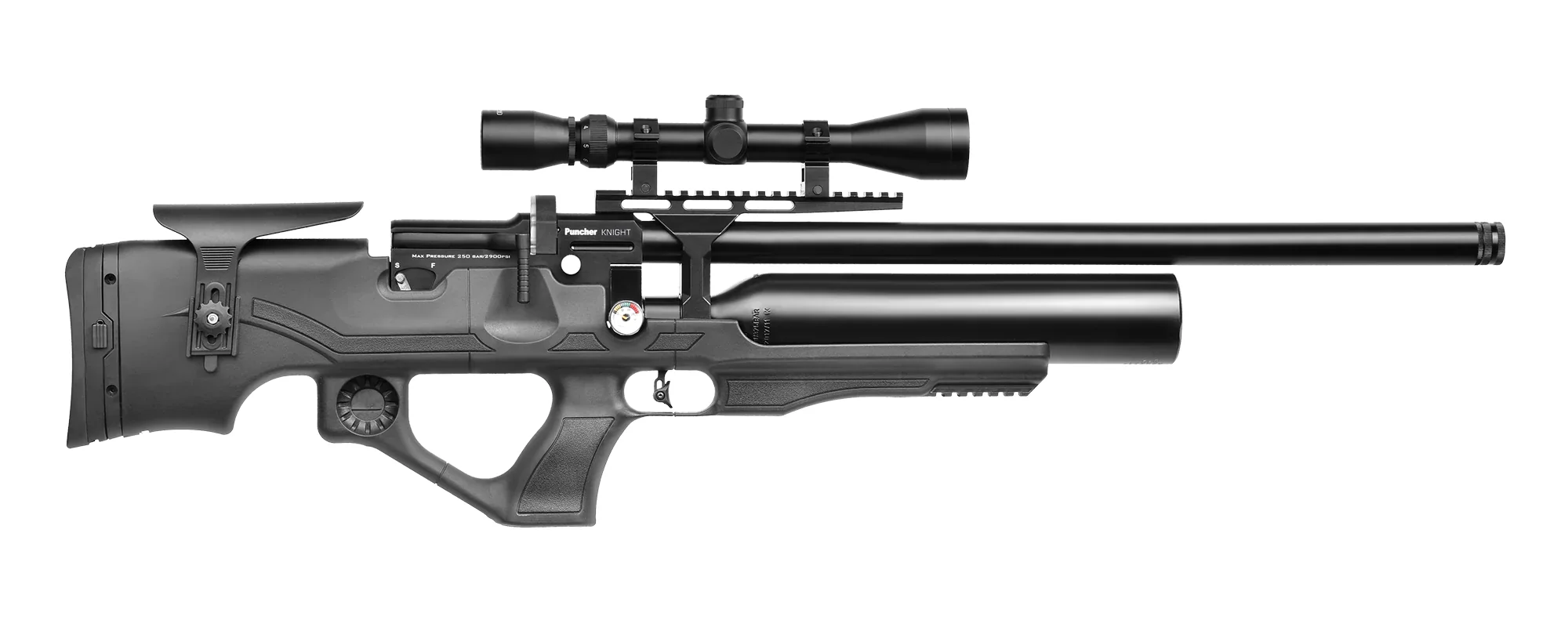
The KRAL KNIGHT SYNTHETIC is a pre-charged pneumatic (PCP) air rifle manufactured by Kral Arms, a Turkish manufacturer known for its range of airguns and sporting equipment. Engineered around an adjustable synthetic-stock configuration, this model combines a compact bullpup-style layout with a large-capacity compressed-air reservoir, side-lever operation, and a rifled barrel.
Unlike traditional spring-powered air rifles, the KRAL KNIGHT SYNTHETIC operates using compressed air stored in an onboard reservoir. Consequently, its firing system does not rely on the same spring-and-piston movement associated with conventional spring airguns. Nevertheless, consistent results still depend on ammunition characteristics, air pressure, maintenance, and environmental conditions.
Furthermore, the model incorporates ergonomic adjustments intended to accommodate different adult users. Its adjustable cheekpiece, repositionable buttpad, and customizable trigger components contribute to a configurable shooting platform.
The manufacturer identifies the synthetic version as the Knight S, distinguishing it from the walnut-stock Knight W and other finishes available within the product family.
Key Features of the KRAL KNIGHT SYNTHETIC
-
PCP operating system: Pre-charged pneumatic mechanism using compressed air.
-
Synthetic stock: Durable polymer-based furniture with an adjustable configuration.
-
Side-lever action: Mechanical cocking system with a detachable rotary magazine.
-
500cc air reservoir: Manufacturer-rated maximum filling pressure of 250 bar.
-
Available calibres: .177 (4.5mm), .22 (5.5mm), and .25 (6.35mm).
-
Rifled barrel: Kral-manufactured choked barrel with an integrated shroud.
-
Adjustable cheekpiece: Repositionable support for different facial dimensions.
-
Adjustable buttpad: Five vertical positions and approximately 20mm of fore-and-aft movement.
-
Trigger adjustments: Adjustable pull weight and multidirectional trigger-shoe positioning.
-
Optics mounting: 22mm Picatinny rail system.
-
Manual safety: Incorporated into the rifle’s operating controls.
-
Synthetic-model weight: Approximately 3.7kg, according to manufacturer specifications.
Advanced PCP Air Rifle Engineering
Pre-Charged Pneumatic Technology
A compressed-air system powers the KRAL KNIGHT SYNTHETIC. Before operation, the onboard air reservoir must be charged using compatible, manufacturer-approved filling equipment.
Unlike a break-barrel spring rifle, a PCP system stores its operating energy separately from the cocking mechanism. Therefore, the side lever controls the mechanical loading sequence while the reservoir supplies the compressed air.
In addition, the rifle’s 500cc aluminum air cylinder provides relatively substantial onboard storage capacity. Its maximum manufacturer-specified filling pressure is 250 bar, equivalent to approximately 3,600 psi.
However, filling limits must always be respected. Approved equipment, routine inspections, and adherence to the manufacturer’s operating manual are essential for safe ownership.
Rifled Barrel Construction
The rifle features a Kral-manufactured rifled barrel with a choked muzzle design. Internal rifling imparts rotational movement to a compatible pellet as it travels through the barrel.
Additionally, the factory barrel shroud surrounds the barrel assembly. The manufacturer also specifies a threaded muzzle interface, although compatible attachments and their legality depend on the market.
Importantly, mechanical specifications should not be confused with guaranteed accuracy. Actual grouping performance varies according to pellet consistency, environmental factors, mechanical condition, and the individual rifle.
Adjustable Synthetic Stock
The synthetic-stock configuration provides an alternative to traditional wooden furniture. Unlike natural walnut, synthetic materials do not feature wood grain and generally require different surface-care procedures.
Furthermore, the rifle incorporates a vertically adjustable cheekpiece. This component allows the position of the cheek support to be changed to accommodate different facial proportions and sighting arrangements.
Meanwhile, its adjustable buttpad provides additional flexibility. According to Kral Arms, the pad offers five vertical adjustment stages alongside approximately 20mm of forward-and-backward movement.
As a result, the rifle provides several fitting options without requiring a different factory stock.
KRAL KNIGHT SYNTHETIC Specifications and Performance
Manufacturer-Listed Technical Specifications
| Specification |
Details |
| Manufacturer |
Kral Arms |
| Model |
Knight S / Knight Synthetic |
| Operating system |
Pre-charged pneumatic (PCP) |
| Action |
Side lever |
| Stock material |
Synthetic |
| Available calibres |
.177, .22, .25 |
| Maximum fill pressure |
250 bar / 3,600 psi |
| Air reservoir |
500cc |
| Barrel type |
Rifled, choked, shrouded |
| Overall length |
87.5cm |
| Barrel length |
58cm |
| Approximate weight |
3.7kg |
| Optics interface |
22mm Picatinny |
| Safety |
Manual |
| Trigger |
Adjustable |
Specifications are based on Kral Arms’ published Knight S catalogue information. Regional versions and production batches may differ.
Calibre Options and Factory Performance Ratings
Three calibre configurations are listed for the KRAL KNIGHT SYNTHETIC. However, output ratings depend on the factory configuration and the regulations applicable to the destination market.
| Calibre |
Published velocity |
Published energy |
Magazine capacity |
| .177 / 4.5mm |
900 FPS |
21 joules |
14 pellets |
| .22 / 5.5mm |
900 FPS |
44 joules |
12 pellets |
| .25 / 6.35mm |
820 FPS |
52 joules |
10 pellets |
These figures represent manufacturer-published performance ratings rather than guaranteed results for every rifle. Furthermore, actual muzzle velocity can vary with pellet weight, temperature, air pressure, and the particular market specification.
Ergonomics, Handling and Mechanical Configuration
Side-Lever Operation and Magazine Design
A side-lever mechanism distinguishes this model from conventional break-barrel designs. The rifle also incorporates a removable rotary magazine matched to its factory calibre.
The magazine capacity changes according to pellet dimensions, with the largest listed capacity associated with the .177 configuration.
Additionally, the manual safety forms part of the operating system. However, no mechanical safety device replaces established airgun handling precautions.
Adjustable Trigger Components
Kral Arms specifies an adjustable trigger mechanism for the Knight series. The trigger shoe offers positional adjustment, while the trigger assembly includes a manufacturer-defined pull-weight adjustment feature.
These characteristics allow individual fitting preferences to be accommodated. Nevertheless, unauthorized alterations to the trigger mechanism can compromise safe operation. Any servicing should therefore follow official manufacturer guidance or be performed by a qualified technician.
Maintenance and Long-Term Ownership Considerations
Routine External Care
Correct maintenance contributes to the service life of any compressed-air rifle. Consequently, several considerations are relevant to the KRAL KNIGHT SYNTHETIC.
External surfaces should be examined periodically for deterioration, loose components, or signs of damage. Meanwhile, the synthetic stock can generally be cleaned using appropriate nonabrasive materials.
The reservoir, pressure gauge, and filling connections also require attention in accordance with the manufacturer’s maintenance schedule.
Furthermore, incompatible lubricants and unsuitable cleaning chemicals should be avoided, particularly around seals and pressurized components.
Storage and Safe Handling
When not in use, the rifle should be stored securely and away from unauthorized individuals. Ammunition should also be stored separately.
Equally important, applicable local legislation must be checked before ownership, transportation, or use. Licensing requirements and permitted muzzle-energy limits vary significantly between jurisdictions.
KRAL KNIGHT SYNTHETIC – Overall Product Assessment
The KRAL KNIGHT SYNTHETIC PCP air rifle combines several identifiable characteristics within one factory configuration: a synthetic adjustable stock, side-lever action, rifled barrel, substantial compressed-air reservoir, and detachable magazine system.
Its defining engineering features include the 500cc aluminum air cylinder, configurable stock components, and availability in multiple calibres. Additionally, the model’s specifications demonstrate how modern PCP technology differs mechanically from spring-powered airguns.
Nevertheless, buyers evaluating the rifle should distinguish published performance ratings from independently measured results. Accuracy, reliability, and operating characteristics require assessment under controlled conditions, while regional product specifications should be confirmed against the individual rifle supplied.
Ultimately, the KRAL KNIGHT SYNTHETIC represents a feature-rich example of Kral Arms’ PCP airgun engineering, with particular emphasis on adjustability, compressed-air operation, and synthetic-stock construction.
KRAL KNIGHT SYNTHETIC – Calibres, FAC Power, Recommended Scopes and Essential Accessories
KRAL KNIGHT SYNTHETIC Calibre Options and Performance
The KRAL KNIGHT SYNTHETIC PCP air rifle is manufactured in three primary calibres: .177 (4.5mm), .22 (5.5mm), and .25 (6.35mm). Each configuration features distinct projectile dimensions, magazine capacities, and factory-published performance characteristics.
Furthermore, the Knight platform incorporates an interchangeable-calibre design, although calibre conversion should only be undertaken by appropriately qualified personnel using manufacturer-approved components.
.177 Calibre (4.5mm) – Target Shooting and Precision Sports
The .177 configuration uses smaller-diameter pellets and is widely associated with recreational target shooting and organized airgun disciplines.
According to Kral Arms’ published specifications, this version has a maximum listed velocity of approximately 900 FPS and a nominal muzzle energy of 21 joules.
Additionally, the .177 magazine accommodates 14 pellets, providing the largest magazine capacity among the three listed configurations.
Its characteristics include:
-
4.5mm pellet compatibility.
-
Manufacturer-listed 900 FPS velocity.
-
Published 21-joule muzzle energy.
-
14-round removable magazine.
-
Compatibility with suitably rated airgun target equipment.
.22 Calibre (5.5mm) – A Popular General-Purpose Airgun Calibre
The .22 configuration represents another established calibre within recreational airgun shooting.
Compared with .177, its projectiles have a larger diameter and are commonly available in a wide selection of designs and weights.
Moreover, the manufacturer lists a maximum velocity of approximately 900 FPS and an energy rating of 44 joules for the applicable full-power specification.
Its principal characteristics include a 12-round magazine, 5.5mm rifled barrel, and compatibility with appropriately specified .22 airgun pellets.
.25 Calibre (6.35mm) – Larger-Diameter Pellet Configuration
The .25 version offers the largest factory-listed pellet diameter within the standard Knight S range.
In addition, Kral Arms publishes a nominal velocity of 820 FPS and a muzzle-energy rating of 52 joules for this configuration.
The detachable magazine accommodates 10 pellets. However, its actual ballistic characteristics depend on the ammunition and factory specification.
Calibre Comparison Table
| Calibre |
Velocity |
Muzzle energy |
Magazine |
| .177 / 4.5mm |
900 FPS |
21 J |
14 shots |
| .22 / 5.5mm |
900 FPS |
44 J |
12 shots |
| .25 / 6.35mm |
820 FPS |
52 J |
10 shots |
Figures are manufacturer-published ratings, not guaranteed performance measurements.
KRAL KNIGHT SYNTHETIC FAC and Power Specifications
Understanding FAC Air Rifle Classification
FAC stands for Firearm Certificate, a licensing designation commonly encountered in the United Kingdom.
In England and Wales, an air rifle generally requires an FAC when its muzzle energy exceeds 12 foot-pounds, approximately 16.3 joules. Different legal provisions apply in Scotland and Northern Ireland.
Therefore, a rifle described as FAC-rated may require additional licensing and ownership authorization depending on its location.
The higher-output configurations listed in the manufacturer’s catalogue exceed the conventional 12 ft-lb threshold. Nevertheless, regional models may be supplied with different factory power ratings.
Power System and Air Reservoir
The Knight Synthetic incorporates a 500cc aluminum compressed-air reservoir with a manufacturer-specified maximum filling pressure of 250 bar.
Unlike traditional spring-powered systems, its pneumatic mechanism derives operating energy from stored compressed air.
Consequently, air quality, seal condition, reservoir pressure, and factory calibration all contribute to operating consistency.
Importantly, maximum reservoir pressure should never be exceeded, and power specifications should be verified against the individual rifle’s documentation.
Recommended Scopes for the KRAL KNIGHT SYNTHETIC
Choosing a Compatible Rifle Scope
The KRAL KNIGHT SYNTHETIC features a 22mm Picatinny mounting rail, allowing the installation of suitably compatible optical sights.
However, the manufacturer lists the scope as an optional accessory rather than standard equipment. Therefore, the contents of individual retail packages should always be confirmed.
Several optical configurations are commonly considered for recreational airgun activities:
-
3–9×40 scope: A conventional variable-magnification option for general recreational target shooting.
-
4–12×40 scope: Offers additional magnification flexibility for supervised sporting-range activities.
-
4–16×44 scope: Provides a broader magnification range for precision target disciplines.
-
Fixed-magnification scope: Offers uncomplicated optical operation with fewer adjustments.
Important Optical Features
When evaluating a compatible riflescope, attention should be given to optical clarity, eye relief, reticle visibility, weather resistance, and manufacturer warranty coverage.
Furthermore, adjustable parallax can be useful for airgun target disciplines where distances vary.
Suitable Picatinny-compatible mounts are essential, although exact ring dimensions depend on the selected optic.
Recommended Accessories for the KRAL KNIGHT SYNTHETIC
Essential PCP Airgun Equipment
Several accessories contribute to responsible ownership, safe storage, and routine maintenance.
Recommended accessory checklist:
-
Approved PCP filling equipment: Equipment specifically rated for the rifle’s compressed-air requirements.
-
Compatible fill connector: A manufacturer-approved fitting matching the rifle’s filling interface.
-
Airgun pellets: Correctly sized ammunition for the factory-marked calibre.
-
Protective rifle case: Suitable padding and secure closures for storage and transportation.
-
Lockable storage: A cabinet or safe appropriate for local legal requirements.
-
Protective shooting glasses: Suitable eye protection for authorized recreational shooting.
-
Hearing protection: Appropriate protection based on the shooting environment.
-
Manufacturer-approved cleaning supplies: Nonabrasive materials compatible with airgun components.
-
Spare factory magazines: Calibre-specific replacements obtained through authorized suppliers.
-
Pellet-catching target equipment: A properly rated system used with an adequate backstop.
Maintenance Accessories and Care
Additionally, compatible cleaning materials and approved seal-maintenance supplies can support routine ownership requirements.
Nevertheless, reservoir servicing, pressure-system repairs, and internal mechanical adjustments should be entrusted to qualified professionals.
For longer-term ownership, original replacement components and manufacturer service documentation are especially important.
Why the KRAL KNIGHT SYNTHETIC Offers a Versatile Equipment Platform
The KRAL KNIGHT SYNTHETIC combines three available calibres, adjustable stock components, a substantial compressed-air reservoir, and a standard Picatinny optics interface.
Furthermore, its synthetic furniture offers an alternative to traditional wooden stocks, while the adjustable cheekpiece and buttpad provide additional fitting flexibility.
Its side-lever action and detachable magazine distinguish the platform from single-shot spring-powered airguns. Meanwhile, the manufacturer’s calibre-specific specifications make the differences between available variants relatively straightforward to evaluate.
Ultimately, the KRAL KNIGHT SYNTHETIC is a configurable PCP air rifle with clearly documented calibre, power, and accessory compatibility considerations. Buyers should confirm the supplied rifle’s regional power rating, included equipment, licensing requirements, and approved maintenance procedures before purchase.
Frequently Asked Questions (FAQs)
General Information and Product Features
1. What makes this pre-charged pneumatic rifle different from traditional spring-powered models?
The primary difference lies in its operating mechanism. Unlike traditional spring-powered designs, this platform uses compressed air stored inside an onboard reservoir to generate the pressure required for operation. Consequently, the mechanical characteristics differ considerably from conventional spring-piston systems.
Furthermore, the rifle features an adjustable stock, side-lever action, detachable rotary magazine, and integrated optics mounting rail. These components contribute to its distinctive construction.
Additionally, the absence of a conventional spring-piston propulsion system eliminates the characteristic mechanical movement associated with spring-powered models. Nevertheless, careful handling, appropriate maintenance, and compliance with relevant regulations remain essential.
2. Is the synthetic stock durable enough for regular recreational use?
Yes. Synthetic furniture is commonly selected for its practical maintenance characteristics and resistance to environmental changes that can affect natural wood.
Unlike traditional wooden stocks, polymer-based materials do not require specialized wood-conditioning treatments. Furthermore, normal variations in humidity generally have less influence on their appearance and dimensional stability.
However, synthetic materials are not completely resistant to damage. Excessive heat, aggressive chemicals, abrasive surfaces, and significant impacts can cause deterioration.
Consequently, appropriate cleaning and secure storage remain important for preserving the stock’s condition over time.
3. Is the rifle suitable for beginners?
Suitability depends on the prospective owner’s experience, local legal requirements, and access to qualified instruction.
Because the platform incorporates a high-pressure compressed-air system and may be supplied in higher-energy configurations, it requires a thorough understanding of safe operation.
Furthermore, features such as adjustable trigger components, removable magazines, and pressurized filling equipment introduce additional responsibilities.
Therefore, individuals without previous experience should seek instruction from qualified shooting-sports professionals before handling or operating this type of equipment.
4. What is the advantage of an adjustable cheekpiece?
An adjustable cheekpiece provides flexibility in the position of the shooter’s facial support.
Since individuals have different facial proportions and preferred equipment configurations, a fixed stock may not provide an equally comfortable fit for everyone.
The adjustable component allows its position to be modified within the manufacturer’s specified range.
Additionally, this feature can accommodate differences in the physical dimensions of approved optical equipment.
However, adjustments must always follow manufacturer guidance, and all locking components should remain properly secured.
Calibre and Technical Specifications
5. How many calibre options are available?
Three factory-listed calibre configurations are available: 4.5mm, 5.5mm, and 6.35mm.
Each version uses ammunition with a corresponding diameter. Furthermore, magazine capacity and published performance ratings differ between configurations.
The 4.5mm version accommodates 14 pellets, while the 5.5mm configuration accommodates 12. Meanwhile, the 6.35mm version uses a 10-pellet magazine.
Importantly, ammunition must always match the calibre marking on the individual rifle.
6. Can different calibres be used interchangeably?
No. Different pellet diameters must never be substituted directly into a rifle manufactured for another calibre.
Although the wider product family may include manufacturer-supported calibre conversion provisions, such work requires appropriate components and qualified servicing.
Additionally, any conversion must comply with applicable firearms regulations and manufacturer requirements.
Using incorrectly sized ammunition can damage equipment and create serious safety hazards.
Therefore, owners should only use factory-approved ammunition matching the rifle’s current configuration.
7. What is the maximum compressed-air filling pressure?
The manufacturer specifies a maximum filling pressure of approximately 250 bar for the standard reservoir configuration.
This figure represents an important engineering and safety limitation rather than a recommended pressure to exceed.
Furthermore, compatible filling equipment must meet the relevant pressure ratings and connection specifications.
Because compressed-air systems contain substantial stored energy, damaged reservoirs, incompatible connectors, and unauthorized modifications present serious hazards.
Consequently, owners should follow the manufacturer’s documentation and use qualified service providers for pressure-system inspection and repairs.
8. How large is the air reservoir?
The standard factory-listed reservoir capacity is approximately 500 cubic centimeters.
This measurement describes the internal storage volume of the compressed-air cylinder rather than the number of usable shots.
Actual air consumption depends on multiple variables, including the rifle’s factory configuration, operating pressure, mechanical condition, and ammunition specifications.
Therefore, reservoir size alone should not be interpreted as a guarantee of a particular shot count.
9. What are the published muzzle-energy ratings?
Manufacturer specifications list nominal muzzle-energy figures of approximately 21 joules, 44 joules, and 52 joules across the three standard calibre configurations.
Nevertheless, these figures are associated with specific factory versions and may not represent every regional model.
Furthermore, muzzle energy is influenced by projectile mass and measured velocity.
Because actual performance can vary, the manufacturer’s documentation accompanying the individual rifle remains the appropriate reference for its supplied specification.
10. Does the rifle require a firearms certificate?
Licensing requirements depend on the country, region, and particular model configuration.
For example, in England and Wales, an air rifle exceeding 12 foot-pounds of muzzle energy generally requires a Firearm Certificate.
However, Scotland has a separate air-weapon certification framework, while Northern Ireland operates under different firearms legislation.
Additionally, importation, transportation, storage, and use may be subject to separate requirements.
Prospective owners should therefore consult the relevant licensing authority before purchasing or possessing the equipment.
Optics, Mounting and Accessories
11. Can an optical sight be mounted on this model?
Yes. The rifle incorporates a 22mm Picatinny mounting interface designed to accommodate compatible optical equipment.
However, optics are not necessarily included with every retail package. Consequently, customers should confirm the supplied accessories before purchase.
Furthermore, compatibility depends on the dimensions and mounting specifications of the individual sight.
Properly manufactured mounts and manufacturer-approved installation procedures should always be used.
12. Does the rifle come with a scope already installed?
Not necessarily. Retail packages vary according to distributor, market, and promotional configuration.
Some suppliers may offer packages containing additional optical equipment, while others supply the rifle without a scope.
Therefore, buyers should inspect the product listing carefully and request confirmation of included components.
Additionally, photographs used in advertisements may show optional accessories that are not part of the standard package.
13. What type of filling equipment is required?
A compatible high-pressure pneumatic filling system is required for the compressed-air reservoir.
Approved filling solutions may include equipment specifically manufactured for PCP sporting equipment.
However, the filling apparatus must satisfy the manufacturer’s pressure, air-quality, and connector requirements.
Additionally, damaged connectors, unsuitable adapters, and unapproved equipment should never be used.
Professional guidance is particularly important for individuals unfamiliar with high-pressure pneumatic systems.
14. Are replacement magazines available?
Replacement magazines may be available through authorized distributors and specialist airgun suppliers.
Nevertheless, availability depends on the specific calibre, model generation, and regional supply network.
Furthermore, magazine dimensions and internal components can differ between product families.
Consequently, replacement parts should be matched using the manufacturer’s official model designation and the rifle’s factory calibre marking.
Accuracy, Handling and Practical Applications
15. Is the rifle accurate for recreational target shooting?
The rifle incorporates a rifled barrel, adjustable stock components, and a pre-charged pneumatic operating system.
These are relevant mechanical characteristics for precision-oriented sporting equipment.
However, no specific accuracy guarantee can be established from those features alone.
Actual performance depends on factors such as ammunition consistency, equipment condition, environmental influences, and testing procedures.
Furthermore, different production examples can produce different measured results.
Independent range testing under controlled conditions provides more meaningful accuracy information than generalized promotional claims.
16. Is the overall design compact?
Yes. The manufacturer lists an overall length of approximately 87.5 centimeters.
The rifle incorporates a bullpup-style arrangement, allowing a relatively long barrel to be housed within a more compact overall configuration.
However, compactness does not necessarily mean lightweight construction.
With an approximate weight of 3.7 kilograms before optional accessories, the rifle still has substantial physical mass.
Therefore, its dimensions and weight should both be considered when evaluating personal handling preferences.
17. How comfortable is the rifle for different adult users?
Comfort depends on individual body proportions, physical ability, and preferred equipment arrangements.
Nevertheless, the adjustable cheekpiece and buttpad provide opportunities for fitting the rifle to different adult users.
Furthermore, the synthetic stock offers a different surface texture and maintenance profile from natural wood.
The manufacturer’s listed configuration also includes positional trigger adjustments.
Importantly, personal fit should be evaluated in accordance with the operating manual and applicable range-safety procedures.
18. Can the rifle be used at an organized shooting range?
Potentially, yes, provided the facility permits its particular calibre and muzzle-energy classification.
However, not every recreational shooting range accepts high-energy pneumatic equipment.
Some clubs also impose restrictions on permitted projectiles, equipment types, and target systems.
Consequently, owners should contact the range operator in advance to confirm eligibility.
Additionally, range rules, required supervision, protective equipment, and local firearms regulations must always be observed.
Cleaning, Maintenance and Reliability
19. How frequently should the rifle be inspected?
Inspection frequency depends on usage patterns, environmental exposure, and manufacturer maintenance recommendations.
Before each authorized shooting session, the condition of accessible external components should be assessed according to the operating manual.
Furthermore, owners should remain alert to visible damage, unusual mechanical behavior, and signs of pressure-system deterioration.
A qualified technician should address suspected internal faults.
Regular professional servicing can also help identify wear affecting components that are not safely accessible during ordinary external inspections.
20. Does the synthetic stock require special cleaning products?
Generally, synthetic furniture can be maintained using gentle, nonabrasive cleaning materials approved by the manufacturer.
However, strong solvents, aggressive detergents, and unsuitable lubricants can damage certain polymer surfaces.
Additionally, prolonged exposure to extreme heat should be avoided.
For routine external cleaning, owners should consult the product manual and follow its recommended materials and procedures.
This approach helps preserve the stock without introducing unnecessary chemical exposure.
21. Is professional servicing necessary?
Professional servicing is advisable whenever faults involve the compressed-air reservoir, pressure-bearing components, internal valves, or trigger mechanisms.
Although routine exterior care may fall within ordinary owner maintenance, pressurized mechanical systems require specialist knowledge.
Furthermore, unauthorized disassembly can create serious hazards and may invalidate warranty coverage.
Therefore, qualified service providers should handle internal mechanical repairs and pressure-system work.
22. How should the rifle be stored when not in use?
Secure storage is essential.
The equipment should be kept in a locked location inaccessible to children and unauthorized individuals.
Additionally, ammunition should be stored separately, subject to local legal requirements.
Storage conditions should minimize excessive moisture, extreme temperatures, and potential mechanical damage.
Furthermore, any manufacturer instructions relating to reservoir pressure during extended storage should be followed.
A protective case can reduce incidental surface damage, but it should not replace a suitably secure storage arrangement.
Purchasing, Warranty and Ownership
23. How can buyers confirm they are purchasing an authentic model?
Authenticity should be established through the manufacturer’s markings, product documentation, and the seller’s credentials.
A legitimate product should have identifiable manufacturer information and appropriate documentation for its market.
Furthermore, purchasers should examine the seller’s warranty terms, return policy, and proof-of-purchase arrangements.
Authorized distributors can also help confirm whether a particular configuration belongs to the manufacturer’s recognized product range.
24. Are spare parts and servicing support available?
Availability depends on location and the manufacturer’s distribution arrangements.
Common replacement components may be supplied through authorized dealers, while more specialized assemblies may require a manufacturer-approved service center.
Additionally, replacement compatibility can vary between production generations.
Therefore, customers should provide the correct model designation and relevant product identifiers when requesting service assistance.
25. What should buyers check before completing a purchase?
Several important details should be verified before purchasing any compressed-air sporting rifle.
These include the exact factory calibre, legal power classification, supplied accessories, warranty coverage, and availability of authorized servicing.
Furthermore, buyers should confirm that the equipment complies with local ownership, importation, and transportation requirements.
The retailer should also clearly identify what is included in the package, particularly whether optical equipment, filling connectors, spare magazines, or a carrying case are supplied.
Ultimately, informed purchasing depends on accurate technical documentation, transparent product information, and compliance with relevant safety regulations.
Reviews
There are no reviews yet.