Snowpeak M16 PCP Air Rifle – Technical Overview, Features and Specifications
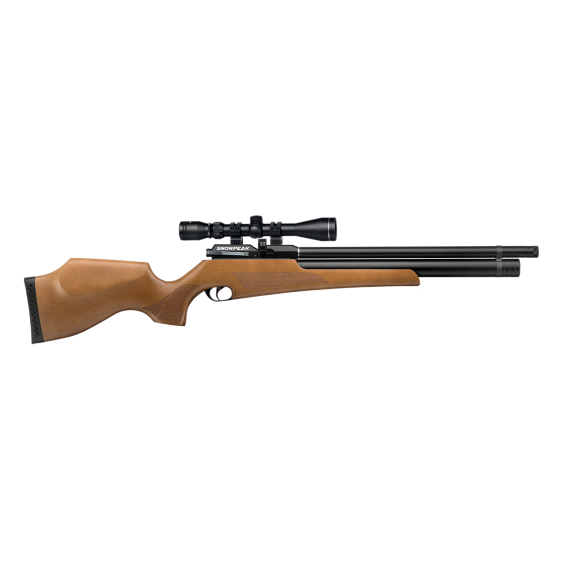
The Snowpeak M16 PCP Air Rifle is a pre-charged pneumatic air rifle designed around a traditional full-length rifle platform, a side-lever action, regulated air delivery, and a German beech stock. Built for shooters who value straightforward mechanical operation, consistent pressure management, and a conventional rifle profile, the M16 combines modern PCP technology with familiar handling characteristics.
Rather than relying on a spring-powered mechanism, compressed air is stored inside the rifle’s reservoir. Consequently, the firing cycle is comparatively smooth because the heavy spring movement associated with traditional spring-piston air rifles is absent. This operating principle helps explain why PCP rifles are widely associated with predictable shot behaviour and manageable recoil characteristics.
The Snowpeak M16 is currently offered in 4.5 mm (.177), 5.5 mm (.22), and 6.35 mm (.25) configurations. According to Snowpeak, nominal velocities are approximately 1000 fps, 900 fps, and 800 fps respectively, although actual velocity depends on pellet weight, environmental conditions, rifle configuration, pressure level, and applicable regional power restrictions.
Snowpeak M16 PCP Air Rifle Design
At the centre of the rifle is a regulated PCP system intended to manage compressed-air delivery throughout the usable portion of the reservoir’s pressure range. A regulator helps meter air before each shot so that pressure supplied to the firing valve remains more consistent than it would with an entirely unregulated system.
As a result, variations between consecutive shots may be reduced when the rifle, ammunition, regulator, and operating pressure are correctly matched.
The Snowpeak M16 PCP Air Rifle also incorporates a side-lever cocking mechanism. Instead of operating a conventional rear bolt, the shooter cycles the lever positioned alongside the action. Snowpeak specifically highlights the side-lever arrangement as one of the model’s principal handling characteristics.
German Beech Stock
A German beech stock gives the M16 a traditional appearance that differs significantly from modern synthetic or bullpup PCP platforms. Natural timber also means that minor differences in grain pattern, shade, and weight can occur from one rifle to another.
The overall configuration has been designed around a conventional shoulder-fired rifle format. Therefore, shooters familiar with traditional sporting air rifles should find the basic layout recognizable.
Key Snowpeak M16 Features
Important characteristics associated with the M16 include:
- PCP pre-charged pneumatic operating system
- Available in 4.5 mm (.177), 5.5 mm (.22), and 6.35 mm (.25)
- Regulated air-delivery system
- Side-lever cocking action
- German beech stock
- Built-in pressure gauge
- Quick-fill adaptor arrangement
- 11 mm dovetail rail
- Multi-shot magazine system
- Adjustable trigger pull
- Manual safety
- Maximum listed fill pressure of 25 MPa
- Approximately 960 mm overall length
- Approximately 3.0 kg listed weight
- 460 mm barrel listed in Snowpeak documentation
Snowpeak describes the rifle as having a simple structure, stable handling, a pressure-monitoring gauge, and a standard quick-fill system.
Calibre Options
4.5 mm / .177
The 4.5 mm configuration uses smaller-diameter pellets and is listed by Snowpeak with a nominal velocity of up to approximately 1000 fps.
Because pellet mass, design, and local power settings vary, velocity figures should be regarded as manufacturer-rated specifications rather than guaranteed field measurements.
Current manufacturer information lists a magazine capacity of approximately 13 shots for this calibre.
5.5 mm / .22
The 5.5 mm (.22) version is listed at approximately 900 fps under the manufacturer’s specification.
Its larger pellet diameter produces different ballistic behaviour compared with .177 ammunition. Pellet weight, pellet shape, barrel compatibility, pressure regulation, and power configuration can all influence performance.
Snowpeak currently lists an 11-shot magazine for the 5.5 mm version.
6.35 mm / .25
For the larger 6.35 mm (.25) configuration, Snowpeak specifies a nominal velocity of approximately 800 fps and a magazine capacity of 9 shots.
Because heavier projectiles generally require different amounts of energy and air compared with smaller pellets, shot behaviour and air consumption may differ substantially between calibres.
Regulated PCP Air System
The regulator is an important component of the Snowpeak M16 PCP Air Rifle.
Compressed air is stored under high pressure before being metered toward the firing system. Instead of exposing each shot directly to whatever pressure remains in the reservoir, the regulator is intended to provide a more controlled pressure level.
Consequently, properly regulated PCP systems can produce a more stable firing cycle across a useful pressure range.
Snowpeak lists a maximum pressure of 25 MPa, equivalent to approximately 250 bar. Only suitable high-pressure filling equipment and the correct manufacturer-approved fittings should be used.
A built-in pressure gauge allows reservoir pressure to be monitored visually. Nevertheless, safe filling procedures remain essential because PCP reservoirs contain highly compressed air.
Side-Lever Operation and Magazine System
Another defining characteristic of the M16 is its side-lever action.
Once the rifle has been safely prepared in accordance with the manufacturer’s instructions, the lever operates the internal cocking and loading mechanism. Its location allows the action to be cycled without using a traditional rear-mounted bolt.
Multi-shot magazines are provided according to calibre and production specification. However, Snowpeak documentation published at different times shows slightly different capacities. Current Snowpeak product information gives 13 shots for 4.5 mm, 11 shots for 5.5 mm, and 9 shots for 6.35 mm, whereas some manuals list 12, 10, and 9 respectively.
Therefore, buyers and owners should verify the supplied magazine for their specific rifle rather than relying exclusively on older specification charts.
Trigger and Safety
Snowpeak lists an adjustable trigger pull range of approximately 1–5 lbf.
Trigger adjustment should always remain within manufacturer specifications because inappropriate adjustment can affect safe operation.
A manual safety is also incorporated. However, mechanical safeties should never replace proper handling practices. The rifle should always be treated as potentially loaded, pointed in a safe direction, and kept away from unintended targets.
Scope Mounting Rail
An 11 mm dovetail rail is incorporated into the M16 platform.
This rail format is commonly found on air rifles and can accommodate appropriately compatible optic mounts. Exact ring height and optic dimensions will depend on the sighting system being installed.
Any optic should be mounted securely and checked according to the optic and rifle manufacturers’ guidance.
Dimensions and Handling
Snowpeak currently lists the M16 at approximately:
- Overall dimensions: 960 × 190 × 55 mm
- Weight: approximately 3.0 kg
- Barrel length: approximately 460 mm
- Maximum operating pressure: 25 MPa
- Stock material: German beech
- Rail: 11 mm dovetail
These dimensions place the rifle firmly within a conventional full-length PCP format rather than an ultra-compact bullpup configuration.
Actual weight can vary slightly because natural wood density is not completely uniform.
Maintenance and Responsible Ownership
Like any compressed-air rifle, the Snowpeak M16 PCP Air Rifle should be maintained according to the manufacturer’s instructions.
External surfaces should be kept clean and dry, while seals, filling components, and pressure-related parts should be inspected periodically. Only lubricants recommended for high-pressure pneumatic systems should be used where lubrication is required.
The air reservoir should never be dismantled, modified, heated, drilled, or subjected to unauthorized repair.
Before storage, the rifle should be unloaded and secured against unauthorized access. Ammunition should also be stored responsibly according to applicable local requirements.
Finally, air-rifle power limits, licensing rules, ownership requirements, transportation restrictions, and permitted uses vary significantly between jurisdictions. The exact legal classification of an M16 can therefore depend on its calibre, muzzle energy, configuration, and location.
For that reason, owners should verify current local regulations before possession or use.
Snowpeak M16 PCP Air Rifle Summary
The Snowpeak M16 PCP Air Rifle combines a regulated pneumatic system with a traditional German beech stock, side-lever operation, multi-shot magazines, a built-in pressure gauge, and an 11 mm dovetail rail.
Its three principal calibre options allow the same platform to be configured around different pellet diameters, while the regulated action is intended to support consistent compressed-air management.
Because specifications have changed slightly between Snowpeak documentation revisions, exact reservoir capacity, magazine capacity, supplied accessories, and power configuration should always be confirmed for the individual production version.
When maintained correctly and operated according to manufacturer instructions and applicable laws, the Snowpeak M16 represents a conventional PCP platform centred on regulated operation, practical pressure monitoring, traditional rifle ergonomics, and straightforward mechanical design.
Snowpeak M16 PCP Air Rifle Calibres, FAC, Power and Accessories
The Snowpeak M16 PCP Air Rifle is available in several calibre configurations, allowing the same core PCP platform to be supplied with different pellet diameters and factory performance specifications. Snowpeak currently lists the M16 in 4.5 mm (.177), 5.5 mm (.22), and 6.35 mm (.25). Each calibre has different projectile characteristics, magazine capacity, nominal velocity, and air-consumption behaviour.
Because air-rifle regulations differ between countries, the exact power specification supplied by a dealer or distributor may also vary. Therefore, calibre alone should never be used to determine the legal classification or actual muzzle energy of an individual rifle.
Snowpeak M16 .177 / 4.5 mm Calibre
The 4.5 mm or .177 Snowpeak M16 represents the smallest calibre currently listed by Snowpeak for this model.
According to the manufacturer’s present specification, the .177 version has a nominal velocity of approximately 1000 fps. Snowpeak also lists a 13-shot magazine capacity for the current 4.5 mm configuration.
However, velocity should not be confused with muzzle energy. Pellet weight strongly influences the energy produced at a given velocity. Consequently, two .177 pellets travelling at different velocities or having different masses may produce considerably different energy figures.
For that reason, the actual legal power classification of an individual rifle should be determined from measured muzzle energy rather than velocity alone.
Snowpeak M16 .22 / 5.5 mm Calibre
The 5.5 mm (.22) Snowpeak M16 uses a larger and generally heavier projectile than the .177 version.
Snowpeak currently specifies a nominal velocity of approximately 900 fps for this configuration. The current factory specification also lists an 11-shot magazine for the .22 model.
Because projectile weight usually increases substantially when moving from .177 to .22, muzzle velocity does not provide a direct comparison of power between the two calibres.
A .22 pellet travelling more slowly can still carry greater muzzle energy than a lighter .177 pellet. Accordingly, actual energy should be confirmed with the precise pellet and rifle configuration concerned.
Snowpeak M16 .25 / 6.35 mm Calibre
The largest calibre currently specified for the standard M16 is 6.35 mm or .25 calibre.
Snowpeak lists an approximate nominal velocity of 800 fps, together with a 9-shot magazine capacity.
The heavier projectiles normally associated with .25-calibre PCP rifles can require more compressed air per shot. Consequently, usable shot count and pressure behaviour may differ from the smaller-calibre versions, even when the rifles share the same fundamental action.
Again, factory velocity figures should be treated as reference specifications rather than guarantees for every individual rifle.
Snowpeak M16 Power System
The M16 operates through a pre-charged pneumatic system. Compressed air is stored inside its reservoir and released in controlled quantities during operation.
Snowpeak currently specifies a 270 cc air capacity, a maximum pressure of 25 MPa, or approximately 250 bar, and a consistent-valve system.
The maximum fill pressure does not represent muzzle power. Instead, it describes the maximum reservoir pressure specified by the manufacturer.
Several variables influence the energy generated by a PCP air rifle, including:
- Pellet calibre
- Pellet mass
- Pellet design
- Factory valve configuration
- Regulator setting
- Hammer and valve characteristics
- Reservoir pressure
- Barrel configuration
- Regional specification
- Individual manufacturing tolerances
Therefore, users should not calculate or assume legal muzzle energy solely from the manufacturer’s advertised velocity.
FAC and the Snowpeak M16
In the United Kingdom, the term FAC refers to a Firearm Certificate.
For England and Wales, current Home Office guidance states that an air rifle producing more than 12 foot-pounds of muzzle energy must be held on a firearm certificate. Air rifles at or below the applicable threshold are treated differently under firearms licensing law, although other possession, sale, transport, age, and use restrictions can still apply.
Consequently, a Snowpeak M16 intended for the UK market may exist in different power configurations.
A rifle configured within the relevant non-FAC limit should not automatically be assumed to produce the same output as a full-power export model. Equally, a rifle advertised with high factory velocity figures should not automatically be considered compliant with a particular UK power limit.
The Home Office specifically warns that individual examples of the same air-gun model can produce different muzzle-energy results. For rifles approaching the legal threshold, classification should therefore be based on the individual rifle rather than an assumption that every rifle of that model performs identically.
Furthermore, rules differ elsewhere in the UK. Scotland has a separate air-weapon licensing framework, so owners should check the legislation applicable to their location rather than applying England and Wales rules universally.
M16 Magazine and Loading Accessories
Magazine capacity depends on calibre. Snowpeak currently specifies:
- .177 / 4.5 mm – 13-shot magazine
- .22 / 5.5 mm – 11-shot magazine
- .25 / 6.35 mm – 9-shot magazine
These figures relate to the current M16 information published by Snowpeak.
When purchasing replacement magazines, compatibility should always be confirmed against the exact M16 generation and calibre.
Optics and Scope Accessories
The Snowpeak M16 incorporates an 11 mm dovetail rail. Consequently, optics intended for an 11 mm air-rifle rail can be fitted when suitable mounts are used.
Potential sighting accessories include compatible:
- Telescopic sights
- 11 mm scope rings
- Dovetail mounting systems
- Protective scope caps
- Appropriate optic mounts
Mounting hardware should match both the rifle rail and the optic tube diameter.
PCP Filling Equipment
Because the M16 uses a high-pressure compressed-air reservoir, dedicated PCP filling equipment is required.
Snowpeak lists a standard quick-fill adaptor among the principal features of the rifle.
Compatible filling equipment may include an appropriate:
- PCP hand pump
- High-pressure PCP compressor
- Certified compressed-air cylinder
- Correct fill hose
- Pressure-rated coupling
- Manufacturer-compatible quick-fill adaptor
All equipment used around the reservoir must be correctly pressure rated.
Cleaning, Storage and Maintenance Accessories
Routine maintenance can also involve appropriate air-rifle accessories. Snowpeak itself lists categories including cleaning kits, rifle scopes, gun bags, pumps and compressors, high-capacity air tanks, pellets, and targets within its accessory range.
Suitable maintenance and storage equipment may therefore include:
- Air-rifle cleaning equipment
- Protective gun case or bag
- Appropriate pellet storage
- Exterior cleaning cloths
- Manufacturer-approved seal-maintenance products
- Correct replacement seals or O-rings
- Secure storage equipment
Only products suitable for high-pressure PCP systems should be used around pressure-related components.
Choosing the Correct M16 Configuration
The principal difference between the three Snowpeak M16 PCP Air Rifle calibres lies in pellet diameter, magazine capacity, nominal velocity, and the resulting ballistic characteristics.
However, power classification must be treated separately from calibre.
A .177, .22, or .25 rifle can be manufactured or configured for different regional markets. Therefore, anyone selecting an M16 should confirm the rifle’s actual muzzle-energy specification, calibre, magazine compatibility, reservoir specification, and applicable local licensing requirements.
With its regulated PCP architecture, 270 cc reservoir, 25 MPa maximum pressure, side-lever action, 11 mm rail, and three available calibres, the M16 provides a common platform whose exact legal and performance specification ultimately depends on the individual version being supplied.
Snowpeak Airguns, PCP Rifles, Air Pistols and Umarex Airguns
For shooters researching Snowpeak airguns, Snowpeak Sports, and the wider Snowpeaks product range, there are many PCP rifles, air pistols, and shooting accessories to consider. Popular searches include the Snowpeak AP900, Snowpeak AP900B PCP air rifle, Snowpeak MAX 1, Snowpeak MAX 1 price, Snowpeak PP750, PP750, Snow Peak PP750, and PP750 air pistol. Buyers also regularly compare models such as the Snowpeak P35, P35, P 35, PCP P 35, Snowpeak P35X, P35X, P35X PCP, and Snowpeak P35 vs P35X.
Other Snowpeak models attracting attention include the Snow Peak PP20, Snowpeak PP20, Snowpeak M25, M25 rifle, M-25, M25 weapon, Snowpeak M60, Snowpeak M60B, M 60B, rifle M60, rifle M50, and M50 rifle. Searches such as Snow Peak brand origin are also common among buyers who want to understand the manufacturer before choosing a rifle or pistol.
Snowpeak PCP Models and Related Airgun Searches
The PCP category covers everything from compact pistols to full-size hunting and target rifles. Searches frequently include PR900 Gen 3, CR650, SR 1000X, T Rex 6000, and pistolet PCP Arcea-Snowpeak Onix Sport. People comparing pneumatic platforms may also search what is a PCP airgun, air gun, air rifle, pellet pistol, air gun accessories, 9mm pellet, and pellet 9mm.
Some search phrases overlap with firearm terminology even when shoppers are researching airgun products. These include rifle M60, how much did the M60 weigh, rifle M50, M50 rifle, M25 weapon, and snowfall gun. Therefore, model specifications should always be checked carefully so that a historical firearm search is not confused with a modern sporting airgun product.
Umarex Airguns, Air Rifles, Pistols and PCP Platforms
Alongside Snowpeak products, Umarex USA, UmarexUSA, Umarex airguns, and Umarex air rifles are widely searched by recreational shooters, target shooters, and PCP enthusiasts. The Umarex range includes PCP rifles, CO₂-powered platforms, break-barrel pistols, BB guns, airsoft replicas, and large-caliber airgun systems.
Popular PCP searches include Umarex Notos, Umarex Notos Carbine, Umarex Gauntlet, Umarex Gauntlet 2, Umarex Gauntlet 30, Umarex Zelos, Umarex Origin, Umarex Komplete, and Umarex Komplete NCR .22. Hunters researching larger airgun platforms may also encounter the Umarex Hammer, Umarex Hammer .50 caliber, Umarex Hammer Carbine, Umarex Primal 20, and Umarex AirSaber.
Umarex Pistols, BB Guns and T4E Models
For handgun-style platforms, popular searches include Umarex BB gun, BBgun, BB gun pistol, metal BB gun, Umarex TR50, Umarex HDR 50, Umarex T4E, Umarex T4E Smith, Umarex Smith, and Umarex P2P DR50 how many joules.
Glock-style replicas remain another major category. Search terms include Glock BB gun, Glock 19 BB gun, Umarex Glock 19, Umarex Glock 19X, Umarex Glock 19 Gen3 .177 caliber BB gun air pistol, Umarex Glock 17, Umarex Glock 17 Gen 5, Umarex Glock, airsoft Glock, airsoft Glock 19, Glock 17 airsoft, and Glock airsoft gun.
Other replica and recreational searches include Umarex MP40, Umarex MP5, Umarex Legends, Umarex HK Heckler, Umarex shotgun, and airsoft pistol.Umarex DX17.
Break-Barrel and Sporting Umarex Airguns
Shooters looking for spring or gas-piston platforms frequently research the Umarex Trevox, loading Umarex Trevox break barrel .177, Umarex pistol break barrel, Umarex Fusion 2, Umarex Synergis Elite, and Amazon Umarex Browning 800 Express. These platforms provide alternatives for people who want an airgun without relying on a high-pressure PCP charging system.
Additional searches across the Umarex catalog include Umarex H, while broader terms such as air rifle, pellet pistol, air gun, and air gun accessories help buyers compare platforms, ammunition, optics, filling equipment, targets, cases, and other shooting equipment.
Whether the focus is a Snowpeak M60, Snowpeak M25, Snowpeak P35X, Snowpeak PP750, Snowpeak MAX 1, Umarex Notos, Umarex Gauntlet 2, Umarex Origin, or Umarex Hammer Carbine, buyers should compare caliber, operating system, power level, dimensions, intended use, and local regulations before selecting an airgun.
Practical Use Scenarios
A modern PCP air rifle can fit into several legitimate recreational and sporting environments when it is used responsibly, maintained correctly, and operated in accordance with local law. Its regulated pneumatic system, side-lever action, multi-shot magazine arrangement, conventional stock, and relatively straightforward handling make it suitable for users who prefer a traditional rifle format combined with compressed-air technology.
Rather than being limited to one type of activity, the platform can be used in structured target sessions, controlled recreational shooting, club practice, technical familiarization, equipment testing, and routine accuracy work. The way it performs in each situation will depend on calibre, pellet choice, power specification, optic setup, environmental conditions, and the individual rifle.
Recreational Target Shooting
One of the most common practical applications is recreational target shooting on an approved range or other lawful shooting area.
Because a PCP system produces a comparatively smooth firing cycle, shooters can concentrate more closely on trigger control, breathing, sight alignment, and repeatable body position. Reduced mechanical movement compared with many spring-powered systems can also make it easier to observe inconsistencies in technique.
During a typical target session, the shooter can work through a series of paper targets while maintaining the same basic shooting position. The multi-shot magazine system is particularly convenient in this environment because repeated manual pellet loading is reduced.
That said, speed should never replace safe handling. The rifle should still be pointed in a safe direction, unloaded when required by range rules, and handled according to the instructions provided by the range officer or facility.
Different target distances can also be used to study how pellets behave as range changes. This provides practical experience with pellet trajectory, sight settings, wind influence, and consistency.
For new shooters, controlled target shooting provides an opportunity to become familiar with PCP operation without needing to introduce unnecessary complexity.
Airgun Club Practice
The rifle can also be used during organized airgun club sessions.
Club environments are useful because shooters generally have access to defined firing points, established safety procedures, proper backstops, and experienced members who can provide guidance on lawful and responsible equipment use.
In this setting, the rifle can be used for repeated accuracy testing, supported shooting, standing practice, or other approved disciplines offered by the club.
Its traditional stock shape may feel familiar to people who have previously used conventional sporting rifles. Meanwhile, the side-lever mechanism offers a different operating experience from a break-barrel or rear-bolt design.
A regulated action is particularly useful for structured practice because consistency between shots is important when evaluating shooting technique. If a group begins to widen, the shooter can investigate position, grip, sight picture, ammunition consistency, or environmental conditions rather than assuming every variation comes from changing reservoir pressure.
Informal Plinking in a Safe Environment
Another legitimate use is controlled recreational plinking where local law permits it.
Suitable targets might include commercially manufactured reactive targets positioned in front of an appropriate backstop. The shooting area must be secure, and pellets must never be fired where they could leave the property or enter an unsafe area.
The advantage of recreational plinking is that the session can be less formal than paper-target shooting while still reinforcing basic handling skills.
The magazine-fed system helps maintain a smooth rhythm between shots. Meanwhile, the pressure gauge enables the user to keep track of remaining air pressure rather than guessing how much compressed air remains.
Because every pellet must still be treated as potentially dangerous, proper backstop design remains essential. Hard surfaces that may cause unpredictable ricochets should be avoided.
Accuracy Testing With Different Pellets
A practical ownership scenario involves testing different pellet types to determine which ammunition performs most consistently with an individual barrel.
Two rifles of the same model do not always produce identical groups with every pellet. Small manufacturing tolerances, pellet diameter, projectile mass, skirt design, head size, and barrel condition can influence results.
For that reason, users often evaluate several appropriate pellet options under controlled range conditions.
The most useful method is consistency. Targets should be placed at the same distance, environmental conditions should be recorded where practical, and shooting technique should remain as repeatable as possible.
Groups can then be compared without making conclusions from only one or two shots.
This type of evaluation is particularly relevant for PCP rifles because their relatively smooth firing cycle makes differences between pellet types easier to observe.
Any ammunition used should match the correct calibre marked for the rifle.
Bench-Rest Shooting
Bench-rest practice provides another controlled application.
When a rifle is supported appropriately, much of the movement produced by the shooter can be reduced. This makes it easier to evaluate mechanical consistency, optic setup, pellet suitability, and general accuracy.
A front rest or suitable shooting support may be used if permitted by the facility.
The purpose of bench shooting is not simply to produce small groups. It can also help identify whether accuracy problems are coming from technique, mounting hardware, ammunition, or equipment condition.
For example, if groups remain inconsistent while the rifle is properly supported, the shooter may then check sight mounts, pellet condition, reservoir pressure, or the rifle’s maintenance status.
Bench sessions are therefore useful after installing a new optic, changing ammunition, or returning a rifle to use after a period of storage.
Standing and Unsupported Practice
Once a shooter has become comfortable with supported positions, the rifle can also be used for unsupported target practice where allowed.
Standing shooting requires greater control because the rifle is supported mainly by the user’s body.
The approximate 3 kg weight of the platform means balance and stance become important. A shooter may need to experiment with foot position and shoulder placement to find a stable position that does not create unnecessary fatigue.
Unsupported practice can help develop coordination and controlled trigger operation. However, sessions should remain manageable. Excessive fatigue often causes technique to deteriorate.
A controlled shooting routine is more useful than trying to continue once stability has been lost.
Seated Target Practice
Seated shooting provides a useful middle ground between full bench support and unsupported standing positions.
Depending on range rules, the shooter may use a chair, bench, or approved seated position. This allows the rifle to be supported more comfortably while still requiring active control.
Seated practice can be especially useful during longer sessions because it reduces fatigue while preserving the need for consistent positioning.
The traditional stock design works naturally in many conventional seated shooting positions.
As always, muzzle direction and trigger discipline remain essential during position changes.
Learning PCP Rifle Operation
The rifle can also serve as a platform for becoming familiar with PCP technology.
A user moving from spring-powered equipment to a pre-charged pneumatic system must understand several additional components, including reservoir pressure, filling equipment, pressure gauges, seals, magazines, and safe compressed-air handling.
This makes ownership partly a technical learning experience.
Before use, the owner should become familiar with the manufacturer’s instructions regarding filling pressure, charging equipment, pressure limits, inspection intervals, and storage.
No pressure-related component should be modified casually.
Because compressed air is stored at very high pressure, incompatible fittings, damaged hoses, unsuitable compressors, or improvised connections should never be used.
Scope Familiarization
Where a compatible optic is installed, the rifle can be used to become familiar with telescopic sights.
The 11 mm dovetail rail provides a conventional mounting interface for suitable air-rifle optics and rings.
Practical use may therefore involve learning how eye relief, magnification, focus, and sight picture affect comfortable shooting.
An optic should be installed securely using mounts suitable for both the rail and scope tube.
After installation, the rifle can be checked on a proper target range to confirm that the optic remains secure and behaves consistently.
Users should avoid repeatedly changing adjustment settings without a clear reason. Making one controlled change at a time makes it easier to understand the effect of each adjustment.
Training New Adult Shooters
In a supervised environment, the platform may also be used to introduce legally eligible adults to basic air-rifle handling.
Training should begin with safety rather than firing.
Before any pellet is loaded, the new shooter should understand muzzle direction, trigger discipline, safe loading, the safety mechanism, magazine handling, range commands, and how to confirm that the rifle is unloaded.
Dry explanations can be performed before entering the firing position.
Once live firing begins, only simple exercises should be introduced initially. Short distances and clearly visible paper targets generally make it easier for beginners to understand sight alignment and trigger control.
Supervision should remain close until safe handling becomes consistent.
Controlled Grouping Sessions
A grouping session is a practical way to monitor both shooter technique and equipment consistency over time.
Rather than concentrating on the exact centre of the target, the shooter observes how closely consecutive pellets land together.
This can reveal changes caused by ammunition, environmental conditions, optic movement, or maintenance requirements.
Using the same pellet type and similar pressure range provides a more meaningful comparison.
Results can be written down, including distance, pellet type, weather conditions, and approximate reservoir pressure.
Over time, this information creates a useful performance record for the individual rifle.
Routine Equipment Checks
Not every practical session needs to involve extended firing.
A responsible owner may periodically inspect the rifle and its accessories before a planned range visit.
External surfaces can be checked for corrosion, dirt, loose screws, or visible damage. Optic mounts can be examined for movement, while magazines can be inspected for dirt or deformation.
The fill connection should also remain clean.
If seals appear damaged, the rifle loses pressure unexpectedly, or the reservoir displays unusual behaviour, use should stop until the problem has been properly assessed.
Pressure components should not be dismantled without the required technical knowledge.
Seasonal Storage and Return to Use
Air rifles may remain unused for weeks or months, making correct storage another practical ownership scenario.
The rifle should be stored securely, away from unauthorized users, moisture, and extreme temperatures.
Before being returned to service after a long storage period, the owner should inspect the rifle carefully.
The stock can be checked for damage, metal surfaces can be examined for corrosion, and the pressure system can be observed for abnormal leakage.
Magazines and optics should also be checked before live firing resumes.
The first range session after storage should be treated as a verification session rather than assuming the rifle will perform exactly as it did previously.
Transport to a Shooting Facility
Transport is another important part of practical ownership.
The rifle should normally be unloaded and secured in an appropriate case or bag during lawful transport.
Pellets, magazines, filling equipment, and other accessories should also be organized safely.
Local regulations may impose additional requirements regarding public transport, vehicles, storage, visibility, or documentation.
Therefore, users should understand the rules that apply in their jurisdiction before travelling with any air rifle.
A protective case also prevents unnecessary damage to the stock, barrel, optic, and pressure system.
Extended Range Sessions
For users who spend several hours at an approved range, the PCP system can support structured practice involving multiple exercises.
A session might begin with a basic equipment check, followed by supported groups, position practice, and final confirmation shots.
The pressure gauge should be monitored throughout the day.
When reservoir pressure approaches the recommended refill level, the rifle should be handled according to the manufacturer’s filling procedure rather than continuing until performance becomes unpredictable.
Adequate breaks are also important because physical fatigue can have a greater effect on group consistency than many equipment changes.
Responsible Everyday Ownership
Ultimately, the most important practical scenario is routine, responsible ownership.
The rifle should be treated as functional shooting equipment rather than as a casual household object.
Safe storage, controlled use, correct ammunition, suitable backstops, proper transport, regular inspection, and respect for local law should be part of every session.
Accessories should be selected for compatibility instead of appearance alone, while pressure equipment should always meet the manufacturer’s specifications.
Used within a lawful and controlled environment, the platform can support recreational target shooting, club practice, equipment familiarization, accuracy evaluation, and technical learning.
Its regulated pneumatic action, conventional layout, multi-shot system, pressure monitoring, and adaptable sighting arrangement make it suitable for varied sporting sessions while still requiring the same disciplined handling expected from any air rifle.
Frequently Asked Questions
What type of air rifle is this?
This model uses a pre-charged pneumatic operating system, commonly known as PCP. Compressed air is stored inside an onboard reservoir and released in controlled amounts during each shot. Because there is no large spring moving forward during firing, the shooting cycle is generally smoother than that of a traditional spring-piston air rifle.
The rifle also uses a side-lever action and a multi-shot magazine arrangement. These features make the platform suitable for controlled recreational shooting, club use, accuracy testing, and other lawful sporting activities.
Which calibres are available?
The model is commonly offered in 4.5 mm (.177), 5.5 mm (.22), and 6.35 mm (.25) configurations.
Each calibre has different projectile characteristics, magazine capacity, velocity potential, and air-consumption behaviour. The smallest calibre generally uses lighter pellets, while the larger calibres normally use heavier projectiles.
The best choice depends on legal limits, the type of target shooting being undertaken, ammunition availability, and the exact power specification of the individual rifle.
Is the rifle regulated?
Yes. The design incorporates a regulated pneumatic system.
A regulator helps manage the pressure supplied to the firing mechanism so that each shot is delivered from a more controlled pressure range. This can help reduce changes in performance as the reservoir pressure gradually falls.
However, actual consistency still depends on pellet selection, regulator condition, reservoir pressure, barrel condition, environmental factors, and the overall setup of the rifle.
What is the maximum fill pressure?
The manufacturer lists a maximum operating pressure of approximately 25 MPa, which is equivalent to around 250 bar.
This figure refers to reservoir pressure rather than muzzle power.
Only filling equipment designed specifically for high-pressure PCP systems should be used. Improvised fittings, damaged hoses, unsuitable compressors, or low-pressure equipment should never be connected to the rifle.
Owners should always follow the manufacturer’s filling instructions.
What type of filling equipment can be used?
Suitable PCP filling equipment may include a high-pressure hand pump, certified compressed-air cylinder, or properly rated PCP compressor.
The exact filling system should be compatible with the rifle’s fill connection and maximum pressure rating.
A correct hose, adaptor, and pressure-rated coupling should always be used. Filling should be carried out slowly and while observing the pressure gauge.
If any part of the filling equipment appears damaged or incompatible, it should not be used.
Does the rifle have a pressure gauge?
Yes. A pressure gauge is incorporated so that reservoir pressure can be monitored.
The gauge allows the user to see how much pressure remains before and during a shooting session. This is useful because PCP performance depends partly on the pressure range in which the system is operating.
The gauge should be treated as part of the overall pressure system and should never be removed or modified without appropriate technical knowledge.
How many pellets does the magazine hold?
Magazine capacity depends on calibre.
Current specifications typically list approximately:
- 13 shots in 4.5 mm
- 11 shots in 5.5 mm
- 9 shots in 6.35 mm
Different production versions may use slightly different magazines, so compatibility should be checked before purchasing replacements.
A magazine intended for one calibre cannot simply be substituted for another.
Can the rifle be used as a single-shot platform?
That depends on the specific accessories and configuration supplied with the rifle.
Some PCP platforms can be used with single-shot trays or direct loading systems, while others are primarily intended for magazine-fed use.
Owners should check the accessories supplied with their individual rifle and confirm whether a compatible single-shot tray is available.
Any loading accessory should be designed specifically for the action and calibre concerned.
Is the trigger adjustable?
The trigger system is adjustable within the manufacturer’s specified range.
Trigger adjustment can influence the feel of the firing cycle, but it should not be altered carelessly.
An excessively light or improperly adjusted trigger can create a safety risk. Adjustments should therefore remain within factory guidance, and the rifle should always be tested safely after any permitted adjustment.
If the trigger behaves unpredictably, the rifle should not be used until it has been inspected.
Does the rifle have a safety?
Yes. A manual safety mechanism is included.
However, a safety catch should never be treated as a replacement for correct handling.
The muzzle should always remain pointed in a safe direction, the trigger should remain untouched until the shooter is ready to fire, and the rifle should be treated as loaded until its condition has been personally verified.
Mechanical safeties can fail, so safe handling remains the primary protection.
What type of scope rail does it use?
The rifle uses an 11 mm dovetail rail.
This rail format is widely used on air rifles and supports compatible scope rings and mounting systems.
Before fitting an optic, the user should confirm both the rail size and the diameter of the scope tube.
The optic should also be positioned with correct eye relief so that the shooter can obtain a clear image without straining or placing the eye too close to the scope.
Can a red-dot sight be fitted?
A red-dot sight may be fitted when the mounting system is compatible with the 11 mm dovetail rail.
Some red-dot sights are designed for Weaver or Picatinny rails rather than dovetails. In such cases, an appropriate adaptor may be required.
Any adaptor should fit securely and remain stable during normal use.
The sight should be checked after installation to confirm that it has not shifted.


Reviews
There are no reviews yet.