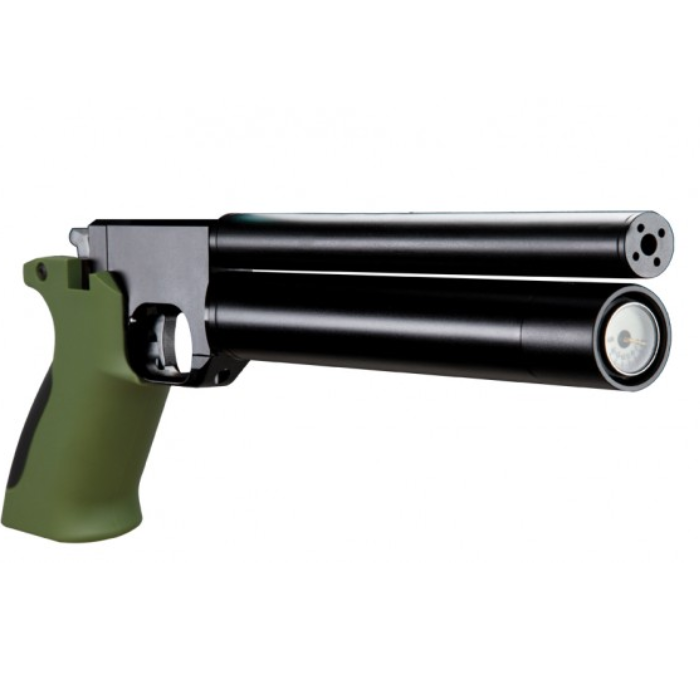
Snowpeak PP700W Air Pistol – Compact PCP Performance with Classic Styling
The Snowpeak PP700W Air Pistol has been developed for shooters who appreciate compact dimensions, PCP efficiency, comfortable handling, and traditional styling in one practical platform. Rather than being burdened with unnecessary complexity, this air pistol has been designed around straightforward operation, consistent performance, and enjoyable target shooting.
A classic wooden grip immediately gives the Snowpeak PP700W Air Pistol a distinctive appearance. At the same time, a compact PCP power system is incorporated into the design, allowing smooth shooting characteristics to be enjoyed without the heavy recoil commonly associated with spring-powered air pistols. Consequently, greater attention can be placed on sight alignment, trigger control, and consistent shooting technique.
Whether informal targets are being used in a suitable controlled environment or regular range practice is being completed, the Snowpeak PP700W Air Pistol can be incorporated into a compact and convenient shooting setup.
Why Choose the Snowpeak PP700W Air Pistol?
Versatility has been built into the overall character of this PCP pistol. Its compact format means excessive bulk does not have to be carried, while the wooden grip provides a more traditional feel than many modern polymer-framed alternatives.
Furthermore, compressed air is used as the power source. Therefore, recoil is significantly reduced compared with many conventional spring-piston designs. Because movement during the firing cycle is minimized, a stable sight picture can be maintained more easily.
For shooters developing their technique, this characteristic can be particularly beneficial. Trigger discipline, breathing control, grip consistency, and follow-through can all be practiced without a harsh mechanical firing cycle distracting from the fundamentals.
Key Product Highlights
- PCP pre-charged pneumatic operating system
- Compact and lightweight pistol format
- Traditional wooden grip
- Available in common pellet calibres depending on market
- Smooth, low-recoil firing characteristics
- Adjustable trigger arrangement on applicable versions
- Designed for controlled target and recreational shooting
- Efficient compressed-air operation
- Straightforward loading and cocking system
- Compact construction for convenient storage
- Suitable for developing consistent shooting technique
- Practical platform for both new and experienced PCP users
Traditional Wooden Grip and Comfortable Handling
One of the defining characteristics of the Snowpeak PP700W Air Pistol is its wooden grip. Whereas many modern air pistols are dominated by synthetic components, a warmer and more traditional appearance is provided here.
Beyond appearance, the grip has been shaped to support controlled handling. A secure interface between the shooter and pistol can therefore be maintained during target sessions.
Because the overall platform remains relatively compact, excessive front-end weight is avoided. As a result, prolonged aiming sessions can be made more comfortable, particularly when deliberate target shooting is being practiced.
Moreover, the balance allows the pistol to feel manageable without sacrificing the substantial feel expected from a PCP design.
PCP Power for Smooth and Consistent Shooting
Compressed air provides the operating energy for the Snowpeak PP700W Air Pistol. Before shooting, its onboard air reservoir is charged using suitable high-pressure PCP filling equipment.
Once correctly filled, multiple shots can be taken before another charge is required, although actual shot count will depend upon calibre, pressure settings, pellet choice, environmental conditions, and the specific configuration supplied.
Unlike a spring-powered pistol, a large spring and piston do not move sharply during every firing cycle. Therefore, the characteristic recoil impulse associated with spring-powered designs is greatly reduced.
In turn, improved stability can be experienced while the trigger is being released. This makes the platform particularly suitable for deliberate target practice, where small changes in grip or trigger input can affect group size.
Designed with Accuracy in Mind
Accuracy is never determined by the pistol alone. Pellet quality, shooter technique, environmental conditions, maintenance, sight adjustment, and consistency all contribute to the final result.
Nevertheless, the Snowpeak PP700W Air Pistol provides an inherently stable PCP platform from which good shooting technique can be developed.
A rifled barrel is used to stabilize the pellet as it travels toward the target. Meanwhile, manageable recoil helps the shooter remain focused on alignment and follow-through.
Additionally, different quality pellets can be tested so that the ammunition preferred by an individual barrel can be identified. Because pellet dimensions and weights vary slightly between manufacturers, testing several suitable options is often beneficial when accuracy is being optimized.
Adjustable Trigger for Greater Control
Trigger control remains one of the most important elements of accurate pistol shooting. Accordingly, an adjustable trigger system is featured on commonly supplied PP700-series configurations.
Instead of having to compensate for an unnecessarily heavy or unpredictable trigger release, a more controlled firing process can be achieved when the pistol is correctly set up.
However, adjustments should always be completed according to the manufacturer’s instructions. Safety mechanisms and adequate sear engagement should never be compromised in pursuit of a lighter trigger.
Once a comfortable configuration has been established, the shooter can concentrate more effectively on maintaining a steady sight picture throughout the shot.
Compact Design with Practical PCP Capability
Large dimensions are not required for enjoyable PCP shooting. In fact, compactness remains one of the strongest advantages offered by the Snowpeak PP700W Air Pistol.
The pistol can be stored in an appropriately secured case without the space requirements associated with a full-length air rifle. Likewise, less equipment has to be handled when travelling to an authorized shooting location or range.
Despite its compact proportions, the basic advantages of PCP technology are retained.
Consequently, users can experience smooth firing characteristics, compressed-air operation, and excellent handling without committing to a full-size rifle platform.
Practical Benefits at a Glance
Because several useful characteristics have been combined, the Snowpeak PP700W can suit a variety of recreational target-shooting requirements:
- Compact dimensions allow convenient handling.
- PCP operation produces minimal mechanical recoil.
- The wooden grip creates a traditional appearance.
- Rifled-barrel construction supports pellet stability.
- Trigger adjustment can assist with controlled shooting.
- Multiple shots can generally be obtained from one suitable air fill.
- Common pellet calibres provide broad ammunition availability.
- Straightforward operation makes the platform approachable.
- Balanced construction supports deliberate target work.
Suitable for Target Practice and Skill Development
For regular target practice, consistency is particularly important. A shooter should ideally be able to repeat the same grip, stance, sight picture, trigger movement, and follow-through from one shot to the next.
The Snowpeak PP700W Air Pistol supports this style of deliberate practice because disruptive recoil is minimized.
Paper targets can therefore be used to evaluate grouping, sight adjustment, and gradual improvements in technique within a safe and legally permitted environment.
Likewise, experienced shooters may appreciate the simplicity of a compact PCP pistol when a full rifle setup is unnecessary.
Convenient Charging and Maintenance
As with every PCP platform, appropriate high-pressure filling equipment must be used. Depending on the equipment available, a compatible PCP hand pump, filling cylinder, or compressor may be used according to the manufacturer’s requirements.
Only clean, dry compressed air and properly rated PCP equipment should be used.
Meanwhile, routine maintenance should remain straightforward. The exterior can be kept dry and clean, while the barrel and seals should be maintained according to the manufacturer’s recommendations.
Furthermore, excessive lubrication should be avoided, particularly around high-pressure components. Correctly maintained seals and fittings help preserve reliable operation and reduce unnecessary air leakage.
Snowpeak PP700W Air Pistol Calibres, FAC, Power and Accessories
The Snowpeak PP700W Air Pistol can be selected in different calibre configurations depending on the market and version being supplied. Because each calibre produces a slightly different shooting character, pellet choice, intended use, local power restrictions, and preferred shooting distance should all be considered before a configuration is selected.
Common PP700-family variants are offered in 4.5 mm (.177) and 5.5 mm (.22) calibre. Comparable Snowpeak PP-series pistols are also sold in these two calibres, although exact specifications should always be confirmed against the specific PP700W supplied.
.177 / 4.5 mm Calibre
The .177 calibre Snowpeak PP700W Air Pistol will generally appeal to users who prioritize target shooting, flatter pellet trajectories, economical ammunition, and precise paper-target work.
Because .177 pellets are normally lighter than equivalent .22 pellets, higher muzzle velocity can generally be achieved at the same energy level. Therefore, the trajectory can remain relatively flat across typical pistol-shooting distances.
For recreational target shooters, that characteristic can simplify holdover calculations and sight adjustment. Additionally, the widespread availability of .177 pellets gives shooters a broad range of wadcutter, domed, pointed, and specialist pellet designs to test.
The lighter ammunition can also make .177 particularly attractive for regular practice, where hundreds of pellets may be used over repeated sessions.
.22 / 5.5 mm Calibre
Alternatively, the 5.5 mm (.22) Snowpeak PP700W Air Pistol uses a larger and typically heavier pellet.
At an equivalent muzzle-energy level, a .22 pellet will normally leave the barrel at a lower velocity than a .177 pellet. However, greater pellet mass is retained, which gives the calibre a different ballistic character.
For shooters who prefer larger pellet holes on paper targets, heavier ammunition, or a more substantial pellet, the .22 configuration can therefore be attractive.
Furthermore, many quality .22 pellets are available in different head sizes and weights. As a result, individual pellet testing can be carried out to determine which combination produces the most consistent groups from a particular barrel.
No single calibre should automatically be regarded as superior. Instead, the appropriate choice should be determined by legal requirements, range conditions, shooting style, pellet availability, and personal preference.
Snowpeak PP700W Power and Velocity
Power figures for the Snowpeak PP700W Air Pistol should always be treated as configuration-dependent rather than as one universal specification.
Velocity can be affected by several factors, including:
- Pellet calibre
- Pellet weight
- Reservoir pressure
- Valve configuration
- Factory market specification
- Temperature
- Mechanical condition
- Local legal restrictions
Published data for PP700-family products illustrates this variation. One PP700 listing reports approximately 623 fps in .22 with recommended energy around 11 ft-lb, while a PP700S-A retailer lists approximately 213 m/s in 4.5 mm and 182 m/s in 5.5 mm, with technical output stated around 11–15 joules maximum. These figures relate to specific versions and should not automatically be applied to every PP700W.
Consequently, exact muzzle energy should be verified for the actual pistol supplied rather than assumed from a model-family figure.
Understanding Muzzle Energy
Muzzle energy describes the kinetic energy carried by the pellet as it exits the barrel. It is usually expressed in foot-pounds (ft-lb) or joules (J).
Importantly, velocity alone does not establish muzzle energy. Pellet weight must also be considered.
For example, two pellets travelling at the same velocity can produce different energy figures when their masses differ. Therefore, responsible specifications should include both pellet weight and measured velocity whenever accurate energy calculations are required.
FAC and Legal Power Considerations
The term FAC is commonly encountered in UK airgun discussions and refers to a Firearm Certificate.
However, the legal treatment of an air pistol is not identical to that of an air rifle. In Great Britain, air pistols exceeding 6 ft-lb are generally subject to significantly tighter firearm controls, while air rifles have a separate 12 ft-lb threshold.
Therefore, buyers should not assume that a higher-powered PP700W can simply be treated like a sub-12 ft-lb air rifle.
Legal rules also differ between England and Wales, Scotland, Northern Ireland, the Channel Islands, Europe, and other international markets. Age limits, certificates, registration requirements, transport rules, storage requirements and permitted shooting locations can consequently vary.
For that reason, the exact market-compliant PP700W version should always be selected before purchase.
Where a lower-power model is required, a version configured by the manufacturer or authorized supplier for the relevant jurisdiction should be chosen rather than attempting unauthorized modifications.
PCP Charging Accessories
Because the Snowpeak PP700W is a PCP platform, an appropriate compressed-air source is required.
Common charging accessories include:
- High-pressure PCP hand pump
- PCP compressor
- Certified diving or carbon-fibre air cylinder
- Compatible fill probe or adaptor
- Rated high-pressure hose
- Pressure gauge
- Moisture filtration equipment where applicable
A hand pump can provide a relatively portable setup for a small-reservoir pistol. Meanwhile, a compressor can provide additional convenience when several PCP airguns are regularly being filled.
Only equipment rated for the required pressure should be used.
Optics and Sight Accessories
Depending on the exact PP700W configuration, a compatible dovetail rail can allow suitable compact aiming accessories to be fitted.
A PP700 listing identifies an 11 mm dovetail rail, while closely related Snowpeak PP-series products use dovetail mounting arrangements as well.
Possible accessories may therefore include:
- Compact pistol scope
- Compatible red-dot sight
- Dovetail mounts
- Low-profile optic rings
- Open-sight accessories where compatible
Before purchasing an optic, rail width and mounting dimensions should be checked carefully.
Pellets and Target Accessories
Quality ammunition can have a noticeable effect on group consistency.
Useful additions include:
- Match wadcutter pellets
- Domed pellets
- Pellet selection packs
- Paper targets
- Pellet trap
- Target holder
- Chronograph for lawful performance testing
Testing multiple pellet types can reveal which ammunition performs most consistently in an individual barrel.
Maintenance and Storage Accessories
PCP equipment should also be stored and maintained appropriately.
Useful accessories can include:
- Padded pistol case
- Protective gun sleeve
- Suitable cleaning equipment
- Approved airgun lubricant
- Replacement seals or O-rings specified by the manufacturer
- Silicone cloth for exterior protection
- Secure storage equipment
A compatible fill adaptor and spare sealing components are particularly useful because maintaining an airtight PCP system is essential for dependable operation.
Overall, the Snowpeak PP700W Air Pistol offers a flexible compact PCP platform that can be configured around .177 or .22 shooting preferences, appropriate market power limits, and a practical selection of charging, sighting, target, maintenance and storage accessories. By matching the calibre, legal specification and supporting equipment carefully, a balanced setup can be created for controlled recreational and target shooting.
A Versatile Compact PCP Air Pistol
Ultimately, the Snowpeak PP700W Air Pistol combines traditional appearance with modern pre-charged pneumatic technology in a compact package.
Its wooden grip provides distinctive styling, while PCP operation delivers the smooth firing characteristics sought by many target shooters. Additionally, manageable proportions make the pistol convenient for controlled practice sessions and secure storage.
Whether a first compact PCP pistol is being considered or another lightweight platform is being added to an established collection, the PP700W offers a straightforward approach to recreational airgun shooting.
For users who prioritize uncomplicated operation, comfortable handling, low recoil, and classic wooden styling, the Snowpeak PP700W Air Pistol provides an appealing balance of practicality and performance.
Important: Exact calibre options, muzzle energy, velocity, charging pressure, accessories, and configuration can differ according to production version and destination market. Local airgun laws, power limits, age restrictions, storage requirements, and range rules should always be checked before purchase or use.
Snowpeak Airguns, PCP Rifles, Air Pistols and Umarex Airguns
For shooters researching Snowpeak airguns, Snowpeak Sports, and the wider Snowpeaks product range, there are many PCP rifles, air pistols, and shooting accessories to consider. Popular searches include the Snowpeak AP900, Snowpeak AP900B PCP air rifle, Snowpeak MAX 1, Snowpeak MAX 1 price, Snowpeak PP750, PP750, Snow Peak PP750, and PP750 air pistol. Buyers also regularly compare models such as the Snowpeak P35, P35, P 35, PCP P 35, Snowpeak P35X, P35X, P35X PCP, and Snowpeak P35 vs P35X.
Other Snowpeak models attracting attention include the Snow Peak PP20, Snowpeak PP20, Snowpeak M25, M25 rifle, M-25, M25 weapon, Snowpeak M60, Snowpeak M60B, M 60B, rifle M60, rifle M50, and M50 rifle. Searches such as Snow Peak brand origin are also common among buyers who want to understand the manufacturer before choosing a rifle or pistol.
Snowpeak PCP Models and Related Airgun Searches
The PCP category covers everything from compact pistols to full-size hunting and target rifles. Searches frequently include PR900 Gen 3, CR650, SR 1000X, T Rex 6000, and pistolet PCP Arcea-Snowpeak Onix Sport. People comparing pneumatic platforms may also search what is a PCP airgun, air gun, air rifle, pellet pistol, air gun accessories, 9mm pellet, and pellet 9mm.
Some search phrases overlap with firearm terminology even when shoppers are researching airgun products. These include rifle M60, how much did the M60 weigh, rifle M50, M50 rifle, M25 weapon, and snowfall gun. Therefore, model specifications should always be checked carefully so that a historical firearm search is not confused with a modern sporting airgun product.
Umarex Airguns, Air Rifles, Pistols and PCP Platforms
Alongside Snowpeak products, Umarex USA, UmarexUSA, Umarex airguns, and Umarex air rifles are widely searched by recreational shooters, target shooters, and PCP enthusiasts. The Umarex range includes PCP rifles, CO₂-powered platforms, break-barrel pistols, BB guns, airsoft replicas, and large-caliber airgun systems.
Popular PCP searches include Umarex Notos, Umarex Notos Carbine, Umarex Gauntlet, Umarex Gauntlet 2, Umarex Gauntlet 30, Umarex Zelos, Umarex Origin, Umarex Komplete, and Umarex Komplete NCR .22. Hunters researching larger airgun platforms may also encounter the Umarex Hammer, Umarex Hammer .50 caliber, Umarex Hammer Carbine, Umarex Primal 20, and Umarex AirSaber.
Umarex Pistols, BB Guns and T4E Models
For handgun-style platforms, popular searches include Umarex BB gun, BBgun, BB gun pistol, metal BB gun, Umarex TR50, Umarex HDR 50, Umarex T4E, Umarex T4E Smith, Umarex Smith, and Umarex P2P DR50 how many joules.
Glock-style replicas remain another major category. Search terms include Glock BB gun, Glock 19 BB gun, Umarex Glock 19, Umarex Glock 19X, Umarex Glock 19 Gen3 .177 caliber BB gun air pistol, Umarex Glock 17, Umarex Glock 17 Gen 5, Umarex Glock, airsoft Glock, airsoft Glock 19, Glock 17 airsoft, and Glock airsoft gun.
Other replica and recreational searches include Umarex MP40, Umarex MP5, Umarex Legends, Umarex HK Heckler, Umarex shotgun, and airsoft pistol.Umarex DX17.
Break-Barrel and Sporting Umarex Airguns
Shooters looking for spring or gas-piston platforms frequently research the Umarex Trevox, loading Umarex Trevox break barrel .177, Umarex pistol break barrel, Umarex Fusion 2, Umarex Synergis Elite, and Amazon Umarex Browning 800 Express. These platforms provide alternatives for people who want an airgun without relying on a high-pressure PCP charging system.
Additional searches across the Umarex catalog include Umarex H, while broader terms such as air rifle, pellet pistol, air gun, and air gun accessories help buyers compare platforms, ammunition, optics, filling equipment, targets, cases, and other shooting equipment.
Whether the focus is a Snowpeak M60, Snowpeak M25, Snowpeak P35X, Snowpeak PP750, Snowpeak MAX 1, Umarex Notos, Umarex Gauntlet 2, Umarex Origin, or Umarex Hammer Carbine, buyers should compare caliber, operating system, power level, dimensions, intended use, and local regulations before selecting an airgun.
Practical Use Scenarios
A compact PCP air pistol becomes most useful when it is placed into realistic shooting situations where portability, controllability, repeatability, and ease of setup matter. Rather than being treated purely as a specification sheet, this type of platform is best understood through the environments in which it can be used responsibly and effectively.
For many shooters, the strongest advantage comes from convenience. A full-size rifle can be unnecessary when the purpose is short-range target work, technique development, sight adjustment, or recreational shooting in an approved location. In those situations, a compact pre-charged pneumatic pistol can provide an efficient and enjoyable alternative.
Because compressed air is used instead of a spring-piston firing system, recoil is generally reduced. Therefore, the shooter can focus more closely on grip, sight alignment, trigger control, and follow-through. This makes the platform particularly relevant for structured practice sessions where consistency matters more than raw power.
Indoor Target Practice in an Approved Range
One of the most practical uses is controlled indoor target shooting.
An indoor range removes many external variables, including wind, changing weather, and inconsistent lighting. Consequently, the shooter can concentrate on technique and equipment setup.
Paper targets can be positioned at suitable distances according to range rules. Once a stable stance has been established, repeated groups can be fired and compared.
This type of session is useful because small errors become easier to identify. If shots consistently move left, right, high, or low, the shooter can determine whether sight adjustment, trigger technique, grip pressure, or ammunition choice may be contributing.
Moreover, the relatively compact dimensions make the pistol easier to handle on a shooting bench than a full-length rifle.
A simple indoor setup may involve:
- A secure firing point
- An approved pellet trap
- Paper target sheets
- Suitable eye protection
- A chronograph where permitted
- A stable rest for testing
- Several pellet types for comparison
When the goal is accuracy development, a controlled environment provides some of the most useful feedback.
Backyard or Private-Property Target Shooting Where Legal
In jurisdictions where private-property airgun shooting is lawful, a properly designed home target area may offer convenient practice.
However, safety must always come first.
A secure backstop should be used so that pellets cannot leave the shooting area. The target direction must also be selected carefully, with people, animals, roads, neighboring property, windows, and hard ricochet-producing surfaces kept completely outside the line of fire.
Local laws should be checked before any shooting takes place.
When permitted, a short-range home setup can be especially useful for brief practice sessions. Rather than travelling to a range for every session, a shooter can work on fundamentals such as trigger control and sight alignment in shorter intervals.
Because the platform is compact, setup and pack-away can remain straightforward.
Developing Trigger Discipline
Trigger control is one of the clearest practical areas in which a low-recoil PCP pistol can be useful.
Many new shooters disturb the gun at the exact moment the trigger is pressed. This usually happens because the trigger is pulled abruptly rather than pressed smoothly.
A stable PCP platform can make that movement easier to notice.
For example, a shooter may place a target at a comfortable distance and fire several slow groups while concentrating on one element only: a smooth trigger press.
After each group, the results can be examined.
If the grouping tightens, the technique is being repeated successfully. If the group opens, the shooter can reset and work on consistency again.
This simple exercise can improve shooting fundamentals without requiring high shot volume.
Sight Adjustment and Zero Confirmation
Another realistic use involves adjusting and confirming sights.
Whenever an optic or open-sight arrangement is changed, the point of impact should be checked.
A stable bench-rest setup can be used first. The pistol can be supported safely while several shots are fired at a known aiming point.
Rather than moving the point of aim after every single shot, a small group should generally be observed first. This helps determine whether the error is consistent.
If the shots consistently group away from the intended point, sight correction can then be made.
Once the sighting system has been adjusted, additional groups can be fired to confirm the change.
This process is particularly useful after:
- Installing a compatible optic
- Changing sight components
- Switching pellet type
- Transporting the pistol
- Performing maintenance
- Replacing seals
- Changing shooting distance
A confirmed sight setup allows later practice to be conducted with greater confidence.
Pellet Testing and Accuracy Comparison
Not every pellet performs identically in every barrel.
For that reason, practical pellet testing can be worthwhile.
Several suitable pellet types can be fired under the same conditions. The distance, fill pressure, shooting position, and aiming method should remain as consistent as possible.
Each pellet type can then be evaluated for group size and consistency.
Wadcutter pellets may be preferred for clean holes in paper targets, while domed pellets may behave differently depending on distance and barrel preference.
Rather than choosing ammunition purely by brand reputation, practical testing allows the shooter to identify which pellet performs best in the individual pistol.
A useful session might involve five-shot or ten-shot groups with each pellet type.
The best-performing option can then be retested later to confirm the result.
Chronograph Testing
A chronograph can provide additional information when lawful performance testing is required.
By measuring pellet velocity, the shooter can observe whether the pistol is producing consistent shot-to-shot results.
Large velocity changes can sometimes indicate changes in air pressure, pellet fit, seals, or other mechanical factors.
Chronograph data can also be useful when checking that the pistol remains within the applicable legal energy limit.
However, energy calculations should be based on the actual pellet weight being used.
This type of test should be approached as a diagnostic and compliance exercise rather than an attempt to maximize power.
Short Recreational Shooting Sessions
Not every session needs to be highly technical.
The platform can also be used for simple recreational target shooting in an appropriate environment.
Reactive targets designed specifically for low-energy airgun use can make sessions more engaging, provided they are used with a safe backstop.
Examples may include resettable metal targets, paper scoring cards, or approved knock-down targets.
The goal can simply be consistency and enjoyment.
Because PCP operation reduces the mechanical movement associated with spring-powered pistols, repeated target shooting can feel smooth and controlled.
This makes the platform suitable for users who want a relaxed shooting session without the bulk of a rifle.
Introducing New Shooters Under Supervision
A compact PCP pistol can also be useful when introducing an adult beginner to basic airgun handling under competent supervision and within local law.
The first lesson should not begin with firing.
Instead, the new shooter should first learn how the pistol is handled safely.
This includes:
- Keeping the muzzle pointed in a safe direction
- Keeping the finger away from the trigger until ready to fire
- Understanding the safety mechanism
- Identifying the target and backstop
- Understanding loading and unloading
- Wearing appropriate eye protection
- Following all range commands
Once these principles are understood, supervised target shooting can begin.
The reduced recoil of a PCP system can make it easier for a beginner to understand what happens during the firing cycle.
Because there is less mechanical disturbance, the learner can focus more easily on sight alignment and trigger control.
Bench-Rest Accuracy Practice
Although the pistol is designed for handheld use, supported shooting can be extremely useful when evaluating equipment.
A rest can help separate shooter error from mechanical accuracy.
For example, if groups remain tight from a rest but become much wider during unsupported shooting, the equipment is probably performing consistently and technique deserves further attention.
Supported shooting can also help when comparing pellets or confirming sight adjustments.
The purpose is not necessarily to shoot from a bench permanently.
Instead, the bench becomes a diagnostic tool.
Once the equipment has been checked, the shooter can return to unsupported practice with greater confidence.
Standing Precision Practice
Standing pistol shooting introduces a different challenge.
The firearm must be supported entirely by the shooter, so natural movement becomes more noticeable.
A practical session may involve aiming at a larger scoring target and firing slowly rather than trying to eliminate all movement.
The objective is to maintain consistent alignment while allowing the sights to move naturally within a small area.
Breathing becomes important.
Many shooters prefer to settle the sights, pause briefly after exhaling, and complete the trigger press without forcing the pistol to remain perfectly motionless.
This type of training can improve stability over time.
One-Handed Target Practice
Traditional target-pistol technique often involves one-handed shooting.
A lightweight and compact PCP pistol can be used for this style of training where appropriate.
One-handed shooting requires more careful attention to stance and balance.
The body is usually positioned in a repeatable orientation, while the shooting arm is extended without excessive muscular tension.
Short practice strings are often more productive than long sessions because fatigue can quickly affect stability.
The shooter can compare one-handed groups with two-handed groups and identify which elements of technique need improvement.
Two-Handed Recreational Technique
A two-handed grip may feel more natural for many recreational shooters.
The support hand can help stabilize the pistol and reduce unnecessary movement.
This approach may be particularly useful when a shooter is learning sight alignment and trigger control.
Once a consistent two-handed technique has been established, different distances and target sizes can be introduced gradually.
The emphasis should remain on accuracy and safe handling rather than speed.
Filling and Air-Management Practice
PCP ownership also involves learning to manage compressed air safely.
A practical shooting session should therefore include appropriate attention to fill pressure.
Before use, the reservoir pressure can be checked.
If a refill is required, the correct charging equipment and compatible fitting should be used.
The fill process should remain controlled, with the pressure monitored carefully.
Overfilling should always be avoided.
After shooting, the remaining pressure can be noted. Over several sessions, the shooter can develop a better understanding of practical shot count and how performance changes through the pressure range.
This information can be especially useful when planning longer range sessions.
Testing Different Shooting Distances
Distance testing is another valuable practical exercise.
A pistol may be highly consistent at a short distance, yet pellet drop becomes more noticeable as distance increases.
Targets can therefore be placed progressively farther away, where range rules permit.
For example, a shooter may begin at a short range before moving the target farther out.
This demonstrates how trajectory changes and how sight hold must be adjusted.
The exercise also reveals how group size changes with distance.
Rather than assuming that the same point of aim will remain correct everywhere, the shooter learns how the pellet actually behaves.
Training for Repeatability
Perhaps the most important practical use is developing repeatable shooting habits.
Accuracy is usually created through repetition rather than one exceptional shot.
A productive session can therefore be built around a simple routine:
Assume the same stance.
Use the same grip.
Align the sights in the same way.
Control breathing.
Press the trigger smoothly.
Maintain follow-through.
Then repeat.
Over time, the goal is for these actions to become consistent.
A low-recoil PCP pistol can support this process because fewer mechanical distractions occur during the firing cycle.
Portable Range Setup
The compact format also makes the pistol practical for users who regularly travel to authorized shooting ranges.
A basic range kit can remain relatively small.
The pistol can be stored securely in a suitable case alongside pellets, eye protection, targets, compatible charging accessories, and basic maintenance items.
This is particularly convenient for shooters who do not want to transport the larger equipment associated with a full rifle setup.
Once at the range, the system can be prepared quickly and packed away just as easily.
Routine Function Checking
After maintenance or extended storage, a controlled function check can be useful.
Before serious target work begins, the shooter can inspect the pistol for obvious damage, verify that the action operates normally, and check for signs of air leakage.
A few controlled shots can then be fired at a secure target.
If the point of impact, trigger behavior, or air consumption appears unusual, further inspection may be appropriate before continuing.
This type of routine checking can help identify minor issues before they become more significant.
Long-Term Skill Development
The strongest practical value of this type of pistol often becomes clear over repeated sessions.
It can be used to build a structured shooting routine rather than simply providing occasional entertainment.
A shooter may track group sizes, pellet preference, sight settings, fill pressure, and shooting distance over time.
This information can reveal measurable improvement.
For example, groups that initially appear inconsistent may gradually become smaller as grip and trigger technique improve.
The equipment therefore becomes more than a compact air pistol.
It becomes a useful training platform for learning how small changes in technique affect accuracy.
When used responsibly, maintained correctly, and operated within local law, the platform can serve effectively for controlled target shooting, sight testing, pellet evaluation, beginner instruction, supported accuracy work, recreational practice, and long-term shooting-skill development.
Frequently Asked Questions
What type of air pistol is the Snowpeak PP700W?
The Snowpeak PP700W is a pre-charged pneumatic air pistol, commonly referred to as a PCP air pistol. Instead of relying on a spring-powered mechanism, compressed air is stored inside an onboard reservoir and released during each shot. This operating system generally produces a smoother firing cycle with less mechanical movement than many spring-piston pistols.
Because recoil is reduced, the shooter can concentrate more effectively on sight alignment, trigger control, grip consistency, and follow-through. The compact format also makes the platform practical for recreational target shooting, range use, and controlled skill development.
What calibres are available?
The platform is commonly associated with .177 and .22 calibre configurations, although exact availability can vary by market, production version, and distributor.
A .177 configuration generally appeals to shooters who prefer lighter pellets, flatter trajectories, and precise paper-target work. A .22 configuration normally uses heavier pellets and produces a different ballistic feel, with lower velocity at comparable energy levels.
Before purchasing, the calibre printed on the specific pistol or product documentation should always be confirmed.
Is .177 or .22 better?
Neither calibre is automatically better in every situation.
For target shooting, .177 is often preferred because lighter pellets generally travel faster and produce a relatively flat trajectory. In addition, wadcutter-style .177 pellets can create clean holes in paper targets.
By comparison, .22 pellets are usually heavier and larger. Some shooters simply prefer the handling and feedback of a heavier pellet.
The better choice depends on intended use, legal restrictions, ammunition availability, shooting distance, and individual preference.
Is this a PCP air pistol?
Yes. The pistol operates using pre-charged pneumatic technology.
Before shooting, the air reservoir must be filled with clean, dry compressed air using compatible high-pressure PCP equipment. Once charged, multiple shots can normally be fired before another refill is needed.
Actual shot count depends on factors such as reservoir pressure, calibre, pellet weight, valve setup, temperature, and the exact factory configuration.
Does it have recoil?
PCP air pistols normally produce considerably less recoil than conventional spring-piston air pistols.
Because a large spring and piston are not moving rapidly during the firing cycle, mechanical disturbance is reduced. This can make aiming and follow-through easier, particularly during precision target practice.
However, no air pistol should be regarded as completely motionless. Small amounts of movement can still be produced by the release of compressed air and the shooter’s own technique.
Is it suitable for beginners?
It can be suitable for adult beginners when used legally and under appropriate supervision.
Its compact dimensions and relatively mild firing cycle can make basic shooting principles easier to learn. A new shooter can focus on safe muzzle control, sight alignment, trigger discipline, breathing, and follow-through without dealing with the stronger mechanical movement found in some spring-powered designs.
However, beginners should be taught correct handling procedures before live firing begins.
Can experienced shooters use it as well?
Yes.
Experienced shooters may appreciate the compact format for deliberate target practice, pellet testing, sight adjustment, or technique refinement.
A smaller PCP pistol can also be useful when a full-sized rifle is unnecessary. Experienced shooters may use it to examine trigger control, one-handed technique, stance, and consistency at shorter distances.
What is the pistol mainly used for?
Its most practical applications are controlled recreational shooting, paper-target practice, supported accuracy testing, sight adjustment, pellet comparison, and shooting-skill development.
It can also be useful for introducing new adult shooters to PCP operation in a controlled environment.
Any use must remain consistent with local laws and range regulations.
Shop the Snowpeak PP700W Air Pistol, a compact PCP pistol with smooth handling, low recoil, wooden grip styling, and reliable target-shooting performance.
How accurate is it?
Accuracy depends on more than the pistol itself.
A correctly functioning barrel and stable PCP system can provide a solid foundation, but actual results are affected by pellet quality, pellet fit, sight setup, trigger control, grip pressure, shooting distance, wind, and the shooter’s skill.
For this reason, accuracy is best evaluated by firing several groups using different quality pellets under controlled conditions.
What pellets should be used?
Only pellets that match the marked calibre of the pistol should be used.
Quality lead airgun pellets from established manufacturers are generally preferred for accuracy testing.
Wadcutter pellets can be convenient for short-range paper targets because they create clear round holes. Domed pellets may provide a useful alternative for general target shooting.
Rather than assuming one pellet will perform best, several suitable pellet weights and designs can be tested.
Can different pellet weights change performance?
Yes.
Pellet weight affects velocity, trajectory, muzzle energy, and sometimes group consistency.
A lighter pellet will usually travel faster than a heavier pellet when fired from the same powerplant. However, greater velocity does not automatically mean greater accuracy.
Some barrels perform better with medium or heavier pellets. Consequently, practical pellet testing is usually more useful than relying only on published velocity figures.



Reviews
There are no reviews yet.