Weihrauch HW100 BPK – Compact Bullpup PCP Air Rifle Overview
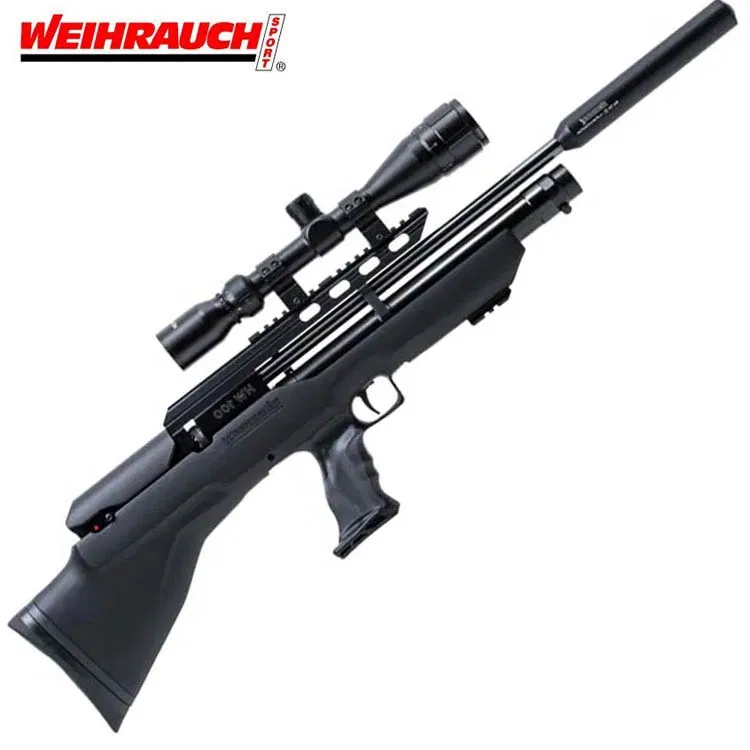
The Weihrauch HW100 BPK brings the established HW100 platform into a compact bullpup configuration designed around balance, manageable overall dimensions, and consistent PCP operation. Developed by German manufacturer Weihrauch, the platform combines a short overall format with many of the mechanical characteristics associated with the wider HW100 family.
Rather than extending the action behind a conventional rifle stock, the bullpup layout positions major operating components farther to the rear. Consequently, a comparatively useful barrel length can be retained while overall dimensions remain compact. This layout makes the Weihrauch HW100 BPK notably different in handling from traditional sporter-style PCP rifles.
The current generation is officially identified by Weihrauch as the HW 100 X-BP/BPK, with the BPK representing the shorter carbine configuration. Weihrauch states that the revised X-series introduces an aluminium air cylinder, increased fill pressure, an updated regulator, and improved air capacity compared with earlier HW100 versions.
Compact Bullpup Architecture
Compactness defines the Weihrauch HW100 BPK.
Because the action is incorporated into a bullpup-style stock, much of the rifle’s mass is positioned closer to the shooter’s body. As a result, the rifle can feel substantially different from a conventional PCP whose barrel, cylinder, and fore-end project farther forward.
Earlier HW100 BPK specifications listed a carbine barrel of approximately 310 mm, while the complete rifle remained substantially shorter than conventional HW100 variants. The UK Weihrauch distributor has also described the BPK as being particularly quick to bring onto target because its weight is concentrated closer to the user.
Although compact dimensions can be advantageous for handling, individual comfort remains subjective. Stock fit, arm length, optic placement, shooting position, and personal preference all influence how naturally a bullpup feels.
Weihrauch HW100 BPK PCP System
Pre-Charged Pneumatic Operation
The Weihrauch HW100 BPK operates through a pre-charged pneumatic system.
Compressed air is stored inside a dedicated air cylinder and released in controlled quantities when the action is operated. Therefore, the firing cycle avoids the spring movement normally associated with spring-piston air rifles.
On the latest HW 100 X-BPK, Weihrauch specifies a lightweight aluminium air cylinder rated for a 250-bar filling pressure. The manufacturer says the redesigned system provides at least 50% greater firing capacity compared with its preceding HW100 configuration.
Additionally, an integrated pressure gauge allows the remaining cylinder pressure to be monitored.
Redesigned Regulator
An important update within the HW100 X platform is its revised regulator.
The regulator manages the pressure supplied from the main cylinder to the firing system. Consequently, controlled air delivery can be maintained as the cylinder pressure gradually falls during use.
Weihrauch specifically identifies improved consistency as one of the objectives of the redesigned regulator used in the X-series.
14-Shot Rotary Magazine
Repeated loading is handled through a removable rotary magazine.
The current Weihrauch specification lists a 14-pellet capacity, continuing a system closely associated with earlier generations of the HW100.
For organized sporting or training sessions, a multi-shot magazine reduces the need to manually insert an individual pellet before every shot. Nevertheless, standard firearm and airgun safety procedures remain essential whenever the rifle is being loaded, unloaded, transported, or handled.
The magazine should always be inspected carefully whenever confirming whether the rifle is unloaded.
Advanced Side-Lever Action
Another recognizable feature of the platform is its repeating lever mechanism.
The current HW100 X generation incorporates what Weihrauch describes as an advanced biathlon lever. Its location and operating movement are intended to provide straightforward cycling of the action between shots.
Furthermore, Weihrauch offers configurations suitable for different user requirements, including left-handed operating arrangements on applicable variants.
Smooth mechanical cycling has historically been one of the defining characteristics of the HW100 platform.
Adjustable Two-Stage Match Trigger
Trigger control plays an important role in consistent precision shooting.
Accordingly, the Weihrauch HW100 BPK features a two-stage adjustable match trigger. The design separates the initial trigger movement from the final release stage, enabling the shooter to establish a more deliberate trigger sequence.
The system is accompanied by a manual safety.
A predictable trigger does not replace correct technique. Instead, consistency depends on several factors working together, including body position, stable support, trigger control, breathing, optic setup, and suitable ammunition.
Ambidextrous Bullpup Stock
The HW100 BPK uses a compact stock designed for both right- and left-handed users.
Its soft-touch exterior provides a distinct tactile surface, while the pistol-grip geometry supports the characteristic bullpup shooting position. Weihrauch’s current HW 100 X-BP/BPK also incorporates an adjustable buttplate, allowing height and lateral positioning to be altered for improved individual fit.
Because the stock is ambidextrous, the platform is accessible to a wider range of shooters.
However, bullpup ergonomics differ noticeably from those of a traditional rifle. Users should therefore become familiar with the position of the magazine, safety, lever, trigger, and pressure system before operation.
Optic Mounting Configuration
Picatinny and Scope-Mounting Options
The latest HW100 X platform provides scope-mounting configurations using either a Picatinny rail or 11 mm prism system, depending on configuration.
A Picatinny arrangement provides standardized mounting positions for compatible optical equipment. Correct ring spacing and appropriate eye relief remain especially important on compact bullpup rifles because the action and stock geometry place the shooter closer to the rear of the system.
The fore-end of the current X-BP/BPK also incorporates a Picatinny mounting point.
Any accessories should be installed according to manufacturer instructions and without obstructing safe operation.
Available Calibres
Weihrauch currently lists the HW 100 X-BP/BPK in:
- .177 calibre
- .20 calibre
- .22 calibre
Actual availability may differ according to country, distributor, configuration, and applicable legislation.
Each calibre has different projectile characteristics, including pellet mass, trajectory behaviour, energy retention, and ammunition selection. Consequently, the appropriate configuration depends on lawful intended use and local regulations rather than calibre alone.
Key Weihrauch HW100 BPK Features
Important characteristics of the current platform include:
- Compact bullpup configuration
- Pre-charged pneumatic operating system
- 250-bar aluminium air cylinder on the current X-series
- Redesigned regulated action
- 14-shot rotary magazine
- Advanced repeating lever
- Two-stage adjustable match trigger
- Manual safety
- Ambidextrous stock configuration
- Adjustable buttplate
- Integrated pressure gauge
- Quick-fill equipment
- Picatinny-compatible mounting provisions
- Available .177, .20 and .22 calibre configurations
- Air stripper fitted as standard on the current HW100 X-BP/BPK
Balance and Handling Characteristics
Physical balance is particularly important with bullpup platforms.
Instead of concentrating much of the rifle’s mass toward the muzzle, the Weihrauch HW100 BPK positions more weight around the action and shoulder area. Accordingly, the rifle can feel compact without necessarily feeling unusually light.
This difference is significant because weight and perceived weight are not identical. Two rifles of similar measured mass can handle very differently depending on where their centre of gravity is positioned.
The BPK format therefore emphasizes compact handling rather than simply reducing total weight.
Precision-Oriented Engineering
Weihrauch describes the HW100 X platform as providing vibration-free shot release, straightforward repeating operation, balanced handling, and excellent accuracy.
Nevertheless, practical precision always depends on more than the rifle itself. Pellet compatibility, air pressure, environmental conditions, optic setup, shooting support, maintenance, and shooter technique all affect real-world group consistency.
Testing several appropriate pellet types is generally more informative than assuming one projectile will perform identically across every individual barrel.
Maintenance and Responsible Ownership
A PCP system requires periodic inspection and appropriate care.
External surfaces should be kept clean and dry, while seals, filling connections, magazines, and the pressure cylinder should be inspected according to the manufacturer’s instructions. Petroleum-based products should never be introduced indiscriminately into high-pressure air systems.
The cylinder’s service requirements and filling limits should also be observed carefully.
Furthermore, compressed-air equipment should be filled only with compatible charging equipment designed for the required working pressure.
Sporting and Training Context
Weihrauch categorizes the current HW100 X-BP/BPK as suitable for training and more advanced users.
Its regulated PCP action, multi-shot magazine, compact bullpup geometry, and adjustable features can support controlled sporting practice where possession and use are lawful.
Before using any air rifle, however, owners should understand the laws that apply within their country or region. Restrictions can involve permitted power levels, licensing, transport, storage, age requirements, shooting locations, projectile energy, and lawful quarry.
Safe handling remains essential regardless of an air rifle’s power classification.
Weihrauch HW100 BPK: A Compact Interpretation of the HW100 Platform
The Weihrauch HW100 BPK represents a distinctive branch of the long-running HW100 family. By combining a bullpup stock with a regulated PCP action, multi-shot magazine, adjustable match trigger, and compact architecture, Weihrauch has retained many recognizable HW100 characteristics while substantially changing the rifle’s proportions.
More importantly, the current HW 100 X-BPK introduces technical updates beyond the original BPK. A 250-bar aluminium cylinder, revised regulator, increased firing capacity, adjustable buttplate and updated mounting provisions differentiate the modern X-series platform from earlier examples.
For readers researching compact PCP technology, the Weihrauch HW100 BPK is therefore particularly notable for the way traditional HW100 engineering has been incorporated into a shorter bullpup format while preserving an ambidextrous, precision-oriented design.
Weihrauch HW100 BPK Calibres, FAC Power, Scope and Accessories
Selecting the appropriate Weihrauch HW100 BPK calibre, power configuration, scope and supporting accessories depends on local legislation, intended sporting use and personal shooting preferences. Because the compact bullpup platform is available in several factory configurations, understanding these differences helps users interpret specifications correctly without confusing the latest HW 100 X-BPK with earlier HW100 BPK models.
Weihrauch HW100 BPK .177 Calibre
The .177 calibre (4.5 mm) configuration represents the smallest projectile diameter currently listed by Weihrauch for the HW 100 X-BPK.
According to Weihrauch’s 2026 technical data, the FAC version of the X-BPK in .177 is rated at approximately 25 joules, while the 16.3 J configuration produces approximately 240 m/s using the manufacturer’s specified test parameters. A lower-energy 7.5 J configuration is also listed for markets where that classification applies.
Because .177 pellets are generally lighter than larger-calibre alternatives, they are commonly associated with relatively flat trajectories at typical sporting air-rifle distances. Consequently, .177 remains widely used in formal target disciplines, recreational precision shooting and training where permitted.
Pellet weight and design still influence actual velocity. Therefore, catalogue velocity figures should never be interpreted as universal values for every type of .177 pellet.
Weihrauch HW100 BPK .20 Calibre
Sitting between .177 and .22, .20 calibre (5.0 mm) offers another factory-listed option.
For the current HW 100 X-BPK, Weihrauch specifies approximately 30 joules in FAC configuration. A 16.3 J version is also included in the manufacturer’s technical data.
The .20 calibre combines a projectile diameter larger than .177 with a profile smaller than .22. As a result, some sporting shooters regard it as a useful middle-ground configuration.
However, ammunition availability can vary considerably by country. Anyone considering this calibre should therefore check whether suitable manufacturer-approved pellets are readily obtainable locally.
Weihrauch HW100 BPK .22 Calibre
The .22 calibre (5.5 mm) version uses heavier and wider pellets than the .177 model.
Weihrauch’s current technical chart lists the HW 100 X-BPK FAC version at approximately 35 joules. The manufacturer additionally lists 16.3 J and 7.5 J versions for appropriate markets.
Because pellet mass, shape and individual barrel characteristics influence performance, identical calibre markings do not guarantee identical velocities or trajectories between different pellet designs.
Accordingly, users should follow manufacturer recommendations and applicable sporting regulations when selecting ammunition.
FAC and Standard-Power Configurations
The term FAC generally identifies higher-power versions intended for jurisdictions where such output requires, or may require, additional legal authorization.
Importantly, FAC rules are not universal. Licensing thresholds, permitted energy levels, age restrictions, transportation requirements and lawful places of use vary significantly between countries and regions.
For the latest HW 100 X-BPK, Weihrauch lists factory FAC outputs of approximately:
- .177 / 4.5 mm – 25 joules
- .20 / 5.0 mm – 30 joules
- .22 / 5.5 mm – 35 joules
- 16.3-joule versions – available in multiple calibres
- 7.5-joule versions – available in selected calibres
These figures relate specifically to current manufacturer data and should not automatically be applied to older HW100 BPK examples.
Earlier BPK rifles used a 200-bar pneumatic system, whereas the updated HW 100 X-BPK uses a 250-bar aluminium cylinder and redesigned regulator. Consequently, specification sheets from different generations should not be combined when describing one rifle.
Suitable Scope Characteristics for the Weihrauch HW100 BPK
A scope fitted to a compact bullpup should complement its proportions rather than unnecessarily increasing overall size and weight.
Moderate-Magnification Variable Scope
For general sporting and target use, a variable optic in approximately the 3-12x or 4-16x magnification class provides a practical balance between field of view and target detail.
Lower magnification can provide a wider view, whereas additional magnification can help when observing smaller paper targets from established shooting positions.
Adjustable Parallax
An optic with adjustable objective or side-focus parallax adjustment can be particularly useful for air-rifle shooting because air rifles are frequently used at distances shorter than those associated with centrefire optics.
Being able to set parallax appropriately can improve the consistency of the sight picture.
Compact Scope Body
Because the HW100 BPK already emphasizes short overall dimensions, a relatively compact optic generally preserves the advantages of the bullpup layout.
The current HW100 X platform can be configured with either Picatinny or 11 mm prism scope mounting, depending on model specification. Therefore, compatible mounts should always be confirmed before fitting an optic.
Proper eye relief must also be maintained so that the shooter can establish a comfortable and repeatable head position.
Recommended Supporting Accessories
Several general accessories can complement the Weihrauch HW100 BPK without altering its fundamental operating characteristics.
Quality Scope Mounts
Correctly matched mounts create a secure interface between the rifle and optic. Ring diameter, rail type and mounting height should all correspond with the chosen scope.
PCP Charging Equipment
Because the latest HW 100 X-BPK operates from a 250-bar compressed-air cylinder, only suitable PCP-rated charging equipment should be used.
Depending on local availability, this may include an appropriate high-pressure charging cylinder, PCP compressor or compatible hand pump rated for the necessary working pressure.
Protective Rifle Case
A padded or hard protective case can help protect the stock, optic and pressure system during lawful storage or transportation.
Transport requirements vary by jurisdiction, so applicable local rules should always be followed.
Pellet Storage
A secure pellet tin or organizer protects ammunition from dirt, deformation and moisture. Damaged pellets may produce inconsistent results and should not be used when dependable accuracy is required.
Cleaning and Maintenance Equipment
A basic air-rifle maintenance kit can include suitable exterior cleaning cloths and manufacturer-approved barrel-care products.
PCP seals and high-pressure components require particular care. Oils or chemicals that have not been approved for high-pressure pneumatic equipment should never be introduced into the filling system.
Matching the Weihrauch HW100 BPK Configuration to Sporting Use
Ultimately, there is no single calibre, power level or optic that is automatically suitable for every user.
The .177 Weihrauch HW100 BPK emphasizes a smaller projectile and is commonly associated with precision target disciplines. The .20 configuration provides an intermediate calibre option, while .22 uses a larger and generally heavier pellet.
Meanwhile, FAC and lower-energy versions allow the platform to be supplied for different regulatory environments.
Whichever configuration is considered, the most appropriate setup should combine lawful power classification, compatible ammunition, properly fitted optics and safe PCP charging equipment. This approach preserves the compact character of the Weihrauch HW100 BPK while ensuring that its configuration remains appropriate for responsible sporting and training use.
Snowpeak Airguns, PCP Rifles, Air Pistols and Umarex Airguns
For shooters researching Snowpeak airguns, Snowpeak Sports, and the wider Snowpeaks product range, there are many PCP rifles, air pistols, and shooting accessories to consider. Popular searches include the Snowpeak AP900, Snowpeak AP900B PCP air rifle, Snowpeak MAX 1, Snowpeak MAX 1 price, Snowpeak PP750, PP750, Snow Peak PP750, and PP750 air pistol. Buyers also regularly compare models such as the Snowpeak P35, P35, P 35, PCP P 35, Snowpeak P35X, P35X, P35X PCP, and Snowpeak P35 vs P35X.
Other Snowpeak models attracting attention include the Snow Peak PP20, Snowpeak PP20, Snowpeak M25, M25 rifle, M-25, M25 weapon, Snowpeak M60, Snowpeak M60B, M 60B, rifle M60, rifle M50, and M50 rifle. Searches such as Snow Peak brand origin are also common among buyers who want to understand the manufacturer before choosing a rifle or pistol.
Snowpeak PCP Models and Related Airgun Searches
The PCP category covers everything from compact pistols to full-size hunting and target rifles. Searches frequently include PR900 Gen 3, CR650, SR 1000X, T Rex 6000, and pistolet PCP Arcea-Snowpeak Onix Sport. People comparing pneumatic platforms may also search what is a PCP airgun, air gun, air rifle, pellet pistol, air gun accessories, 9mm pellet, and pellet 9mm.
Some search phrases overlap with firearm terminology even when shoppers are researching airgun products. These include rifle M60, how much did the M60 weigh, rifle M50, M50 rifle, M25 weapon, and snowfall gun. Therefore, model specifications should always be checked carefully so that a historical firearm search is not confused with a modern sporting airgun product.
Umarex Airguns, Air Rifles, Pistols and PCP Platforms
Alongside Snowpeak products, Umarex USA, UmarexUSA, Umarex airguns, and Umarex air rifles are widely searched by recreational shooters, target shooters, and PCP enthusiasts. The Umarex range includes PCP rifles, CO₂-powered platforms, break-barrel pistols, BB guns, airsoft replicas, and large-caliber airgun systems.
Popular PCP searches include Umarex Notos, Umarex Notos Carbine, Umarex Gauntlet, Umarex Gauntlet 2, Umarex Gauntlet 30, Umarex Zelos, Umarex Origin, Umarex Komplete, and Umarex Komplete NCR .22. Hunters researching larger airgun platforms may also encounter the Umarex Hammer, Umarex Hammer .50 caliber, Umarex Hammer Carbine, Umarex Primal 20, and Umarex AirSaber.
Umarex Pistols, BB Guns and T4E Models
For handgun-style platforms, popular searches include Umarex BB gun, BBgun, BB gun pistol, metal BB gun, Umarex TR50, Umarex HDR 50, Umarex T4E, Umarex T4E Smith, Umarex Smith, and Umarex P2P DR50 how many joules.
Glock-style replicas remain another major category. Search terms include Glock BB gun, Glock 19 BB gun, Umarex Glock 19, Umarex Glock 19X, Umarex Glock 19 Gen3 .177 caliber BB gun air pistol, Umarex Glock 17, Umarex Glock 17 Gen 5, Umarex Glock, airsoft Glock, airsoft Glock 19, Glock 17 airsoft, and Glock airsoft gun.
Other replica and recreational searches include Umarex MP40, Umarex MP5, Umarex Legends, Umarex HK Heckler, Umarex shotgun, and airsoft pistol.Umarex DX17.
Break-Barrel and Sporting Umarex Airguns
Shooters looking for spring or gas-piston platforms frequently research the Umarex Trevox, loading Umarex Trevox break barrel .177, Umarex pistol break barrel, Umarex Fusion 2, Umarex Synergis Elite, and Amazon Umarex Browning 800 Express. These platforms provide alternatives for people who want an airgun without relying on a high-pressure PCP charging system.
Additional searches across the Umarex catalog include Umarex H, while broader terms such as air rifle, pellet pistol, air gun, and air gun accessories help buyers compare platforms, ammunition, optics, filling equipment, targets, cases, and other shooting equipment.
Whether the focus is a Snowpeak M60, Snowpeak M25, Snowpeak P35X, Snowpeak PP750, Snowpeak MAX 1, Umarex Notos, Umarex Gauntlet 2, Umarex Origin, or Umarex Hammer Carbine, buyers should compare caliber, operating system, power level, dimensions, intended use, and local regulations before selecting an airgun.
Practical Use Scenarios for the Weihrauch HW100 BPK
The Weihrauch HW100 BPK is designed around compact handling, regulated pre-charged pneumatic performance, a multi-shot magazine system, and the familiar engineering qualities associated with the HW100 platform. In practical use, those characteristics make the rifle relevant to a wide range of lawful sporting, recreational, and training environments.
Because it uses a bullpup layout, much of the rifle’s overall length is reduced without requiring the platform to feel excessively abbreviated. Weight is concentrated closer to the shooter’s body, while the PCP system provides a consistent and relatively smooth firing cycle. These characteristics can be valuable when the rifle is used in controlled environments where precision, comfort, repeatability, and ease of handling matter.
Practical suitability, however, always depends on the rifle’s legal power classification, the user’s experience, local regulations, and the type of shooting activity being undertaken.
Recreational Target Shooting
One of the most natural uses for the Weihrauch HW100 BPK is recreational target shooting.
Whether used on a professionally managed shooting range, at an approved club, or on other lawful private facilities, the rifle’s regulated PCP action supports repeatable sporting practice. The absence of the spring movement found in conventional spring-piston rifles also creates a different shooting experience, with comparatively little mechanical movement during the firing cycle.
For recreational shooters, this can make longer practice sessions more comfortable. Instead of repeatedly breaking a barrel or manually cocking a spring mechanism, the side-lever and rotary magazine system simplify the process of preparing the rifle for subsequent shots.
A multi-shot configuration can also be particularly convenient during structured target sessions. The user can focus more attention on position, consistency, breathing, and general shooting discipline rather than frequently interrupting the session to reload individual pellets.
Even in casual practice, normal safety rules should always be maintained. The rifle should remain pointed in a safe direction, the safety system should be used appropriately, and the shooting environment should have an adequate backstop.
Precision Practice from a Bench
Bench-supported target shooting is another environment in which the HW100 BPK can be used effectively.
When a rifle is supported from a stable shooting position, users can concentrate on consistency rather than holding the rifle’s entire weight. This makes bench shooting useful for evaluating general rifle performance, familiarizing oneself with a new optic, or simply practicing controlled trigger technique.
The compact proportions of the bullpup configuration can be convenient on shooting benches where space is limited. Rather than having a long stock and fore-end extending across the bench, the shorter overall structure keeps the rifle relatively manageable.
Because the HW100 platform incorporates a regulated air system, pressure delivery is designed to remain consistent across a useful portion of the cylinder’s operating range. Consequently, a bench session can be carried out without the dramatic changes in firing characteristics that might otherwise result from less controlled air delivery.
Bench practice also provides a useful setting for new owners to become familiar with the rifle’s controls. The magazine, safety, lever, adjustable trigger, pressure gauge, and charging system can all be learned in a calm environment before more demanding sporting activities are considered.
Shooting Club Training
For users who participate in an organized air-rifle club, the Weihrauch HW100 BPK can serve as a capable training platform where its configuration complies with club rules.
Formal clubs often provide controlled ranges, experienced supervision, target equipment, safe storage procedures, and clearly defined firing lines. These conditions make them suitable places for developing responsible shooting habits.
Because the rifle is available in different power configurations, users should confirm that the particular version they own is permitted by the club.
Lower-energy configurations may be appropriate for certain target environments, while higher-energy FAC versions may be subject to additional restrictions or may require different range facilities.
The ambidextrous stock can also make the platform suitable for a broader variety of users. Although individual fit remains important, both right- and left-handed shooters can potentially adapt to the bullpup arrangement.
Regular club use can further encourage correct handling habits because safety procedures are reinforced repeatedly.
Field Target and Similar Sporting Disciplines
Compact PCP rifles are often considered for outdoor target disciplines where competitors move between designated shooting positions.
The HW100 BPK’s relatively short overall format can be convenient in this type of environment. Moving between targets, carrying the rifle through a controlled sporting course, and taking different permitted shooting positions may feel less cumbersome compared with using a much longer traditional rifle.
However, competition regulations vary substantially.
Some disciplines may specify maximum power levels, equipment restrictions, optic requirements, rifle dimensions, or permitted shooting positions. Therefore, anyone intending to use the rifle competitively should review the relevant governing rules before configuring their equipment.
The bullpup layout can also require an adjustment period. Because the action is located farther toward the rear than it would be on a conventional sporter stock, balance, cheek position, and hand placement may initially feel unfamiliar.
With regular sporting practice, users can determine whether the compact architecture suits their preferred technique.
Informal Paper Target Practice
Simple paper-target shooting remains one of the most accessible lawful uses for a precision PCP air rifle.
Printed targets can support a variety of sporting exercises, from basic grouping practice to more structured scoring activities. They can also provide a clear visual record of how consistently a shooter is performing across multiple sessions.
For this type of use, the HW100 BPK benefits from its smooth PCP firing cycle and adjustable trigger system.
The multi-shot magazine also reduces interruptions between individual shots, which can be useful during repeated scoring strings.
Nevertheless, target placement is important. Paper targets should be positioned only where there is a suitable backstop capable of safely containing pellets. A target should never be placed in a direction where people, animals, vehicles, buildings, or public areas could be endangered by a missed shot.
Indoor Range Use
Where local rules and facility specifications allow it, the Weihrauch HW100 BPK may also be suitable for indoor air-rifle ranges.
Its compact dimensions are particularly relevant in enclosed environments. A shorter platform can be easier to handle when bench spacing is limited or when shooters are operating within designated lanes.
Indoor shooting also removes many environmental variables associated with outdoor practice. Wind, rain, changing temperature, and variable natural lighting are reduced or eliminated.
Consequently, the user can focus primarily on technique and equipment consistency.
However, the rifle’s energy level must always be appropriate for the range. Not every indoor facility is rated for higher-powered air rifles, and FAC versions may be prohibited even where lower-powered PCP rifles are permitted.
Range staff should therefore be consulted before use.
Developing Consistent Shooting Technique
Another practical application of the Weihrauch HW100 BPK is structured technique development.
Because a regulated PCP produces a relatively consistent firing cycle, the shooter can concentrate on repeatable fundamentals. These may include body position, breathing, trigger control, sight alignment, follow-through, and general consistency.
The adjustable two-stage trigger can support this type of practice because the user can become familiar with a clearly defined trigger movement.
However, trigger settings should remain within safe manufacturer specifications, and inexperienced users should avoid making adjustments they do not understand.
The rifle’s compact dimensions can additionally help users explore different supported shooting positions within the rules of their chosen sporting discipline.
Rather than treating raw power as the primary objective, this type of practice emphasizes control and consistency.
Familiarization with PCP Air-Rifle Systems
For users moving from a spring-powered air rifle to a PCP platform, the HW100 BPK can also provide practical experience with high-pressure pneumatic technology.
PCP ownership involves considerations that do not apply to traditional spring rifles.
Cylinder pressure must be monitored. Compatible filling equipment is required. Seals and charging connections need appropriate care, and the manufacturer’s maximum pressure must never be exceeded.
Learning these procedures is part of responsible PCP ownership.
The integrated pressure gauge allows the available cylinder pressure to be monitored, while the quick-fill arrangement provides the interface required for compatible charging equipment.
Only equipment rated for the required pressure should be used.
High-pressure air systems should also be kept free from inappropriate petroleum-based substances or contaminants because unsuitable products can create serious safety risks.
Compact Handling in Restricted Range Spaces
One of the practical advantages of the BPK configuration is its short overall length.
On crowded shooting benches, inside small club facilities, or when moving between designated positions on a sporting course, a shorter rifle can be easier to control.
This does not mean that normal muzzle discipline becomes less important.
Indeed, compact rifles require the same careful handling as any other airgun. Their shorter dimensions can sometimes make users less conscious of where the muzzle is positioned, which makes deliberate safe handling especially important.
The rifle should always be treated as loaded until its status has been properly confirmed.
Extended Recreational Shooting Sessions
PCP rifles are particularly well suited to extended recreational sessions because their firing cycle does not require the physical effort associated with repeatedly compressing a powerful spring.
On the current HW100 X-BPK, the 250-bar aluminium cylinder and redesigned regulator are intended to provide increased usable air capacity compared with earlier versions.
This can reduce the frequency of interruptions for charging during normal sporting use.
Actual shot count will still vary according to calibre, power configuration, pellet weight, temperature, regulator characteristics, and other operating conditions.
For that reason, users should treat published capacity figures as manufacturer reference values rather than guarantees for every situation.
Monitoring the pressure gauge remains the most dependable way to understand the rifle’s current air status.
Optics-Based Sporting Practice
The HW100 BPK can also be used for lawful sporting activities that involve telescopic sights.
Its scope-mounting arrangement allows compatible optics to be fitted, while the compact stock configuration can support a relatively streamlined overall system when an appropriately sized scope is selected.
Moderate magnification is often sufficient for ordinary sporting target use.
A compact optic can complement the proportions of the bullpup rather than overwhelming the rifle with unnecessary bulk.
Correct eye relief, secure mounts, and comfortable head positioning are more important than simply selecting the highest available magnification.
For air-rifle disciplines involving targets at different known distances, a suitable parallax-adjustable optic may also improve viewing comfort.
Responsible Ownership and Storage
Practical use does not end when a shooting session is finished.
Secure storage is an essential part of owning the Weihrauch HW100 BPK.
The rifle should be stored in accordance with local regulations and kept inaccessible to unauthorized users or children. Ammunition and associated equipment should likewise be managed responsibly.
During lawful transportation, a suitable padded or hard case can protect both the rifle and its optic.
Where regulations require the rifle to be unloaded, locked, separated from ammunition, or accompanied by licensing documents, those requirements should be followed exactly.
FAC-classified versions may be subject to considerably stricter transport and storage obligations than lower-powered models.
A Versatile Platform for Controlled Sporting Use
Across these different scenarios, the central strengths of the Weihrauch HW100 BPK are its compact bullpup architecture, regulated PCP system, multi-shot magazine, adjustable trigger, and balanced handling characteristics.
It can be relevant to recreational paper-target shooting, shooting-club training, bench-supported precision practice, selected field-target disciplines, indoor ranges, and general technique development where such activities are lawful.
Different calibre and power configurations also allow the platform to exist within several regulatory environments.
Nevertheless, responsible use depends on far more than rifle specifications.
Safe handling, suitable range facilities, appropriate backstops, secure storage, correct high-pressure charging equipment, local licensing compliance, and disciplined shooting practices should always remain central to ownership.
Used within those boundaries, the Weihrauch HW100 BPK provides a compact and technically sophisticated platform for structured air-rifle sport, recreational target practice, and ongoing shooting-skill development.
Frequently Asked Questions About the Weihrauch HW100 BPK
What is the Weihrauch HW100 BPK?
The Weihrauch HW100 BPK is a compact pre-charged pneumatic air rifle built around the established HW100 platform. Its bullpup-style layout places the action farther toward the rear of the rifle, which helps reduce overall length while retaining the mechanical characteristics associated with the HW100 family. The platform is designed for sporting and recreational target use where permitted by local law.
The current generation is commonly identified as the HW 100 X-BPK. It incorporates updates such as a redesigned regulator, a lightweight aluminium air cylinder, a high-pressure filling system, a multi-shot magazine, and an adjustable stock arrangement.
What does BPK mean on the HW100?
The BPK designation refers to the compact bullpup carbine configuration of the HW100 platform. Compared with a conventional sporter-format rifle, the bullpup architecture positions much of the action behind the trigger area.
As a result, the overall rifle can remain relatively short without requiring the barrel to be reduced to the same degree. This makes the BPK notably different in balance and handling from a standard HW100 rifle.
Is the Weihrauch HW100 BPK a PCP air rifle?
Yes. The HW100 BPK uses a pre-charged pneumatic system.
Compressed air is stored in a removable or integrated high-pressure air cylinder and released in controlled quantities when the rifle is fired. Because the system does not use a spring-piston mechanism, the firing cycle is generally smooth and produces little internal mechanical movement.
The current X-series uses a 250-bar aluminium cylinder, while earlier versions of the HW100 BPK were associated with different pressure specifications.
What calibres are available?
The current HW100 X-BPK is offered in several commonly used air-rifle calibres.
These include:
- .177 / 4.5 mm
- .20 / 5.0 mm
- .22 / 5.5 mm
Availability may differ depending on country, distributor, local legislation, and power classification.
Each calibre behaves differently because pellet diameter, pellet weight, velocity, trajectory, and retained energy all vary. For that reason, the most suitable option depends on the intended lawful sporting application rather than calibre size alone.
What is the power of the Weihrauch HW100 BPK?
Power varies according to calibre and factory configuration.
Current manufacturer data for the X-BPK lists different energy levels for standard and FAC-classified versions. Certain configurations are offered around 7.5 joules or 16.3 joules, while higher-powered FAC versions are available in selected markets.
Approximate FAC figures vary according to calibre, with higher outputs generally associated with larger-calibre configurations.
Because legislation differs between countries, users should always confirm the legal status of a particular rifle before possession or use.
What does FAC mean?
FAC generally refers to a higher-powered air-rifle configuration that may require licensing or additional legal authorization in some jurisdictions.
The exact meaning depends on local law.
In the United Kingdom, for example, higher-powered air rifles may fall within firearm-certificate requirements once certain energy thresholds are exceeded. Other countries use completely different classifications.
Therefore, the term should never be interpreted as a universal legal category.
Is the HW100 BPK regulated?
Yes. The HW100 platform uses a regulated PCP system.
A regulator controls the pressure delivered from the main air cylinder to the firing system. This helps maintain more consistent pressure from shot to shot over a useful portion of the cylinder’s operating range.
The current X-series features an updated regulator intended to improve efficiency and consistency compared with earlier versions.
A regulated action can support more predictable performance, although pellet choice, temperature, maintenance, cylinder pressure, and shooting technique still influence real-world results.
How many shots does the magazine hold?
The HW100 BPK uses a rotary multi-shot magazine.
The current platform is typically specified with a 14-shot capacity.
A removable magazine allows pellets to be loaded in advance before being inserted into the rifle. This can reduce interruptions during controlled target shooting sessions.
Even when the magazine has been removed, users should still confirm the rifle’s condition carefully because safe handling should never depend solely on whether a magazine is present.
Is the rifle suitable for left-handed users?
The stock is designed with ambidextrous characteristics, making it more accessible to both right- and left-handed shooters.
However, individual comfort still depends on personal fit.
Factors such as cheek position, reach to the trigger, scope placement, lever position, and preferred shooting stance can affect how natural the rifle feels.
Left-handed users should also verify the exact operating configuration of the version they are considering because control arrangements may vary.
What type of stock does the HW100 BPK use?
The BPK uses a compact bullpup-style stock.
Its design moves much of the rifle’s action toward the rear, which reduces overall length and shifts the balance point closer to the shooter’s body.
The current X-BPK also incorporates an adjustable buttplate, allowing some adjustment to fit and shoulder positioning.
This layout can feel quite different from a traditional sporter stock, so users who are unfamiliar with bullpup rifles may need time to adapt.
Is the HW100 BPK suitable for target shooting?
Yes, where local laws and range rules permit it.
The combination of a regulated PCP action, adjustable trigger, multi-shot magazine, and compact handling can make the platform appropriate for recreational target shooting, club practice, bench-supported shooting, and selected organized air-rifle disciplines.
Suitability for formal competition depends on the rules of the specific discipline.
Some competitions impose restrictions on power levels, optics, rifle dimensions, or equipment configuration.
Can the HW100 BPK be used indoors?
It can be used at an indoor air-rifle facility if the range is rated for the rifle’s particular power level and local rules permit it.
Not all indoor ranges accept higher-powered PCP rifles.
A lower-energy version may be allowed where an FAC configuration is prohibited.
Before using the rifle indoors, users should confirm range policy, backstop ratings, permitted calibres, and maximum energy limits.
What scope works well with a compact bullpup?
A relatively compact variable-magnification optic usually complements the dimensions of the HW100 BPK.
Scopes in moderate magnification ranges are often suitable for normal sporting target use because they provide a balance between field of view, target detail, and manageable overall size.
Features such as adjustable parallax can also be useful for air-rifle distances.
The most important considerations are correct eye relief, compatible mounts, comfortable head position, and appropriate mounting height.
Does it use Picatinny or 11 mm scope mounts?
The latest HW100 X platform may be supplied with different mounting interfaces depending on model configuration.
These can include Picatinny or traditional 11 mm prism arrangements.
Before fitting a scope, users should confirm the exact rail fitted to their rifle.
Using the wrong mount type can cause poor fit, instability, or damage to mounting surfaces.
What accessories are commonly used with the rifle?
Typical supporting accessories include scope mounts, suitable optics, a protective rifle case, pellet storage, PCP-rated charging equipment, and manufacturer-approved maintenance products.
A stable shooting rest or bag may also be used for bench-supported target practice where permitted.
Accessories should support safe use rather than interfere with controls, pressure systems, or handling.
Only equipment designed for high-pressure PCP systems should be used with the rifle’s charging system.
What pressure does the current HW100 X-BPK use?
The current X-series is designed around a 250-bar aluminium air cylinder.
This is one of the significant differences between the latest generation and earlier HW100 BPK models, which may be associated with lower filling pressures.
Owners should always follow the pressure marked on the actual rifle and cylinder rather than relying on specifications found for another generation.
Overfilling any PCP cylinder can create a serious safety hazard.
How should the rifle be charged?
The rifle should only be filled using compatible high-pressure PCP charging equipment rated for the required working pressure.
Depending on the setup, this could include an appropriate PCP compressor, hand pump, or certified high-pressure air cylinder.
The fill connection should be clean and properly seated before charging.
Pressure should be increased in a controlled manner, and the manufacturer’s maximum fill pressure must never be exceeded.
How should the rifle be maintained?
Routine maintenance should focus on keeping the rifle clean, dry, and free from contaminants.
External metal surfaces can be wiped with an appropriate cloth, while the stock should be cleaned according to the manufacturer’s instructions.
PCP seals, fill connections, and pressure components should be inspected periodically.
Only products specifically suitable for PCP air-rifle systems should be used.
Ordinary petroleum oils should not be introduced into high-pressure air systems because they may present serious safety risks.
Does pellet choice affect performance?
Yes. Pellet weight, shape, diameter, construction, and manufacturing consistency can all affect how an individual barrel performs.
Two pellet types of the same calibre may produce noticeably different velocity, trajectory, and grouping characteristics.
For target shooting, users often test several suitable pellet types to determine which produces the most consistent results in their individual rifle.
All ammunition should be appropriate for the rifle’s calibre and lawful intended use.
Is the trigger adjustable?
The HW100 platform uses an adjustable two-stage match-style trigger.
A two-stage system allows the shooter to feel an initial stage before reaching the final release point.
This can support controlled trigger operation during target shooting.
Any adjustments should remain within the manufacturer’s recommended settings.
Users who are unfamiliar with trigger adjustment should consult the manual or a qualified technician rather than making extensive changes without understanding the mechanism.
Is the Weihrauch HW100 BPK quiet?
PCP rifles are generally mechanically quieter than spring-piston rifles because they do not contain a large moving spring and piston assembly.
However, the actual sound level depends on power, calibre, pellet choice, barrel configuration, local equipment regulations, and shooting environment.
The latest X-BPK is supplied with an air stripper in standard specification.
Users should not assume that reduced mechanical noise means the rifle is silent.
How heavy is the HW100 BPK?
Weight varies according to generation, stock specification, calibre, mounted optic, and accessories.
Although the BPK is compact, its short length does not necessarily mean it feels extremely light.
One of the main advantages of the bullpup layout is that the rifle’s mass is concentrated closer to the shooter.
This can make it feel more balanced even when the measured weight is comparable to longer rifles.
Is it suitable for beginners?
The HW100 BPK can be used by responsible shooters who have received appropriate safety instruction and who are legally permitted to use it.
However, a PCP rifle introduces high-pressure air systems, magazine operation, charging procedures, and more advanced mechanical features.
A beginner should therefore receive proper guidance before use.
Starting at a controlled shooting club or supervised range can provide a safer environment for learning correct handling and equipment procedures.
How should the rifle be stored?
The rifle should be unloaded, secured, and stored in accordance with local law.
Access by children or unauthorized individuals should be prevented.
Where required, the rifle may need to be kept in a locked cabinet, gun safe, or other approved storage system.
Pellets and charging equipment should also be managed responsibly.
FAC versions may be subject to additional legal storage conditions.
Is the HW100 BPK different from the older HW100 BPK?
Yes.
Although both belong to the same overall family, the latest HW 100 X-BPK includes several technical updates.
These include a redesigned regulator, higher-pressure 250-bar aluminium cylinder, increased air capacity, updated stock features, and revised mounting options.
Because older product descriptions may contain different pressures, weights, dimensions, and shot-count figures, buyers and owners should always identify the exact generation before relying on published specifications.
What makes the HW100 BPK practical for sporting use?
Its main practical qualities are compact dimensions, rearward balance, regulated pneumatic operation, multi-shot capability, and an adjustable trigger system.
These characteristics can make the platform comfortable for controlled target shooting, range practice, club use, and bench-supported sessions.
However, responsible use depends on far more than mechanical specifications.
Correct storage, safe handling, lawful power classification, proper charging equipment, appropriate backstops, and compliance with local airgun laws should always be treated as essential parts of ownership.



Reviews
There are no reviews yet.