Weihrauch HW44 Air Pistol PCP: Precision Performance in Compact Form
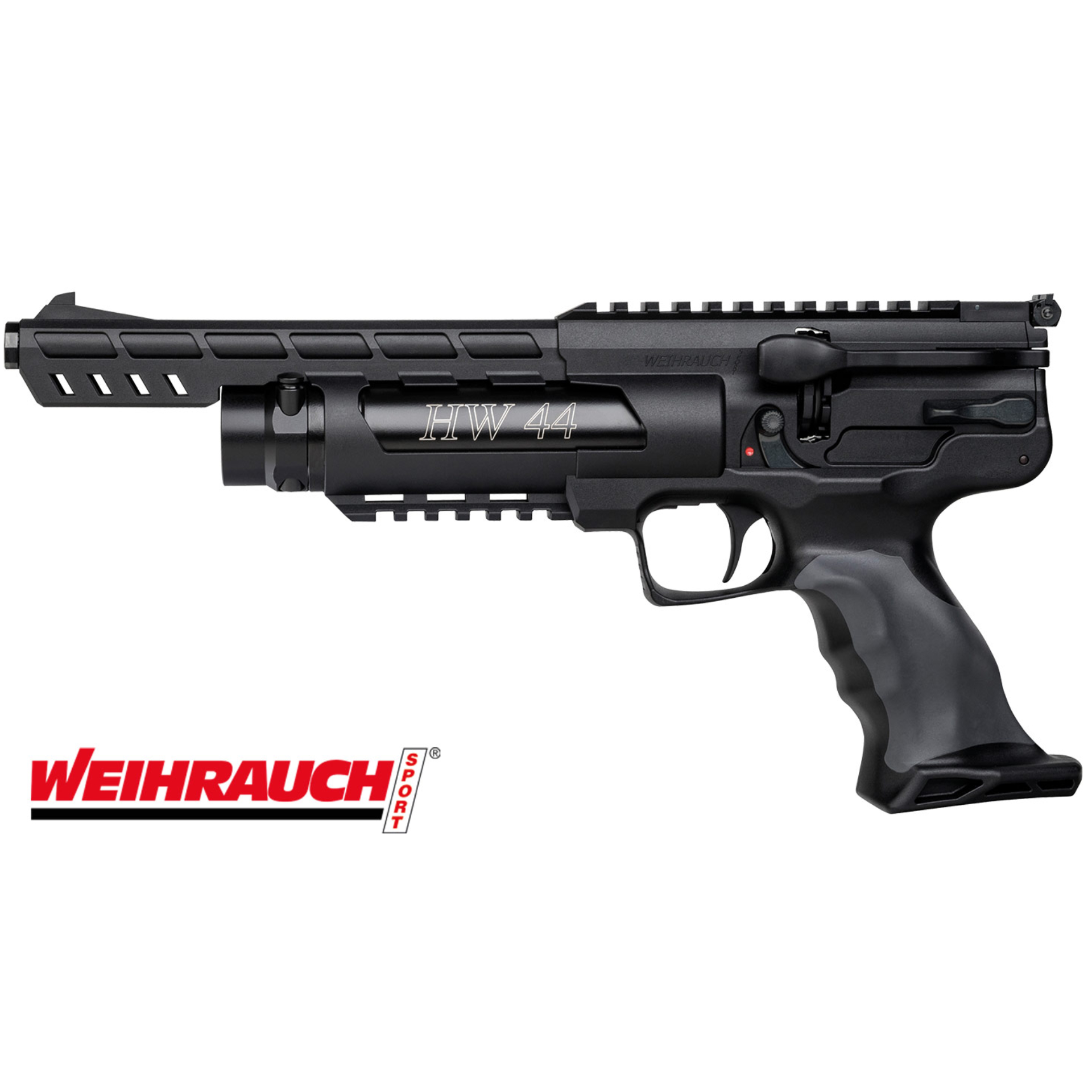
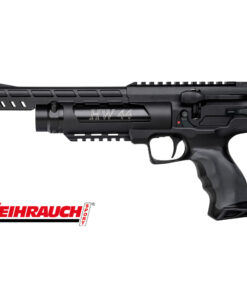
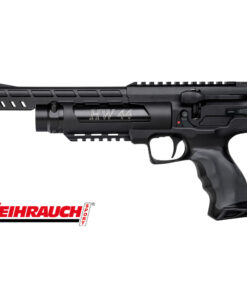
Exceptional German engineering is embodied by the Weihrauch HW44 Air Pistol PCP. Consequently, a recoilless pre-charged platform is offered to shooters who demand rifle-like consistency from a compact handgun. Moreover, the proven side-lever action of the HW110 rifle is scaled into a well-balanced pistol chassis. Therefore, vibration-free shot release is delivered shot after shot. In addition, inclusive design choices are incorporated so that both left-handed and right-handed shooters are accommodated without compromise.
Design Heritage and Build Quality of the Weihrauch HW44 Air Pistol PCP
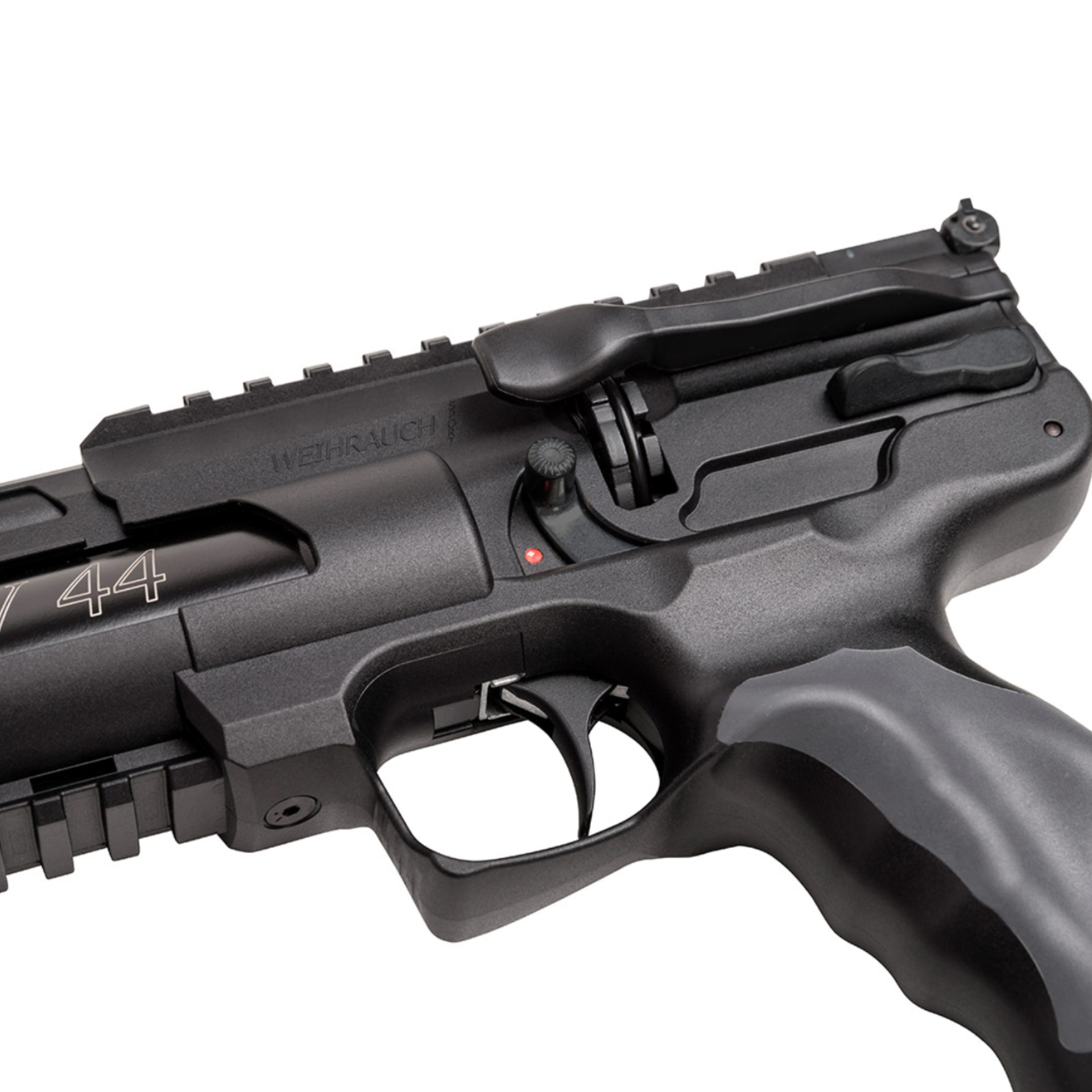
A ballistic-polymer frame is employed throughout the Weihrauch HW44 Air Pistol PCP. As a result, durability is combined with a manageable overall mass of approximately 1.3 kg. Furthermore, a total length of 337 mm is maintained, while a match-grade barrel of 247 mm is fitted. Meanwhile, two Picatinny rails are integrated so that optics, red-dot sights, or lasers can be mounted with ease. Likewise, fully adjustable open sights are provided for immediate use. Notably, a slip-resistant ambidextrous grip is moulded so that a secure hold is achieved during extended sessions. Through this compact layout, balance is preserved even when a moderator or compact scope is added.
PCP Powerplant, Regulator, and Fill System
A built-in air cartridge is charged to a maximum of 200 bar through a quick-fill probe. Subsequently, remaining pressure is displayed on an integral forward-facing gauge. In addition, a regulated valve system is utilised so that velocity consistency is preserved across a long shot string. Consequently, more than 100 shots in .177 and approximately 125 shots in .22 are typically obtained from a single fill on the 7.5-joule specification. Moreover, high-power FAC versions are offered where local regulations permit greater energy.
Dry, filtered diving-quality air is required for charging. Therefore, a standard probe and friction-fit plug are supplied so that the fill port is protected when not in use. After each session, residual pressure can be monitored at a glance. Thus, unexpected drop-off is avoided and session planning is simplified. Because overfilling is prohibited, the 200-bar limit must be observed at all times.
Side-Lever Action and Ten-Shot Magazine
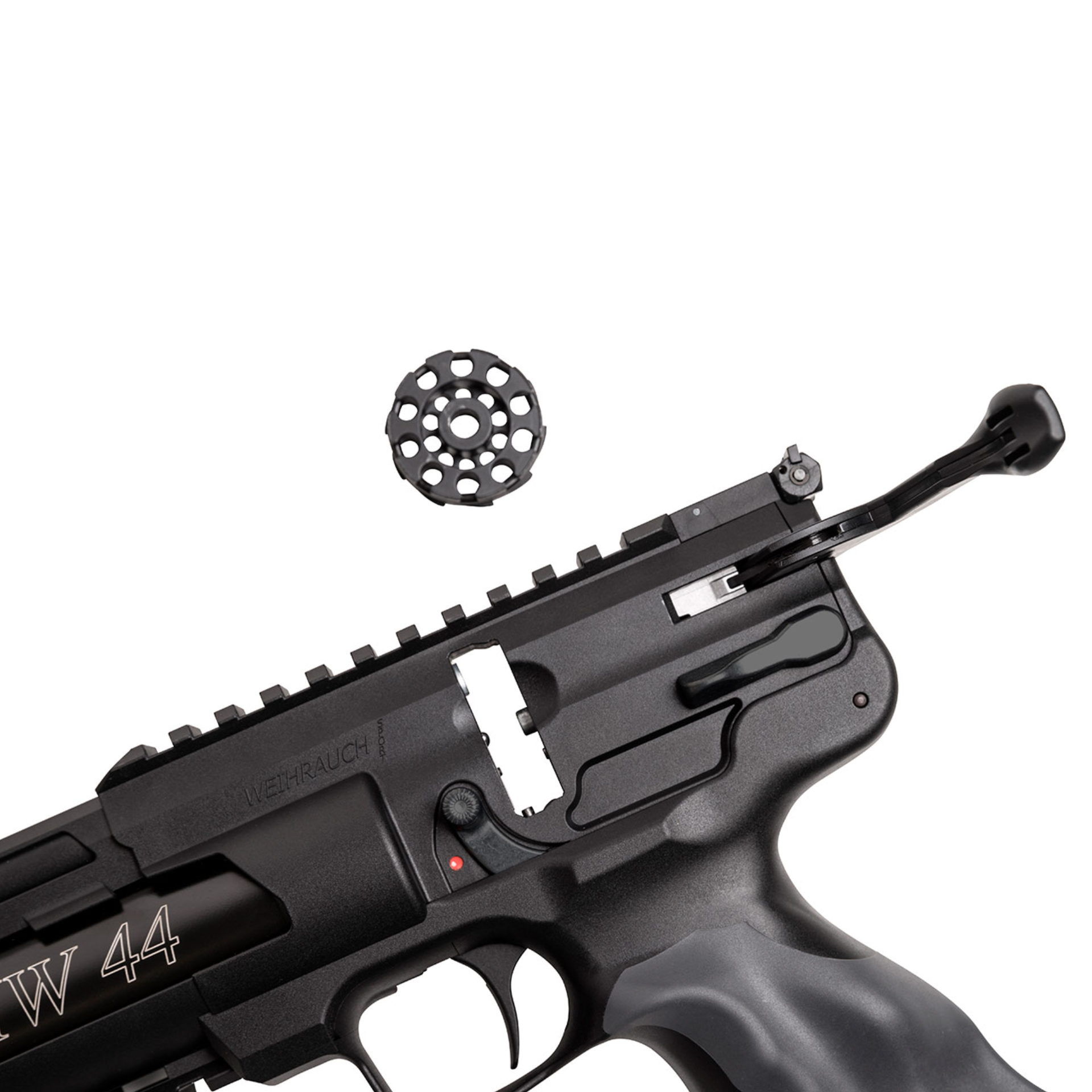
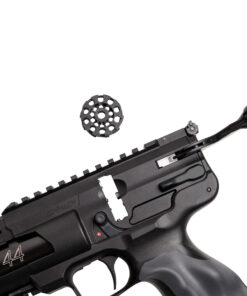
Rapid repeating is enabled by a smooth side-lever mechanism. Meanwhile, a 10-shot rotary magazine is inserted from the left after the retaining catch is lifted. Two magazines are included so that uninterrupted practice can be maintained. Importantly, double-loading is prevented by the action design. As a result, pellets are indexed cleanly and reliably. Furthermore, a single-shot tray can be fitted by many owners when competition rules require it. Loading of the rotary magazine is completed by simply seating quality diabolo pellets into each chamber.
Trigger, Safety, and Handling Characteristics
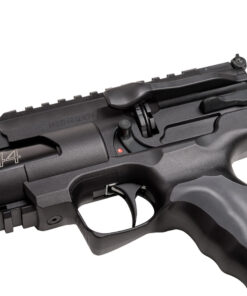
A two-stage adjustable match trigger is fitted as standard. Consequently, a crisp, clean break is produced after a short first stage. Additionally, the trigger blade is broad and slightly curved so that consistent finger placement is encouraged. A manual ambidextrous safety is located on both sides of the action. Therefore, the pistol can be made safe or ready without a change of grip. Vibration-free shot release is repeatedly praised in independent tests because recoil is virtually eliminated. Handling comfort is further supported by the stippled, semi-anatomical grip surfaces.
Accuracy Potential Across Distances
Sub-20 mm groups at 25 metres have been recorded from a rest. Moreover, quarter-inch clusters at 30 yards have been printed once a compact pistol scope is mounted. Through the combination of a match-grade barrel, regulated output, and a recoilless cycle, rifle-class precision is placed in the palm. Freehand spinning targets at 15 metres are regularly engaged by developing shooters. Meanwhile, advanced competitors can exploit the platform for pistol field-target and long-range plinking. Consistency of a few feet per second over a ten-shot string is commonly reported on chronograph tests.
Calibres, Power Options, and Inclusive Use Cases
Three calibres are listed by the manufacturer: .177, .20, and .22. Accordingly, two power bands are typically offered so that legal limits in different markets can be respected.
Highlighted specifications of the Weihrauch HW44 Air Pistol PCP:
- Action: Side-lever, multi-shot PCP
- Magazine capacity: 10-shot rotary (two magazines supplied)
- Fill pressure: 200 bar maximum
- Barrel length: 247 mm
- Overall length: 337 mm (moderator extra)
- Weight: Approximately 1.3 kg
- Trigger: Two-stage adjustable match trigger
- Safety: Manual, ambidextrous
- Grip: Slip-resistant, ambidextrous polymer
- Rails: Dual Picatinny (optics and accessory)
- Sights: Adjustable open sights plus rail
- Regulator: Integrated regulated-valve system
- UK-legal energy: 7.5 J with 105–125 shots depending on calibre
- FAC / high-power options: Up to 18–25 J with reduced shot count
- Handedness: Standard and left-hand configurations available
- Optional extras: Moderator, compact pistol scope, single-shot loader
Because both sub-12 ft-lb and higher-energy versions are produced, legal compliance can be observed in multiple jurisdictions. Training, backyard plinking, pest management at appropriate ranges, and formal pistol disciplines are all supported. Inclusive language is reflected in the ambidextrous grip and optional left-hand action so that no shooter is excluded by dominant-hand preference.
Accessories, Quiet Operation, and Long-Term Ownership
An optional moderator is offered so that report is further reduced. Consequently, neighbour-friendly sessions become practical. In addition, a compact long-eye-relief pistol scope can be mounted on the upper rail so that the full accuracy potential is unlocked. Dual rails also allow a laser or light to be fitted underneath. Maintenance remains straightforward: quality diabolo pellets are recommended, and the cylinder must never be filled beyond 200 bar. After ten years of service, cylinder inspection is advised by the manufacturer.
German manufacturing standards are applied throughout. Therefore, a long service life is reasonably expected when the pistol is charged with clean air and stored correctly. Spare magazines, fill probes, and aftermarket single-shot loaders remain widely available. Thus, the Weihrauch HW44 Air Pistol PCP can be kept in competition-ready condition for many seasons.
Ultimately, a rare combination of compact handling, high shot count, match-grade trigger, and genuine long-range accuracy is delivered. Shooters seeking a recoilless, multi-shot PCP pistol that can be configured for either legal-limit or FAC use are therefore well served. Responsible ownership, local airgun laws, and safe storage practices are expected of every user before the Weihrauch HW44 Air Pistol PCP is taken to the range.
Weihrauch Air Rifles, PCP Platforms, Spring-Piston Systems, and Related Airgun Terminology
Enthusiasts researching premium German airgun engineering frequently encounter models and search terms such as Weihrauch HW100X Karbine, Thumbhole PCP Air Rifle, hw35, h 45, german air rifle, accurate air rifles, hw97k, hw 70, hw35e for sale, hw40, weihrauch hw30, weihrauch hw80, weihrauch hw 95, hw100, hw 97k, hw35 air rifle, hw50 s, weihrauch hw45, weihrauch english, weihrauch hw98, weihrauch englisch, hw77 air rifle, weihrauch hw50s, compressed air rifles, air rifle makes, spring piston, what are air rifles, weihrauch hw44, air shot gun, sk x rifles, weihrauch hw50, hw30s, hw 30, what are air pistols, hw50, and rifles de aire.
Within the Weihrauch lineup, the Weihrauch HW77 air rifle is widely recognized as a traditional fixed-barrel underlever platform. Related terminology includes HW77 Green Laminate rifle, Weihrauch underlever air rifle, HW77 spring piston air rifle, Weihrauch HW77 for sale, and German precision air rifle. Researchers comparing versions may also encounter phrases such as buy Weihrauch HW77 Green Laminate online, Weihrauch HW77 Green Laminate price and specs, Weihrauch HW77 accuracy review, HW77 Green Laminate vs HW97 comparison, is Weihrauch HW77 good for beginners, precision shooting airgun, high quality German airguns, best price Weihrauch HW77, where to buy Weihrauch HW77, Weihrauch HW77 in stock, affordable premium air rifle, and top rated underlever air rifle.
Technical comparison searches commonly include Weihrauch HW77 vs HW97, HW77 vs break barrel air rifle, best Weihrauch air rifles, most accurate air rifle for target shooting, air rifle with low recoil, durable air rifle for outdoor use, and reliable air rifle for long term use. These phrases generally reflect interest in operating systems, mechanical durability, handling characteristics, consistency, and the differences between fixed-barrel underlever designs, break-barrel rifles, and PCP platforms.
Other Weihrauch-related terminology includes air pistols, hw100 airgun, weihrauch hw95, weihrauch hw 30, weihrauch hw90, hw 44, hw 40, hw 98, and weihrauch hw100. The HW100 family represents the PCP side of Weihrauch’s catalog, while models such as the HW30, HW50, HW80, HW90, HW95, HW97, and HW98 are associated with spring-powered or gas-ram-style sporting airgun platforms depending on the specific model and configuration. By contrast, the HW44 is commonly discussed as a PCP air pistol.
The broader airgun market also includes search terminology connected with alternative PCP manufacturers and modern platforms. Examples include 25 karma, pcp bb gun, karma eq air rifle, karma red panda, panda guns, full auto pcp, karma sls compact, air karma, red panda hat, eq air, karma sls, eq magazine, air pcp, and karma airguns. These terms may refer to specific products, product families, accessories, community terminology, or unrelated search phrases that appear alongside airgun research.
Reximex is another name frequently encountered in PCP discussions. Related search phrases include reximex airguns, reximex rp, reximex throne gen 2, reximex mito, reximex rpa, sbs12, reximex mitos, reximex lieva, reximex accura pcp air rifle, and reximex throne gen2. Model naming can vary slightly between retailers, regions, and search listings, which explains variations such as “Throne Gen 2” and “Throne Gen2” or “Mito” and “Mitos.”
Airgun research also involves understanding velocity and energy. Searches such as fps to joules calculator, fps to ft lbs, and airgun calculator relate to converting projectile velocity and mass into kinetic-energy measurements. These calculations are commonly used for technical comparison, range evaluation, regulatory research, and understanding how different compressed-air or spring-powered platforms perform within their intended specifications.
More general discovery terms can include gunseek and yivli av tüfeği, alongside broader international phrases such as rifles de aire. Because airgun terminology varies considerably between English, German, Spanish, and Turkish-speaking markets, researchers may encounter several different naming conventions for comparable sporting, target, and recreational airgun platforms.
Taken together, terms ranging from Weihrauch HW100X Karbine and Thumbhole PCP Air Rifle to HW77 Green Laminate rifle, spring piston, compressed air rifles, karma airguns, and reximex airguns illustrate the diversity of modern airgun technology. Weihrauch remains particularly associated with German engineering, fixed-barrel underlever rifles, traditional spring-powered designs, precision PCP systems, and air pistols, while Karma and Reximex represent additional names encountered when comparing contemporary PCP platforms and associated airgun technology.
Calibres, FAC Options, Power Output, and Accessories for the Weihrauch HW44 Air Pistol PCP
A carefully planned range of calibres, power bands, and supporting accessories is offered with the Weihrauch HW44 Air Pistol PCP. Consequently, legal-limit use, FAC-rated performance, and tailored shooting roles can all be addressed from the same proven platform. Moreover, inclusive choices are provided so that left-handed and right-handed shooters, beginners, and advanced competitors are equally served. Therefore, the correct combination of pellet size, energy, and add-ons can be selected before the first fill is taken.
Available Calibres of the Weihrauch HW44 Air Pistol PCP
Three factory calibres are listed by Weihrauch: .177 (4.5 mm), .20 (5.0 mm), and .22 (5.5 mm). Accordingly, trajectory, pellet mass, and on-target energy can be matched to the intended discipline. Furthermore, quality diabolo pellets only are specified so that the match-grade barrel and rotary magazine are protected.
.177 Calibre Performance
A flatter trajectory is typically produced in .177. As a result, holdover is reduced at pistol distances of 10–25 metres. Additionally, a higher shot count is obtained on the 7.5-joule specification, with approximately 105 consistent shots commonly recorded from a 200-bar fill. Meanwhile, the high-power listing of 230 m/s and 18 J is reserved for jurisdictions in which elevated muzzle energy is permitted. Lightweight match pellets are frequently favoured so that grouping is tightened on paper and spinning targets.
.20 Calibre Balance
A middle path between speed and strike energy is struck by .20. Consequently, a useful compromise is delivered for shooters who want more pellet mass than .177 without the extra drop of .22. Moreover, official figures of 150 m/s at 7.5 J (about 115 shots) and 217 m/s at 21 J (about 20 shots) are published. Therefore, this calibre is often chosen when a single pistol must cover both training and more demanding outdoor work.
.22 Calibre Authority
Greater pellet mass and retained energy at the target are associated with .22. In addition, the legal-limit listing of 125 m/s at 7.5 J yields approximately 125 shots per fill. Likewise, the high-power figure of 174 m/s and 25 J is stated for FAC or export specifications. Heavy match or hunting-weight diabolo pellets are commonly seated so that consistency through the regulator is maximised. Because wind drift is more noticeable, careful pellet selection remains essential.
Highlighted calibre and power listings for the Weihrauch HW44 Air Pistol PCP:
- .177 legal-limit: 170 m/s – 7.5 J – approx. 105 shots
- .20 legal-limit: 150 m/s – 7.5 J – approx. 115 shots
- .22 legal-limit: 125 m/s – 7.5 J – approx. 125 shots
- .177 high-power / FAC-style: 230 m/s – 18 J – approx. 20 shots
- .20 high-power / FAC-style: 217 m/s – 21 J – approx. 20 shots
- .22 high-power / FAC-style: 174 m/s – 25 J – approx. 20 shots
- Maximum fill: 200 bar on all versions
- Magazine: 10-shot rotary, two units supplied
FAC, Legal Limits, and Responsible Power Choice
Power output is not a single number on the Weihrauch HW44 Air Pistol PCP. Instead, two distinct bands are manufactured so that national airgun laws can be observed. In the United Kingdom, air pistols above 6 ft-lb (approximately 8.1 J) are subject to Firearm Certificate control. Consequently, the widely distributed 7.5 J specification is aligned with unlicensed pistol limits in that market. Elsewhere, higher-energy FAC or export versions are supplied where certificates, licences, or unrestricted ownership are already in place.
A regulated valve system is used so that velocity spread is kept tight across the usable portion of the charge. Therefore, a subtle power curve of roughly 15 fps over a long string is typical rather than a sharp collapse. Importantly, advertised shot counts on high-power models are lower because more air is consumed per discharge. Local statutes, transport rules, and storage requirements must be verified by every purchaser before an FAC-rated Weihrauch HW44 Air Pistol PCP is ordered. Inclusive, responsible ownership is expected of all users regardless of experience level.
Factory and Aftermarket Accessories
A practical accessory ecosystem is built around the Weihrauch HW44 Air Pistol PCP. Dual Picatinny rails are integrated from the factory so that optics and under-barrel devices can be fitted without gunsmithing. Open sights with a fully adjustable rear notch are also provided, and the front blade height is chosen so that an optional moderator can still be used with iron sights.
Optics, Moderator, and Sighting Options
A compact long-eye-relief pistol scope is frequently mounted on the upper rail. As a result, the pistol’s sub-20 mm potential at 25 metres is more easily realised. Additionally, a red-dot or miniature reflex sight can be preferred for rapid target acquisition. An optional Weihrauch moderator is offered at extra charge so that muzzle report is reduced for garden or club use. Because the moderator lengthens the overall profile, local pistol-length rules should be checked where they apply.
Magazines, Loaders, and Fill Equipment
Two 10-shot rotary magazines are included in the box. Spare magazines can be kept loaded so that range time is not interrupted. Furthermore, aftermarket single-shot loaders are produced by specialist makers for HW110/HW44 actions. These trays are inserted after the magazine catch is lifted and are valued in events where a magazine is not permitted. A tapered quick-fill probe and friction-fit port plug are supplied as standard. A 200-bar capable hand pump, compressor with a 200-bar limiter, or diving cylinder with a suitable reducer can therefore be used for charging.
Handedness, Grips, and Support Gear
A left-hand action is available against extra charge so that the side-lever and magazine catch are reversed. Meanwhile, the standard slip-resistant polymer grip is already ambidextrous. Trigger adjustment is possible after the grip panels are removed, although the factory setting is widely left unchanged. A compact range bag, quality diabolo pellets matched to calibre, and a protective case complete a practical kit. Inclusive fit is thus supported for a wide range of hand sizes and shooting styles.
Practical Use Scenarios for Everyday and Advanced Shooting
A compact pre-charged pistol of this class is intended to be used across many real-world settings rather than a single discipline. Consequently, backyard sessions, formal club nights, skill-building drills, and carefully judged outdoor work can all be supported when local laws and safe backstops are observed. Moreover, recoilless discharge, a regulated air supply, and a ten-shot magazine are combined so that long strings can be fired without the fatigue associated with spring-piston handguns. Therefore, practical use is best planned around distance, pellet choice, sighting method, and the legal energy band that has been purchased.
Inclusive participation is encouraged throughout. Left-handed and right-handed shooters are accommodated by an ambidextrous grip, and an optional reversed action can be specified where the side-lever must sit on the opposite side. Beginners and experienced competitors can share the same platform because trigger weight, sight picture, and shot cycle remain predictable. Responsible ownership, eye protection, and a verified safe direction are assumed in every scenario described below.
Garden and Home-Range Plinking
Short-range enjoyment is most often sought in a private garden where a pellet trap or dense backstop has already been installed. Distances of eight to fifteen metres are typically chosen so that open sights or a compact red-dot can be used without excessive holdover. Subsequently, a legal-limit fill is preferred in many domestic settings because report and carry-through are kept modest. An optional moderator is frequently fitted so that neighbours are less likely to be disturbed.
A spinning target or resettable plate is placed at a known range. Meanwhile, the ten-shot magazine is loaded with a single consistent diabolo so that variables are reduced. After the side-lever is cycled, a two-stage trigger press is completed and the impact is observed. Because recoil is virtually absent, the sight picture can be held through the shot. As a result, immediate feedback is given and small corrections to grip or trigger timing can be made between strings.
Highlighted checks that are completed before a garden session:
- A safe, impenetrable backstop is confirmed
- Local airgun and discharge rules are reviewed
- Eye protection is worn by every person present
- The fill pressure is kept at or below the marked maximum
- Only diabolo pellets of the correct calibre are seated
- The muzzle is pointed in a safe direction during magazine changes
- Spent pellets and lead fragments are collected after shooting
During warm weather, a short session of three or four magazines is often enough to maintain familiarity without wasting air. In cooler months, a slightly longer string can be fired because velocity consistency remains useful for learning hold and follow-through. Ultimately, the garden is treated as a training space rather than a playground, and the pistol is locked away unloaded when the session is finished.
Club Range Practice and Formal Pistol Disciplines
A different rhythm is adopted on a club range. Distances are marked, benches or standing positions are assigned, and other members must be considered. Consequently, the pistol is carried cased until the firing point is reached. The magazine is loaded at the bench, the safety is applied until the range is declared live, and shots are fired only on command where that protocol exists.
Open sights can be retained for traditional pistol practice. Alternatively, a long-eye-relief optic is mounted on the upper rail so that groups at twenty and twenty-five metres can be studied. Tight clusters from a rest have been recorded with this action, yet freehand standing work remains the more honest test of the shooter. Therefore, mixed strings are recommended: five shots from a bag or rest, followed by five shots unsupported.
Pistol field-target and similar timed or positional events can also be attempted where club rules allow a pre-charged handgun. Knockdown targets at varying ranges reward a stable grip and a clean second-stage break. Because double-loading is mechanically discouraged by the action, a missed cycle is less likely to produce a dangerous double feed. After each detail, the magazine is removed, the action is shown clear, and the pistol is bagged before it is carried from the line.
Inclusive coaching is easily arranged. A new shooter can be introduced to the side-lever and safety while an experienced member observes from the side. Recoilless behaviour reduces flinch that is often learned on spring pistols. Meanwhile, the adjustable match trigger can be left at the factory setting until confidence is established. Group notes, not scores alone, are recorded so that progress is visible from week to week.
Skill Transfer, Dry Practice, and Trigger Mastery
Many owners treat the compact PCP as a training aid for larger rifles that share a similar side-lever and magazine philosophy. Trigger discipline, follow-through, and a locked high grip are rehearsed in miniature. Subsequently, those habits are transferred to a full-size PCP on a later range day. Consistency of hold is easier to study when recoil is almost entirely absent.
Dry handling, with an empty magazine and a confirmed empty barrel, can be used at home where it is legal and safe to do so. The side-lever stroke is practised until it becomes smooth. The safety is moved on and off without shifting the firing grip. A wall-safe aiming mark is used only when the pistol is verified unloaded. Live fire is never mixed with dry practice in the same room without a complete safety reset.
Pellet testing is another practical use. A chronograph is placed at a safe distance and a single pellet type is run through a ten-shot string. Velocity spread is noted. Then a second head size or weight is substituted. Because a regulated valve is employed, the middle of the charge is usually the most stable region for comparison. Notes are kept so that a club pellet and a wind pellet can be identified for each calibre that is owned. Those notes later guide which tin is packed for still evenings and which tin is reserved for breezy club nights.
Quiet Outdoor Walks and Ethical Close-Range Work
Where national law permits an air pistol to be carried and used for pest management, ethical close-range work can be considered only after several conditions are met. Landowner permission is obtained. A safe backstop is present behind every shot. The quarry is within the effective range of the chosen energy level. A clean, instant dispatch is the only acceptable outcome. If any of those conditions cannot be guaranteed, the shot is not taken.
Legal-limit pistols are modest in energy compared with FAC rifles. Consequently, distances are kept short and shot placement is restricted to appropriate targets at ranges the shooter has already proved on paper. High-power versions, where legally held on the correct certificate, still demand the same ethical standard. Power on a specification sheet is never treated as a substitute for judgement.
A moderator is especially useful outdoors because it reduces the chance of alarming livestock or nearby houses. A compact red-dot or low-power pistol scope can be preferred when light is fading, provided zero has been confirmed that same day. Two loaded magazines may be carried in a pouch, yet the pistol itself is kept safe until the moment of use. After the outing, every pellet is accounted for and the cylinder pressure is checked before the next fill.
Travel, Holiday Ranges, and Compact Kit Building
The short overall length makes transport simpler than a carbine. A lockable case, a small tin of pellets, a fill probe, and a spare magazine form a complete kit that can be taken to a holiday club or a friend’s permission. Airline and border rules for compressed-air cylinders must be read in advance; many travellers empty the onboard reservoir before any flight and refill at the destination. Documentation of energy rating and ownership is carried where inspectors may request it.
On an unfamiliar range, a conservative zero is established first at ten metres, then confirmed at the distance that will actually be used. Wind, altitude, and a different pellet batch can all move point of impact. Therefore, no remembered zero from home is trusted without a confirmation group. Inclusive groups of mixed experience can share the same pistol because the grip and trigger do not require large hands or unusual strength. A brief safety briefing is given before the first magazine is inserted so that every participant understands the side-lever, the safety, and the cease-fire procedure.
Long-Range Pistol Challenges and Optic-Aided Practice
Although the platform is a handgun, surprising distance work is possible once an optic is fitted. Cards at twenty-five and thirty metres have been used in published tests, and very small groups have been produced from a rest when the shooter does their part. Practical use of that potential looks like this: a stable sitting or kneeling position is adopted, the wrist is locked, breathing is settled, and the second stage is pressed without disturbing the sight picture.
Holdover charts can be built for one pellet. Five-shot groups are fired at each distance. The centre of each group is measured and recorded. Those notes become a field card that is kept in the case. Freehand work at the same distances is then attempted so that the difference between mechanical accuracy and field accuracy is understood. Frustration is avoided when expectations are matched to position and wind.
A lower rail can accept a laser for dry or close-range drills where rules allow aiming devices. The laser is zeroed to the same pellet and distance as the iron or optical sight. Alignment is checked often because mounts can shift. The laser is treated as a training aid, not a substitute for a proper sight picture in formal events.
Session Planning, Air Management, and Aftercare
Practical use is unfinished until air, pellets, and the pistol itself are put away correctly. A 200-bar fill yields a large number of shots on legal-limit settings and a smaller number on high-energy settings. Session length is therefore planned against the gauge, not against optimism. When the needle approaches the region where the power curve steepens, the string is ended and a refill is arranged.
After shooting, the magazine is emptied. The barrel is confirmed clear. The exterior is wiped. The fill port plug is replaced. The pistol is stored in a secure cabinet, separate from pellets, in accordance with local secure-storage rules. Cylinders on this design are integral; they are never heated, overfilled, or used past the inspection interval recommended by the maker.
A simple log supports better practical use over months. Date, calibre, pellet, fill pressure, number of shots, and a one-line note on grouping or wind are recorded. Patterns appear. A particular pellet that grouped in still air may open in a cross-wind. A grip change that felt odd on day one may produce tighter freehand clusters by week four. Inclusive review of that log with a club coach can accelerate improvement for shooters of any background.
Matching Scenario to Power Band and Accessories
Not every accessory is required for every outing. Garden plinking is well served by open sights, a moderator, and a single pellet trap. Club grouping benefits from a compact scope and a rest bag. Ethical outdoor work, where lawful, depends more on permission, backstop, and shot selection than on extra rails. Long-range experiments are safer when a chronograph and a large paper target are added before steel is ever placed downrange.
Power band is chosen first, accessories second. A legal-limit pistol is the correct tool for most unlicensed domestic and club use. A higher-energy version is only brought into play where the certificate, the land, and the task all justify it. Mixing the two roles in one outing without a clear plan leads to either wasted air or an unethical shot. Clear planning prevents both.
Through these scenarios, the compact pre-charged pistol is used as a precise, quiet, and inclusive training and sporting tool. Distances stay inside proven capability. Laws are followed. Other people on the range or in the garden are respected. When those habits are kept, the same platform can provide years of measured, enjoyable practice rather than a short burst of novelty. The next session is then planned from the log, the gauge, and the backstop—not from impulse.
Calibres, FAC Options, Power Output, and Accessories
A carefully planned range of calibres, power bands, and supporting accessories is offered with the Weihrauch HW44 Air Pistol PCP. Consequently, legal-limit use, FAC-rated performance, and tailored shooting roles can all be addressed from the same proven platform. Moreover, inclusive choices are provided so that left-handed and right-handed shooters, beginners, and advanced competitors are equally served. Therefore, pellet size, energy level, and add-ons should be selected together before the first 200-bar fill is taken.
Available Calibres
Three factory calibres are listed by the manufacturer: .177 (4.5 mm), .20 (5.0 mm), and .22 (5.5 mm). Accordingly, trajectory, pellet mass, and on-target energy can be matched to the intended discipline. Furthermore, quality diabolo pellets only are specified so that the match-grade barrel and rotary magazine are protected.
.177 Calibre
A flatter trajectory is typically produced in .177. As a result, holdover is reduced at pistol distances of 10–25 metres. Additionally, a higher shot count is obtained on the 7.5-joule specification, with approximately 105 consistent shots commonly recorded from a full fill. Meanwhile, the high-power listing of 230 m/s and 18 J is reserved for jurisdictions in which elevated muzzle energy is permitted. Lightweight match pellets are frequently favoured so that grouping is tightened on paper and spinning targets.
.20 Calibre
A middle path between speed and strike energy is struck by .20. Consequently, more pellet mass than .177 is delivered without the extra drop of .22. Moreover, official figures of 150 m/s at 7.5 J (about 115 shots) and 217 m/s at 21 J (about 20 shots) are published. Therefore, this calibre is often chosen when one pistol must cover both training and more demanding outdoor work.
.22 Calibre
Greater pellet mass and retained energy at the target are associated with .22. In addition, the legal-limit listing of 125 m/s at 7.5 J yields approximately 125 shots per fill. Likewise, the high-power figure of 174 m/s and 25 J is stated for FAC or export specifications. Heavy match or hunting-weight diabolo pellets are commonly seated so that consistency through the regulator is maximised. Because wind drift is more noticeable, careful pellet selection remains essential.
Highlighted calibre and power listings:
- .177 legal-limit: 170 m/s – 7.5 J – approx. 105 shots
- .20 legal-limit: 150 m/s – 7.5 J – approx. 115 shots
- .22 legal-limit: 125 m/s – 7.5 J – approx. 125 shots
- .177 high-power / FAC-style: 230 m/s – 18 J – approx. 20 shots
- .20 high-power / FAC-style: 217 m/s – 21 J – approx. 20 shots
- .22 high-power / FAC-style: 174 m/s – 25 J – approx. 20 shots
- Maximum fill: 200 bar on all versions
- Magazine: 10-shot rotary, two units supplied
FAC, Legal Limits, and Responsible Power Choice
Power output is not a single number on the Weihrauch HW44 Air Pistol PCP. Instead, two distinct bands are manufactured so that national airgun laws can be observed. In the United Kingdom, air pistols above 6 ft-lb (approximately 8.1 J) are subject to Firearm Certificate control. Consequently, the widely distributed 7.5 J specification is aligned with unlicensed pistol limits in that market. Elsewhere, higher-energy FAC or export versions are supplied where certificates, licences, or unrestricted ownership are already in place.
A regulated valve system is used so that velocity spread is kept tight across the usable portion of the charge. Therefore, a subtle power curve of roughly 15 fps over a long string is typical rather than a sharp collapse. Importantly, advertised shot counts on high-power models are lower because more air is consumed per discharge. Local statutes, transport rules, and storage requirements must be verified by every purchaser before an FAC-rated example is ordered. Inclusive, responsible ownership is expected of all users regardless of experience level.
Factory and Aftermarket Accessories
A practical accessory ecosystem is built around this platform. Dual Picatinny rails are integrated from the factory so that optics and under-barrel devices can be fitted without gunsmithing. Open sights with a fully adjustable rear notch are also provided, and the front blade height is chosen so that an optional moderator can still be used with iron sights.
Optics, Moderator, and Sighting Options
A compact long-eye-relief pistol scope is frequently mounted on the upper rail. As a result, sub-20 mm potential at 25 metres is more easily realised. Additionally, a red-dot or miniature reflex sight can be preferred for rapid target acquisition. An optional factory moderator is offered at extra charge so that muzzle report is reduced for garden or club use. Because the moderator lengthens the overall profile, local pistol-length rules should be checked where they apply.
Magazines, Loaders, and Fill Equipment
Two 10-shot rotary magazines are included in the box. Spare magazines can be kept loaded so that range time is not interrupted. Furthermore, aftermarket single-shot loaders are produced by specialist makers for this action family. These trays are inserted after the magazine catch is lifted and are valued in events where a magazine is not permitted. A tapered quick-fill probe and friction-fit port plug are supplied as standard. A 200-bar capable hand pump, a compressor with a 200-bar limiter, or a diving cylinder with a suitable reducer can therefore be used for charging.
Handedness, Grips, and Support Gear
A left-hand action is available against extra charge so that the side-lever and magazine catch are reversed. Meanwhile, the standard slip-resistant polymer grip is already ambidextrous. Trigger adjustment is possible after the grip panels are removed, although the factory setting is widely left unchanged. A compact range bag, quality diabolo pellets matched to calibre, and a protective case complete a practical kit. Inclusive fit is thus supported for a wide range of hand sizes and shooting styles.
Through this combination of three calibres, two power bands, and a mature accessory list, the Weihrauch HW44 Air Pistol PCP can be specified for club training, precision plinking, or licensed higher-energy work. Legal compliance, correct pellet choice, and appropriate add-ons should be confirmed together so that performance, safety, and enjoyment are all protected.


Reviews
There are no reviews yet.