Precision Power Is Delivered by the Weihrauch HW45 Air Pistol
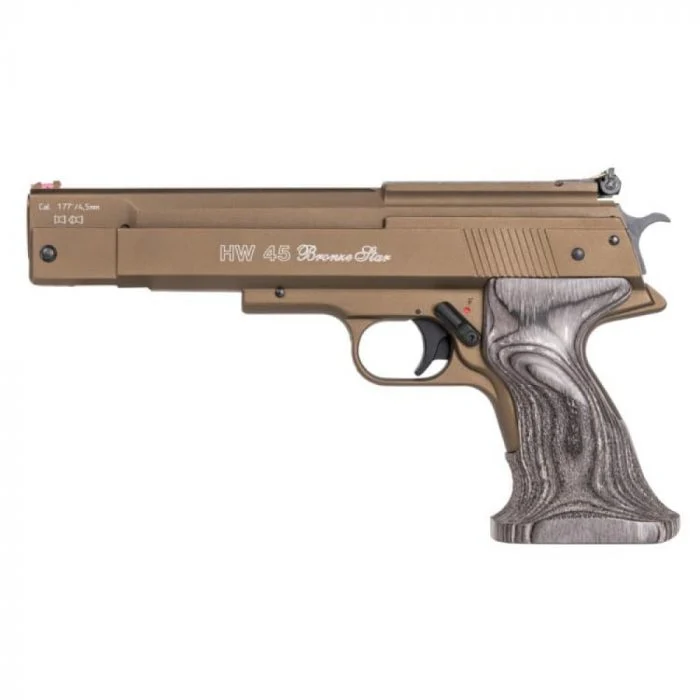
Remarkable performance is consistently associated with the Weihrauch HW45 Air Pistol by shooters who value compact size, German engineering, and selectable power. Inspired by a classic service-pistol silhouette, this spring-piston over-lever design is offered as one of the most capable air pistols in its class. Consequently, training, plinking, and close-range pest work can all be approached with a single, self-contained platform. Furthermore, no external air source is required, so sessions can be enjoyed anywhere legal shooting is permitted.
Moreover, two power levels are selected simply by the angle to which the cocking lever is raised. Reduced energy is produced when the action is cocked to approximately 90 degrees, while maximum output is engaged when the lever is fully opened. Therefore, indoor practice and outdoor use can both be accommodated without extra equipment. In addition, a dry-fire facility is incorporated so that trigger control can be refined safely between live strings.weihrauch hw90
Dual-Power Spring Action and Proven Construction
A robust spring-piston mechanism is housed within a steel lower frame and an alloy upper section that is finished to Weihrauch’s exacting standard. As a result, durability and a satisfying all-metal feel are provided in a package that weighs approximately 1.15 kg and measures about 278 mm overall. Meanwhile, a 170 mm rifled barrel is employed so that pellet stability can be maintained downrange.h 45.hw 70
Additionally, single-shot loading is performed directly into the breech after the over-lever is opened. Subsequently, the action is closed and the selected power level is locked in. Hence, a deliberate, repeatable cycle is created that suits both newcomers and experienced pistol shooters. Likewise, a manual ambidextrous safety is fitted so that the pistol can be made safe by either right-handed or left-handed users.
Highlighted features of the Weihrauch HW45 Air Pistol include:
- Selectable dual power — lower output for practice and higher output for outdoor work, chosen by cocking angle
- Spring-piston over-lever action — self-contained power with no pumps or cylinders required
- Fully adjustable two-stage match trigger — travel and break can be tuned to individual preference
- Dry-fire facility — trigger practice can be conducted without a pellet
- Fibre-optic front sight and micrometer rear sight — windage and elevation can be adjusted with high visibility
- 11 mm dovetail rail (Picatinny adapter included on current versions) plus under-barrel rail for accessories
- Checkered ambidextrous walnut grips — a secure hold is offered to shooters of either hand
- Calibres .177, .20 (special order), and .22 — velocity and energy can be matched to the intended use
Power Levels, Calibres, and Velocity
Manufacturer figures are published as follows. In .177, approximately 125 m/s is recorded on the first power stage and about 170 m/s on the second. In .20, roughly 120 m/s and 150 m/s are listed. In .22, about 105 m/s and 125 m/s are specified. Consequently, energies in the region of 2–3 ft-lb on the low setting and around 5.5 ft-lb on the high setting are typically achieved, depending on pellet weight. Therefore, a useful spread of applications is covered while remaining within common air-pistol legal limits in many jurisdictions.
Furthermore, independent testing has shown consistent strings when quality diabolo pellets are used. Thus, grouping potential at typical pistol distances can be realised once the recoil impulse is understood and a consistent hold is applied. In contrast to multi-pump or CO2 designs, shot-to-shot variation from changing fill pressure is avoided.
Sights, Trigger, and Accessory Options
A fibre-optic enhanced front sight is paired with a fully adjustable micrometer rear sight so that both windage and elevation can be corrected. Additionally, contrast is improved in mixed light. Moreover, an 11 mm parallel prism rail is provided on the upper section; a Picatinny adapter is commonly supplied so that a compact red-dot or pistol scope can be mounted when open sights are not preferred. An extra rail under the barrel is also available on newer examples for lights or other accessories.
Meanwhile, the two-stage match-style trigger can be adjusted for first-stage travel and break weight. As a result, a crisp, predictable release can be obtained after a short familiarisation period. Inclusive design is further supported by ambidextrous grips and safety, so that left-handed and right-handed shooters are equally well served.hw 97k
Practical Use, Handling, and Care
A compact yet substantial feel is created by the 1.15 kg mass and 278 mm length. Consequently, the pistol can be held steadily for aimed fire while still remaining portable. Recoil is more noticeable on the high-power setting; therefore, a firm two-handed grip and follow-through are recommended until the cycle becomes familiar. Low power, by comparison, is often preferred for extended indoor sessions because cocking effort and muzzle jump are both reduced.hw 40
Furthermore, quality waisted pellets should be used exclusively; steel darts, balls, or similar projectiles are not recommended. Regular inspection of the breech seal and modest lubrication according to the manufacturer’s guidance will help reliability to be maintained over many thousands of shots. Storage in a dry place with the spring not left compressed for long periods is likewise advised.
Responsible ownership remains essential. Local airgun laws, age restrictions, and safe backstops must always be observed. Training and recreation can then be enjoyed with confidence by the whole shooting community.weihrauch hw 95
Why the Weihrauch HW45 Air Pistol Continues to Be Chosen
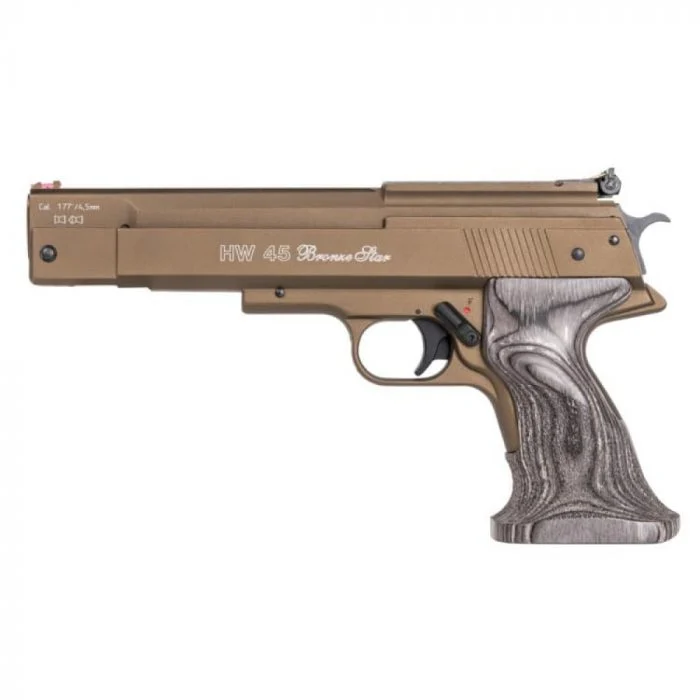
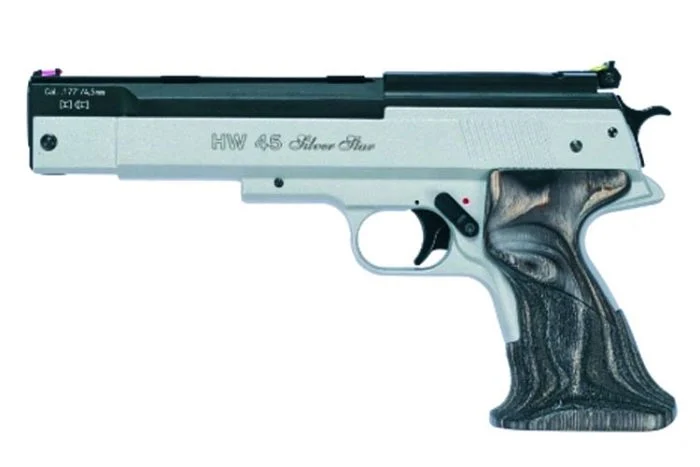
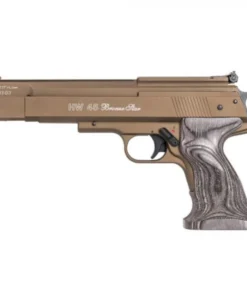
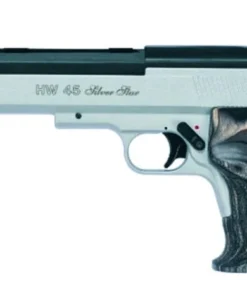
German manufacturing standards, selectable power, a match-oriented trigger, and classic styling are combined in one compact pistol. Moreover, no batteries or gas cartridges are needed, so running costs stay low after the initial purchase. In addition, variants such as Black Star, Silver Star, and Bronze Star finishes allow personal preference in appearance to be expressed without changing the core mechanism.
Ultimately, accuracy potential, build quality, and versatility are the reasons this model has remained a benchmark spring pistol for decades. When a dependable, powerful, and inclusive air pistol is required for practice or recreational shooting, the Weihrauch HW45 Air Pistol stands ready to deliver. Explore current finishes and calibres and add this proven classic to the range today.weihrauch hw80
Weihrauch HW100X Karbine, Thumbhole PCP Air Rifle, HW35, HW45, HW97K, HW70, HW40, HW30, HW80, HW95, HW98, HW77, HW50S, HW44 and HW90, while explaining differences between PCP, spring piston, underlever, break-barrel, compressed-air rifles and air pistols. It can also incorporate comparison phrases such as Weihrauch HW77 vs HW97, HW77 vs break barrel air rifle, HW77 Green Laminate vs HW97 comparison, and informational searches including what are air rifles, what are air pistols, what is a PCP air rifle, and precision shooting airgun.
For the HW77 specifically, the content can discuss the Weihrauch HW77 air rifle, HW77 Green Laminate rifle, Weihrauch underlever air rifle, HW77 spring piston air rifle, German precision air rifle, Weihrauch HW77 accuracy review, Weihrauch HW77 Green Laminate price and specs, is Weihrauch HW77 good for beginners, air rifle with low recoil, durable air rifle for outdoor use, reliable air rifle for long term use, top rated underlever air rifle, best Weihrauch air rifles, and most accurate air rifle for target shooting.hw 44
Broader terminology can also be integrated naturally, including german air rifle, accurate air rifles, compressed air rifles, air rifle makes, spring piston, air pistols, rifles de aire, high quality German airguns, affordable premium air rifle, hw100 airgun, Weihrauch HW100, Weihrauch HW95, Weihrauch HW50S, Weihrauch HW44, Weihrauch HW98, Weihrauch HW70, Weihrauch HW30, HW30S, HW50, HW50 S, HW40, HW44, HW70, HW98, HW100, HW97K, HW97K, HW35 air rifle, HW77 air rifle, Weihrauch English, Weihrauch Englisch, H45, SK X rifles, and air shot gun.weihrauch hw 30
Commercial search expressions such as Weihrauch HW35E for sale, Weihrauch HW77 for sale, buy Weihrauch HW77 Green Laminate online, best price Weihrauch HW77, where to buy Weihrauch HW77, and Weihrauch HW77 in stock can be discussed as examples of common buyer search terminology without directing readers toward acquiring a weapon.hw 98
Calibres, FAC Status, Power Output, and Accessories for the Weihrauch HW45 Air Pistol
Versatility across pellet sizes, legal power bands, and mounting options is built into the Weihrauch HW45 Air Pistol so that training, plinking, and close-range outdoor work can all be approached with one compact spring-piston platform. Consequently, calibre choice, energy output, and accessory fitment can be matched to local rules and personal preference without a change of action type. Furthermore, inclusive design is retained throughout, so that right-handed and left-handed shooters are equally well served.
Available Calibres and Typical Uses
Three pellet diameters are offered. The .177 (4.5 mm) chambering is the most common choice for target practice and indoor use because a flatter trajectory and a higher pellet count per tin are usually obtained. In addition, manufacturer velocity figures of approximately 125 m/s on the first power stage and about 170 m/s on the second stage are published for this calibre. Therefore, grouping work at typical pistol distances can be conducted with widely available match and field pellets.
Meanwhile, the .22 (5.5 mm) option is selected when greater pellet mass and a more pronounced impact signature are preferred. Lower listed speeds of roughly 105 m/s and 125 m/s are recorded on the two stages, yet usable energy is still delivered because heavier diabolo pellets are employed. As a result, outdoor plinking and careful close-range pest work (where legally permitted) can be undertaken with a round that carries more weight downrange.
A .20 (5.0 mm) barrel is listed as a special-order option. Intermediate velocity figures of about 120 m/s and 150 m/s are associated with this size. Hence, a middle path between the flatness of .177 and the mass of .22 can be chosen by shooters who already standardise on that calibre. In every case, only high-quality waisted pellets should be used; steel darts, balls, or similar projectiles are not recommended, because barrel and seal life can otherwise be reduced.
Calibre points at a glance:
- .177 (4.5 mm) — highest listed speed; favoured for practice and precision work
- .20 (5.0 mm) — special-order balance of speed and pellet weight
- .22 (5.5 mm) — greater mass per shot for outdoor recreational use
- Single-shot loading — each pellet is seated directly in the breech after the over-lever is opened
- Rifled 170 mm barrel — spin is imparted so that stability can be maintained
FAC Considerations and Legal Power Context
Because the Weihrauch HW45 Air Pistol is a pistol rather than a rifle, national energy limits that apply to hand-held airguns must be observed. In the United Kingdom, an air pistol that remains at or below 6 foot-pounds (approximately 8.1 joules) of muzzle energy is generally held without a Firearms Certificate, provided all other legal conditions are met. Independent and manufacturer figures for this model typically place full-power output in the region of 5.5 ft-lb, depending on pellet weight and the individual example. Consequently, the standard production pistol is commonly treated as a non-FAC air pistol in that jurisdiction.
Nevertheless, energy can vary slightly from gun to gun and from pellet to pellet. Therefore, chrono testing after purchase is advised wherever local rules make the exact figure important. Moreover, other countries apply different ceilings, licensing, transport, and storage rules. Inclusive responsible ownership requires that current national and local regulations be checked before purchase, import, or use. Age limits, safe-storage duties, and public-place restrictions remain in force regardless of FAC status.
In contrast to FAC-rated PCP rifles that can legally exceed 12 ft-lb in the UK when certified, this spring pistol is intentionally kept within the conventional air-pistol band. Thus, simplicity of ownership is preserved for recreational shooters while still providing one of the stronger spring-pistol outputs on the market. No certificate upgrade path is built into the design; any modification that would raise energy above the legal pistol limit would change the legal classification and must not be attempted.
Dual Power Levels and How Output Is Selected
Two energy stages are selected solely by cocking angle. Reduced power is engaged when the over-lever is raised to approximately 90 degrees. Full power is engaged when the lever is opened fully to the second detent. As a result, indoor sessions can be conducted with less cocking effort and milder recoil, while outdoor use can draw on the higher setting without a change of pistol.
Furthermore, a dry-fire facility is included so that trigger work can continue when no pellet is loaded. Recoil is more noticeable on the high setting; a firm two-handed hold and consistent follow-through are therefore recommended until the cycle is familiar. Low power is often preferred for extended practice because both fatigue and muzzle jump are reduced. Shot-to-shot consistency is typically good once quality pellets are matched to the barrel, because no reservoir pressure curve is involved.
Power and handling notes:
- Low stage — roughly 2–3.5 ft-lb class output, suited to indoor and close practice
- High stage — typically around 5.5 ft-lb, suited to outdoor plinking where legal
- Spring-piston over-lever — self-contained; no pumps, CO2, or PCP fills required
- Match-style two-stage trigger — first-stage travel and break can be adjusted
- Manual ambidextrous safety — the action can be made safe by either hand
Accessories, Optics, and Supporting Equipment
An 11 mm parallel prism rail is machined on the upper section so that a compact pistol scope or red-dot sight can be fitted. On current examples a Picatinny adapter is commonly supplied, and an additional rail under the barrel is provided for a light or other accessory. Consequently, open fibre-optic sights can be retained for traditional use, or an optic can be added when a different sight picture is preferred. Windage and elevation on the factory micrometer rear sight remain fully adjustable when irons are used.
Checkered ambidextrous walnut grips are fitted as standard so that a secure hold can be obtained by left-handed and right-handed shooters alike. Aftermarket grip panels in different sizes or textures may be considered where a more specialised palm swell is desired. A quality padded case, a pellet tin of known head size, a simple chrono, and a safe backstop complete a practical kit. Spare breech seals and modest lubrication, applied according to the manufacturer’s guidance, help reliability to be maintained over a long service life.
Inclusive shooting is further supported by the dry-fire mode and the two power stages, because newcomers and experienced pistol shooters can share the same platform at an energy level that suits the session. When calibre, legal power band, and accessories are chosen with care, the Weihrauch HW45 Air Pistol remains a compact, self-contained option for precise, responsible air-pistol shooting.
Practical Use Scenarios
Everyday shooting is made more flexible when a compact spring-piston over-lever pistol with two selectable energy stages is kept ready. Consequently, indoor practice, garden sessions, club coaching, and carefully controlled outdoor work can all be planned around the same action. Furthermore, no reservoir fill, no gas cartridge, and no pump sequence are required before the first shot. Therefore, a session can be started as soon as a safe range, a backstop, and legal conditions have been confirmed. Inclusive participation is supported throughout, because ambidextrous grips and a manual safety can be used comfortably by left-handed and right-handed shooters alike.
Indoor Target Practice and Dry-Fire Preparation
Quiet, repeatable training is often the first role assigned to a dual-power spring pistol. Reduced output is selected when the cocking lever is raised only to the first detent. As a result, cocking effort, muzzle jump, and report are all lowered, so that longer strings can be fired in a garage, cellar range, or approved indoor bay. Meanwhile, a paper target or a purpose-made pellet trap is placed at a known distance, typically six to ten metres, and a consistent two-handed hold is adopted.
Moreover, trigger control can be rehearsed without a pellet when the dry-fire facility is used. First-stage travel and break weight can be felt repeatedly until a clean release is produced on every attempt. Subsequently, live pellets are introduced only after the hold and the sight picture have been settled. Fibre-optic inserts help the front and rear elements to be aligned even when workshop lighting is uneven. In addition, a compact red-dot or pistol optic may be fitted to the upper rail when open sights are not preferred for that session.
Fatigue is reduced on the low setting, so that newcomers and returning shooters can share the same lane without being discouraged by a heavy cocking stroke. Likewise, coaches can demonstrate follow-through and trigger timing while energy remains modest. A pellet tin of known head size should be kept to hand; seating pressure that is too firm or too loose can otherwise disturb groups. After the session, spent pellets and fragments are collected so that the trap and the floor remain safe for the next user.
Indoor session checklist:
- Low power stage selected for milder recoil and easier cocking
- Approved trap or backstop confirmed before the first pellet is loaded
- Dry-fire work completed before live groups are shot
- Consistent two-handed grip and a defined sight picture
- Quality waisted pellets matched to the barrel
- Hearing and eye protection worn whenever live fire takes place
Garden, Patio, and Short Outdoor Ranges
A change of setting is made simply by opening the over-lever fully to the second detent. Higher energy is then available for garden plinking and short outdoor lanes where local rules allow air-pistol use. Consequently, reactive targets, spinners, and small knockdowns can be engaged at distances that would feel marginal on the reduced stage. A firm hold and deliberate follow-through remain essential, because recoil is more noticeable when the spring is fully compressed.
Furthermore, trajectory on the high setting is relatively flat across typical pistol distances. Point of aim at ten metres and at twenty metres can therefore stay close together once the individual pistol and pellet combination has been mapped. Wind still affects light pellets; a sheltered lane or a brief pause for a lull is advised when groups are being recorded. In contrast, the low setting may print higher on the same sight picture, so a separate aim point should be noted if both stages will be used in one outing.
Inclusive garden use is easiest when a dedicated, clearly marked backstop is left in place and when non-shooters in the household understand when the range is live. Steel targets must be placed so that splash-back cannot reach the firing point. Soft catchers or thick timber with a pellet-stopping face are often kinder to the surroundings and to the pellets themselves. After shooting, the action is left uncocked, the safety is applied, and the pistol is returned to a locked cabinet or case.
Club Coaching, Shared Lanes, and Skill Building
Club evenings benefit from a pistol that can be passed, under supervision, between shooters of different experience. Ambidextrous grips and a manual safety that can be operated from either side allow the same example to be used without a swap of furniture. Moreover, the two energy stages let a coach keep beginners on the milder setting while more practised members move to full power on an adjacent detail.
Trigger adjustment can be left at a moderate break for shared use, or it can be refined for a single regular user. A written note of the chosen screw settings helps the original feel to be restored after another member has experimented. Dry-fire between relays keeps the line moving when a pellet trap is occupied. Sight-radius and the fibre-optic contrast also make the pistol useful for explaining alignment to new members who have only used coarse sporting sights.
Group sizes at ten metres can be tightened over successive weeks when the same pellet, the same hold, and the same power stage are kept constant. Chronograph checks at the club, where permitted, confirm that output remains in the expected band and that no unexpected change has occurred after a large number of shots. Records of pellet brand and head size further reduce variables when accuracy is being developed rather than merely enjoyed.
Mapping the Two Power Stages in Real Use
Practical value is obtained only when each stage is understood. The first detent is treated as the practice and indoor setting. Cocking is shorter, the report is softer, and the muzzle dips less. The second detent is treated as the outdoor and reactive-target setting. Energy rises, recoil increases, and the hold must be firmer. Mixing the two stages in one group without a change of aim point produces scattered results; therefore, a stage is chosen before the string begins and is held until that string is finished.
Additionally, seating depth and pellet choice interact with power. A tight pellet on the high stage can feel harsh and may not group as well as a slightly easier fit. Conversely, a very light pellet on the low stage may lack authority on a spinner. A short test ladder—two or three brands at both stages—quickly shows which combination is kindest to that particular barrel. Thereafter, that combination is kept for serious practice so that the shooter, not the ammunition, remains the variable.
Travel between home and club is simple because no cylinder pressure or gas inventory must be managed. A padded case, a small tin of pellets, and a folding target frame are usually sufficient. On arrival, a brief function check is made: safety operation, trigger feel, and a visual inspection of the breech seal. Any unusual resistance during cocking is treated as a reason to stop and inspect rather than to force the lever.
Field habits that support consistent results:
- One power stage per string so that point of impact is not mixed
- Noted aim points for low and high settings at each regular distance
- Pellet brand and head size recorded once a good match is found
- Uncocked storage between sessions to spare the spring
- Chrono spot-checks after long use or after a service
- Clear range commands when more than one person is present



Reviews
There are no reviews yet.