We Deliver Airguns Directly To Your Door
SKU N/A Category

Weihrauch HW57 Open Sights

€310.00

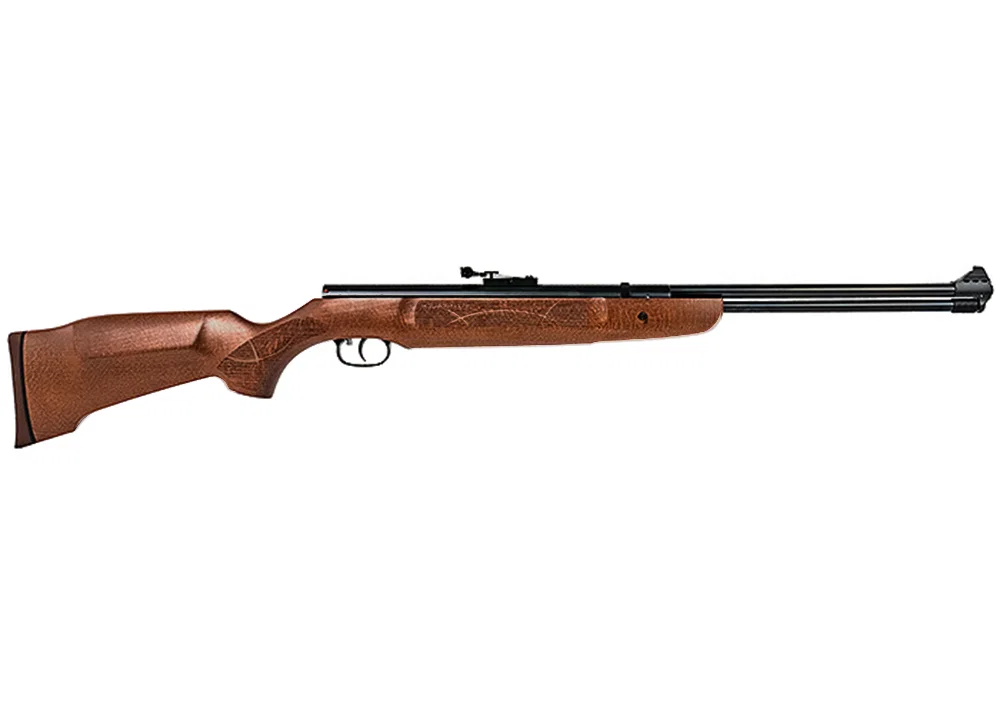
The Weihrauch HW57 with Open Sights is a precision underlever cocking air rifle with a modern design.

Single shot with loading gate. Medium heavy and well-balanced. Automatic safety, adjustable match trigger “Rekord”, micrometer sight adjustable for windage and elevation with four different notches.

Long and handy Beechwood stock with cheekpiece on both sides, stippling on pistol grip and forearm, ambidextrous, rubber buttplate.

Weihrauch HW57 Open Sights Specifications:

  • Calibre – .177 / .22
  • Trigger – 2 Stage Match Rekord Trigger
  • Overall Weight – 3.2kg
  • Overall Length – 102cm
  • Loading Mechanism – Single Pellet Loading
  • Barrel Length – 36cm
  • Ambidextrous – Yes
  • Threaded for moderator – Yes

Design and Construction of the Weihrauch HW57 Open Sights

A modern yet traditional sporting profile is presented by the Weihrauch HW57 Open Sights. Underlever cocking is employed so that the barrel remains fixed, and therefore barrel alignment is preserved shot after shot. A rising loading gate (loading tap) is incorporated; after the underlever is drawn down, a single pellet can be seated without skirt deformation. After the gate is closed and the automatic safety is disengaged, the rifle is made ready to fire.

High-quality chemically blued and polished metalwork is finished to Weihrauch standards. Wood-to-metal fit is executed tightly, and a durable rubber buttplate is fitted so that recoil is absorbed and shouldering remains secure. Stippling or checkering is applied to the pistol grip and forearm, and dual cheekpieces are machined so that a consistent head position can be achieved from either side. As a result, the rifle is handled confidently by shooters of varying stature and experience.

Key Features Highlighted

The following attributes are provided by the Weihrauch HW57 Open Sights:

  • Underlever spring-piston action with fixed barrel for inherent accuracy
  • Single-shot loading gate that protects pellet skirts during charging
  • Automatic safety that engages on cocking
  • Rekord two-stage adjustable match trigger known for a crisp, creep-free break
  • Ambidextrous beechwood sporter stock with cheekpieces on both sides, stippled grip and forend, and rubber buttplate
  • Factory open sights: hooded/tunnel front sight (fiber-optic on many current examples) plus fully adjustable micrometer rear sight with four interchangeable notch profiles for windage and elevation
  • 11 mm dovetail rail revealed when the rear sight is removed, allowing later scope mounting
  • Available calibers: .177 (4.5 mm) and .22 (5.5 mm)
  • UK-legal power typically in the 10.8–11.8 ft-lbs range (no FAC required in standard configuration)
  • Approximate specifications: overall length 1020–1045 mm (40.25 in), barrel length 360–385 mm (14.2–14.6 in), weight 3.2 kg (approximately 7 lb)

Furthermore, certain current production examples are supplied with a ½″ UNF muzzle thread so that a moderator can be fitted if desired.

Open Sight Performance and Handling

Excellent visibility and rapid target acquisition are enabled by the Weihrauch HW57 Open Sights. A hooded front sight is paired with a finely adjustable rear unit; four different notch shapes can be selected so that the sight picture can be matched to lighting conditions and personal preference. Windage and elevation corrections are made via clearly marked thumbwheels. Consequently, close- to medium-range work—plinking, pest control, or introductory hunting—can be performed effectively before a scope is ever mounted.

Because the rear sight is removable, the 11 mm dovetail is left unobstructed when glass is preferred later. Recoil of the HW57 is generally described as mild for a full-power springer, yet a stop-pin mount is still recommended if a scope is fitted, so that zero is retained. Meanwhile, the Rekord trigger can be adjusted for first-stage travel and pull weight; a clean release in the region of 500 g is commonly achieved after fine-tuning.

Balance is another strength. At roughly 3.2 kg the rifle sits lighter than Weihrauch’s larger underlevers (HW77/HW97 family) while still delivering full legal-limit energy. Therefore it can be carried for longer periods without fatigue, making it suitable for field use as well as range sessions. Smooth cocking effort and a relatively vibration-free firing cycle are reported by many users once the rifle has been properly bedded and a suitable pellet has been identified.

Practical Applications

Versatility across disciplines is supported by the Weihrauch HW57 Open Sights. Close-range vermin control and garden pest work can be undertaken with open sights at 12–25 yards, where half-inch groups have been recorded in published tests with well-matched pellets. Target practice and plinking are equally well served; the fixed barrel and quality trigger reward consistent technique. Recreational shooters, younger or smaller-framed users, and those who prefer a lighter underlever all find the platform approachable. Inclusive design—ambidextrous stock, adjustable sights, and a straightforward loading sequence—means the rifle can be enjoyed by a wide range of enthusiasts provided local laws and safe-handling practices are observed.

Pellet selection remains important. Consistency in the 11+ ft-lbs range is typically obtained with quality domed or field pellets; individual rifles often show a clear preference, so chrono and group testing are advised. After a short break-in period, sub-inch groups at 25–30 yards are regularly achievable with iron sights or modest optics.

Why the Weihrauch HW57 Open Sights Stands Out

German engineering and long-term durability are associated with the Weihrauch name, and the HW57 continues that tradition in a more compact, accessible package. Fixed-barrel accuracy, a respected trigger, automatic safety, and factory-fitted open sights are supplied as standard rather than extras. Moreover, the ability to add a scope later without sacrificing the original sighting system adds long-term flexibility.

Responsible ownership is emphasized: the rifle is intended for legal, ethical use only, and all applicable airgun regulations, power limits, and storage requirements must be followed. When these conditions are met, a reliable, accurate, and enjoyable springer is placed in the hands of the shooter.

In summary, a well-balanced combination of classic Weihrauch quality, practical open-sight capability, and everyday usability is offered by the Weihrauch HW57 Open Sights. Whether the goal is learning marksmanship fundamentals, controlling pests, or simply enjoying precise single-shot shooting, this underlever platform is engineered to deliver consistent performance for years of service.

Available Calibres for the Weihrauch HW57 Open Sights

Two standard calibres are supplied by Weihrauch for the HW57 platform. Consequently, both precision-oriented and slightly heavier-impact applications can be served by a single model family.

.177 (4.5 mm) is frequently chosen when flatter trajectory and higher pellet count are desired. Official factory velocity in this calibre is listed at approximately 260 m/s (about 853 fps) with suitable pellets, although real-world figures vary with pellet weight and individual rifle tune. Tight groups at typical sporting distances are commonly produced, and the lighter projectile is favoured for target practice and longer-range plinking when wind is moderate.

.22 (5.5 mm) is preferred when greater down-range energy and a more pronounced impact are required. Factory velocity is given as approximately 185 m/s (about 607 fps). Pest-control and short-to-medium hunting scenarios are therefore well supported, provided local regulations and ethical shot placement are observed. Pellet energy remains within the same overall power envelope as the .177 version on standard-specification rifles.

Both calibres utilise the same single-shot loading gate and fixed-barrel underlever system. Therefore pellet seating remains consistent and skirt damage is minimised. Inclusive use is supported: either calibre can be handled comfortably by shooters of different experience levels once a preferred pellet brand and weight have been identified through testing.

Highlighted Calibre Comparison

  • .177 / 4.5 mm: flatter trajectory, higher velocity potential, excellent for targets and precision work
  • .22 / 5.5 mm: increased pellet mass and impact, often selected for pest control
  • Shared features: single-shot loading gate, Rekord trigger, identical stock and sighting system
  • Typical use: recreational shooting, training, and legal small-game or vermin work where permitted

Pellet selection remains critical. Quality domed or field pellets from reputable makers are recommended so that consistency and accuracy can be maximised. Chronograph and grouping tests are advised after the rifle has been allowed a short break-in period.

Power Output and FAC Considerations

Factory power of the standard Weihrauch HW57 Open Sights is set below the 12 ft-lbs threshold commonly applied in the United Kingdom. Measured output in published tests typically falls in the 10.8–11.8 ft-lbs range, depending on pellet and individual example. Consequently, a Firearm Certificate (FAC) is not required for ownership or use of the standard-specification rifle in England, Wales and Scotland when the rifle remains in its factory-legal configuration.

Higher-power FAC-rated versions of some Weihrauch models exist, yet the HW57 is ordinarily supplied as a sub-12 ft-lbs sporting rifle. Therefore it can be purchased and used by holders of a simple airgun certificate or, in many cases, without additional licensing beyond age and storage rules. Local laws must always be verified, because regulations differ across countries and even within regions. Export or import of air rifles may also be subject to additional controls.

Energy figures are achieved through a conventional spring-piston mechanism. Consistency rather than extreme velocity is emphasised; spreads of only a few feet per second across a string of shots are regularly recorded once a suitable pellet is found. Automatic safety engagement on cocking further supports responsible handling.

Users who later wish to increase power must follow all legal procedures, including FAC application where required, professional inspection, and compliance with storage and transport rules. Modification outside legal limits is neither recommended nor supported.

Recommended Accessories and Upgrades

A practical set of accessories can be added to the Weihrauch HW57 Open Sights so that versatility and comfort are extended. Because an 11 mm dovetail rail is revealed when the rear open sight is removed, a wide choice of telescopic sights can be fitted. Quality two-piece or one-piece mounts that incorporate a recoil-arrestor (stop) pin are strongly advised; spring-piston recoil can otherwise cause scope shift over time.

Current-production examples of the HW57 are frequently supplied with a ½″ UNF muzzle thread. A compact sound moderator can therefore be attached when quieter shooting is desired and local rules permit. The original thread protector should be retained when a moderator is not fitted.

Additional useful items include:

  • Extra front-sight inserts so that the tunnel sight can be tailored to light conditions
  • A padded gun slip or hard case for transport and storage
  • A quality sling and swivel set if the rifle will be carried for extended periods
  • A basic cleaning kit and spring-piston-safe lubricant
  • A chronograph for pellet and power verification
  • Quality pellets in both .177 and .22 for testing and regular use

Open sights remain fully functional even after a scope is mounted, because the rear unit is simply lifted off the rail. Consequently shooters can switch between iron-sight practice and magnified aiming without permanent alteration. Inclusive design is maintained: ambidextrous stock geometry and straightforward accessory mounting allow both left- and right-handed users, as well as shooters of differing physical stature, to customise the rifle comfortably.

When accessories are chosen, compatibility with the compact 40-inch overall length and 3.2 kg weight should be kept in mind. Overly large or heavy optics can unbalance the rifle, so compact-to-medium scopes in the 3–9× or 4–12× class are typically the most harmonious pairing.

Responsible use of any accessory—especially moderators and higher-magnification optics—must remain within legal power and licensing limits. With appropriate additions, the Weihrauch HW57 Open Sights continues to serve as a capable, long-lasting spring-piston rifle for training, recreation and permitted field work.

Weihrauch Air Rifles, PCP Platforms, Spring-Piston Systems, and Related Airgun Terminology

Enthusiasts researching premium German airgun engineering frequently encounter models and search terms such as Weihrauch HW100X Karbine, Thumbhole PCP Air Rifle, hw35, h 45, german air rifle, accurate air rifles, hw97k, hw 70, hw35e for sale, hw40, weihrauch hw30, weihrauch hw80, weihrauch hw 95, hw100, hw 97k, hw35 air rifle, hw50 s, weihrauch hw45, weihrauch english, weihrauch hw98, weihrauch englisch, hw77 air rifle, weihrauch hw50s, compressed air rifles, air rifle makes, spring piston, what are air rifles, weihrauch hw44, air shot gun, sk x rifles, weihrauch hw50, hw30s, hw 30, what are air pistols, hw50, and rifles de aire.

Within the Weihrauch lineup, the Weihrauch HW77 air rifle is widely recognized as a traditional fixed-barrel underlever platform. Related terminology includes HW77 Green Laminate rifle, Weihrauch underlever air rifle, HW77 spring piston air rifle, Weihrauch HW77 for sale, and German precision air rifle. Researchers comparing versions may also encounter phrases such as buy Weihrauch HW77 Green Laminate online, Weihrauch HW77 Green Laminate price and specs, Weihrauch HW77 accuracy review, HW77 Green Laminate vs HW97 comparison, is Weihrauch HW77 good for beginners, precision shooting airgun, high quality German airguns, best price Weihrauch HW77, where to buy Weihrauch HW77, Weihrauch HW77 in stock, affordable premium air rifle, and top rated underlever air rifle.

Weihrauch HW57

Technical comparison searches commonly include Weihrauch HW77 vs HW97, HW77 vs break barrel air rifle, best Weihrauch air rifles, most accurate air rifle for target shooting, air rifle with low recoil, durable air rifle for outdoor use, and reliable air rifle for long term use. These phrases generally reflect interest in operating systems, mechanical durability, handling characteristics, consistency, and the differences between fixed-barrel underlever designs, break-barrel rifles, and PCP platforms.

Other Weihrauch-related terminology includes air pistols, hw100 airgun, weihrauch hw95, weihrauch hw 30, weihrauch hw90, hw 44, hw 40, hw 98, and weihrauch hw100. The HW100 family represents the PCP side of Weihrauch’s catalog, while models such as the HW30, HW50, HW80, HW90, HW95, HW97, and HW98 are associated with spring-powered or gas-ram-style sporting airgun platforms depending on the specific model and configuration. By contrast, the HW44 is commonly discussed as a PCP air pistol.

The broader airgun market also includes search terminology connected with alternative PCP manufacturers and modern platforms. Examples include 25 karma, pcp bb gun, karma eq air rifle, karma red panda, panda guns, full auto pcp, karma sls compact, air karma, red panda hat, eq air, karma sls, eq magazine, air pcp, and karma airguns. These terms may refer to specific products, product families, accessories, community terminology, or unrelated search phrases that appear alongside airgun research.

Reximex is another name frequently encountered in PCP discussions. Related search phrases include reximex airguns, reximex rp, reximex throne gen 2, reximex mito, reximex rpa, sbs12, reximex mitos, reximex lieva, reximex accura pcp air rifle, and reximex throne gen2. Model naming can vary slightly between retailers, regions, and search listings, which explains variations such as “Throne Gen 2” and “Throne Gen2” or “Mito” and “Mitos.”

Airgun research also involves understanding velocity and energy. Searches such as fps to joules calculator, fps to ft lbs, and airgun calculator relate to converting projectile velocity and mass into kinetic-energy measurements. These calculations are commonly used for technical comparison, range evaluation, regulatory research, and understanding how different compressed-air or spring-powered platforms perform within their intended specifications.

More general discovery terms can include gunseek and yivli av tüfeği, alongside broader international phrases such as rifles de aire. Because airgun terminology varies considerably between English, German, Spanish, and Turkish-speaking markets, researchers may encounter several different naming conventions for comparable sporting, target, and recreational airgun platforms.

Taken together, terms ranging from Weihrauch HW100X Karbine and Thumbhole PCP Air Rifle to HW77 Green Laminate rifle, spring piston, compressed air rifles, karma airguns, and reximex airguns illustrate the diversity of modern airgun technology. Weihrauch remains particularly associated with German engineering, fixed-barrel underlever rifles, traditional spring-powered designs, precision PCP systems, and air pistols, while Karma and Reximex represent additional names encountered when comparing contemporary PCP platforms and associated airgun technology.

Everyday shooting tasks are supported by a compact underlever spring-piston rifle that remains light enough to carry yet powerful enough for legal sporting use. Fixed-barrel accuracy, factory open sights and a crisp two-stage trigger are combined so that a wide range of practical situations can be handled without immediate need for optics. Inclusive design further ensures that left-handed and right-handed users, as well as shooters of differing stature and experience, can participate comfortably when local laws and safe-handling rules are observed.

Close-Range Vermin Control and Garden Work

Short-distance pest management is one of the most common applications. Distances of 10–25 yards are typically involved when rats, feral pigeons or similar legal quarry are encountered around outbuildings, farmyards or large gardens. Because the barrel stays fixed during cocking, point of impact remains consistent from shot to shot. Consequently a reliable zero can be established with the adjustable rear sight and hooded front sight, and half-inch groups at 12 yards have been recorded in published tests when a well-matched pellet is used.

After the underlever is drawn down, a single pellet is seated in the rising loading gate. Skirt deformation is thereby avoided, and the gate is closed before the automatic safety is released. A steady hold is then adopted, the sight picture is aligned, and the Rekord trigger is pressed through its first stage until the clean second-stage break occurs. Recoil is generally described as mild for a full-power springer, so follow-through can be maintained and a second shot prepared quickly if required.

Early-morning or late-evening patrols are facilitated by the rifle’s modest weight of approximately 3.2 kg. Fatigue is reduced compared with heavier underlevers, and the ambidextrous stock with dual cheekpieces allows a natural head position from either shoulder. Stippling on the grip and forend further improves control when gloves are worn or surfaces are damp. Inclusive use is therefore practical: smaller-framed adults and experienced juniors (where legally permitted and supervised) can manage the cocking effort and hold the rifle steadily.

Legal and ethical constraints must always be respected. Only permitted species may be taken, safe backstops are obligatory, and power must remain within the factory sub-12 ft-lbs specification unless an FAC-rated conversion has been completed through proper channels. When these conditions are met, discreet and effective close-range work can be performed with open sights alone.

Highlighted Close-Range Considerations

  • Distances of 10–25 yards suit the factory iron sights
  • Fixed barrel preserves zero during repeated cocking
  • Mild recoil aids rapid follow-up shots
  • Ambidextrous stock supports either-shoulder use
  • Automatic safety engages on every cocking cycle

Target Practice, Plinking and Skill Building

Formal and informal target work is equally well served. Paper targets, knock-down silhouettes and reactive spinners can all be engaged at 15–40 yards. Because open sights of good quality are fitted as standard, fundamental marksmanship can be developed before a scope is ever mounted. Windage and elevation are adjusted via clearly marked thumbwheels, and four interchangeable rear-notch profiles allow the sight picture to be refined for different lighting and personal preference.

A consistent cheek weld is encouraged by the dual cheekpieces. Consequently head position remains repeatable, and grouping improves as trigger control and follow-through are practised. Published tests have shown three-quarter-inch to half-inch groups at 25 yards once a favoured pellet is identified. Weihrauch’s own field pellets and certain mid-weight domes frequently produce the tightest results, although individual rifles display preferences that are best discovered through chrono and group testing.

Club range sessions benefit from the rifle’s compact overall length of roughly 40 inches. Storage in a vehicle or gun cabinet is straightforward, and the underlever action can be cocked without the barrel being swung through a large arc. Meanwhile the automatic safety provides an extra layer of control between shots. Recreational plinking in a safe private setting follows the same principles: a solid backstop, eye protection, and disciplined loading sequence keep the activity enjoyable and responsible.

New shooters often find the platform approachable. Cocking effort is moderate, the trigger can be adjusted to a comfortable pull weight (commonly around 500 g after fine-tuning), and the open sights teach alignment without the complexity of magnification and eye relief. Inclusive language and design matter here: both experienced adults and supervised beginners can share the same rifle because stock geometry and sighting system accommodate a range of physiques.

Field Walking and Light Hunting Applications

Longer walks across permitted land are made easier by the balanced 7 lb class weight. Compared with larger fixed-barrel siblings, this model can be carried for several hours without the same degree of shoulder fatigue. A sling can be added if desired, yet many users find the rifle comfortable enough to be held in the hands during short stalks.

When legal small-game or pest species are encountered at 20–35 yards, the open sights remain usable provided light is adequate and the shooter has practised hold-over. Trajectory of a typical .177 pellet is relatively flat inside these distances; a .22 pellet delivers more pronounced impact at the cost of a slightly more arched path. Either calibre can be employed according to local conditions and personal preference. Ethical shot placement remains the priority: only high-probability shots at correctly identified quarry should be taken, and a safe backstop must exist beyond the target.

Weather resistance of the chemically blued metalwork and lacquered beech stock is sufficient for typical field use, although prolonged exposure to rain should still be avoided and the rifle wiped down afterward. Stippled surfaces retain grip when hands are cold or wet. Because the rear sight can be removed in minutes, a compact scope can be fitted for later outings without permanent modification. Transition between iron-sight days and magnified days is therefore simple.

Inclusive field use is supported by the ambidextrous layout. Left-handed shooters are not forced into awkward positions, and the rubber buttplate helps absorb the modest recoil during repeated shots. Younger or slighter adults who find heavier underlevers tiring often report that this compact example remains manageable throughout a morning or afternoon session.

Training Fundamentals and Inclusive Participation

Marksmanship fundamentals are taught effectively when open sights are used first. Sight alignment, sight picture, breathing control, trigger press and follow-through can all be isolated and practised. The four-notch rear sight lets instructors demonstrate how small changes in aperture affect the view of the target. Subsequently a scope can be introduced so that the same principles are applied under magnification.

Family or club training sessions benefit from the single-shot nature of the action. Each shot is deliberate; there is no magazine to encourage rushed firing. The loading gate is visible and tactile, so the status of the rifle is easily confirmed. Automatic safety engagement after cocking adds a consistent pause before the shot is taken. These features collectively encourage a safety-first culture that is valuable for mixed-ability groups.

Physical inclusivity is another practical advantage. At 3.2 kg the rifle sits between ultra-light youth models and full-size adult underlevers. Cocking effort, while not negligible, is within reach of many adult shooters and older supervised juniors where regulations allow. Dual cheekpieces and a reasonably straight stock comb reduce the need for extreme head twisting. Consequently a single rifle can be shared among several users during a session without constant adjustment of length of pull or comb height.

Range officers and instructors often appreciate the predictable behaviour of a well-made spring-piston action. Recoil is rearward and relatively sharp but short-lived; once the shooter learns to ride it, groups tighten quickly. Pellet testing becomes part of the training curriculum: different weights and head shapes are tried so that the relationship between ammunition and accuracy is understood.

All-Day Recreational Sessions and Club Use

Extended plinking or informal competition can be sustained because fatigue accumulates more slowly than with heavier rifles. A morning at the club followed by an afternoon of garden practice remains realistic. The underlever can be cocked hundreds of times in a day provided the shooter uses proper technique and rests when needed. Fixed-barrel accuracy means that zero does not wander as the action heats or as the session lengthens.

Storage and transport are uncomplicated. The overall length fits most standard gun slips, and the absence of a large underlever protruding far below the forend keeps the profile slim. After a session the rifle is wiped, the bore is protected if required, and it is returned to a secure cabinet in accordance with local storage laws.

When a moderator is legally fitted to threaded examples, noise is reduced and neighbouring properties are less likely to be disturbed. Even without a moderator the report is typical of a full-power springer—noticeable but not extreme. Ear protection remains advisable during prolonged shooting.

Social shooting is supported by the rifle’s classic appearance and reputable trigger. New club members who have previously used only break-barrel springers often comment on the smoother cocking arc and the security of a fixed barrel. Experienced springer enthusiasts appreciate that a lighter, shorter underlever can still deliver legal-limit energy and respectable accuracy.

Transitioning Between Iron Sights and Optics

Practical flexibility is increased because the rear sight is designed to be lifted off the 11 mm dovetail. A compact 3–9× or 4–12× scope in quality mounts that include a recoil-arrestor pin can therefore be added when longer distances or poorer eyesight make iron sights less convenient. Zeroing is performed in the usual way, and the original open sights can be replaced in minutes if a return to fundamentals is desired.

Hold-over and windage estimation learned with iron sights transfer directly to scoped use. Consequently the time spent practising with the factory sights is never wasted. Shooters who begin with open sights frequently develop a more instinctive understanding of trajectory and lead, skills that remain useful even after magnification is introduced.

In every scenario—garden patrol, target card, field walk or club afternoon—the same core attributes are relied upon: a fixed barrel, a quality adjustable trigger, an automatic safety, a balanced ambidextrous stock, and open sights that are good enough to stand alone. When these elements are combined with legal compliance, safe backstops and appropriate pellet choice, a versatile and enduring spring-piston rifle is placed in service for years of practical shooting.

Weihrauch HW57

General Design and Operation

What type of action is used?

An underlever spring-piston mechanism is employed. The barrel remains fixed while the cocking lever is drawn downward, so alignment is preserved from shot to shot. After the lever is returned, a rising loading gate is presented and a single pellet can be seated. The gate is then closed and the automatic safety is disengaged before the shot is taken. Consequently skirt damage is minimised and fixed-barrel accuracy is retained.

How is the rifle loaded?

A single-shot loading tap is used. Once the underlever has been cocked, the gate rises and a pellet is placed flush with the chamber. The gate is pressed fully downward until alignment marks disappear. Thereafter the rifle is considered loaded. Because only one pellet is introduced at a time, rushed magazine-style firing is avoided and each shot remains deliberate.

Is an automatic safety fitted?

Yes. The safety is engaged automatically when the action is cocked. It must be released manually before the trigger can be pressed. An extra pause is therefore introduced between cocking and firing, which supports safe handling during training sessions and mixed-ability groups.

Calibres, Power and Legal Status

Which calibres are available?

Two standard pellet diameters are offered: .177 (4.5 mm) and .22 (5.5 mm). The smaller calibre is frequently selected when a flatter trajectory is desired. The larger calibre is often preferred when greater pellet mass and impact are required. Both versions share the same stock, trigger and sighting system.

What power output can be expected?

Factory specification is held below the 12 ft-lbs threshold commonly applied in the United Kingdom. Measured results in published tests typically fall between 10.8 and 11.8 ft-lbs, depending on pellet weight and individual rifle. Therefore a Firearm Certificate is not required for the standard sporting version in England, Wales and Scotland, provided the rifle remains unmodified.

Does an FAC version exist?

Higher-power conversions of some spring-piston models are possible through proper legal channels. The standard rifle discussed here is supplied as a sub-12 ft-lbs sporting gun. Any increase in power must be accompanied by the correct certificate, professional work and compliance with storage and transport rules. Modification outside legal limits is neither recommended nor supported.

Which pellets work best?

Quality domed or field pellets from established makers are recommended. Individual rifles display preferences, so chrono and grouping tests are advised after a short break-in period. Mid-weight pellets frequently produce the most consistent velocities and tightest groups. Steel BBs, darts or damaged ammunition must never be used.

Sights, Optics and Accuracy

Are open sights supplied as standard?

Yes. A hooded or tunnel front sight is paired with a micrometer rear sight that is adjustable for windage and elevation. Four interchangeable notch profiles are provided so that the sight picture can be matched to lighting conditions and personal preference. Close- to medium-range work can therefore be performed without a scope.

Can a telescopic sight be fitted later?

The rear iron sight is removable. Once it is lifted off, an 11 mm dovetail rail is revealed. Quality mounts that incorporate a recoil-arrestor pin are strongly advised, because spring-piston recoil can otherwise cause scope movement. Compact-to-medium magnification (for example 3–9× or 4–12×) generally balances well with the rifle’s size and weight.

What accuracy can reasonably be expected?

With a well-matched pellet and consistent technique, groups of approximately half an inch at 12 yards and three-quarter to half an inch at 25 yards have been recorded in published tests using open sights. Scoped performance at 30–40 yards is typically similar or slightly better once zero is established. Results vary with shooter skill, pellet choice and conditions.

Should the rifle be scoped immediately?

Not necessarily. Fundamental marksmanship is developed effectively when iron sights are used first. Sight alignment, breathing and trigger control can be isolated. A scope can be added later without permanent alteration of the original sighting system.

Stock, Handling and Inclusivity

Is the stock ambidextrous?

Yes. Cheekpieces are present on both sides of the beechwood sporter stock. Stippling or checkering is applied to the pistol grip and forend, and a rubber buttplate is fitted. Left-handed and right-handed shooters can therefore obtain a consistent head position and secure hold.

How heavy is the rifle and how long is it?

Approximate figures are 3.2 kg (about 7 lb) unscoped and 1020–1045 mm (roughly 40.25 inches) overall, with a barrel length of 360–385 mm. The combination is lighter than many larger underlevers while still delivering legal-limit energy. All-day carry is therefore more realistic for a wider range of users.

Is the cocking effort suitable for smaller-framed shooters?

Cocking effort is moderate rather than extreme. Many adult shooters of slighter build, as well as supervised older juniors where legally permitted, find the underlever manageable. Proper technique—using the body rather than the arms alone—further reduces strain. Inclusive use is supported provided local age and supervision rules are followed.

Can the rifle be shared among several users?

The ambidextrous stock and straightforward loading sequence make sharing practical during club or family sessions. Length of pull is fixed, yet the dual cheekpieces and balanced weight allow a range of physiques to shoulder the rifle comfortably without constant adjustment.

Weihrauch HW57

Maintenance, Accessories and Longevity

How should the rifle be maintained?

A light wipe-down after use is recommended. The bore should be protected according to the manufacturer’s guidance, and only spring-piston-safe lubricants should be applied if needed. Over-oiling the action can cause dieseling and inconsistent power. Storage in a dry, secure cabinet that meets local legal requirements is essential.

Is a muzzle thread provided?

Certain current-production examples are supplied with a ½″ UNF thread so that a compact moderator can be fitted where local rules allow. The original thread protector should be retained when a moderator is not in use.

What accessories are commonly added?

Typical additions include quality scope mounts with a stop pin, a compact telescopic sight, extra front-sight inserts, a padded slip or hard case, a sling, a basic cleaning kit and a chronograph. Overly large optics can unbalance the compact platform, so proportion should be considered.

Is a break-in period required?

A short series of shots with quality pellets is usually sufficient for the action to settle. Velocity and grouping often improve after the first few tins. Harsh cocking or dry-firing must be avoided.
Caliber

.177, .22

Reviews

There are no reviews yet.

Be the first to review “Weihrauch HW57 Open Sights”

FAQ

  • Spring-Piston (Break-Barrel or Underlever): Cock by compressing a spring. Reliable, no external air source needed, but can have more recoil (“spring twang”) and require technique to shoot accurately.
  • Pre-Charged Pneumatic (PCP): Filled from a scuba tank, compressor, or pump. High power, low recoil, multiple shots per fill. Popular for precision and hunting.
  • CO₂: Powered by disposable cartridges. Good for pistols and semi-auto/repeaters, but performance drops in cold weather.
  • Multi-Pump Pneumatic: Hand-pumped to build pressure. Versatile but requires effort.
  • Gas Ram (Nitro Piston): Uses compressed gas instead of a metal spring. Smoother than traditional springers.

Calibers: Most common are .177 (4.5mm) for speed/flat trajectory and general use, and .22 (5.5mm) for better hunting knockdown power. Larger “big bore” (.25, .30, .357+) exist for hunting bigger game where legal.

Yes, many modern PCP and springers deliver enough energy for small game (rabbits, squirrels, birds) and even larger game in some areas. Muzzle energy (in ft-lbs or joules) matters more than velocity alone. Always match caliber, pellet weight, and energy to the game and check local hunting regs.

Treat every airgun as if it is loaded.

  • Always point the muzzle in a safe direction.
  • Keep your finger off the trigger until ready to shoot.
  • Know your target and what is beyond it (pellets can ricochet or travel far).
  • Wear eye protection.
  • Store unloaded, out of reach of children/untrained users, and ideally locked.
  • Never shoot at hard surfaces or in areas where pellets could escape your property.

Follow these rules strictly—airguns cause real injuries.

Laws differ dramatically by country, state/province, and even city. Always verify current local laws before buying, owning, transporting, or using an airgun. Age restrictions (often 18+) are common.

Examples (summaries only; check official sources):

  • UK: Air rifles ≤12 ft-lbs (16.3 joules) and pistols ≤6 ft-lbs generally do not require a license (FAC needed above that).
  • USA: Varies by state. Some treat powerful airguns as firearms; others do not. Many states now allow big-game hunting with air rifles.
  • Canada: Some airguns classified as firearms if they exceed velocity/energy thresholds.
  • Australia: Often treated as firearms; licensing/registration required in most states.
  • EU/France/Belgium/etc.: Varies; many allow low-power (<20J) guns freely to adults, with higher power needing permits. Germany has strict ~7.5J limits in some contexts.
  • Other countries: Some have no restrictions below certain energies; others ban or heavily regulate them.

Resources: Wikipedia “Air gun laws”, airgun forums, or official government sites. For travel, research transit laws carefully.

Consider:

  • Purpose: Plinking/backyard → lower power springer or CO₂. Hunting/precision → PCP.
  • Budget: Entry-level springers are affordable; PCPs need a fill system (extra cost).
  • .177 vs .22: .177 easier for beginners/targets; .22 better for hunting.
  • Power source: Convenience vs performance.
  • Test pellets in your gun—accuracy varies.

Buy from reputable dealers and consider warranties.

  • Clean barrel periodically (especially if accuracy drops) with patches and appropriate tools/solvents. Avoid over-oiling.
  • Lubricate moving parts and seals with airgun-specific oil (not general gun oil). Springers need piston seal oil occasionally.
  • Check screws, seals for leaks (PCP), and safety mechanisms regularly.
  • Store in a cool, dry place, ideally in a case. Avoid leaving cocked for long periods.

Follow your model’s manual. Basic care extends life significantly.

International shipping may be available for select products. Customers are responsible for understanding and complying with their local import laws and regulations before ordering.

Yes. Customers are required to confirm their order number through WhatsApp or Live Chat before orders are processed and shipped.

If local laws prevent shipment to your area, your order may be canceled and refunded according to our store policy.

Processing typically takes 1–3 business days after payment confirmation. Delivery times vary depending on destination, carrier, and product availability.


  • Wrong pellets for your barrel/caliber.
  • “Death grip” or poor shooting form (especially with springers—let the gun recoil naturally).
  • Loose scopes or mounts.
  • Ignoring safety or local laws.
  • Over-oiling or shooting with obstructions.


Pellets are the most common projectile (lead or lead-free). Match them to your gun, caliber, and purpose—test several brands as accuracy varies by barrel.

  • Domed (Round-Head): Best all-rounder. Excellent accuracy, ballistic coefficient, and energy retention. Ideal for target shooting, field target, and general hunting (e.g., JSB Exact, Air Arms Diabolo Field, H&N Field Target Trophy).
  • Wadcutter (Flat-Head): Clean holes in paper. Best for close-range target/plinking (under 20-25 yards).
  • Hollow Point: Expands on impact for better energy dump. Good for small game hunting (e.g., Predator Polymag, H&N Terminator).
  • Pointed: More penetration, but often less accurate than domed.
  • Slugs: Heavier, more aerodynamic for high-power PCPs at longer ranges (better for big game where legal).

Tips: Heavier pellets in .22/.25 for hunting (better momentum). Lighter in .177 for speed/flat trajectory. Always check head size fit (e.g., 4.51-4.53mm variants).

Muzzle energy (ft-lbs or joules) matters more than velocity. Ethical shots require precise placement (head/heart-lung) within effective range.

Rough Guidelines (adjust for distance, pellet, and local laws):

  • Small game (squirrels, rabbits, birds): 9-20+ FPE, .177/.22.
  • Medium (raccoons, etc.): 25+ FPE, .22/.25 recommended.
  • Larger game: 40-100+ FPE in .30+ calibers (up to big bore for deer/hogs where permitted).

PCPs dominate serious hunting due to power and shot count. Springers/gas rams work well for small game but require skill. Always prioritize clean kills and check seasons/species rules.

  • Barrel Cleaning: Use a pull-through kit or rod with patches. Avoid brushes that could damage rifling. Clean when accuracy drops or after 500-1000 shots.
  • Lubrication: Airgun-specific silicone oil for seals/O-rings (sparingly—excess causes dieseling in springers). Springers may need piston lube periodically.
  • PCP Specific: Check for leaks (soapy water test), monitor regulator/hammer settings, and keep fill systems clean. Don’t exceed rated pressure.
  • General: Tighten stock screws, inspect for wear, store properly. Chronograph shots to track consistency.

Common Issues:

  • Inconsistent velocity → dirty barrel, bad pellets, or seal problems.
  • Spring “twang” → tuning or proper hold.
  • Low power → worn seals or under/over-pumping.

Toggle Content

  • Scopes: Airgun-rated (hold zero under recoil). 3-9x or 4-12x common.
  • Fill Systems: Hand pumps, compressors, or tanks for PCPs.
  • Safety Gear: Eye/ear protection, targets with backstops.
  • Noise: Airguns quieter than firearms, but moderators help further.

Budget Tip: Start with a quality springer (~$150-400) before investing in PCP setup.

Airgunning offers endless depth—from backyard plinking to precision competition and ethical hunting. Prioritize safety, legality, and practice. If you want specifics (e.g., recommendations for a country, budget, hunting small game, or a particular type like PCP vs springer), let me know for more targeted info! Shoot responsibly.

Tuning improves accuracy, reduces noise/recoil, or increases power (within legal limits).

  • Springers: Lighter springs, guides, seals, or custom tuning kits for smoother shot cycle. “V-Mach” or similar professional tunes popular.
  • PCPs: Regulator tuning, hammer spring adjustments, valve work for efficiency and shot count. Some add electronic systems.
  • Accessories: Suppressors (often unregulated on airguns), better triggers, stocks, and scopes.

Caution: Check laws—power increases may reclassify your gun. DIY only if experienced; professional tuners recommended.

You must be at least 18 years old to purchase any airgun or related accessories from our store. By placing an order, you confirm that you meet the legal age requirements in your state or country.

Yes. Orders may require age verification before processing and shipping. In some cases, we may request a valid government-issued ID to confirm eligibility.