KRAL KNIGHT WALNUT – Premium PCP Air Rifle with Turkish Walnut Stock, Precision Engineering and Advanced Shooting Features
Meta Description: Discover the KRAL KNIGHT WALNUT PCP air rifle, featuring a premium Turkish walnut stock, precision-rifled barrel, adjustable ergonomics and high-capacity air system.
KRAL KNIGHT WALNUT – Product Description
Premium Turkish Craftsmanship and Modern PCP Air Rifle Engineering
The KRAL KNIGHT WALNUT is manufactured by Kral Arms, a Turkish airgun manufacturer recognised for producing pre-charged pneumatic rifles with traditional stock materials and modern mechanical features. A distinctive combination of natural walnut craftsmanship, precision-machined components and adjustable shooting controls is presented in this model.
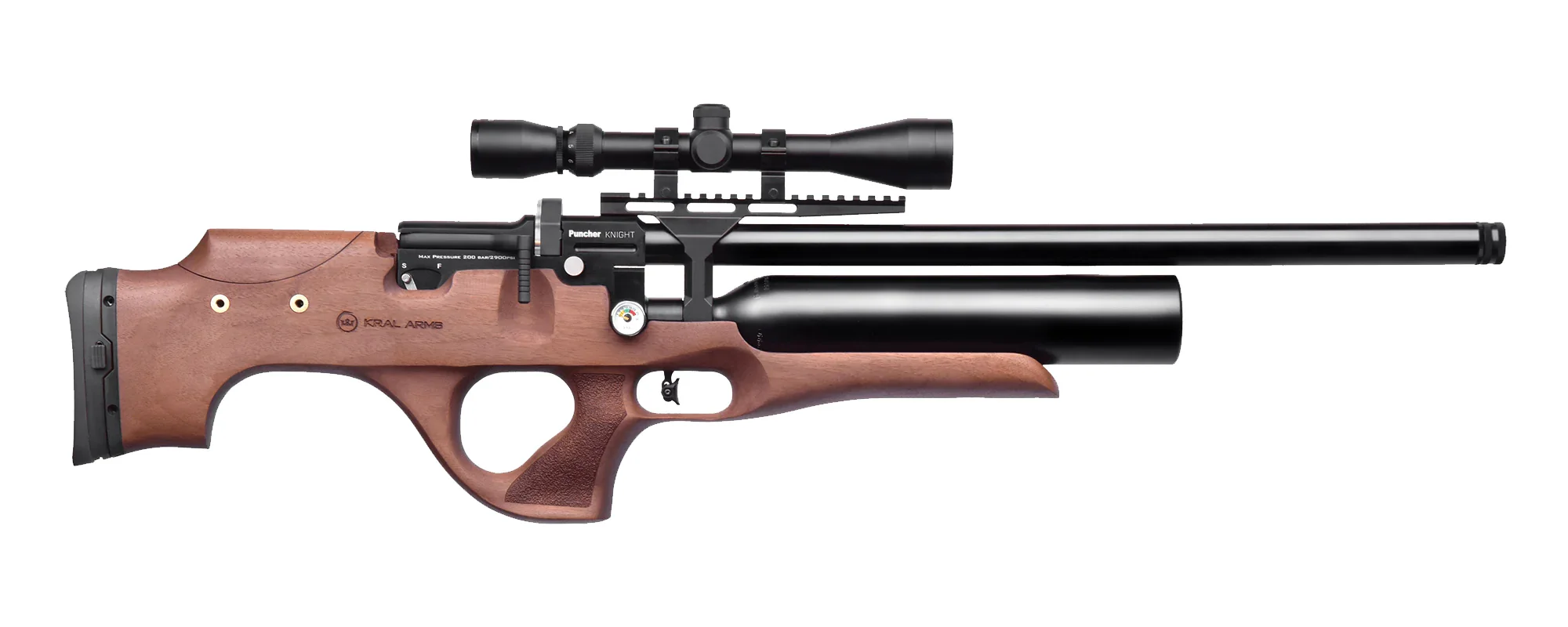
At first glance, the rifle is distinguished by its high-quality Turkish walnut stock. Furthermore, an individual wood grain pattern is displayed on every stock, ensuring that a naturally distinctive appearance is achieved. The warmth of traditional hardwood is complemented by a contemporary bullpup-inspired layout, creating a balance between classic aesthetics and compact engineering.
In addition, the rifle is equipped with a side-lever cocking mechanism, a fully shrouded barrel and a substantial compressed-air reservoir. Consequently, several important mechanical functions are incorporated into a relatively compact platform.
For recreational target shooting and authorised sporting activities, the rifle’s technical characteristics are designed to provide a consistent operating experience. However, performance remains dependent on the selected calibre, ammunition, environmental conditions and individual setup.
High-Quality Turkish Walnut Stock and Ergonomic Design
Natural Walnut Construction and Premium Appearance
A carefully finished Turkish walnut stock is incorporated into the rifle’s construction. Because walnut is valued for its appearance and natural grain, a traditional aesthetic is maintained without abandoning modern design elements.
Moreover, the hardwood stock is paired with metal components to create a distinctive contrast between natural and manufactured materials. The overall appearance is further enhanced by the rifle’s compact configuration and integrated adjustment features.
The walnut stock is characterised by several notable qualities:
-
Natural Turkish Walnut: A traditional hardwood appearance is provided through carefully selected walnut material.
-
Distinctive Wood Grain: Individual patterns and colour variations are naturally displayed.
-
Contemporary Stock Profile: A compact rifle configuration is combined with a classic wooden finish.
-
Adjustable Cheek Piece: The cheek support position can be adapted to accommodate different users.
-
Adjustable Buttpad: Additional stock adjustment options are incorporated for personalised positioning.
-
Solid Construction: A substantial overall weight and conventional hardwood feel are retained.
As a result, the rifle is characterised by a combination of traditional stock design and contemporary manufacturing.
Precision-Rifled Barrel and Mechanical Construction
Fully Shrouded Barrel Design
The KRAL KNIGHT WALNUT is fitted with a Kral-manufactured, choked and rifled barrel. Through this construction, a defined internal bore profile is provided for compatible pellets.
Additionally, a fully shrouded barrel assembly is incorporated into the rifle. This configuration is intended to protect the barrel assembly and contribute to the product’s integrated appearance.
A barrel length of approximately 58 cm (22.8 inches) is specified by the manufacturer. Meanwhile, the rifle’s overall length is listed at approximately 87.5 cm (34.4 inches), demonstrating the relatively compact proportions of its design.
Performance claims should nevertheless be considered alongside ammunition quality, mechanical condition and manufacturer specifications. Accordingly, no particular group size or accuracy guarantee is implied.
Side-Lever Action and Adjustable Trigger
A side-lever operating system is used instead of a traditional break-barrel arrangement. Therefore, the rifle is classified as a pre-charged pneumatic air rifle rather than a spring-powered break-barrel model.
Furthermore, an adjustable trigger assembly is included within the manufacturer’s design. Trigger-pull adjustment and multidirectional trigger-shoe positioning are identified among its mechanical features.
A manual trigger safety is also incorporated. Nevertheless, mechanical safety devices should never be regarded as substitutes for safe handling, secure storage and responsible supervision.
Advanced Pre-Charged Pneumatic Air System
500cc Compressed-Air Reservoir
A large-capacity compressed-air reservoir is integrated into the rifle’s pneumatic system. The manufacturer specifies a nominal reservoir volume of 500cc, together with a maximum filling pressure of 250 bar (approximately 3,600 psi).
Because compressed air is used as the energy source, external compressed-air filling equipment is required. In addition, the manufacturer’s instructions and approved pressure limits must always be followed.
An understanding of operating pressure, appropriate maintenance and safe filling practices is particularly important. Consequently, servicing and inspection should be undertaken in accordance with the official instructions.
Calibre Options and Manufacturer-Rated Performance
The rifle is manufactured in three principal calibre configurations. Each variant is associated with its own manufacturer-listed performance ratings and magazine capacity.
The following factory specifications are provided:
-
.177 / 4.5mm: Rated at 900 FPS and 21 joules, with a 14-pellet magazine.
-
.22 / 5.5mm: Rated at 900 FPS and 44 joules, with a 12-pellet magazine.
-
.25 / 6.35mm: Rated at 820 FPS and 52 joules, with a 10-pellet magazine.
These are manufacturer ratings rather than guaranteed results. Actual velocities and energy levels may vary according to ammunition, regional configuration and environmental conditions.
Moreover, power classifications and ownership requirements differ between jurisdictions. Therefore, the legality of a particular variant should be verified before acquisition or use.
Adjustable Ergonomics and Shooting Comfort
Personalised Cheek Support and Buttpad Positioning
An adjustable cheek piece is incorporated to accommodate different facial dimensions and preferred head positions. Similarly, the buttpad is designed with adjustment capability.
Through these features, some variation in fit can be accommodated without modifying the wooden stock itself.
The listed length of pull is approximately 38.5 cm (15.1 inches). Meanwhile, the walnut version has a manufacturer-listed average weight of approximately 4.0 kg (8.8 lb).
Consequently, overall weight and physical dimensions should be considered carefully by prospective users. Although compact in length, the rifle remains a substantial piece of sporting equipment.
Integrated Optics Mounting Platform
A 22mm Picatinny mounting rail is incorporated into the design. Compatibility with suitable mounting components is therefore provided, although individual accessory dimensions and specifications must still be confirmed.
Additionally, the manufacturer identifies an optional scope arrangement rather than guaranteeing that an optic is supplied with every rifle.
For this reason, the exact package contents should be reviewed through the retailer’s product listing.
Product Highlights and Technical Specifications
KRAL KNIGHT WALNUT Key Features
-
Manufacturer: Kral Arms, Türkiye
-
-
Operating System: Pre-charged pneumatic (PCP)
-
-
Stock: High-quality Turkish walnut
-
Available Calibres: .177, .22 and .25
-
Barrel: Choked, rifled and fully shrouded
-
Barrel Length: 58 cm / 22.8 inches
-
Overall Length: 87.5 cm / 34.4 inches
-
-
Maximum Filling Pressure: 250 bar / approximately 3,600 psi
-
Magazine Capacity: 14, 12 or 10 pellets, depending on calibre
-
Average Weight: 4.0 kg / 8.8 lb
-
Length of Pull: 38.5 cm / 15.1 inches
-
Trigger: Adjustable trigger assembly
-
Safety: Manual trigger safety
-
Mounting Rail: 22mm Picatinny
-
-
All figures are based on published manufacturer information; market-specific configurations should be verified.
Maintenance, Responsible Ownership and Long-Term Care
Preserving the Rifle’s Walnut Finish and Mechanical Condition
Routine exterior care is particularly important for a rifle fitted with natural hardwood furniture. The walnut stock should be protected from excessive moisture, prolonged exposure to extreme temperatures and inappropriate cleaning chemicals.
Similarly, the metal surfaces should be inspected for corrosion, visible damage and signs of abnormal wear.
Pneumatic components should be maintained only according to manufacturer guidance. Furthermore, the compressed-air reservoir should be inspected within the applicable service requirements, and any suspected defect should be assessed by a qualified technician.
Safe storage should also be prioritised. The rifle should be kept unloaded, securely stored and inaccessible to unauthorised persons.
KRAL KNIGHT WALNUT – A Combination of Traditional Materials and Contemporary Design
The KRAL KNIGHT WALNUT is distinguished by its Turkish hardwood stock, compressed-air operating system and adjustable mechanical features. Traditional materials are combined with a modern sporting-rifle layout, while several calibre configurations are offered to accommodate different regulated markets.
Its technical specification is defined by a 500cc reservoir, a side-lever mechanism, a rifled barrel and manufacturer-developed adjustment systems.
Overall, the model represents an example of how natural stock craftsmanship can be integrated into contemporary PCP air-rifle manufacturing.
KRAL KNIGHT WALNUT – Calibres, FAC Power, Air System, Recommended Scopes and Essential Accessories
Understanding the Available Calibre Options
The KRAL KNIGHT WALNUT is offered in several calibre configurations, allowing different sporting requirements and regional regulations to be accommodated. Each calibre is associated with specific pellet dimensions, magazine capacities and manufacturer-rated power figures. Therefore, the differences between these configurations should be understood before a particular version is selected.
Furthermore, the rifle’s pre-charged pneumatic system is designed around compressed-air operation, while its side-lever mechanism and traditional walnut stock are retained across the principal configurations.
.177 Calibre (4.5mm) – Target Shooting and Pellet Availability
The .177 calibre configuration is widely associated with recreational target shooting and organised air-rifle disciplines. Its relatively small pellet diameter is suitable for a broad range of manufactured paper-target ammunition.
Additionally, .177 pellets are produced by numerous established airgun ammunition manufacturers, making different pellet weights and designs available.
The manufacturer’s published specifications identify the following characteristics:
-
-
Manufacturer-rated Velocity: Up to 900 FPS
-
Manufacturer-rated Energy: Approximately 21 joules
-
Magazine Capacity: 14 pellets
-
Operating System: Pre-charged pneumatic
-
Barrel Design: Rifled and fully shrouded
Actual performance is influenced by ammunition selection, environmental conditions and the rifle’s mechanical condition. Consequently, published velocities should not be interpreted as guaranteed results for every pellet.
.22 Calibre (5.5mm) – Alternative Sporting Configuration
The .22 configuration is another established option within the air-rifle category. Its larger pellet diameter distinguishes it from the .177 version, while a broad variety of sporting pellets is available through specialist retailers.
Moreover, the manufacturer specifies a different energy rating and magazine capacity for this configuration.
Published specifications include:
-
-
Manufacturer-rated Velocity: Up to 900 FPS
-
Manufacturer-rated Energy: Approximately 44 joules
-
Magazine Capacity: 12 pellets
-
-
Maximum Fill Pressure: 250 bar
As with every calibre, regional power restrictions and applicable ownership requirements should be checked before purchase.
.25 Calibre (6.35mm) – Larger-Calibre Configuration
The .25 version is distinguished by a larger pellet diameter and a higher manufacturer-listed muzzle-energy figure. Its factory specifications differ from those of the two smaller calibres.
In addition, its detachable magazine has a lower stated pellet capacity, reflecting the physical dimensions of the ammunition.
Key specifications include:
-
-
Manufacturer-rated Velocity: Up to 820 FPS
-
Manufacturer-rated Energy: Approximately 52 joules
-
Magazine Capacity: 10 pellets
-
Barrel Length: Approximately 58cm
-
Overall Length: Approximately 87.5cm
These figures describe the manufacturer’s standard published configuration. However, actual specifications may differ in country-specific editions.
FAC Classification and Power Regulations
What Does FAC Mean for an Air Rifle?
FAC stands for Firearm Certificate, a term commonly encountered in the United Kingdom when discussing higher-powered air rifles.
In England and Wales, air rifles exceeding 12 foot-pounds of muzzle energy generally fall within firearm-certification requirements. Therefore, an air rifle should not automatically be regarded as licence-exempt simply because compressed air is used instead of conventional firearm ammunition.
Scotland operates a different air-weapon licensing framework, while Northern Ireland has additional firearm-control requirements.
Understanding Power Ratings
Manufacturer-published muzzle-energy ratings are expressed in joules. For comparison, approximate foot-pound equivalents are:
These ratings exceed the 12 ft-lb threshold generally applicable to unlicensed air rifles in England and Wales. Consequently, appropriate legal authorisation may be required.
Furthermore, the published power rating must not be confused with reservoir pressure. Muzzle energy describes the projectile’s kinetic energy, whereas the 250-bar figure identifies the manufacturer’s maximum permissible reservoir-filling pressure.
Recommended Scopes for the KRAL KNIGHT WALNUT
Optical Compatibility and Scope Selection
The KRAL KNIGHT WALNUT is equipped with a 22mm Picatinny mounting rail, allowing compatible optical accessories to be fitted. However, the scope is identified as optional in the manufacturer’s catalogue, meaning that package contents may vary between retailers.
For general target observation and recreational range activities, a suitable optical sight may provide clearer visibility of paper targets. The chosen optic should be selected according to its intended sporting application, construction quality and compatibility with the rifle’s mounting system.
Several established optical manufacturers produce products that may be considered for compatibility assessment:
-
Hawke Optics: Offers sporting riflescopes with varied magnification ranges and reticle configurations.
-
Vector Optics: Manufactures optical sights with different objective sizes, adjustment systems and mounting requirements.
-
Vortex Optics: Provides sporting optics supported by published technical specifications and warranty information.
-
Discovery Optics: Offers several categories of target-oriented riflescopes.
-
UTG: Manufactures optical accessories, mounting rings and Picatinny-compatible components.
Before an optic is fitted, mounting compatibility, appropriate eye relief and the manufacturer’s instructions should be reviewed. In addition, professional installation can be considered where additional technical assistance is required.
Essential Accessories and Maintenance Equipment
Supporting Safe Ownership and Proper Storage
A selection of compatible accessories can support storage, routine care and responsible handling of the rifle. Furthermore, accessories should be selected according to the exact model configuration rather than appearance alone.
Recommended general-purpose equipment includes:
-
Protective Rifle Case: Helps protect the rifle from dust, superficial scratches and accidental impacts during permitted transportation.
-
Lockable Gun Cabinet: Provides secure storage and helps prevent unauthorised access.
-
Protective Eyewear: Offers additional eye protection during supervised sporting activities.
-
Hearing Protection: May be appropriate according to the shooting environment and applicable range rules.
-
Walnut Stock Care Products: Help preserve the natural wood finish when approved by the manufacturer.
-
Microfibre Cleaning Cloth: Allows exterior surfaces to be cleaned without abrasive materials.
-
Manufacturer-Approved Cleaning Kit: Supports maintenance in accordance with the official user manual.
-
Compatible Storage Accessories: Provide organised storage for approved equipment and documentation.
-
Replacement Seals and Service Components: Should be sourced according to the manufacturer’s specifications and installed by qualified technicians when necessary.
-
Owner’s Manual: Provides essential instructions concerning servicing, storage, inspection and safe operation.
Air Reservoir Maintenance and Inspection
The rifle’s 500cc aluminium reservoir is a fundamental component of its compressed-air operating system. Accordingly, its condition and servicing requirements should be treated as important aspects of ownership.
Only manufacturer-approved filling equipment should be used, and the stated maximum pressure of 250 bar must not be exceeded. Furthermore, pressure-system repairs should be entrusted to appropriately qualified personnel.
Through regular inspection, appropriate storage and adherence to the manufacturer’s instructions, the rifle’s condition can be maintained responsibly.
Final Overview: Calibre Choices, Power and Accessories
The KRAL KNIGHT WALNUT combines three available calibre configurations with a substantial compressed-air reservoir, adjustable components and a traditional hardwood stock.
Its published power figures clearly distinguish it from many lower-energy recreational air rifles. Therefore, the relevant legal classifications must be understood before the rifle is acquired.
Meanwhile, compatible optical accessories, protective storage equipment and approved maintenance products can complement responsible ownership.
Ultimately, the most appropriate configuration will depend on local legislation, authorised sporting activities, physical fit and the exact specifications of the model supplied.
FX Airguns, PCP Air Rifles, Hatsan Models and Modern Airgun Platforms
Modern airguns cover a wide range of platforms, from a basic pellet gun or BB gun to sophisticated regulated PCP airguns designed for target shooting, sporting applications, and long-range precision. Buyers researching an air rifle and air pistol collection will often encounter manufacturers such as FX and Hatsan because both companies offer extensive selections of air rifles, accessories, configurations, and caliber choices.
FX Airguns Sweden and the FX PCP Rifle Range
FX Airguns has become strongly associated with Swedish airgun engineering. Searches for fx airguns sweden, fx airguns sverige, fxairguns, and fx usa commonly lead enthusiasts toward the manufacturer’s extensive PCP lineup. In the American market, fx airguns usa is another widely searched phrase when people are researching available models, specifications, support, and accessories.
Among fx air rifles, the Impact family remains particularly recognizable. Searches frequently include fx impact, f x impact, fx impact m4, fx m4, impact m4 air rifle, and impact m4 500mm when comparing current configurations. The modular design philosophy associated with the Impact platform has helped make the fx air rifle range popular among shooters who appreciate adjustability and configurable PCP systems.
Earlier generations remain widely researched as well. The fx impact m3, impact m3, fx impact mk3, fx m3, and fx m3 airgun continue to attract attention from owners comparing generations or researching replacement components.
Caliber-specific searches include fx impact m3 .22cal air rifle, fx impact m3 .22cal air rifle. 600mm barrel, and the more general fx impact m3 air rifle. People comparing international pricing may also search fx impact m3 precio, fx impact m3 precio en usa, or fx impact m3 price before checking local regulations, specifications, and availability.
Beyond the Impact series, the FX catalog includes several distinctive designs. The fx leopard and fx leopard airgun are frequently researched alongside fx leopard .22 pcp specs by users interested in specifications and configuration details.
Other notable searches include fx drs, fx drs tactical, fx drs classic, and fx drs pro. These terms reflect interest in the different DRS configurations and their intended shooting styles.
The wider FX family also includes models such as the fx king, fx wildcat, fx panthera, and fx dreamline. Collectively, these platforms demonstrate the variety available to anyone researching a premium pcp air rifle, pellet rifle, or configurable precision air gun.
Some enthusiasts also search fx outdoors when researching outdoor shooting equipment and related products, while marketplaces and information sources such as guns.com may appear during broader online research.
Understanding Pellet Guns and PCP Air Rifles
A traditional pellet gun uses shaped pellets rather than conventional firearm ammunition. The broader term pellet guns can describe spring-powered, CO₂-powered, pneumatic, and PCP platforms.
A PCP air rifle stores compressed air inside a reservoir. This system can provide consistent pressure across multiple shots depending on the rifle’s regulator, reservoir capacity, caliber, and power configuration.
For shooters comparing ammunition sizes, .177 caliber remains one of the most common options. Larger configurations are also available, including the increasingly searched 30 cal air rifle category.
Some users accidentally search pallet gun when looking for pellet-powered equipment. Regardless of terminology, specifications such as energy output, caliber, barrel length, intended range, and local legal requirements should always be reviewed before use.
The practical range of air rifle platforms varies significantly. Pellet weight, velocity, environmental conditions, barrel design, optics, and shooter technique can all affect useful range and accuracy.
Hatsan Air Rifle and PCP Platforms
The hatsan air rifle lineup covers traditional spring-powered designs as well as modern PCP systems. Searches such as hatsanusa, hatsan usa, hatsan air guns, and hatsan pcp are commonly used by enthusiasts researching the company’s models.
One of the most recognizable platforms is the hatsan blitz. Search variations include hatsun blitz, hatzan blitz, hatsan blitz full automatic, hatsan blitz 30 cal, and hatsan blitz .30 cal. Specifications and legal classifications can vary by market, so owners should verify the rules applicable in their jurisdiction.
Another frequently researched model is the hatsan model 95, also searched as hatsan mod 95 and mod 95. This traditional air rifle platform remains familiar to shooters interested in conventional stock designs.
The hatsan 125 is another established model, while the hatsan 135 family attracts shooters researching powerful spring-piston platforms. Related searches include hatsan 135 vortex air rifle, hatsan 135 carnivore, and hatsan big bore carnivore rifle.
Hatsan Sortie, BullBoss and Bullpup Designs
Compact and semi-automatic PCP designs form another part of Hatsan’s catalog. The hatsan sortie is commonly researched alongside hatsan sortie tact, hatsan sortie tact semi-auto pcp, and hatsan sortie accessories.
Bullpup enthusiasts may encounter the hatsan bullboss, bullmaster, and hatsan hercules bully. Their compact layouts are designed to reduce overall length while maintaining useful barrel dimensions.
Other PCP models include the hatsan flash, hatsan flashpup qe, and hatsan invader. These rifles provide additional choices for people comparing conventional and bullpup PCP configurations.
Hatsan Hercules, Piledriver and Large-Caliber Platforms
For people researching larger airgun platforms, hatsan hercules and hatsan piledriver often appear in search results. Large-bore air rifles differ considerably from standard .177 and .22 pellet rifles in projectile size, power output, air consumption, and intended application.
The hatsan harpoon is associated with specialized projectile launching, while an arrow launcher represents another distinct air-powered category. Such equipment can be subject to different legal rules depending on location, so local regulations should be checked before ownership or use.
Additional Hatsan Models
The Hatsan catalog extends well beyond its best-known rifles. The hatsan airtact and hatsan airtact air rifle provide another entry point into the brand’s conventional rifle selection.
Other searches include hatsan zada, hatsan neutron star, hatsan factor rc, hatsan velox, and hatsan jet 2. Each platform serves a somewhat different role, making specifications such as caliber, reservoir capacity, operating system, barrel configuration, and overall dimensions important comparison points.
Shoppers researching discounted equipment may also encounter hatsan refurbished listings or broader searches for refurbished air rifles. Condition, warranty coverage, seals, regulators, reservoirs, and service history should be checked carefully when evaluating previously used or factory-refurbished equipment.
Airgun Optics, Pellets and Accessories
Accessories can significantly affect how an air rifle is configured. A compact 4×20 optic may suit basic shooting applications, while more advanced PCP rifles are frequently paired with adjustable optics.
Pellet choice also matters. Products such as h&n field target trophy bleifrei provide an option for shooters specifically researching lead-free projectile designs. Pellet diameter, weight, head size, and barrel compatibility should all be considered when evaluating accuracy.
Terms such as econ ii may also appear when researching airgun-related equipment and accessories. Compatibility should always be verified against the exact manufacturer, model, and specification rather than relying solely on a product name.
Comparing FX and Hatsan Air Guns
FX and Hatsan approach the modern air rifle market from different directions. FX is particularly well known for highly configurable PCP platforms such as the Impact, Panthera, Wildcat, Dreamline, Leopard, DRS, and King. Hatsan, meanwhile, maintains an exceptionally broad range spanning spring-powered rifles, PCP systems, bullpups, semi-automatic platforms, and larger-caliber airguns.
Whether researching an FX Impact M3, FX Impact M4, FX DRS, Hatsan Blitz, Hatsan Sortie, Hatsan Hercules, or another platform, specifications should be compared carefully. Caliber, operating pressure, reservoir capacity, barrel length, projectile compatibility, optics mounting, overall dimensions, energy output, and regional legal requirements can all influence which configuration is appropriate for a particular lawful sporting or target-shooting application.
Frequently Asked Questions (FAQs)
1. What makes this air rifle different from other PCP models?
Several distinctive features are incorporated into this model, including a natural hardwood stock, a compact bullpup-style configuration, a side-lever operating mechanism and a substantial compressed-air reservoir. These characteristics distinguish its overall construction from conventional break-barrel and traditional full-length sporting air rifles.
Furthermore, the combination of metal components and carefully finished wood creates an appearance that balances classic craftsmanship with contemporary engineering. Adjustable stock components are also included, allowing different physical preferences to be accommodated.
Its specifications should nevertheless be assessed alongside weight, maintenance requirements, local regulations and the intended sporting environment.
2. Is this model suitable for beginners?
Suitability depends on the user’s experience, physical capabilities, applicable laws and access to qualified supervision. Because a high-pressure compressed-air system is incorporated, familiarity with safe airgun handling and maintenance procedures is important.
For someone with limited experience, formal safety instruction and supervised range participation are recommended before independent handling is considered.
In addition, the rifle’s weight, dimensions and power classification should be assessed carefully. A lower-energy sporting model may be more appropriate for introductory training, depending on local regulations.
3. What type of operating system is used?
A pre-charged pneumatic operating system is incorporated. Compressed air is stored inside a purpose-built reservoir and serves as the rifle’s energy source.
Unlike a conventional spring-powered break-barrel design, this system does not depend on manually compressing a main spring before every discharge.
Furthermore, the compressed-air reservoir is designed to operate within a specified pressure range. Therefore, proper maintenance, authorised filling equipment and compliance with manufacturer instructions are essential.
4. Does the rifle require an external air supply?
Yes. Because compressed air is consumed during operation, the reservoir must eventually be replenished using approved equipment.
However, not every compressed-air filling device is suitable for every pneumatic system. Compatibility, pressure ratings and the manufacturer’s approved procedures must be confirmed before equipment is connected.
Professional assistance should be obtained if any uncertainty exists concerning filling equipment, pressure-system condition or service requirements.
5. What is the maximum permitted filling pressure?
The manufacturer’s published specifications identify a maximum reservoir pressure of 250 bar, equivalent to approximately 3,600 psi.
This represents an upper pressure limit rather than a recommended figure to exceed. Consequently, the reservoir should never be subjected to pressure beyond the stated manufacturer rating.
Additionally, pressure-system components should be inspected for visible damage and serviced only by appropriately qualified personnel.
6. How long does a full reservoir last?
The number of available shots cannot be accurately guaranteed without knowing the specific configuration, ammunition characteristics, mechanical condition and operating parameters.
Furthermore, usable shot count may vary as reservoir pressure decreases. Different versions can therefore produce different results despite sharing the same nominal reservoir capacity.
For accurate performance information, the manufacturer or an authorised service provider should be consulted about the exact configuration supplied.
7. Is the hardwood stock made from genuine wood?
The manufacturer’s walnut configuration is specified with a natural Turkish walnut stock.
As a naturally occurring material, walnut displays variations in grain, colour and surface pattern. Consequently, the stock on one rifle may differ slightly in appearance from another example of the same model.
These variations are normal characteristics of genuine hardwood rather than manufacturing defects.
Moreover, the finish should be maintained according to approved wood-care recommendations to preserve its appearance over time.
8. Can the stock be adjusted for different users?
Adjustable cheek support and buttpad components are included in the manufacturer’s design.
These features allow some variation in positioning to accommodate individual physical dimensions. However, their available adjustment ranges are determined by the specific mechanism fitted.
Before making adjustments, the rifle should be confirmed unloaded and handled in accordance with its safety instructions.
A qualified sporting-airgun technician can provide assistance where necessary.
9. How much does the rifle weigh?
The manufacturer’s published specifications indicate an approximate weight of 4.0 kilograms, equivalent to around 8.8 pounds, for the hardwood-stock configuration.
Actual packaged weight may differ because of protective materials, optional accessories and retailer-specific contents.
Therefore, shipping weight should not be confused with the rifle’s standalone weight.
Additionally, the weight should be considered when evaluating physical comfort and suitability for extended supervised sporting sessions.
10. What is the overall length?
An approximate overall length of 87.5 centimetres is specified by the manufacturer.
The relatively compact dimensions are achieved through the model’s particular receiver and stock arrangement.
Nevertheless, compact overall dimensions do not necessarily indicate low weight. Therefore, both physical measurements and mass should be considered when evaluating the rifle’s handling characteristics.
11. Is an optical sight included with the purchase?
An optical sight is not necessarily supplied as standard equipment. Package contents can differ according to the retailer, product edition and individual sales arrangement.
Consequently, prospective buyers should review the product listing carefully to determine which components are included.
If an optic is advertised as part of a package, its manufacturer, model designation and mounting compatibility should be verified before an order is completed.
12. Does the rifle have an adjustable trigger?
Yes. The manufacturer’s specifications identify an adjustable trigger assembly.
However, any adjustment should be performed strictly in accordance with the official instructions or by a qualified technician.
Incorrect trigger adjustment can compromise the proper operation of mechanical safety systems. Therefore, unauthorised alterations and improvised modifications should be avoided.
Regular professional inspection is advisable whenever unusual trigger behaviour, inconsistent operation or mechanical wear is observed.
13. Is a manual safety mechanism included?
A manual trigger safety is incorporated into the rifle’s design.
Nevertheless, mechanical safety systems cannot eliminate every risk associated with improper handling. Consequently, safe muzzle direction, secure storage and careful handling remain essential at all times.
The safety mechanism should be inspected according to the manufacturer’s maintenance recommendations.
If damage or abnormal operation is suspected, use should be discontinued until the rifle has been professionally examined.
14. Is the rifle suitable for organised target shooting?
Participation in organised target shooting depends on the regulations and equipment rules established by the relevant club, range or governing organisation.
Some ranges restrict particular power classifications, projectile types or equipment configurations. Therefore, acceptance should be confirmed with the range operator before attendance.
Additionally, local licensing requirements must be satisfied.
Proper supervision, approved protective equipment and adherence to range safety rules are essential components of responsible sporting participation.
15. Does the rifle require a firearm certificate?
Licensing requirements vary significantly between countries and, in some cases, between regions within the same country.
In England and Wales, air rifles exceeding 12 foot-pounds of muzzle energy generally require firearm certification. Different legal arrangements apply in Scotland and Northern Ireland.
Therefore, the exact configuration and legal classification should be confirmed with the appropriate licensing authority.
Ownership, transportation, storage and permitted use may each be subject to separate requirements.
16. Can this model be legally owned in different European countries?
Ownership requirements are determined by national legislation and may depend on muzzle energy, calibre, age restrictions, certification and intended use.
A configuration that is legally available in one country may be restricted in another.
Furthermore, cross-border transportation can involve additional documentation, customs procedures or authorisations.
Consequently, buyers should consult official national guidance before purchasing, importing or transporting any regulated airgun equipment.
17. How should the exterior surfaces be cleaned?
Exterior surfaces should be maintained using materials approved by the manufacturer.
A clean, soft cloth can generally be used to remove superficial dust from suitable surfaces. However, abrasive products, aggressive solvents and excessive moisture should be avoided unless specifically authorised.
The wooden furniture and metal components may require different care products.
Before cleaning, the rifle must be confirmed unloaded and placed in a safe condition according to the manufacturer’s instructions.
18. How should the hardwood finish be protected?
Natural hardwood should be protected from prolonged exposure to excessive moisture, direct heat and severe temperature fluctuations.
Additionally, cleaning chemicals should be selected carefully because unsuitable substances can damage protective finishes.
A dry, stable storage environment is generally preferable. However, the manufacturer’s care instructions should take precedence over generic wood-maintenance recommendations.
Normal variations in colour and grain should be expected because every natural stock is visually distinctive.
19. Is regular professional servicing necessary?
Professional servicing is recommended in accordance with the manufacturer’s schedule and whenever signs of mechanical deterioration are identified.
Compressed-air systems contain pressure-rated components that require specialised knowledge and appropriate tools.
Therefore, internal repairs, pressure-vessel servicing and safety-critical adjustments should not be attempted without the necessary qualifications.
A documented service history can also provide useful information about maintenance, inspection dates and the condition of important components.
20. What happens if the air reservoir develops a leak?
Any suspected pressure-system leak should be treated as a potential safety concern.
The rifle should not be used or refilled until the fault has been assessed by an appropriately qualified technician.
Furthermore, damaged seals, fittings and reservoir components should be replaced only with manufacturer-approved parts.
Improvised repairs are particularly unsuitable for high-pressure equipment because incorrect materials or installation procedures can create significant hazards.
21. Are replacement components available?
The availability of replacement components depends on the manufacturer’s distribution network, authorised service centres and regional supply arrangements.
Certain maintenance items may be available separately, while other components may require professional installation.
Consequently, the exact model designation and relevant product information should be supplied when requesting replacement parts.
Compatibility should always be confirmed before components are purchased.
22. Can the rifle be transported in a protective case?
A suitable protective case can help prevent superficial damage during lawful transportation.
However, a carrying case does not replace applicable legal transport requirements.
The rifle should be unloaded, secured appropriately and transported in accordance with local legislation.
Additional requirements may apply when crossing borders, using public transport or travelling to organised sporting facilities.
23. What storage conditions are recommended?
A secure, dry and appropriately controlled storage environment is recommended.
The rifle should be kept unloaded and protected against unauthorised access. Depending on local legislation, an approved lockable cabinet or other specified security arrangements may be required.
Furthermore, the equipment should be kept away from children and unauthorised persons.
Long-term storage procedures should follow the manufacturer’s instructions, particularly those concerning the compressed-air system.
24. Does the natural wood affect the rifle’s appearance over time?
Yes. Natural wood can exhibit subtle changes in appearance as a result of age, handling, environmental exposure and maintenance.
However, excessive moisture, unsuitable chemicals and uncontrolled storage conditions may cause undesirable deterioration.
Proper care can help preserve the original finish and distinctive grain pattern.
Because natural hardwood is not completely uniform, slight cosmetic differences between individual products are expected.
25. What should be checked before purchasing?
Several important considerations should be reviewed before a purchase is completed.
First, the precise model configuration and published specifications should be confirmed. Next, applicable ownership and licensing requirements should be checked.
Furthermore, the retailer’s warranty terms, included accessories, delivery conditions and available after-sales support should be examined.
The manufacturer’s documentation should also be available for reference.
Finally, the rifle’s dimensions, weight and maintenance requirements should be assessed against the intended lawful sporting use.
26. Is a manufacturer’s warranty available?
Warranty availability depends on the manufacturer, authorised distributor, purchasing country and retailer’s terms.
Some warranties may cover qualifying manufacturing defects while excluding accidental damage, misuse, unauthorised modifications or improper maintenance.
Consequently, warranty duration and coverage should be confirmed before purchase.
The original receipt, product documentation and any applicable registration records should be retained to support future warranty enquiries.
27. Why is the manufacturer’s manual important?
The official manual contains model-specific information about safe handling, maintenance, inspection, storage and mechanical features.
Because equipment configurations may vary, generic instructions from unrelated products should not be substituted for approved documentation.
Additionally, important safety warnings and service requirements are provided through the manufacturer’s guidance.
The manual should therefore remain accessible throughout the product’s service life.
28. What distinguishes a premium sporting air rifle from a basic model?
Differences may include stock materials, manufacturing tolerances, mechanical features, adjustability, finish quality and service requirements.
Higher prices do not automatically guarantee superior suitability for every user. Therefore, product specifications should be evaluated against actual needs rather than appearance alone.
Likewise, the availability of authorised servicing and replacement components can be an important consideration.
A responsible purchasing decision should account for ownership costs, legal compliance, comfort and long-term maintenance.
29. How can the condition of a previously owned example be assessed?
A second-hand example should be examined by a competent, qualified professional before acquisition or use.
The inspection should include the overall condition of the stock, external metal surfaces, safety mechanisms and pressure-system components.
Furthermore, available maintenance records, ownership documentation and service history should be reviewed.
Visible corrosion, structural damage or unexplained mechanical alterations may warrant additional investigation.
Professional inspection is especially important when the previous maintenance history cannot be established.
30. What should buyers expect from long-term ownership?
Long-term ownership involves more than the original purchase. Appropriate storage, periodic inspection, manufacturer-approved maintenance and compliance with legal requirements are continuing responsibilities.
Additionally, natural hardwood furniture requires suitable environmental protection, while compressed-air components require particular attention to their service condition.
Over time, replacement consumables or professional servicing may become necessary.
Consequently, the quality of after-sales support, documentation availability and access to authorised technicians should be considered before purchase.
A well-documented maintenance history and responsible handling practices can help preserve the equipment’s condition, support safe sporting use and provide reassurance throughout its ownership life.
Practical Use Scenarios – Real-World Applications, Comfort, Performance and Sporting Versatility
1. Recreational Target Shooting at an Approved Range
For recreational shooting enthusiasts, a controlled target range is considered one of the most appropriate environments for enjoying the equipment. Paper targets can be positioned within designated shooting areas, while established safety procedures are followed throughout each session.
Furthermore, the adjustable cheek piece and buttpad allow individual preferences to be accommodated. As a result, a comfortable shooting position can be established under qualified supervision.
Additionally, the traditional hardwood construction provides a distinctive sporting appearance, while the compact configuration is appreciated by enthusiasts who prefer contemporary engineering.
2. Organised Shooting Club Activities
At licensed sporting facilities, structured shooting sessions are commonly organised for members with different experience levels.
Through these activities, responsible handling, concentration and equipment familiarity can be developed. Moreover, established range procedures are reinforced through professional instruction.
Before participation, the rifle’s power classification and technical specifications should be reviewed against the club’s equipment regulations.
Consequently, compatibility with the particular sporting discipline can be confirmed before the equipment is brought onto the range.
3. Supervised Shooting Education and Equipment Familiarisation
Within approved training environments, the mechanical characteristics of pre-charged pneumatic equipment can be explained by qualified instructors.
For example, the differences between pneumatic operating systems and conventional spring-powered mechanisms can be demonstrated through appropriate educational procedures.
Furthermore, the importance of compressed-air safety, secure storage and routine inspection can be emphasised.
Through supervised familiarisation, essential responsibilities associated with sporting-airgun ownership can be understood without unnecessary mechanical experimentation.
4. Precision-Oriented Paper Target Practice
For enthusiasts interested in recreational paper-target disciplines, repeatable range conditions provide opportunities for structured participation.
During supervised sessions, target visibility, equipment condition and consistent safety procedures can be prioritised. In addition, approved optical equipment may be used where permitted by the sporting organisation.
However, individual performance should not be assumed from manufacturer specifications alone. Environmental conditions, ammunition characteristics and equipment condition can influence observed results.
Therefore, performance expectations should be evaluated using appropriate sporting standards rather than unsupported accuracy claims.
5. Equipment Collection and Traditional Craftsmanship Appreciation
Beyond supervised sporting activities, the natural hardwood construction may be appreciated by collectors interested in modern pneumatic engineering.
Distinctive wood-grain patterns are displayed across individual examples, while contemporary mechanical components are incorporated into the overall design.
Furthermore, the combination of natural materials and manufactured metal surfaces creates an appearance that can be appreciated independently of sporting performance.
For long-term preservation, suitable storage conditions and manufacturer-approved exterior maintenance are recommended.
6. Long-Term Ownership and Routine Care
During extended ownership, careful inspection and professional servicing are essential considerations.
The exterior finish should be protected against excessive moisture, while the compressed-air system should be maintained according to manufacturer instructions.
Additionally, secure storage arrangements should be provided to prevent unauthorised access.
Ultimately, responsible use is best supported through appropriate training, lawful sporting participation, regular maintenance and careful preservation of the equipment’s mechanical and cosmetic condition.

Reviews
There are no reviews yet.