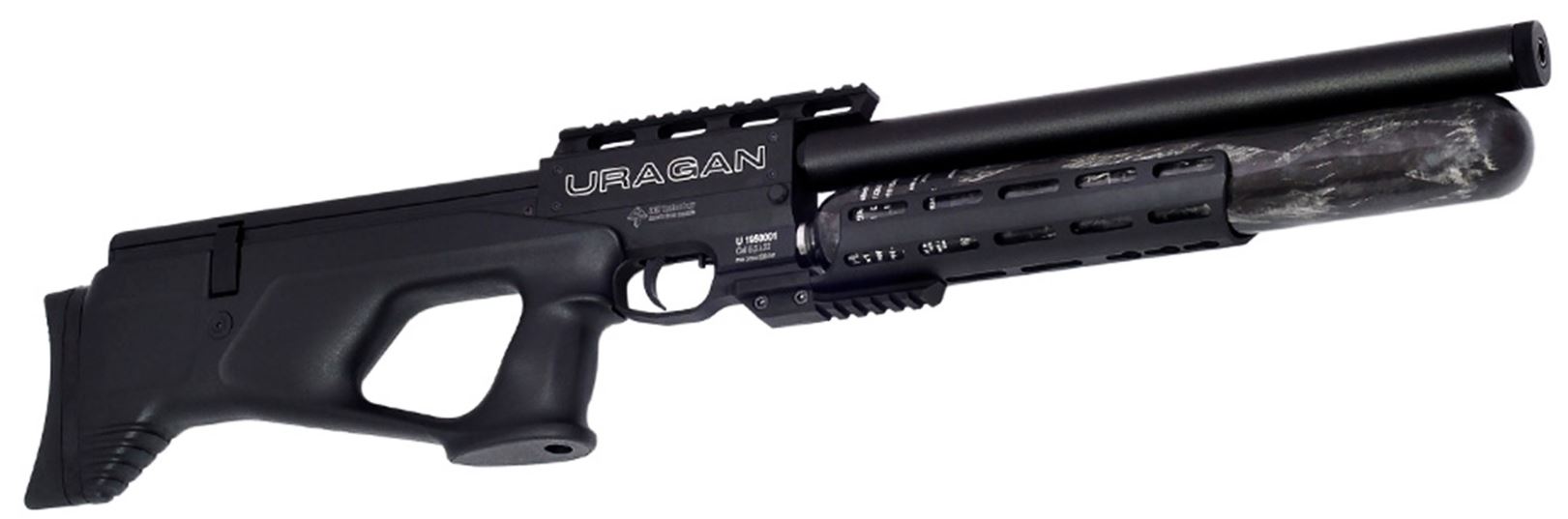
AGT Uragan Synthetic PCP Air Rifle
Precision, consistency, and field-ready durability are delivered by the AGT Uragan Synthetic, a regulated bullpup PCP platform engineered in the Czech Republic for target work, pest control, and hunting applications. Weather-resistant synthetic furniture is combined with a high-capacity air system, a shrouded CZ barrel, and fully ambidextrous controls so that reliable performance can be enjoyed by every shooter.
Engineered Performance of the AGT Uragan Synthetic
A compact bullpup layout is employed so that barrel length is preserved while overall handling remains manageable. Consequently, a balanced feel is maintained whether the rifle is used from a bench, a bipod, or a standing field position. Furthermore, a 530 cc carbon-fiber cylinder charged to 300 bar is integrated beneath the action, and regulated output is supplied so that shot-to-shot consistency is protected across a long string.
Moreover, a power plenum and refined firing valve are incorporated so that airflow is optimized and maintenance is simplified. In addition, a pressure gauge is provided so that remaining air can be monitored at a glance. As a result, extended sessions can be completed with fewer fills, and confidence is supported from the first shot to the last.
Barrel, Shroud, and Quiet Delivery
A cold-hammer-forged CZ barrel is housed inside an integral shroud so that blast is reduced and grouping potential is protected. Additionally, muzzle threading (commonly M14 or adapter-ready) is offered so that a secondary moderator can be fitted when extra suppression is required. Therefore, a quieter profile is achieved without sacrificing velocity potential.
Likewise, twist rates suited to each caliber are specified so that both pellets and appropriate slugs can be stabilized. Hence, tight groups at mid-range distances are supported when quality ammunition and a stable rest are used.
Highlighted Features of the AGT Uragan Synthetic
- Weather-resistant synthetic stock built for all-season field use
- Regulated 300 bar PCP system with approximately 530 cc capacity
- Ambidextrous biathlon side lever that can be swapped left or right
- Shrouded CZ precision barrel with provision for extra moderation
- 20 MOA Picatinny top rail for optics, including night-vision setups
- Lower Picatinny / KeyMod-style forend for bipods and accessories
- Two-stage adjustable trigger and manual safety
- Adjustable butt pad for a customized length of pull
- High-capacity rotary magazines matched to each caliber
- Pressure gauge and probe-fill system included in typical kits
Calibers, Power, and Magazine Capacity
Multiple chamberings are offered so that the platform can be matched to the intended task. Typically, .177 is selected for high shot count and precision paper or HFT-style work. Meanwhile, .22 is favored as a balanced hunting and pest-control option. Subsequently, .25 and .30 configurations are chosen when greater downrange energy is required and local regulations allow FAC or high-power use.
Magazine capacity is generally arranged as follows: about 15 rounds in .177, 12 in .22, 10 in .25, and 9 in .30. Consequently, follow-up shots can be delivered quickly without breaking position. Factory-tuned energy and shot counts vary by barrel length, regulator setting, and pellet weight; therefore, published figures should be treated as guidance and confirmed on a chronograph after the rifle is received.
FAC Considerations and Responsible Use
Power levels above local airgun limits are available on specified models where licensing permits. Nevertheless, legal compliance must always be verified before purchase and use. In addition, safe handling, secure storage, and appropriate backstops are required so that every session remains responsible. Inclusive design choices—especially the reversible side lever and ambidextrous stock geometry—ensure that left- and right-handed users are equally accommodated.
Ergonomics and Inclusive Handling
A thumbhole-style synthetic chassis is molded so that a firm, repeatable grip is provided in wet or dusty conditions. Furthermore, an adjustable rubber butt pad is fitted so that length of pull can be tailored. Moreover, the biathlon-style cocking lever can be relocated without specialized tools, and a slide or catch safety is placed within easy reach.
As a result, fatigue is reduced during longer practice sessions. Likewise, glove use in colder weather is supported by the revised trigger-guard geometry found on later Uragan generations. Therefore, the AGT Uragan Synthetic can be shared among household members or club shooters without awkward conversion kits.
Rails, Accessories, and Modular Setup
A sloped 20 MOA Weaver/Picatinny rail is machined along the receiver so that long-range zeroing of quality optics is simplified. Additionally, a lower rail and KeyMod or M-LOK slots are provided on the handguard so that a bipod, light, or sling hardware can be attached. Consequently, a hunting or bench configuration can be built without custom gunsmithing.
Typical packages include two magazines, a fill probe, a padded case or work mat, and a scuba/DIN-style adaptor depending on the retailer kit. Hence, the rifle can be put into service shortly after unboxing once a suitable scope and pellets are selected.
Practical Use Scenarios
On the range, regulated consistency and a crisp two-stage trigger allow tight groups to be printed once a preferred pellet is identified. In the field, the compact bullpup length and weatherproof stock allow the rifle to be carried through brush without a fragile wood finish being exposed to moisture. For pest control around barns or paddocks, the shrouded barrel and optional extra moderator keep report modest, while magazine capacity supports multiple opportunities before a reload is required.
Meanwhile, HFT and informal field-target shooters benefit from the stable rear-biased balance of the bullpup layout. Subsequently, hunting users who operate under FAC can select longer barrels and larger calibers so that ethical energy is retained at distance. In every case, a proper zero, legal power setting, and suitable ammunition remain essential.
Why the AGT Uragan Synthetic Belongs on a Serious Shortlist
Czech manufacturing standards, a proven regulated air system, and a truly ambidextrous control layout are combined in one package. Furthermore, synthetic furniture keeps weight reasonable (typically around 3.5–3.7 kg unscoped, depending on barrel) while resisting knocks that would mark a laminate or walnut stock. Moreover, shot counts on a 300 bar fill are generous for the class, especially in .177 and .22.
Therefore, value is delivered for shooters who want a durable daily driver rather than a safe queen. Conversion is straightforward: match caliber to local law and intended quarry, fit quality glass on the 20 MOA rail, and confirm velocity on a chronograph. After that, the AGT Uragan Synthetic is ready to earn its place on the line or in the field.
Responsible ownership, correct licensing where required, and regular maintenance of seals and fill fittings will keep performance consistent for years. When those basics are observed, a refined, inclusive, and highly capable PCP platform is placed in the hands of every enthusiast who chooses this Czech-built synthetic bullpup.
Diana, Bintac, AEA and Hatsan Airguns: Rifles, Pistols, PCPs and Accessories
For shooters comparing trusted platforms, the Diana range remains a major point of interest. Searches such as diana air rifle, diana air rifles, air rifle diana, rws diana air rifle, rws diana, diana rws, and diana r reflect the continued popularity of classic airgun designs. Well-known spring-powered choices include the diana 34, diana model 34, diana rws 34, rws diana 34, diana r34, and diana 34 air rifle. Shooters interested in the updated modular platform may also search for diana 34 ems or diana 34 ems fiber optic sights.
Other established models continue to attract enthusiasts, including the diana 35, diana 48, diana mod 48, rws diana model 48, diana 54, diana 350 magnum, diana 350 magnum air rifle, 350 magnum diana, and diana rws 460 magnum. These rifles appeal to buyers comparing traditional spring-piston construction, power, accuracy, build quality, and different configurations for recreational or sporting use.
Diana PCP Air Rifles, Pistols and Accessories
The Diana catalog also includes PCP, CO2, and pistol-format options suited to different shooting preferences. Popular searches include diana r22, diana 2, diana 250, diana two fifty, diana 250 air rifle, diana stormrider, diana outlaw gen 2, diana airbug, diana bandit black, diana lp8, lp8 diana, diana air pistol, and diana pellet gun.
Owners looking to maintain, repair, or customize certain platforms may also search for diana chaser accessories and diana chaser parts. For target shooting and recreational plinking, a 4.5mm air gun remains a common caliber choice. Meanwhile, hunting diana searches often focus on Diana rifles suited to lawful pest-control or hunting applications where airgun use is permitted.
The term nerf diana can occasionally appear alongside Diana-related search traffic, although it represents a different product category and should not be confused with traditional pellet rifles or air pistols.
Bintac and AEA PCP Airguns
Big-bore and tactical PCP enthusiasts frequently compare Diana products with Bintac and AEA platforms. Popular searches include bintac aea harpoon, aea harpoon air gun, bintac t9 full auto, bintac t9 price, bintac mcar 457, aea terminator, and aea megalodon for sale.
Other related searches include airgun shotgun, automatic air gun, air powered 50 cal rifle, and zeus 72 cal air rifle price. Shooters setting up high-pressure PCP equipment may also research an air tank for pcp airguns or anti air tanks while comparing suitable filling equipment and accessories.
The broader phrase bee bee gun rifle may also be used by new shooters searching for BB rifles, pellet rifles, and other recreational air-powered platforms.
Hatsan Air Rifles and PCP Platforms
Hatsan remains another widely searched manufacturer across spring-piston, PCP, semi-automatic, and big-bore categories. General searches such as hatsan air rifle, hatsan air guns, hatsan pcp, hatsanusa, hatsan usa, air rifle, air rifles, and airguns cover a broad selection of products.
Break-barrel shoppers frequently compare the hatsan model 95, hatsan mod 95, mod 95, hatsan 125, hatsan 135, hatsan 135 vortex air rifle, hatsan 135 carnivore, hatsan zada, and hatsan airtact air rifle. The related search hatsan airtact is also common among buyers researching lightweight and affordable break-barrel rifles.
Customers searching for discounted or previously owned products may also use the phrase hatsan refurbished while comparing factory-refurbished or pre-owned Hatsan models.

Hatsan PCP and Big-Bore Airguns
For PCP enthusiasts, popular searches include hatsan flash, hatsan flashpup qe, hatsan bullboss, hatsan hercules, hatsan hercules bully, hatsan invader, hatsan factor rc, hatsan neutron star, hatsan harpoon, hatsan piledriver, and hatsan big bore carnivore rifle.
These searches cover everything from compact PCP rifles to powerful large-caliber platforms. Buyers can compare factors such as air capacity, operating pressure, caliber, barrel configuration, magazine capacity, stock design, overall weight, and intended use before selecting a suitable platform.
Hatsan Blitz, Sortie and Semi-Automatic Models
Shooters interested in rapid-fire PCP platforms frequently search for hatsan sortie, hatsan sortie tact, hatsan sortie tact semi-auto pcp, and hatsan sortie accessories. The Hatsan Blitz family also generates searches including hatsan blitz, hatsun blitz, hatsan blitz full automatic, and hatsan blitz 30 cal.
Compact PCP pistol and carbine shoppers may also research the hatsan velox and hatsan jet 2, providing additional choices for shooters who prefer smaller platforms.
Airgun Optics, Pellets and Accessories
Accessories, optics, ammunition, and filling equipment are important parts of a complete airgun setup. A basic 4×20 optic may suit certain entry-level rifles, while ammunition such as h&n field target trophy bleifrei can appeal to shooters specifically searching for lead-free pellets.
The search phrase econ ii may also appear alongside airgun-related product research depending on the equipment, accessory, or platform being compared.
Whether the goal involves target shooting, recreational plinking, collecting, pest control, or lawful hunting, the wide selection of Diana, AEA, Bintac, and Hatsan platforms gives shooters numerous choices. Comparing the correct caliber, rifle type, filling system, optics, pellets, accessories, and replacement parts can help buyers identify equipment that best matches their intended application.
Calibres, FAC, Power and Accessories for the AGT Uragan Synthetic
A wide performance envelope is offered by the AGT Uragan Synthetic, so that the same regulated bullpup platform can be specified for target work, pest control, or licensed hunting. Consequently, calibre choice, legal power class, and accessory layout should be considered together before an order is placed. Furthermore, inclusive controls and modular rails ensure that left- and right-handed shooters can configure the rifle without compromise.
Available Calibres and Typical Magazine Capacity
Four principal chamberings are commonly listed for the AGT Uragan Synthetic. Therefore, the intended use and local pellet or slug supply can be matched with confidence.
- .177 (4.5 mm) is selected when high shot count, flat trajectory, and paper or HFT-style precision are required. A 15-round magazine is typically supplied.
- .22 (5.5 mm) is chosen as the most versatile hunting and pest-control option. A 12-round magazine is generally provided.
- .25 (6.35 mm) is preferred when greater impact energy is needed at moderate range. A 10-round magazine is usually included.
- .30 (7.62 mm) is specified for maximum downrange energy where regulations allow. A 9-round magazine is commonly fitted.
Moreover, twist rates around 1:17.7 (and a slightly faster rate on some .30 barrels) are employed so that both diabolo pellets and suitable slugs can be stabilized. Additionally, CZ-made, shrouded barrels in 500 mm, 600 mm, or 700 mm lengths are offered on related Uragan generations, so that velocity potential and handling can be balanced. As a result, a compact synthetic stock does not force a short, underpowered tube.
FAC, Legal Power Classes and Factory Tune
Two broad legal classes must be distinguished. Sub-12 ft-lbs (or the equivalent national limit) versions are supplied for unlicensed use in many jurisdictions. Meanwhile, FAC or high-power tunes are released where a firearms certificate or equivalent permit is held. Therefore, the correct specification must be confirmed with the retailer before dispatch.
On factory-regulated settings, published energy and shot-count figures vary by barrel length, pellet weight, and regulator set point. Typical guidance for longer-barrel, high-power examples includes approximately 50-plus ft-lbs in .22, 70-plus ft-lbs in .25, and 100-plus ft-lbs in .30, with shot strings that remain useful across a 300 bar fill of the 530 cc cylinder. Conversely, sub-12 examples emphasize consistency and very high shot counts—often well over 100 rounds in .22 and substantially more in .177.
Hence, published numbers should be treated as a starting point. Subsequently, a chronograph session is recommended after the rifle is received so that actual output, regulator plateau, and preferred pellet can be verified. In addition, local airgun and hunting laws must always be observed; power that is legal in one country may be restricted in another.
Inclusive language applies here as well: licensed and unlicensed users are equally served when the correct variant is ordered. A certificate is not implied by marketing language; compliance remains the owner’s responsibility.
Power Delivery, Regulator and Plenum
A 300 bar fill pressure is specified, and a precision regulator is fitted so that muzzle energy stays consistent across a long string. Furthermore, a power plenum (often cited around 54 cc on related models) is integrated so that the firing valve receives a stable air charge. Moreover, later Uragan 3 updates include a revised valve assembly, upgraded hammer spring, and a depinger so that harsh “ping” and wear are reduced.
Consequently, velocity standard deviation can be kept low when quality ammunition is used. Likewise, the synthetic chassis and carbon-fibre bottle keep all-up weight in the region of 3.5–3.7 kg unscoped, so that extra power is not paid for with excessive mass. Nevertheless, FAC barrels and heavier slugs will change point of impact and recoil impulse; therefore, a fresh zero is required after any power or ammunition change.
Optics, Rails and Sighting Accessories
A 20 MOA sloped Picatinny/Weaver rail is machined along the receiver so that long-range zeroing of full-size scopes is simplified. Additionally, the rail length on current generations supports larger optics and night-vision or thermal add-ons. As a result, the AGT Uragan Synthetic can be set up for dusk pest control as readily as for daylight paper.
Quality mounts of the correct tube diameter (often 30 mm or 34 mm) are recommended. Meanwhile, adjustable mounts may still be useful even with the built-in 20 MOA, because some optical combinations require extra elevation. Inclusive setup is straightforward: the same rail geometry serves every shooter, regardless of dominant eye or hand.
Sound Moderation and Muzzle Accessories
An integral shroud already reduces report. In addition, a muzzle thread—commonly M14×1 (or M14 CW on some batches)—is provided so that a secondary moderator can be fitted. Therefore, an adapter to ½-UNF may be required if a standard UK-style silencer is preferred. Quiet field use is thereby supported without altering the regulated power curve.
A thread protector is supplied from the factory so that the crown remains guarded when no extra can is fitted. Subsequently, only moderators rated for the rifle’s power class should be used.
Support Accessories, Magazines and Fill Gear
Typical kits include two rotary magazines, a fill probe, a padded case or bench mat, and a DIN/scuba-style adaptor. Furthermore, spare magazines should be kept on hand so that calibre-specific payloads can be pre-loaded. Moreover, a quality pump or compressor rated to 300 bar, plus a water-trap and bleed protocol, is essential for cylinder longevity.
Lower Picatinny and KeyMod/M-LOK slots accept bipods, lights, and sling hardware. An adjustable butt pad allows length of pull to be tailored so that shorter and taller shooters share the same rifle comfortably. A two-stage trigger can be refined within safe limits; however, internal power screws should be left to qualified technicians when FAC settings are involved.
Building a Complete, Inclusive Package
Calibre, legal power, barrel length, optic, moderator, and bipod should be chosen as one system. Consequently, a .177 sub-12 setup with a lightweight scope suits club and garden use, while a .25 or .30 FAC rifle with a 700 mm barrel, 20 MOA-friendly glass, and extra moderator suits licensed hunting. In every case, the AGT Uragan Synthetic remains ambidextrous, weather-ready, and magazine-fed.
Responsible storage, correct fill practice, and verification of local FAC or airgun limits complete the package. When those steps are followed, a versatile Czech PCP platform is placed in service with the accessories required for accurate, legal, and inclusive shooting.
Frequently Asked Questions
General Platform and Design
What type of air rifle is being described?
A regulated, pre-charged pneumatic bullpup is described. Compressed air is stored in a high-capacity cylinder, and a regulator is used so that consistent muzzle energy can be delivered across a long shot string. Furthermore, a compact overall length is achieved because the action is placed behind the trigger. Consequently, barrel length can be retained without an overly long package. Moreover, weather-resistant synthetic furniture is fitted so that the chassis can be carried in wet or dusty conditions without a fragile wood finish being exposed.
Who can use this rifle comfortably?
Ambidextrous controls are provided so that both left- and right-handed shooters can be accommodated. In addition, the biathlon-style side lever can be relocated from one side of the action to the other without specialized tooling. Likewise, an adjustable butt pad is fitted so that length of pull can be tailored. Therefore, a single rifle can be shared among household members or club shooters of different stature. Inclusive handling is further supported by a reachable safety and a grip geometry that remains usable with gloves.
Is a bullpup layout more difficult to learn?
A short period of familiarization is normally required because the magazine and cocking lever sit farther to the rear than on a conventional rifle. Nevertheless, balance is often described as rear-biased and stable once a natural hold is found. Subsequently, follow-up shots can be cycled without the rifle being taken far off the shoulder. As a result, many field users prefer the compact profile for hides, vehicles, and tight woodland paths.
Calibres, Magazines and Ammunition
Which calibres are typically offered?
Four common chamberings are listed: .177, .22, .25 and .30. Therefore, the intended task can be matched to pellet or slug availability. Precision paper and high shot-count practice are usually associated with .177. Meanwhile, balanced hunting and pest control are most often assigned to .22. Greater impact at moderate range is sought with .25. Maximum licensed energy is pursued with .30 where regulations allow.
What magazine capacities should be expected?
Rotary magazines are supplied in capacities that generally follow this pattern:
- Approximately 15 rounds in .177
- Approximately 12 rounds in .22
- Approximately 10 rounds in .25
- Approximately 9 rounds in .30
Additionally, two magazines are included in many retail kits so that a spare can be pre-loaded. Hence, time spent off the aim is reduced during a session.
Can slugs as well as pellets be used?
A CZ-made, rifled barrel with a twist rate suited to the calibre is fitted. Consequently, both diabolo pellets and appropriate slugs can be stabilized when weight and length remain within the barrel’s design window. However, point of impact will change when projectile type is swapped. Therefore, a fresh zero and a chronograph check are recommended after any ammunition change. Moreover, jacketed or overly long projectiles should be avoided unless the manufacturer’s guidance confirms compatibility.
How pellet-fussy is the barrel?
Quality match or hunting pellets from established makers are usually grouped well once a preferred batch is identified. Furthermore, a short ladder test at a known distance is advised so that the most consistent lot can be selected. In addition, the barrel should be cleaned of storage oil before serious grouping is attempted. As a result, first-session scatter is often reduced after a modest break-in.
FAC, Power Levels and Legal Use
What is the difference between a standard and an FAC specification?
A standard or “sub-limit” tune is set so that muzzle energy remains within the unlicensed airgun threshold of the destination country—commonly 12 ft-lbs in the United Kingdom. Meanwhile, an FAC or high-power tune is released only where a firearms certificate or equivalent permit is held. Consequently, the same mechanical platform can serve garden, club, and licensed hunting roles when the correct factory setting is ordered.
Are published energy and shot-count figures guaranteed?
Factory figures are supplied as guidance for a given barrel length, regulator setting and pellet weight. Therefore, they should not be treated as a legal certificate of power. Subsequently, a chronograph session on the owner’s own ammunition is the only reliable confirmation. In addition, temperature, fill pressure and pellet batch can shift velocity slightly. Responsible owners verify output before hunting or competition use.
How many shots can be expected from one 300 bar fill?
A cylinder of approximately 530 cc is combined with a regulator so that a useful plateau is produced. Shot count is calibre- and power-dependent. High counts—often well over one hundred rounds—are typical in .177 and efficient .22 sub-limit tunes. Conversely, FAC settings in .25 and .30 consume more air per shot, so fewer rounds are delivered before pressure falls off the regulator. A gauge on the rifle allows remaining air to be monitored throughout the session.
Must local law be checked before purchase?
Yes. Import rules, age limits, FAC requirements, hunting seasons and permitted species vary by country and region. Furthermore, a rifle that is legal in one market may be restricted in another. Inclusive retail practice means specifications are confirmed with the buyer before dispatch, yet final compliance remains the owner’s duty.
Filling, Regulation and Maintenance
How is the cylinder filled?
A probe-style fill port is used. A hose from a pump, compressor or scuba bottle is connected after the probe is inserted, and the cylinder is charged to a maximum of 300 bar. Moreover, a water trap and correct bleed sequence are required so that moisture is not driven into the valve. Additionally, the supplied DIN or scuba adaptor in many kits allows filling from a larger storage bottle.
Can a hand pump be used?
A high-quality three-stage pump rated to 300 bar can be used for occasional top-ups. Nevertheless, operator fatigue increases as pressure rises. Therefore, a compressor or pre-filled bottle is preferred for regular FAC use or for several rifles. In every case, the manufacturer’s maximum pressure must not be exceeded.
What routine care is expected?
The exterior can be wiped after field use, and the barrel should be cleaned with airgun-safe methods only. Furthermore, o-rings on the fill probe and magazines should be inspected and lightly lubricated with airgun-compatible grease. Hammer and valve work beyond basic cleaning is best left to a qualified technician, especially on FAC examples. Consequently, seal life and regulator consistency are protected.
Is dry-firing harmful?
Repeated dry-firing without a pellet is generally discouraged on PCP valves. A snap cap is not a substitute for correct procedure. Hence, the action should be cycled only when a pellet is chambered or when the manufacturer explicitly permits an empty cycle for function checks.
Trigger, Safety and Controls
What trigger is fitted?
A two-stage, match-style trigger is specified. Pull weight and travel can be refined within safe limits on many examples. Therefore, a crisp break can be obtained for precision work without a hair-trigger being created. Adjustment beyond the intended range should be avoided so that safety is not compromised.
How does the safety operate?
A manual safety—often a sliding catch near the trigger guard—is provided so that the trigger can be blocked when the rifle is not being fired. Inclusive design places the control where it can be reached by either hand after the side lever has been swapped. The safety should be applied whenever the rifle is carried, climbed with, or set down.
Can the cocking lever be swapped by the owner?
Yes. A biathlon-style lever is designed to be moved from left to right (or the reverse) with ordinary workshop care and the correct fasteners. No special factory jig is normally required. After the swap, function and safety should be checked before live firing.
Optics, Rails and Accessories
What sight rail is provided?
A Picatinny or Weaver rail with a built-in 20 MOA slope is machined on the receiver. Consequently, elevation for longer-range zeros is assisted, and full-size scopes or night-vision add-ons can be mounted. Quality rings of the correct tube diameter must be used. Adjustable mounts may still be helpful with some optical combinations.
Can a bipod and sling be attached?
A lower Picatinny section and KeyMod or M-LOK slots are incorporated in the forend and bottle guard. Therefore, a bipod, light or sling stud can be added without gunsmithing. Balance should be re-checked after heavy accessories are fitted, because muzzle-heavy setups can slow target acquisition.
Is an extra silencer supported?
An integral shroud already reduces report. In addition, a muzzle thread—commonly M14—is provided so that a secondary moderator can be fitted. An adapter to ½-inch UNF may be required for many aftermarket cans. Only moderators rated for the rifle’s power class should be used.
Which accessories are usually included in the box?
Typical kits contain two magazines, a fill probe, a padded case or bench mat, and a scuba or DIN-style adaptor. A thread protector is fitted at the muzzle. Optics, bipods and extra magazines are purchased separately so that the setup can be tailored.
Field Use, Hunting and Storage
Is the synthetic stock suitable for all weather?
A polymer chassis is chosen specifically so that rain, mud and temperature swings are tolerated better than unprotected wood. Furthermore, the carbon-fibre cylinder is protected by the forend structure. After wet use, the rifle should still be dried and inspected. Inclusive field use means the same stock can be issued to any team member without finish anxiety.
Can the rifle be used for pest control and hunting?
Where local law and power class permit, regulated consistency and magazine capacity support ethical pest control and hunting. Shot placement, legal energy and appropriate ammunition remain the shooter’s responsibility. Night-vision or thermal optics can be mounted on the long top rail when regulations allow.
How should the rifle be stored?
A padded case is recommended for transport. At home, a locked cabinet that meets local storage rules should be used. Cylinders should not be stored completely empty for long periods, nor left at maximum pressure indefinitely if manufacturer guidance advises a mid-level storage fill. Pellets and fill gear should be kept dry and separate from unauthorized users.
What warranty and support are commonly offered?
A multi-year manufacturer warranty is advertised by many distributors, often in the region of three years, subject to registration and fair use. Service work on regulators and valves should be directed to authorized technicians so that proof of origin is preserved.
Buying and Setup Decisions
How should calibre, barrel length and power be chosen together?
A single system should be specified. Club and garden use is usually served by a sub-limit .177 or .22 with a mid-length barrel and a lightweight scope. Licensed hunting is better served by a longer barrel, a larger calibre and an FAC tune, plus a moderator and bipod. Inclusive households may keep a sub-limit rifle for shared practice and a separately stored FAC rifle for ticketed use.
What should be done on the first range session?
The barrel should be degreased, magazines loaded correctly, and a chronograph used to confirm velocity. Groups should be fired from a rest at a known distance so that the preferred pellet is identified. The zero of the chosen optic should then be confirmed. Subsequently, the regulator plateau can be mapped by recording velocity across the fill.
Are spare parts and magazines easy to obtain?
Rotary magazines and fill probes are widely stocked by specialist retailers. Seals and probes are consumable items and should be kept on hand. Major valve components are best ordered through the importing distributor so that the correct generation of parts is supplied.
When these points are observed, a regulated synthetic bullpup can be specified, filled, sighted and used with clarity. Legal power, inclusive handling and a modular accessory set remain the foundation of a safe, consistent shooting setup.




Reviews
There are no reviews yet.