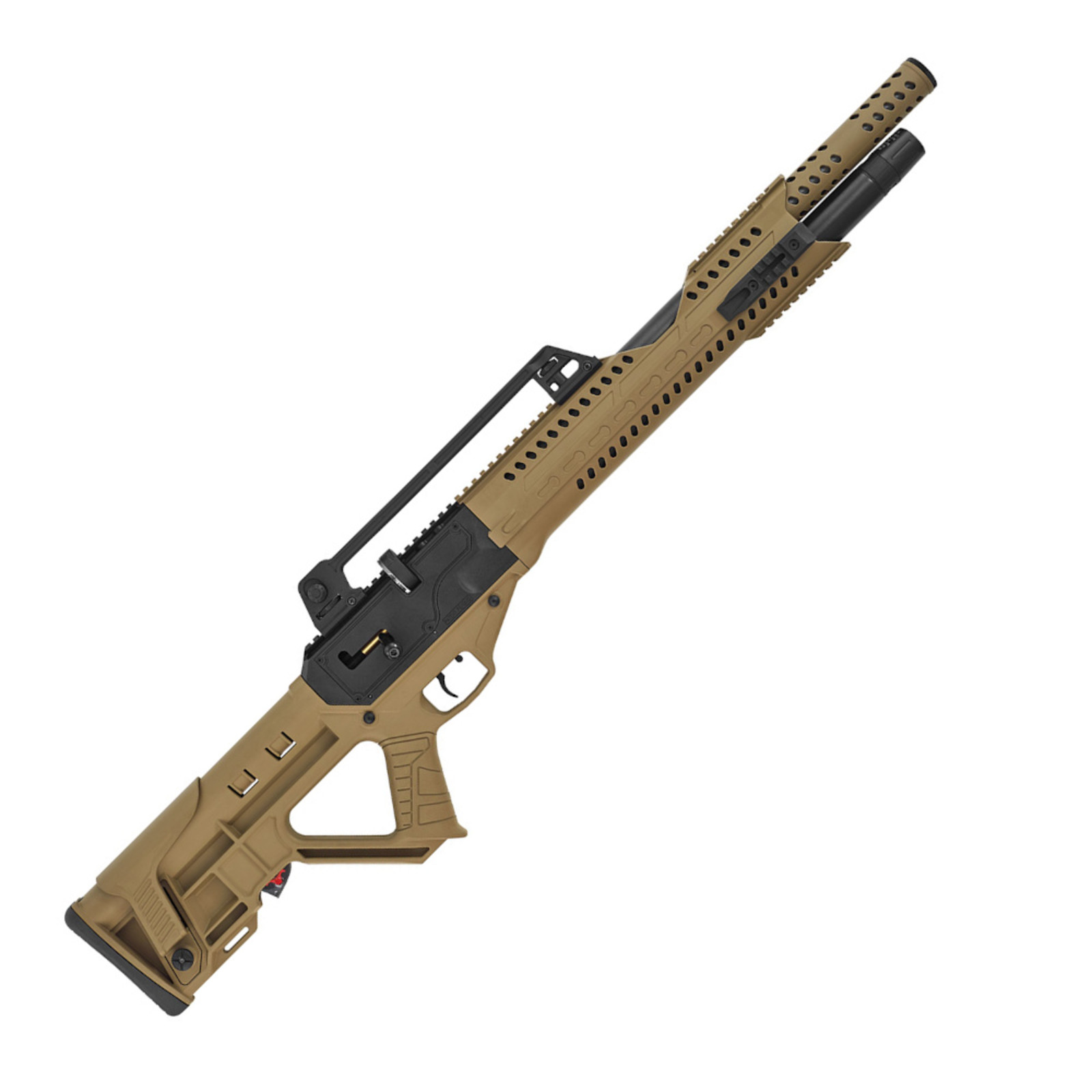
Hatsan Invader Auto Semi-automatic PCP Flat Dark Earth
Performance is engineered for rapid, consistent shooting. Precision, tactical handling, and dependable PCP power are combined in one platform so that target work, plinking, and small-game use can be enjoyed by shooters of every experience level.
Semi-Automatic Action and PCP Power Delivery
Rapid sequential shots are produced by the semi-automatic mechanism. After the trigger is squeezed, the next pellet is indexed and the valve is reset automatically, so that a fresh cocking cycle is not required between rounds. Consequently, sight picture is maintained more easily and follow-up opportunities are increased.
Pre-charged pneumatic operation is employed throughout. A detachable 255 cc aluminum cylinder is filled to 200 BAR. Thereafter, approximately 50 semi-automatic shots at optimal velocity are typically obtained from a single fill, provided remaining pressure stays above the level required for reliable cycling. Moreover, cylinder pressure is monitored at a glance because an integral gauge is fitted to the tube. In addition, a rotating dust cover is provided over the fill port, and both a quick-fill nozzle and a discharge cap are supplied so that charging and safe emptying can be completed without extra tools.
Velocity and energy figures vary by caliber and pellet. Up to 1020 fps and about 20 ft-lbs are listed for .177, up to 950 fps and about 29 ft-lbs for .22, and up to 870 fps and about 33.5 ft-lbs for .25 under manufacturer test conditions. Therefore, suitable power for paper, steel, and small-game work is made available when legal limits and local regulations are observed.

Barrel, Magazine, and Shot Consistency
Accuracy is supported by a fully shrouded, precision-rifled, and choked 500 mm (19.7 in) barrel. Heat-shield style ventilation is incorporated so that barrel temperature rise during strings can be moderated. Meanwhile, rotary magazines are used: 14 rounds in .177, 12 in .22, and 10 in .25. Three magazines are included, and a spare-magazine recess is molded into the stock so that a loaded spare can be carried on the rifle itself.
Anti-knock protection is built into the design on many listings, reducing the chance that a jolt will dump air unexpectedly. As a result, field reliability is improved when the rifle is carried or transported.
Tactical Stock, Optics Readiness, and Inclusive Handling
An all-weather synthetic tactical stock in Flat Dark Earth is fitted. An ambidextrous thumbhole layout and an elevation-adjustable cheek rest are provided so that a comfortable cheek weld can be obtained by right- or left-handed users of different statures. Furthermore, a rubber butt pad is installed to help manage felt impulse, and textured grip surfaces are molded in so that a secure hold is maintained in wet or gloved conditions.
Three Picatinny accessory rails are located on the forend (sides and underside), while a Picatinny rail runs along the receiver for 22 mm optics. Additionally, a detachable carry handle with elevation- and windage-adjustable fiber-optic sights is supplied; once the handle is removed, the rail beneath it remains available for a scope or red-dot. Sling swivels are fitted as standard so that a sling can be attached immediately.
Overall length is 1030 mm (40.5 in) and unladen weight is approximately 3.7 kg (8.2 lb). Consequently, a balanced feel is achieved for offhand, kneeling, or supported positions without excessive bulk.
Highlighted Product Listings
- Semi-automatic PCP action with automatic indexing after each shot
- Available calibers: .177 (14-shot), .22 (12-shot), .25 (10-shot)
- Detachable 255 cc aluminum air cylinder, 200 BAR fill, onboard pressure gauge
- Fully shrouded, rifled, and choked 19.7 in barrel
- Approximately 50 optimal-velocity semi-auto shots per fill
- Tactical Flat Dark Earth synthetic stock, ambidextrous thumbhole, adjustable cheek rest
- Spare magazine slot in the stock; three magazines included
- Receiver Picatinny rail plus three forend accessory rails
- Detachable carry handle with adjustable fiber-optic open sights
- Manual safety, sling swivels, rubber butt pad, quick-fill probe, and discharge cap
Practical Use and Responsible Ownership
Plinking and informal target sessions are well served because fast follow-up shots can be taken without breaking position. Likewise, pest and small-game applications benefit when a second shot is needed quickly, provided local laws, licensing, and energy limits are respected. Because the platform is optic-ready, a compact scope or reflex sight can be mounted once the carry handle is removed, extending useful range for those who prefer magnified or unmagnified aiming solutions.
Maintenance remains straightforward. After each session the barrel is kept clean, the cylinder is stored with residual pressure as recommended by the manufacturer, and moving parts are kept free of grit. Spare cylinders can be purchased separately so that a second charged tube can be swapped in the field. Importantly, the rifle must only be used where possession and discharge are legal; FAC or equivalent restrictions apply in many jurisdictions, and muzzle energy figures above local limits must not be assumed.
Conversion-focused value is created by the combination of semi-automatic speed, included magazines, detachable air supply, and a complete set of rails and sights. Therefore, extra aftermarket items are not required on day one. Shooters seeking a distinctive Flat Dark Earth tactical look together with rapid-fire PCP capability will find that the Hatsan Invader Auto Semi-automatic PCP Flat Dark Earth is configured to deliver engaging sessions and dependable results when it is handled safely and within the law.
Calibers, FAC Ratings, Power Output, and Accessories
Caliber choice, certificate status, muzzle energy, and supporting accessories are all addressed by the Hatsan Invader Auto Semi-automatic PCP Flat Dark Earth so that a suitable configuration can be selected by shooters of every experience level. Because regional laws differ, local licensing and energy limits must always be confirmed before purchase or use.
Available Calibers and Magazine Capacities
Three factory calibers are offered. A 4.5 mm (.177) chambering is provided with a 14-shot rotary magazine. A 5.5 mm (.22) chambering is supplied with a 12-shot magazine. A 6.35 mm (.25) chambering is fitted with a 10-shot magazine. Consequently, pellet count per cylinder is balanced against projectile mass and intended use. Moreover, three magazines are included with each rifle, and a molded spare-magazine recess is located in the stock so that a loaded spare can be carried on the gun itself.
Lightweight, high-velocity pellets are typically favored in .177 when paper targets or longer-range plinking are planned. Greater downrange energy and a heavier strike are delivered in .22, which is frequently chosen for mixed target and small-game work. Still more momentum is produced in .25, so that medium pests and closer-range hunting applications can be served where such use is lawful. Therefore, the same platform can be specified according to discipline rather than forcing a single compromise caliber.
FAC Status and Legal Power Considerations
Firearm Certificate (FAC) classification applies to the published factory energy figures in many jurisdictions, including the United Kingdom. Sub-12 ft-lb (approximately 16.3 J) air rifles may be held without an FAC in England and Wales when other conditions are met; the listed outputs of the Hatsan Invader Auto Semi-automatic PCP Flat Dark Earth exceed that threshold. As a result, an FAC (or the equivalent national authorization) is required wherever those higher-power versions are sold or used.
Manufacturer energy figures are stated as approximately 27 J / 20 ft-lbs in .177, 39.8 J / 29 ft-lbs in .22, and 45 J / 33.5 ft-lbs in .25 under test conditions. Velocity is correspondingly listed at up to 310 m/s (1020 fps) in .177, 288 m/s (950 fps) in .22, and 265 m/s (870 fps) in .25. Importantly, actual results vary with pellet weight, shape, temperature, altitude, and remaining cylinder pressure. Additionally, a minimum of about 100 BAR is required for reliable semi-automatic cycling; once pressure falls below that point, semi-auto function may cease even if air remains in the tube.
In several European markets a restricted-energy variant near 16–17 J is also distributed so that certificate-free ownership can be maintained where national rules allow it. Consequently, the exact specification that is shipped must be verified against the destination country’s law. Inclusive, responsible ownership is supported only when the rifle is stored, transported, and discharged in accordance with those rules.
Power Delivery and Shot Count
Power is supplied by a detachable 255 cc aluminum cylinder filled to 200 BAR. Approximately 50 semi-automatic shots at optimal velocity are typically obtained from a full charge when suitable pellets are used and pressure remains in the working range. Thereafter, velocity begins to drop and cycling may become inconsistent. Because a regulator is not fitted, a mild power curve is expected across the shot string; groups remain usable when the same pellet and a consistent hold are employed.
Detachable cylinders can be swapped in the field. Spare tubes are offered separately by Hatsan and many retailers, so that a second charged cylinder can be carried and exchanged without a compressor on site. Furthermore, an onboard gauge allows remaining pressure to be read at a glance, and a rotating dust cover protects the fill port when the rifle is not being charged.
Accessories Included and Recommended Add-Ons
A practical accessory package is supplied from the factory. Three rotary magazines, a quick-fill probe, and an air-cylinder discharge cap are included so that filling, emptying, and extended strings can begin immediately. A detachable carry handle with elevation- and windage-adjustable fiber-optic sights is fitted; once the handle is removed, the Picatinny rail beneath it is freed for a scope or reflex sight.
Additional mounting points are already present. A receiver Picatinny rail accepts 22 mm optics rings. Three further Picatinny rails are located on the forend—left, right, and underside—so that a bipod, light, laser, or vertical grip can be attached without aftermarket adapters. Sling swivels are installed at the factory, allowing a two-point sling to be fitted at once.
Recommended extras that are commonly paired with the Hatsan Invader Auto Semi-automatic PCP Flat Dark Earth include a compact variable-power scope, a short Picatinny bipod, a quality two-point or single-point sling, a portable PCP compressor or a second 255 cc cylinder, and a hard or padded case that accepts the 40.5 in overall length. QuietEnergy-style shrouds are already integrated on many examples; an extra moderator is not required on every barrel because threading is not provided on standard Invader Auto muzzles.
Highlighted accessory and specification list:
- Calibers: .177 (14-shot), .22 (12-shot), .25 (10-shot)
- Factory energy (FAC-level listings): ~20 / 29 / 33.5 ft-lbs respectively
- Cylinder: 255 cc, 200 BAR, detachable, gauged, spare tubes available
- Included: 3 magazines, fill probe, discharge cap, carry handle with FO sights
- Rails: receiver Picatinny plus three forend accessory rails
- Stock features: spare-mag slot, adjustable cheek rest, rubber pad, sling swivels
When caliber, certificate status, and accessories are matched to local law and intended use, consistent semi-automatic performance can be obtained from the Hatsan Invader Auto Semi-automatic PCP Flat Dark Earth by every responsible shooter.
Practical Use Scenarios in Everyday Shooting
Practical performance is revealed only when a pre-charged, self-indexing rifle is taken beyond a workbench and placed in the positions, weather, and time pressure that real sessions create. Consequently, the following scenarios are written so that backyard practice, formal targets, pest work, and small-game outings can be planned by shooters of every stature and experience level. Inclusive language is used throughout because the same platform is handled by right- and left-handed users, seated or standing, on private land or at a club.
Informal Plinking and Backyard Sessions
Casual strings are where the self-indexing action is felt first. After a safe backstop is confirmed and a filled cylinder is fitted, pellets are sent as quickly as the trigger can be pressed. Sight picture is therefore held more easily than with a bolt that must be cycled after every shot. Moreover, a spare magazine already seated in the stock recess can be exchanged in a few seconds, so that a short session is not interrupted by a walk back to a bench.
Lightweight targets—spinner plates, resettable silhouettes, and reactive cans—are well served because a second and third pellet can be launched before the first target has finished moving. Meanwhile, felt impulse remains modest, so that a compact optic or the supplied open sights can be kept on the same aiming mark. Additionally, an onboard gauge is glanced at between magazines; once pressure approaches the lower working limit, the session is paused and the cylinder is swapped or refilled rather than forcing weak shots.
Highlighted backyard checklist:
- A safe, legal backstop is verified before the first pellet is chambered
- A second charged cylinder or a compressor is kept nearby for longer strings
- Magazines are pre-loaded so that downtime is limited to a magazine change
- Open sights or a low-power optic are used so that close reactive targets remain fast to acquire
Paper, Steel, and Club Target Work
Formal practice is approached differently. A rested position—bench, bags, or a bipod on the forend rail—is adopted so that group size can be read honestly. Thereafter, a single pellet type is selected and a full magazine is fired without a hold change. Because a regulator is not fitted, a mild velocity curve is expected; groups are still usable when the same point of aim and a consistent cheek weld are maintained.
Steel plates at known distances reward the rapid follow-up capability. After the first hit is called, the next pellet is already indexed, so that a plate that rings and swings can be engaged again before it settles. Consequently, timing drills and “two on each plate” strings become realistic training rather than a series of interrupted bolt strokes. Furthermore, the adjustable cheek piece is raised or lowered until the chosen optic sits naturally; once that height is set, the same weld is repeated from sitting and kneeling so that field positions are not a surprise later.
Distance work is paced. Closer cards are used to confirm zero and trigger feel. Mid-range steel is then engaged so that hold-over and wind calls can be practiced while the cylinder still holds useful pressure. Importantly, the last ten shots of a fill are treated as informational rather than competitive; they show how the curve behaves and when a cylinder change should have been made.
Pest Control on Private Land
Where local law allows air-powered pest control, the same rapid second shot is the practical advantage. A rabbit or corvid that is not immediately anchored can be engaged again while the sight picture is still close to the original hold. Therefore, a loaded spare magazine in the stock slot is not a luxury; it is part of a short, ethical sequence.
Approach is kept quiet. A sling is fitted to the factory swivels so that the rifle can be carried muzzle-down or across the chest until a shot is presented. Meanwhile, the forend rails accept a compact bipod or a short rail-mounted rest if a fence line or bag is not available. After the shot, the area is watched; if a follow-up is required, the trigger is pressed again without a cocking motion that would shift the muzzle.
Energy and caliber choice matter. Heavier pellets in the larger chamberings are often preferred when penetration and remaining energy at typical pest distances are needed. Conversely, the smaller chambering may be selected where over-penetration must be limited and a safe backstop is close. In every case, permission, season, and national energy limits are confirmed before the first outing. Inclusive practice means that a smaller-framed shooter can use the adjustable comb and thumbhole so that the same ethical standard is reached without fighting the stock.
Small-Game Hunting Sequences
Small-game use is built from the same habits, only with more walking and more varied rests. A charged spare cylinder is carried in a pouch so that a mid-morning refill is not required at a vehicle. Thereafter, magazines are kept loaded with the chosen hunting pellet only; mixed pellets in one magazine are avoided because point of impact would shift mid-string.
Positions change constantly. Offhand shots at close, sudden targets are possible because the rifle balances around the pistol grip and the rubber pad helps the shoulder stay in place. Kneeling and sitting are used when time allows; the adjustable cheek piece keeps the eye behind the optic in each posture. Additionally, the detachable carry handle can be left on for a day of still-hunting with iron sights, or removed so that a low-power scope can be mounted on the rail beneath it.
Follow-up discipline remains the same as on the range. The first shot is placed as carefully as if it were the only one. The second shot is taken only when it is still ethical. Because indexing is automatic, the temptation to “spray” must be resisted; the mechanism is a tool for a clean second opportunity, not a substitute for patience.

Field Carry, Weather, and Air Management
All-weather synthetic furniture is intended for damp grass, light rain, and dusty tracks. After a wet sit, the fill-port cover is checked so that grit is not packed into the charging hole. Likewise, magazines are wiped before they are seated; a grain of sand in a rotary magazine is enough to cause a misfeed at the worst moment.hatzan blitz.crow magnum
Air management is planned before leaving the vehicle. A full cylinder is fitted. A second cylinder, already filled to the working pressure, is packed. The gauge is read after every magazine or after every known-distance string so that the shooter is never surprised by a weak last shot. When pressure nears the minimum required for reliable cycling, the tube is exchanged in a safe direction with the safety applied.
Highlighted field-air routine:
- Cylinders are filled at home or at a shop so that field time is spent shooting, not pumping
- A discharge cap is carried so that a tube can be emptied safely if a seal must be inspected
- Magazines are numbered or marked so that a suspect feed can be isolated
- A brief function check is performed after any knock or drop before live pellets are used
Positions, Optics, and Inclusive Fit
Standing, kneeling, sitting, and prone are all used across a season. The thumbhole and textured grip help the support hand stay consistent when gloves are worn. Elevation of the comb is adjusted once for the primary optic and then left alone so that muscle memory is not reset every outing. Shooters who prefer iron sights keep the handle installed; those who prefer glass remove it and mount rings on the receiver rail. Side and bottom rails remain available for a light or a short bipod in either setup.
Inclusive fit is not an afterthought. A shorter-statured shooter raises the comb and uses the rubber pad to find a repeatable weld. A taller shooter lowers the comb and checks that the eye relief of the optic still clears the thumbhole. Left-handed users benefit from the ambidextrous layout; the magazine and side lever remain on the right, yet the stock itself does not force a right-hand-only hold.
Safety, Law, and Session Close
Every scenario above is possible only where possession and discharge are legal. Certificate requirements, energy caps, and land permission are confirmed before the cylinder is filled. The safety is applied whenever the muzzle leaves a target. After the last shot, the magazine is removed, the action is confirmed clear, and remaining air is left in the cylinder or bled according to the maker’s guidance.
A session is closed the same way it was opened: with a backstop check, a gauge reading, and a decision about whether the next outing needs a spare tube, a different pellet, or a comb adjustment. When those habits are repeated, rapid follow-up capability, detachable air supply, and a rail-ready tactical stock become practical tools rather than catalogue features. Consistent, responsible use is therefore available to every shooter who matches the platform to the land, the law, and the shot that is actually presented.bee bee gun rifle.hatsan pcp.hatsan usa.range of air rifle.bullmaster
Frequently Asked Questions
Answers below are written so that first-time buyers, club shooters, and field users of every experience level can plan a purchase and a first session with fewer surprises. Local law is always checked first, because energy ratings, certificate rules, and permitted uses differ by country.
Buying, Certificates, and Legal Limits
Is a firearm certificate required?
Certificate status depends on the energy version that is shipped and on national rules. Published factory figures for the higher-output variants sit above the common 12 ft-lb (about 16.3 J) threshold used in parts of the United Kingdom. Consequently, an FAC or the equivalent authorization is required wherever those versions are sold or used. In some European markets a restricted-energy variant near 16–17 J is also distributed. Therefore, the exact specification on the carton must be matched to the destination country’s limit before an order is placed.
Can the rifle be used for pest control or small game?
Pest and small-game use are lawful only where land permission, season, species, and muzzle-energy rules allow it. When those conditions are met, a rapid second shot can be taken without a separate cocking stroke, which is useful if the first pellet does not immediately anchor the animal. Inclusive, ethical practice still requires that the first shot be placed as carefully as if it were the only one.
Is the platform suitable for beginners?
A new shooter can learn the platform if safe handling, a proper backstop, and local law are already understood. Trigger feel, magazine changes, and gauge reading are straightforward. However, higher-energy versions are not treated as toys; supervision and a clear safety brief are provided before the first live string.
Highlighted legal reminders:
- National energy caps and licensing are confirmed before purchase
- Landowner permission is obtained for any field use
- A safe backstop is verified for every session
- Storage and transport rules for pre-charged rifles are followed
Calibers, Power, and Shot Count
Which calibers are offered?
Three chamberings are factory-available. A 4.5 mm option is paired with a 14-shot rotary magazine. A 5.5 mm option is paired with a 12-shot magazine. A 6.35 mm option is paired with a 10-shot magazine. Lightweight, high-velocity pellets are often chosen in the smallest caliber for paper and longer plinking. Greater downrange energy is typically sought in the middle caliber for mixed target and pest work. Still more momentum is produced in the largest caliber when closer-range hunting applications are lawful.
What velocities and energies are listed?
Manufacturer test figures are commonly stated near 1020 fps and about 20 ft-lbs in the smallest caliber, near 950 fps and about 29 ft-lbs in the middle caliber, and near 870 fps and about 33.5 ft-lbs in the largest caliber. Actual results change with pellet weight, shape, temperature, altitude, and remaining cylinder pressure. Moreover, a variation of up to about 20 percent is noted by the maker under differing conditions.


Reviews
There are no reviews yet.