Remington Vought PCP Air Rifle – Precision Engineering, Modern Design & Reliable Shooting Performance
Remington Vought PCP Air Rifle – An Innovative Combination of Power, Accuracy and Comfort
The Remington Vought PCP Air Rifle has been developed to combine modern pre-charged pneumatic technology with a distinctive design, comfortable handling and consistent shooting performance. Designed for recreational target shooting, precision practice and lawful field applications, this air rifle offers an interesting alternative to conventional PCP platforms.
Furthermore, a regulated air delivery system has been incorporated to support more consistent performance between shots. Consequently, fluctuations in operating pressure can be better managed, allowing a more predictable shooting experience throughout the usable air supply.
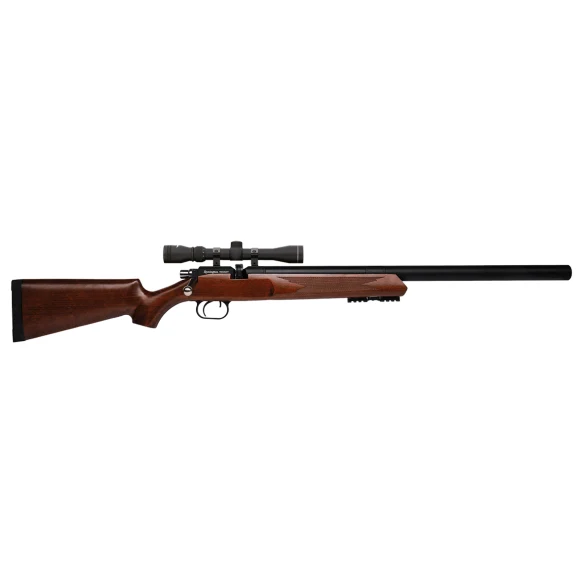
Unlike traditional air rifles with clearly exposed air cylinders, the Remington Vought features an unconventional configuration in which the compressed-air reservoir is arranged around the barrel. As a result, a streamlined appearance is achieved without sacrificing the familiar handling characteristics of a full-length sporting rifle.
Meanwhile, different stock configurations are offered to accommodate individual preferences. A traditional hardwood design provides classic styling, whereas the synthetic option offers a contemporary appearance and practical resistance to everyday environmental exposure.
Additionally, the rifle is available in different calibres and power configurations, depending on the model and market. Therefore, individual specifications should always be reviewed before selecting the appropriate version.
Key Features and Product Highlights
- PCP operating system: Compressed air is used to power each shot without conventional spring-piston recoil.
- Regulated air delivery: A regulator is incorporated to support consistent operating pressure.
- Multi-shot bolt action: A manually operated bolt allows pellets to be cycled from a detachable magazine.
- Integrated air reservoir: The unusual barrel-surrounding design provides a distinctive exterior profile.
- Precision-rifled barrel: Pellet stabilization is supported through the barrel’s rifling.
- Integrated sound moderator: Muzzle noise is reduced compared with an equivalent unmoderated configuration.
- Optics-ready receiver: A mounting system is provided for compatible telescopic sights.
- Additional accessory rails: Picatinny mounting points are incorporated for suitable accessories.
- Manual safety mechanism: An additional safety control is provided.
- Ergonomic stock design: Comfortable positioning is supported during extended range sessions.
- Rubber recoil pad: Additional shoulder comfort is provided.
- Scope package: Selected configurations are supplied with a 3–9×40 telescopic sight and mounts.
Advanced PCP Technology for Consistent Airgun Performance
Regulated Air System and Controlled Pressure Delivery
At the centre of the Remington Vought PCP Air Rifle, compressed-air technology is used to produce its firing energy. Unlike a conventional spring-powered design, the rifle is operated using air that has been stored under pressure.
Furthermore, an internal regulator helps manage the pressure delivered to the firing mechanism. Through this arrangement, consistency can be improved compared with an unregulated system as reservoir pressure changes.
As a result, predictable performance can be supported during target practice. Nevertheless, actual accuracy will also depend on pellet selection, barrel condition, atmospheric conditions and the shooter’s technique.
Importantly, the air reservoir must be filled using compatible PCP charging equipment. Proper pressure monitoring is essential, and the maximum operating pressure specified for the individual model must never be exceeded.
Innovative Air Reservoir and Integrated Barrel Configuration
One of the most distinctive features of this rifle is its unconventional compressed-air storage arrangement.
Instead of being mounted prominently beneath the barrel, the reservoir is incorporated into the surrounding structure. Consequently, the Vought achieves a remarkably different appearance from many traditional PCP sporting rifles.
Additionally, the arrangement contributes to the model’s substantial fore-end profile. The result is a visually distinctive combination of sporting-rifle proportions and modern airgun engineering.
Although the reservoir is concealed within the exterior design, pressure information remains accessible through fitted gauges. Therefore, users can monitor the rifle’s air supply and regulator pressure as appropriate.
Precision Barrel, Bolt-Action Mechanism and Magazine System
Rifled Barrel for Consistent Pellet Stabilization
A rifled steel barrel is incorporated into the rifle’s construction to provide rotational stabilization to compatible pellets.
As each pellet travels through the barrel, spin is imparted by the rifling. Consequently, improved flight stability can be supported when suitable ammunition is used.
Moreover, the relationship between pellet dimensions, weight and barrel characteristics influences shooting results. For this reason, compatibility and consistency should be considered whenever ammunition is selected.
Although performance will vary according to the individual rifle and its operating configuration, the barrel design provides the foundation for controlled target shooting.
Multi-Shot Bolt Action for Convenient Operation
The Remington Vought has been equipped with a manually operated bolt-action mechanism.
Through this arrangement, successive pellets can be fed from a detachable rotary magazine. Accordingly, repeated manual placement of individual pellets directly into the breech is generally avoided during normal multi-shot operation.
Furthermore, a positive mechanical loading process is provided, allowing users to develop a familiar, repeatable operating routine.
Magazine capacities vary by calibre and product configuration. Therefore, the capacity supplied with the selected version should be confirmed rather than assumed.
Ergonomic Stock Design and Shooting Comfort
Traditional Hardwood and Modern Synthetic Options
Different stock finishes are offered across the Remington Vought range.
With the hardwood version, classic sporting-rifle aesthetics are emphasized through a natural wood appearance. Meanwhile, the synthetic configuration is designed to provide a practical alternative for users who prefer modern styling.
Additionally, stock shaping and surface detailing contribute to comfortable handling. Through the rifle’s conventional shoulder-mounted layout, a familiar shooting position can be maintained.
A fitted rubber recoil pad further supports shoulder comfort, even though PCP systems typically generate less mechanical recoil than many spring-piston air rifles.
Consequently, the overall configuration can be appreciated by both experienced airgun enthusiasts and newer shooters receiving appropriate instruction.
Balanced Dimensions and Practical Handling
The Remington Vought is designed as a full-length sporting air rifle rather than an especially compact platform.
An overall length of approximately 111 cm and a weight of around 3.1 kg are specified for several versions. As a result, the rifle has a substantial feel that may appeal to users accustomed to traditional sporting stocks.
Nevertheless, dimensions and weight should be verified for the exact model supplied, particularly when different stocks or accessories are fitted.
Integrated Optics and Accessory Compatibility
Telescopic Sight Mounting System
For precision-oriented recreational use, provision has been made for a compatible telescopic sight.
Selected packages include a 3–9×40 scope with mounting hardware. Therefore, a basic optical sighting arrangement may already be included with the product.
Additionally, compatible accessory rails are incorporated into the rifle’s construction. These provide mounting locations for appropriate equipment, subject to the dimensions and requirements of the selected accessories.
Because package contents can differ between suppliers, the included optical components should be confirmed before the product is purchased.
Integrated Sound Moderator and Manual Safety
A sound moderation system is incorporated into the model to reduce muzzle report.
Consequently, a more controlled acoustic experience may be provided, although the rifle should never be described as silent.
Moreover, a manually operated safety mechanism is included as an additional safety feature. However, safe handling procedures remain essential regardless of the position of the safety control.
Proper supervision, secure storage, appropriate eye protection and the use of a designated shooting area are recommended whenever the rifle is handled.
Remington Vought PCP Air Rifle Technical Specifications
| Specification |
Details |
| Brand |
Remington |
| Model |
Vought |
| Product category |
PCP air rifle |
| Operating system |
Pre-charged pneumatic |
| Action |
Multi-shot bolt action |
| Available calibres |
.177 / 4.5 mm and .22 / 5.5 mm |
| Regulator |
Regulated PCP system |
| Stock options |
Hardwood or synthetic |
| Barrel |
Rifled steel |
| Magazine |
Detachable rotary magazine |
| Capacity |
Varies by version |
| Approximate length |
111 cm |
| Approximate weight |
3.1 kg |
| Maximum fill pressure |
Up to 200 bar on documented versions |
| Sound moderation |
Integrated |
| Safety |
Manual |
| Optic |
3–9×40 scope in selected packages |
| Mounting system |
Scope mounting provision and Picatinny accessory rails |
| Power output |
Depends on calibre, model and regional configuration |
Practical Applications and Long-Term Ownership
Recreational Shooting and Precision Practice
The Remington Vought PCP Air Rifle is suited to recreational shooting environments where consistent handling and repeatable performance are valued.
For example, paper targets, approved reactive targets and structured range activities can be used to develop fundamental shooting skills.
Furthermore, a regulated operating system provides a useful platform for observing the relationship between pellet selection, pressure conditions and group consistency.
When lawful and appropriate, the rifle may also be considered for permitted field applications, subject to local regulations and the suitability of the exact power configuration.
Maintenance, Inspection and Responsible Storage
For long-term reliability, routine care should be performed according to the manufacturer’s instructions.
External surfaces should be inspected periodically, while seals and air fittings should be checked for wear or leakage. Additionally, only approved charging equipment should be used.
Before maintenance, the rifle should be made safe according to the manufacturer’s procedures. Any internal pressure-system repairs should be completed by a qualified technician.
When not in use, secure storage should be provided to prevent unauthorized access.
Remington Vought PCP Air Rifle – A Distinctive Modern Sporting Platform
With its concealed reservoir arrangement, regulated PCP operation, multi-shot action and selection of stock finishes, the Remington Vought PCP Air Rifle represents an unusual combination of traditional sporting-rifle ergonomics and contemporary airgun engineering.
Furthermore, optics compatibility and the availability of different calibre configurations contribute to its versatility.
For recreational shooters who appreciate distinctive mechanical design, the Vought offers an engaging platform for precision practice and responsible airgun ownership.
Ultimately, its combination of recognizable Remington styling, practical features and unconventional construction makes it a noteworthy addition to the modern PCP air rifle category.
Remington Vought PCP Air Rifle – Calibres, FAC Power, Recommended Scopes and Essential Accessories
The Remington Vought PCP Air Rifle is available in several configurations designed to accommodate different shooting preferences, power requirements and regional regulations. Furthermore, its regulated pre-charged pneumatic system has been developed to deliver consistent air pressure, controlled pellet propulsion and dependable operation.
Whether recreational target shooting or precision practice is being considered, the correct combination of calibre, power specification, optics and accessories should be selected. Consequently, the rifle can be configured around individual requirements while maintaining safe and responsible operation.
Available Calibres and Performance Characteristics
.177 Calibre (4.5 mm) – Precision and Target Shooting
The .177 calibre version is commonly selected for recreational target shooting, organized competitions and general marksmanship practice.
Because smaller and lighter pellets are typically used, relatively flat trajectories can be achieved within suitable shooting distances. Additionally, the calibre is widely supported by pellet manufacturers, allowing different ammunition types to be evaluated for consistency.
Furthermore, reduced pellet costs may be appreciated by users who practise regularly.
Key advantages of .177 calibre:
- Excellent suitability for paper-target shooting.
- Wide availability of compatible pellets.
- Relatively flat trajectory with suitable ammunition.
- Popular choice for recreational precision practice.
- Compatibility with many organized airgun target disciplines.
.22 Calibre (5.5 mm) – Versatility and Pellet Selection
For shooters who prefer a larger projectile, the .22 calibre configuration provides another option within the Vought range.
Generally, heavier pellets are used, and their external ballistics differ from those of .177 ammunition. As a result, trajectory characteristics and retained energy must be evaluated according to the selected pellet and muzzle-energy specification.
Moreover, .22 calibre pellets are available in numerous profiles and weights, making the calibre suitable for different recreational applications.
Key advantages of .22 calibre:
- Broad selection of pellet weights.
- Suitable for recreational target shooting.
- Distinctive ballistic characteristics.
- Compatibility with numerous pellet manufacturers.
- Available in selected Vought configurations.
.25 Calibre (6.35 mm) – Availability and Compatibility
A .25 calibre option has also been advertised by some retailers. However, its availability and factory specifications should be confirmed against the individual product code.
Because a larger pellet diameter is used, different ammunition characteristics are encountered. Furthermore, magazine compatibility, operating energy and pellet availability should be verified before purchase.
For this reason, the .25 version should not be assumed to share the same specifications as the more commonly documented .177 and .22 models.
FAC Classification, Legal Power and Energy Output
Understanding FAC and Non-FAC Air Rifles
In England and Wales, the term FAC (Firearms Certificate) is commonly associated with air rifles producing muzzle energy above the legal non-FAC threshold of 12 ft-lb, approximately 16.27 joules.
Consequently, air rifles exceeding this threshold generally require the appropriate firearms certification. However, different laws apply in Scotland, Northern Ireland and other countries.
For standard non-FAC configurations in England and Wales, operation at or below the applicable legal limit is required. Nevertheless, individual products must be assessed according to their actual energy output rather than marketing descriptions alone.
Power Output and Regulated PCP Performance
Several Remington Vought configurations have been advertised with energy ratings of 7.5 J, 10 J and 16 J. Additionally, an independent review recorded approximately 11.3 ft-lb from a tested .177 example.
Because different regional versions are supplied, a universal muzzle-energy figure cannot be assigned to every rifle.
Furthermore, pellet weight, ammunition characteristics and the factory configuration influence measured velocity and energy.
The regulator supports consistent air delivery during operation. As a result, pressure variations can be managed more effectively throughout the usable air supply.
Power Specifications at a Glance
| Configuration |
Published energy |
| Reduced-power variant |
7.5 J |
| Intermediate-power variant |
10 J |
| Higher-power European variant |
16 J |
| Independently tested UK .177 |
11.3 ft-lb (approximately 15.3 J) |
| FAC-rated version |
Must be verified by exact model |
Recommended Scopes for the Remington Vought PCP Air Rifle
3–9×40 Scope – Practical Everyday Optics
A 3–9×40 telescopic sight is supplied with several Vought packages. Therefore, a suitable basic optical system may already be included.
Its variable magnification range is well suited to introductory target shooting and general recreational use.
Additionally, its moderate size helps preserve the rifle’s traditional appearance without introducing excessive weight.
Hawke Vantage 4–12×40 – Versatile Range Practice
The Hawke Vantage 4–12×40 can be considered by shooters interested in a wider magnification range.
Compared with a basic 3–9×40 optic, additional magnification is provided for viewing smaller targets. Furthermore, selected versions offer adjustable objective focusing.
Before installation, the appropriate mounting dimensions and receiver compatibility should be verified.
Hawke Airmax 4–12×40 – Airgun-Oriented Optics
The Hawke Airmax 4–12×40 offers another option for recreational airgun applications.
Its airgun-oriented optical design makes it an attractive consideration for shooters interested in consistent sight pictures and target observation.
Moreover, suitable focusing adjustments can be appreciated during structured practice sessions.
Compatibility with the chosen mounts, rail dimensions and individual configuration should always be established before purchase.
Essential Accessories for the Remington Vought PCP Air Rifle
Recommended Equipment and Maintenance Accessories
The following accessories can contribute to convenient ownership, safe charging and routine upkeep:
- PCP hand pump: A compatible high-pressure pump can be used for reservoir filling.
- PCP air compressor: A purpose-built compressor provides an alternative filling method.
- Certified charging cylinder: A suitably rated air cylinder can be used with approved filling equipment.
- Compatible filling adaptor: The correct connection is required for safe charging.
- Pressure gauge: Reservoir pressure can be monitored using the fitted or approved measuring equipment.
- Pellet storage case: Ammunition can be protected from dirt, moisture and deformation.
- Replacement magazines: Additional compatible magazines may provide convenience during range sessions.
- Spare O-rings: Approved replacement seals can support maintenance when fitted by qualified personnel.
- Cleaning supplies: Manufacturer-approved materials can be used for appropriate barrel and exterior care.
- Padded rifle case: Protection against accidental damage is provided during lawful transportation.
- Protective eyewear: Eye protection is recommended during shooting activities.
- Secure storage equipment: Unauthorized access can be prevented through appropriate locked storage.
Choosing Compatible Equipment
Before accessories are purchased, the rifle’s exact calibre, mounting arrangement and supplied components should be checked.
Furthermore, a maximum fill pressure of 200 bar is documented for several versions, although an independent review recommended a 190-bar working fill for its test example. Therefore, the operating instructions for the particular rifle must take priority.
Only clean, dry compressed air from properly rated PCP equipment should be used. Oxygen, carbon dioxide and other unapproved gases must never be substituted.
Why the Correct Configuration Matters
The overall ownership experience can be improved when suitable ammunition, optics and maintenance equipment are selected.
With the correct calibre, intended recreational activities can be accommodated. Meanwhile, appropriate optical equipment supports comfortable target observation and sight alignment.
Additionally, the regulated air system provides a useful foundation for consistent performance, while compatible charging accessories make routine operation more convenient.
Ultimately, the Remington Vought PCP Air Rifle offers a combination of contemporary PCP engineering, distinctive styling and practical accessory compatibility. By selecting a legally compliant power version and properly matched equipment, shooters can enjoy a well-equipped platform for responsible target practice and recreational airgun ownership.
JTS Airguns, Airacuda, Kral Arms, Reximex and PCP Air Rifle Guide
The modern PCP market covers a broad range of platforms, calibers, accessories, and shooting styles, with JTS airguns becoming increasingly visible among enthusiasts searching for performance-focused pneumatic rifles. Popular searches include JTS Airacuda, JTS Airacuda Max, Airacuda, JTS Aircuda, Airacuda Max, and JTS Aircuda Max, reflecting strong interest in this family of regulated PCP rifles. Shooters researching ammunition also commonly look for JTS pellets, while those comparing compact or alternative platforms may search for the JTS Airstryke, JTS Airstryke Carbine, and other JTS guns.
Caliber-specific searches are equally important. Terms such as JTS Airacuda 25 and JTS Airacuda Max 30 cal are frequently used by buyers comparing configurations and specifications. Other searches connected with the wider brand ecosystem include JTS firearms, JTS Group, JT guns blog, field supply airguns, Trenier Outdoors, TSC air, QTS 11, JPC 100, lindstradt air gun, tom air gun, and even broader or less directly related searches such as JROTC air rifle and jschlatt gun.
JTS Airacuda and Airstryke Searches
The JTS Airacuda platform attracts attention because many shooters compare it with other PCP rifles in similar price and performance categories. Search variations such as JTS Aircuda, JTS Aircuda Max, Airacuda, and Airacuda Max are commonly entered by users who may spell or abbreviate the product name differently. Meanwhile, the JTS Airstryke and JTS Airstryke Carbine expand the range of search intent toward compact PCP configurations.
Ammunition research often accompanies rifle research, which explains searches for JTS pellets alongside rifle model queries. Buyers may compare pellet weights, caliber compatibility, accuracy characteristics, and intended target use before selecting ammunition appropriate for their particular air rifle.
Hatsan PCP and Semi-Auto Searches
Another major group of related search terms concerns Hatsan products. These include Hatsan Sortie Tact semi-auto PCP, Hatsan Sortie, Hatsan Sortie Tact, Hatsan Jet, and Hatsan Jet 3. These searches often appear when enthusiasts compare compact PCP systems, semi-automatic platforms, and portable airgun designs.
Because buyers frequently research several brands during the same shopping session, JTS products may be compared with Hatsan, Kral Arms, Reximex, and other manufacturers before a final model is selected.
Kral Arms and Kral Puncher PCP Air Rifles
Kral Arms has a substantial presence in airgun searches, particularly among users researching PCP rifles. Search variations include KRQL, Kral NP 02, Kral Puncher, Kral Breaker Puncher, Kral Puncher K, Puncher Mega, Shadow Puncher, and Puncher Auto. These terms represent different model families as well as spelling variations entered by customers searching online.
Other Kral-related search phrases include Kral pump, Kral airguns, Krale airguns, Krale wholesale, KR9, KR9 rifle, KR-101, NP500, Bigmax, Raptor S, Dazzle S, EmpireX, TacticalX, Tactical Tundra, Rutundra, ST 500, and ST-500.
Search behavior does not always follow official product naming. As a result, visitors may also enter variants such as kr al, kiral, kroll firearms, kar gun, k gun, kora gun, aram gun, and akr gun while looking for rifles, parts, manufacturers, or related shooting equipment.
International searches can introduce additional terminology. Examples include الكرال, av tüfeği, and tabancalar, which may appear alongside English-language product and category searches.
PCP Air Rifles and Related Search Terms
Broad-category phrases remain important for users who have not yet selected a specific brand. These include PCP air rifles, PCP rifles, PCP air gun, air rifle PCP, rifle PCP, and rifles PCP 5.5. These phrases can lead shoppers toward a wider selection before they narrow their choice to a particular manufacturer or model.
Users comparing platforms may also search for terms such as muskrat gun, kalibre pistol, kahr firearms, and king arms FAL. Because several of these phrases refer to different product categories or manufacturers, specifications and legal classifications should always be checked individually rather than assuming that similarly worded searches describe the same type of equipment.
Reximex Airguns and PCP Models
Reximex airguns represent another important category within PCP search traffic. Common product searches include Reximex RP, Reximex Throne Gen 2, Reximex Mito, Reximex Mitos, Reximex RPA, and Reximex Lieva. These searches often come from shooters comparing configurations, ergonomics, caliber choices, air-cylinder capacity, and other factory specifications.
Reximex products may be compared directly with JTS, Kral, Hatsan, and other PCP manufacturers. Consequently, a shopper researching the JTS Airacuda Max may also investigate a Reximex Throne Gen 2, Kral Puncher, Kral NP 02, or another PCP rifle before deciding which configuration best suits their intended lawful sporting or target use.
Shotgun and Firearm-Related Search Variations
Some search phrases in this wider keyword group refer to firearm platforms rather than PCP airguns. Examples include 223 rifle, 223 guns, 223 arma, 410 shotgun semi auto magazine fed, inertia shotguns, K12 shotgun, KP12, A12 shotgun, XM shotgun, shotgun XM, Krieg shotgun, and SBS12.
Accessory-oriented searches include JTS X12PT shotgun accessories and JTS shotgun accessories. Users entering these terms may be looking for product compatibility information, replacement components, or manufacturer-specific accessories.
Other broader firearm-related search phrases include rifle cal 22 semiautomatico and Kahr firearms. Because legal definitions, licensing requirements, permitted calibers, magazine rules, and ownership regulations differ by jurisdiction, users should verify the rules applicable in their location before purchasing or possessing regulated equipment.
Additional Model and Brand Searches
The wider search ecosystem includes terms such as Ekinoks, King Arms FAL, Raptor S, EmpireX, Bigmax, and TacticalX. Although some searches overlap semantically, each unique term can represent a distinct user query and should therefore be handled with product-specific information where appropriate.
For customers specifically researching PCP equipment, the strongest relevance remains around JTS Airguns, JTS Airacuda, JTS Airacuda Max, JTS Airstryke, Kral Arms, Kral Puncher, Kral Breaker Puncher, Kral NP 02, Reximex Airguns, Reximex Throne Gen 2, Reximex Mito, and related PCP air rifles. Clear specifications, accurate model identification, compatible ammunition information, and transparent product descriptions help visitors distinguish among these different platforms without confusing unrelated product categories.
Frequently Asked Questions (FAQs)
1. What is a PCP air rifle, and how does it work?
A pre-charged pneumatic air rifle is operated using compressed air that has been stored in a pressurized reservoir. Unlike traditional spring-powered models, mechanical spring compression is not required for every shot. Instead, a controlled quantity of stored air is released through an internal valve system.
Consequently, smoother firing characteristics and reduced mechanical vibration are generally experienced. Furthermore, a regulated air system can be incorporated to maintain more consistent pressure delivery as the reservoir’s pressure gradually decreases.
For many recreational shooters, this technology provides an enjoyable combination of consistent performance, comfortable handling and modern engineering. Nevertheless, safe charging procedures and routine maintenance remain essential.
2. What calibres are available?
Several configurations may be offered in .177 (4.5 mm) and .22 (5.5 mm), depending on the manufacturer, distributor and intended market. Other calibres should be confirmed against official product specifications before ordering.
The .177 calibre is commonly preferred for paper-target shooting and recreational precision practice. Meanwhile, .22 calibre ammunition provides different projectile weights and ballistic characteristics.
Ultimately, the most appropriate calibre depends on the intended activity, legal requirements and availability of compatible pellets. Each version should be evaluated according to its published technical specifications.
3. Is the air rifle suitable for beginners?
Beginners who have received appropriate safety instruction may find the platform suitable for supervised recreational shooting.
Because a PCP operating system typically produces less mechanical vibration than a spring-piston design, a relatively comfortable firing experience can be achieved. Furthermore, the familiar stock arrangement and manually operated action can help users become acquainted with basic handling procedures.
However, the rifle should not be considered a toy. Proper supervision, secure storage and safe range practices are essential.
Before independent use, new owners should understand loading procedures, safety controls, air-pressure monitoring and the manufacturer’s operating instructions.
4. How powerful is the rifle?
Power output depends on the individual factory configuration, calibre and market requirements. Certain versions are supplied with reduced muzzle-energy ratings, while other variants may offer higher output.
Additionally, the energy produced is influenced by the ammunition used during testing. Different pellet weights can produce different measured velocities and muzzle-energy results.
Therefore, published performance figures should be interpreted according to the exact product version. For legal compliance, the actual muzzle energy must be considered rather than relying exclusively on advertised velocity.
5. What does FAC mean?
FAC stands for Firearms Certificate. Within the United Kingdom, the term is commonly used when discussing air rifles that exceed certain legal energy limits.
In England and Wales, an air rifle exceeding 12 foot-pounds of muzzle energy generally requires the appropriate firearms certification. However, different licensing requirements apply in Scotland and Northern Ireland.
Additionally, international regulations vary significantly. Some countries impose specific limits on energy, calibre, transportation or possession.
Before purchasing or using a particular configuration, local legislation should be consulted to establish the relevant requirements.
6. Is the rifle fitted with a regulator?
A regulated air-delivery system is included in documented configurations.
Through this mechanism, pressure delivered to the firing system can be maintained at a more consistent level across part of the usable air supply.
Consequently, variations associated with declining reservoir pressure may be reduced. This can support repeatable performance during recreational shooting.
Nevertheless, the regulator does not eliminate every potential source of shot-to-shot variation. Pellet quality, mechanical condition, environmental factors and reservoir pressure still influence results.
7. How accurate is the rifle?
Accuracy depends on numerous factors, including pellet compatibility, barrel condition, sighting equipment and user technique.
A rifled barrel provides rotational stabilization to compatible pellets, while the regulated pneumatic system supports consistent air delivery.
Furthermore, a stable shooting position and properly maintained equipment contribute to repeatable results.
Although the platform has been developed for precision-oriented recreational use, guaranteed group sizes cannot be established without controlled testing of the specific rifle.
For meaningful comparisons, testing should be performed under consistent conditions at an approved shooting range.
8. What is the maximum filling pressure?
Several documented configurations specify a maximum filling pressure of 200 bar. However, the approved pressure must always be verified using the instructions supplied with the individual rifle.
Under no circumstances should the manufacturer’s stated maximum pressure be exceeded.
Additionally, only compatible filling connectors and properly rated PCP equipment should be used. Compressed air must be clean, dry and suitable for the pressure system.
If uncertainty exists regarding the correct charging procedure, assistance should be obtained from a qualified airgun technician.
9. Can the reservoir be filled using a hand pump?
A suitable high-pressure PCP hand pump may be used when compatible with the manufacturer’s filling requirements.
However, ordinary bicycle pumps and standard low-pressure workshop equipment are not appropriate substitutes.
Furthermore, the correct filling adaptor must be fitted, and pressure must be monitored throughout the process.
Because manual pumping can require considerable effort, some users prefer purpose-built compressors or certified charging cylinders.
Regardless of the method selected, the approved pressure limit and recommended charging procedure should always be followed.
10. Is an air compressor required?
A compressor is not necessarily required because compatible manual pumps and certified charging cylinders may be available.
Nevertheless, a dedicated PCP compressor can offer greater convenience for owners who regularly recharge compressed-air reservoirs.
When choosing equipment, pressure ratings, filtration requirements and filling connections should be checked carefully.
Moreover, equipment designed exclusively for ordinary pneumatic tools must not be assumed suitable for high-pressure airgun charging.
Routine inspection of hoses, seals and connectors is also recommended to support safe operation.
11. How many shots can be fired from one fill?
The number of usable shots depends on reservoir capacity, operating pressure, calibre, pellet characteristics and regulator configuration.
Consequently, one universal shot-count figure cannot accurately represent every model.
Higher-energy versions may consume more compressed air per shot than reduced-power configurations. Likewise, variations in the pressure range used can affect the total number of consistent shots.
For this reason, owners should consult model-specific documentation and monitor performance during normal range use.
A gradual reduction in performance may indicate that the reservoir has moved outside its intended regulated operating range.
12. Does the rifle have a magazine?
A detachable rotary magazine is supplied with documented multi-shot versions.
This component allows several compatible pellets to be accommodated within the loading system. Furthermore, a manually operated bolt is used to cycle the mechanism.
Magazine capacity depends on the calibre and specific configuration.
Before replacement magazines are purchased, compatibility should be confirmed using the exact model designation and magazine specifications.
Correctly sized ammunition and undamaged components are important for reliable operation.
13. Does the rifle come with a scope?
Selected retail packages include a 3–9×40 telescopic sight and suitable mounting hardware.
However, package contents can vary between distributors and individual listings. Therefore, a scope should not automatically be assumed to accompany every version.
Where an optic is included, its manufacturer, reticle type and adjustment features should be confirmed before purchase.
Alternatively, compatible aftermarket optics may be selected according to the intended recreational activity.
14. Can a different telescopic sight be installed?
Compatible aftermarket telescopic sights can generally be considered, provided that the appropriate mounting hardware is used.
Before installation, receiver specifications, rail dimensions, ring compatibility and available clearance should be checked.
Furthermore, different scope designs offer different magnification ranges and focusing capabilities.
For recreational target shooting, moderate variable magnification can provide practical versatility.
Professional mounting assistance may be useful when compatibility is uncertain, particularly where specialized accessories or unusually sized optical components are involved.
15. Is the integrated sound moderator effective?
An integrated sound-moderating arrangement is incorporated into documented versions.
Its purpose is to reduce the muzzle report associated with the release of compressed air. Consequently, the acoustic signature may be less pronounced than that of a comparable unmoderated configuration.
However, complete silence should never be expected.
The sound produced will also depend on ammunition, power output, surroundings and other operating conditions.
Additionally, regulations governing sound moderators differ between jurisdictions and must be observed.
16. What stock materials are available?
Hardwood and synthetic stock configurations are offered within the product range.
Traditional hardwood provides a classic sporting appearance and natural surface characteristics. Meanwhile, synthetic materials are commonly selected for their practical maintenance requirements and contemporary styling.
Both designs may provide comfortable shoulder positioning when correctly matched to the user.
Nevertheless, dimensions, surface finishes and accessory compatibility can differ.
For this reason, the exact stock version should be confirmed before purchase.
17. Is the rifle heavy?
Published specifications for several versions indicate an approximate weight of 3.1 kilograms.
Although this provides a useful reference, the final weight can vary according to stock material, optical equipment and accessories.
Furthermore, overall balance is influenced by the distribution of weight throughout the rifle rather than its total mass alone.
Some users may appreciate the stable feel of a full-length sporting design, while others may prefer lighter alternatives.
Handling comfort is therefore best evaluated according to individual requirements.
18. What pellets are recommended?
Only ammunition of the correct calibre and suitable specification should be used.
High-quality pellets from established manufacturers may offer consistent dimensions and manufacturing quality.
Nevertheless, individual barrels can respond differently to particular pellet designs, so universal accuracy claims should be avoided.
Damaged, deformed or contaminated pellets should not be used.
Additionally, manufacturers’ ammunition recommendations should be followed, and unsuitable projectiles must never be substituted.
For recreational shooting, reliable ammunition selection contributes to consistent operation and responsible equipment care.
19. How should the barrel be cleaned?
Barrel maintenance should follow the manufacturer’s instructions.
Generally, approved airgun cleaning materials and properly sized equipment are recommended. Harsh abrasives and unsuitable solvents should be avoided because internal finishes and seals may be damaged.
Before cleaning begins, the rifle must be made safe and checked in accordance with its operating manual.
Furthermore, excessive cleaning should not be assumed necessary after every short shooting session.
Where accuracy changes unexpectedly or mechanical resistance is encountered, professional inspection may be preferable to unnecessary disassembly.
20. What maintenance does the rifle require?
Routine maintenance generally includes exterior cleaning, inspection of visible seals and verification that accessible fittings remain in satisfactory condition.
Additionally, the reservoir and charging components should be inspected for signs of damage or leakage.
Only manufacturer-approved lubricants and replacement parts should be used.
Internal regulator, valve and pressure-system repairs should be performed by qualified personnel rather than attempted without appropriate training.
Regular care can help preserve dependable operation and identify minor problems before more extensive servicing becomes necessary.
21. Can the rifle be used in different weather conditions?
Outdoor operation may be possible under appropriate conditions, but environmental exposure should always be considered.
Rain, excessive moisture, dust and temperature extremes can affect materials, accessories and mechanical components.
Furthermore, compressed-air behavior and shooting conditions can change with temperature.
After exposure to moisture, external surfaces should be dried according to the manufacturer’s recommendations.
Protective cases and suitable storage conditions are also beneficial.
For long-term preservation, the rifle should not be left unattended in environments with extreme temperatures or persistent humidity.
22. How should the rifle be stored?
Secure storage is essential whenever the rifle is not being used.
A locked cabinet or suitable security enclosure should be considered to prevent unauthorized access. Additionally, ammunition should be stored safely in accordance with local requirements.
Before storage, the rifle should be unloaded and made safe following the manufacturer’s instructions.
Reservoir pressure should be maintained only within the storage conditions specified in the operating manual.
Furthermore, a clean and dry environment helps protect metal, wood and synthetic components against unnecessary deterioration.
23. Is the rifle suitable for recreational target shooting?
Yes, properly configured examples can be used for recreational target activities where ownership and use are legally permitted.
The combination of a rifled barrel, regulated air delivery and compatible sighting equipment makes the platform relevant to structured range practice.
Furthermore, paper targets and approved target systems provide opportunities to evaluate consistency and develop responsible handling habits.
Suitable backstops and designated shooting areas remain essential.
For beginners, supervised instruction is recommended before independent shooting activities are undertaken.
24. Are spare parts and replacement accessories available?
Replacement magazines, seals, filling accessories and selected maintenance components may be available through authorized dealers and specialist suppliers.
However, availability depends on regional distribution, production status and the exact configuration.
Consequently, part numbers should be verified before replacements are ordered.
Original or manufacturer-approved components are generally preferable where pressure-system compatibility or safe operation may be affected.
If a replacement part cannot be identified confidently, assistance from an authorized service provider should be requested.
25. What should be checked before purchasing?
Several important details should be confirmed before a purchase is completed.
First, the exact calibre and power configuration should be identified. Next, the approved filling pressure, stock material and included accessories should be reviewed.
Furthermore, the availability of warranty support and replacement parts should be considered.
Any licensing, age-verification, possession or transport requirements applicable to the intended destination must also be established.
Finally, product condition, documentation and manufacturer identification should be checked. These considerations help prospective owners make an informed decision and support responsible long-term ownership.
Practical Use Scenarios – Real-World Performance, Comfort, Accuracy and Shooting Experience
1. Recreational Target Shooting at an Outdoor Range
For enthusiasts who enjoy recreational target shooting, a regulated pneumatic platform offers a comfortable and controlled experience. Whether practising at a designated outdoor range or participating in a supervised shooting session, consistent air delivery can contribute to predictable performance.
Furthermore, the rifled barrel supports pellet stabilization, while a compatible telescopic sight allows targets to be viewed clearly. Consequently, shooters can concentrate on developing fundamental marksmanship skills and evaluating their progress.
During regular practice, comfortable stock positioning and manageable mechanical vibration can make extended sessions more enjoyable. Additionally, the manually operated action provides a deliberate and familiar operating experience.
An approved backstop, protective eyewear and appropriate range supervision should always be provided to ensure that activities are conducted responsibly.
2. Backyard Target Practice Where Legally Permitted
In locations where residential airgun shooting is legally permitted, a properly controlled private practice area may provide opportunities for recreational shooting.
Before any activity begins, local regulations, property restrictions and safety requirements must be reviewed. Furthermore, a suitable pellet-rated backstop must be installed, and the shooting direction must be selected to prevent projectiles from leaving the designated area.
For example, approved paper targets may be used to evaluate consistency and monitor improvement over time. Meanwhile, the regulated operating system can support repeatable air delivery throughout its normal working-pressure range.
However, sound moderation should not be interpreted as permission to shoot in residential environments. Noise restrictions, nearby properties and public safety must always be respected.
3. Precision Practice and Structured Marksmanship Development
Precision-oriented recreational shooting requires patience, concentration and consistent equipment performance.
During structured practice sessions, the rifled barrel and regulated air system provide a suitable mechanical foundation for evaluating repeatability. Additionally, a compatible optical sight can improve target visibility and support a comfortable sight picture.
For shooters interested in tracking their progress, target sheets can be retained and compared over successive sessions. Consequently, improvements in consistency, concentration and handling can be evaluated objectively.
Furthermore, regular maintenance and inspection of optical mounting components help preserve dependable equipment performance.
Rather than focusing exclusively on power, experienced recreational shooters often appreciate mechanical consistency, comfortable ergonomics and reliable operation.
4. Weekend Shooting Activities and Sporting Clubs
Organized shooting clubs offer environments in which enthusiasts can enjoy recreational activities while benefiting from established safety procedures.
At a supervised club, the platform can be used during scheduled practice sessions, informal recreational events and approved target activities.
Moreover, club participation provides opportunities for beginners to learn equipment care and safe handling techniques from qualified instructors.
The familiar sporting-stock configuration may be particularly appealing to users accustomed to traditional rifle designs. Meanwhile, the multi-shot magazine arrangement can provide convenience during supervised range activities.
Between sessions, the rifle should be unloaded and secured according to club rules. Additionally, compressed-air pressure should be monitored using the manufacturer’s approved procedures.

Reviews
There are no reviews yet.