Remington Vought SYN PCP Air Rifle – Features, Specifications and Design Overview
Remington Vought SYN PCP Air Rifle Overview
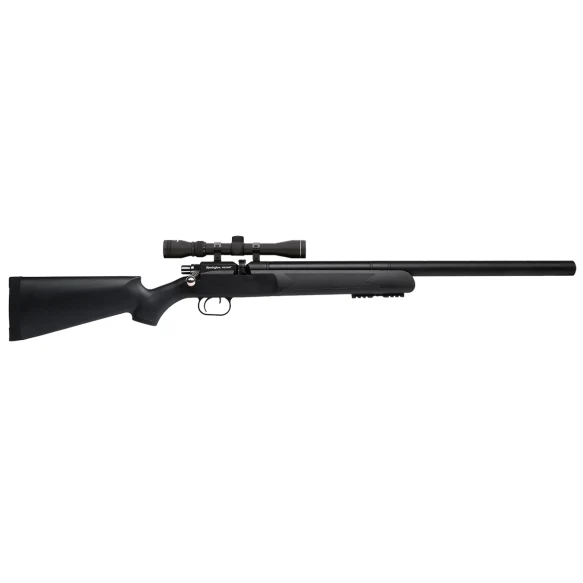
The Remington Vought SYN PCP Air Rifle is a pre-charged pneumatic airgun featuring a black synthetic stock, multi-shot bolt-action mechanism, and distinctive modern styling. Designed around a compressed-air power system, this model combines traditional air rifle functionality with a contemporary exterior and integrated accessory mounting options.
Unlike conventional spring-powered airguns, the Remington Vought SYN PCP Air Rifle uses stored compressed air to propel pellets. Consequently, the firing mechanism operates without the substantial spring movement associated with traditional spring-piston designs.
Furthermore, its synthetic stock provides a practical alternative to conventional wooden furniture. The black finish complements the metal components, while the broad fore-end and straight-line stock profile contribute to the rifle’s recognizable appearance.
Several important components are incorporated into its construction, including a pressure gauge, manual safety, integrated sound moderator, and rifled barrel. Depending on the market and configuration, the rifle may also be supplied with a telescopic sight and mounting equipment.
Key Features and Technical Specifications
The Remington Vought SYN PCP Air Rifle incorporates several established airgun technologies into one platform.
Highlighted Product Features
- Brand: Remington
- Model: Vought SYN
- Airgun Type: Pre-Charged Pneumatic (PCP)
- Operating Mechanism: Multi-shot bolt action
- Stock Material: Black synthetic
- Available Calibres: .177 (4.5 mm) and .22 (5.5 mm), with additional regional variants
- Barrel: Tapered rifled barrel
- Safety Mechanism: Manual safety
- Trigger: Two-stage design, with adjustment listed for some variants
- Sound Management: Integrated moderator
- Pressure Monitoring: Built-in air pressure gauge
- Optics Mounting: Grooved upper mounting system
- Accessory Mounting: Integrated Picatinny rails
- Recoil Pad: Fitted rubber butt pad
- Overall Length: Approximately 111 cm on commonly listed versions
- Weight: Approximately 3.1 kg on commonly listed versions
- Optics Package: 3–9×40 scope and mounts on specified packages
- Power: Varies by market, calibre, and version
Specifications and included accessories should be checked against the manufacturer’s information for the exact product variant.
Pre-Charged Pneumatic Technology Explained
How the PCP Air System Works
Compressed-air technology forms the operating foundation of this model. Before operation, pressurized air is stored inside the rifle’s reservoir. During firing, a controlled quantity of that stored air is released through the internal mechanism.
As a result, pellet propulsion is achieved without relying on a conventional spring-piston powerplant. This distinction is central to the PCP category and affects the way the rifle operates, feels, and requires maintenance.
Additionally, the compressed-air reservoir must be monitored through the fitted pressure gauge. Appropriate filling equipment, pressure limits, and handling procedures are defined by the manufacturer’s instructions.
Importantly, only compatible filling equipment and approved operating pressures should be used. All maintenance and inspection activities must follow the official user manual.
Pressure Regulation and Monitoring
Pressure-monitoring components provide information about the condition of the compressed-air system. Some versions are described as featuring regulated operation, with separate indicators associated with the reservoir and regulator.
However, equipment layouts can differ between regional models. Therefore, the exact configuration should be confirmed before product specifications are published.
Synthetic Stock Construction and Exterior Design
Black Synthetic Stock
A defining characteristic of the Remington Vought SYN PCP Air Rifle is its synthetic stock.
Instead of traditional timber, a manufactured material is used for the exterior furniture. Consequently, the stock does not require the same wood-specific finishing and care practices associated with natural hardwood.
Moreover, its matte-black appearance complements the modern receiver and barrel assembly.
Although synthetic materials can offer practical maintenance advantages, the rifle should still be protected from excessive heat, prolonged environmental exposure, and unsuitable cleaning chemicals.
Ergonomic Stock Features
The stock incorporates a rubber recoil pad at the rear. Its broad fore-end and substantial profile contribute to the rifle’s overall handling characteristics.
Meanwhile, the straight-line configuration creates a distinctive appearance compared with conventional sporting airgun designs.
Because individual comfort depends on body proportions and shooting position, stock fit should be assessed independently rather than assumed from appearance.
Bolt-Action Mechanism and Magazine Design
Multi-Shot Operating System
The Remington Vought SYN PCP Air Rifle features a manually operated bolt-action mechanism combined with a removable pellet magazine.
The bolt mechanism is used to cycle the rifle’s action, while the magazine accommodates multiple pellets according to its calibre-specific capacity.
For example, commonly listed configurations include ten-shot magazines in .177 and nine-shot magazines in .22.
Nevertheless, magazine capacities may differ between versions. Compatibility must therefore be verified using the correct model identification.
Trigger and Manual Safety
A two-stage trigger is listed among the features of certain versions, with an adjustable design specified by some suppliers.
In addition, a manual safety mechanism is incorporated into the rifle.
However, mechanical safety devices are not substitutes for appropriate handling. Safe muzzle direction, secure storage, and compliance with applicable range procedures remain essential.
Rifled Barrel and Integrated Moderator
Barrel Construction
The tapered rifled barrel is another notable component.
Rifling consists of spiral grooves formed within the barrel. These grooves are intended to impart rotational stability to compatible pellets during travel.
Barrel specifications, manufacturing tolerances, pellet compatibility, and individual mechanical condition can influence performance. Accordingly, accuracy should not be represented by an unsupported fixed distance or grouping measurement.
Integrated Sound Management
An integrated sound moderator is included in commonly advertised configurations.
Its purpose is to manage some of the sound produced during discharge. Nevertheless, actual noise characteristics depend on several factors, including the rifle’s power configuration and surrounding environment.
Furthermore, sound moderators may be regulated differently across jurisdictions. Local requirements should always be checked.
Scope Compatibility and Accessory Mounting
Upper Optics Mounting System
The rifle includes an upper mounting arrangement intended for compatible optical sights.
Many retail configurations are supplied with a 3–9×40 telescopic scope and corresponding mounts. However, the precise package contents may vary according to the retailer, product code, or regional distributor.
Consequently, scope inclusion should be identified clearly in a product listing rather than assumed for every version.
Picatinny Accessory Rails
Additional accessory rails are incorporated into the forward section of the platform.
These Picatinny-style mounting surfaces are designed to accommodate compatible equipment. Their dimensions and compatibility requirements should be verified against accessory manufacturer specifications.
Calibre Options and Regional Power Versions
The Remington Vought SYN PCP Air Rifle is available in multiple configurations, depending on its intended market.
Two commonly documented options are .177 (4.5 mm) and .22 (5.5 mm). Additionally, certain international distributors list a .25 (6.35 mm) version.
Different power ratings are also offered in selected markets, including 7.5-joule, 10-joule, and 16-joule configurations.
Therefore, neither calibre nor muzzle energy should be inferred solely from the model name.
Legal Classification and Ownership Requirements
Airgun ownership, permissible power levels, transportation, and usage restrictions differ between countries and regions.
For this reason, the exact configuration should be checked against the requirements applicable in the owner’s jurisdiction.
Where licensing, age verification, dealer transfer, or registration is required, those obligations must be satisfied.
Maintenance, Inspection and Storage
Routine care is an important consideration for any compressed-air platform.
External surfaces should be inspected periodically, while the air reservoir and associated fittings should be maintained according to the manufacturer’s servicing instructions.
Furthermore, only recommended cleaning materials should be applied to the appropriate components.
Seals, gauges, and pressure-bearing parts should never be modified outside approved servicing procedures.
When the rifle is not in use, secure storage should be provided in accordance with local law. Unauthorised access must be prevented, and the product should be kept in an appropriate environment.
Final Product Summary
The Remington Vought SYN PCP Air Rifle is characterized by its compressed-air operating system, black synthetic stock, manually operated multi-shot action, rifled barrel, and integrated mounting features.
Its appearance reflects modern airgun design, while its technical configuration incorporates established PCP components.
Ultimately, the most important distinctions between available versions concern calibre, power rating, magazine capacity, accessory package, and local legal classification. Accurate identification of these details helps ensure that published product information remains complete, reliable, and useful to readers.
Diana Air Rifles and Western Airguns: Complete Guide to Precision, Performance, Models, and Airgun Technology
Discovering Diana Air Rifles and Their Reputation for Quality
The world of precision airguns continues to attract enthusiasts who value engineering quality, shooting consistency, and dependable performance. Among established manufacturers, diana air rifles have developed a recognizable identity through traditional craftsmanship, innovative mechanisms, and a diverse product collection. Whether researching a diana air rifle for recreational target shooting or comparing the different models available, understanding the brand’s history provides an excellent starting point.
Throughout the years, the rws diana air rifle category has attracted considerable attention from enthusiasts familiar with the longstanding relationship between Diana products and RWS branding. Consequently, searches for rws diana, diana rws, and air rifle diana often involve comparisons between older models, contemporary releases, and different regional product names.
Additionally, the term diana pellet gun covers several different configurations designed for sporting and recreational applications. Each model offers distinct characteristics, including variations in weight, powerplant design, handling, and sight arrangements.
For customers researching airgun ownership, evaluating mechanical reliability, manufacturer documentation, and intended use remains essential.
Diana 34 Series: Traditional Design and Modern Developments
The diana 34 remains one of the manufacturer’s most recognizable model families. Its longstanding reputation has encouraged continued interest in the diana model 34, particularly among enthusiasts who appreciate conventional spring-piston engineering.
Similarly, the diana 34 air rifle has become a familiar reference in conversations about break-barrel mechanisms and traditional sporting rifles.
Owners of older equipment may encounter the designation diana rws 34, while product listings sometimes use rws diana 34 to describe historically associated versions.
Other searches, including diana r34, frequently reflect abbreviated product naming rather than a completely separate model.
Furthermore, the diana 34 ems introduced a more modular approach to an established platform. Its Easy Modular System provides a distinctive identity within the manufacturer’s product collection.
For enthusiasts evaluating sight configurations, diana 34 ems fiber optic sights represents another important research topic. Nevertheless, specifications should always be checked against the precise model and production version.
Exploring Classic Diana Models and Magnum Air Rifles
Beyond the 34 series, several older and specialist designs maintain a place in airgun history.
The diana 35 represents a traditional model that collectors and experienced owners continue to research. Meanwhile, searches for diana 2 may refer to historic equipment requiring careful model identification.
More powerful spring-piston designs include the diana 350 magnum, widely recognized as part of the company’s performance-oriented product heritage.
The diana 350 magnum air rifle, also searched as 350 magnum diana, demonstrates the manufacturer’s longstanding interest in high-performance spring-powered technology.
Additionally, the diana rws 460 magnum is associated with a different fixed-barrel, underlever design.
The diana mod 48, diana 48, and rws diana model 48 are commonly connected with sidelever-operated air rifles. Such systems offer a different shooting experience from conventional break-barrel platforms.
Another notable model is the diana 54, which became associated with specialized recoil-management technology.
Research into hunting diana models should consider legal requirements, appropriate sporting applications, and the importance of responsible equipment selection.
Modern Diana PCP Rifles and Compact Air Pistols
Pre-charged pneumatic technology has expanded the manufacturer’s portfolio beyond conventional spring-powered equipment.
For example, the diana stormrider has become a recognizable entry in the company’s PCP rifle collection. Its design appeals to enthusiasts interested in compressed-air operation and modern airgun handling.
Similarly, the diana outlaw gen 2 is a useful search phrase for people investigating Outlaw versions and potential generational differences. However, the exact designation should be confirmed with official product documentation.
The diana r22, commonly presented as the diana r22 or R-22, offers another product family to examine when comparing current sporting rifle designs.
Other models include the diana 250, also known as the diana 250 air rifle, and the diana two fifty, providing additional options within the manufacturer’s wider catalog.
For compact shooting equipment, the diana air pistol category introduces different handling characteristics.
Examples include the diana lp8, sometimes searched as lp8 diana, alongside the diana airbug and diana bandit black.
Owners may also research diana chaser accessories and diana chaser parts when identifying compatible replacement components or manufacturer-approved additions.
Meanwhile, broad phrases such as diana r and nerf diana should be interpreted carefully because they do not necessarily identify a specific Diana airgun model.
Western Airguns and American PCP Engineering
Another important part of the sporting airgun industry involves western airguns, a manufacturer associated with American-designed and assembled PCP equipment.
Research into western air guns, western air gun, and airguns usa frequently reflects interest in domestic manufacturing, contemporary designs, and specialist sporting platforms.
Although searches for western arms, western firearm, western firearms, or western arms shotgun may appear alongside PCP terminology, these phrases can refer to different product categories or manufacturers.
Therefore, brand identification is important when comparing american made air rifles and specialist compressed-air equipment.
The company’s catalog includes several distinctive platforms, particularly the western rattler, western sidewinder, and western mordax families.
These products highlight how modern pneumatic engineering can accommodate multiple configurations, calibers, and operating systems.
Western Rattler Bullpup and Big-Bore Models
The western rattler bullpup is associated with a compact rifle layout that places much of the action behind the trigger.
Consequently, the western rattler air gun attracts attention from enthusiasts researching unconventional rifle configurations.
Common variations and search phrases include western rattler 357, 357 rattler, and western rattler 45, which relate to different caliber categories.
Similarly, searches for 357 air rifle and .35 cal air rifle often involve comparing big-bore pneumatic platforms and the practical differences between manufacturer specifications.
Interest in the western rattler bullpup for sale and western rattler bullpup amazon illustrates how customers research distribution channels, although listing availability and seller authorization require independent verification.
Another significant product is the western big bore bushbuck 45.
Research into bushbuck air rifle price often involves questions about configuration, warranty coverage, and included accessories rather than price alone.
Within the wider category, terms such as big bore pellet gun, big game air guns, and bullpup air rifle describe distinct equipment characteristics.
Because these models can produce substantial energy, responsible storage, suitable facilities, and applicable legal restrictions deserve particular attention.
Western Mordax and Mordax Venom Technology
Compact PCP engineering is represented by the western airguns mordax, a platform associated with modern controls and adaptable handling.
The western mordax pcp designation highlights its compressed-air operating system, while mordax airgun and mordax air gun remain common alternative search terms.
The western mordax venom expands this product family with additional design features and a different air-storage arrangement.
Consequently, both mordax venom and western airguns mordax attract interest from people comparing compact pneumatic platforms.
Manufacturer documentation identifies the Mordax Venom as a selectable semi-automatic and fully automatic design, subject to applicable legal restrictions.
Although the phrase desert scorpion pistol is associated with Mordax branding, buyers should distinguish marketing terminology from official model identification.
Likewise, mordax air gun price should be considered alongside configuration, legal classification, support, and warranty information.
Searches involving venom arms and serpent arms may describe unrelated businesses or terminology and should not automatically be treated as official Western product names.
Western Sidewinder and Additional Airgun Technology
The western sidewinder provides another example of contemporary PCP design.
Searches for sidewinder gun, sidewiner, and western sidewinder compact may involve different product references, spelling variations, or configuration questions.
For accurate identification, owners should consult original documentation before relying on marketplace descriptions.
In addition, sidewinder length is an important consideration when comparing dimensions, storage arrangements, and handling comfort.
People searching for a sidewinder k7a-00008 manual should verify that the document genuinely corresponds to their exact equipment, rather than assuming similarly named products share instructions.
Elsewhere, edgun west and edgunwest are additional search expressions encountered in the broader airgun marketplace, but they should not be confused with Western Airguns branding.
Selecting Suitable Airguns and Understanding Caliber Categories
Different sporting applications require different design priorities. An accurate pellet rifle may emphasize consistent grouping, comfortable handling, and repeatable operation rather than maximum advertised velocity.
Similarly, the phrase long range air rifle should encourage realistic evaluation of manufacturer specifications, environmental conditions, and properly supervised target facilities.
A 4.5mm air gun generally refers to the .177-caliber category, commonly encountered in recreational and precision-target contexts.
Meanwhile, pcp guns use stored compressed air, distinguishing them from conventional spring-powered systems.
The broader category of semi automatic pellet gun describes a particular operating arrangement, although availability and legality differ between jurisdictions.
Search terms such as lethal air guns and steel penetrating full auto airgun highlight the importance of treating powerful pneumatic equipment as potentially dangerous rather than harmless recreational devices.
Likewise, anyone investigating air pistols for hunting must understand local restrictions, humane considerations, and the limitations of the equipment involved.
Finding Reliable Airgun Information and Responsible Ownership
Enthusiasts frequently use phrases such as air guns near me, air gun dealers near me, air rifle dealers, air rifle online, and az air guns while researching local retailers, product information, and specialist services.
However, availability should never replace proper consideration of local legislation, age requirements, safe storage, and verified manufacturer support.
Searches for air gun for semi truck may relate to vehicle-carried equipment, making transportation regulations and secure storage particularly important.
Furthermore, the question where do bullets land when shot in air addresses a serious safety issue: projectiles discharged upward eventually return to earth and can cause severe injuries or death. Never fire a projectile into the air.
Ultimately, choosing sporting equipment responsibly involves understanding its design, limitations, and lawful use.
Whether comparing classic Diana engineering with modern Western pneumatic technology, informed research helps enthusiasts appreciate manufacturing quality while prioritizing safety, reliability, and responsible participation in shooting sports.
Frequently Asked Questions (FAQs)
General Information and Product Features
1. What is a pre-charged pneumatic airgun, and how does it work?
A pre-charged pneumatic (PCP) airgun operates by using compressed air stored within a high-pressure reservoir. Unlike traditional spring-powered mechanisms, this system releases a controlled quantity of compressed air when the trigger is operated. Consequently, the projectile is propelled through the barrel without requiring a spring-piston assembly.
Furthermore, the compressed-air mechanism produces different firing characteristics compared with conventional spring-powered designs. The operating pressure, internal valve arrangement, and overall mechanical condition influence performance. Regular maintenance and proper pressure monitoring are therefore essential.
2. What are the main advantages of a synthetic stock?
A synthetic stock offers several practical benefits, particularly regarding maintenance, appearance, and resistance to ordinary environmental conditions. Unlike natural wood, synthetic materials do not require traditional polishing or wood-conditioning treatments.
Additionally, manufactured stock materials generally provide consistent external dimensions under normal conditions. However, prolonged exposure to extreme heat, harsh chemicals, or direct sunlight may still cause damage.
For users who prefer straightforward exterior maintenance, synthetic furniture provides a convenient alternative to wooden stocks.
3. Is this model suitable for beginners?
Suitability depends on the individual’s experience, familiarity with compressed-air equipment, and access to appropriate supervision or training.
Although the manually operated action is relatively straightforward in principle, the high-pressure air system requires specific safety knowledge. Therefore, new owners should receive instruction from a qualified professional or experienced instructor.
Beginners must also understand the relevant legal requirements, safe handling procedures, and manufacturer’s operating instructions before using any compressed-air equipment.
4. What makes a regulated air system different from an unregulated system?
A regulated air system incorporates a mechanical regulator intended to control the pressure delivered from the main reservoir to the firing mechanism.
As a result, the pressure available to the valve may remain more consistent across a designated operating range.
By comparison, an unregulated system relies more directly on changing reservoir pressure. Nevertheless, a regulator does not automatically guarantee identical projectile velocities or flawless mechanical consistency.
Actual performance depends on the condition, specifications, and design of the individual airgun.
Calibres, Power and Performance
5. What calibre options are commonly available?
The most frequently documented configurations include .177 (4.5 mm) and .22 (5.5 mm).
Each calibre accommodates pellets manufactured to a corresponding nominal diameter. However, pellet weight, geometry, and construction can vary considerably within the same calibre.
Certain international listings also reference additional variants. Consequently, owners should verify the exact product identification before purchasing replacement magazines or other calibre-specific components.
6. Does a larger calibre always provide greater muzzle energy?
No. Muzzle energy depends on both projectile mass and velocity.
Although larger-diameter pellets often weigh more, their presence does not automatically indicate a higher-powered airgun.
For example, two different calibres can produce similar muzzle energy while exhibiting different projectile velocities. Furthermore, manufacturing specifications and local power restrictions may determine the maximum energy permitted.
Therefore, verified technical documentation provides a more reliable basis for comparing configurations than calibre designation alone.
7. What is the difference between muzzle velocity and muzzle energy?
Muzzle velocity describes how quickly a projectile travels when leaving the barrel. It is typically measured in feet per second or metres per second.
Muzzle energy, meanwhile, describes the projectile’s kinetic energy at that point. It is usually expressed in joules or foot-pounds.
Because kinetic energy incorporates mass and velocity, two projectiles travelling at different speeds may still produce comparable energy measurements.
Both specifications are useful when interpreting published technical information, although neither independently guarantees precision.
8. What does FAC mean in relation to airguns?
FAC stands for Firearm Certificate, a designation associated with firearms licensing in Great Britain.
In England and Wales, an air rifle capable of exceeding 12 foot-pounds of muzzle energy generally requires firearm certification.
However, Scotland and Northern Ireland have different legal arrangements, and additional requirements may apply.
The relevant licensing authority should always be consulted before acquiring, transferring, or possessing a configuration that may be subject to firearms legislation.
9. Can the power output vary between different versions?
Yes. Manufacturers may produce different power configurations to satisfy market regulations and product requirements.
Additionally, published specifications may vary according to the manufacturing period, model designation, and regional distributor.
For this reason, figures from one version should not automatically be applied to another.
The individual product label, manufacturer documentation, and applicable legal classification provide the most appropriate reference points.
Scope Compatibility and Optical Features
10. Does the package include a telescopic scope?
Many commonly advertised packages include a 3–9×40 telescopic sight and compatible mounting rings. However, the exact equipment supplied may depend on the distributor, regional market, and product configuration.
The first number indicates the variable magnification range, while the second refers to the objective lens diameter in millimetres.
Furthermore, package specifications may change without every retailer updating its product images. Therefore, the accompanying equipment list should be checked before purchase.
11. What is the purpose of the upper mounting rail?
The upper mounting rail provides an attachment interface for compatible optical equipment.
Many versions feature an 11 mm dovetail mounting arrangement, although the exact dimensions should be confirmed through the technical documentation.
Different mounting standards are not necessarily interchangeable. Consequently, accessories should be checked for mechanical compatibility rather than selected by appearance alone.
Secure installation and inspection should follow the relevant manufacturers’ instructions.
12. What does parallax adjustment mean?
Parallax refers to an apparent change in the position of the reticle relative to the target when the observer’s eye moves away from the optical centre.
Some telescopic sights incorporate adjustable parallax systems intended to reduce this effect at different viewing distances.
Furthermore, parallax adjustment may be located on the objective housing or side of the optical instrument, depending on its design.
The availability and adjustment range of this feature depend on the particular sight rather than the airgun itself.
Magazine, Trigger and Mechanical Components
13. How does the multi-shot magazine system work?
A multi-shot magazine holds several compatible pellets within a removable feeding assembly.
During normal operation, the manually operated action cycles the feeding mechanism according to its mechanical design.
Magazine capacity differs between calibre configurations. For example, commonly documented versions use a ten-shot magazine in .177 and a nine-shot magazine in .22.
Nevertheless, owners should confirm the correct replacement component using the manufacturer’s model identification.
14. What is a two-stage trigger?
A two-stage trigger is designed with two distinguishable phases of movement.
The first stage involves initial trigger travel, while the second stage leads to the release point.
Some versions incorporate adjustment provisions, although the available adjustments depend on the exact trigger assembly.
Importantly, internal trigger modifications should not be attempted without appropriate professional qualifications. Incorrect adjustments can compromise mechanical safety.
15. Does the integrated moderator eliminate firing noise?
No. An integrated moderator is intended to reduce certain aspects of the sound associated with firing, but it does not eliminate all audible noise.
Mechanical operation, compressed-air release, environmental conditions, and projectile characteristics contribute to the overall sound signature.
Additionally, moderator ownership and configuration may be subject to regional legislation.
Therefore, acoustic performance should not be represented as completely silent, and any published noise measurements should identify the testing conditions.
Compressed-Air Filling and Maintenance
16. What equipment is required for compressed-air filling?
A compatible high-pressure filling system is required for a PCP reservoir.
Possible equipment categories include pressure-rated hand pumps, certified compressed-air cylinders, and purpose-designed compressors.
However, connectors, pressure ratings, and filtration requirements differ between equipment types.
The precise filling method must be established from the manufacturer’s instructions. Furthermore, pressure-bearing components should be inspected for damage and serviced by appropriately qualified personnel.
17. What is the maximum filling pressure?
The maximum permitted filling pressure depends on the specific reservoir and model configuration.
Some published technical references identify a recommended pressure of approximately 190 bar, while other listings reference 200 bar.
These differences make the individual reservoir marking and official technical manual particularly important.
Never assume that a pressure limit published for a similar model applies to every version. Exceeding the approved pressure can create serious safety hazards.
18. Why is a pressure gauge important?
A pressure gauge provides information about the compressed air contained within a reservoir or associated regulated system.
This allows the operator to monitor the equipment’s pressure condition in accordance with the manufacturer’s instructions.
Furthermore, certain configurations incorporate more than one gauge, potentially displaying different parts of the air system.
Gauge readings must be interpreted using the correct technical documentation. A visibly damaged, inaccurate, or malfunctioning gauge requires professional inspection.
19. How often should the equipment be maintained?
Maintenance intervals depend on usage frequency, environmental exposure, storage conditions, and manufacturer recommendations.
Regular external inspections are generally important for identifying visible damage, corrosion, loose fittings, or deterioration.
Additionally, seals and pressure-bearing components may require periodic professional attention.
Only approved servicing procedures should be followed. Internal high-pressure assemblies must not be dismantled without proper training and authorization.
20. Can ordinary lubricating oil be used?
Not necessarily. Conventional household oils and petroleum-based lubricants may be unsuitable for certain compressed-air components.
In particular, high-pressure systems require materials compatible with their seals, operating conditions, and manufacturer specifications.
Applying an inappropriate substance may damage components or create additional safety risks.
Consequently, only approved maintenance materials should be used, and internal servicing should be performed by qualified technicians.
Storage, Durability and Ownership
21. Is synthetic furniture waterproof?
Synthetic stock materials generally offer better resistance to moisture-related swelling than untreated natural wood.
However, that does not mean the entire airgun is waterproof.
Metal components, optical equipment, internal mechanisms, and exposed fittings may remain vulnerable to moisture intrusion and corrosion.
After exposure to damp conditions, the exterior should be inspected and maintained according to the manufacturer’s guidance.
22. How should the equipment be stored?
Secure storage is essential for preventing unauthorized access, accidental handling, and avoidable damage.
A suitable locked cabinet or approved secure enclosure should be used where required by law.
Additionally, the storage environment should be dry, stable, and protected from excessive temperatures.
The equipment should be placed in the condition prescribed by the manufacturer’s storage instructions, with all relevant legal obligations followed.
23. Can a damaged air reservoir be repaired at home?
No. Damage involving a compressed-air reservoir, high-pressure connection, or pressure-control assembly requires specialist assessment.
Visible cracks, deformation, suspected leakage, or unexplained pressure loss may indicate a potentially hazardous condition.
The equipment should not be operated or refilled until it has been evaluated by an appropriately qualified service provider.
Furthermore, replacement pressure components must meet the original manufacturer’s compatibility and certification requirements.
Warranty, Spare Parts and Final Considerations
24. Are replacement magazines and seals available?
Replacement components may be offered through authorized distributors, specialist airgun suppliers, and manufacturer service networks.
Nevertheless, availability depends on the exact model, production version, calibre, and regional distribution arrangements.
A magazine that appears mechanically similar may not necessarily be compatible.
Therefore, the correct part number should be established before ordering any replacement component.
25. What should be checked before purchasing?
Several technical and ownership considerations deserve attention before a final purchasing decision.
First, the specific calibre and power classification should be verified. Next, the supplied optical equipment, magazine capacity, and accessory contents should be confirmed.
Additionally, warranty conditions, replacement-part availability, and servicing arrangements should be reviewed.
Finally, applicable ownership, transportation, licensing, and storage requirements should be established through reliable local authorities.
By checking these details, prospective owners can make a more informed decision based on documented specifications, lawful ownership requirements, and long-term maintenance considerations.
Practical Use Scenarios: Real-World Applications, Handling and Everyday Performance
1. Recreational Target Shooting at a Supervised Range
Recreational target shooting provides an opportunity to become familiar with the handling characteristics of compressed-air sporting equipment. Within a properly supervised shooting facility, participants can learn about safe operating procedures, equipment inspection, and responsible handling.
Furthermore, the regulated pneumatic system is intended to maintain controlled air delivery during normal operation. Consequently, its mechanical characteristics can be evaluated under consistent and professionally supervised conditions.
The synthetic stock also provides a practical exterior construction that can withstand ordinary handling when appropriately maintained. However, users should remain mindful of environmental exposure, storage conditions, and routine equipment inspection.
Additionally, supervised range environments provide structured opportunities to understand applicable safety requirements and equipment responsibilities.
2. Structured Club Training and Sporting Education
Organized shooting clubs frequently provide supervised programmes focused on responsible equipment handling, safety awareness, and sporting discipline.
During these sessions, instructors may explain the differences between compressed-air and spring-powered operating systems. Furthermore, participants can learn how pressure gauges, manual safety mechanisms, and other components contribute to the equipment’s overall operation.
An important advantage of structured training is the availability of experienced supervision. Rather than relying exclusively on written instructions, participants receive guidance within a controlled environment.
Meanwhile, the manually operated action provides a recognizable example of mechanical cycling technology commonly discussed in sporting equipment education.
3. Equipment Familiarization and Mechanical Demonstrations
A supervised educational demonstration can illustrate the fundamental components of pre-charged pneumatic technology without requiring live firing.
For example, an instructor may use a safely secured and verified unloaded demonstration unit to explain the reservoir, pressure gauge, regulator, barrel assembly, and synthetic stock.
Additionally, the differences between air-pressure storage and spring-powered mechanisms can be presented through diagrams and manufacturer documentation.
Such demonstrations are particularly relevant to technical education because they connect general mechanical principles with recognizable equipment.
Most importantly, high-pressure components should remain untouched unless inspected by appropriately qualified personnel.
4. Optical Equipment Evaluation and Compatibility Checks
Another practical application involves evaluating the physical compatibility of optical accessories under professional supervision.
The upper mounting arrangement can be examined to identify its mounting standard, while the supplied sight can be assessed for external condition, clarity, and manufacturer-specified features.
Furthermore, a technical comparison may address eye relief, objective diameter, adjustment markings, and overall instrument weight.
These observations help explain how optical systems differ in construction and functionality.
Nevertheless, mounting compatibility must be verified using the relevant technical documentation. Equipment that appears similar may use different mechanical standards.
5. Maintenance Workshops and Ownership Education
Routine maintenance education represents another valuable practical scenario.
Within an organized workshop, participants may learn to recognize common signs of exterior wear, surface corrosion, deteriorated seals, and damaged accessories.
Moreover, qualified technicians can explain the importance of approved maintenance products and documented service intervals.
The synthetic stock generally requires different care from traditional wooden furniture. However, metal components and optical surfaces still demand appropriate protection.
High-pressure reservoirs, internal valves, and regulators must be reserved for specialist inspection and servicing.

Reviews
There are no reviews yet.