REXIMEX PRETENSIS AMBUSH CERAKOTE – Precision PCP Air Rifle with Premium Tactical Styling
REXIMEX PRETENSIS AMBUSH CERAKOTE – Product Description
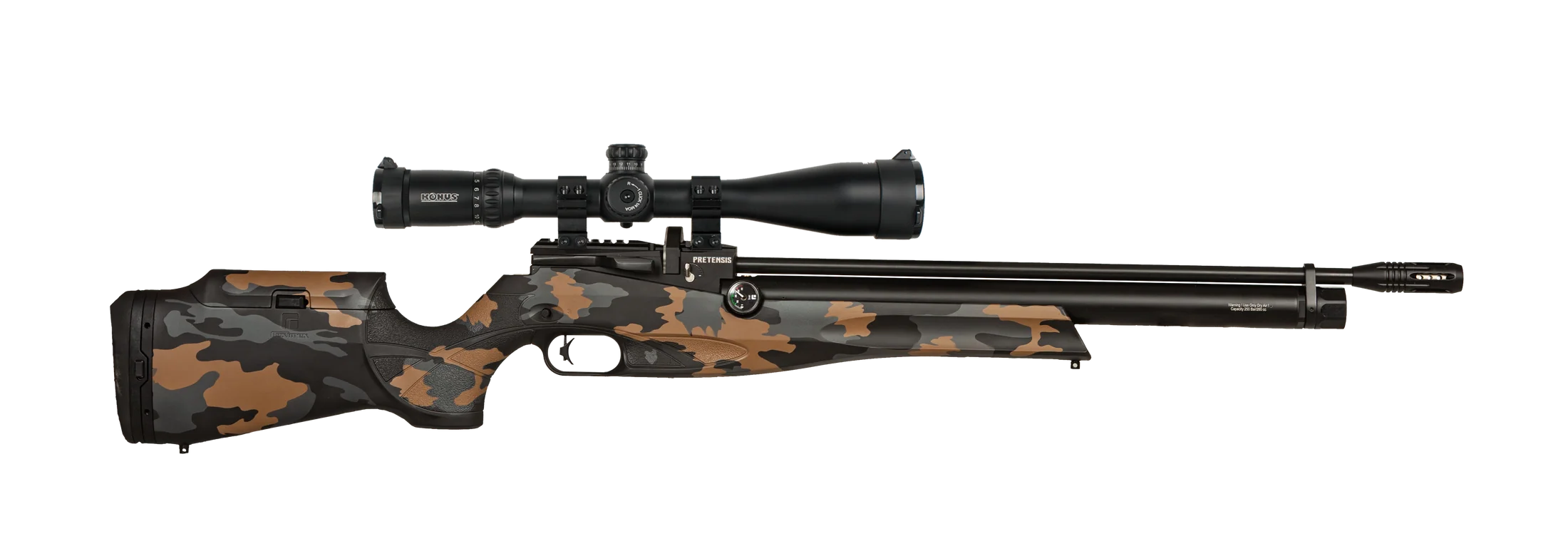
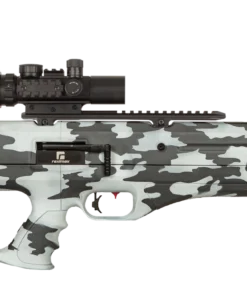
The REXIMEX PRETENSIS AMBUSH CERAKOTE is designed as a full-length pre-charged pneumatic (PCP) air rifle, combining contemporary styling, adjustable ergonomics, and a practical multishot operating system. A distinctive Cerakote-inspired finish is complemented by a soft-touch synthetic stock, while essential shooting controls are positioned for convenient operation.
Furthermore, a 260cc compressed-air cylinder is incorporated into the rifle’s construction, providing an air supply for extended shooting sessions. Its side-lever cocking mechanism, adjustable two-stage trigger, and detachable rotary magazine system contribute to a versatile platform for recreational target shooting and supervised range practice.
Premium Cerakote Styling and Durable Construction
A distinctive appearance is provided by the Ambush finish, which complements the rifle’s modern sporter configuration. Alongside its attractive exterior, a practical synthetic stock is incorporated to provide a comfortable and manageable shooting platform.
Moreover, the Cerakote designation distinguishes this model from conventional Pretensis stock and finish options. Cerakote finishes are generally associated with protective ceramic-based coatings; however, the exact coating coverage and corrosion-resistance specifications should be confirmed for the particular version supplied.
The overall construction is intended to balance visual appeal with functional performance. Consequently, the rifle offers a combination of modern aesthetics and recognizable PCP engineering.
Advanced PCP Technology and Compressed-Air Performance
At the center of the rifle’s operating system, a pre-charged pneumatic mechanism is employed to propel pellets using stored compressed air.
Unlike spring-powered air rifles, PCP systems do not depend on a large mainspring being released during each shot. As a result, spring-related vibration is eliminated, and a different shooting sensation is provided.
A 260cc air reservoir is fitted to the Pretensis Ambush Cerakote. Depending on calibre, power configuration, fill pressure, and shooting conditions, different shot counts may be achieved.
Furthermore, a pressure gauge is included to allow the remaining air pressure to be monitored. Appropriate filling equipment must be used, and the manufacturer’s specified maximum pressure must never be exceeded.
For reference, retailer specifications commonly identify a maximum fill pressure of 250 bar for the Cerakote variant, although configuration-specific documentation should always be checked.
Adjustable Synthetic Stock for Comfortable Handling
A soft-touch synthetic stock is fitted to provide a secure and comfortable contact surface during normal handling.
Additionally, an adjustable cheekpiece is incorporated, allowing the rifle’s cheek support to be adapted to the shooter’s physical characteristics and optic arrangement.
An adjustable butt pad is also provided. Therefore, the overall fit can be personalized within the manufacturer’s available adjustment range.
This ergonomic configuration is especially relevant during structured target practice, where consistent positioning is often emphasized.
Other stock-related features include pre-fitted sling swivel mounting points. These contribute to the rifle’s practical outdoor-oriented design, although compatible sling hardware must be selected separately where necessary.
Side-Lever Cocking System and Multishot Magazine
A right-side cocking lever is incorporated into the action. This mechanism is designed to operate the rifle’s pellet-loading system in conjunction with its detachable rotary magazine.
In addition, magazine capacities vary according to calibre. Commonly published configurations include 14 rounds in .177, 12 rounds in .22, and 10 rounds in .25.
Two magazines are listed as supplied accessories by certain retailers, while other package components may differ according to the distributor.
For single-pellet target applications, a single-shot loading tray may also be included.
Importantly, all loading and unloading procedures should be performed according to the manufacturer’s instructions, with the muzzle continuously directed toward a safe backstop.
Fully Adjustable Two-Stage Trigger
A two-stage trigger system is installed to provide a distinct mechanical trigger arrangement. Adjustment capability is another characteristic of the Pretensis platform.
Because trigger characteristics can influence the handling experience, the factory-approved adjustment system is intended to accommodate different preferences within the manufacturer’s safe operating limits.
Nevertheless, unauthorized trigger alterations should be avoided. Any required servicing or adjustment beyond the manufacturer’s user instructions should be referred to a qualified airgun technician.
Manual Safety and Responsible Handling
A manually operated safety mechanism is incorporated into the rifle’s action.
Its purpose is to provide an additional mechanical safety feature when the rifle is being handled according to established operating procedures.
However, the safety mechanism must never be regarded as a substitute for responsible muzzle control, secure storage, and proper handling.
Furthermore, appropriate eye protection, suitable pellet traps, and a secure backstop should always be used during authorized target practice.
Optical Mounting and Accessory Compatibility
A Picatinny-style optics rail is listed for the Cerakote configuration, allowing suitable optical equipment to be mounted when the correct compatible fittings are used.
Consequently, the rifle’s modular accessory arrangement supports different authorized target-shooting configurations.
In addition, a 1/2-inch UNF threaded muzzle is specified by retailers for compatible muzzle accessories, subject to applicable local regulations.
Optical sights and mounting hardware are not necessarily included in the standard package. Therefore, the contents of the supplied configuration should be checked against the product listing.
Calibre Options and Shooting Applications
The Reximex Pretensis Ambush Cerakote is offered in several calibre configurations, including .177 (4.5mm), .22 (5.5mm), and .25 (6.35mm), depending on market availability.
Each calibre is associated with a different magazine capacity and potentially different factory power specifications.
For UK-market sub-12 ft-lb versions, approximately 10.8–11.8 ft-lb has been published for the broader Pretensis Cerakote range. Nevertheless, this figure should not be assumed to apply to every international or FAC configuration.
The rifle is principally associated with recreational airgun shooting, paper-target activities, and appropriately supervised range practice. All use must comply with relevant laws, local restrictions, and safe-shooting requirements.
REXIMEX PRETENSIS AMBUSH CERAKOTE – Key Features and Specifications
- Brand: Reximex
- Model: Pretensis Ambush Cerakote
- Airgun type: Pre-charged pneumatic (PCP) air rifle
- Available calibres: .177, .22, and .25, subject to configuration
- Air cylinder: 260cc
- Cocking mechanism: Right-side lever
- Magazine system: Detachable rotary magazine
- Magazine capacities: 14 / 12 / 10 rounds, depending on calibre
- Trigger: Adjustable two-stage mechanism
- Safety: Manual safety system
- Stock: Soft-touch synthetic with adjustable cheekpiece
- Butt pad: Adjustable
- Optics interface: Picatinny rail
- Muzzle thread: 1/2-inch UNF
- Overall length: Approximately 1050mm on certain Cerakote listings
- Weight: Approximately 2.8kg
- Maximum fill pressure: Listed as 250 bar on certain Cerakote configurations
- Accessories: Package-dependent; magazines, fill probe, and other accessories may be supplied
Care, Maintenance, and Long-Term Ownership
Regular inspection and appropriate maintenance are important aspects of PCP air rifle ownership.
The exterior should be cleaned with products approved for the relevant stock materials and protective finish. Likewise, the compressed-air reservoir, seals, fittings, and filling equipment should be inspected according to the manufacturer’s maintenance schedule.
Any suspected air leakage, damaged seal, or mechanical malfunction should be assessed by a qualified technician rather than corrected through unauthorized modifications.
Additionally, storage should be arranged in a secure, dry location inaccessible to unauthorized users. The rifle should be unloaded and stored in accordance with manufacturer instructions and applicable legislation.
By following these precautions, the rifle’s components can be maintained appropriately throughout its service life.
Conclusion – REXIMEX PRETENSIS AMBUSH CERAKOTE
The REXIMEX PRETENSIS AMBUSH CERAKOTE combines a distinctive exterior finish, a practical synthetic stock, adjustable ergonomic components, and a modern PCP action.
Furthermore, its 260cc reservoir, side-lever mechanism, multishot magazines, adjustable trigger, and optical mounting interface form a comprehensive technical package.
For enthusiasts researching full-length PCP sporter rifles, the Pretensis Ambush Cerakote represents a notable example of contemporary Reximex airgun design, with individual specifications determined by calibre, market, and factory configuration.
REXIMEX PRETENSIS AMBUSH CERAKOTE – Calibres, FAC Power, Recommended Scopes and Essential Accessories
Available Calibres and Performance Characteristics
The REXIMEX PRETENSIS AMBUSH CERAKOTE is offered in three popular pellet calibres, allowing different preferences in recreational target shooting and regulated airgun activities to be accommodated. Each calibre is associated with a particular pellet diameter, magazine capacity, and ballistic profile.
.177 Calibre (4.5mm) – Precision Target Shooting
The .177 calibre configuration is commonly selected for paper-target shooting, recreational competitions, and general accuracy practice. Its relatively lightweight pellets can provide flatter trajectories than heavier alternatives when comparable muzzle energies are used.
Additionally, a 14-round rotary magazine is specified for this calibre, providing convenient multishot operation during supervised shooting sessions.
Pellet performance is influenced by ammunition quality, muzzle energy, environmental conditions, and individual barrel characteristics. Therefore, consistent results cannot be guaranteed solely by calibre selection.
.22 Calibre (5.5mm) – Versatile Shooting Performance
A .22 calibre option is also offered, with a 12-round magazine capacity. This configuration accommodates larger and typically heavier pellets than the .177 version.
Furthermore, the .22 calibre is frequently associated with recreational sporting air rifles because of its broad pellet availability and versatility.
Actual trajectory and accuracy depend on the rifle’s factory power specification and the ammunition selected.
.25 Calibre (6.35mm) – Larger Pellet Configuration
The .25 calibre variant accommodates pellets with a nominal diameter of 6.35mm and features a 10-round rotary magazine.
Compared with smaller calibres, .25 pellets are generally heavier, although actual projectile mass varies between manufacturers.
Consequently, trajectory characteristics, energy retention, and shot counts may di ffer from those of the .177 and .22 versions. Buyers should verify that the desired calibre is officially supported in their market.
FAC and Non-FAC Power Configurations
The Reximex Pretensis Ambush Cerakote is commonly listed in the United Kingdom as a sub-12 ft-lb PCP air rifle.
Non-FAC configurations are generally supplied with muzzle energies below the UK air-rifle licensing threshold of 12 ft-lb, equivalent to approximately 16.3 joules.
Published specifications for the Cerakote range indicate approximately 10.8–11.8 ft-lb, while an Ambush retailer listing identifies 11.3 ft-lb.
However, FAC configurations, where offered, must be distinguished from standard sub-12 ft-lb models. An FAC is a Firearm Certificate under the relevant UK licensing system, not a particular calibre or universally fixed power rating.
Importantly, a verified factory muzzle-energy rating for a higher-powered Pretensis Ambush Cerakote version should be obtained before any FAC power figure is advertised.
Regulations also differ internationally. Therefore, the legal classification, permitted ownership, transportation, and use of each configuration must be confirmed within the buyer’s jurisdiction.
Air Reservoir, Fill Pressure and Shot Count
A 260cc compressed-air reservoir is incorporated into the rifle, supplying the pneumatic energy required for operation.
Certain Cerakote specifications identify a maximum fill pressure of 250 bar. Nevertheless, the actual pressure limit must always be verified using the rifle’s markings and official documentation.
Approximate shot counts published for the Cerakote range include:
- .177 calibre: Up to approximately 180 shots per fill.
- .22 calibre: Up to approximately 210 shots per fill.
- .25 calibre: Up to approximately 140 shots per fill.
These values are indicative rather than guaranteed. Actual performance varies with fill pressure, power configuration, ambient temperature, and the manufacturer’s test conditions.
Recommended Rifle Scopes
The REXIMEX PRETENSIS AMBUSH CERAKOTE features a Picatinny optics interface, allowing compatible scope mounts to be used.
For recreational target shooting, the following scope categories may be considered.
Hawke Vantage 3-9×40
A Hawke Vantage 3-9×40 is a practical option for general range use. Its variable magnification supports different target sizes and shooting distances, while its relatively compact format complements a full-length sporter rifle.
Hawke Airmax 4-12×40
The Hawke Airmax 4-12×40 provides another variable-magnification option for precision-oriented paper-target shooting. Depending on the specific version, an airgun-oriented reticle and adjustable parallax features may be provided.
Element Optics Helix 4-16×44
The Element Optics Helix 4-16×44 may be considered by enthusiasts seeking a wider magnification range and more detailed optical adjustments.
Before purchasing any optic, the exact model dimensions, mounting-ring requirements, eye relief, and compatibility with the rifle’s rail should be checked.
Essential Accessories for the Rifle
Several accessories can complement the Pretensis Ambush Cerakote while supporting responsible ownership, maintenance, and safe operation.
Recommended accessories include:
- PCP filling equipment: A manufacturer-approved high-pressure hand pump, compressor, or charging cylinder with suitable filtration and compatible fittings.
- Compatible fill probe: An appropriate probe for the rifle’s designated filling connection.
- Rotary magazines: Calibre-specific replacement magazines for the appropriate Pretensis version.
- Single-shot tray: A compatible loading tray for individual pellet loading where supported.
- Scope mounts: Suitable Picatinny-compatible rings selected according to the optic’s tube diameter.
- Protective rifle case: A padded or lockable case for secure storage and lawful transportation.
- Pellet trap and targets: Properly rated target equipment with a safe backstop.
- Cleaning equipment: Manufacturer-approved cleaning products designed for airgun barrels and exterior components.
- Eye protection: Impact-rated protective glasses for shooting activities.
- Maintenance accessories: Approved replacement seals and servicing components fitted by competent personnel.
Final Considerations for Calibre and Accessory Selection
The Reximex Pretensis Ambush Cerakote combines multiple calibre options, a substantial air reservoir, adjustable ergonomic components, and a modern optical mounting system.
Its configurations provide different characteristics for recreational shooting, while appropriate accessories support safe handling, convenient transport, and regular maintenance.
Ultimately, the correct factory configuration should be identified before purchase, with particular attention given to calibre availability, muzzle energy, legal requirements, filling specifications, and package contents. This ensures that the selected rifle and accessories are appropriate for their intended lawful use.
Falcon Scope, Falcon Optics, Element Titan 3-18×50 and Precision Rifle Optics: Complete Buying Guide
Discover Falcon Scope Technology and Modern Precision Optics
Choosing the right falcon scope can transform the viewing experience for target shooters, outdoor enthusiasts, and precision optics users. Modern optical technology combines high-quality glass, adjustable magnification, durable construction, and advanced reticle systems to support clear observation across different distances.
Whether researching falcon optics, falcon optical, falcon vision, or falcon tactical equipment, understanding individual product specifications remains essential. Different optic companies manufacture equipment for competitive target shooting, hunting, observation, thermal imaging, and specialist applications.
The Falcon Optical Systems product range includes competition-oriented riflescopes, while other manufacturers offer digital and thermal solutions. Consequently, buyers should distinguish traditional optical scopes from electronic observation equipment before comparing features.
Falcon Optics and Popular Optical Configurations
Falcon Optical Systems produces riflescopes designed for demanding precision applications. Its competition-oriented products include high-magnification options featuring specialized turret adjustments and optical systems.
Popular search terms include:
- falcon 10×50 and 10 x50 configurations for fixed-magnification optical research.
- falcon xl and falcon sp for model identification and compatibility searches.
- falcon 40 and 30 falcon when researching unidentified Falcon-related equipment.
- falcon claw and falconclaw for accessories or products requiring brand verification.
- tactical falcon and falcon arm when comparing tactical accessories and related equipment.
- falcon receiver when identifying device-specific components.
- falcon scanner and falcon thermal for electronic observation equipment.
Because similarly named products may belong to unrelated manufacturers, confirming the exact model is always recommended.
Understanding Rifle Scope Magnification and Objective Lens Sizes
Comparing 3-18×50, 4.5-18 and High-Magnification Scopes
Optical magnification determines how large a distant subject appears through a scope. For example, 3-18 magnification provides an adjustable viewing range suitable for diverse observation and sporting applications.
Searches for 3×18, 3×18 scope, 3-18 scopes, and 3:18 often relate to variable-magnification optics. Meanwhile, 4.5 x 18, 4.5 18, 4x-18, and 18 scope reflect interest in alternative magnification ranges.
Consumers comparing nightforce 3-18 equipment with the best 3-18 scopes should examine optical clarity, adjustment consistency, weight, eye relief, and warranty coverage.
Similarly, numerical searches such as 18x-4, 60x 3 50x 5, 3/5/25, and 3 5 25 should be checked against manufacturer specifications rather than interpreted automatically as verified optical configurations.
Understanding 50mm and 60mm Objective Lenses
An objective lens collects incoming light and contributes to image brightness and resolution. Common measurements include 50mm and 60mm, although overall image quality depends on glass composition, coatings, magnification, and environmental conditions.
Buyers sometimes search for how big is 50 x 60 or what size is 50 x 60. These measurements require context because 50 x 60 could describe physical dimensions rather than magnification.
Other numerical search variations include 25 x .50, 500 x 50, 500×60, 510 50, 50×0, 36x 50, 1/4×40, .25×50, 800 x 50, 60 x50, .50 x 10, 50x.05, 7.5 x 50, 50x 05, .25 x 50, 50 600, and 1050 x 5.
Furthermore, searches such as 10:50, scope50, and xoi50.com may represent alternative notation, incomplete model references, or unrelated websites. Therefore, these strings should never substitute for documented optical specifications.
Element Titan 3-18×50: Premium Optical Performance
Why the Element Titan 3-18×50 Deserves Attention
The element titan 3-18×50 is a versatile first-focal-plane riflescope designed around a broad magnification range and precision adjustment system.
Also searched as element titan 3 18×50, this model combines a 34mm main tube, 50mm objective lens, illuminated reticle, and adjustable parallax.
Its notable features include:
- 3-18x magnification: Supports flexible viewing across different distances.
- 50mm objective: Provides substantial light-gathering area.
- 34mm main tube: Accommodates a wide internal adjustment range.
- First-focal-plane reticle: Maintains consistent angular subtensions throughout magnification changes.
- Precision turrets: Support repeatable elevation and windage adjustments.
- HD glass: Helps minimize optical distortion and improve image definition.
- Weather-resistant construction: Supports operation in challenging outdoor conditions.
The manufacturer’s published specifications include 150 MOA of elevation adjustment, a mechanical zero-stop, and parallax adjustment beginning at 10 yards.
Consequently, this optic is worth considering when comparing premium variable-magnification scopes. Element Optics official specifications.
Chromatic Aberration and Optical Image Quality
Understanding chromatic aberration scope performance helps buyers evaluate image sharpness. Chromatic aberration appears as unwanted colored fringes around contrasting objects.
High-quality glass and effective lens coatings can reduce these imperfections, improving visual definition.
Likewise, users researching element ll should verify whether the search refers to a specific product generation, model designation, or accessory.
Falcon Thermal Imaging, Red Dot Optics and Electronic Sensors
Advanced Falcon Vision and Thermal Observation
Modern thermal equipment detects infrared radiation rather than depending entirely on visible light.
For users exploring falcon thermal, this distinction is important because thermal imaging and conventional optical magnification serve different purposes.
Some searches also mention elbit falcon and elbit falcon red dot. However, the precise manufacturer and model must be established before making compatibility or performance claims.
Additionally, falcon sensor manual searches generally indicate a need for operating instructions, sensor calibration information, maintenance guidance, or technical support.
Related search terms such as falke optics and optical camp may point toward alternative optic brands or specialist optical applications.
Even accessories marketed under unrelated product categories, including the falconeye patriot convertible bluetooth headset, require independent compatibility checks.
How Far Can a Falcon See?
The question how far can a falcon see can refer either to the bird’s remarkable natural eyesight or the observation distance of an optical device.
For riflescopes, useful viewing distance depends on magnification, atmospheric clarity, objective lens performance, and the size of the observed subject. No universal distance rating applies to every Falcon-branded device.
Rifle Rangefinders and Advanced Distance-Measuring Technology
Choosing a Rifle Rangefinder and Integrated Optics
A rifle rangefinder measures distance using optical or electronic technology. Modern laser devices can provide fast measurements and improve distance awareness in sporting and observation environments.
Common product searches include rifle range finder, laser range finder for rifle, rangefinder scope for rifle, and rangefinding rifle scope.
Additionally, scopes with rangefinders built in combine observation and distance measurement within a single optical platform.
A picatinny mounted rangefinder, sometimes described as a picatinny range finder, uses a compatible rail interface for attachment.
Other configurations include a weapon mounted range finder, while the abbreviation wmlrf commonly refers to a weapon-mounted laser rangefinder.
Electronic Ballistic Calculators and Distance Systems
A weapon mounted ballistic calculator can combine measured distance with programmed ballistic information, depending on its design.
Products associated with arken wmlrf searches include Arken’s weapon-mounted ranging equipment. Its TargetLock TL3000 incorporates laser-ranging and ballistic calculation capabilities. Arken Optics official product information.
Meanwhile, element rf searches may relate to Element Optics rangefinding products. Buyers should confirm the exact model, intended purpose, and accessories before purchasing.
Rifle Scope Mounts, Rings and Precision Accessories
Understanding Picatinny and Dovetail Scope Mounts
Choosing the correct mounting system is essential for secure installation and optical alignment.
A dovetail scope mount connects compatible optics to a dovetail-style rail, while dovetail rings provide alternative mounting arrangements.
Similarly, dovetail scope mounts and 30mm dovetail scope rings must match both the optic tube diameter and rail dimensions.
For Picatinny systems, popular options include picatinny scope mounts, picatinny scope rings, 30mm scope mount picatinny, and 30mm picatinny scope rings.
Buyers should confirm tube size, ring height, rail compatibility, and appropriate installation specifications.
Diving Board Mounts and Scope Accessories
Specialist mounting configurations include a 34mm diving board mount, 34mm scope mount with diving board, diving board scope mount, and 30mm diving board mount.
A scope diving board generally describes an elevated accessory mounting platform integrated with or attached to a compatible optical mounting system.
An element mount may provide a manufacturer-specific mounting solution, while a turret wheel can assist with handling or adjustment on compatible scopes.
Protective Covers for Optical Equipment
Protecting lenses helps preserve optical performance during transportation and storage.
Popular protective accessories include:
- tenebraex scope caps for compatible objective and ocular lenses.
- tenebraex scope covers for additional lens protection.
- allen neoprene scope cover for cushioning and shielding an optic during storage or transport.
Choosing the Right Falcon Scope and Optical Accessories
Selecting an effective optical system requires more than comparing magnification numbers. Glass quality, mechanical reliability, reticle design, mounting compatibility, environmental resistance, and manufacturer support all influence long-term satisfaction.
Whether researching Falcon optics, Element Titan models, advanced rangefinding technology, or protective accessories, prioritize verified product specifications over ambiguous search terminology.
For the best purchasing experience, compare authentic manufacturer documentation, confirm compatibility, and choose equipment suited to your intended sporting or observation application.
Frequently Asked Questions (FAQs)
General Information and Features
1. What type of air rifle is this model?
This model is a pre-charged pneumatic (PCP) air rifle designed for recreational target shooting and other lawful sporting applications. Instead of using a conventional spring mechanism, compressed air is stored inside a dedicated reservoir and released through the rifle’s operating system.
Additionally, a side-lever cocking mechanism, detachable rotary magazine, adjustable trigger, and synthetic stock are incorporated into its construction. These features make it a modern sporting platform suitable for enthusiasts who appreciate convenient handling and configurable ergonomics.
2. What makes this air rifle different from traditional spring-powered models?
The principal difference is found in the power system. A traditional spring-powered rifle uses a mechanical spring or gas ram, whereas this model relies on stored compressed air.
Consequently, the characteristic movement associated with a released mainspring is absent during firing. Furthermore, a multishot magazine system is incorporated, providing a different loading arrangement from conventional single-shot break-barrel designs.
However, an external source of appropriately compressed air is required for refilling.
3. Is this rifle suitable for beginners?
Beginners may find its ergonomic features appealing, particularly when supervised instruction and appropriate safety procedures are provided.
Nevertheless, compressed-air equipment requires familiarity with operating pressures, filling connections, magazine handling, and secure storage.
Therefore, first-time owners should carefully review the manufacturer’s instruction manual and receive practical training from a qualified instructor.
4. What materials are used in its construction?
A synthetic stock is combined with metal components throughout the action and pneumatic system. The stock provides a practical exterior suited to regular handling, while the internal operating components perform their respective mechanical functions.
Furthermore, the distinctive protective finish contributes to the rifle’s appearance. Specific coating coverage and material composition should be confirmed against the manufacturer’s documentation for the exact production version.
5. Is the rifle comfortable to handle during longer shooting sessions?
Comfort depends on the shooter’s build, technique, and individual preferences. However, an adjustable cheekpiece and butt pad are incorporated to accommodate different ergonomic requirements.
Additionally, the soft-touch stock surface provides a comfortable gripping area. Properly fitted eye protection and a suitable shooting position remain important during extended target sessions.
Calibre and Performance Questions
6. Which pellet calibres are available?
Commonly listed configurations include .177 (4.5mm), .22 (5.5mm), and .25 (6.35mm).
Each calibre uses a different nominal pellet diameter and an appropriately sized magazine. Consequently, pellets and magazines must always match the calibre marked on the rifle.
Availability may vary according to distributor, country, and production batch.
7. How does the .177 version compare with larger calibres?
The .177 configuration uses a smaller pellet diameter and is commonly associated with paper-target practice and recreational accuracy shooting.
By comparison, larger calibres generally accommodate heavier projectiles. However, actual performance depends on the ammunition, factory muzzle energy, and environmental conditions.
No calibre automatically guarantees superior accuracy, since individual equipment characteristics and ammunition consistency also influence results.
8. Does the .22 version provide good versatility?
The .22 configuration is widely regarded as a versatile sporting-airgun calibre because a broad selection of suitable pellets is available.
Moreover, its magazine arrangement accommodates repeated loading through the manufacturer’s designated operating mechanism.
For recreational target shooting, ammunition consistency and a suitable backstop are especially important. Buyers should select only pellets approved for the rifle’s calibre and intended use.
9. What should buyers know about the .25 version?
The .25 version uses a larger projectile diameter and generally accommodates heavier pellets than the smaller configurations.
Because of differences in projectile mass and factory power settings, its shot count and ballistic characteristics may vary.
Additionally, this calibre uses a different magazine capacity. Before ordering replacement components, owners should verify compatibility with the exact model and calibre.
10. Can different pellet calibres be used interchangeably?
No. The rifle must only be loaded with ammunition corresponding to its designated calibre.
Using incorrectly sized pellets can create serious safety risks and may damage internal components.
Furthermore, magazine dimensions differ between configurations. A magazine intended for one calibre should never be assumed compatible with another.
Power, Pressure and FAC Questions
11. What does FAC mean?
FAC stands for Firearm Certificate within the relevant UK firearms licensing framework.
Certain air rifles exceeding the applicable legal energy threshold require certification. However, FAC does not describe a universal power setting or a particular design feature.
Licensing requirements may differ between England, Wales, Scotland, Northern Ireland, and other jurisdictions. Therefore, the applicable regulations should be checked before purchasing or possessing any specific configuration.
12. How powerful is the standard version?
Published information for UK-market configurations commonly identifies muzzle energies below 12 foot-pounds.
However, individual listings and production variants may differ. The precise factory specification should always be verified through official documentation or the supplying authorized dealer.
A numerical muzzle-energy claim should not be applied to every version without supporting manufacturer information.
13. Does a larger calibre automatically produce more power?
Not necessarily. Pellet diameter and muzzle energy are separate technical characteristics.
Muzzle energy depends on projectile mass and velocity, while calibre identifies the nominal projectile diameter.
Consequently, two different calibre configurations may have different operating characteristics without either being universally more powerful.
The factory-rated specification remains the appropriate reference for accurate comparisons.
14. What is the air reservoir capacity?
A 260cc compressed-air reservoir is commonly specified for this platform.
The reservoir stores the high-pressure air required for normal PCP operation. However, its capacity alone does not establish a guaranteed number of shots.
Factors including the approved fill pressure, factory power configuration, and operating conditions affect performance.
15. What is the recommended filling pressure?
Some published specifications identify a maximum filling pressure of 250 bar.
Nevertheless, the pressure permanently marked on the individual rifle and the accompanying manufacturer instructions must take precedence over general online listings.
Under no circumstances should the manufacturer’s maximum permitted pressure be exceeded.
Only compatible, correctly maintained filling equipment should be used.
16. How many shots can be expected from one fill?
Shot counts depend on calibre, factory power setting, fill pressure, and operating conditions.
Some retailer listings provide indicative figures of approximately 180 shots for .177, 210 for .22, and 140 for .25 configurations.
These values should be treated as estimates rather than guaranteed performance figures.
For an accurate assessment, the official specifications for the exact variant should be consulted.
17. Does the air rifle require CO2 cartridges?
No. This model operates through a pre-charged pneumatic system rather than disposable CO2 cartridges.
Compressed air is stored within its dedicated reservoir and supplied through the rifle’s designed operating mechanism.
Additionally, approved high-pressure filling equipment is required. Ordinary workshop compressors and equipment not rated for PCP use should never be connected.
Accuracy, Optics and Shooting Experience
18. Is the rifle suitable for precision target shooting?
Yes. Its PCP operating system, adjustable stock components, and provision for optical sights make it suitable for recreational precision-target activities.
However, accuracy depends on numerous factors, including pellet quality, shooting conditions, equipment maintenance, and individual technique.
Therefore, no particular group size should be guaranteed without verified manufacturer testing under clearly defined conditions.
19. Can an optical scope be installed?
Yes. A Picatinny-style optical mounting rail is commonly specified for this configuration.
Compatible scope rings and correctly sized mounting hardware are required.
Furthermore, the optical sight should be selected according to the intended target-shooting application, its mounting dimensions, and the user’s visual preferences.
20. What magnification is suitable for recreational target practice?
Variable-magnification scopes are commonly considered for recreational airgun target shooting.
For example, optical models offering 3–9× or 4–12× magnification provide flexibility when viewing targets at different permitted range distances.
Nevertheless, higher magnification does not automatically improve accuracy. Image clarity, parallax adjustment, proper eye relief, and secure mounting are also relevant.
21. Is the trigger adjustable?
An adjustable two-stage trigger mechanism is included in the rifle’s design.
This arrangement provides distinct stages of trigger movement, with permitted adjustments described in the manufacturer’s documentation.
However, safety-related components should never be modified outside approved procedures. Professional assistance is recommended whenever mechanical servicing is necessary.
22. Does the rifle have a manual safety?
Yes. A manual safety mechanism forms part of its operating system.
Although this provides an additional mechanical safety feature, responsible handling remains essential.
The muzzle must always be directed toward a safe area, and the rifle should be treated as loaded until its condition has been verified according to the manufacturer’s instructions.
Accessories and Compatibility
23. Are magazines supplied with the rifle?
Certain retailer packages include two detachable rotary magazines, although the number of supplied magazines can vary between distributors.
Furthermore, magazine capacities differ by calibre.
Buyers should check the advertised package contents to confirm exactly what is included before completing an order.
24. Can a single-shot loading tray be used?
A single-shot tray is listed among the accessories supplied with some configurations.
Such a component provides an alternative loading arrangement for individually loaded pellets.
Nevertheless, compatibility should be verified for the particular model version, and all handling must follow the official instructions.
25. What equipment is required for refilling?
A suitable PCP-rated air source, compatible filling connection, and approved pressure-monitoring equipment are required.
Depending on the equipment selected, additional filtration or moisture-management components may also be necessary.
Importantly, high-pressure air systems should only be operated according to manufacturer instructions. Damaged or incompatible equipment must never be used.
26. Is a protective carrying case recommended?
Yes. A properly fitted protective case helps reduce the possibility of accidental external damage during lawful transportation.
A lockable case can also provide an additional security measure.
However, safe storage should follow all applicable legal requirements, including restrictions concerning unauthorized access and transportation.
Maintenance, Durability and Ownership
27. How often should the rifle be cleaned?
Cleaning frequency depends on usage, environmental exposure, and the manufacturer’s maintenance recommendations.
External surfaces should be inspected regularly, while internal components should only be serviced according to approved procedures.
Excessive or inappropriate cleaning can potentially damage sensitive parts. Consequently, manufacturer-recommended materials and methods should be prioritized.
28. Does the protective finish require special care?
The exterior finish should be maintained using cleaning products compatible with its specific coating.
A soft cloth is generally preferable to abrasive cleaning materials for routine exterior care.
Additionally, chemical solvents should not be applied without first checking their compatibility with the manufacturer’s finish recommendations.
29. What should be done if an air leak is suspected?
A suspected leak should be treated as a potential equipment fault.
The rifle should not be used until its condition has been assessed, and attempts to dismantle pressurized components should be avoided.
Instead, inspection and repair should be performed by an appropriately qualified airgun technician using approved replacement parts.
30. Is this model suitable for long-term ownership?
Its synthetic stock, replaceable service components, and established pneumatic operating platform offer practical features for regular sporting use.
Nevertheless, long-term reliability depends on maintenance, correct filling procedures, appropriate storage, and availability of genuine replacement parts.
With responsible ownership and proper servicing, the rifle can remain a functional part of a recreational shooting collection.
31. What should be checked before purchasing?
Before purchasing, buyers should verify the exact calibre, factory-rated muzzle energy, reservoir pressure specification, package contents, and warranty arrangements.
Additionally, legal eligibility and any applicable certification requirements should be confirmed.
The most reliable product information should be obtained from the manufacturer’s documentation and an authorized retailer, especially where regional specifications differ.

Reviews
There are no reviews yet.