Sig Sauer MCX CO2 FDE – Premium .177 Calibre Semi-Automatic Air Rifle
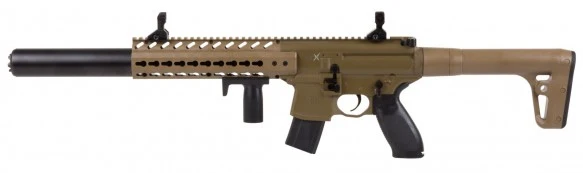
The Sig Sauer MCX CO2 FDE combines the recognizable styling of the SIG MCX platform with the convenience of a CO2-powered pellet air rifle. Designed for recreational target shooting and supervised training environments, this distinctive model offers realistic proportions, durable construction, and a practical semi-automatic operating system.
Furthermore, its Flat Dark Earth (FDE) finish creates a distinctive appearance that complements the contrasting black components. The combination provides a modern aesthetic while maintaining the recognizable profile associated with SIG SAUER engineering.
Unlike conventional single-shot air rifles, this model incorporates a 30-round pellet magazine. Consequently, recreational shooting sessions can be enjoyed with fewer interruptions for magazine changes.
Additionally, the metal housing and synthetic furniture provide a substantial feel. The integrated accessory rail, folding sights, and ergonomic stock design further distinguish this model within the CO2 air rifle category.
For enthusiasts who appreciate realistic styling, established manufacturing heritage, and convenient CO2 technology, this model represents an interesting addition to a recreational airgun collection.
Key Features and Product Highlights
The following specifications apply to the original FDE model rather than the separately available GEN II version.
- Brand: SIG SAUER
- Model: MCX CO2 FDE
- Calibre: .177 / 4.5 mm
- Operating system: CO2-powered
- Action: Semi-automatic
- Magazine capacity: 30 pellets
- CO2 compatibility: 88 g or 90 g cylinders
- Barrel: 18-inch rifled steel
- Exterior finish: Flat Dark Earth and black
- Construction: Metal housing with synthetic furniture
- Accessory interface: M1913 Picatinny rail
- Sights: Folding front and rear sights
- Stock: Synthetic construction
- Overall length: Approximately 34.75 inches / 883 mm
- Weight: Approximately 7.35 lb / 3.33 kg
- Manufacturer-listed velocity: Up to 545 FPS, depending on conditions and configuration
- Intended application: Recreational target shooting and supervised training
Durable Construction and Distinctive Flat Dark Earth Styling
A Recognizable Exterior Inspired by the Original MCX
One of the most distinctive characteristics of the Sig Sauer MCX CO2 FDE is its exterior design.
Inspired by the original SIG MCX platform, the air rifle features a full-length profile, defined receiver contours, and contrasting exterior components. As a result, its appearance differs considerably from that of many traditional pellet rifles.
Moreover, the Flat Dark Earth finish introduces a contemporary visual identity. This attractive colour combination has become popular among enthusiasts who prefer alternatives to conventional all-black equipment.
The synthetic components have been incorporated to provide durability and practical everyday handling. Meanwhile, the metal housing contributes to the substantial feel of the platform.
Synthetic Furniture and Quality Materials
Durability remains an important consideration when evaluating recreational airguns.
For that reason, the MCX incorporates a combination of metal and polymer construction. The synthetic handguard offers a practical exterior, while the stock contributes to the rifle’s recognizable overall profile.
Similarly, the rubberized rear pad adds a comfortable contact surface. The exterior materials can also be maintained through routine cleaning and appropriate storage.
Because the rifle is intended for repeated recreational use, its construction emphasizes practical handling alongside visual authenticity.
CO2-Powered Technology and Semi-Automatic Design
Convenient CO2 Operating System
The Sig Sauer MCX CO2 FDE operates using compatible 88 g or 90 g CO2 cylinders.
This system distinguishes the model from spring-powered and pre-charged pneumatic alternatives. Rather than requiring a separate high-pressure air compressor, the rifle uses its designated CO2 power source.
Additionally, CO2 technology provides a familiar operating format for enthusiasts who already own compatible recreational airguns.
Actual performance varies according to ambient temperature, pellet characteristics, and other operating conditions. Therefore, manufacturer specifications should be treated as reference values rather than guaranteed results.
30-Round Magazine System
Another notable feature is the included 30-round pellet magazine.
Its capacity provides an alternative to traditional single-shot designs, making it an identifiable characteristic of this particular air rifle.
Furthermore, the magazine forms part of SIG SAUER’s purpose-designed pellet-feeding system.
The semi-automatic configuration is intended for organized recreational target activities and appropriate supervised training.
Importantly, all handling should follow the manufacturer’s instructions and applicable safety requirements.
Sig Sauer MCX CO2 FDE – Calibres, FAC Classification, Power, Scope Options, and Accessories
Calibre Specifications and Ammunition Compatibility
The Sig Sauer MCX CO2 FDE is manufactured in .177 calibre (4.5 mm), making it part of the widely established recreational pellet-airgun category. This calibre is associated with sporting target activities, structured training environments, and responsible recreational ownership.
Unlike airguns offered in several calibre configurations, the original model has a specific factory chambering. Consequently, customers should not assume that .22 or .25 calibre versions are available.
Furthermore, its pellet-feeding system has been designed around the manufacturer’s dedicated magazine arrangement. Although numerous .177-calibre pellets are sold commercially, compatibility must always be confirmed.
Official Calibre Information
- Factory calibre: .177 / 4.5 mm
- Ammunition category: Airgun pellets
- Manufacturer’s specified pellet weight range: 5.0–8.5 grains
- Magazine capacity: 30 pellets
- Barrel construction: Rifled steel
- Alternative factory calibres: Not listed for the original configuration
Using approved ammunition helps maintain compliance with the manufacturer’s operating requirements.
Additionally, ammunition should be stored separately from the rifle and protected against moisture, contamination, and unauthorized access.
FAC Classification and Legal Ownership Requirements
FAC stands for Firearm Certificate, a term commonly associated with firearm licensing in the United Kingdom.
However, an air rifle’s licensing status depends on its technical specifications and the laws of the jurisdiction in which it is possessed.
In England and Wales, air rifles exceeding the applicable 12 ft-lb muzzle-energy threshold generally require firearm certification, subject to relevant legal exemptions and restrictions.
Scotland operates a separate air-weapon licensing framework, while Northern Ireland has different requirements.
Consequently, the same product can be subject to different legal conditions depending on the purchaser’s location.
Understanding FAC and Non-FAC Classifications
A model should not be advertised as FAC or non-FAC solely because it has a particular appearance, operating system, or manufacturer.
Instead, its verified muzzle energy and the applicable legal definitions must be considered.
Additionally, published velocity figures do not independently establish FAC classification. The mass of the pellet and the energy produced are also relevant.
Customers should therefore request documented specifications for the exact configuration and consult the appropriate licensing authority.
Importantly, no claim is made that this particular model is automatically exempt from licensing in every country.
CO2 Power System and Published Performance
The original model operates using compatible 88 g or 90 g CO2 cylinders.
This distinguishes it from pre-charged pneumatic rifles that rely on high-pressure compressed-air reservoirs.
Accordingly, a PCP compressor or hand pump is not required for its standard CO2 operating system.
The manufacturer currently lists a maximum muzzle velocity of up to 545 FPS for the original FDE configuration. Nevertheless, older catalogues and some retailer descriptions contain different maximum-velocity figures.
Therefore, performance information should always be linked to an identifiable model number and official specification.
Performance Information
- Power source: CO2
- Compatible cylinder sizes: 88 g and 90 g
- Published maximum velocity: Up to 545 FPS
- Operating mechanism: Semi-automatic
- Barrel length: 18 inches
- Energy classification: Must be confirmed for the actual model and jurisdiction
Environmental temperature, ammunition characteristics, and equipment condition may influence performance.
Furthermore, CO2 pressure is sensitive to temperature changes. For this reason, cylinders must be stored and handled according to manufacturer instructions.
Scope Configurations and Optical Accessories
Different factory packages have been offered with different sighting arrangements.
For example, the standard original FDE configuration includes folding front and rear sights.
Meanwhile, SIG SAUER has also offered a factory-scoped version featuring a 1–4×24 optic and a separately configured red-dot version.
These distinctions matter because a product advertised simply as the original FDE model does not necessarily include an optical sight.
Factory Optical Configurations
Standard model: Folding front and rear sights are included in the manufacturer’s published specifications.
Factory scope package: A 1–4×24 scope and appropriate mounting components are listed with the dedicated scoped version.
Factory red-dot package: A micro red-dot sight is included with the corresponding manufacturer-designated configuration.
Customers should confirm their intended package directly against the official model number.
Additionally, optical equipment should be manufacturer-approved, correctly matched to the applicable rail interface, and assessed by a qualified retailer for compatibility.
The presence of a Picatinny rail does not guarantee compatibility with every optical product.
Recommended Ownership and Safety Accessories
Appropriate accessories contribute to responsible ownership, maintenance, transportation, and equipment protection.
Rather than selecting additional equipment based solely on appearance, customers should prioritize documented compatibility and quality.
Essential Accessories and Equipment
- Protective shooting glasses: Appropriate eye protection for authorized recreational shooting environments.
- Lockable storage case: Helps prevent unauthorized access during storage.
- Padded transport case: Protects exterior components during lawful transportation.
- Manufacturer-approved CO2 cylinders: Consumables appropriate to the original operating system.
- Compatible replacement magazines: Original or approved components matched to the correct generation.
- Cleaning cloths: Suitable nonabrasive materials for exterior maintenance.
- Airgun maintenance supplies: Products recommended by the manufacturer.
- Printed owner’s manual: A useful reference for operating limits, inspections, and maintenance requirements.
- Secure pellet storage container: Keeps ammunition organized and inaccessible to unauthorized users.
Furthermore, spare seals and replacement components should be selected through authorized service channels.
Unapproved modifications may compromise reliability, invalidate warranties, or create safety concerns.
Compatibility and Long-Term Ownership Considerations
Before purchasing accessories, owners should establish whether their rifle belongs to the original generation or the later GEN II family.
Although the models share recognizable styling, changes to their furniture and controls can affect component compatibility.
Additionally, product listings may describe complete packages differently. Some include optical equipment, while others supply only the manufacturer’s standard components.
Consequently, the SKU, generation, included accessories, and technical documentation should be checked together.
Proper storage also remains essential. The rifle should be unloaded, secured, and maintained in accordance with the manufacturer’s instructions.
Final Overview
The Sig Sauer MCX CO2 FDE combines .177-calibre construction, a semi-automatic CO2 system, a 30-round magazine, and distinctive Flat Dark Earth styling.
Its published specifications provide a useful foundation for comparing factory configurations, ownership requirements, and compatible accessories.
Furthermore, the availability of standard, scoped, and red-dot factory packages makes accurate model identification particularly important.
For prospective owners, the most important considerations are verified specifications, appropriate legal authorization, genuine accessories, and responsible storage.
By prioritizing these factors, customers can make an informed purchasing decision and maintain their equipment in accordance with the manufacturer’s recommendations.
Rifled Steel Barrel and Integrated Sighting Features
Purpose-Built Barrel Construction
An 18-inch rifled steel barrel is incorporated into the original MCX CO2 FDE design.
This component reflects the manufacturer’s emphasis on a dedicated pellet-airgun platform rather than a purely decorative replica.
Nevertheless, performance can differ between individual examples and operating conditions. Pellet compatibility, environmental conditions, and appropriate maintenance should always be considered.
Folding Front and Rear Sights
Folding sights are supplied as part of the standard configuration.
Additionally, an integrated Picatinny rail forms part of the rifle’s exterior design, creating compatibility with selected manufacturer-approved accessories.
The original model also includes a front grip as part of its distinctive configuration.
However, accessory packages differ across retail listings. Consequently, customers should verify whether a particular listing includes only the standard sights or additional optical equipment.
Ergonomic Design and Recreational Ownership
Familiar Handling Characteristics
Ergonomics contribute significantly to the overall ownership experience.
The MCX-style layout incorporates recognizable controls and a substantial full-length body. In addition, its synthetic stock and handguard create a consistent external design.
Its approximate 34.75-inch overall length also provides an important reference for customers comparing available storage options.
Because personal comfort varies, prospective owners should consider the rifle’s weight and dimensions when evaluating suitability.
Suitable for Organized Recreational Activities
The platform is intended for responsible recreational shooting in appropriate environments.
For example, established shooting clubs and designated target ranges may offer suitable settings where local regulations permit CO2 air rifles.
Moreover, the platform may appeal to collectors interested in licensed SIG SAUER airgun designs and distinctive FDE finishes.
Regardless of experience, appropriate eye protection, a safe shooting environment, and compliance with local regulations remain essential.
Maintenance, Storage, and Long-Term Care
Protecting the Exterior Finish
Proper maintenance helps preserve the appearance and condition of recreational airguns.
The exterior should be kept free from accumulated moisture, dust, and unnecessary contamination. Furthermore, cleaning materials should be compatible with the manufacturer’s recommended maintenance procedures.
A dry, secure storage environment is also advisable.
Likewise, the rifle should be stored unloaded and secured against unauthorized access, particularly by children.
Manufacturer Guidance and Replacement Components
Routine care should follow the official SIG SAUER owner’s manual.
Only compatible replacement components and approved consumables should be considered. Unauthorized modifications may create safety concerns and affect warranty coverage.
Additionally, seals and other serviceable components should be inspected by an appropriately qualified technician when necessary.
Why Consider the Sig Sauer MCX CO2 FDE?
Several characteristics distinguish this model within the recreational CO2 airgun category.
First, its licensed MCX styling offers a recognizable appearance closely associated with SIG SAUER.
Second, the Flat Dark Earth finish provides an alternative to conventional black configurations.
Furthermore, the metal-and-polymer construction creates a substantial exterior, while the included 30-round magazine distinguishes the design from simpler single-shot airguns.
The folding sights, integrated accessory rail, and CO2 operating system also contribute to its overall specification.
Finally, the manufacturer’s established airgun product line provides access to published technical documentation and model-specific operating guidance.
Gamo Air Rifles, PCP Airguns, Pellet Pistols and Modern Airgun Systems
Choosing the right gamo air rifle depends on how the rifle will be used, the preferred caliber, the powerplant, and the shooter’s experience level. Gamo produces a broad range of recreational, target, and sporting airguns, so buyers searching for a gamo pellet gun, gamo air rifles, or a traditional gamo pellet rifle can compare several operating systems before deciding which configuration best fits their needs.
One of the most familiar designs is the break barrel air rifle. This platform remains popular because it combines straightforward operation with a self-contained powerplant. Shooters comparing high powered air rifles or a high power air rifle should consider much more than headline velocity. Pellet weight, caliber, barrel length, trigger quality, consistency, and shooting conditions all affect practical performance.
Models chambered as a gamo 177 configuration are frequently selected for target shooting and recreational use because .177 pellets generally offer a flatter trajectory than heavier calibers. Likewise, a gamo break barrel rifle provides the simplicity many shooters want without the need for a separate compressed-air charging system.
Break-Barrel Rifles and Pistols
People researching the best air rifles frequently encounter spring-powered and gas-piston break-barrel platforms. Search terms such as brake barrel bb gun are also common, although pellet rifles and BB guns are technically different categories and may use different ammunition and barrel designs.
Compact airguns include the break barrel pellet pistol, break barrel air pistol, and break barrel pistol. Larger-caliber searches may include a 22 caliber break barrel air pistol, while buyers may also look for a break action pellet pistol, the best break barrel pellet pistol, or a 22 pellet pistol for recreational shooting.
Power-oriented shoppers sometimes search for the most powerful break barrel pellet gun. However, raw velocity should never be the only specification considered. Accuracy, appropriate ammunition, safe handling, and local laws are equally important. A phrase such as bee bee gun pistol may be used informally by shoppers, but users should confirm whether a particular handgun actually fires steel BBs, lead pellets, or another compatible projectile.
Gamo Swarm Multi-Shot Air Rifles
Gamo’s magazine-fed break-barrel systems have helped popularize multi-shot operation in a category that historically required a pellet to be loaded manually after every shot.
The gamo swarm magnum 10x gen3i is closely associated with this concept, while searches for the gamo swarm magnum, gamo swarm maxxim gen 3, and swarm magnum gen3i reflect interest in different Swarm generations and configurations. Another commonly researched model is the gamo swarm magnum pro 10x gen3i.
The broader gamo magnum gen3i category appeals to shooters who want high-energy break-barrel performance together with magazine-fed convenience. Gamo’s multi-shot technology is also frequently found through searches for gamo 10x, multi shot pellet gun, gamo swarm, gamo swarm 10x, and pellet gun with magazine.
A magazine system can make repeated target sessions more convenient because pellets can be prepared before shooting begins. Nevertheless, users should always verify magazine compatibility, pellet length, pellet diameter, and model generation before ordering replacements.
Gamo Arrow PCP Air Rifles
Shooters interested in pre-charged pneumatic technology may encounter the gamo arrow range. The gamo arrow pcp combines a PCP powerplant with a lightweight sporting format, while the full term gamo arrow pcp air rifle is commonly used when comparing it with conventional spring or gas-piston rifles.
Related searches include pcp arrow guns, arrow rifle, pcp arrow gun, arrow rifles, and arrow air rifle. These phrases generally reflect interest in compact PCP-style sporting rifles rather than traditional break-barrel platforms.
Caliber-specific buyers may search for a gamo arrow .22, while the gamo arrow classic may appeal to shooters looking for another Arrow-series configuration.
PCP technology uses stored compressed air rather than relying on a spring or piston being compressed for each shot. This can produce a smooth firing cycle, reduced mechanical movement, and consistent shot-to-shot performance when the rifle is properly filled and maintained.
Understanding PCP Airguns
A pcp air rifle uses a reservoir filled with high-pressure air. PCP stands for precharged pneumatic, and the technology is widely used in modern sporting and precision airguns.
Searches for pcp air rifles, pcp rifle, pcp guns, pcp rifles, and pcp air gun generally refer to this same basic operating principle. Some buyers describe the platform as an air rifle compressed air system, while others search for a pcp pellet rifle or use the reversed phrase rifle pcp.
PCP rifles usually require additional filling equipment such as a suitable hand pump, compressor, or certified high-pressure cylinder. Users should follow the manufacturer’s recommended fill pressure because overfilling a reservoir can be unsafe and may also reduce performance.
Gas-Piston and Lever-Operated Airguns
A common beginner question is what is a gas piston air rifle. Instead of using a traditional coiled steel spring, a gas-piston system compresses gas inside a sealed cylinder. When the trigger is released, the piston moves rapidly and compresses air behind the pellet.
Other mechanical airgun designs include under lever air rifles, the singular underlever air rifle, and the alternative spelling under lever air rifle. In these designs, a separate lever positioned beneath the barrel is used to cock the mechanism.
Shooters may also research a side lever air gun or side lever air rifle, where the cocking lever operates from the side of the receiver. These fixed-barrel layouts can provide a different shooting experience compared with conventional break-barrel systems.
Search terms such as lever action pellet gun, air gun thumb lever, and lever action air rifle can refer to several different mechanisms, so buyers should check the specific manufacturer’s action type rather than assuming every lever-operated airgun works identically.
Gamo Shadow and High-Velocity Searches
Long-running Gamo product lines continue to generate searches including gamo shadow 1000, shadow 1000 gamo, and gamo 1000 shadow. Another associated search phrase is 1000/4.5, which is often used by shoppers researching 4.5 mm or .177-class air rifles.
Velocity-focused buyers may also search for a gamo 1800 fps air rifle. Advertised velocity can vary according to pellet composition and weight, so actual shooting performance may differ when standard lead pellets are used.
Likewise, shoppers researching gamo 1800 fps air rifle price should compare the exact model number, caliber, powerplant, bundled optic, warranty, and regional specification rather than relying solely on a velocity figure.
Other unusual search terms such as shotgun pellet gun may describe an airgun with styling inspired by a shotgun rather than a conventional pellet rifle. Searches for pellet guns that can kill should be approached from a safety perspective: airguns are not toys, and even relatively modest-powered models can cause severe or fatal injuries. Every airgun should therefore be handled with the same disciplined muzzle and trigger control expected of potentially dangerous sporting equipment.
Air Pistols, Pellet Pistols and CO2 Systems
The air pistol category includes many different operating systems, and modern air pistols may use springs, gas pistons, CO2 cartridges, or pre-charged pneumatic reservoirs.
For pellet-firing handguns, common searches include pellet pistols, pellet pistol, pistol pellet gun, pellet handgun, pellet gun pistol, pellet gun pistols, pistol air, and air pellet pistol.
CO2-powered handguns form another major category. A co2 pistol typically uses a disposable carbon-dioxide cartridge to propel BBs or pellets. Buyers may also search for pistol co2, co2 pistols, or the commonly mistyped c02 pistol.
Related searches include co2 air pistols, co2 gun, c02 guns, guns co2, and co 2 gen. Regardless of spelling, the key consideration is ammunition compatibility and the correct cartridge type specified by the manufacturer.
CO2 performance can be affected by ambient temperature because pressure changes as the cartridge becomes warmer or colder. For that reason, shooters should expect some variation in velocity during different environmental conditions.
Target Shooting and 10-Meter Airgun Use
Precision shooting requires appropriate targets and a safe backstop. A 10m rifle is generally associated with structured 10-meter air-rifle shooting, where accuracy, repeatability, shooting position, and trigger control are emphasized.
Recreational shooters may use pellet gun targets, while rifle users commonly search for air rifle targets, targets for air rifle, and airgun targets. The term air gun targets is another broad variation covering both rifle and pistol applications.
Dedicated practice setups can include air rifle shooting targets and airgun shooting targets designed to provide clear aiming points and easy scoring. Depending on the shooting discipline, an air rifle target may use small scoring rings intended for precision practice.
Handgun shooters may choose air pistol targets, whereas a pellet rifle target should be paired with a backstop capable of safely containing the pellets used by the particular rifle.
Airgun Cleaning and Maintenance
Regular airgun maintenance helps preserve reliability, accuracy, and safe function. Although airguns generally require less bore cleaning than many powder-burning firearms, seals, external metalwork, fasteners, magazines, and moving components still need periodic inspection.
A pellet rifle cleaning kit can contain cleaning rods, pull-through systems, suitable patches, and other airgun-safe tools. Likewise, a pellet gun cleaning kit can help remove accumulated debris when cleaning is genuinely required.
Proper air gun maintenance also involves checking stock screws, inspecting seals, keeping optics securely mounted, and following the manufacturer’s lubrication guidance. Excessive oil should be avoided because unsuitable lubricants can damage seals or cause unwanted combustion inside some spring-piston airguns.
For PCP equipment, reservoir condition, fill fittings, O-rings, and pressure gauges should also be inspected periodically. Magazine-fed models should be kept clean so pellets feed smoothly without deformation.
Ultimately, the best choice depends on the intended use. A traditional break-barrel rifle offers simplicity, a Gamo Swarm platform adds multi-shot convenience, and a PCP system provides a smoother firing cycle with an external filling requirement. Comparing caliber, powerplant, ergonomics, ammunition, maintenance demands, and safe target equipment makes it much easier to select an airgun that delivers dependable performance for responsible recreational or target shooting.
Frequently Asked Questions (FAQs)
1. What makes this CO2-powered air rifle different from conventional pellet rifles?
This model combines distinctive modern styling with a semi-automatic operating system and a substantial metal-and-polymer construction. Unlike traditional spring-powered rifles, which rely on manually compressing a spring, this design uses compressed carbon dioxide as its energy source.
Furthermore, the integrated magazine system provides a different ownership experience from conventional single-shot designs. The exterior features recognizable receiver contours, a synthetic stock, and an accessory rail.
Additionally, its Flat Dark Earth finish creates a striking appearance that appeals to collectors and recreational airgun enthusiasts.
Ultimately, its combination of licensed styling, CO2 technology, and recognizable design characteristics distinguishes it from many conventional recreational pellet rifles.
2. What calibre does this model use?
The original configuration uses .177 calibre, equivalent to approximately 4.5 mm.
This calibre is widely associated with recreational airguns and designated target-shooting activities. However, ammunition compatibility depends on the specific magazine and barrel design.
Importantly, only manufacturer-approved pellets of the correct dimensions should be considered.
Although different pellet designs exist, not every product marketed as .177 calibre is necessarily compatible with every airgun feeding system.
Therefore, checking the manufacturer’s ammunition recommendations remains important before selecting consumables.
3. Does this air rifle require a compressor or hand pump?
No. This particular design uses compatible CO2 cylinders rather than a pre-charged pneumatic air reservoir.
Consequently, a separate PCP compressor or manual high-pressure pump is not part of its normal operating requirements.
The original version is designed around compatible 88 g or 90 g CO2 cylinders, subject to the manufacturer’s specifications.
Nevertheless, CO2 cylinders are consumable items and require appropriate handling and storage.
Owners should follow the official instructions concerning compatible cylinders, safe storage temperatures, and the correct disposal of empty containers.
4. Is the air rifle semi-automatic or fully automatic?
The original version uses a semi-automatic operating system.
Semi-automatic means the mechanism is designed to perform one firing cycle for each individual trigger pull. This differs from a fully automatic mechanism, which can continue cycling while the trigger remains depressed.
Additionally, the magazine arrangement is specifically designed for its pellet-feeding system.
The operating configuration should not be confused with similarly styled airsoft replicas or other products within the manufacturer’s wider catalogue.
Before purchasing, customers should always verify the precise model designation and published operating characteristics.
5. How many pellets can the magazine hold?
The standard magazine has a published capacity of 30 pellets.
This capacity is one of the model’s recognizable features and distinguishes its design from many traditional single-shot recreational airguns.
Furthermore, the magazine forms part of a purpose-built feeding arrangement rather than a conventional detachable firearm magazine.
As with any mechanical component, correct compatibility and condition matter.
Consequently, replacement magazines should be verified against the specific model and generation before purchase.
Owners should also inspect the magazine for visible damage and consult the official manual whenever feeding irregularities occur.
6. How powerful is this air rifle?
The manufacturer’s published specifications for the original configuration indicate a maximum velocity of approximately 545 feet per second under specified conditions.
However, published maximum velocity should not be interpreted as a guaranteed result during every shooting session.
Actual performance depends on variables such as ambient temperature, pellet characteristics, CO2 conditions, and the mechanical condition of the equipment.
Furthermore, velocity and muzzle energy represent different measurements. A velocity figure alone does not fully describe the energy produced by an airgun.
Customers should consult verified technical documentation when comparing performance specifications or evaluating local legal restrictions.
7. Is this model suitable for beginners?
Suitability depends on the individual’s experience, local regulations, physical ability, and access to qualified supervision.
Although the CO2 operating system differs from more complicated pneumatic equipment, the product remains an airgun capable of causing serious injury.
Therefore, inexperienced owners should receive appropriate safety instruction before handling it.
Moreover, supervised training at an authorized facility may help individuals understand basic equipment responsibilities, range etiquette, and safe storage principles.
The manufacturer’s minimum-age recommendations should always be followed.
Ultimately, the most important considerations are maturity, lawful ownership, proper supervision, and responsible handling.
8. What materials are used in its construction?
The design combines a metal housing with synthetic exterior components.
This construction contributes to the model’s substantial appearance and recognizable proportions.
Additionally, polymer furniture provides practical surfaces that can be maintained through suitable cleaning procedures.
The Flat Dark Earth exterior offers a distinctive colour combination, while the contrasting black components complement the overall design.
Nevertheless, metal and synthetic materials still require appropriate care.
Exposure to moisture, unsuitable cleaning chemicals, and careless storage can affect appearance and condition over time.
For this reason, routine inspection and manufacturer-recommended maintenance remain important.
9. Does the rifle come with a scope?
The original standard configuration includes folding front and rear sights.
A separate optical sight should not automatically be assumed to be included unless the retailer specifically identifies it as part of the package.
Furthermore, some sellers offer optional accessory bundles that differ from the manufacturer’s basic configuration.
The integrated Picatinny rail is an identifiable design feature, but accessory compatibility must be verified separately.
Consequently, customers should review the package contents carefully before ordering.
Product photographs may also display optional equipment for illustration, so the written list of included components should take priority.
10. What is the difference between Flat Dark Earth and black finishes?
The main distinction is their external appearance.
Flat Dark Earth is a muted earth-tone colour commonly used on outdoor equipment and modern sporting designs. Black, by comparison, provides a more conventional monochromatic appearance.
Both finishes may appear across different product configurations and generations.
However, exterior colour alone does not establish differences in operating performance, internal mechanisms, or manufacturing quality.
Furthermore, lighting conditions and product photography can make a finish appear lighter or darker than it looks in person.
Therefore, buyers interested in a particular colour should verify the manufacturer’s official product images and exact model designation.
11. How heavy is the air rifle?
The original model has a published weight of approximately 7.35 pounds, equivalent to about 3.33 kilograms.
This figure reflects its substantial full-length construction and combination of metal and synthetic components.
Nevertheless, the overall weight of an individual package may differ when accessories, packaging materials, or other items are included.
Additionally, perceived handling comfort varies between individuals.
Physical dimensions, personal preference, and the intended recreational environment should all be considered when comparing models.
Customers seeking an especially lightweight product may wish to review several available designs before making a decision.
12. What is the overall length of the rifle?
The original configuration measures approximately 34.75 inches, or 883 millimetres, in overall length.
This measurement helps owners understand the product’s physical dimensions for lawful transportation and secure storage.
Furthermore, it provides a useful comparison point when evaluating different recreational airgun designs.
The length should not be confused with barrel length, which is a separate technical specification.
Additional accessories or different factory configurations may also change external dimensions.
For accurate product comparisons, measurements should always be taken from the manufacturer’s specifications for the exact version under consideration.
13. Does CO2 performance change in cold weather?
Yes. Ambient temperature can affect the pressure characteristics of carbon dioxide, which may influence the operating performance of CO2-powered equipment.
In cooler conditions, a reduction in available pressure may affect consistency and overall performance.
Conversely, excessive heat can create dangerous pressure conditions inside pressurized cylinders.
Therefore, CO2 containers should never be exposed to extreme temperatures or stored in direct sunlight inside hot vehicles.
Additionally, owners should observe the manufacturer’s stated environmental limits.
Appropriate storage practices help protect both the pressurized components and the surrounding equipment.



Reviews
There are no reviews yet.